Once again, I’ll be leading two “Classes With The Experts” at the Marlborough Fly Fishing Show next weekend. This is a great opportunity for you to book some time with me for far less than the cost of a guided trip. Both classes are designed to duplicate a teaching session on the water. Here are some details.
Tying & Fishing Wet Flies. Saturday, January 18, 2:00-4:30PM. What you’ll learn: When, where and how to fish wet flies; how to tie classic spiders, soft hackles, winged and wingless wets (I will demo these patterns and discuss materials); leader construction and how to build a team of three wet flies; matching the hatch and fly selection; plus more. Did I mention having fun?
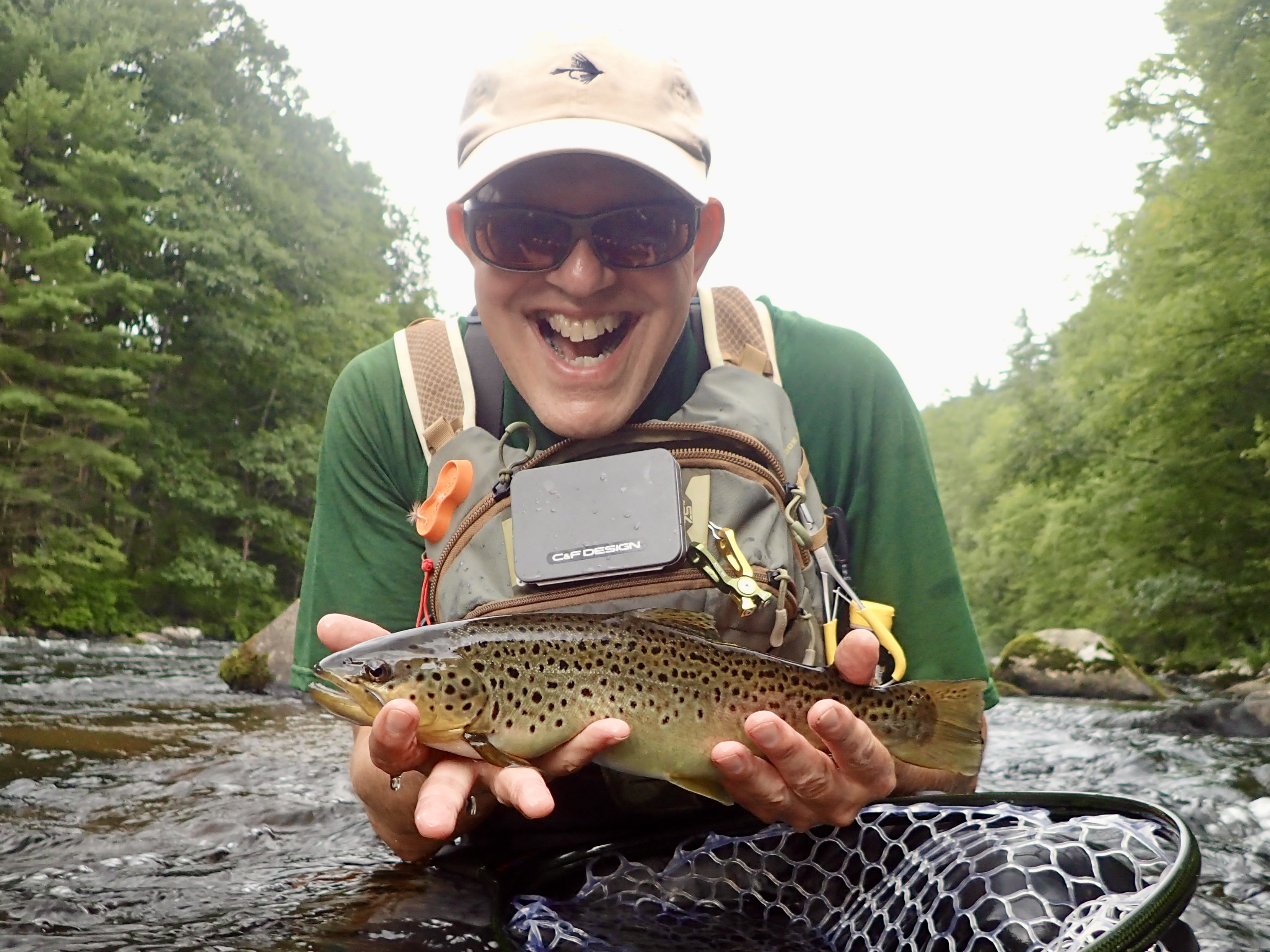
Wet flies have been fooling trout for centuries, and the fish aren’t getting any smarter. This lovely wild Farmington River brown savaged an Isonychia soft hackle on a steamy August late afternoon.
Beyond Cast & Strip: Presentation Flies For Stripers. Sunday, January 18, 8:30-11:00AM. What You’ll Learn: How to catch the stripers that other anglers can’t; why cast-and-strip presentations are ultimately limiting; how to target and catch bigger bass on a consistent basis; how to tie classic New England-style sparse flies like bucktails, soft-hackles, and flatwings (I will demo such patterns and discuss materials); the presentations that bring your fly to the fish; and more!
Being able to repeatedly catch big bass like this on the fly from shore is no accident. Take this class, and I’ll reveal my secrets of how I do it.
First things first: Don’t forget to get your 2025 CT fishing license!
I hope you had a festive and happy new year holiday. I did. Today is a catchup day for me; I’m getting a lot of odds and ends done because on Monday, we’re back to the grindstone.
First up is show prep: getting things ready for the Marlborough and Edison Fly Fishing Shows, both coming up fast. Then, it’s book writing. And more book writing. All, of course, a labor of love.
In the next few weeks, I’ll be sending out more information about my show schedules. I’m hoping to see a lot of you there!
It won’t be long until we start seeing Tiny Black Stones.
You probably saw this one coming a mile away. Obvious or not, signing a publishing contract with Stackpole Books and beginning work on the Fly Fishing Guide to the Farmington River was easily the biggest deal for me in 2024. Technically, I’m halfway done. Practically, I’ve got a lot more work to do.
For starters, even though I’ve finished my first 50% of the work, I’ve still got to go back through it all and make some editorial adjustments. This isn’t merely changing a few words; the workload can probably be counted in weeks. No complaints, though! It’s a privilege to be charged with writing this book, and anything with my name on it is going to be the best it can possibly be.
I’ll be back to it sometime in early January. And of course, you’ll hear all the latest and greatest right here as things develop.
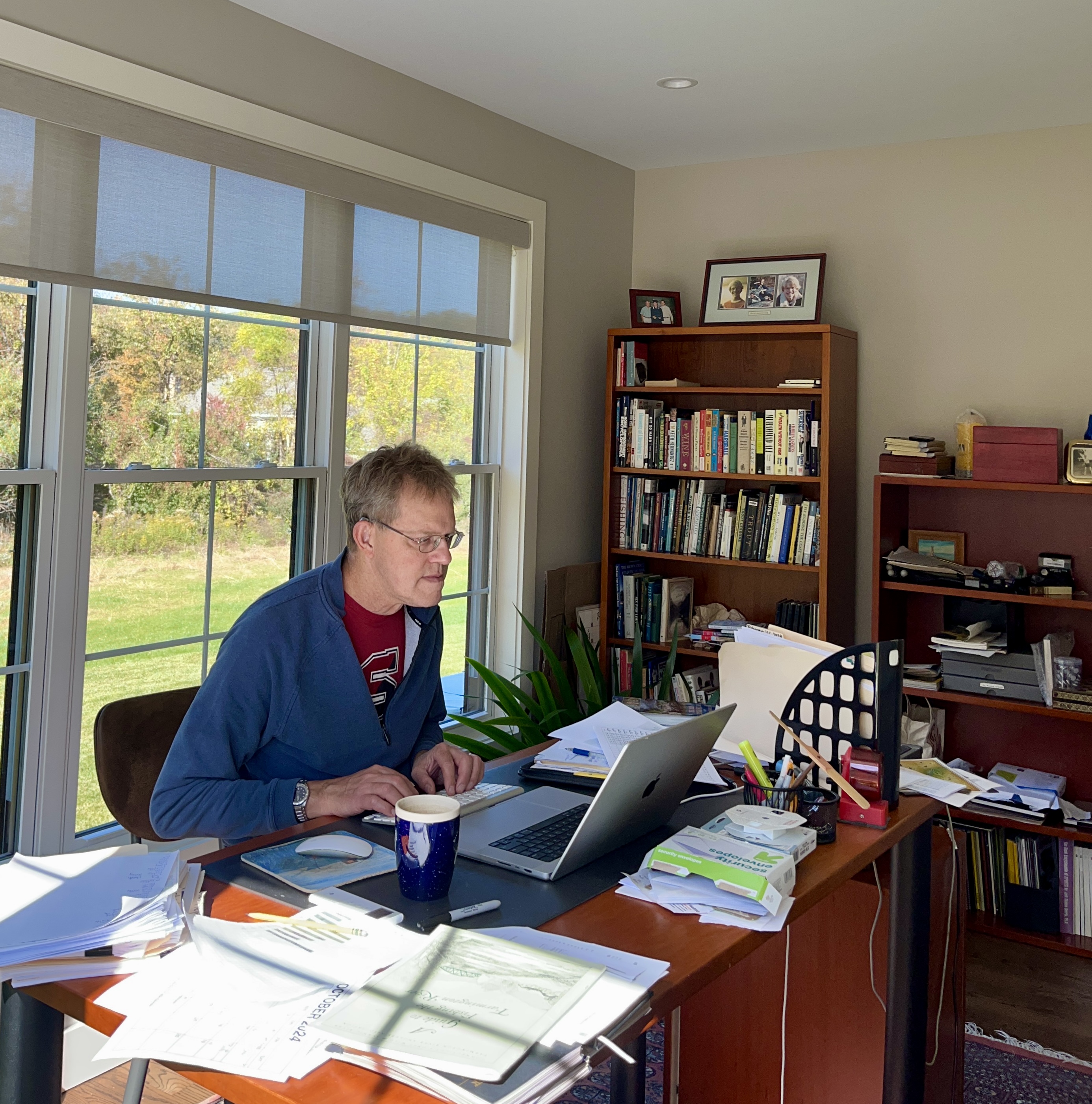
This is where the magic happens. I really like my writing space — although, the vista behind me is currently brown and white and gray. Winter is a good time for a big writing job.
#4: The Edison Fly Fishing Show. I love being a part of all of the Fly Fishing Shows, but there was something about this year’s Edison show that particularly struck my fancy. I think it’s because I reconnected with so many old friends, strengthened some newer friendships, and had some really good first-time meetings. I gave away and traded a bunch of flies. My classes drew well, and I had some impressive crowds for my talks. Oh. I also bought stuff — some I wanted, some I needed, all of it putting a smile on my face. If you came to see me speak or if you took one of my classes, thank you again. And did I mention the wine party and my take-out run to Shanghai Dumpling? See you next month!
If we were kids in school, the teacher might have to separate us…
#3: The Best Striper of the Year an Hour Into my First Trip. After I caught and released her, I considered staying to fish some more. But I knew that it wasn’t going to get any better than this wonderful 25-pound fish. The experience made such an impact that I ended up writing a story about it, “At the Intersection of Lucky and Good” for Surfcaster’s Journal. You can read it in issue #86.
I almost didn’t go that night in March. I’ve written before that while I believe that fish aren’t intelligent, the eyes of a striped bass like this one communicate a different story to me. I hope she’s still swimming.
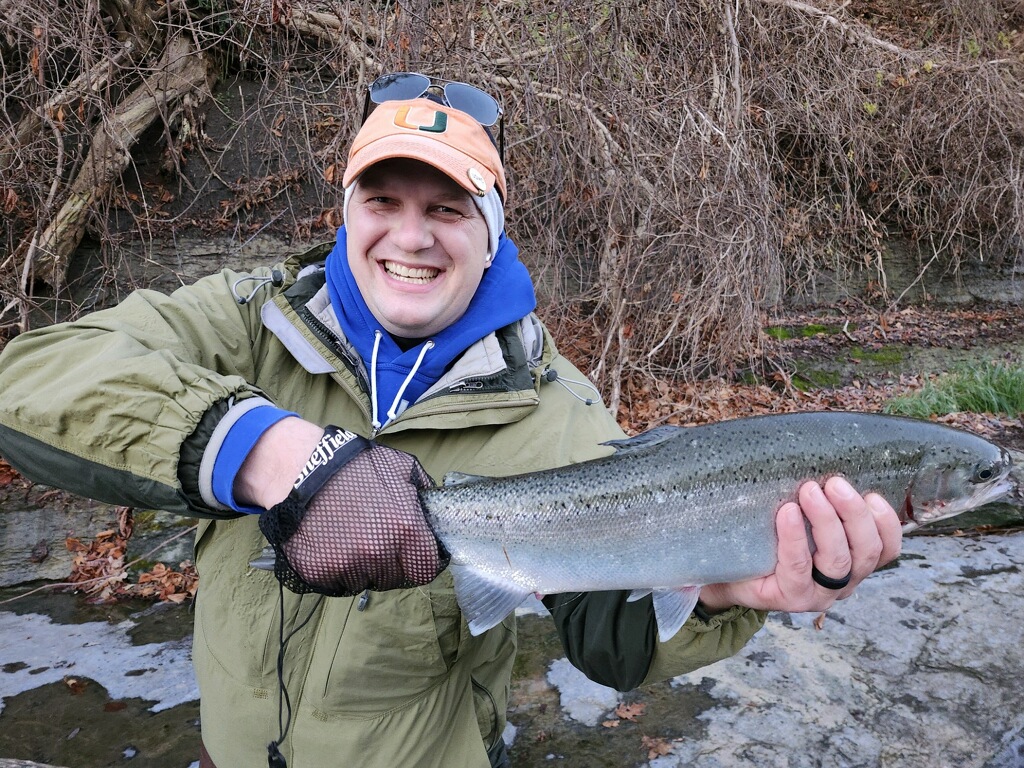
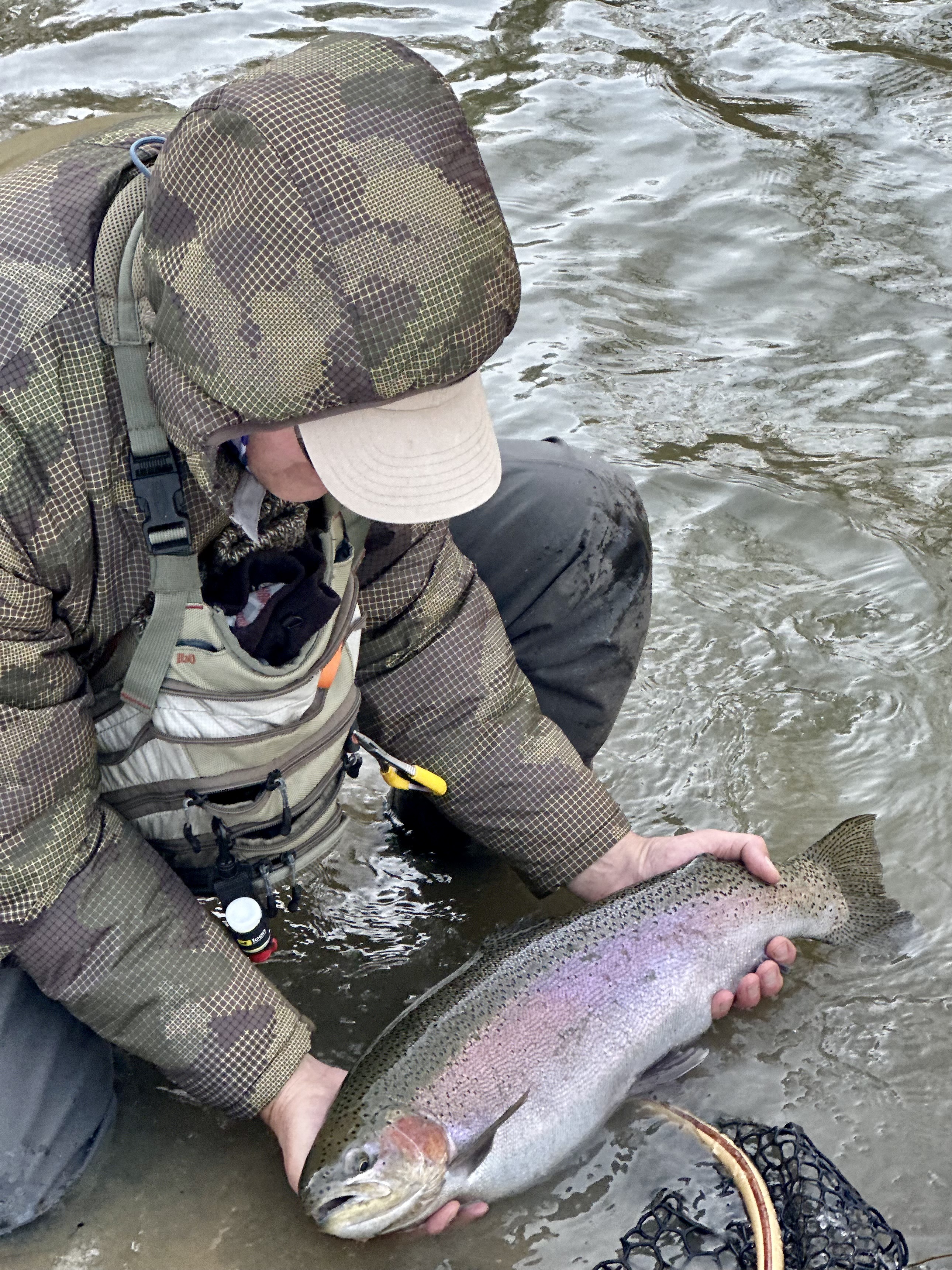
#2: Bill’s First Steelhead. I have three sons, and they’ve all caught steelhead. Except for Bill. Number One Son went with me once about ten years ago, but the neither the weather nor the steelheading gods smiled upon us. Time went on, year after year, until it came to pass that Bill and I found ourselves standing on the banks of North Sandy Creek in the pre-dawn hours of the Monday before Thanksgiving. As I have done with my other sons, I placed Bill in the skilled hands of guide extraordinaire Row Jimmy. For over an hour, nothing. And then it happened.
Happiness is hooking and landing your first steelhead. Well done, Bill!
#7: Steelheading in PA. You can get spoiled pretty quickly on the Erie tribs. Not the case this year. A parching autumn drought kept the creeks at a trickle, and what did come up from the lake was skittish and in constant state of high alert. I fished Elk Creek in November with guide extraordinaire Bob Packey and solo. The water was comically low, and I saw more raptors in the trees than anglers on the water. I felt like King of the Creek with nine on the first day. Then, the heavens opened up and it poured. Too much of a good thing, for the next day the creek was the color of tea and milk and loaded with leaves. That was my first blank on Erie tribs ever. I returned in December with my middle son, and seeing as you just read about that a few days ago, I won’t make you do it again. Unless you want to, and in that case you can find it here. The point is: even when the fishing is at its worst, Erie tribs are frequently better than anywhere else.
As with small streams, it would be safe to say that I am addicted to steelheading — although the steelheading affliction is probably far worse.
#6: Featured Fly Tier at the International Fly Tying Symposium. This was my third year doing IFTS, but my first as Featured Fly Tier. I went on after Bob Clouser (what a tremendously nice guy!) and I think I crushed it. The subject was “Matching the Hatch with Wet Flies,” and you can see me do it again at the Marlborough Fly Fishing Show next month on Friday, Jan 17 at 2:30pm.
In addition to being featured tier, I really enjoyed seeing so many old friends, and making new ones. Plus all the tying swag that’s available, some of which I bought. Plus the chance to watch and learn from the industry’s best. You can do the same at the Fly Fishing Shows this January — see you there!
#5: Speaking at the Shows and to Fly Fishing Clubs. It was a busy speaking season for me. I did my usual full boat of talks at the shows, but I also spoke to eight different groups this year, both in-person and via zoom. Speaking/teaching/presenting is a true love of mine, and I hope that if you’re in the audience, you see that in my delivery. If you’re in charge of booking speakers for your group, you know where to find me!
What a treat to make a return to the FRAA in January. I hadn’t been in a while, and I must say that holding the meetings at Brewery Legitimus is a most excellent idea.
It’s been a different kind of year around Currentseams headquarters, what with us moving into a new house in April, and then diving into the process of writing the Farmington River guide book. It was a difficult year for weather, and flows. Sometimes I felt like the energy was “Fishing? What’s that?” But, you persevere, and when you get out you tend to relish it even more. Here’s my annual list, presented in installment form, of my top 10 most memorable moments of 2024.
#10: Small Streams. Not actually a moment, but rather a series of outings across the seasons. Veteran readers of currentseams are quite familiar with my passion for thin blue lines. Fishing them was a bit of a challenge this year, mostly due to the horrific drought of late summer into fall. I haven’t been since October, but I’m generally confident that nature found a way. Please, if you like to fish small streams, respect, preserve and protect the resource. Sometimes nature needs little help, too. If you’re going to be at the Edison Fly Fishing Show next month, I’ll be giving a seminar on Small Streams on Friday the 24th at 10am.
Leaves and low water made for some challenging conditions this fall. I should be standing in water instead of stream bed. Always be sure that in low flows, the water is at non-stress temperatures.
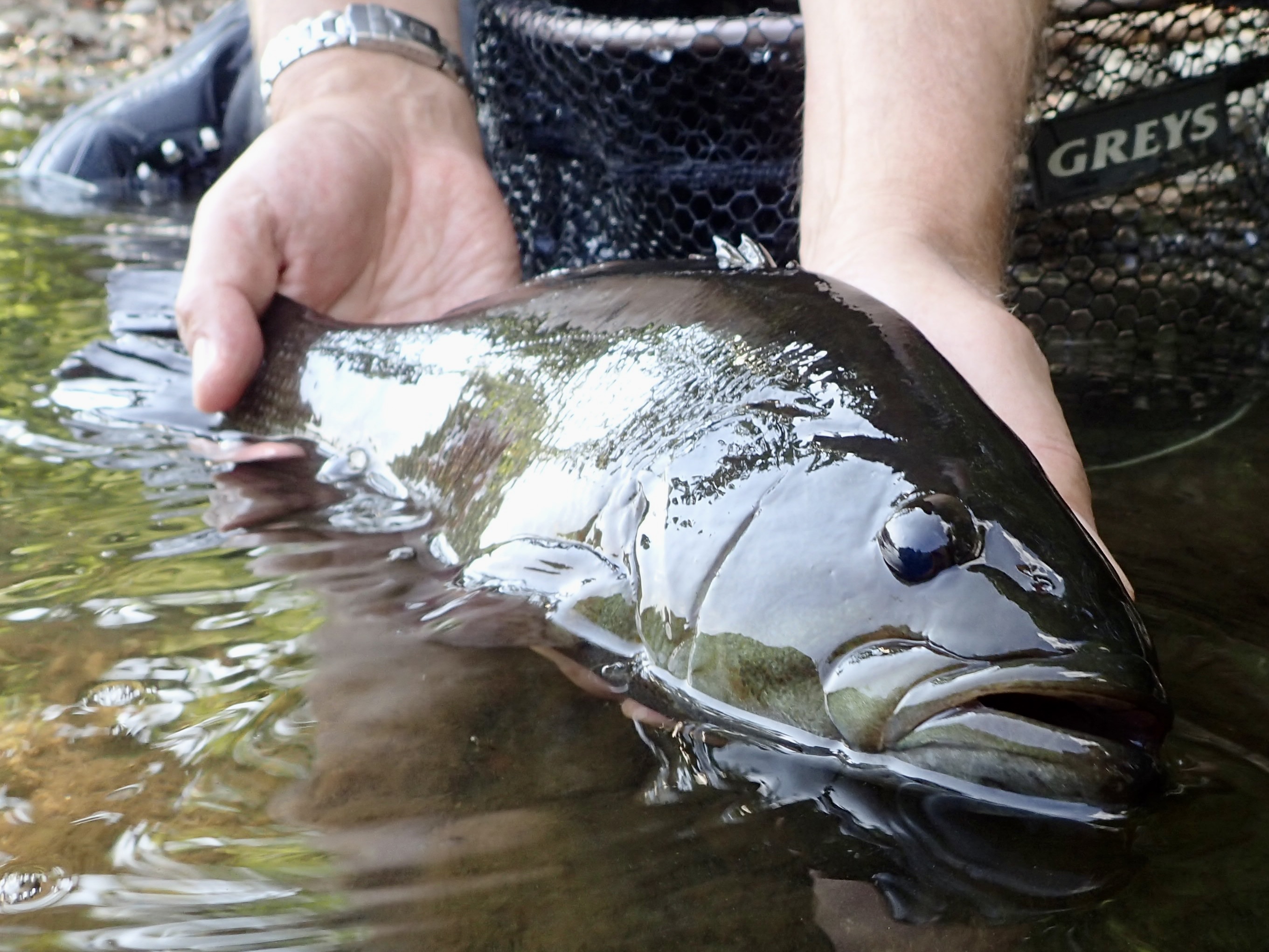
#9: Smallmouth Season. It wasn’t the best year for smallies, but nor was it dreadful — and we have had some dreadful years in recent memory. The White Fly hatch was a good one, and while I didn’t consistently get into the bigger slobs, I had enough foot-plus fish to keep me happy. Then there was the solitude factor — priceless. One day, I invited fly tyer extraordinaire Lou DiGena up to fish. We started off in an area that has been completely unproductive for me the last two years. I was fishing one of Lou’s crayfish patterns under an indicator when I connected with my best smallmouth of the year.
A hunka hunka burning hot bronze.
#8: Photo sessions for the Farmington River book. I spent several days as both subject and shooter and I must say that I enjoyed both roles immensely. Many thanks to Steve Hogan, Derrick Kirkpatrick, Joey Takeman, Antoine Bissieux, Yannick Riviere, and Lou Digena for letting me shadow and shoot them. Special thanks to Matthew Vinick and Bob Lindquist for taking the time to shoot me. Thanks to the DEEP for letting me tag along for their September sampling. You’ll see it all in the book, and the best part is that I get to do it again this winter and spring.
For the last three years, I’ve driven out to Ohio in December to pick up Number Two Son Cam from school for winter break. Oh! That’s right. There are steelhead creeks out that way. So let’s fish a couple days before we make the trek home to Connecticut.
It was somewhat miraculous that we even got to fish this year. After months of relentless drought, Steelhead Alley got bombed by lake effect snow in mid November. Then, it rained and the snow melted. Creeks were impossibly up and the color of chocolate milk. By the second weekend in December, there was a short window that we lucked into.
The price of admission was bitter cold and slush-filled, shelf ice-choked creeks. These are the times that try men’s souls (or at least those men who steelhead). Still, I’ll take time on the water in adverse conditions over not going at all — especially since Cam’s a senior.
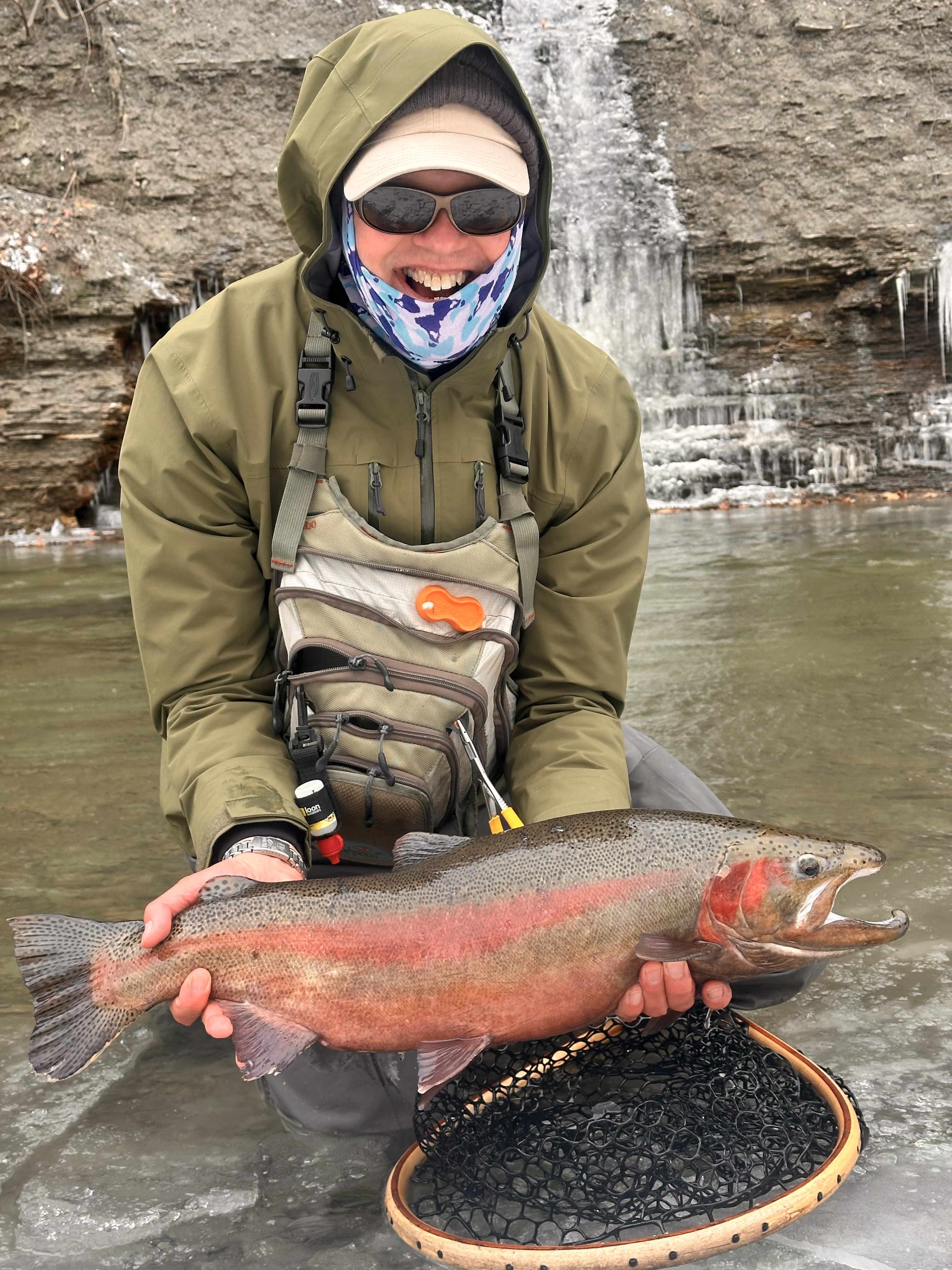
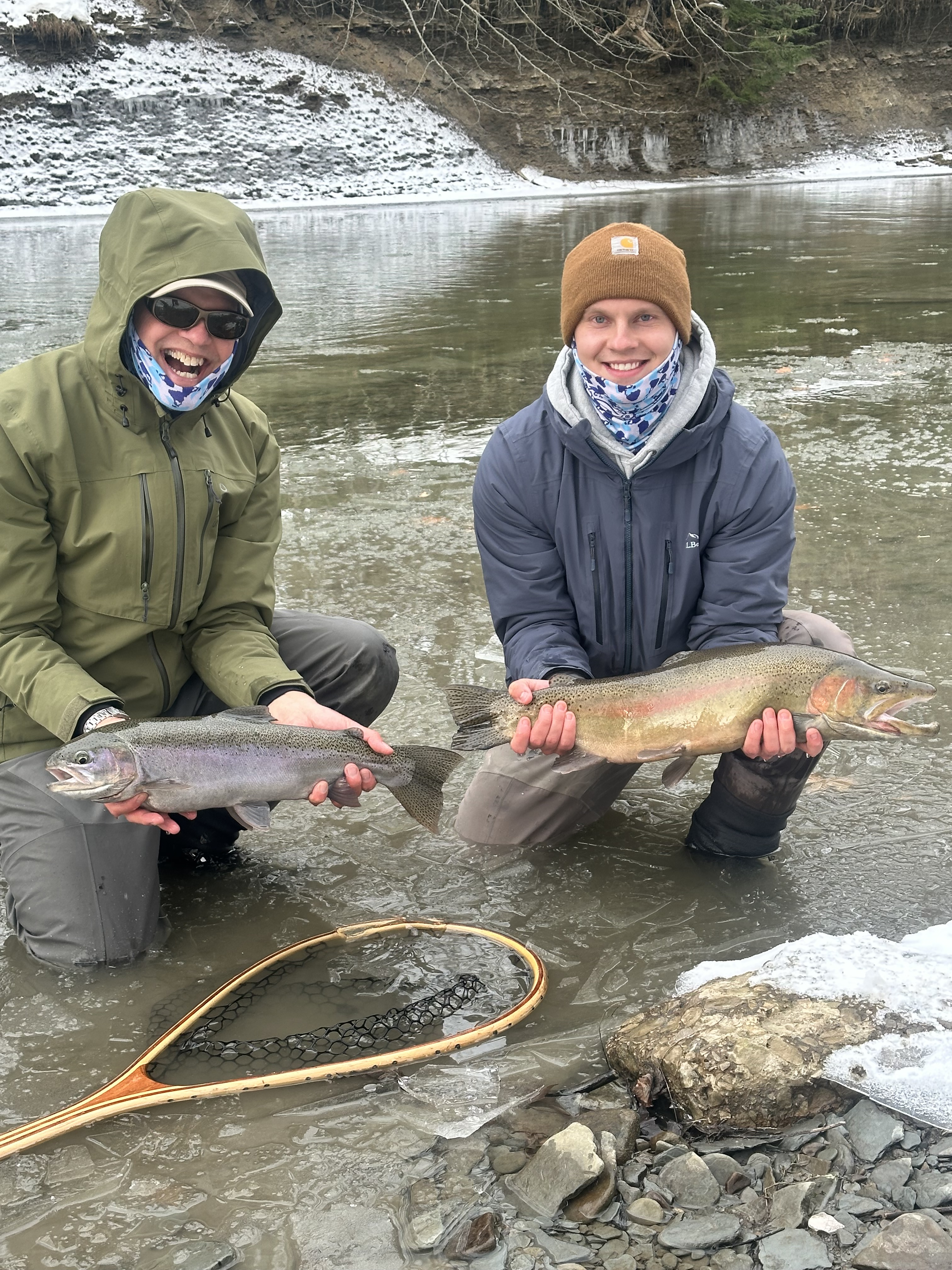
Saturday morning was the third coldest temperature I’ve ever fished in. We slept in and went to a diner for a proper, civilized breakfast and coffee. We hiked through snow down to the river at 10am. Fishing was difficult due to slush conditions; you can’t catch steelhead if your fly isn’t getting down to them. Even though there had been some recent higher flows, the numbers weren’t up to the level we’re used to. What was there was in very cold temperature mode; getting them to eat was a matter of persistence, precision, and plain old fine fortune.A chunky, pre-spawn hen, just beginning to color up. At the first mark, it took me hundreds of casts to get two fish to eat. I was targeting a pod made up of several fresher hens and a fish we dubbed “Old Blackie,” a very dark horse buck who was not the slightest bit interested in eating while he guarded his harem. At a second spot downstream, I fouled six fish; they simply would not eat. Finally, after pecking away, we found a hole that held a good number of steelhead that did not have lockjaw. The fish pictured here came from that group. Despite the non-optimal conditions, I had myself a day: sixteen steelhead fair hooked and in the hoop. I was so excited, I almost had a third cigar.Cam had a tough go on the first day, mostly because he doesn’t really fly fish, and the conditions demanded flawless presentations. By the second day, he was nailing it, and tripled the number of fish he put in the hoop. This is from day one. Pro tip: apples are a great way to get some quality calories and a wee bit of hydration. I carry several in my pack on every steelhead trip. Sunday presented an entirely different form of winter fishing misery: temperatures just above freezing and rain. We thought the fishing would be better. It wasn’t. The steelhead had lockjaw like I’ve never seen. The creeks remained slushy and ice shelf challenged, and that certainly didn’t help. This guy would not eat, would not eat, would not eat, and then on one drift he did. No backing sighted, but he took me for a good hike along the creek bank, out of the pool, down a long, shallow shelf, down a riffle, then into another pool. Fantastic color, impressive shoulders, and a worthy opponent. And yes, it’s as cold as it looks.We could see the fish, but when they’re not eating that can prove to be highly frustrating. Late morning, the bite suddenly turned on. After hours of lethargy, we actually witnessed a fish move to take my fly. Instead of repeated rejection, we had the jollity of our only double of the trip. But what we thought was the start of better fishing was merely a short bite window that snapped shut with cruel finality. The rest of the day was grind for every fish. My last steelhead of 2024 was a good one, though. We returned to the scene of our first stop on Saturday. Old Blackie’s harem was now one. Expecting only to maybe, possibly, hopefully getting the hen to eat, my first cast was, instead, stomped on by none other than Old Blackie. Poor guy was worse for the wear during his extensive time in the system: missing one eye, and he had foul hook scars all over his back. We removed a couple hooks from his flank and fins, then sent him back to make the next generation of Erie steelhead this spring. A shout out to our guide extraordinaire, Bob Packey of Solitude Steelhead Guide Service. Well done!
It’s just a month away! The 2025 Marlborough Fly Fishing Show will be held Friday, January 17 though Sunday, January 19. I’ll be there all three days, along with some of the best and brightest in the fly fishing world. This is a great opportunity to up your skills, meet some exceptional anglers, and have a plain old great time. From demos to talks to classes, I’ve got a busy schedule:
Friday, January 17, 11am, Destination Theater Room A: The Farmington River: Southern New England’s Blue Ribbon Trout Stream. In addition to the river, I’ll also be talking about my upcoming book on the Farmington River.
What a fantastic resource, right here in our back yard. Oh! There’s this new guide book coming out, too…
Friday, January 17, 2:30pm, Featured Tier: Matching the Hatch with Wet Flies. Come see me on the main show floor as I talk about matching specific wet flies to popular hatches — then show you how I tie the fly. These patterns are all consistent producers that should be in your box.
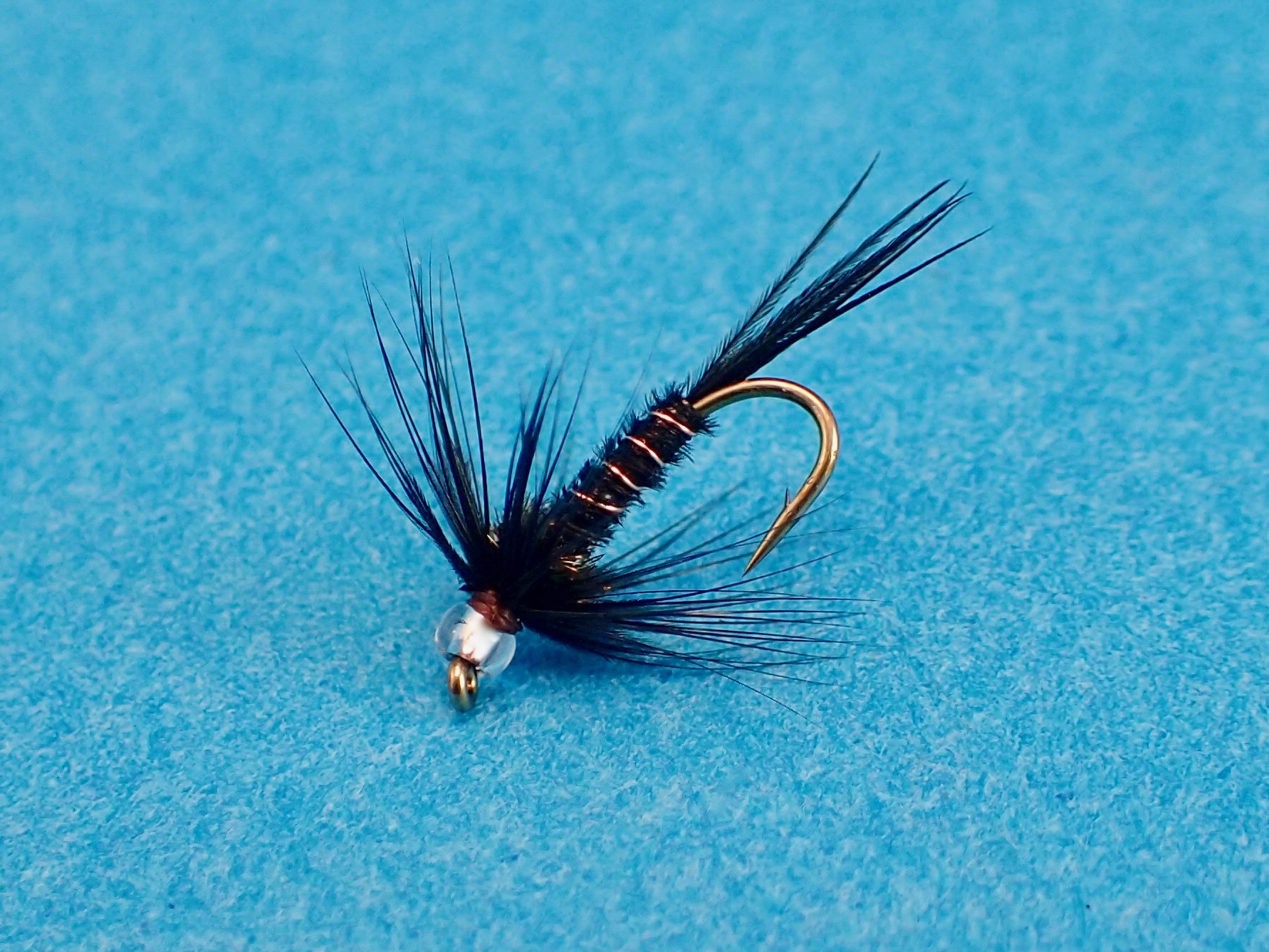
If you aren’t familiar with the singularly awesome power of this wet fly, you should come get acquainted.
Friday, January 17, 4:30pm, Seminar (Release Room): Wet Flies: Fishing Under the Hatch. A new look at fishing wet flies and soft hackles. If you’ve ever wanted to be that person who is catching all the fish, come to this seminar. There are times when wet flies will dramatically out-fish any other style, and the angler who understands the hatches — and how to match them — will be handsomely rewarded.
Saturday, January 18, 10am, Destination Theater Room A: The Farmington River: Southern New England’s Blue Ribbon Trout Stream. In case you can’t make it Friday, a repeat performance. In addition to the river, I’ll also be talking about my upcoming book on the Farmington River.
Saturday, January 18, 11:30am, Featured Tier: Farmington River Favorites. Come see me on the main show floor as I talk about and tie some of my favorite Farmington River guide flies. My secret weapons revealed!
This lovely wild brown ate one of the flies I’m going to demo. You should have it in your box.
Saturday, January 18, 2pm – 4:30m, Class: Tying and Fishing Wet Flies with Steve Culton: This is the next best thing to a lesson on the water! You too can become a dangerous wet fly machine. While not a tying class, I will demo tying classic North Country spiders, winged, and wingless wet flies that trout can’t resist, and show you how to rig and fish them. The course also covers basics like leader construction, matching the hatch, fly selection, where to fish wet flies, and how to fish them. All levels. Click HERE for more info and to register.
Sunday, January 19, 8:30am – 11am, Class: Beyond Cast & Strip: Presentation Flies for Striped Bass. Have you ever wanted to catch bigger stripers on a consistent basis — or the stripers that no one else seems able to catch? This class is for you! It covers traditional New England-style bucktails, soft-hackles, and flatwings, and how to fish them. These are sparse flies that look alive even when at rest and creat the illusion of life. While not a tying class, I will demo some patterns. All Levels. Click HERE for more info and to register.
Being able to repeatedly catch big bass on the fly from shore is no accident. Come to this class and I’ll show you how I do it.
Sunday, January 19, 3pm, Destination Theater Room A: Wet Flies 101. If you’re not fishing wet flies, you’re missing out. This is an intro to the ancient and traditional art of subsurface fly fishing with wets and soft hackles.
As usual, I’m counting on the currentseams crew to make a strong turnout. See you there, and please come say hello.
I realize I’m squarely in the better-late-than- space. So rather than blather, let’s get to it.
We start with a brief PA Erie tribs sortie in mid-November. The water was painfully low, and that made fishing extremely challenging, especially in the public water sections of Elk Creek. I did one day on private water (with a dabble in public), and then a half day on public water.
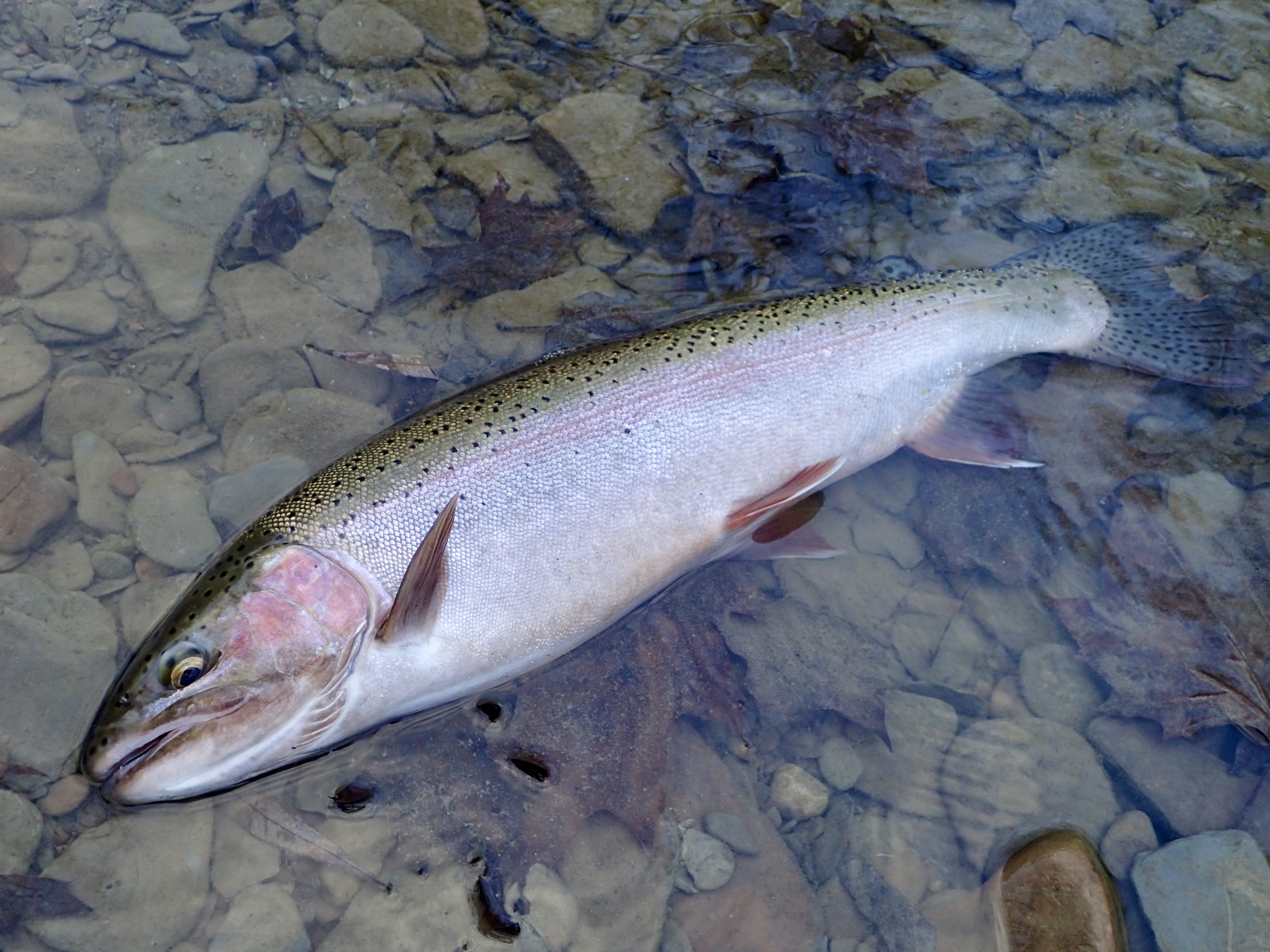
Harsh conditions. They’ve gotten ridiculous rain and snow since then, so where I’m standing is probably up to my chest! The fish were on high alert — we saw raptors everywhere and several fish with bird attack wounds. If the water had a flat surface and you were in the fish’s vision cone, they generally wanted nothing to do with your offerings. Even in the bigger, deeper pools that held a hundred steelhead, virtually every drift went ignored. With little-to-no current it was difficult to even get a drift. You had to make ultra-precise casts to get them to eat.I had my greatest success targeting fish that held in the shallow broken water of dump-ins and pockets. One such spot produced two steelhead. Here’s one of them. We fished Blood Dot eggs, White Death Zonkers, and pink Squirmy Worms, and the Blood Dot was the overwhelming favorite. Since you can fish two flies in PA, all of the flies were dropped off an another Blood Dot. This was the first time I’ve ever fished for steelhead without any weight. I also tried a new tactic to get my flies into the lane: as soon as the flies hit the water, I dragged them as needed to move them into position. Success!I finished the first day in public water. Holy hyper-spooky steelhead, Batman! It was extremely difficult to get into casting position, let alone present, without triggering the flight reflex. I managed one fish before a squall front moved in and blasted the area with gusty winds and torrential downpours. The next day, the creek was way up and running the color of tea with a dash of milk. Great color, but leaves were an issue. That influx of water moved all the steelhead out of the section I fished, and unfortunately no replacements came in overnight. I fought the good fight, but I didn’t get a single touch, and saw only one other fish hooked all morning. Time to head home and get ready for…
…Ontario tribs, and my long-awaited trip with Number One Son Bill. Bill had been steelheading before, but had never hooked and landed a fish. Under the watchful eye and excellent guidance of Row Jimmy, our mission was to change that. Like western PA, upstate NY had suffered from low rainfall. While the flows weren’t as dire, a float trip was ruled out. So crik stomping we went.
We arrived early and locked down a couple spots. I chose wrong, fruitlessly flogging the water for a three hours without so much as a courtesy touch. We had excellent conditions, and the clients of one of Jim’s guide friends had hooked 15 the day before. But something changed overnight in between dropping water levels (color was still good) and a dreaded cold front (I had ice in my guides until 9:30am. Nonetheless, Bill hooked and dropped one above me, so that gave us hope that creatures might be stirring. About 15 minutes later, yes! With pictures retaining their constant rate of worth, I’ll let Bill’s smile do the talking. Congratulations!
The rest of the day was peck away persistence fishing. I’ve never seen this creek so crowded, but people largely came and went because the action was virtually non-existent. It seemed like everyone had the same idea about the potential of the fishing, and then, once they realized they were wrong, left. We stuck it out, and I eventually landed three. With one more day to fish, we decided that rather than jockey for position and start well before dawn in the Altmar area, we would try some private water on the Salmon River.
We got a quarter inch of rain overnight, and that small amount was enough to move the fish out of our target run. Picture us standing in the rain at first light, wondering where all the fish went because no one is getting even a courtesy tap. Silver linings took the literal form of a few dime-bright steelhead fresh from the lake. Bill dropped a couple before hooking and landing a beautiful chrome hen, which he brandished with almost child-like delight. Though 1pm, all I had to show for my efforts was a silvery skipper.
I decided to attack a different section of the run, and it payed off. As my fly glided along the bottom of an uneven run, the indicator dipped as if it had somewhere else to be in a hurry. By the time I set the hook, the steelhead was running diagonally across and upstream, peeling off line at an astonishing rate. By the time he stopped, I could see the expanse of white that was my backing. I began furiously cranking the handle. As I regained precious line, the fish tuned and the line went slack. My heart sunk as I feared the worst. I even announced, “Fish off!” After I landed it, I remembered other such battles where the hook remained seated due to the tremendous drag of the line in the current. Next came the aerials, two of them, and I could see that I had a fresh fish the size of Bill’s. Bill grabbed the net and did a pro job netting the fish. Well, done, Bill! We decided to end on a high note, and victory was declared. Let’s go get a cheeseburger. I’m buying.
I don’t usually make posts like this. But if people want to know what to get you for the holidays, and you’re struggling with gift ideas, here are two suggestions.
Book a guide trip with me for 2025. There’s no real gift certificate, but there is the promise that we’ll go out fishing for four hours next year. Your gift giver pays now, but it’s at my 2024 rate (rates usually go up every few years). I build a 20% gratuity into the price, so all you have to do is show up with your gear on a mutually-agreed-upon date and time and we have at it. If you’re interested in wet flies, we’re looking at a May-Juneish window. Because of the book writing process, I will be limiting my guide trips in 2025, so this is a great way to lock in. Easy-squeezy…
Insert your likeness here.
Take a “Classes With The Experts” with me at the Fly Marlborough Fishing Show. With this, you get almost instant gratification. Two choices: Saturday, January 18, 2pm-4:30pm, Tying and Fishing Wet Flies with Steve Culton: Watch Steve tie classic North Country spiders, winged, and wingless wet flies that trout can’t resist, and learn how to rig and fish them. The course also covers basics like leader construction, matching the hatch, fly selection, where to fish wet flies, and how to fish them. All levels.
Or, Sunday, January 19, 8:30am-11am, Beyond Cast & Strip – Presentation Flies for Stripers with Steve Culton: Learn how to tie (Steve will demo) presentation flies – traditional New England-style flies that create the illusion of life even when at rest – and how and where to present them. All Levels.
For the Fly Fishing Show classes, you cannot register and pre-pay through me. You do that on the Fly Fishing Show Site, which is here.
I’m hoping to be offering the same for Edison on January 24-26, but that schedule has not been released. Stay tuned for my full Marlborough and Edison schedules.










 currentseams.com