Farmington River Report 7/21/16: The best time to fish in summer is…noon?

Conventional wisdom holds that in summer, Farmington River trout will be most active early in the morning and late afternoons into dark. You won’t get any serious arguments from me. After all, I was plumbing the depths with my drop-shot nymph rig before 8am. Then again, I’ve always been fond of the old saw, “The best time to go fishing is when you can.” I stayed through 1pm, and my best fish of the day came at high noon under blazing, brilliant sunshine.

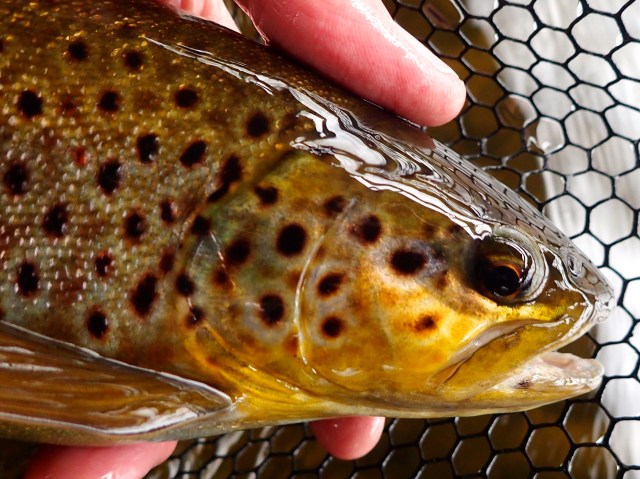
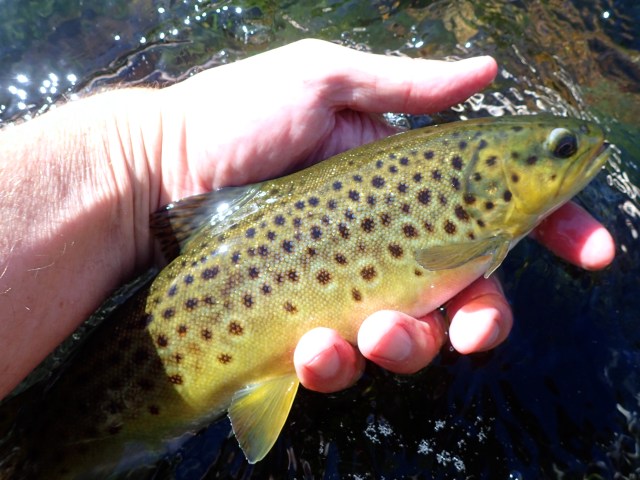
A Survivor Strain brown in the high teens, taken at noon of one of the warmest days of the summer in about two feet of water. Top dropper was the winning fly, a size 18 soft-hackled  Pheasant Tail.

DCIM100GOPROG0013432.

The action continues to be slow; I managed six fish in five hours. Of the dozen or so anglers I fished near yesterday, I saw only one hook up. I believe one of the keys to success this time of year is to aggressively cover water. I visited seven spots yesterday, blanking in two of them (the method was nymphing) and taking two on four casts in another. I also did some playing around fishing without my beloved indicator, using a section of 12-lb. yellow Stren as a sighter. (I still like the indicator better. So there.)

Farmington River 7/19/16: Persistence pays off

I first met Mike when I presented to his TU chapter a couple years ago. He expressed an interest then in learning the black arts of the wet fly, and today we finally got around to making it happen. Conditions were far nicer than yesterday, with lower temperatures, lower humidity, and a good breeze out of the north. However, the fishing was still slow, and we again had to work hard for every fish. Hatch activity was virtually nonexistent, and we saw precious few risers. Mike did a great job persevering and never lost faith in the method, even when it wasn’t producing. Well done, Mike! One of my favorite parts of today’s outing was taking Mike to some deep, dark, mysterious holes that I believe are rarely fished. It is truly rewarding to hook a trout on a wet fly in spots like that.

Mike’s first trout on a wet fly came about two hours into our session. Almost every fish we connected with today came in the transition zone between the main current and the softer edges by the riverbank.

DCIM100GOPROG0013383.

~

Portrait of a soon-to-be-dangerous wet fly machine hard at work.

DCIM100GOPROG0013317.


Farmington River 7/18/16: Hot and not

Today was the kind of day where we had to work hard for every trout. I guided Josh and his dad, and they both did a great job persevering under some truly difficult conditions. We started off with an indicator nymphing session, and though we gave it an A+ effort, the results simply weren’t there. Not so with wets, which is where we saw all our action. Wouldn’t you know it? Right when things started to pick up, the weather rolled in, so we had to call the outing. We’ll get ’em next time, guys!

Got him! Josh’s first fish, a Survivor Strain brown taken on a Squirrel and Ginger.

DCIM100GOPROG0013104.


After the rains, the fog rolled in…

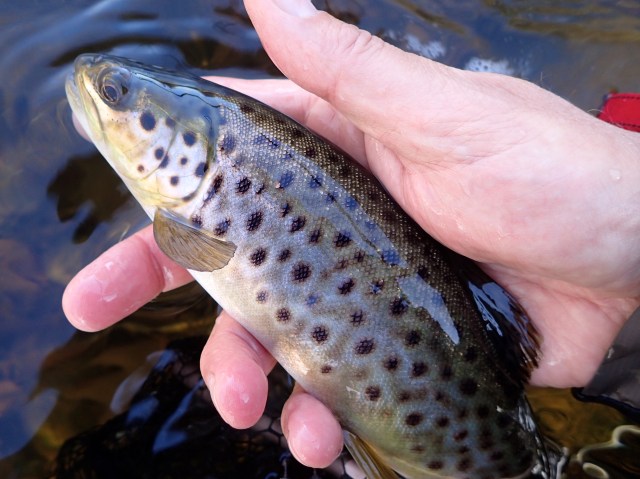
…as did this chunky mid-teens wild brown. Note full adipose, scarred mouth, and healing old wound (raptor?) mid-flank. This buck has seen a little action.

OLYMPUS DIGITAL CAMERA


Farmington River Mini-Report 7/13/16: 1-for-90

I had 90 minutes to fish mid-day today. Sunny, hot, and a gusty south wind, so I figured the terrestrials-blown-into-the-water energy might work in my favor. Fished a three fly team of (from top to point) a drowned hopper, Drowned Ant, and SHBHPT. The venue was a long, snotty run that would be a very manageable wade at 240cfs (59 degrees at 3pm if you’re keeping score at home).

Didn’t I feel like a genius when a fat rainbow jumped on on the second cast. But, it was on the PT. And it was the only fish to net today. So that proves how little I know.

On the other hand, while much of the east coast was working, I was standing in a gorgeous river, fishing.

Maybe I’m not so dumb after all.

Farmington River Report 6/21/16: Cane and able

Gadzooks! Can it be June 21st and I have not yet fished the Farmington with my beloved cane pole during my beloved Sulphur hatch? Begone, oh evil scheming time-space continuum! Here are some notes:

Fished the upper TMA. Water was 313cfs, clear, and cold. So cold, that I was shivering. Got to remember the fleece next time.

Hatches: Excellent! Sulphurs (16-18), caddis (18), a few small BWOs (18-20) and the ubiquitous midge. When I arrived at 5:00pm, there were sulphur duns on the water and the trout were enjoying them immensely. I find emerger patterns like the Usual and the Magic Fly to be less effective when the trout are eating duns, and that was the case last night. A classic Catskills-style dry worked nicely. By 7pm, the duns were off the water and the trout were on a second sulphur emergence (splashy rises) and spinners or something smaller (gentle porpoising). Small comparaduns and the Magic Fly size 20 worked for me.

A summer evening, a bent rod, and a My Father Le Bijou 1922 box-pressed torpedo. For one shining hour, all is right with the world.

DCIM100GOPROG0062824.

~

My tastes in dry fly water vary, but I think what I enjoy the most is technical water that requires tricky mends. You know the kind — nasty cross-currents and variable speeds, and if you get one good, natural drift out of ten casts, you’re doing well. My first dry fly session of the year usually exposes the rust — from presentation to hook set — and last night was no exception. I stuck six fish that I lost moments after the strike. I had another dozen quality rises to my fly that came up empty. Still, I landed enough browns and rainbows to keep me chuckling.

I still don’t understand why people leave the river at 8pm. As I point out in the current issue of American Angler, the last hour of twilight in the summer is when the fish go nuts — and get reckless. The rise activity was steady and solid from 5pm-8:15pm, but in the next hour it went off the charts. And I had 75 yards of prime water all to myself. I like a size 10-12 Light Cahill Catskills dry during this time.

Once I can no longer see the fly, I use the bucket method (look it up) of strike detection. That is, unless my line suddenly comes tight because a mid-teens wild brown slaughtered the fly and is now swimming upstream with fierce conviction. Note the kype, haloed spots, white edges and full adipose.

OLYMPUS DIGITAL CAMERA


Observations from yesterday’s Farmington River outing

I nymphed in and out of the permanent TMA for several hours and found trout in every spot. Water was around 320 cfs, 56 degrees, and clear. Not much in the way of hatch activity, although there were some caddis and midges. Four things stood out to me.

— My fish were evenly divided between the top dropper (sz 14 March Brown wingless wet) and bottom fly (sz 12 BHSHPT). So it’s good to give the fish a choice.

— One of the fish was a juvenile salmon. When I was stripping him in, a big brown gave chase and bailed just as I was lifting the salmon out of the water. I think it’s time to tie up a JV salmon flatwing.

— The last fish, a substantial wild brown in the high teens, took the fly on my first cast after I witnessed a smaller fish clear the water and another boil at the surface. Clearly, there was a caddis emergence in that brief window, and I was not surprised that he took the top dropper (which looks very caddis-y — see point number one.)

— In one spot, there were several anglers fishing in the run above me. All of them blanked. It could have been that it was just a slow day, or it could have been that they were all standing in the same place, fishing the same water for 45 minutes. If you’re not catching, move and find the fish.


Farmington River Report: “I usually get skunked.”

That was Wayne’s general assessment of his Farmington River experiences.

Of course, that was before Thursday. Wayne put on a wet fly clinic, hooking nearly double-digits in trout and landing most of them. I had Wayne fishing a traditional three-fly team, and he saw action on both the top dropper (Squirrel and Ginger size 12) and the point fly (SHBHPT size 12). We fished three locations within and outside of the permanent TMA, and found customers in all of them. Caddis, midges, and in the afternoon some Light Cahills and smaller BWOs. Water a terrific wet fly height, 350cfs, and a cool 54 degrees. Hats off to Wayne for an outstanding day.

“Are you still there?” Yes,  he was, and as a result we have this bent rod to deal with. 

OLYMPUS DIGITAL CAMERA

~

Wayne admires his handiwork.

DCIM100GOPROG0022674.

~

A different perspective on the release.

OLYMPUS DIGITAL CAMERA


Farmington River Mini-Report 5/11/16: Hot and not

I fished below the permanent TMA yesterday from 11am-2pm. I started off indicator nymphing in a pool that was infested with rainbow trout. I caught a ridiculous number of fish in a half-hour — not a testament to any skill on my part, but rather to the aggressive nature of these trout. Most of the action was on the bottom fly, a SHBHPT. I was pleased to get one on the top dropper, a new fly for me, Liesenring’s Blue Dun Hackle (size 14). Then I went to explore some virgin wet fly water. Nice run, but I blanked with my team of three. Did likewise in two other favorite runs. (Harrumph. I covered a good third of a mile of river without so much as a tap. Nice day for wading, though.) Finished up nymphing and took one more fish. I have to say that while recently stocked rainbows are not why I fish the Farmington, some of these fish are fat and healthy and display tremendous fighting and leaping instincts. Lots of midges and a few small (size 16) caddis.


Farmington River Report 5/6/16: Hendricksons (and then some)

Sometimes I have no idea what I’m talking about.

Exhibit A: As we waded into the Farmington at 2pm, I remarked to my client Paul, “We’re going to out fish those guys four-to-one.” Some splashy rises had me convinced we were going to clean up with wet flies in this snotty run. The two anglers below us were casting dries in a more moderate flow. Cue game show wrong buzzer sfx. They got one, we got one.

Exhibit B: On Wednesday, I said to Paul, “The Hendricksons are pretty much finished here,” “here” being near the bottom of the permanent TMA. Yesterday, we were fishing well downriver, and the splashy rises were due to an outstanding Hendrickson emergence. The water surface soon became littered with Hendrickson duns. How strong was the hatch? It was raining steadily, and the flies were still easy to pick out on a mottled surface flecked with raindrops. The problem was there was nothing feasting on these easy meals. Paul persevered, and induced a rainbow to eat the middle dropper, a gray/brownish wingless wet.

We decided to head upstream. This is where it got good. The hike to our spot took us past some glassy water where a large pod of trout were picking off Hendrickson duns at will.  We gave them a brief sniff of the wets — nothing. Then I suggested that we clip off the subsurface patterns in favor of a dry. The Usual size 12 was the fly, and the trout loved it. (Apparently, sometimes I do know what I’m talking about.) All you had to do was drift it over a feeder, and BANG! Game on. It was one of the better Hendrickson hatches I’ve experienced on this river. I know Paul had fun.

We went back to the wets for the last hour and managed a couple more trout. A very productive four hours, in terms of both catching and learning. Paul is well on his way.

Water was 275cfs, 49 degrees and clear. Air was 60, clouds and rain. The fishing was quite a bit hotter.

DCIM100GOPROG0022455.

~

This isn’t the best underwater shot I’ve taken, but I do like the reflection of the spots on the surface film. Since I know where you live, see you sometime this summer.

DCIM100GOPROG0022457.