Stop me if you’ve heard this one before: The Farmington River is so low, and the weather so hot, that the DEEP has announced thermal refuge areas that are closed to fishing. My opening reference was to a similar decree in the summer of 2016. The difference this year is that the water coming out of the dam is significantly colder.
This would be the good news.
Rather than parrot the temporary regs, here’s a link to the DEEP site that will tell you everything you need to know. The decree goes into effect today, Saturday August 6. As always, I urge you to carry a thermometer, don’t fish if the water is above 68, stick to the upper end of the river, and fish early or late.
I guided Matt and his son John yesterday afternoon from 3:15-7:15. We started off nymphing in the PTMA. Water was 115cfs, a tad low for my liking, but plenty cold! Matt went tight line and John fished under an indicator, both drop shot. The fish, however, weren’t very cooperative, so we moved to another mark. Here we found some smaller fish, smutting. Whatever they were eating, we failed to duplicate the process. We held council and decided to try our luck at the evening rise.
The mark I wanted to fish was on lockdown, so we headed to Plan B Spot which we had to ourselves. The pool was dead as Julius Caesar, but summer evenings on the Farmington being what they are, I knew it wouldn’t be long before the natives got restless. To make a long story short: we had a modest hatch. Midges, sulphurs, caddis, but mostly attenuata. Attenuata can be a very frustrating hatch to fish — the rise-to-hook-stick ratio can be maddening — but we kept at it and had a blast fooling trout. I stuck around after the session and fished until dark. I rose a good two dozen trout, but had only one partial hookset. (Sigh.) The spinner fall was not that great, and we called at dark.
We like tight lines. So, like father……like son. We a treat to be able to guide two enthusiastic anglers. We got to cover nymphing and dry fly basics, plus a little bit of wet fly for good measure. Excellent job, Matt and John, in some very technically difficult conditions. Dry fly tip of the week: longer leaders make for better drifts. Think a minimum of 13 feet, and you don’t need to go below 6x.
It’s a fair question, and unless you’re in the know (and sometimes even if you are) it can be confusing. The current situation is that the bottom release flow was increased over the weekend…and now it’s back down. Here’s a good explanation from our friends at UpCountry: “The MDC just emailed us, the CT DEEP is providing another 25cfs from their bank of water, which means the dam release went up by another 25cfs (they were already adding an additional 25cfs to the minimum flow that MDC has been running this Summer, so now they are adding a total of 50cfs). They were releasing 96cfs (was reading 113cfs at the USGS gauge)- this morning, this increase brings the dam release up to 121cfs, and by the time it hits the Riverton gauge (about 2-2.5 miles downstream) it will read closer to 140cfs, and with about 20cfs additional water coming in from the Still River the total flow below that will be around 160cfs, putting us closer to a normal late August level (200+ cfs) this weekend. This flow bump is being done to help lower the water temps- predicted highs this weekend of 94 for Saturday, low of 72 Saturday night, 96 high for Sunday, and a low of 77 Sunday night- the heat wave breaks on Monday/Tuesday. A big kudos to the DEEP for taking this action, it will keep the entire river cooler, and especially help the downstream trout in Canton, Collinville, Unionville & below make it through this hot weather. I suspect the DEEP will drop their 50cfs contribution down to 25cfs sometime soon after the weekend, as they don’t have a very big “bank” of water to use.”
That was posted before this most recent weekend. The dam flow on Monday noon is 122cfs and the release temperature is under 50 degrees, which is fantastic. Hopefully we’ll get some rain today, which will raise the Still River (currently under 20cfs) and temporarily add some water to the system.
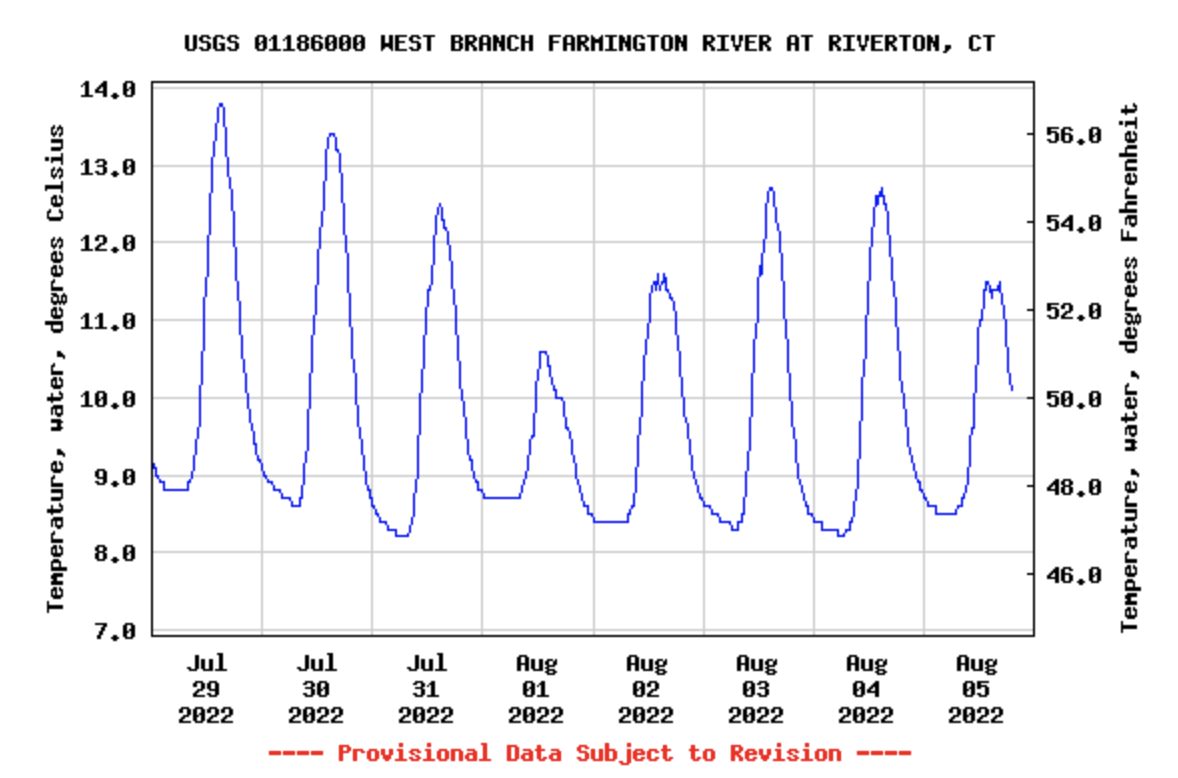
The bad news is, we’re in a disgusting heat wave. The good news it, we have some very cold water coming out of Hogback. Let’s start with this graph:
As you can see, the current release temps range from a morning low of around 47 degrees, and spike at around 56 in the afternoon. This is fantastic, and very fish friendly. But wait: that doesn’t mean all is well in Collinsville. With flows on the low side — just barely into three-figures of CFS — and air temperatures in the 90s, it doesn’t take long for that water to warm up.
So: use common sense. The closer you are to Hogback, the colder the water will be. The water will be warmest from noon into evening. Carry a thermometer, and use it. If you start getting readings approaching 68 degrees, don’t fish. Head north, or fish when the sun’s not beating down on the water.
I thank you. The trout thank you. Now, let’s all do a rain dance…
I guided Mike and his son Deven yesterday from late morning to mid-afternoon. We had a gorgeous sunny summer day. Although flows are low — 90cfs from the dam plus 40 from the Still — the water was delightfully cold (I got 60 degrees mid-day at the upper end of the PTMA). That’s great news for both anglers and the fish. As always, I urge you to aware of water temps in low, summer flows. If you don’t have a stream thermometer, please get one.
We started off in the PTMA. Mike, who’s an intermediate level fly fisher, decided to tight line nymph. Deven, who’s just getting started, spent a little time with me working on his casting; I then rigged him up with a two-fly wet team and we had at it. The action was slow, but, yes, Deven stuck a trout in a swift little slot under some overhanging branches. Well done, young man! Meanwhile, Mike got into a fish downstream. The action was very slow, however, and we decided to move on. (Many thanks to the very courteous and chill anglers who so graciously shared water with us.)
Next stop was a riffle near the top of the PTMA. Sadly, goose eggs. On to a mark above the PTMA. Deven and I concentrated on swinging wets in some faster water, then on using an indicator in some slower, deeper water with a large drowned hopper and a nymph dropper. We blanked, but Mike, who was now dry fly fishing, stuck one more fish on a tiny caddis emerger before we called it a day. A pleasure, gentlemen, and you both did well under some very challenging conditions.
Thankfully, what’s coming out of the bottom of Hogback is cold and clear and very trout-friendly.
Hello, all. My apologies for the lack of regular posts, but it’s summertime, and I’m working hard, playing hard. And so much to write about! Here’s what’s going on.
First, the fishing. I am in hard-core summer mode, which usually means long afternoons into nights. I know you won’t begrudge me the chance to get out and fish at the expense of writing here. I hope you’re getting out too. I’m also doing a bit of guiding. Then, there’s the yard and the garden. Speaking of which…
…we need rain! They’ve dropped the flow from the dam on the Farmington to 85cfs. The Still is currently a warm trickle. Ugh! The good news is that what’s coming out of the dam is plenty cold. I suppose we’ll have to rejoice in that.
Hot bronze, baby! Fortunately, smallmouth like warmer water.
I’m currently writing a piece for Surfcasters Journal on fishing the sand eel hatch with a floating line. It’s going to be loaded with tips on how to catch those stripers that not everyone can. Naturally, I’ll let you know when it comes out.
Last but not least, I am now officially a Scientific Anglers Pro. I’m a big fan of their Mastery Anadro line, and I’m waiting to give the Mastery Bass line a whirl. As always, I never hump products that I don’t use and love!
Every day is different. For proof, I offer yesterday. Yesterday was my worst wet fly fishing outing of 2022. If you had shown me the conditions, the mark, the number of actively feeding fish, the time of day, then offered a bet that would not catch a fish, I would have taken your money without another thought, Then, for over 90 minutes, I would have been frustrated to the point of incredulity. I would have eventually won the bet, as I managed one 11th hour trout, but the lack of wet fly hookups was a mystery that I pondered as I re-rigged for dry fly.
My best guess as to what was happening was that the fish were keyed on really small stuff — and they wanted the fly delivered on an absolute dead drift. Over the course of two hours, I had two bumps, both coming when I raised the rod tip to cast. This kind of reaction strike that doesn’t result in a hook set is clearly the result of a fish not committed to the take. I was fishing with Toby Lapinski, and he was working some slower water below me. Toby had a good dozen bumps on his team of three wets, but no hookups. Clearly, these trout were feeding on something other than what we were throwing, and how we were throwing it. Still, I’d expect at least a few accidents — trout being the small-brained-wired-to feed-opportunistic creatures that they are. The final piece to the puzzle that clued me in to the fact that they would only eat on the dead drift (rather than the mended swing or dangle) was that each of our wet fly trout came on an upstream dead-drift presentation.
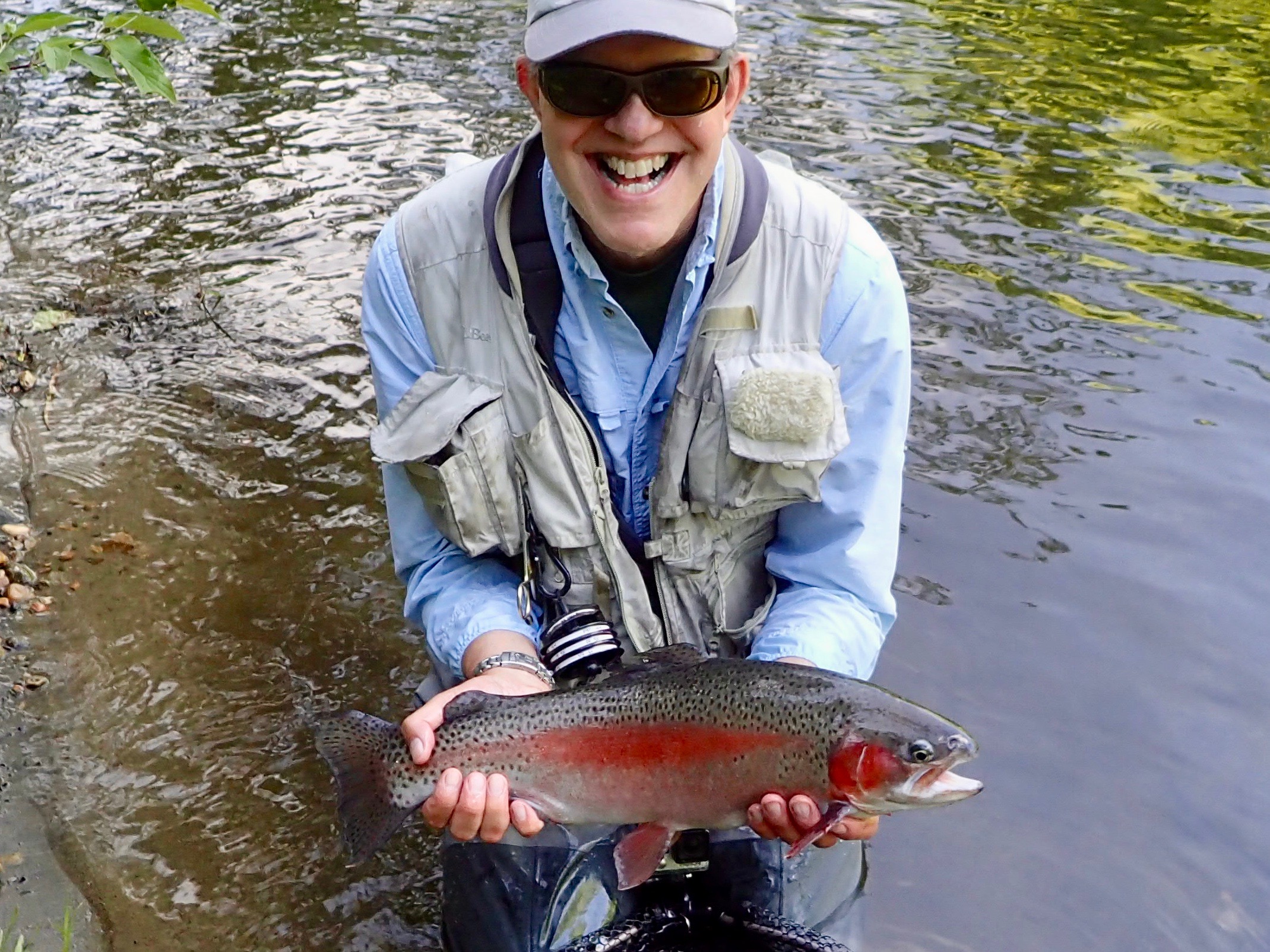
A hefty mid-teens rainbow taken by Toby on one of my size 12 soft-hackled Hendricksons, which is a fair stand-in for an Isonychia. The late afternoon Iso hatch was pretty good — I’d give it a 7 out of 10 — and yet the trout were not keyed on that bug. That’s too bad, because if they were I have no doubt we would have caught far more trout on wets. We never heard any of the loud splashy takes that are so typical of trout feeding on Isos. The sulphur hatch was disappointing — that gets a 2 or 3 — but hatches progress and evolve and it up to you to crack the code. Which, as it turns out, I did once the pattern changed. (Photo by Toby Lapinski.)
I often talk about making adjustments to increase your fishing success. But sometimes you’ve got to be prepared to fail, and fail miserably, in order to figure things out. To wit: I kept fishing wets on mended swings and dangles to prove that the trout were keyed on small bugs on a dead drift. I was also fascinated by the prospect that they would not hit any of my wet flies (Squirrel and Ginger, Partridge and Light Cahill, Hackled March Brown) even when presented directly over their lie. It’s all more useful data for the fishing experience bank.
But I’d had enough experiments. By 7:20 I was in position and rigged for dry fly. I started with a size 20 because the rise forms were textbook smutting trout. Remember last week when I told you that I stuck fish on seven consecutive casts? On this night, I rose nine consecutive fish before I could rack up a hook set. By then, it was after 8pm and I’d made the command decision to go with a bigger fly. Our Lady of Blessed Magic Fly (size 16) don’t fail me now! And she didn’t.
Any misgivings I may have had about catching fish during this session were gleefully crushed by the last half-hour of dusk into darkness. Using a mix of Usuals, the Magic Fly, and Catskills Light Cahills, I took a good number of trout on the surface. We stayed until dark; my last two customers came when I could no longer see my fly. One was bucket method hook set, the other a sharp tug as the trout, Mykiss the Leaper, came tight to my reel. Toby was still casting to rising fish as he slowly made his way out of the pool in the indigo darkness.
It’s almost mid-boggling how a river can go from nothing to boiling in a matter of a couple hours. When I arrived at my mark below the PTMA around 5pm, there were a few haphazard sulphurs, but you’d have been stretching it if you called it a hatch. The surface was dimple-free. That was all good with me, because I knew what was coming. Or at least I thought I did.
There is a distinct meter to most sulphur hatches. This one, as sulphur hatches often do, began slowly. A sip here. A bulge there. Nothing really that would suggest the full-bore frenzy that was to come. I was standing on a gravel bar that drops off into some deeper water, and as the shadows stretched across the surface of the water the fish began to move into feeding lanes. I chose a group of two or three sporadic risers that were about 20 feet downstream. The ignored my mended swing, so I decide to try the Leisenring lift.
The Leisenring lift is one of the most misunderstood presentations in fly fishing. It’s also a challenge with a shorter rod (I was wielding my 7’9″ cane.) To do it correctly, you’ve got to effort the rise of the flies so that it coincides with the exact position of the trout. Even if you do it right, sometimes the fish just won’t have it. But on this day, I had a bump on my first cast. I made the same presentation and felt another bump.
The third time was the charm. The trout struck and set herself. When she rolled, she sounded large. Right away, I could tell this was going to be an adventure on a whippy cane rod.
To add to the challenge, I was also using an old click-and-pawl reel. But I had a good hook set and 4-pound Maxima on my side. You pressure the fish as much as you can, don’t let ’em breathe, and if the planets align the fish is in the hoop before you know it. Now, I could have used a bigger net for sure. My net opening is 17″ — she was well past that — and as you can see, baby got some back. And that pink band! This shot really doesn’t do the fish justice; she’s over 20″. Thanks to Joe for being my photographer. Taken on a Hackled March Brown, size 12.
Whew! I took a short breather and waited for my hands to stop shaking. When I got back into position, I could see that while the hatch was beginning to ramp up, I was in the wrong spot to fish it with wet flies. Most of the good, slashing-at-emergers activity was in the faster water above me, but that real estate was occupied. I didn’t dare move, especially since I knew this small area would be money once the feed turned to surface action. I had no doubt, though, that if I was in a position to fish the faster water, I would have done very well.
I did manage another cracking rainbow on a wet fly. This lovely trout, taped at 17″, gave me a spirited battle. On any other day, it could have been the fish of the evening.
The hatch intermission came around 7pm. I took the opportunity to re-rig for dry, warm up my legs, and light a victory cigar. (For those who will want to know, it was an EP Carrillo La Historia E-III.) By 7:30, I was back in position. I reckoned I had a good 75 minutes left to fish. If time does indeed fly, it does so with unmatched alacrity during the waning hour of a sulphur hatch. Depending on the mood of the fish, that hour can be an exercise in frustration and humility or a giddy delight. The fates chose option B for me. Trout rose to my dry flies (The Usual, The Magic Fly, Light Cahill Catskills style) seemingly at my command. During one fortuitous stretch, I stuck a trout on seven consecutive casts. I don’t usually count fish in volume, but I thought tonight that might it might be fun to do so. I was having so much fun, I forgot to keep track after a dozen. The overage was certainly impressive.
As is my SOP, I was the last angler off the water, long after it was practical to have a hope of seeing my fly in the darkness, even if it is a size 12 and white. The last two fish I landed inhaled the fly without any visual clue of the transaction; I knew I was on only after I felt a sharp tug-tug.
You’d think that a writer could come up with a better word for an ending. But sometimes simpler is better, even if it’s unimaginative (or dare I say lazy). So we’ll go all in.
I guided Dan yesterday from noon-4pm. Dan has attended several of my wet fly tying classes and seminars, and now it was time to put those lessons into practice. We began in the Permanent TMA; there was no visible hatch activity, but we managed a swing and a miss before we connected with a gorgeous wild brown on the top dropper, a Squirrel and Ginger, in some faster water. (The current flow, 175cfs, is on the bottom end of ideal for wet flies. You’ve got a lot of fish looking up, but unless there is something going on subsurface, you’ll find your best action in the faster water, riffles, dump-ins, and pockets.) Next up was a mark below the PTMA that’s usually good for a fish or two. Sure enough, Dan scored a nicely colored brook trout on the point fly, a Hackled March Brown. We finished at another mark upstream, but couldn’t find any trout willing to jump on. It was kind of a funky afternoon, with a cold front coming through the night before, rain showers, and very little bug activity. So Dan did well with two in the hoop — great job, Dan! You’re on your way.
This gorgeous creature was Dan’s first Farmington River trout on a wet fly. There’s a certain sort of poetry in catching a brown that was never seen the inside of a hatchery tank or a stocking truck. What a jewel!
After our session, I decided to do a little experimenting. I was curious about the mark below the PTMA Dan and I hit earlier, so I started there with a team of three wet flies: Squirrel and Ginger on top, Partridge and Light Cahill middle, Hackled March Brown on point. This was about 4:30pm. It was slow. I managed a few bumps from smaller fish and two bigger brothers to net. When I left, creamy mayflies were just starting to show.
I headed a few miles downstream to walk a snotty run. It was just OK; I covered water, kept moving, and banged up a few fish. My wade brought me to an oddly-structured riffle that dumps into deeper water. It’s now about 5:30pm. Still no bugs in the air, but I began catching fish on wet flies in earnest. I wasn’t crazy good, but I was steadily connecting with fish with no bugs in the air and no visible risers. This is usually an indication that there is something good coming your way, namely a strong hatch. Now I could see creamy mayflies and sulphurs and an occasional March Brown. The surface began to simmer. I don’t often change flies on my wet fly team, but on a hunch I switched out the Hackled March Brown for a Pale Water Wingless, AKA The Magic Fly. The trout immediately demonstrated their approval.
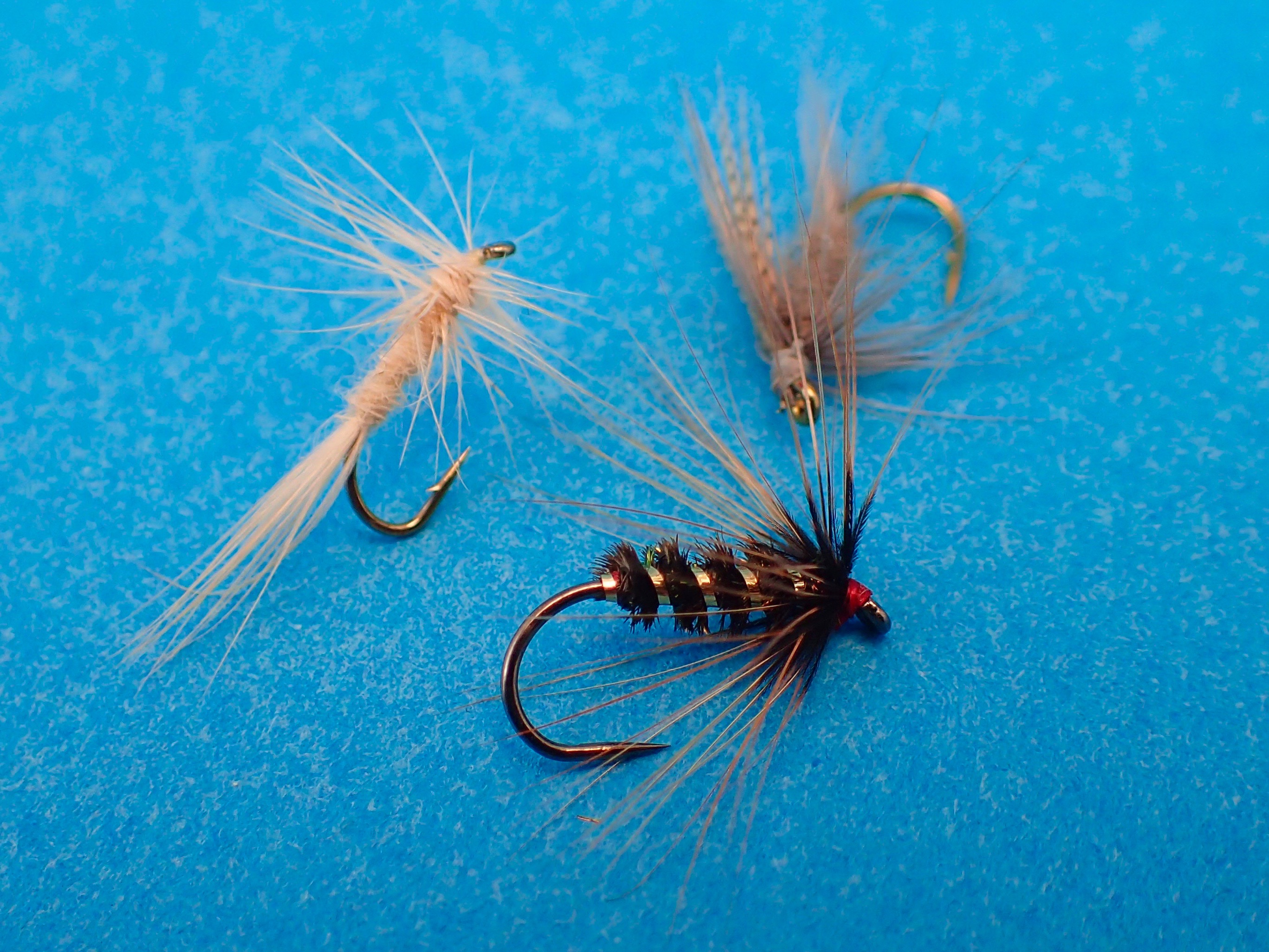
My Pale Watery Wingless variant, upper left. It’s a wet. It’s a dry. It’s the Magic Fly. Fish it and you’ll see why.
I have no idea how many fish I landed before 7:15. (There’s a lull in these evening hatches, and it usually comes in the 7pm-7:30 time frame. It lasts about a half hour, and then the party resumes.) What intrigued me the most was that while I was fishing in a steady rain, the wet fly takes near the surface remained unaffected by the barrage of droplets. I doubt that if I was dry fly fishing I’d have had the same success.
Once you see duns being snapped off the surface, it’s time to switch to dry. So I did. The rain stopped, the hatch came back with a vengeance, and the feeding frenzy began building exponentially to its crescendo. I fished a mix of Usuals, the Magic Fly, and Catskills-style Light Cahills. All three produced multiple fish. Around 8:15 I tied into an obstreperous trout that immediately went on the reel. The way it peeled line and cartwheeled subsurface made me certain that I’d foul hooked it. Nope. It was just a pig of rainbow, powerful, spirited, and worthy of honorary steelhead status.
Fish were rising everywhere. I had two or three that were working less than a rod’s length away. There were so many bugs and so many feeders that it became a challenge to focus on a single area or trout. (I recommend you find an active feeder, observe its rhythm, and target that fish. If you go shotgun during an event like this, you can get lost in frantic shuffle.)
All good things must come to an end, and since it was long past the time when I could see my fly, I began the wade back. Of course, I fished along the way. Thwack! One more glutton nailed the Light Cahill. I lost the trout to a popped 5x tippet, no doubt compromised by a toothy mouth of gill plate.
This was the kind of night that you dream about during those dark winter days. You relish them because they don’t come along too often. I wish I were going back tonight, but duty calls on the home front. But that doesn’t mean you can’t go fishing tonight.
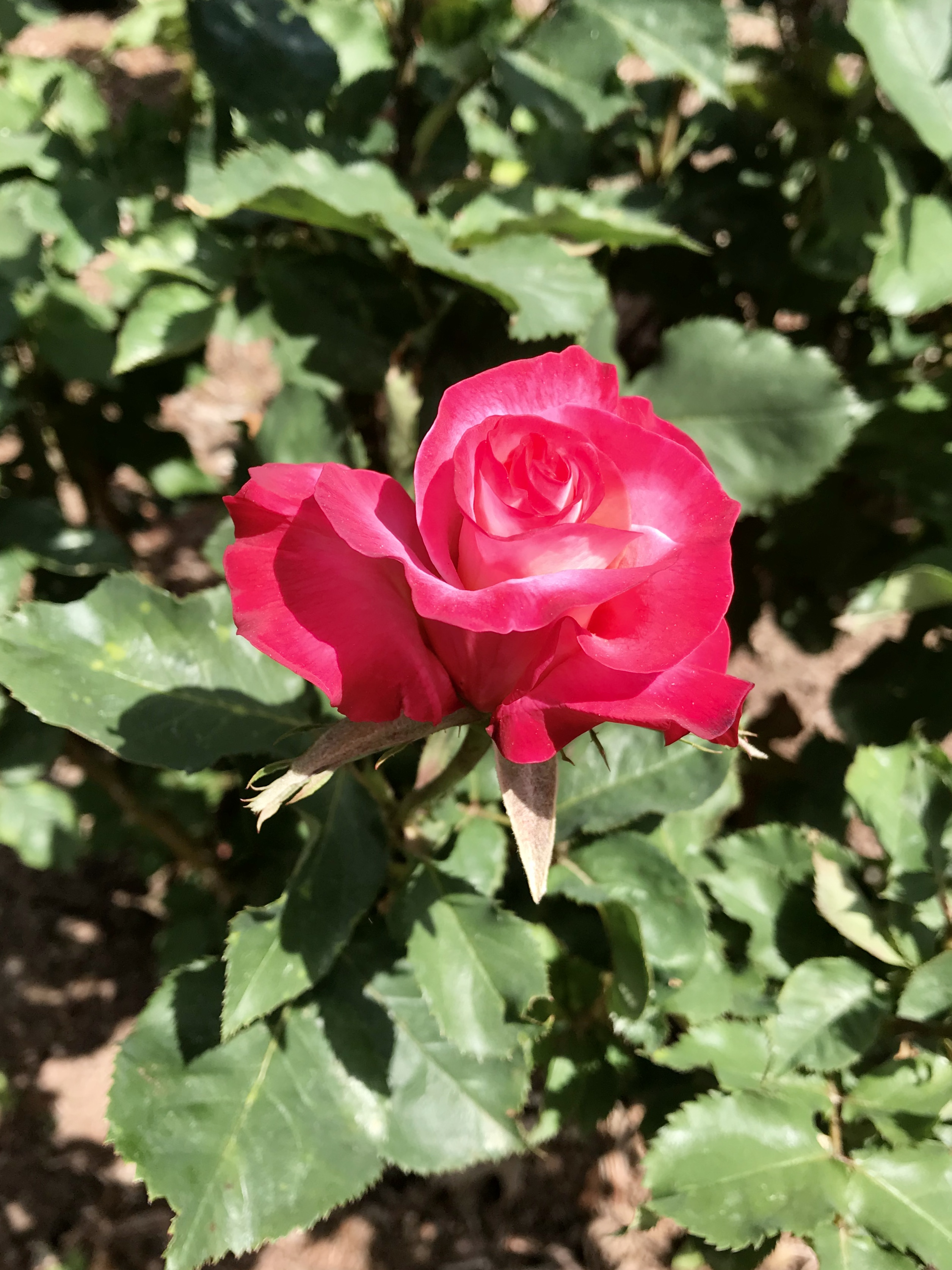
This happened Monday, so I’m a little late with the post, but my first rose blooms always mean there are Light Cahills on the lower end of the Farmington. The hatch is already progressing upstream. Call them what you want (Vitreus, sulphurs, etc.) — I see these first signs of summer as simple creamy mayflies, and I go with the generic term of Light Cahill, which suits me just fine.
Remember, you are matching size, color, and profile. These first invaders are usually a size 14-16 — sometimes you get a big 12. For dry flies I like the classic Catskills Light Cahill, the Pale Watery Wingless AKA The Magic Fly, and the Usual. For wets, the Light Cahill winged, the Pale Watery Wingless, and the Partridge and Light Cahill. Any of the creamy Leisenring or North Country patterns will also serve you well.
Old reliable “Grenada,” a hybrid tea rose, is always the first to pop. If I weren’t so busy with yard work, I’d be all over this hatch. Catch a few for me, will ya?