It’s that time of year when the phone begins to ring. People want to go fishing! Me, too.
Given my schedule, I want to give currentseams followers first dibs for lessons on what looks like a very limited availability in April. Some dates are already out: every weekend, Monday 4/3 and Good Friday. Between other commitments and my own fishing, I will very likely only have a handful of dates available to take people out. Of course, there’s always May. But if you wanted to get out with me in April, jump on it before it’s gone.
If you’re unfamiliar with my guiding/teaching philosophy, you can find that here. I’ve also updated my Trip Checklist which is basically an FAQ. Thank you again for all your support!
I’ve been fortunate to have had so many fantastic days fishing the Hendrickson hatch on the Farmington River. So naturally, I’m licking my chops in anticipation of this year’s complex action and (hopefully) grand style. Here are some of the things going though my mind on this lovely March morning (which, if it were three weeks from now, would have Hendrickson written all over it).
Mssr. H.
I hope the water comes down. I’ve had many days where the river was way up — with legions of bugs dotting the surface — and nothing was snapping at them. Oh, sure, the trout gorged below, but is there anything more discouraging than seeing the water littered with Hendrickson duns and nothing is trying to eat them?
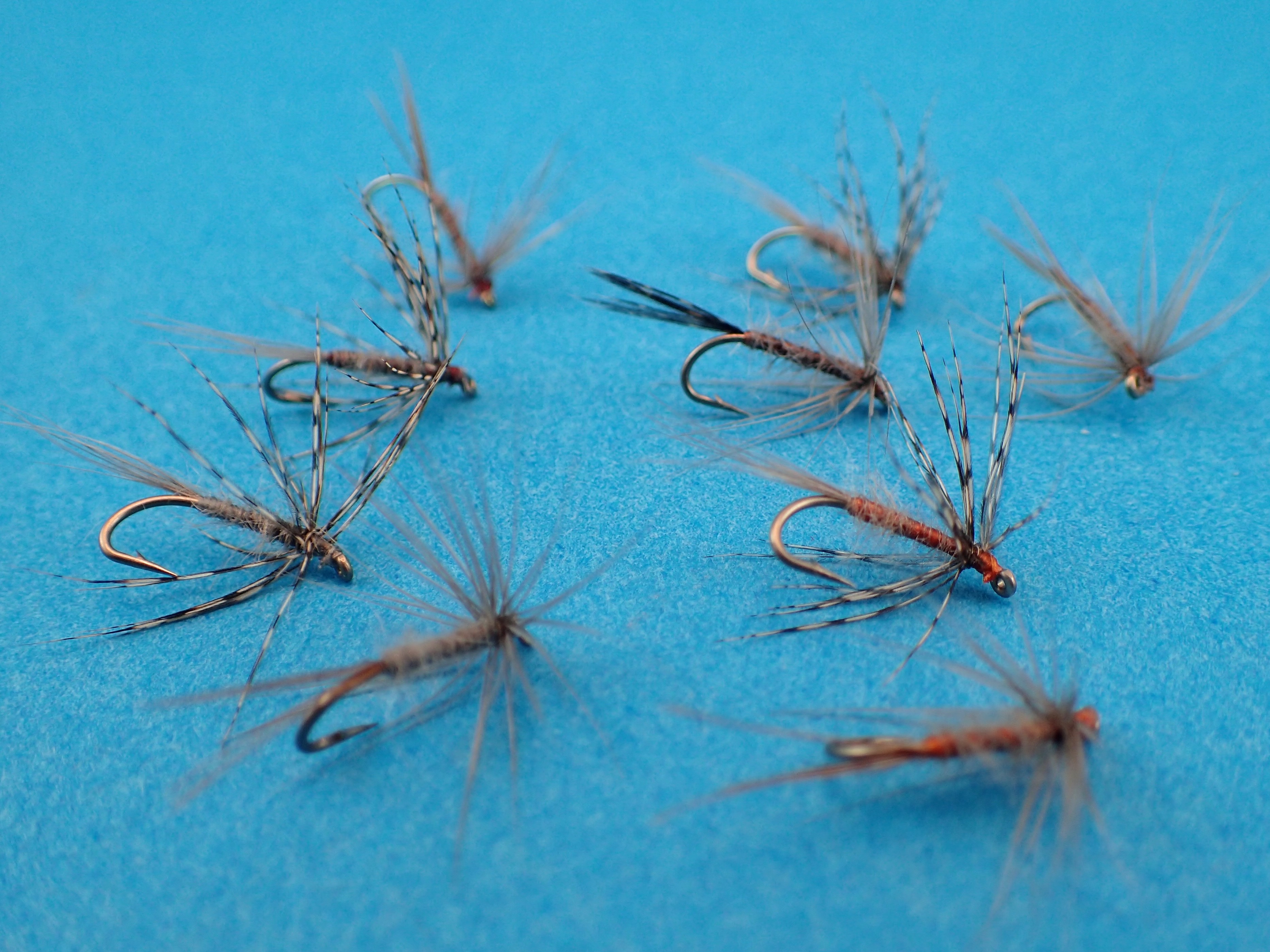
So, tailor your presentation to to the water level. Most anglers associate the Hendrickson hatch with dry fly action. But I’ve had some crazy days nymphing when it seemed like it was a fish on every cast. You can use specific Hendrickson nymphs, pheasant tails or something like this.
Don’t neglect wet flies. The earliest stages of this hatch are tailor made for wet flies like the Dark Hendrickson winged wet. You’ll know when to switch to dries because you’re not taking a trout — or multiples if you’re fishing three flies — on every cast.
I’m going to try some new things this year. Here’s a post from years past where I riffed on the Dark Hendrickson theme. I’m curious about soft hackles this year, particularly glass beads vs brass beads. More on that as I get out for some field testing next month.
I do really well with The Usual. Of course, I have Comparaduns and classic Catskills-style dries. But I embrace simplicity, and trout almost always display a wanton eagerness to attack Fran Betters’ classic.
Be aware of other hatches. Little BWOs, Mahogany Duns, and especially caddis can come off at the same time. Woe be to the angler who is unprepared for the trout taking something other than H-bombs. I always have a Squirrel and Ginger as the top dropper on my team of three.
I can’t remember the last time I had two consecutive blanks on the river. But there we are. To be fair, I only fished a couple hours on Tuesday, but yesterday I put in a full half day in five locations for not…a…touch. This was my first time to the Farmington since January. Tuesday was sunny and breezy and chilly. I’d planned on hitting the lower river, but settled for a few miles below the PTMA. Still, the water was about 800cfs. BWOs #20 flitting about. Headed up to hobnob with my friends at UpCountry, then with Sal at Legend’s, and then I re-hit the water. Observed airborne: tiny olives, small tan caddis, and early black stones #14. At my third mark, I stuck a fish, but it quickly became unbuttoned — we’re talking about two seconds of head shakes — which was too bad because it didn’t feel small. And that was it.
I should mention that over the two days, I was dedicated to the nymphing cause. I thought Thursday would be better with the warmer air and damp conditions — the olives loved it — but the Still River bumped up and we had over 600cfs in the PTMA. I nymphed the snot out of three marks, then hit two above the PTMA. Zero. Zip. Zelch. It wasn’t just me. Over the course of the two days, I saw one trout hooked among about a dozen anglers over six hours. In hindsight, I probably should have thrown streamers.
Fellow lefty Paul being bold and daring swinging wets in March. He was so kind and willing to share water, and I thank him for his giving spirit and positive energy. He even let me nymph the deep slot in front of him. Neither of us could believe that I blanked.
But what I really wanted to talk about are the new things I tried. I started with a different butt section for my indicator nymph rig. It’s 6′ long, and I flip-flopped the yellow sighter section with the clear section, making the sighter the bottom of two halves. I didn’t like it, so I’ll go back to my original configuration. (On a side note, everyone sees differently, and the yellow really pops to my eyes. Make sure you can see your sighter!)
The next thing I tried was a three-fly team for nymphing. I’d only done it once before, way out west on the South Platte, but the more I thought about it, the more it makes sense. I kept the bottom two patterns fairly close — about 16″ apart. The top dropper was a soft hackle. Obviously, this setup needs far more field testing with some willing subjects. It goes without saying that good casting form and minimal false casting is paramount to prevent tangles (which you will get).
And finally, I played around with some new flies — that early black stone I posted on Instagram, and a slightly larger version of Pat Torrey’s Little BWO. Once again, more field testing required.
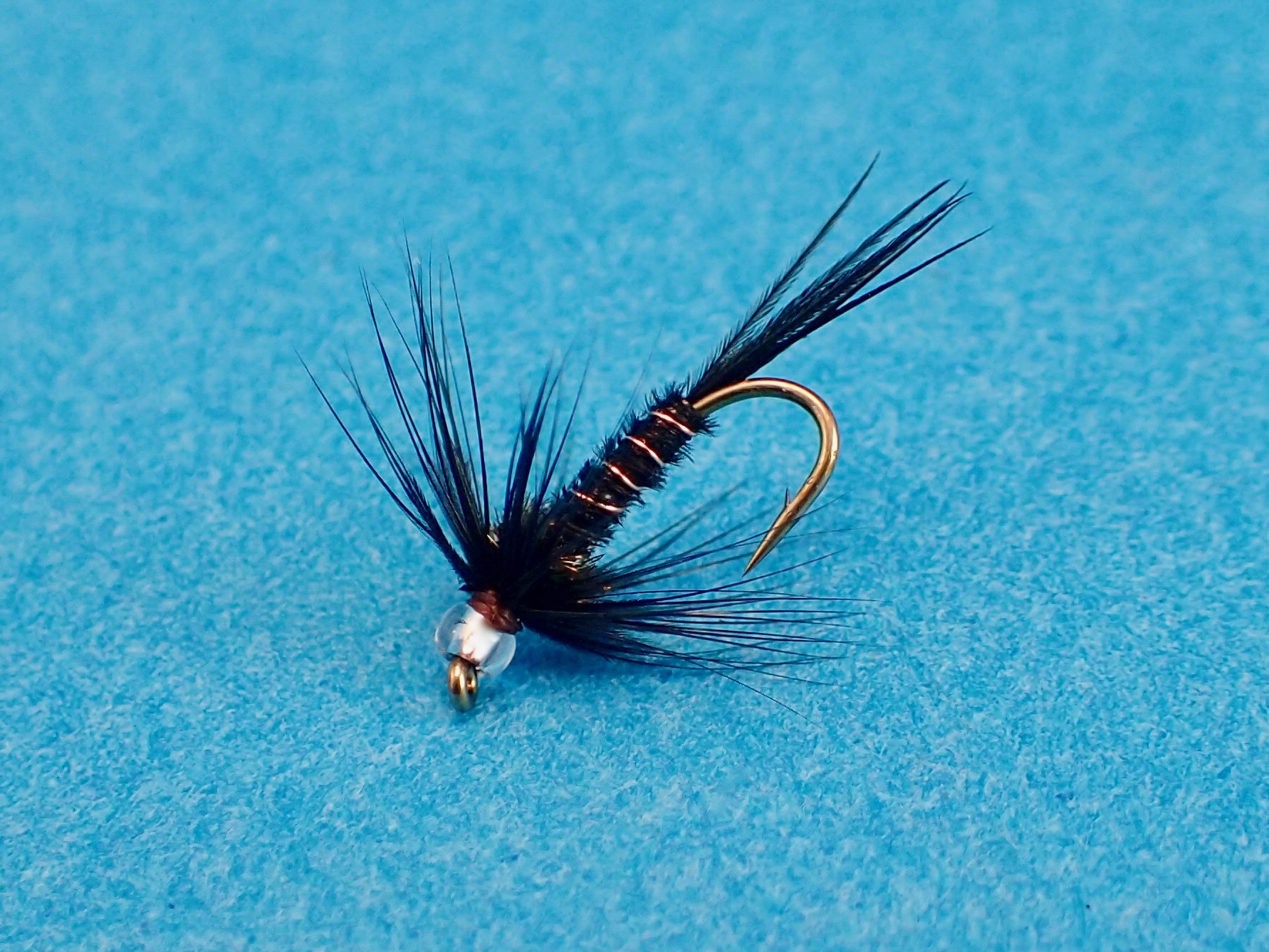
Happy hump day! Just a wee reminder that if you’re not following me on Instagram — @stevecultonflyfishing — you may be missing out on some good stuff. What goes on Instagram doesn’t usually make it to currentseams. Like this website, I try to keep it informative, entertaining, or useful (and on a good day, all three). So, if you’re not following me on Instagram, hop to it. I just posted this nifty little black stonefly soft hackled nymph….
Steve’s BHSH Little Black Stone. You can find the recipe on Instagram. 🙂
I have shamefully neglected my trout vest and its accoutrements and baubles and other implements of destruction. So that’s today’s job: get it ready to go for some late winter/early spring fishing. Find a place for everything, and put everything in its place. Make sure I’m not missing anything. And restock the pathetic container that is my subsurface fly box — especially the nymph side, which is embarrassingly barren. Enough self-flagellation. To the tasks at hand!
I have a traditionalist streak a mile wide. So for years, I used one of those old-school wool fly patches. I shudder to think of all the dozens of flies I lost with that system.
Then, fly fishing pack makers introduced the rippled foam fly patch. They conveniently placed this patch inside the front compartment of their packs. Except, if you’re like me and tend to load up your pack, that system is not very convenient. I shudder to think of all the smaller items I’ve dropped into a river trying to get to a fly.
This product is absolutely brilliant. I attaches to your vest, pack, jacket — whatever — by means of two powerful magnets and a steel backing plate. (Note: the maker suggests that the magnets are so powerful, they are not advisable for use by anglers with pacemakers.) When you’re done with a fly, you place it onto the patch and it stays stuck. No more flies going AWOL. No more wondering where that midge nymph went. No more struggling to get to your stash.
Magnet-ique is headquartered in England. You can order directly from them, and possibly from your local shop. I actually saved some money by ordering a double (two of the orange units) and an extra backing plate, which gave me two usable separate patches.
The Magnet-ique MagMini Double on my steelhead pack. They also make a smaller, single size. Suffice to say I need the room of the double, especially for steelheading where I may be going through double-digit fly numbers in a day.
Zip it. Hush. Shaddup. Small streams and wild trout are a finite resource — and more pressure is usually a very bad thing. So for goodness’ sake, never post stream names and locations on social media. Never take photos that clearly identify your location. (Picture this scenario: you make a video and post it on YouTube. The brook is clearly identifiable. Someone sees it and comments on how beautiful the place is. Someone else comments, “I know where that is!” Someone 1 reaches out to Someone 2, and the location is revealed. Someone 2 likes to share locations with his friends, and the cascade begins. Don’t laugh — I’ve seen it happen.)
And if someone asks, you can always use my line: “I won’t even tell my mother where I fish.”
We continue “Wild Trout/Small Stream Week” on currentseams with a deep dive into the archives. Stalking Wild Trout on Connecticut’s Small Streams was one of the first articles I wrote for myself. That is, not for a specific publisher or editor, but for my own personal use. Although it’s nearly 20 years old, and some of the information is out of date, the piece remains worthy. And I’m guessing that many of you newer subscribers have yet to see it. In case you missed the link above, you can find the article here.
To give you an update: I never did catch Gus. But I did catch and release a few of his relations. Sadly, the pool Gus lived in disappeared not long after I wrote the article. Small streams are highly susceptible to change during high water events.
Anglers wielding cameras have killed more small stream wild trout — intentionally or not — in the last 10 years than in the previous 100. You can blame it on the convenience and portability of digital devices. You can blame it on social media. You can blame it on anglers. Or narcissism. Or all of the above.
Whatever the root cause, I still see far too many images on social media of mishandled wild trout. Fish being held in dry hands. Fish thrashing around in landing nets, airborne, nowhere near the water. Fish photographed laying on grass, twigs, leaves, rocks, and other substrate no wild trout that’s going to be released should ever touch.
Let’s assume for a moment that I’m not talking about you. You’ve visited keepfishwet.org. You know the drill for ensuring more favorable catch and release outcomes. I applaud you. And now, I’d like to ask you a small favor.
Stop taking so many pictures of wild trout.
We all agree: wild trout are beautiful. The delicate parr marks, breathtaking halos, and butter-yellow hues of wild browns. The intricate, Faberge Egg-like designs and vivid colors on wild char. They’re all a wonder, and a marvel to look at. But do we need to see a photo of 2…4….6…and more… wild fish from your most recent small stream outing? The answer, I believe, is no.
So next time you’re on your favorite brook, take the Wild Trout One Photo Challenge: You photograph one fish, and one fish only. That’s it. All the others go quickly back into the stream, and you get bonus points if those non-photo subjects never leave the water. Think of how many wild fish you’re not subjecting to additional stress. It’s a win for you. It’s a win for the next angler. And most of all, it’s a win for the fish. Remember, the stocking truck isn’t coming back to replace what wild fish we kill, accidental or not.
I truly thank you for your consideration.
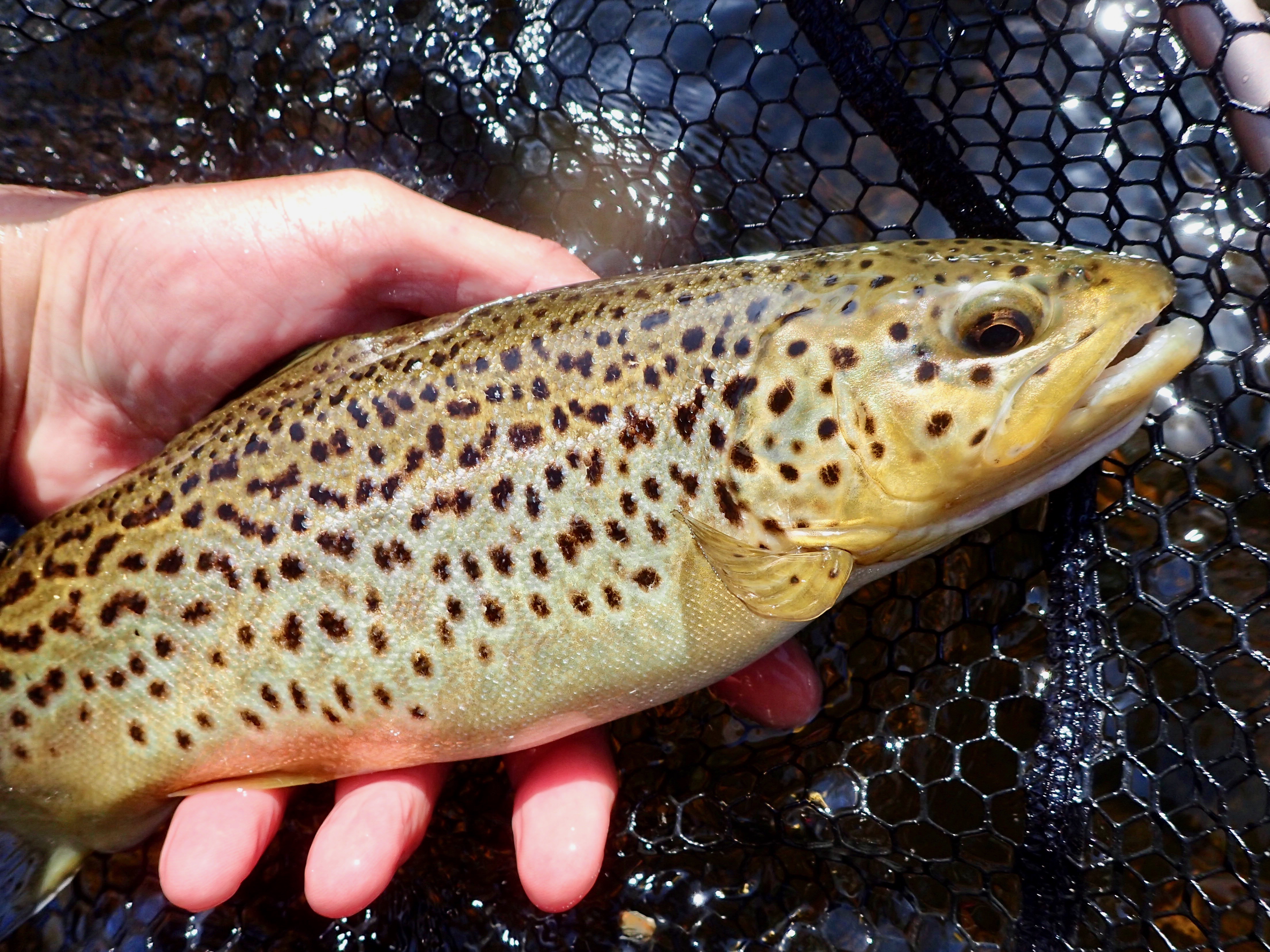
I don’t know how many wild brookies I landed on this day, but I do know that this was the only one I photographed. 1-2-3-lift-shoot, then back into the water. Less isn’t always more, but it usually is when it comes to small streams and wild trout.