Shorter days, longer nights, cooler weather…I’m definitely in the mood, baby! We do need some rain, but as you read this, Great Lakes Steelhead are staging at the mouths of rivers and creeks. I think this thought train all started when I saw that Jeff Blood was going to be one of the tyers at the International Fly Tying Symposium (you’re going right?) on November 16-17. Jeff’s Blood Dot Egg has been my new favorite egg pattern since steelhead guide extraordinaire Bob Packey introduced me to it three years ago. It works on both Erie and Ontario steelhead (not to mention trout in CT). I’ll stand by the title of the article linked here: The best egg pattern for steelhead might be Jeff Blood’s Blood Dot.
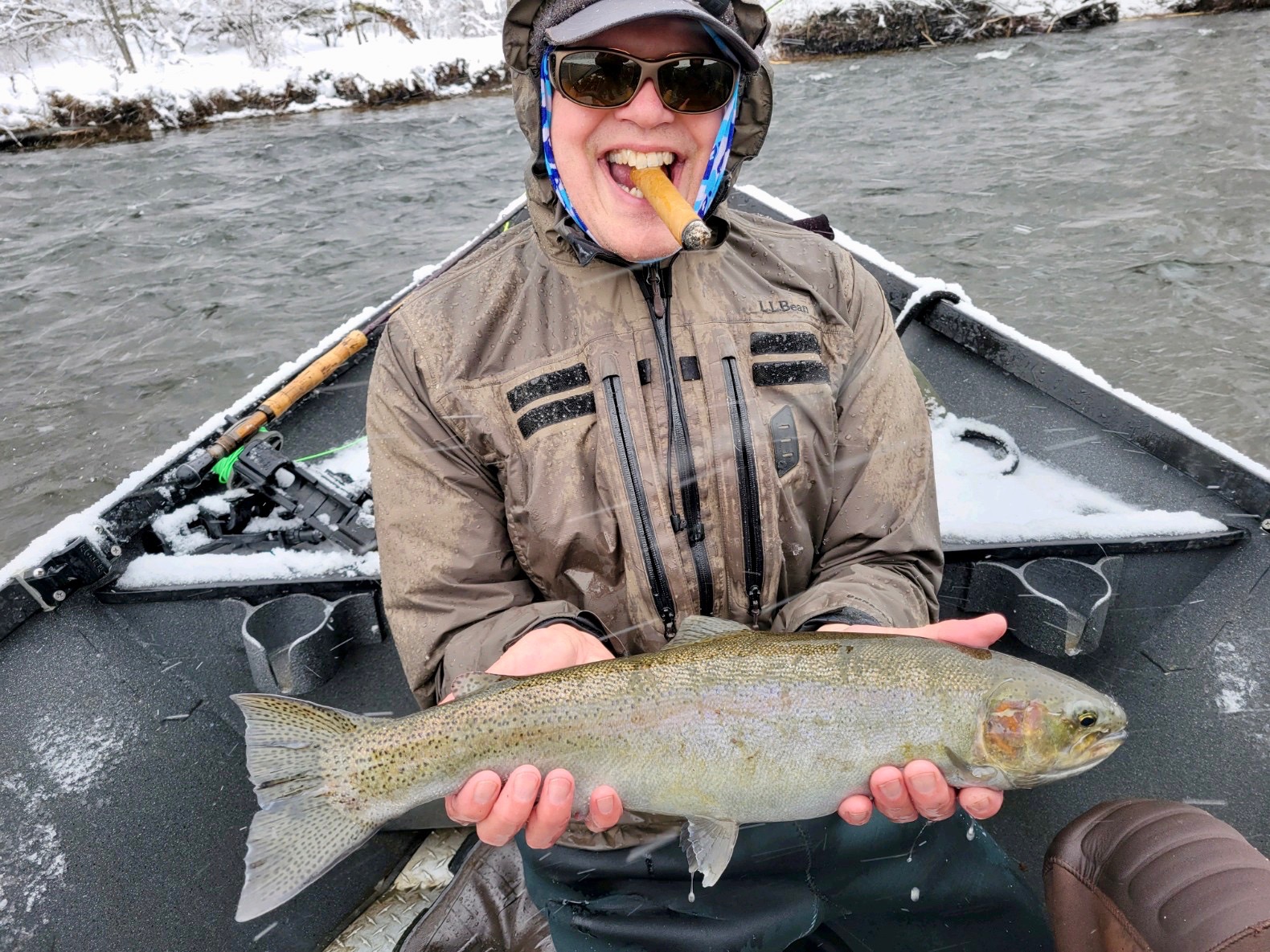
Give that man (Jeff Blood) a ceegar! This is a Salmon River fish from last November taken on Jeff’s fly.
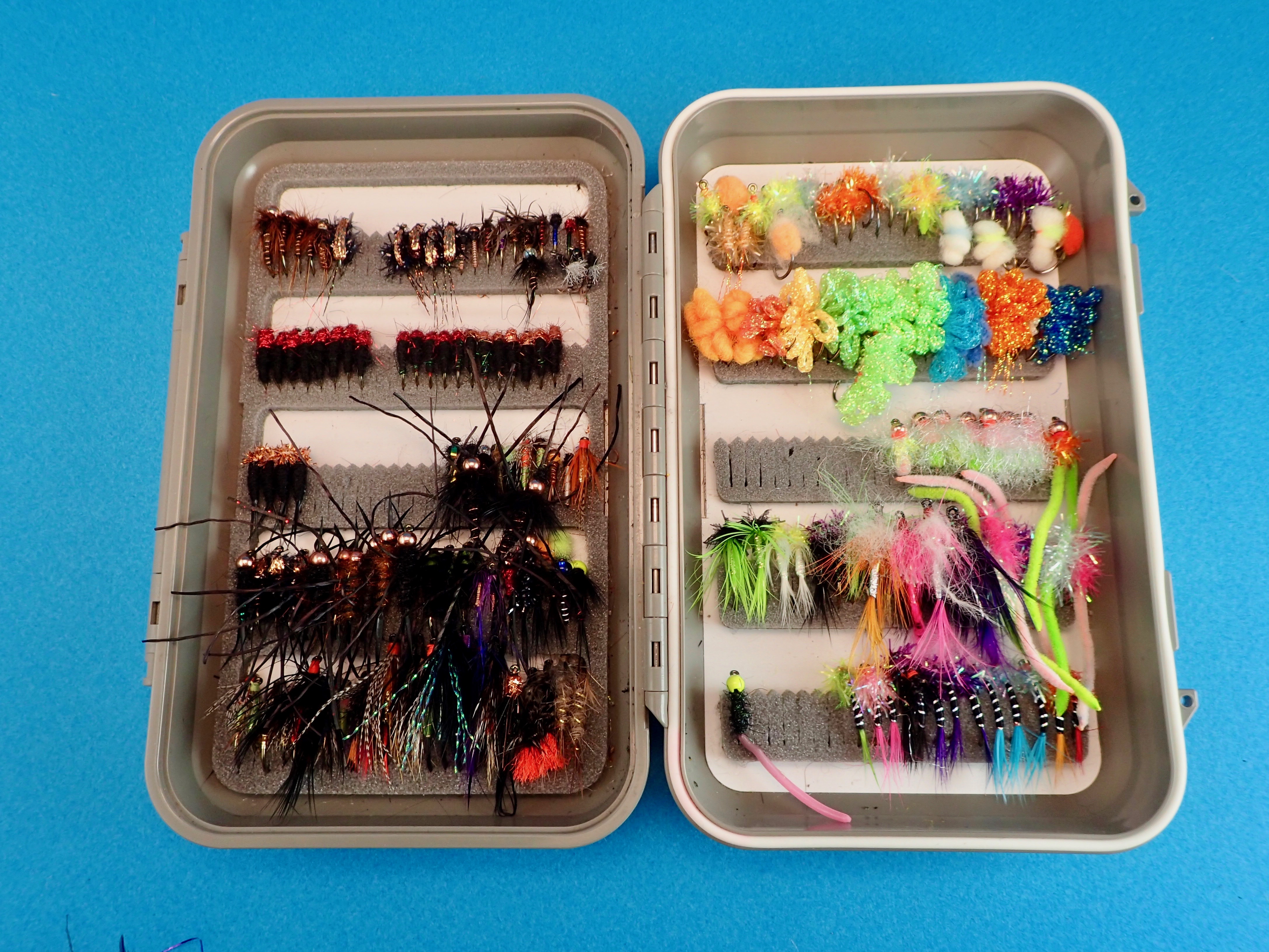
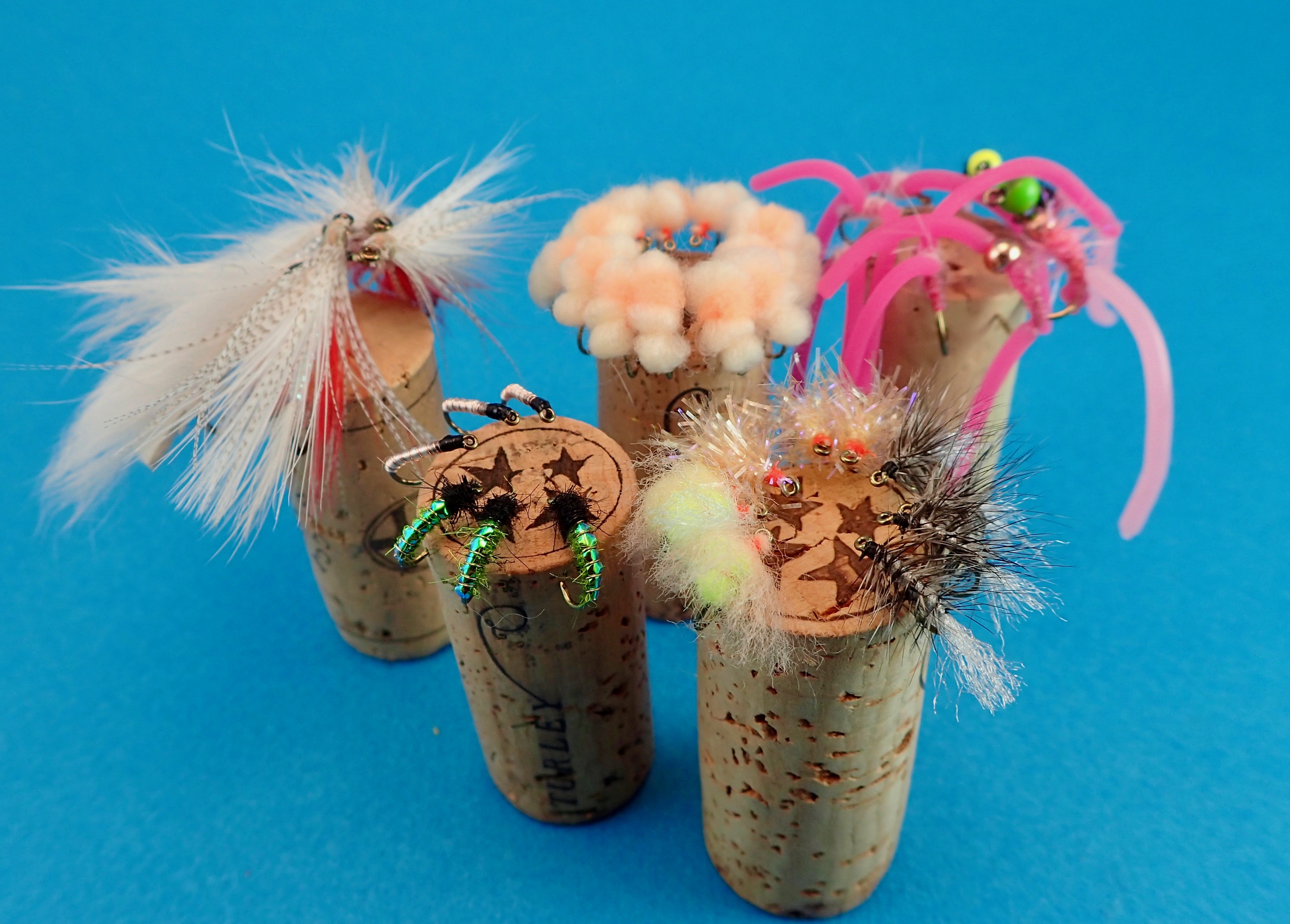
There are a few holes on the bug side that I’d normally fill with small, simple black stones for the Ontario tribs. The egg side is a little too large and loud, especially for the current low water.Time to fill some corks! Clockwise from lower left: sz 14 Electric Caddis and Yerger Miracle nymphs; Winger’s Mallard Minnow and Jeff Blood’s White Death, sz 10; egg/apricot supreme Blood Dots sz 14; various implements of Squirmy Wormy destruction; Kopczyk’s Super Fruit, and Murray’s Go-To and Mini-Bug, all sz 14. I got most of these patterns from John Nagy’s Steelhead Guide, the definitive work on Erie tribs steelhead. Let’s see where they fit in…Ready to go! I replaced the top egg row, which was mostly Estaz eggs, with more muted fare. The Blood Dots are a proven favorite. I love that you can fish a tandem rig in OH and PA, and I’m looking forward to giving the steelhead a choice. Steak? Or eggs? Both?…
Part One: Sunday. My original plan was to hit the Upper Fly Zone on the Salmon River, but after kibitzing with steelhead guide extraordinaire Row Jimmy, gears were shifted. High but falling water, some color to it — yes. The creeks. Creek A was surging along, and in addition to a moderate stain its waters carried a fair amount of leafy debris. I targeted two very likely holding areas, but over the course of an hour the only thing I could hook was the bottom. The UFZ beckoned, but its siren song was drowned out by the call of Creek B, which, as it turns out, was the right choice. Creek B was also running high, but much clearer. I was astonished to find that my secret spot was devoid of anglers. Third cast, right down the gut, the indicator dips and I’m on. I stuck the fish good, but as I’ve learned, now years into this endeavor, you can do everything right and the fish can still come off. (The reader will want to make note of this statement for later reference.) It was a fresh, gleaming bright fish, about five pounds, and it immediately skyrocketed out of the water and spit the hook. My disappointment was salved by the knowledge that there were fish here willing to eat. I ended up going 2-for-5, not a great batting average, but two of those were never really on, coming off seconds after a perceived hook set. It was good to be on the board. It was Sunday. It was sunny. I was steelheading. It felt good.
Our Lady of Blessed Blood Dot did not fail me. I set the hook so hard on this buck that I almost fell over. Being able to fish for steelhead in smaller water in relative solitude is a blessing. To show my appreciation, I made a burnt offering to the creek gods. Ok, so it was a smoldering cigar butt, and I was finished with it anyway. But it felt right.
Part Two: Monday Morning. The fishing on the Salmon River in Altmar stunk. We saw three steelhead hooked and landed. Despite the high flows (1.5K cfs) we were able to target known, proven holding areas (along with multiple other boats) and it just wasn’t happening. I’d been thinking it for a couple hours, but after we blanked in Ellis Cove, Jim suggested that we cut our losses and hit the creeks. It was 11:30am. Sold!
Part Three: Monday Afternoon. In what seemed like a flash, I was 2-for-4. The first one I stuck was a big ole’ fish that came up and planted itself in the main current. If it could think and determine a strategy — to bulldog and try to outlast me — I’d want to shake its hand or fin or however you congratulate a steelhead. Because as I steadily applied pressure to the fish, something gave and I was left wearing my leader around my body. By 1:30, Jim had to leave, so I decided to stay for a bit. I was glad I did.
Part Four: The Comedy of Battle. I was unfamiliar with much of this creek, so before Jim left I’d asked him for some advice on where to fish. One of his suggestions was a run under a dead tree whose branches extended down to just a few feet above the water. The target zone was a slot of deeper water, maybe 1 1/2 to 2 feet. This section of creek was so small that the surrounding trees and bushes would make casting difficult, to say nothing of a hook set. Landing a fish? We’ll deal with that if it comes. What’s more, its boulder and debris-strewn bottom was a snag fest, as I found out on my first few casts. But on the fourth cast, the bottom shook its head.
Steelhead on. Now what?
Twice, I whacked my rod against tree branches trying to set the hook. Things were so tight that I did my best to complete a hook set that was somewhere between a strip and a tip. The steelhead didn’t have too many places to go. Its first run was downstream. This fish had been in the creek for a while. Dark horse, spawning colors, and the biggest steelhead I’d stuck all trip. I decided the best chance of landing him was to strike fast. I spied an LZ across the creek, and charged into the river. Once I got to the shore, the steelhead had other plans. Ziiiiiiiing! Another downstream run. OK, so I gotta follow you. No, don’t swim into those submerged branches! But he did. I had to grab my line — usually the kiss of death in such matters — and free it from the snaking arms of a downed sapling, then pull the fish out of the maze of branches. Whew. Still on. I cranked the reel furiously, only to have the fish peel off another 20 feet of line. I dutifully followed it downstream, adrenaline and heart pumping. No! Not into more submerged branches! But that’s where he went. Again, I had to grab line and leader, fully aware that the tenuous connection between angler and steelhead could disappear at any moment. Again, I had to free the line from submerged branches. At one point I felt the leader go limp. But no. Salvation! Fish still on!
The last few moments were filled with exciting apprehension, if not terror. After all that went down, so many pitfalls avoided, how could I possibly lose the fish now? I eased it into the shallows. Twice, it would have nothing to do with my efforts. Keep the rod tip bent, Steven…drag just tight enough…easy. And then it was over. I made another burnt offering and decided that this was one of the best fights I’ve ever had with a steelhead. My prize earned, I slipped the fish back into the currents of its natal waters and watched it melt into the current.
It would be a good drive home.
Ooh. Ahh. Ohh. What colors! A brilliant display of nature. Well played, good sir. A valiant effort. Now, please, go make some baby steelhead.
I first heard about Jeff Blood’s Blood Dot egg pattern years ago, but I’d never tied nor fished it until recently. Steelhead Alley guide extraordinaire Bob Packey of Solitude Steelhead Guide Service turned me on to it during last December’s smackdown on the OH and PA Erie tribs. I figure I caught about 90% of my fish on the pattern. Now, to be fair, it was also point fly on my leader the vast majority of time. But in some painfully low, clear flows, the Blood Dot proved itself over and over.
Then I took the Blood Dot to the Salmon River last month and again, it produced bites. When properly tied — and dunked in water — the fly does a wonderful job of transforming into a translucent, eggy mass with a suggestion of a yolk sac. It all stems from a very sparse tie using Egg colored GloBug Yarn with a contrast color dot. Here’s a tying video from the pattern’s creator, Jeff Blood.
Two dozen eggs, Blood Dot style. These all have a base color of Egg, with contrasting dots of Apricot Supreme (Bob Packey’s personal favorite), chartreuse, or blue. You can and should experiment with other color combinations. A classic steelhead guide fly. These are size 12.
Benjamin Franklin is famous for declaring the absolute certainty of death and taxes. I’d like to offer me with crappy weather for steelheading. It seems that no matter which days I choose months in advance, the conditions will suck.
I submit to the group this Tuesday and Wednesday. There are decent numbers of fish in the upper Salmon river, and the fly zones are absolutely polluted with steelhead. The bite has been, at worst, average. So what did we do? Dialed up a cold front and snow and wind for our two days. Thus endeth the bite.
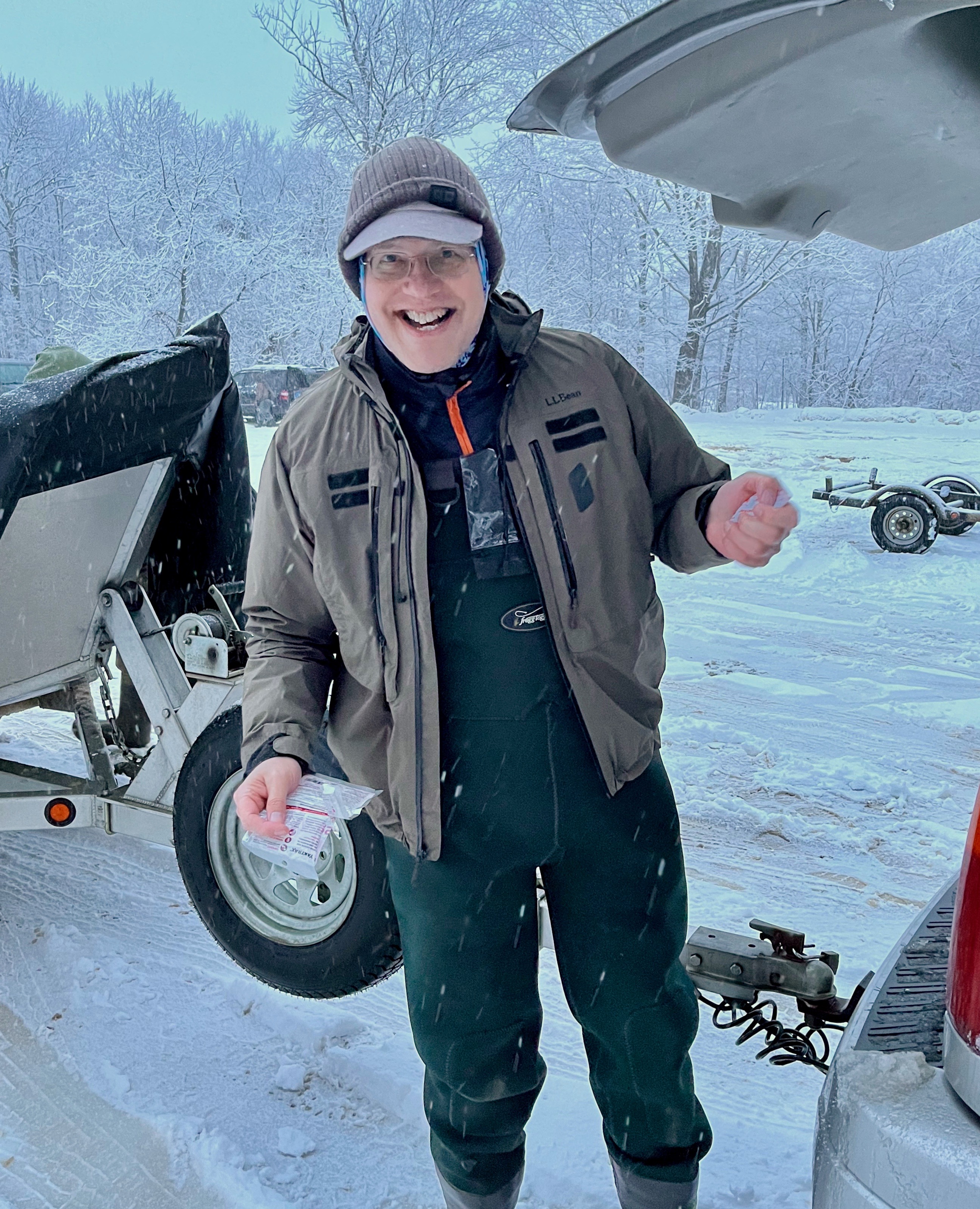
There is a Christian tenet that says, “This is the day that the Lord has made. Let us rejoice in it and be glad.” Whatever religion you follow (or don’t) it’s good advice, especially if you’re a can-do kind of angler. There’s nothing we could do about the weather, so better be prepared for it, and be ready to adapt to conditions. I must confess, however, that I was not this happy by the end of the day. Thus endeth the lesson. (Photo by Gordon Culton)Yes, that’s wet snow blowing sideways across my jacket. After blanking for most of the morning, I stuck this fish in a soft water seam several hundred yards below the Altmar bridge. In fact, I set the hook so hard that I fell over into Gordo’s lap. Poor Gordo! He hooked and dropped a fish in some faster water just above this mark, and that was his only touch of the day. But he stuck it out and never complained. About a half hour after I landed this hen, I also dropped a fish in the same place where Gordo had lost his. Like son, like father?Both of my hookups came on size 12 Blood Dot eggs. If you don’t know that pattern, you should. (Photo by James Kirtland)We were so miserably cold on Tuesday that we called it around 2pm. Given the slow action, it was decided that if there was any open water in the LFZ on Wednesday AM before launch, I’d give it a few drifts. I don’t normally say exactly where I fish, but the mark opposite the boat launch is no secret, and it’s typically loaded with fish. As there was only one angler there, I waded in. Now, I’ve never fished this mark before, and it didn’t take me long to realize that I’d made a classic rookie mistake of wading too far into the river, too close to where I should drift. Once I adjusted my position, I started hooking up along the soft water edge. The problem was, the fish weren’t eating. I fouled four fish here, one in the tail (“Northbound train hooked on the southern end,” cracked Jim) and one on the dorsal. I didn’t see the third, and the fourth left me a souvenir of a scale. I really don’t like fouling fish — others where having the same experience — and I wanted to get Gordo fishing, so we buttoned up and began our float. (A fond note to Tom who was fishing above me, and was courteous and friendly and matey, and a boo-hiss to the churls below me who waded right where I was drifting, then couldn’t be bothered to move when anyone who hooked up above them had a fish roar down to their position. This is the dark side of crowded water, and it remains astonishing how rude some people can be.) (Photo by James Kirtland)Gordo had another rough day. He drifted an egg bag over a run with no love. Then I stepped up to bat and hooked up on my first cast with a Copperhead Stone. I stuck the fish good (I was really happy with my hookset speed, power, and direction on this trip) but it came off. A couple hours later, skippy here put a smile on my face in a fast-moving shallow glide/riffle. And that was it. Two-for-four for me on the trip, which isn’t a bad batting average, but I’d sure liked to have had more opportunities. I shouldn’t complain — Gordo executed dozens and dozens of quality drifts and had nothing to show for it. I’m proud of him for his perseverance.





 currentseams.com