2023 is spread out before us, an immense blank canvas upon which we may paint glorious fishing pictures. Yeah, OK, there will be some blanks and some crappy conditions and days where it just doesn’t go our way. Whatever. It all beats the crap out of sitting at a desk.
To start: don’t forget to get a 2023 Connecticut license. (I only mention this because someone who looks a lot like me did.)
There are some new inland sport fishing regs for CT, too. You can get all the fishing regs from the CT DEEP website, but the one that is most meaningful to all of us is that there is now no closed season for fishing on all lakes, ponds, rivers, and streams. That means if you want to fish for trout on an off-the-books thin blue line in March, have at it. A great change and a long time coming.
For the second consecutive year, our #1 slot goes to steelhead. Normally, my August trip out west would have been the runaway winner, but what I experienced over the course of two days in December in Ohio and Pennsylvania was nothing short of extraordinary. Let me tell you about it…
Saturday, December 17: Conneaut Creek, OH. This trip was years in the making. I’d originally booked a trip to Steelhead Alley with guide Bob Packey (you can find Bob at Solitude Steelhead Guide Service LLC) for a fall trip, but we got flooded out. We rescheduled for last spring, but when the date all the fish had returned to the lake. That left us with a long wait for mid-December 2022. But oh, my goodness, what a worthy wait.
My plan was to drive out to Wooster, OH, on Friday the 16th to pick up #2 Son Cam from college. What should have been a nine-hour drive turned into well over ten, thanks to a snow squall in the Poconos. By the time we had dinner and reached our lodging in PA, it was pushing 11pm.
Conneaut Creek reminded me of the Sandy Creeks north of NY’s Salmon River. A medium-sized creek, shale bottom, water with a peculiar greenish-brown tint, and fish that hold in its deeper pockets and runs. Cam, who could hardly be called a fly fisher — his only serious big river foray in the last decade was this summer in CO — was into three steelhead before I even had my rod set up. Such is the teaching acumen of Mr. Packey, who knew the water by rote and had Cam casting and presenting functionally in minutes. I was using Bob’s leader system with one of my yellow yarn indicators, which was a good choice for me since I had great difficulty seeing Cam’s indicator. (I learned and relearned many lessons on this trip, and the first was: always fish the way you are most comfortable/have the most confidence in.) I dropped my first hookup, but before long I was putting my first Erie trib fish in the hoop.
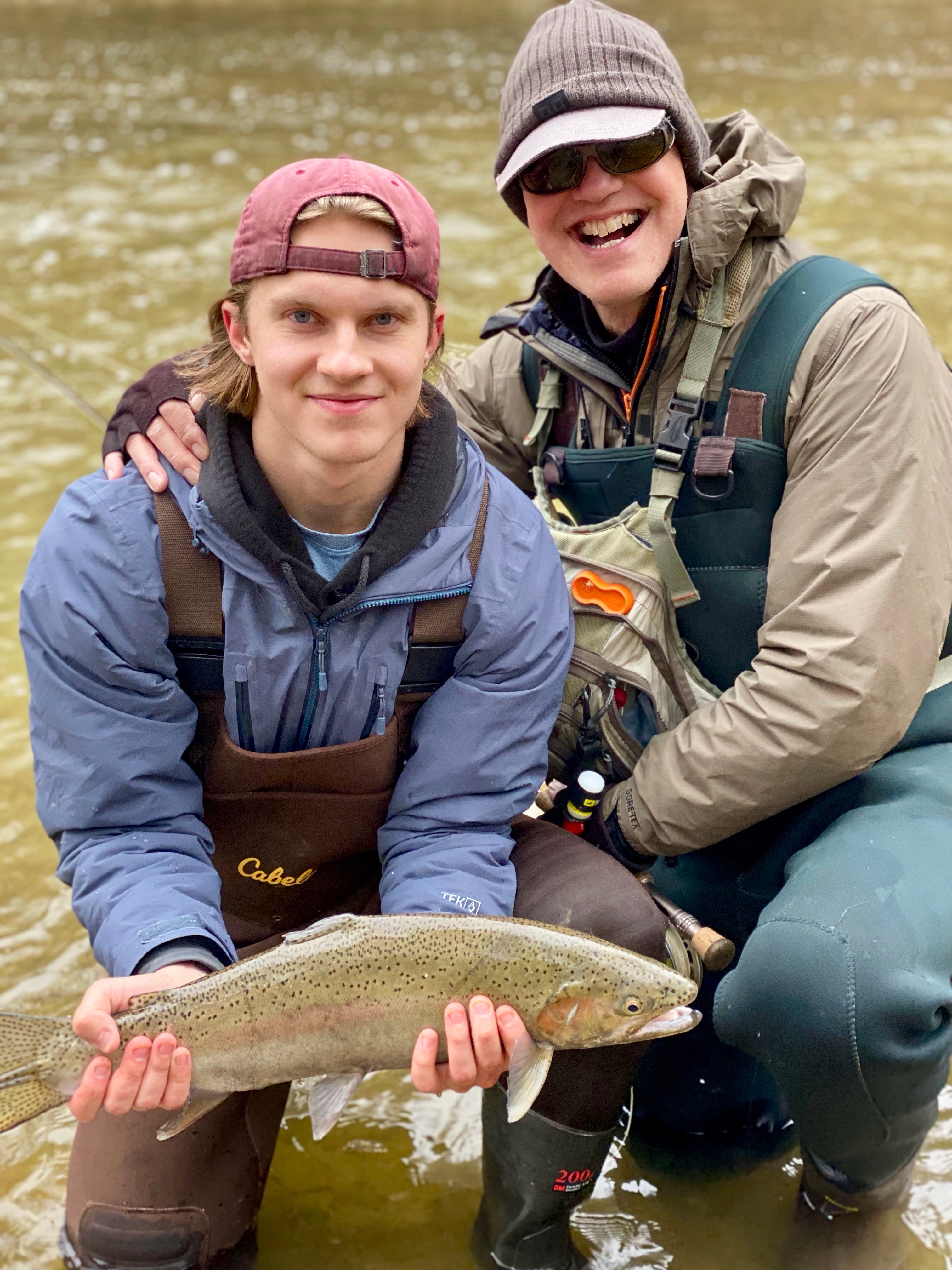
Giving my first Erie Mykiss a kiss. If this had been my only fish of the day — or, let’s get greedy and say the first of five — I would have left the creek a happy man. Little did I know the magnificent bounty that awaited us in the next pool. (Unless otherwise credited, all photos by Bob Packey.)We hiked/waded upstream several hundred yards to the next mark, a deep slot in the tailout of a faster moving pool. I’ve included this photo to show you the incredible shale walls that surround many of the Erie tribs. We were literally fishing from the ledges upon which you see each of my boots — backs to the wall — it’s only a few feet of wiggle room, and if you make a wrong step you’re into deep, 34 degree water. This mark was phenomenal; we had to alternate casts/presentations, and for the first several it was a hookup on every cast. After that, we took turns, the rule being you presented until you hooked up. We’d been using egg patterns — Bob’s favorite is the Blood Dot with an egg body and apricot supreme dot. I switched over to some of my bugs, and hooked up on a 60 Second Redhead and a Copperhead Stone. You can use two flies in both PA and OH, and that was the setup we fished with over both days.The third mark was an intriguing maze of ledges and submerged formations that created several fish-holding slots. I remember Bob suggesting we prospect in a mysterious looking pocket not far from our feet. Gold — or should I say chrome — was struck after a few casts. We fished a bit, ate some lunch, then went back at it. I’m good for at least one act of stupidity per trip, and on today it was a missed hook set that went straight over head and sent my leader cascading into the unreachable upper branches of a tree. While Bob was building a new leader for me, Cam hooked and landed this beauty with me handling net duties. We ended the day far downstream casting to a pod of steelhead that suddenly had lockjaw. My best guess was the cold front that was pushing through; the mercury had dropped, the wind had picked up, and it was a classic case of game over. My final tally for Saturday: 14 steelhead. After countless hours of disappointing fishing in near-freezing water and sub-freezing air in rivers and creeks long ago and far away, I had to ask myself: Was it all a dream? I fell asleep that night certain that it was not.
Now, before I continue, the reader must understand that it took me 40 hours of fishing time to land my first steelhead. It then took me over a decade to land 99 more. This will make what I am about to tell you seem positively magical.
Sunday, December 18, Elk Creek, PA. Bob had warned us that the water in Elk Creek was painfully low and clear. This would would make sight fishing easy; the tradeoff would be that the fish might be uber spooky, and their instinct for self-preservation could overpower any primal urge to strike. The weather had turned decidedly colder; air temperature in the 20s, buffeting wind gusts, lake effect snow squalls. We spent the entire day picking ice out of our guides.
The section of Elk Creek we fished is a hydrological wonderland. There are long sections that are literally only inches deep, and long glassy, glides that race over slippery, table-like pitches of shale. The bottom in other sections is a hodgepodge of skipping stones. Sprinkled throughout are small pockets only one or two feet deep; virtually all of them hold fish. Then there are deeper pools, veritable steelhead hotels with room for a hundred or more. Add in the clarity of the water and it’s an aquarium effect on steroids.
It was in the midst of this steelhead fantasyland that I decided to have one of my worst mornings, technique-wise, of my fly fishing career. Shoddy hook sets, late hook sets, hook sets in the wrong direction — it was embarrassing enough that I made Bob promise not to tell anyone. I wasn’t happy with my casting or my presentations, either. But sometimes you can do everything wrong and still land steelhead. Happily, it was that kind of day. I’m pleased to say that eventually, I got it together, and at one point it almost seemed like the steelhead were being delivered to my feet via conveyor belt. Figuring it all out put me in an even better mood, and I didn’t want to leave this paradise.
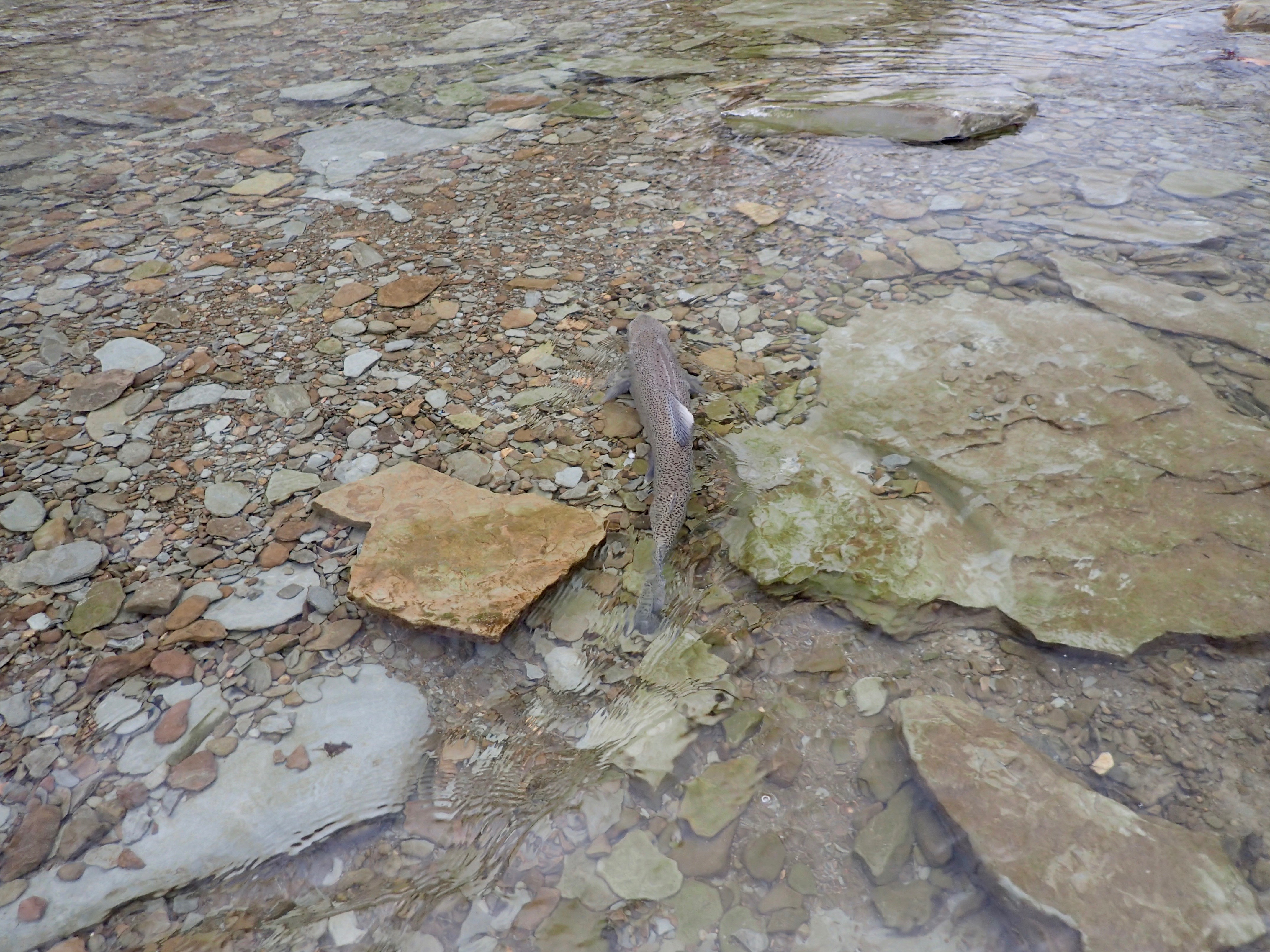
Holy aquarium, Batman! This just-released steelhead is 90% submerged, yet it looks like it’s high and dry on the rocks. The astonishing water clarity and cloud cover made for some exceptional sight fishing. I found this steelhead in a pocket the size of queen mattress. Nonetheless, you had to make a precision cast and presentation to get a hookup. At just over 33 degrees, the water had the fish firmly in winter lethargy mode. Thanks to Bob for letting me take this shot without revealing our location. Photo by Steve Culton.I mentioned a — ahem — less than stellar start. That improved during the morning, and by lunch time I was really dialed in. We were fishing a very slow moving, deep water pool that was loaded with steelhead. At Bob’s suggestion, I’d been using one of his tiny indicators, a mini-corkie in fluorescent yellow and orange. The takes were nearly imperceptible; the indicator didn’t go under. I didn’t even wobble or pause. It just slowed a tiny bit, a subtle enough deviation that you could only perceive it if you were simultaneously watching the tiny foam bubbles alongside it. In water this cold, a few fouls are unavoidable; I was delighted to see that these steelhead were indeed eating, as I hooked fish after fish, fly nestled firmly in the mouth every time.And that’s a wrap. Sunday’s score: Steve 21. Final tally: 35 landed over two days. Cam was also well into double digits. Well done, Bob Packey. Well done.
#4: Getting Published for the First Time in a Real Book, Surfcasting Around The Block II. Although I was late to it in terms of its bookshelf life, I’m a big fan of Dennis Zambrotta’s Surfcasting Around the Block. So you can imagine my delight when, a couple of years ago, Dennis asked if I wanted to write a couple of chapters for the followup. Like filmmaking, writing a book isn’t an instantaneous proposition. In fact, the journey from idea to manuscript to holding bound paper and glossy cover in your hands can be glacial. (Maybe these days that’s not such a good analogy. But I digress.) Published in the fall of 2022, Surfcasting Around the Block II is a must-read for any fan of this fishery. Modesty prevents me from listing my favorite chapters, but suffice to say there are many pearls within the entire book to be harvested by the keen student.
From the original book. (The text, not the fly.)
#3: A Striper That Could be Measured in Pounds Instead of Inches. It’s been a few years since I caught a striper on the fly this big, and man, I don’t have to tell you how good this one felt. After putting in my time at this general mark over several years, what a gas to finally connect with a good fish. And I did it on a fly with which I’ve never had any success, the RLS Sure Thing. So summon your best General Patton voice and shout along with me, “Ken Abrames, you magnificent bastard, I read your book!” Photo by striper master Toby Lapinski. Read more.
#2: Two Glorious Days in Cheesman Canyon. Good lord, what have I been missing all these years?!? I continue to kick myself for never having experienced fly fishing for trout out west before this year. The river was the South Platte; the beats, sections of Cheesman Canyon; the guide, Chris Steinbeck from Pat Dorsey’s Blue Quill Angler. I spent two days in a state of trout nirvana, one with my son Cam and the other solo. Maybe I simply hit it right. Maybe I was spot-on my game. But I know this for sure: an hour on this tailwater has the potential to beat the tar out of a week on the Farmington in terms of nymphing action and robust, belligerent, hefty wild trout. Wow! (It just occurred to me that I never finished my triptych. So I shall endeavor to give you the last part in early January.) Read the first two installments here, and here.
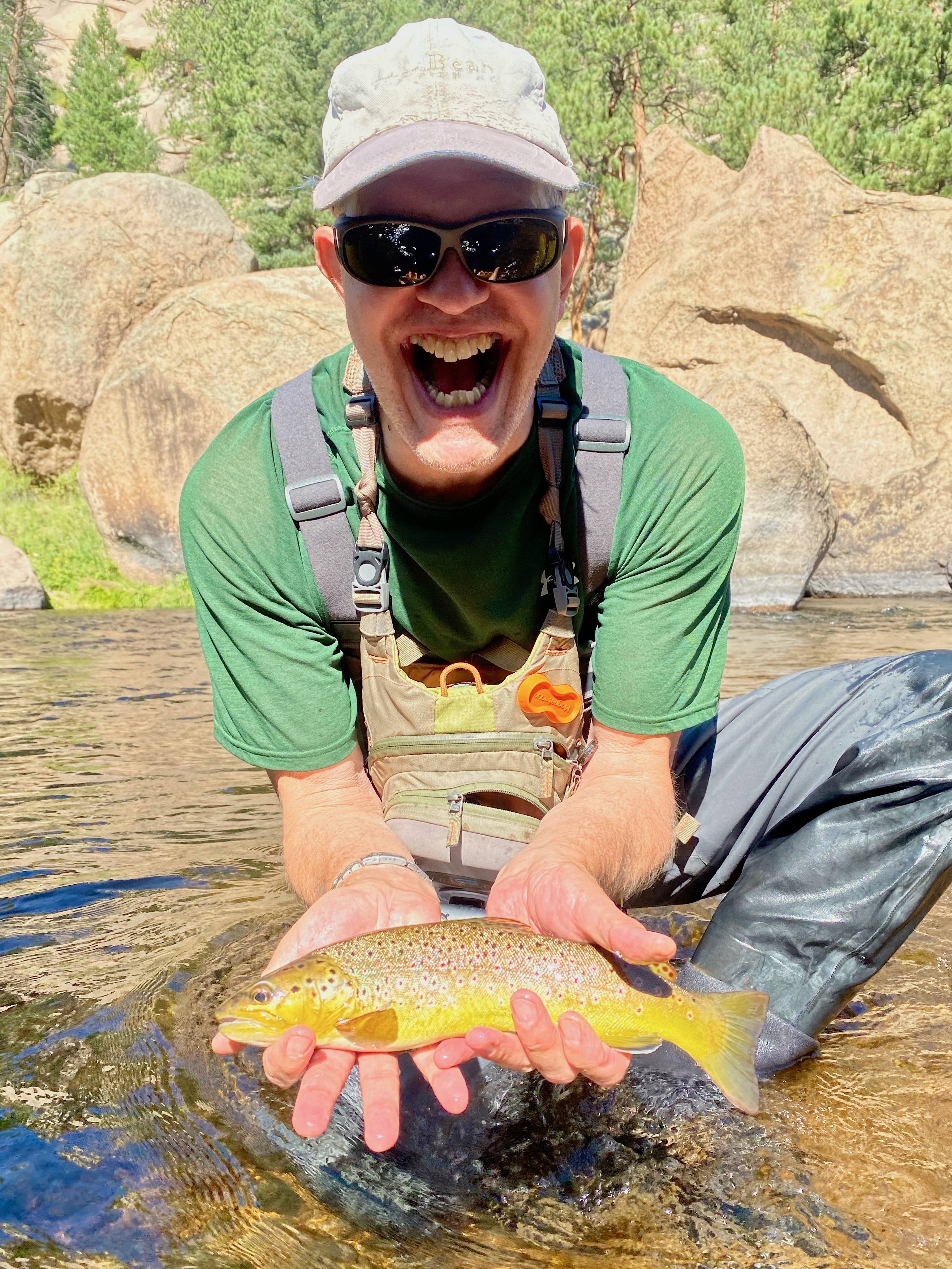
Ironically, my first fish of the trip was by far the smallest. Still, a powerful fighter.
#7: The Return of the Slot Bass. For me, 2021 was a bad year for bigger bass. Now, to be fair, I didn’t go balls-to-the-wall in my search for larger linesiders. But I did get out enough times to enough big bass marks to warrant at least a few courtesy slot fish. I don’t think I caught a striper over 28″ in 2021. 2022 was a different story. Again, I didn’t put in the time that I did 10 years ago, but I had enough slot fish (28″-35″) throughout the year to keep me happy. I won’t list them all, but here is one report; and here’s another.
#6: Tying, Teaching, and Presenting at my First International Fly Tying Symposium. When Chuck Furimsky called me in late August to ask me if I’d be a featured player at the IFT, I was totally stoked. I’d always wanted to do the show, but my annual father-son steelhead trip with Cam got in the way. This year, it was a different weekend, and I immediately said yes. Being a featured presenter/teacher/tyer is a lot of work, but I had way more fun than I could have imagined. As expected, it was a very well-run show, with lots of talented people, and I made many new friends. If you took my class or saw me present or stopped by to say hello, thank you again! Read more.
One of the two new presentations (the other is Beyond Cast & Strip: Presentation Flies for Striped Bass) that debuted at the 2022 IFTS. You can see both of them next month at the Fly Fishing Shows in Marlborough and Edison.
#5: Spectacular Late April Hendrickson Action. Now, don’t get me wrong. I love when the surface of the water is littered with Hendrickson duns and the trout are so gleefully snapping them up that you can see the whites of their mouths. But for me, the wet fly action is what I treasure about this hatch. There may be nothing visibly going on, yet there I am, pounding up trout after trout with my team of three. Or, the surface may be simmering; the dry fly anglers are presenting on the surface to no avail, and there I am, swinging wets, rod bent, with a “Sorry!” grin on my face. When you hit it just right, the Hendrickson hatch and a team of wet flies is pure magic. Read more.
Gather round, currentseamsers, as we kick off our traditional best-of-year-in-review! These are what I consider to be my most notable moments of 2022. Some of them are about fishing trips; others, my writing; maybe it’s an appearance I made or some kind of recognition. Whatever the reason, it’s a chance for me to take stock of the year and celebrate the good times. And we could all use some extra good times, yes? I’ve linked the original reports if you want to read more. So let’s make our first cast…
#10: The Summer Blizzard in August. This was a monumentally disappointing year for smallmouth bass. The numbers and size just weren’t there, and the drop has been so precipitous, I remain alarmed. But there were a few bright moments, and I can tell you this: the white fly population is in tremendous shape. White flies are a remarkable hatch, as it really doesn’t get going until you can no longer see your fly. But fishing under the hatch at dusk can mean the bass-o-matic, and once night falls, seeing your fly becomes irrelevant. Be advised: white flies will find every opening on your face, so keep your mouth closed. White flies taste really, really bad. Read more.
#9: The World Premier of the Film “Summer on the Farmington.” After many months of shooting and editing — these things take time (and we had a Covid spike that forced a postponement) — what a midwinter treat to gather at Brewery Legitimus in New Hartford to view director Matthew Vinick’s homage to the West Branch. I was delighted with my bits, and as a whole I thought Matthew did an excellent job covering the subject in an informative and entertaining way. Read more.
#8. Currentseams Makes “40 Best Fly Tying Blogs and Websites” List. Sometimes I wonder if all the work is worth it. Are people actually reading — and, most of all, enjoying — what I’m doing here? Certainly it’s a labor of love (I don’t get paid for any of this), and while I do occasionally get positive feedback from you, it’s nice to be recognized by an outside source. I’ll try to get even more quality fly tying stuff out for you in 2023. Read more.
Like me, you’re probably busy today. But let’s spend a minute together so I can tell you how much I appreciate your readership. Loyal followers like you are a wonderful gift. I’m looking forward to sharing more fly tying and fly fishing adventures and advice with you in 2023. Stay safe, be well, and I hope you have the happiest of holidays.
I fished the Salmon River in upstate NY on November 21-22 and I’m just writing about it today. Sloth? A little. Busy? Yessir. Late? Most definitely. So let’s get to it.
The drive up was a challenge; it was clear sailing from Connecticut until the Rome area, and then it was heavy lake-effect snow the rest of the way. (This was that system than buried Buffalo.) The roads weren’t plowed, and I passed numerous vehicles stranded in ditches. That’ll get you to slow down and pay attention.
Monday the 21st was a challenging day. We launched out of Altmar — I was floating with guide to the stars Row Jimmy — and although we found a pool with fish, the action wasn’t exactly red hot. We moved from one side of the pool to the other, and over the course of five hours we saw a dozen fish hooked, but only one landed. (I was responsible for three of the hookups and no landings.) Our best guess was that the takes were of a more subtle nature, and it didn’t help that I wasn’t on top of my game. None of the fish I touched were on for more than a few seconds; that tells me either a bad hook set or a very light take, or maybe both. Either way, you’ve got to be hard and fast and sure on your hook sets and I was certainly not.
James Kirtland is one of those guides who can tie knots quickly and efficiently and have you back in the water in no time flat. He’s also the kind of guide who will tell you when you’re doing something wrong, and offer suggestions to correct the issue. We all put our waders on one leg at a time, and I’m no different. Jim noticed that because I was using two hands to manage the line during the fly’s trip through the strike zone, I was losing precious micro-seconds on my hook sets. With one hand, excess slack eliminated, and the fly line gripped firmly against the cork, I could drill the hook point home with far greater efficiency. This is just one of the many things I’ve learned from Jim over the years, and it proved to be a difference maker on Tuesday.
We arrived at the Altmar boat launch Tuesday morning only to discover that I’d left my rod on top on my truck in Pineville. By the time we got back — whew, rod recovered! — we were late enough to not be able to get where we wanted to fish. That turned out to be a good thing, as Jim’s fellow guides reported the previous days’ pool was empty. (The river had come down to 500cfs from 750, and we figured the fish realized they had no depth of flow and skedaddled overnight.) So we set up shop in some fast water and spent the entire day in a few slots that took up no more than 50 yards of river. Right away we were into steelhead; I dropped the first, landed the second, and the third came off just as we were readying the net. But I was right on my hook sets, and it felt good even though the batting average was below .500.
Here’s the slick run we hit first. I’m always amazed at how many steelhead can fit into one little slot.We moved downstream and systematically carpet bombed a swift, churning run. After a morning egg bite, the steelhead got into my collection of small stoneflies: 60 Second Redheads, 60 Second Copperheads, and Copperhead Stones. I hooked 4 fish from late morning to early afternoon; this was the only one I landed. One came off right away. The second was a double-digit pound chrome beast that made a beeline for the Lake; I was into my backing so fast that I had no choice but to try and crank the handle. Doink! Broken off. It’s hard to get upset about episodes like that; when you’re in a boat, you can either lift anchor and follow the fish, or stay put and take your chances. You can’t undo the first option, so you accept a possible poor outcome and move on. The third one I dropped surprised me; I nailed him with my hook set, battled him hard and well, and then for no apparent reason, ploink! Sigh. Still, after Monday’s disappointment, two in the hoop felt like a bounty.
Ray Bondorew calls for light yellow bucktail in his Yellow Rebel pattern. I’m sure light yellow bucktail exists, but I can’t ever recall seeing one at a shop or show. What’s an intrepid fly tier to do? Let the sun shine in! Here’s a yellow bucktail, color side out, taped to a south facing window in my house. It’s done when you like the degree of the bleaching. To quote Bob Dylan, “I never did engage in this kind of thing before,” but bucktail master Brad Buzzi confirmed with me at the International Fly Tying Symposium that it does work. Now all I gotta do is wait…
We’ll continue with the Traveling Wilbury member theme and say, “The waiting is the hardest part.”
I’m pleased to say that Currentseams was just named to FeedSpot’s 40 Best Fly Tying Blogs and Websites list. We came in at a cool #11! The company is good, with sites like AvidMax, Fly Tyer, Tactical Fly Fisher, and Orvis in the mix. If you have some free time over the holiday break, I highly recommend you peruse the list. It includes both vendors and information-based sites. Woo-hoo!
Once again the ASMFC can’t get out of its own way. Their latest hijinks involves allowing states to transfer unused commercial quotas — in other words, killing more striped bass. Sounds like a terrific way to conserve the stocks, yes?
You can get a more in-depth look at this madness on the American Saltwater Guides Association website. Or, here’s a brief synopsis from our friend George Baldwin from his Facebook page: “The receiving state that this mostly refers to is Delaware, who believes they have gotten shorthanded when the quotas were last assigned. The states that haven’t filled their quotas were unable to find enough striped bass to do so. This, in addition to the fact that we’re trying to rebuild striped bass populations by 2029, does not indicate a healthy enough striped bass population. Doing anything that has a good chance of increasing striper harvest while we’re trying to rebuild diminished stocks that were determined to have been overfished does not seem like a great idea. Especially after poor spawning success in the past few years. We’ve got to lower the mortality rates that got us into this position, not raise them.”
Here’s where you come in. The ASMFC is taking public comments on this proposal. It takes about five minutes and the stripers really need your help. Again, this comes from George Baldwin (thank you, George, for being such a strong advocate for striped bass!):
You can help by writing a short letter or email to ASMFC stating your name and state of residency, that you are a recreational fisherman, and that you prefer the commission adopt Option A for Striped Bass Draft Addendum 1, which is to keep the status quo (no commercial quota transfers).
Public comment will be accepted until 11:59 PM (EST) on January 13, 2023 and should be sent to Emilie Franke, FMP Coordinator, at 1050 N. Highland St., Suite 200 A-N, Arlington, Virginia 22201; or at comments@asmfc.org (Subject line: Striped Bass Draft Addendum I).
Your letter doesn’t have to be anything elaborate. It can be as simple as something like the following (feel free to use this as a template for your own email):
To the Striped Bass Management Board, To: comments@asmfc.orgSubject: Striped Bass Draft Addendum I
I am a recreational angler from the state of <INSERT STATE HERE>. I’m writing to express my preference for the options being proposed in Draft Addendum I to the Striped Bass Fishery Management Plan. I prefer option A – status quo, no commercial transfers. Any of the other options are likely to increase mortality at a time when the stock is rebuilding. Thank you.
Sincerely,
<INSERT NAME>
<your email address>
There is great power in conservation, preservation, and proper catch-and-release. Please go send that email!










 currentseams.com