Kicking off the 2017/18 presentation season (and other items of interest)

It’s been a weird weather summer (we’ll take it over last year!) but I hope you got your licks in as much as I did. Housy smallmouth, some striped bass on the Cape and Block, and a ton of night fishing for big browns kept my boots wet and my body clock shattered.

I’m excited about the fall trout season, not to mention stripers and of course steelhead. Hard to believe that my presentation schedule begins next week.

“The Little Things” at SE Mass Trout Unlimited, Middleborough, MA, Tuesday, September 12 at 7pm. This is the original The Little Things presentation. The meeting is open to the public. For more information, visit the SEMASS Trout Unlimited website.

“The Little Things” (with a touch of Farmington River info) at The Fly Casters, Boston, MA, Thursday, October 12. The Fly Casters are a private club, but if you know a member you can wrangle an invite as a guest.

“Trout Fishing for Striped Bass” at the Cape Cod Fly Rodders, Thursday, October 19, Hearth and Kettle, Rt 28, Yarmouth, MA, 6:30pm. It’s a brand new presentation! I’m still putting it together, but the more I work on it, the more excited I’m getting about sharing it. Come learn how to apply trout and salmon fly fishing tactics to striped bass fishing — and start catching the stripers that everyone can’t catch.

Arts of the Angler Show, Saturday/Sunday November 4/5, at Ethan Allen Inn, Danbury, CT. I’m hoping to present at least one of the days. Sadly, fly tying looks like it’s not going to be possible. Details to come once we figure them out. For more information, visit the cffcm website.

The Fly Fishing Show, January 2018. No specifics yet, but I am hoping to present again in Marlborough, MA, and to add Edison, NJ to the schedule.

Articles: Look for Streamer Kings in the Jan/Feb 2018 issue of American Angler. I interviewed George Daniel, Chad Johnson, and Tommy Lynch for this piece, and the result is a treasure trove of information on streamer fishing for big browns. Of course, there are several other articles in the wordsmithing pipeline. I’ll let you know about them as they near publication.

Guiding: Weekends this fall are going to be non-starters, so if you want to hit the Farmington with me, pick a weekday. The river fishes well year-round.

Thank you to everyone who has taken the time to say hello on the water, and of course thank you for reading and following currentseams.

Coming to a fishing club near you this fall.

TroutFishingStripers


The best way to fish an intermediate line?

This question was recently asked on one of the striped bass forums. Here’s my answer:

  1. Take the intermediate line off your reel, wind it back on its spool, and return it to its box.
  2. Put a floating line on your reel.
  3. Never look back.

🙂

Stripers don’t care which line you use. But a floating line places you in charge of the presentation, so you can bring your fly to the fish. Not vice versa.

Block Island All-Nighter first keeper

Rare find for flatwing fans: R.L.S. Extra Long Saddle Hackles available

A selection of Ken Abrames R.L.S. Extra Long Saddle Hackles was recently put up for sale online. These are the genuine item — “New Old Stock” as we’d call them in the vacuum tube world — as originally sold by the creator of the modern flatwing. The saddles are in their original packaging and are in excellent condition. Many are unused; some are missing only a few feathers, leaving you hundreds of hackles to work with.

I want to make this very clear: I am not selling these, nor do I have an interest other than helping the seller offer these to people who may be passionate about tying and fishing flatwings. 

The saddles are priced from $45-$50 depending on color, which I believe is a very fair price (shipping cost varies). Available colors include — this is current to my best knowledge but of course will change as he sells these off — Claret, Off White, Off White Variant, Natural Black, Umber Brown, Ginger Olive, Olive (seller’s comment: “The same name on pkg but looks more like Emerald Green to me.”) and Eggplant Harlequin.

If you’re interested, please email georgejjohnson@gmail.com.

This was the original lot. Many of the colors shown are gone; jump on the remaining ones while you can.

RLSsaddles


Farmington River Report 8/29/17: Slow and getting low

I guided Ed today, and we were faced with a river that hasn’t been this low in months. Fear not, there’s still plenty of water (190 cfs in the permanent TMA) and plenty of trout, although the latter were a bit bashful today.

We worked on Ed’s nymphing and wet fly presentations which were pretty darn good already, a testament to the slowness of the day. Spot A was below the PTMA — there were a few bugs coming off, but the only trout we played with was a camera-shy rainbow that came on a nymph.

Ed presenting his wet fly wares.

OLYMPUS DIGITAL CAMERA

Off to Spot B within the PTMA. Same story — a few bugs coming off and a few random slasher/risers, but nothing consistent. We covered that pool subsurface top (wets) and bottom (nymphing, both indicator and short-line) to no avail, until the 11th hour.

Keep on keeping on, Ed, and the rewards will be measured in pounds, not inches.

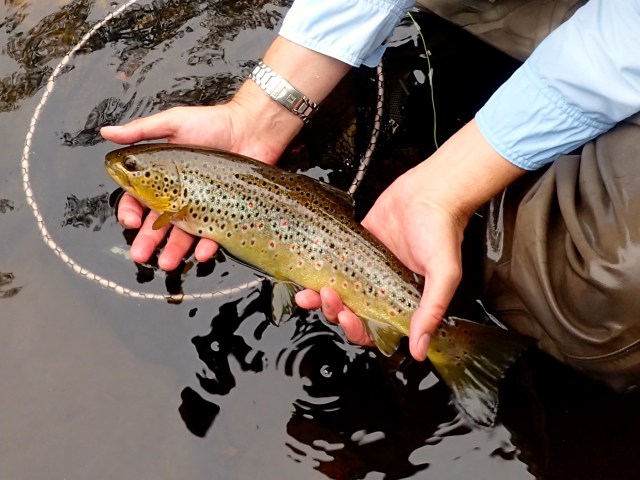
Last cast, we managed this vividly-colored 16″ wild brown with paddle fins and dramatic spotting. Taken on a 2x short size 14 Frenchie variant. A good way to end a slow day.

OLYMPUS DIGITAL CAMERA

Banging around the Cape in the dark

At dinner at the Chatham Squire Friday night, Gordo asked me, “Are you going fishing tonight, dad?” My stock reply for such questions is: “Have we met?”

I spent 90 minutes fishing a mark on Pleasant Bay toward the bottom of the tide. Not a breath of wind. The current was good and my drifts were true, but it was one of those nights where the bass were elsewhere. I cycled through some basic patterns, and the only bump came on a black deer hair head fly about 5″ long. I did see a shooting star, and that helped take my mind off the fact that I was standing in the water in the dark near white shark central. I did note silversides on the wade out.

Saturday I headed to Steve’s Secret Spot (I’ve seen one other angler there in 10 years). It’s a nondescript mid-Cape creek mouth that is either on or off. Tonight it was infested with silversides and a few striped brigands. But unfortunately, it’s an outgoing tide spot only, a fact drilled home to me while I waited almost an hour for the tide to go from slack to incoming to find that the silversides were still there but the bass had skedaddled. I had had only a half hour of outgoing, and could manage only one bump.

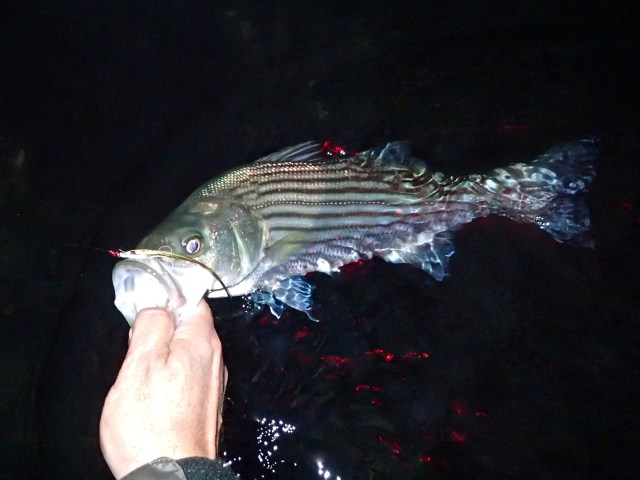
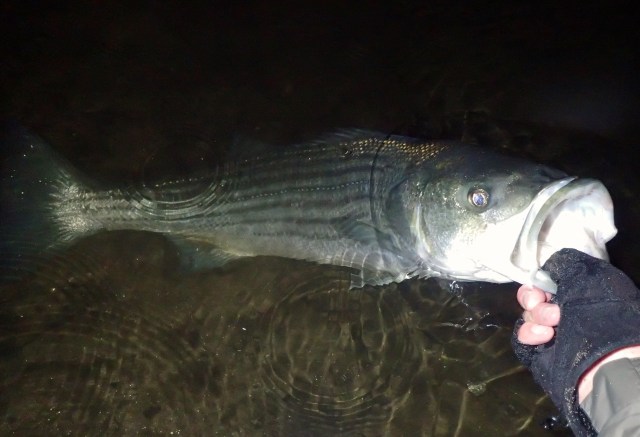
So I hightailed it back to Friday’s spot and gave myself 15 minutes to catch a bass. Midnight, second-to-last-cast, bump on the swing, then bang on the dangle. Our Blessed Lady of the Ray’s Fly Flatwing comes through again.

Four-oh. A perfect fish at a perfect time on a perfect fly. 

OLYMPUS DIGITAL CAMERA


Housy smallmouth mini-report (late)

I fished the Housy the other night from 6pm-8:30pm. Virgin waters for me, below the TMA: some pocket water that dumped into a long boulders-on-the-bottom run, shoulder deep in the middle ringed with frog water. Action: underwhelming. Hatches: underwhelming (mostly tan and black caddis). So it goes, but I did catch fish and I had the place all to myself.

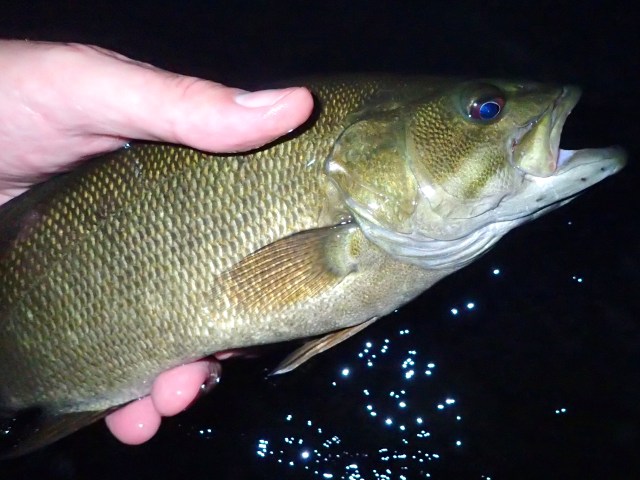
I took the usual assortment of late afternoon dinks. Pre-hatch swung wets produced very little interest (not surprising given the weak evening rise) and all the action came on the Black Magic top dropper. The smallmouth bite window was torturously brief: 8:00pm-8:15pm, then shutdown. I had switched over to a grey and chartreuse Gurgler, and my best fish of the evening came on that fly. Toward dark I did get the largest bluegill I’ve ever landed, but that’s really not why I was there.

Nearly a foot long, this dude whacked the Gurgler upon landing, then hunted it down about ten feet across a current seam. Almost put a burn in my rod hand forearm.

OLYMPUS DIGITAL CAMERA


Ken Abrames 1994 Striper Fly Tying Presentation Video

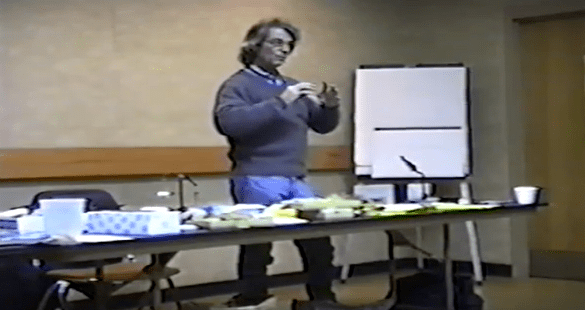
I discovered this gem just yesterday: archival footage of Ken Abrames making a presentation on striped bass fly tying to the Rhody Fly Rodders, circa 1994. Now you too can watch, listen, and learn from the grandmaster as he covers striped bass fly design, materials, color, and traditional tying methods. While I’ve had detailed conversations with Ken on all these topics, it’s still a special treat to be able to see him in action over 20 years ago.

Recorded long before the days of home HD, the video is perfectly watchable — certainly, its content far outweighs any video washout or digital artifacts. You can find it on YouTube in three parts; here’s the link to part one.

What happens when you mix water and bucktail (and other secrets of the art of tying the sparse fly) revealed.

KenAbramesLecture


Coming soon to a stream near you

Tied for a client, this neat little collection will drive smallmouth bass (and trout) out of their minds. We have the subtle (size 12 August White soft hackles), the traditional (size 12 Black Magics, tied as a 14-16), the horrible (size 4 TeQueelys), and the noisy (Gartside Gurglers, size 2 and 4).

OLYMPUS DIGITAL CAMERA


“To play him long is to play him wrong” redux

Glass houses, stones, and all that. So this week when I hooked into a 20+” Survivor Strain brown on the Farmington, I started the clock. 93 seconds — hand-stripped, no reel — from hook set to net. (And it was only that long because I had trouble fitting him into the net first swipe.)

Unfortunately, I had camera disasters. I was using my main shooter for a different project earlier in the day and hadn’t changed the setting, so I ended up with out-of-focus mush. Then I attempted a GoPro movie of the release, only to discover that the battery was dead. So you’ll have to use your imagination: kype, clipped adipose, leopard spotting, brawny, and no match for an angler with a sharp hook and a reliable leader.

Mulling over a striper puzzle

I received this question this morning, and it’s a good one to share. It comes from an angler who is just starting out with a floating line for striped bass.

Q: Last night I fished the last 3 hours of outgoing with a friend. We fished a nice little rip with schoolies feeding. Same fly as my friend, about 20′ apart on my left.  (A spin guy on my right). My friend caught 2 with the same fly as me. Spin guy struck out. My friend has an intermediate sink  line, me and my floating. So I’m thinking is my line doing something completely different or independent from what my leader is doing down below?  It was a can’t miss scenario, they were feeding for about 45 minutes. I’m thinking the line up top is doing one thing, and the leader (about 9′, 20#, 15# tapered) is doing something different in the rip below.   

These were my thoughts:

Ok, let’s break this down unemotionally. Fish actively feeding for 45 minutes, yet in this “can’t miss” scenario, two out of three anglers did, and one of you managed the massive amount of…. two fish. It would be significant if the spin guy caught 20 and your friend caught 20 and you caught nothing. But you’ve got one angler catching all the fish, all being relatively few. None of you did particularly well for can’t miss.

It’s difficult to armchair quarterback a situation when I wasn’t there. But one thought is that your friend had the best angle of presentation. That happens all the time in fishing, from trout to steelhead to stripers. Or, he was simply lucky. (That also happens.) Or, he chanced upon two of the village idiots. Let me explain that last one.

I don’t know how both of you were presenting your flies, but you describe a rip. That means current.  I can tell you what his intermediate line was doing the moment it hit that current. It was starting to drag. His line formed a large “C” shape and his flies followed that path at a high speed, even faster if he was stripping. So he caught two fish that were willing to chase. If you had a floating line, and you weren’t mending, your line was doing the same. Given identical flies, both flies were in the same relative position in the water column. If you were mending, your fly was moving slower, and depending on its weight and the speed of the current, probably higher in the water column.

The concept of line and leader behaving differently is a core principal of line management. When nymping at a distance, a trout angler may have his line flat on the surface — that is, when it’s not airborne because he/she is throwing a series of upstream mends during the presentation — while the leader is at a right angle to the surface with the flies bouncing along the bottom. Line and leader are doing very different things. In a greased line swing, the line is being moved in an upstream arc in a series of mends, while the leader and fly remain perpendicular to the current as they move downstream and toward the angler’s side of the river. Line and leader doing very different things. It’s called line control. Presentation. And it’s the difference between fly fishing and treating your fly rod like a glorified spinning rod.

You weren’t not catching fish because you were using a floating line. None of of you did well because you weren’t presenting a fly or lure that matched what the fish were feeding on in the manner they were feeding.

What’s the bait? How are the bass eating it? What flies do I have that match that bait, and how can I deliver that fly to make it easy for the bass to eat? Answer those questions correctly, and you’re on your way to catching the fish that not everyone can catch.

OLYMPUS DIGITAL CAMERA