
Front cork: 60 Second Redheads and 60 Second Copperheads.
Rear left cork: Copperhead Stones and BHSHPTs
Rear right cork: North Country Steelhead Spiders (purple and black), Spider (originated by Clyde Murray) variant
Mindset: Fresh chrome. Uncorked.
Front cork: 60 Second Redheads and 60 Second Copperheads.
Rear left cork: Copperhead Stones and BHSHPTs
Rear right cork: North Country Steelhead Spiders (purple and black), Spider (originated by Clyde Murray) variant
Mindset: Fresh chrome. Uncorked.
I’m not sure this really needs a how-to video, but the 60 Second Redhead is such an amazingly productive steelhead fly that I had to share it.
It’s the modern way with so many streamers. But today I am not interested in pushing water. I want to embrace it. Cherish it. Become one with its fluidity.
Here are two simple, elegant streamers, tied on articulated shanks with a trailing stinger hook. Their intent is seduction, not overt lateral line pandering. A tail of rabbit with some Krystal Flash. Soft, flowing marabou that caresses the currents and whispers, “I’m alive.” A little flash to augment the flavors, not overpower them. Intended for steelhead, but certainly appealing to trout. Cast. Swing. Dangle.
And hold on.
Steelhead Marabou Stinger

~
Steelhead Marabou Stinger 2

The Grapefruithead Leech is the creation of steelhead guide Kevin Feenstra out of Michigan. I first saw this pattern a couple years ago in John Nagy’s Steelhead Guide. I remember thinking it was a horrible fly. You know, over-the-top, unapologetic, in-your-face, clearly inspired by the egg-sucking leech. I was thumbing through the book this past fall, looking for some ideas, and there it was again. Over the next few weeks, I kept coming back to it. It was kind of like drinking a new bottle of wine that you’re not sure you like; as you’re trying to decide, you realize the bottle’s nearly empty. So I tied some up for my November 2013 trip. Wouldn’t you know, I caught my first steelhead on the swing on this horrible, beautiful, wonderful fly. Feenstra says he likes this pattern whenever there’s snow on the ground. I can tell you that steelhead also like it near dusk on a snowless day, dangling in the current near the tailout of a shallow run.
The Grapefruithead Leech

1) Drink wine
2) Save the cork
3) Tie flies for the next steelhead trip
4) Stick flies in cork as they roll off the production line
5) Catch steelhead
All kinds of eggs, egg masses, stoneflies, soft-hackles, leeches and a few odds and ends that defy description. Dinner, anyone?

God, I hope #5 happens.
Steve Culton
It’s easy to tie. It’s a fast tie. It catches steelhead. ‘Nuff said.
I found this fly a while back on Randy Jones’ Yankee Angler site and was intrigued by its simplicity. The fly got its name (Randy calls it “Tom’s 60 Second Red Head,” Tom being Tom Wilson) because you can supposedly crank them out at the rate of 60 per hour. I’m no speed tyer, but I can get pretty close to a minute on this one if I hustle. Part stone fly/nymph/larva buggy bug, part egg, the pattern certainly lends itself to all kinds of color variations.
The 60 Second Redhead

Hook: 2x strong scud/shrimp, sz 10-12
Thread: Red
Body: Black Krystal Dub
Head: Red Ice Dub
I tied up a bunch of these, and they sat in my box until one fine Saturday afternoon. On my very first cast with the 60 Second Redhead, I hooked a steelhead. That was years ago, and this fly is now a core pattern in my steelhead box.
Tying notes: The original recipe calls for medium red copper wire as the tying “thread.” This adds a tad more weight to the fly. I find the medium diameter difficult to work with, so I use small red copper wire when I’m not using thread. High-tack wax like Loon’s Swax ensures the dubbing sticks to the wire. The original also calls for a complex mixture of furs and flash: for the body, a mix of beaver, angora goat, and black flash. Since speed is in its name, I figured why not just be done with it and use black Krystal dub? Ditto the head, where the original calls for beaver, angora goat, and red flash. Buy a pack of red Ice Dub and you’re cooking with gas. Last year, I met Randy on the Salmon River at the Pineville Boat launch. We had a detailed conversation about the Red Head. I thanked him for introducing me to this fly, and told him it was now an old standby. Randy said to make sure not to tie it with a thick profile, but added if you’re catching fish on it, you’re doing something right. Wise words. What you see here is my standard issue tie.
Also, play around with other colors and materials. Here is the 60 Second Copperhead:
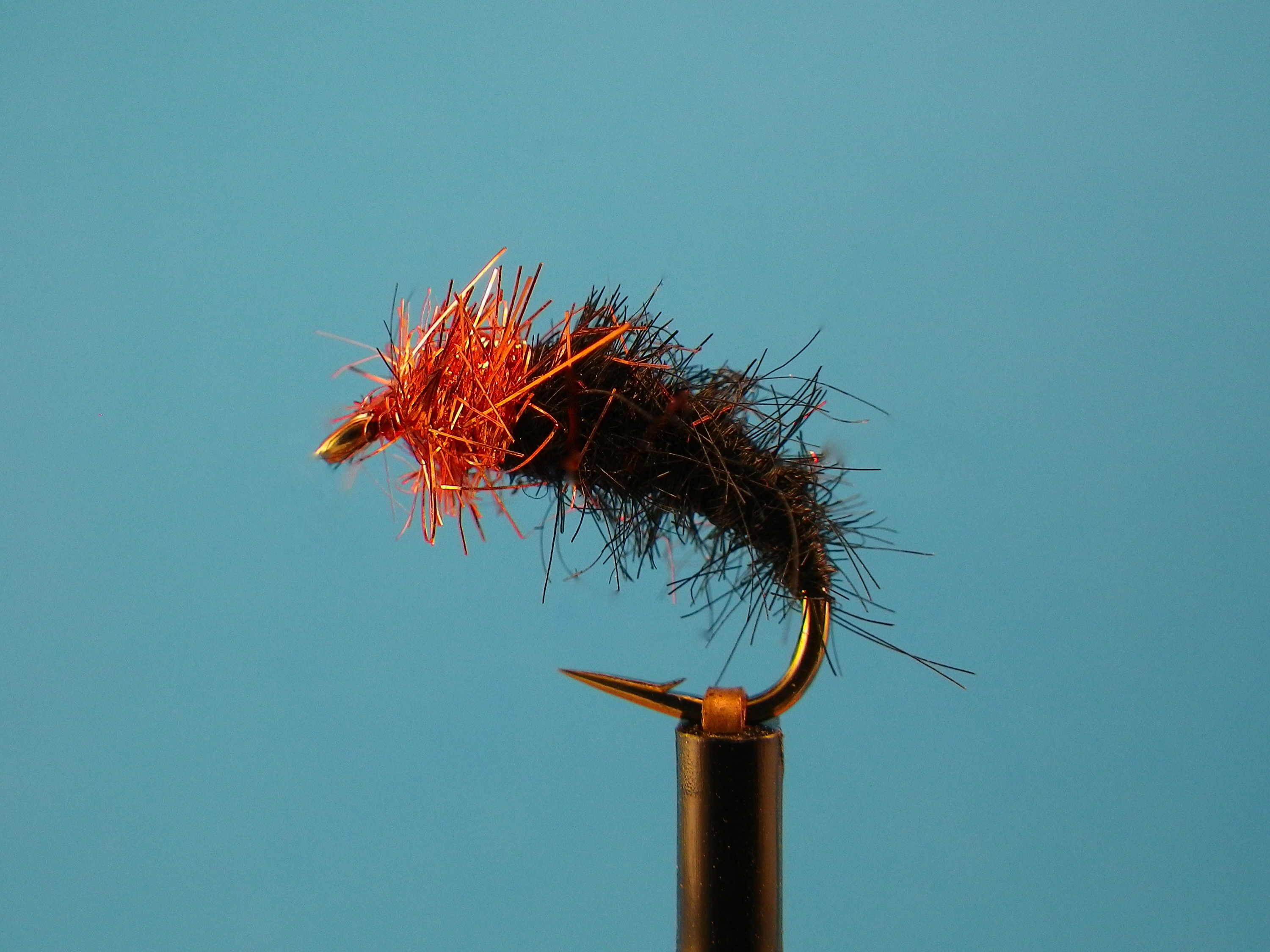
Hook: 2x strong scud/shrimp, sz 10-12
Thread: Red
Body: Black angora goat
Head: Metallic copper Ice Dub
~
60-Second Copperhead Rogues’ Gallery:
Chrome hen, Salmon River, 11/9/14


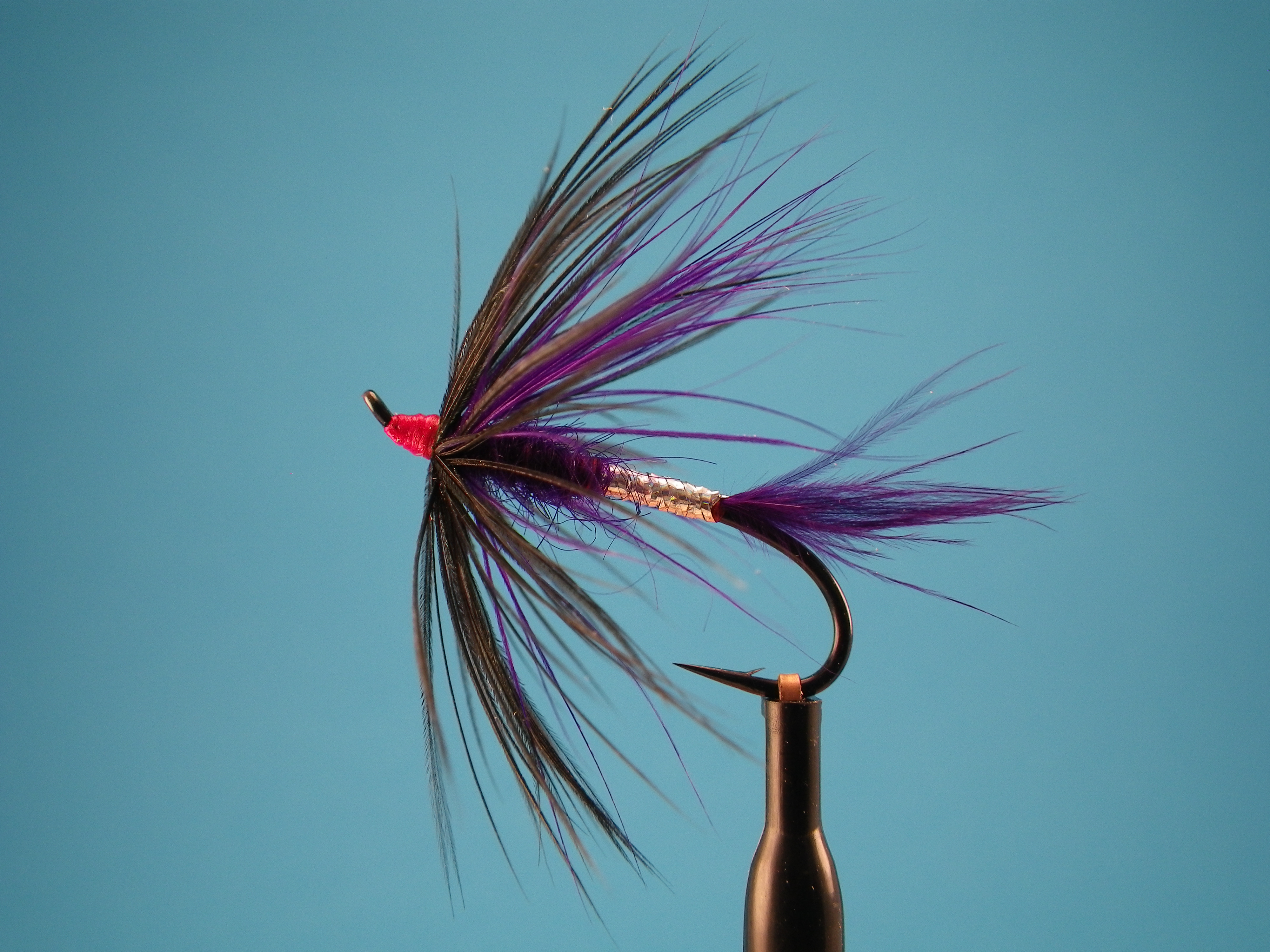

In The Soft-Hackled Fly, Sylvester Nemes writes about fishing for — and catching — steelhead on traditional soft-hackles like the Partridge and Orange. Here’s my steelhead take on four classic patterns, clockwise from upper right: Tups Indispensable, Snipe and Purple, Partridge and Green and Orange, and Grouse and Orange.
Small Steelhead Soft-Hackles

These are all tied on 2x stout, 1x short hooks. They’re a size 10, so effectively they’ll fish like a size 12. Construction should be fairly intuitive from looking at the photo. But, here are the complete recipes.
~
Two years ago, I hooked (and ultimately lost) what was easily the largest steelhead I’ve ever done battle with. He took in the deeper end of a swift run that becomes a shallow whitewater nightmare at its head. I saw him clearly during his cartwheeling histrionics, and he was massive. We finally parted ways when he found a submerged logjam my leader didn’t get along with.
The fly he took was the one at lower left.
~
Steelhead soft hackles Rogues’ Gallery:
Snipe and Purple, November 2016

If you’re the sort who likes things neatly categorized, you can divvy deer hair winged steelhead flies into two groups. The first would be the waking dries, shrimp flies like the Grease Liner and all manner of skating caddis. The second would be the subsurface streamers/wets like the Muddler Minnow or the Muddler Daddy. I took a decided path toward the latter with the Black Caddis.
The Black Caddis

Tying notes: Lagartun mini braid is easy to work with and comes in a range of spiffy colors. Like a Muddler Minnow, the Black Caddis has a head of clipped deer hair; the wing is an extension of those fibers. Because the fly is intended to be fished below the surface, I’ve kept the wing and head sparse. To form the head and wing, make a few taut wraps of thread to secure the wing, then, while wrapping the thread forward, bind down tightly on the hair (give it 3-4 good wraps). The wing should behave itself, while the hair for the head will flare outward. On your next thread wrap, carefully move the flared hairs up and toward the rear of the fly with your thumb and forefinger, while moving the thread under it and forward to the eye. Whip finish. Trim the hair to your liking.
You’re up before the sun. As you hike to the river, there’s a distinct chill in the air that tells you in another month the trail will be covered in snow. Once you get to your spot and wade in, you can feel the gripping cold of the water against your legs. Should have worn the neoprenes. Maybe not, though. It’s supposed to get up to the high 50s today. It’ll be warm enough later. But for now, damn, you’re just about shivering. You’ve already had your coffee, but you want something else. Something warm. And sweet. A cup of hot chocolate would do nicely. The kind your mom used to make after you came in from outside on a snow day. Hmm. Maybe the steelhead would like some, too. A little chocolate brown stone, just like the ones you saw hatching yesterday morning. A hot orange bead to get their attention. Soft hackles that say, “I’m alive.” And a buggy body because that’s what fish like. Once you get that first steelhead on, you’ll be downright toasty.
The Hot Chocolate Stone
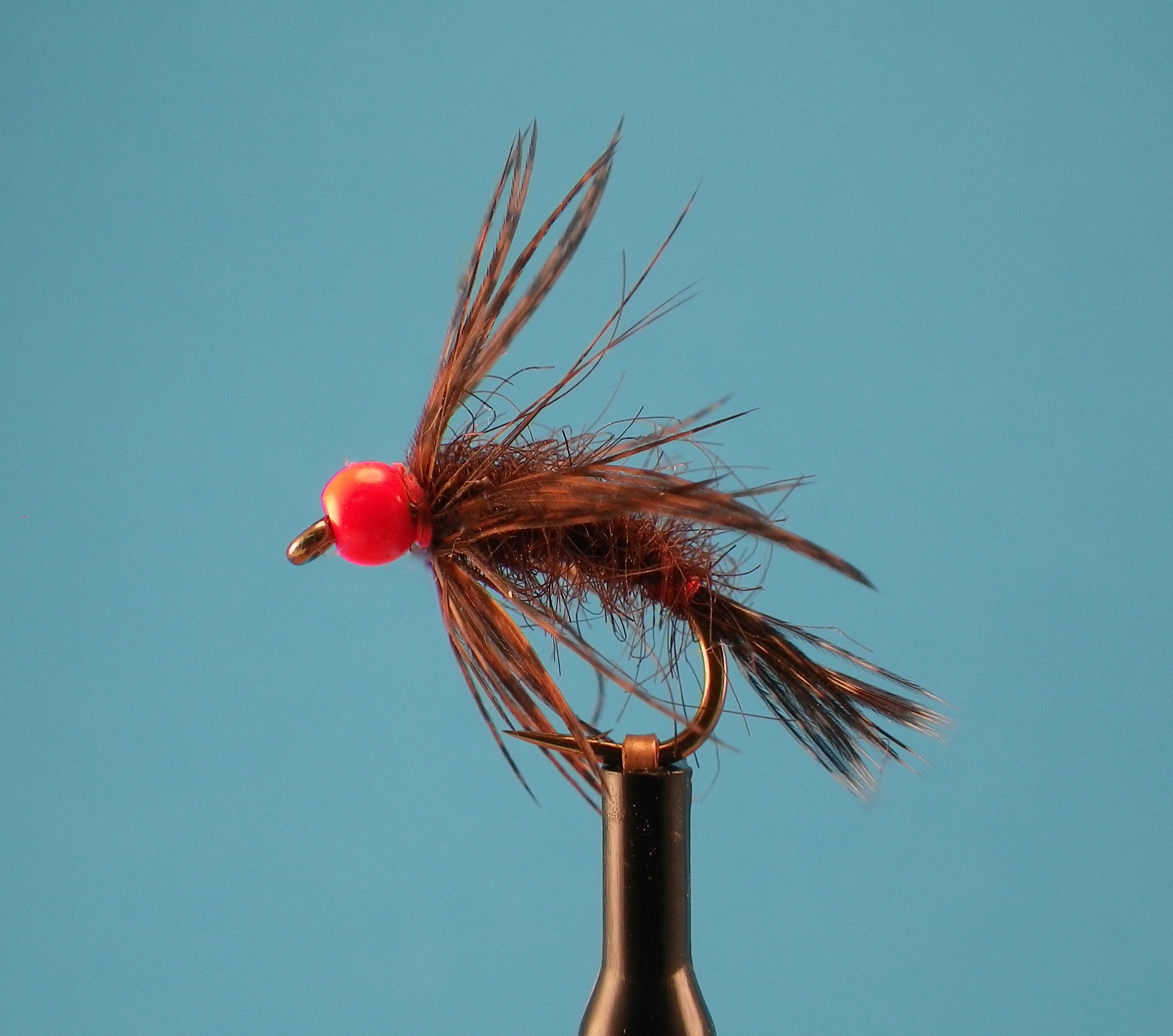
Hook: 2x strong, 1x short emerger, size 8-12
Thread: Hot Orange
Tail: Brown Coq de Leon
Body: Fiery brown angora goat, dubbed roughly
Hackle: Grouse
Bead: Hot Orange
Tying notes: This is a pretty straightforward tie. If you want to add a little more weight to the fly, you can seat the bead with about 8 wraps of undersized wire. Coq de Leon and grouse are beautifully barred materials that naturally create the illusion of segmentation. Angora goat is one of my favorite body materials; it’s spikey and rough, and you can get it in all kinds of colors from muted naturals to fluorescents. Use a dubbing loop to get than uber-buggy look. Play around with different bead colors at your discretion; the fish will always tell you if they have a preference.
~
The Hot Chocolate Stone Rogues’ Gallery:
Salmon River (NY) November 2012

 currentseams.com