Let’s give small stream wild fish a break

Right now is a good time to not go fishing for wild trout on small streams.

As you already know, most of the state is abnormally dry, and the northwest hills are officially in drought. Don’t let the recent rainfall kid you — our small streams are running at a CFS fraction of what they should be.

While nature finds a way, the stresses of summer heat and trickle flows no doubt took a toll. That alone would justify giving small streams a break. But right now is pre-spawn and spawn time. I ventured out yesterday and was stunned by the severity of the low water. The spawn is a stressful time for fish, exacerbated by the dire conditions of late summer. With so much of the stream bed exposed, wild fish will be challenged to find spawning gravel. I didn’t see any redds yesterday, and it may be that the fish are so stressed, and have so few gravel options, that on many small streams we won’t see a successful spawn this fall.

Learn how to identify a redd: typically oval in shape, small gravel, lighter in color than surrounding bottom. There may or may not be fish nearby. It goes without saying, never target fish on a redd!

You don’t have to be a fisheries biologist to reckon that if that is in fact the case, it does not bode well for future wild fish populations.

So here’s how you can help: for the time being, don’t fish small streams. Give the trout a break. Once we get back to normal flows, enjoy — but please be on the lookout for redds and spawning gravel (dime and pea-sized substrate). Most of all, stay out of the stream bed — no wading! — until late March. It’s good for fish. And good for everyone who loves fishing small streams.
Back in the Small Stream Groove

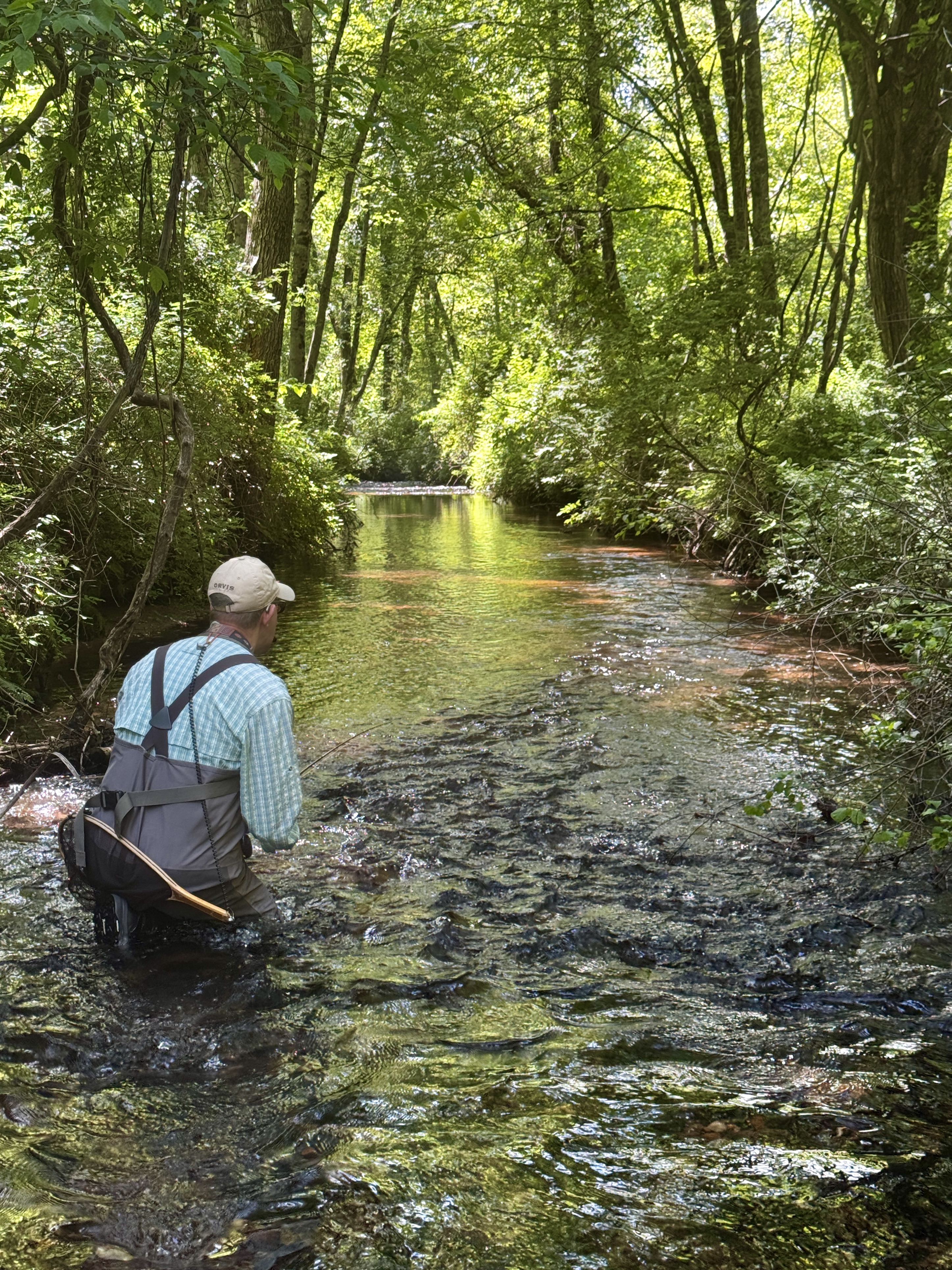
What a treat to be able to fish a small stream again. It’s hard to believe that this was my first fishing-for-fun-only outing of 2025. Surfcaster extraordinaire Toby Lapinski and I spent a few hours last week exploring a woodland gem. Although we fished mid-afternoon, dense canopy blocked the sunlight and the water was surprisingly cold. Water height was on the low side of medium. Although I fished a dry dropper system, the local char showed a clear preference for the dry. Toby fished a size 10 hopper, and they attacked it with wanton ferocity. We pricked a bunch, landed several, and left feeling happy.

I could get used to this. I really, really could. Toby Lapinski photo

Given the daylight and shallower water, I found it curious that the fish weren’t that interested in subsurface offerings. Besides the dry/dropper, I also fished the Squirmy Jiggy Thingy. I felt many nips and tugs, but those were clearly generated by smaller fish. (By the way, we saw/spooked dozens of fingerlings, which portends for a bright next year.) The moment of the day, however, was when we witnessed a 3-foot long northern water snake capture and kill an 8″ brook trout. I’d never seen anything like it. The snake took the fish out of the water, and clamped down on its “neck” to suffocate it. There’s a theory which states that on small streams, terrestrials become a huge part of the trout’s summer diet. Apparently, the tables are sometimes turned.

Small Stream Report 2/27/24: The kids are all right

I didn’t really have the time yesterday, but since my default setting is when in doubt, go fishing, I did. The venue was a small woodland stream, and the time frame was 3:45pm-5:30pm. It was mostly cloudy and very warm for February, with a water temp of 48 degrees. The stream was running medium-low and clear. No hatch activity, although I did see one lonesome sz 600 midge flitting about.

I’ve written before that I’m a massive creature of habit, but on this outing I decided to explore about 100 yards of new water. I was glad I did, as that turned out to be my most productive stretch. I fished mostly subsurface with the Squirmy Worm Jiggy Thingy, but I did get a hysterical swing and miss on a bushy dry for the 5 minutes I fished it. All told, I pricked about 18 and brought probably a third of them to hand. I did catch the same beautifully spotted hen I took in January at the same hole. She really clobbered the fly.

A few of my favorite things: a cigar, a glass rod, and a small stream, and if I can get them all at once that’s even better. What a glorious day to play hooky for a few hours and lose myself in a babbling brook.

Small Stream Report, or: I finally go fishing!

We all know the scientific certainty that all work and no play makes Jack a dull boy. But add a bout with Covid, a never-ending string of home improvement projects, change Jack’s name to Steve, and holy cow, the dullness is magnified when there’s no fishing in January.

So, I snuck out during the last few hours of the month to visit a small stream. It was chilly and overcast, but the water was a good medium height, running clear with an occasional bit of decaying vegetation detritus tumbling by, and a surprisingly warm 42 degrees. Here are some details.

I pricked four and landed three, all on a swung/dangled/stripped Squirmy Worm jig. They had no interest in the dry nor tiny nymph dropper.

I interested, but did not hook, two behemoths (for this size stream) in separate locations. Both fish came out from their holes to inspect the fly, follow it, and then ultimately reject it. In both cases, I tied on, then offered, a larger micro Woolly Bugger in black, but neither fish reappeared. Round 1 to them. (Be advised, fishies, that I know where you live.)

Most of the fish came in water moving at a moderate pace, and all of those locations offered both depth and some form of cover, be it logjams, cutbacks, boulders, etc. Another smaller guy repeatedly whacked the fly as it dangled near his hideout beneath a cutbank.

The last fish was a spawned out female, 8″-9″. Please take care not to wade in gravel beds until mid spring s that the next generation can get a healthy start.

On the board for 2024, and my first fish was a beauty. Please consider taking the Wild Trout One Photo Challenge. It’s better for the fish, the resource, and you’ll feel good about it, too.

More fun on a small stream and some conservation tips

On Thursday I had the opportunity so spend a couple hours on small stream so I jumped on it. I hadn’t fished here since April and boy, did the heavy rains of the summer alter the streamscape. Entire pools were missing, and others were created. The fish were well spread out, and I did not see any signs of redds, nor of fish staging to spawn. Hatch activity was light with some lonely midges and a few stray small caddis. I fished downstream, subsurface, using a Squirmy Worm jig. I did tie on a bushy dry at the end just for fun.

It’s a good time to revisit some basic small stream best practices. First, learn to ID redds. It’s a good idea to stay our of the water from around now through mid-April. The lives you same may be the future of the brook you love to fish.

Please mash down your barbs or fish barbless hooks. You can also fish hook size that’s just a little too big, like a 12 or 14. This will self-eliminate smaller fish from eating the fly, and you’ll still have the sport of seeing them whack it and feeling their aggressive tugs.

Handle fish as little as possible. Keep them in the water if you can. The less exposure to air, the better. Reduce potentially damage to fish by taking the Wild Trout One Photo Challenge.

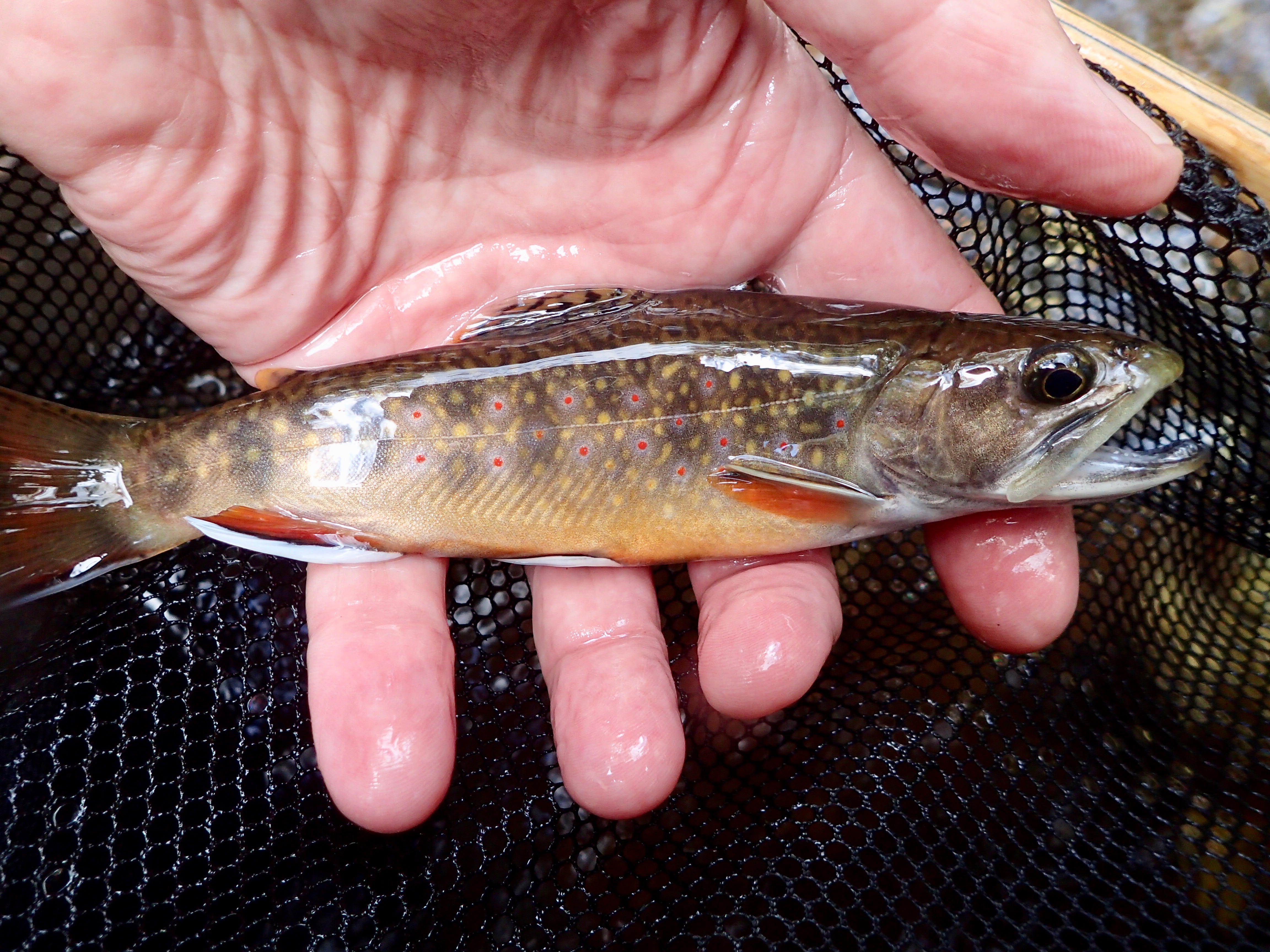
This was my first brookie to net, and it was an easy decision to make this my One Photo Challenge fish. I’m telling you, those blue haloed dots were positively glowing! I lost a few char bigger than this one, and a bunch of smaller ones, and that’s all just fine with me.

More Pre-Spawn Small Stream Action

What a treat to spend a day fishing with #2 Son Cameron on a small woodland stream. The water was on the high side of medium, 55 degrees and crystal clear. Although the spawn has not yet begun, some of the resident char were sporting their ready-to-get-jiggy finery. The leaves are beginning to tumble down, and although they were not an issue, I would expect that they would start becoming one this week. Like my previous trip, the fish were unimpressed with the dry fly; anything subsurface was immediately bull-rushed and nipped at. If you’re heading to a small stream from now until April, please stay out of the water and be on the lookout for redds!

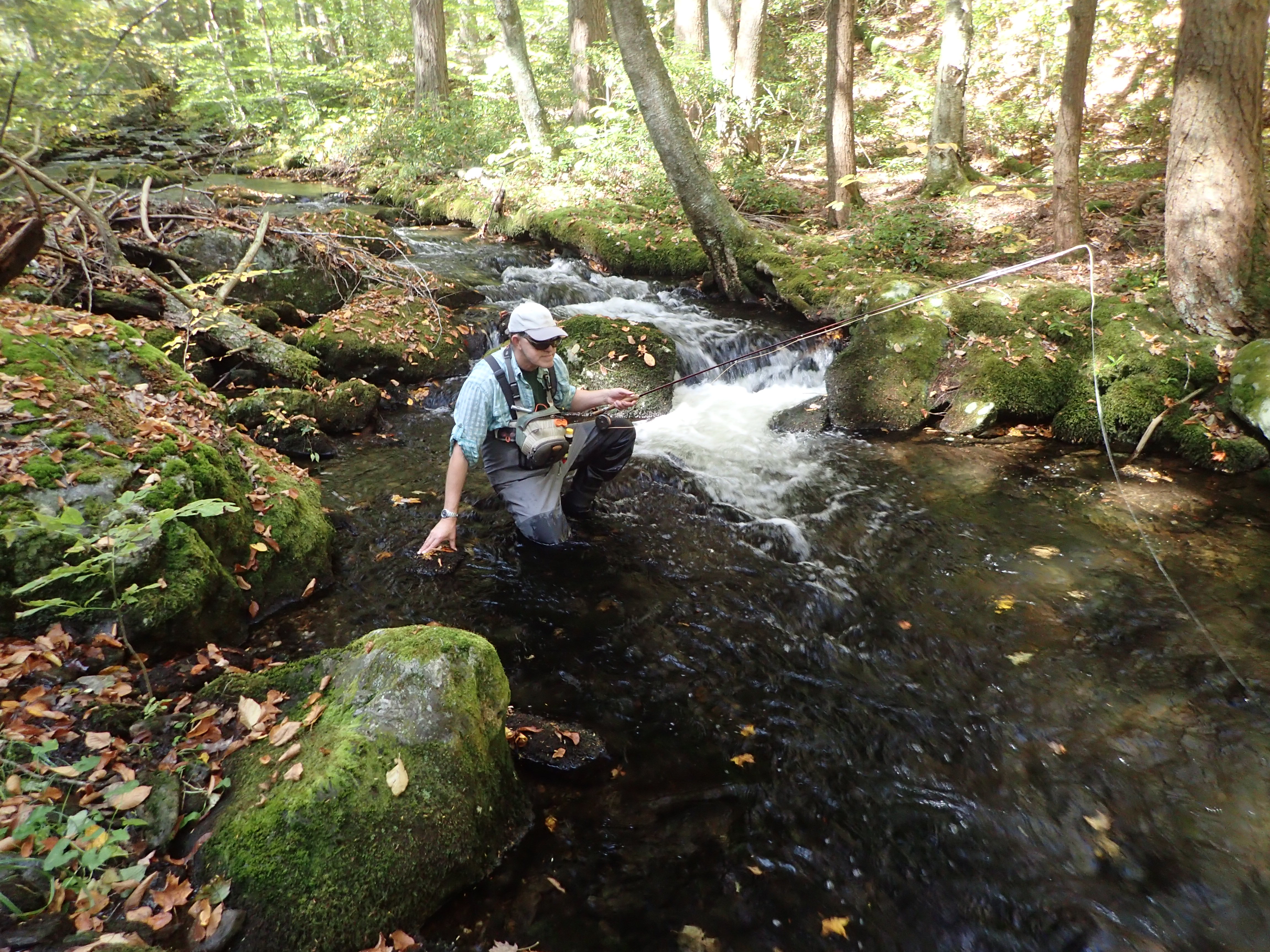
It was another work day of sorts, shooting video and still photos for presentations and social media and other stuff. This would be the “crouching low against the landscape while staying out of the sunlight,” or the “dangling the fly in the current downstream to provoke a strike” shot. Photo by Cam Culton
We all know brookies for their brilliant colors, dots, halos, fins, and vermiculations. One of the things I love about the species is the way they adjust their coloration to their surroundings. Sandy or light-colored substrate means the char will have a lighter flank. Dark horses like this often live in remote, isolated plunges that never see direct sunlight and very little light in general. The photo doesn’t do this brook trout’s dark coloration justice. I nicknamed him “The Chocolate Brookie.” Photo by Cam Culton.

Small Stream Report: The Kids Are (more than) Alright

Last week I spent a couple hours on Ye Olde Brookie Emporium. The water was medium-high and running clear. I hadn’t fished this stream since last spring, and there were some changes over the summer. A constant supply of too much water really moved the fish around, placing them in some holes that are normally low and devoid of char this time of year. A couple pools underwent significant structural changes that altered their size and depth, mostly due to old logjam dams being swept away and new ones being formed. The bottom line was that there were fish almost everywhere, and they were in great shape and eager to jump on.

Due to the volume of water, I started subsurface with the Squirmy Wormy Jig, which was a good call. Almost immediately, the brookies began attacking the fly. I used a size 12 to minimize hookups; later in the day I went down a size to actually land a few. Stripped, dangled, swung, hopped, it didn’t matter. This fly was under constant assault.

A woodland pond in miniature, lovingly rendered by Mother Nature.

Next, I wanted to try out a new pattern I’d read about this winter in Pat Dorsey’s book Favorite Flies for Colorado, the ARF Humpulator. This pattern from Al Ritt was designed to float better, longer. As its title suggests, it’s a riff on a Stimulator and a Humpy. (My favorite feature might be the hi-vis indicator tied onto the wing, something I’ve thought about doing on my Stimulators and Improved Sofa Pillows for years.) Although it is intended to be tied in sizes 6-10, I made my ARF Humpulators in a size 14. Like any big, bushy dry, the wild things slashed and crashed and bashed and mashed it. Again, by going with a larger size, I eliminated unnecessarily hooking smaller fish.

I was disappointed in several of the hero pools, but that may be a function of them being easy to access, and the resulting increase in fishing pressure. Leaves were not yet a factor. No redds were observed, but I did see a pod of good-sized char milling about at the bottom of one deeper gravel bed. I decided to let them be. While it was a work day of sorts (shooting photos and video), it’s hard to beat a day at the office like that.

Designed for larger western rivers, the ARF Humpulator also works on small eastern brooks. Please consider taking the Wild Trout One Photo Challenge on your next small stream outing.

Two hours on a small stream

That’s all the time I had. But there’s a certain comfort in having a time limit. It forces you to keep moving. To spend more time with your flies in the water. And if you feels the pangs of regret over pools not covered and fish not caught, there’s always next time.

It was a lovely, sunny afternoon, albeit with a slight chill in the air. The water was perfect: dropping after the weekend’s downpours, just a tinge of color, nice and cold. There were the ubiquitous midges, BWOs sz 14-16, and some caddis. I fished with a dry/dropper and a small tungsten bead jig. Although I had a few slashes (and one landed) on the dry, the natives showed a clear preference for the jig. I had great success in deeper, darker holes, and along shaded cutbanks.

When I began, it was all BWO duns. But by the end of the trip, I started to find spinners. I love finding the same mayflies on small streams that I see on bigger rivers. Now, to find some risers…
The skunk cabbage is asserting itself in the moist bottoms of the woods. I ran across these on my hike out. Anyone know what they are?
The less photos you take, the less stress you place on the fish. I encourage everyone to Take The Wild Trout One Photo Challenge when fishing small streams. You get bonus points if you keep the fish’s gills submerged.

From the article archives: Everything You Need to Know About Fly Fishing in Small Streams

Everything You Need to Know About Fly Fishing in Small Streams first appeared in Field & Stream Online in August 2021. It covers basics like rods, flies, finding water, tactics, and C&R best practices.

And that’s a wrap for Wild Trout/Small Stream Week! I hope you’ve enjoyed it. And as always, thanks for reading.

This is my default setting for exploring new small stream water. Droppers are always the fastest way to find out what the fish want.

The single best thing you can do for small streams and wild trout is:

Zip it. Hush. Shaddup. Small streams and wild trout are a finite resource — and more pressure is usually a very bad thing. So for goodness’ sake, never post stream names and locations on social media. Never take photos that clearly identify your location. (Picture this scenario: you make a video and post it on YouTube. The brook is clearly identifiable. Someone sees it and comments on how beautiful the place is. Someone else comments, “I know where that is!” Someone 1 reaches out to Someone 2, and the location is revealed. Someone 2 likes to share locations with his friends, and the cascade begins. Don’t laugh — I’ve seen it happen.)

And if someone asks, you can always use my line: “I won’t even tell my mother where I fish.”