Soft-Hackled Flatwings, Ready to Swim

Fresh off the vise and ready to be eaten. Grey dun/fluorescent yellow, pink/chartreuse/olive, and white/blue/mallard flank. Of course, endless color variations are possible. Sparse, yet full. These are all three-and-one-half inches long.

SH FW Hybrids

Here’s the basic template:

Hook: Eagle Claw 253 1/0
Thread: 6/0
Platform: 30 bucktail hairs
Tail: Flatwing saddle to match platform color, under 2-4 strands flashabou
Body: Braid
Wing: 30-45 bucktail hairs, under 10-20 hairs contrasting color, under 2-4 strands Krystal Flash or flashabou
Collar: Blood quill marabou, tied in at tip, 3-4 turns; 1 turn mallard flank (optional)
This is one of my favorite patterns for early season stripers.

The Greased Line, The Sparse Flatwing, and the Big Three-Oh.

This was a weird spring. It was cold. Rainy. I suffered from a debilitating case of tennis elbow. Without my switch rod, there’s no way I could have even fished for stripers. Things started late – I didn’t get my first bass till well into April. Most of what I was catching was in the sub-twenty-inch class. While that bodes well for the future, April and May of 2014 will go down as a complete vexation for courting the big girls. Two of my traditional big fish spots were depressingly unproductive. It was weeks into May before I even had a legal sized striped bass. But, oh, what a bass. Here’s how it went down.

I was fishing a new location that had big bass written all over it: current, structure, and the presence of herring. Attached to my floating line was a seven-foot length of twenty-five pound test mono. The fly was one I’d tied several years ago: Ken Abrames’ Razzle Dazzle. This particular fly was a veteran many striper campaigns. Its top two saddles were long gone, and over the course of the seasons, some of the bucktail had likewise gone AWOL.

For two-and-a-half hours, I fought the good fight: cast. Upstream mend. Another mend. Another. Swing. Pulsing strip. Let the fly fall back. Retrieve. Repeat. If nothing else, greased line for striped bass is meditative, so absent any hits, the routine was comforting and pleasant.

But, it was time to leave. A walk down-current to a different section, then ten more minutes.

The takes on the greased line presentation are usually either a sensation of building pressure, or a sharp pull. Hers was neither. Suddenly, she was simply there, rolling on the fly, taking line downstream. I had dropped a substantial fish the week before when I couldn’t get a good hook set. With that wound still festering, I drove the point home. Hard. She felt strong. But I didn’t have a idea yet of what I was dealing with.

Every big bass fight presents a unique set of challenges. As expected, her first run was downstream. She peeled line off the drag, but I was surprised by how little it was – probably about thirty feet. I pointed the rod at her and set the hook again.

She turned abruptly, and headed upstream. I was simultaneously delighted and horrified; the former because in this heavy current she’d be burning a tremendous amount of oxygen in her flight, the later because of the memories of all those steelhead who shattered my heart with relentless upstream runs and hook-spitting leaps. The challenge was to re-gather line as fast as possible, staying tight to the fish. She was faster than my hands, though, and I was sure I was going to lose her. I raised the rod tip. Still there. I lowered the tip and re-set the hook.

Now, she sounded. I’ve heard that big bass will try to rub their cheeks against the bottom to rid themselves of a fly. I don’t know if that’s true, but I do know that the bottoms of rivers and oceans and estuaries are vast depositories for nature’s junk. Who knows what multiple opportunities for snag hell awaited below? I pulled on the line. It didn’t move an inch.

Unbelievable. Stuck on the bottom. Another good striper lost.

But wait. Did the bottom budge? Yes. A little. I moved the rod tip back and forth in a 180-degree arc over the water, trying to stir the fish. It worked. Instead of ripping down-current, she ran uptide. Paused. I re-set the hook. Again. I decided it was time to try and get her out of the abyss and onto the gravel bar. She would have none of that. “Down goes Frazier!” Or, as I imagined it in my head, Cosell shouting “Down goes Culton!” She sounded a second time.

Again, I couldn’t budge her with a straight pull. The rod wagging thing worked once before, so I tried it again. Now she came up a little faster. I could sense she was tiring. Once I coaxed her out of the depths, she took advantage of the shallows, ripping off a series of short runs. But all that sprinting was taking its toll. I still didn’t know what I had. I was hoping for twenty-five pounds. I decided to try to land her on the beach.

I put the rod over my shoulder and walked her in close, then pulled her to the water’s edge. Now I could see the fish. My mouth fell open, searching for words. My pulse rate skyrocketed. After lipping twenty-inchers all spring, her mouth felt like that of some alien creature. Its opening dwarfed my hand. The flesh between my thumb and forefinger was substantial. I could easily see a small dog disappearing down that gaping maw.

I held my rod against her length. Her gill plates came about to the first guide on my two-hander, thirty-four inches away from the butt. This was a striper over forty inches. The big three-oh in pounds. A new personal best on the fly from the shore. She certainly had been eating well, with a distended belly that gave her a perch-like shape.

Wouldn’t you know that this was the one night all spring I left my camera at home? Fortunately, I had my phone in my pack. I took a couple hurried shots, and felt guilty about it, because I really wanted this fish to live. I took hold of her – good Lord, what an impressive mass – and guided her into the shallows. I was expecting a lengthy revival. But no. Almost immediately she felt ready to go. Just to be sure, I held on a few more seconds. As I was re-adjusting my grip, she thrust from my hands.

She slipped away into the darkness, leaving a gentle wake.

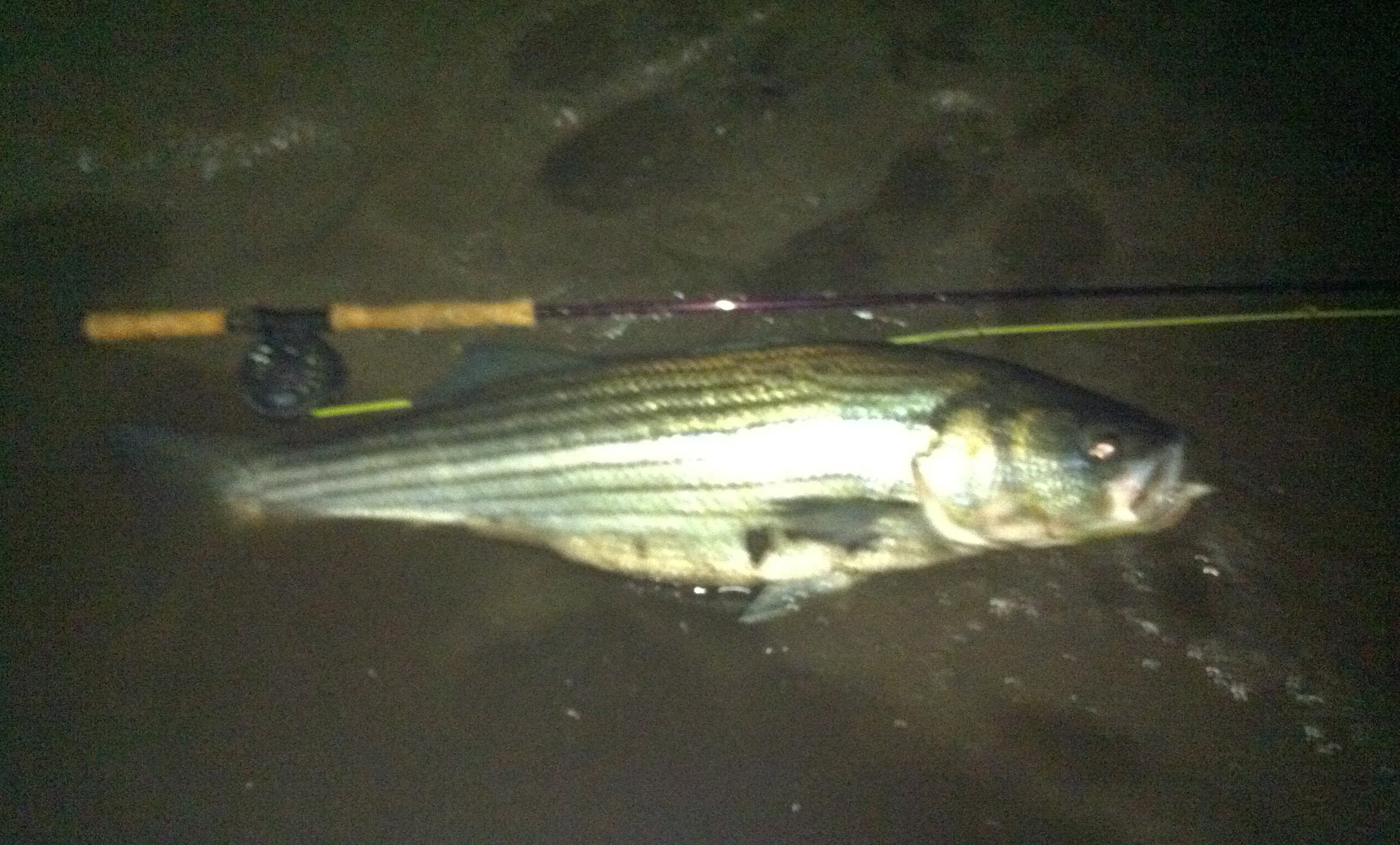
Miss Piggy. A thousand apologies for the sub-par photography. This is what happens when you forget your good camera and are reduced to using an iPhone wrapped in a ziploc baggie. But, you can get a good sense of the sheer mass of the fish. The bottom guide is 34″ from the butt, and her tail extends farther than you can see. Look at that belly full of herring.

Image


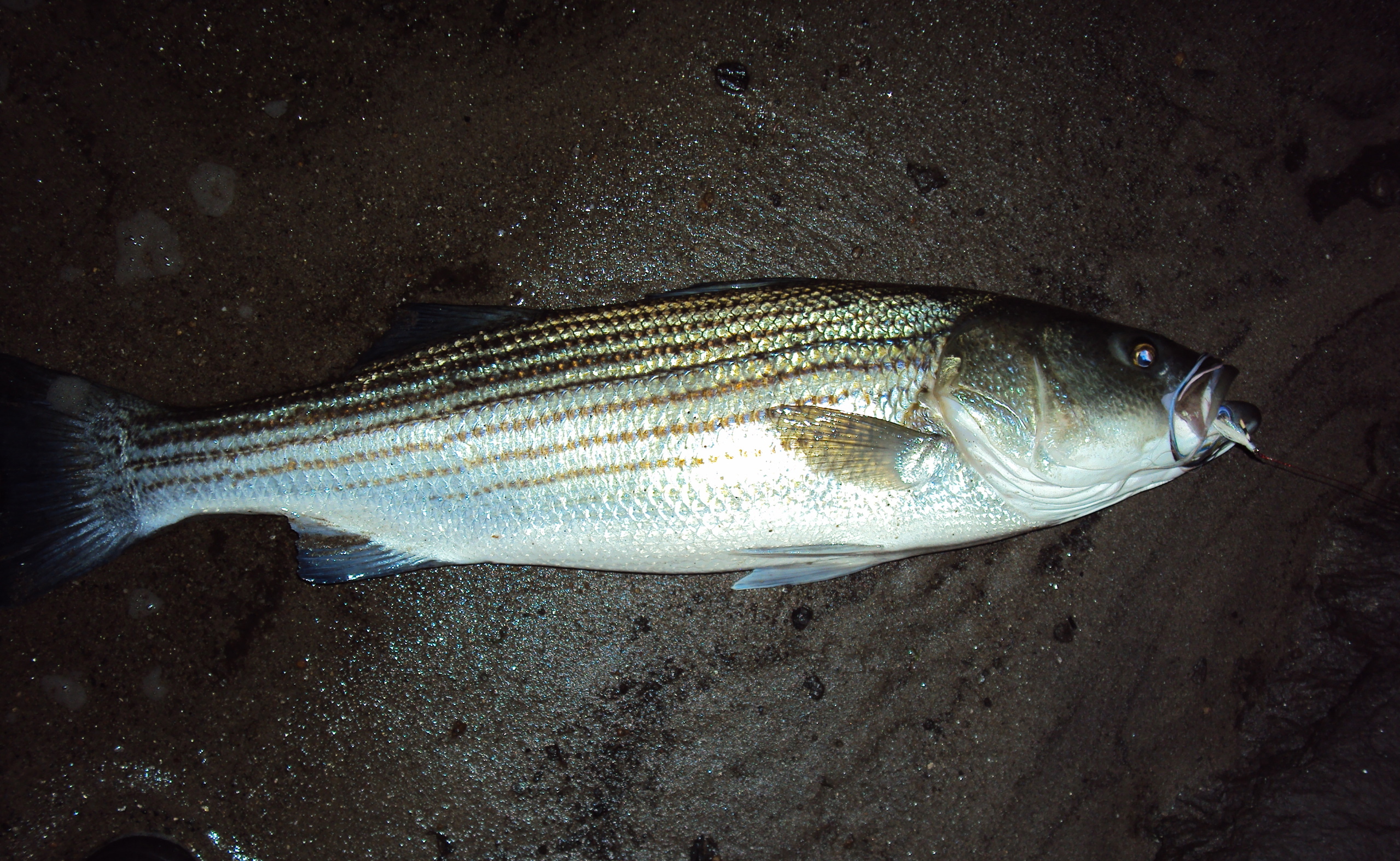
A better shot in terms of detail, but you don’t get the full length effect.

Image


The winning fly. An old Razzle Dazzle, missing two saddles and a fair amount of bucktail. Here we make the case for sparse and impressionistic. This fly is now retired. I may put it out to stud.

Image


Big Eelie Variant: The L&L

While I am loathe to use the phrase “go-to-pattern,” I beg to report that whenever there are large sand eels around, Ken Abrames’ Big Eelie is my go-to pattern.

The Big Eelie differs from 95% of other sand eel flies in that it is not an attempt to carbon copy the bait. Those legions of epoxy- and tube-bodied flies with eyes certainly work, but you can get away quite nicely with something far more impressionistic (if that’s your fancy) like the Big Eelie or Ray Bondorew’s Marabou Sand Eel.

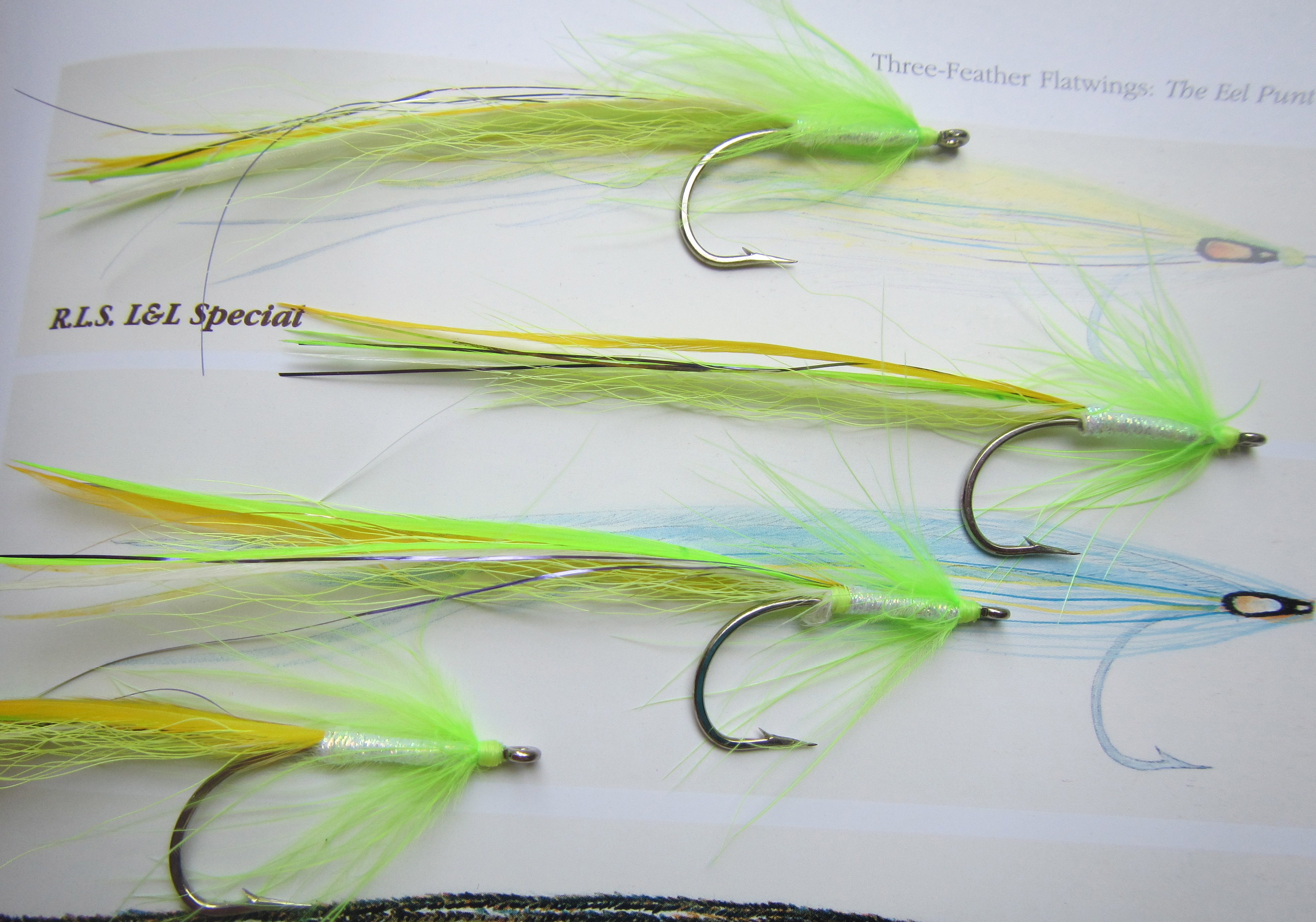
The classic Big Eelie is a four-feather flatwing/soft-hackle hybrid; it’s colors are white, yellow, olive, and blue. I’ve discovered over the years that the Big Eelie works in all kinds of color schemes. One of my favorites is taken from Ken’s three-feather flatwing, the L&L Special. This tart mix of yellow, fluorescent yellow, white, and chartreuse shines on sand flats, day or night.

The L&L Big Eelie

Image

Hook: Eagle Claw 253 3/0
Thread: Chartreuse 6/0
Platform: 30 hairs fluorescent yellow bucktail
Tail: A white saddle, under one strand each of gold and silver flash, under two chartreuse saddles, under two strands purple flash, under a yellow saddle.
Body: Pearl braid
Collar: 2-3 turns chartreuse marabou, tied in by the tip.

Tying notes: Sand eels are a slender bait, so make your saddles about the width of a pencil. You don’t want a flaring broom shape for the platform, so likewise make it slim, and take the bucktail from near the tip of the tail. All the saddles are tied in flat. The marabou adds the magic here, as it veils the body when wet, creating movement and an almost glowing effect. Feel free to play around with different colors on this pattern; some of my favorites are blue/black/purple and white/pink/olive. Stripers love them all. I like to tie this fly about 4  1/2 inches long.

Last night, while you were sleeping…

…I was standing waist-deep in an estuary, searching for stripers.

33″ and well-fed. 15 pounds if she weighed an ounce. And a new personal best on the five-weight. She took a Striper Moon flatwing/bucktail hybrid about 8″ long on the dangle.

Image

The Daily Double: Farmington River trout and LIS stripers

No Hendricksons Monday on the Lower TMA of the Farmington River. At least not in the two spots I fished. It could have been the cool, overcast day (there were small olives). Or, perhaps things are simply winding down. One of the nice things about the Farmington is that the hatches move upstream; two friends that fished Monday just below the upper TMA reported good Hendrickson action. I swung a team of wets (Squirrel & Ginger caddis on top of two Dark Hendricksons) and 2/3 of the fish I caught took the caddis.

Back to work and family responsibilities for the afternoon and early evening. Then off to find some stripers at night with Dr. Griswold. There were some signs of herring, and while there were no bangs and pops on the surface, we did find some hungry fish. Bob brought his two-hander, and I went with the five-weight. We didn’t get anything super big, but there were some legal sized fish in the mix. I fished my Rock Island flatwing, which the bass again found to their liking.

Dr. Griswold with a nice 31-incher on the two-hander. Smile, Bob.

Image

Can’t let Bob have all the fun. A nice keeper bass on the five-weight for me.

Image

A tale of two five-weights

All five weights are not created equal. I should know. I’ve got four of them. You may ask why I need four of the same rod. The answer is that while they’re all five-weights in name, they could not be more different. Each is a specialist in its field. The two I want to talk about here are my 6’ Fenwick glass rod and my 9’ TFO TiCr.

This all started with a steelhead trip I had planned with my ten year-old. We had to cancel due to weather, and we were were both a little bummed about it. But I told Cam that since we weren’t making the drive to Pulaski, we could spend the day fishing closer to home. I gave him options: trout on the Farmington, stripers on the Hous, or wild brook trout over the hills and far away. Cam decided on brookies. I thought that was a fine choice.

I’ve had the Fenwick for many years now. It’s a sweet 2-½ ounce stick that flexes down to the handle. A five-weight line works just fine on it, and like bamboo it’s an exceptionally easy rod to cast. Cam told me he wanted to do a little more of his own fly casting this year, and this would be a good starter setup for him. Unfortunately, the first stream we hit was turbid with runoff. So we hopped in the truck and took a little drive north. The second stream was in fine fettle, medium high, and clear as an aquarium.

 It took us several tries to hook this fish. She kept whacking the microbugger, but we couldn’t seem to get a good hookset. Classic haloes and Fontinalis fin.

Image

Cam got to work with on the surface with a size 14 Improved Sofa Pillow, but we had no takers, even over some confidence-is-high pools and runs. Undeterred, I tied on a blackish micro-bugger with a chartreuse bead head. That did the trick. Whereas the brookies were bashful about showing themselves on the surface, they were more than happy to nip and tug as soon as the fly settled beneath the surface. We landed four nice brook trout with glowing blue haloes and dropped a bunch more. It was a tired and hungry but happy hike out of the mid-April woods.

Eight hours later, I was swinging flatwings for stripers with my TFO TiCr five-weight. Where the Fenwick is a flexible birch sapling, the TFO is one of those redwoods you could drive your car through. I mate this rod with a 9-weight Rio Outbound floating line, and even with that night’s ten mile-per-hour crosswind, casting an eight inch fly was effortless – provided I found that sweet spot where the shooting head met the running line. Not easy on a moonless night.

I was mostly greased-line swinging, my favorite presentation with bigger flatwings. Sometimes the takes are nearly subliminal – instead of a tug, you feel a minute change in pressure that exponentially accelerates into mayhem. On this night it was different. The fish were taking the fly moments after I had completed my mends (I was fishing a narrows that only allowed two) and the takes were an adrenaline-produced amalgam of pull, boil, and surface thrash. I took three stripers on the greased-line swing; two of them in the double-digits pound class.

 31″ of pure pleasure on the five-weight. She fell for my Rock Island flatwing, tied about 8″ long.

Image

Both of those larger fish were quickly played and landed. Both tried to run upstream when I attempted to coax them onto the sandbar I was standing on, and the side pressure I applied with the butt of the rod easily dissuaded both.

Miss Cow never showed up. But she’s out there, somewhere. And one night, on a moon tide, she and I and one of my trusty five-weights are going to go for one hell of a ride.

Guten tag cows mit der Herr Blue flatwing

It’s getting to be that time of year: herring moving upriver with plenty of cow bass along for the ride…or at least a meal or twenty. A floating line, a greased line swing, a Herr Blue flatwing swimming broadside or just hanging there, hackles undulating in the current — I can almost feel the sensation of the strike.

To the fly: my nine-feather flatwing translation of the R.L.S. Herr Blue bucktail, tied about 11 inches long. I really like the colors on this one.

The Herr Blue Flatwing, nearly a foot long.

Hook: Eagle Claw 253 4/0
Thread: White
Platform: Ginger bucktail
Pillow: White
Support: White neck hackle
Body: Silver braid
Tail: 2 white saddles under 1 pink saddle under 2 strands pearl flash under 1 violet saddle under 2 strands silver flash under 1 pink saddle under 1 blue saddle under 2 strands light green flash under 1 orange saddle under 2 strands purple flash under 1 olive saddle under 1 blue saddle.
Collar: White and ginger bucktail, mixed
Wing: 20 hairs dark blue bucktail, 15 hairs olive green, 15 hairs grey, 15 hairs orange, mixed.
Cheeks: 3 hairs each of orange, chartreuse, pink, turquoise bucktail, mixed
Topping: 7 strands peacock herl
Eyes: Jungle cock

A closer look:

Image

And a proven performer. Not quite a cow, but easily into double-digit pounds. The fly is same as the one in the top picture. This striper was taken last spring on a greased-line swing.

Image

Steve Culton

Peepers. But sadly, no stripers.

I usually fish for stripers twelve month a year, but somehow January and February escaped me in 2013. March nearly got away, too. But I took care of that last night.

Met old fishing buddy Dr. Griswold to catch the bottom of the tide at one of our old haunts. The conditions were certainly favorable. A strong moon tide, good water level, and a water temp of 46. But alas, no stripers for either of us. I swung. I greased lined. I nymphed. I stripped. I jigged. I fished deep, on top, and all points in between. But, you can’t catch what isn’t there.

On a positive note, Bob didn’t lose his Christmas gift. Every year I tie some flatwings for friends as a present, and every year Bob loses his fly on the bottom or in a tree within the first five minutes of fishing it. Not last night. Well done, Bobber.

What Santa brought this year: the Rock Island flatwing

Image

I was also able to coax ninety minutes out of an E.P. Carillo Golossos while on the water. Terrific cigar.

And when I got home, the choir was singing. Spring peepers. Their first performance signals that the over-wintering bass in my local rivers are getting ready to move.

Not tonight. But soon.

The (Super-Sized) Magog Smelt Flatwing

It would be pretty fair to say that I’ve got a jones for the Magog Smelt. The Magog Smelt is a classic landlocked salmon streamer that originated in Maine. It sports a striking color palette: white, yellow, and purple bucktail. Silver flash accents. Flowing red marabou, offset with barred teal flank and iridescent peacock herl.

Up until a few years ago, I’d never heard of the Magog Smelt. Then one day I was having a conversation with Ken Abrames about old time striper flies, and he told me the Magog Smelt was his father’s favorite fly for Rhode Island bass. So I looked up the pattern and tied a version based on the Ray’s Fly design. The first time I fished that that fly was at night in a breachway, and when I caught a striper on it, I could almost picture Ken’s dad standing on the shore, nodding in approval.

I started playing around with the color scheme of the Magog Smelt in different formats, from soft-hackle to single feather flatwing. They all worked in the salt. Then I got ambitious and tied up a 10” long, nine-feather flatwing. A substantial morsel to tempt the stripers when the big bait is in. Bold. Daring. More of a caricature of a herring than a formal portrait.

And here it is.

The Super-Sized Magog Smelt

Hook: Eagle Claw 253 3/0
Thread: Black
Platform: White bucktail
Support: White neck hackle
Tail: 3 white saddles, under 2 strands pearl flash, under one yellow saddle, under 2 strands pearl flash, under 2 yellow saddles, under 2 strands silver flash, under one lavender saddle under 2 strands silver flash, under one lavender saddle under 2 strands red flash, under one lavender saddle under 2 strands purple flash.
Body: Silver braid
Collar: a 2/3 veil of long white bucktail one hair thick
Throat: Full tip of red marabou
Wing: 30 strands purple bucktail
Topping: 7 long peacock herl strands
Cheek: Teal flank feather tip
Eyes: Jungle cock

A closer look at a fly that fishes big, casts small.

Tying notes: Since I didn’t have the darker purple the original calls for, I used lavender saddles and some deep purple bucktail in the wing. There’s something magical about the effect created by placing the jungle cock over the teal flank cheeks. This fly is tied Razzle-Dazzle style with the flash about an inch longer than the saddles.

You can see the stiff, white neck hackle I’m using for a support along the arm of the vise. A properly constructed big flatwing like this will not be prone to fouling.

Another Good Night For The Five-Weight

“What?”

That was my wife’s response, delivered with no small amount of incredulity – or was it sympathy – when I told her I was going fishing tonight. I really couldn’t blame her. After all, I had been traveling home from Florida all day. Now it was evening, and I was on the phone with her, calling on a New Haven-bound Amtrak from Manhattan. I wouldn’t be home for another two hours, and then it’d be another two hours before I could leave.

But, you get to used to the oddball treatment from people who don’t obsess over tide times, heights, moons, and river levels like you do. Even if you’re married to them.

I hadn’t fished in over a week, so I had it bad for some stripers. Tonight would be a perfect night for the five weight rod. Not too windy, and the prospect of a striper in the 15 pound class. I attached a fresh 30-pound test leader about eight feet long to the line, then tied on a Herr Blue flatwing about eleven inches long from nose to flash. Everything looked just right.

Not even a nighttime roadwork traffic jam could slow my spirits. I ended up getting my spot ten minutes late. So what? The fish would still be around.

The current on the outgoing tide was moving at a slow walking pace. In what little ambient light there was, I could see the intricate cake-frosting swirls of the eddies as they passed over the hidden bottom structure. I tried to guess the water temperature with my index finger. 58? 62? The thermometer said 59 degrees. Not a bad couple guesses.

I began by working a deep little run between the rocks. Herring swirled near the surface right in front of me. I tried a few dead drifts, almost like high-stick nymphing, but there were no strikes. So I began to methodically walk down-current, greased line swinging the whole way.

The fish in this section of river tend to hit on or about my second mend, but forty minutes had gone by without a tap. The drill was comforting. Cast. Immediately throw an upstream mend. Then another. Let the fly swing around. Swim, pulse, and dance it in the current. A few short strips, then let it fall back. Even fishless, the presentation was pleasant and meditative. A glance at my watch showed it was well into the wee hours, and I was out here all by myself.

Except for her.

She took the fly as they often do on the greased line, slowly, with full confidence, inhaling the Herr Blue near the head, then turning back toward the bottom. I felt it as a sudden change in pressure on the line. Subtle, nuanced, yet distinctive from the unimpeded drift. No demonstrative WHACK! No explosion on the membrane between water and air. Not yet. I came fully tight to the line with a backward thrusting motion. The hook point found its seat in the corner of her mouth. Right where it was supposed to be.

Now she becomes unhinged, tail thrashing at the surface. At first, I’m unsure how large the striper is, and I under-guesstimate her to be in the 24”class. She’s moving toward me, and I’m hand stripping her in. Once she reaches the edge of the sand bar and discovers she no longer has the comfort of depth to rely on, she lets me know that hand stripping will be ill-advised. The fish begins her first run, taking the slack line out of my shooting basket through my thumb and forefinger at a jerky, frantic pace.

The drag protests as more line is peeled off. I ratchet things down a little tighter, and that stops her. Just to be sure, I re-set the hook. Line is regained, lost, and regained. She’s tantalizingly close now, about twenty feet out, but not quite finished.

Her last defense is her undoing. To escape the shallows of the sand bar I’m standing on, she heads for the deepest nearby water, which happens to be upstream. Between the current and the pressure I put on her, she tires quickly.

As I cradle her in the water, I wonder how many herring she’d eaten that night? Our time is all too brief together, not only the fight, but the release as well. I don’t have her in the revival position for more than a few seconds before she thrusts out of my hands and melts away from the beam of my headlamp into the darkness.

I climbed into bed around 4am. The birds were singing. I was, too. All the way home.

Miss Piggy poses for posterity. “Dang,” she’s thinking, “I really thought that was a herring.” For perspective, the fly, a Herr Blue flatwing, is about 11″ long.

Image

A close-up of the Herr Blue flatwing.

Image

This piece was written in May, 2012, and originally appeared in several online fishing forums.