Small Stream 101: Fishing the outgoing tide.

The brook was dozens of miles from the sea. Yet there I was, fishing the outgoing tide. At least that’s what I started calling it several years ago. Let me explain.

What I mean is, I’m fishing a small stream in the day or days after a heavy rain. As with an ebbing tide, the water level is dropping. It’s a great time to fish. Here’s why. The waters have gone from raging and murky to some semblance of normal. They may still have a light tea stain to them, which makes it a little harder for the fish to see you, but not your fly. Most of all, the trout have transitioned from hunker-down survival mode to dinner bell-ready. That was certainly the case today.

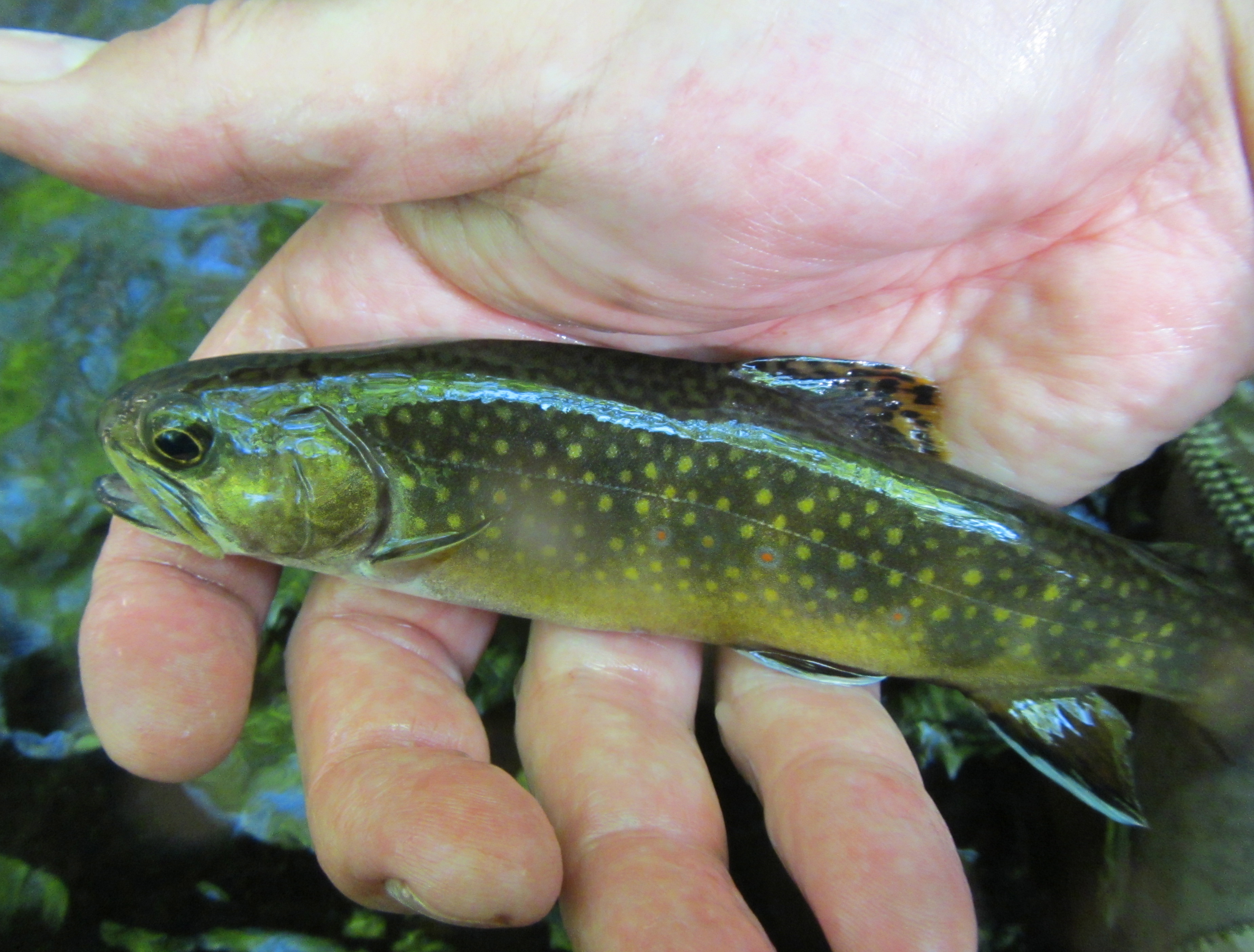
I would crawl on my hands and knees through a skunk cabbage-filled boggy mess to catch a wild brookie like this. Oh, wait. I did.
Image

The lovely woodland stream I visited today is one I haven’t fished in many months. I usually make a pilgrimage in April, but the time-space fishing continuum conspired against me. The woods are only starting to display a vague suggestion of green in April, but on May 31st they were  lush. It was already too hot and humid to be bushwhacking in waders at 8am, and non-biting midges swarmed me. Such was the price of admission for the wild troutstavaganza.

There were fish everywhere, with plenty of young-of-year brookies in the mix. This is always a good sign, as 2012’s new recruits will be 2015’s lunkers. It’s especially gratifying to see nature finding a way after last year’s terrible late summer drought and heat wave.

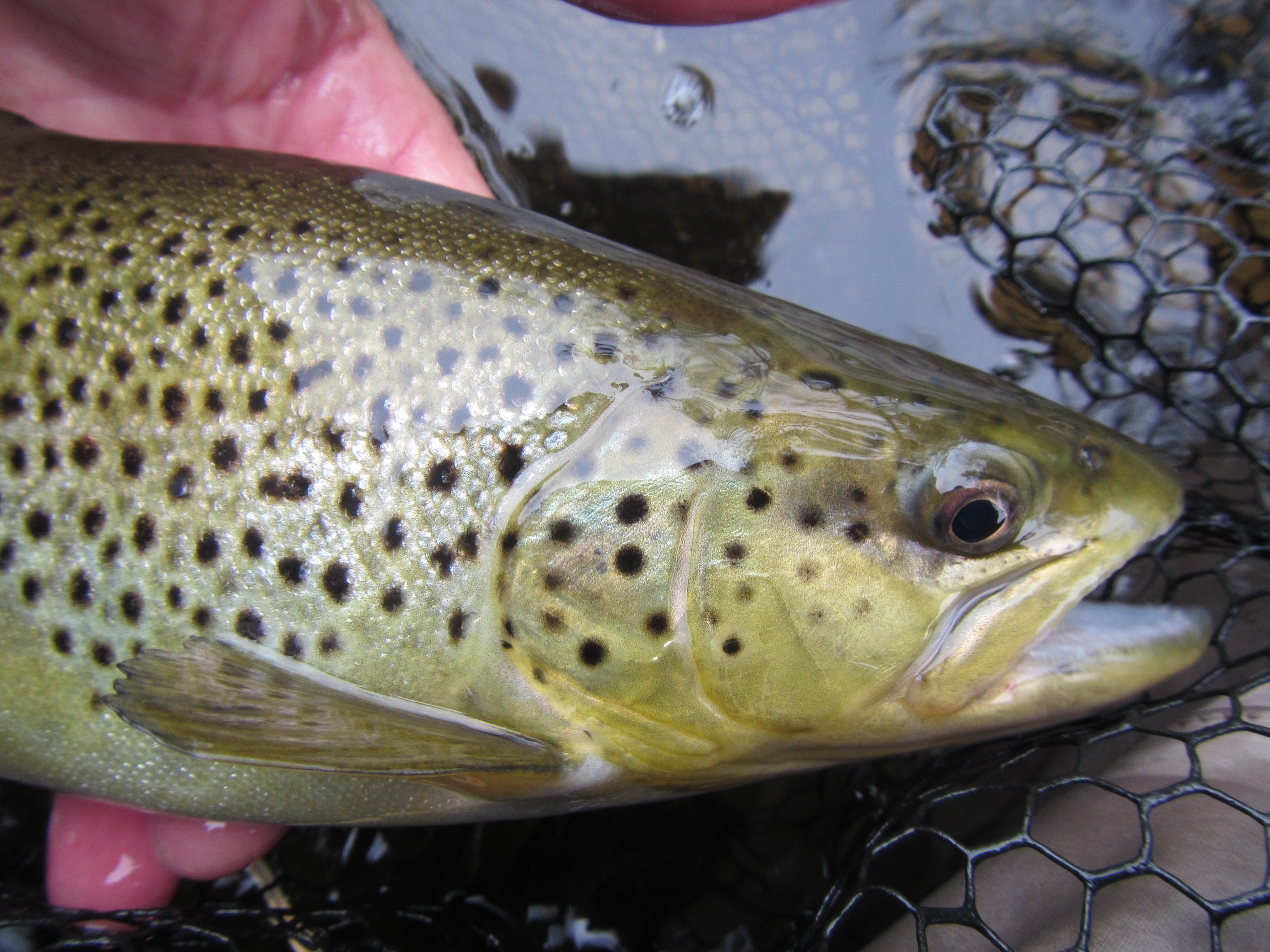
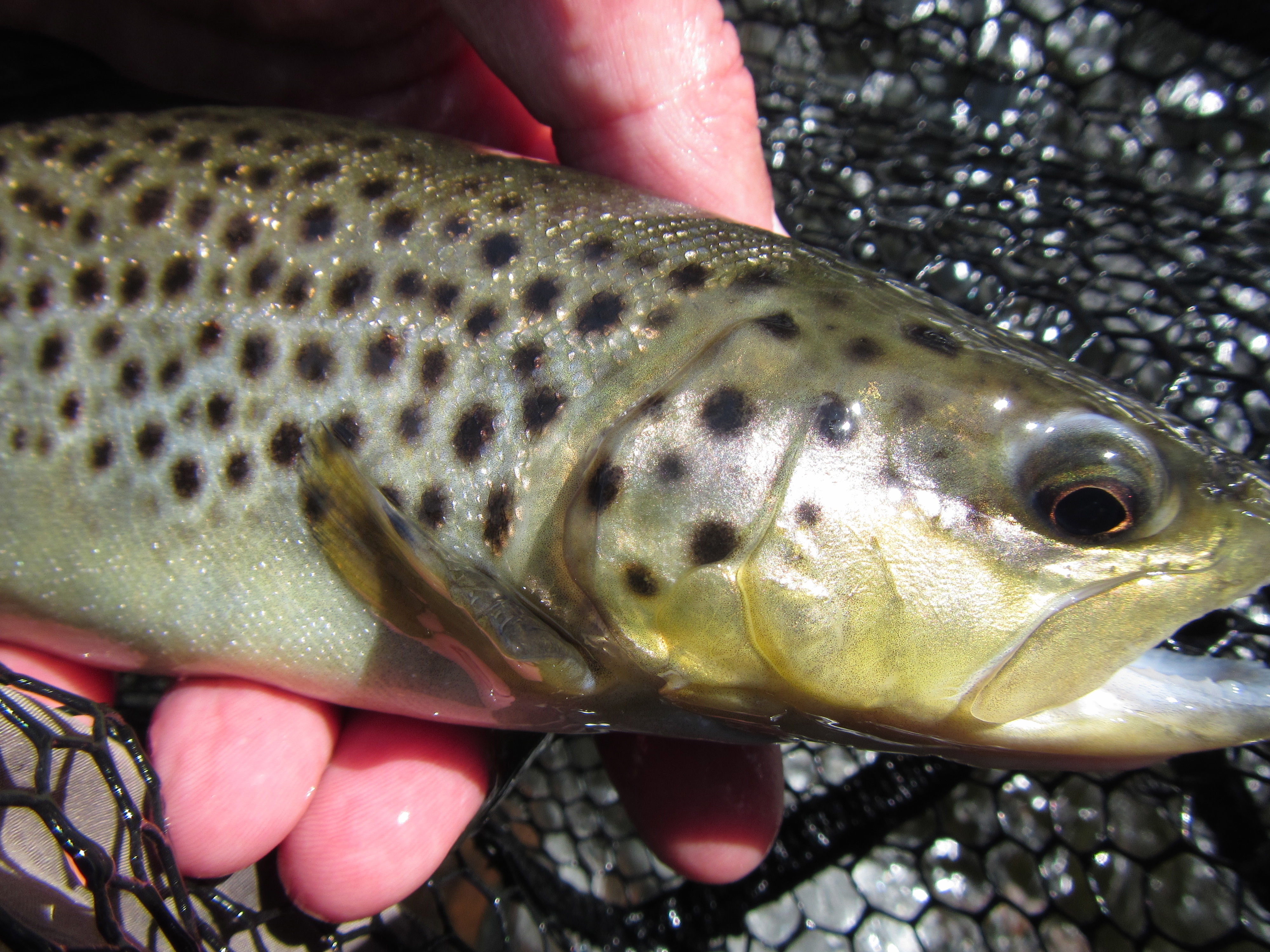
This blindingly beautiful wild brown hit the dry like a ton of bricks. Excuse me for a minute. I’ve got to wipe away the drool I got while gazing longingly at those parr marks.

Image

The fish were particularly active today. I witnessed three good-sized (for this stream — it’s small enought to jump across in more than one spot) trout feeding on the surface. Two were noisily slashing at emergers; the third was clearing the surface as he chased caddis. All of them were camera shy. Every time I tried to shoot some video, they suddenly stopped feeding. Little bastards.

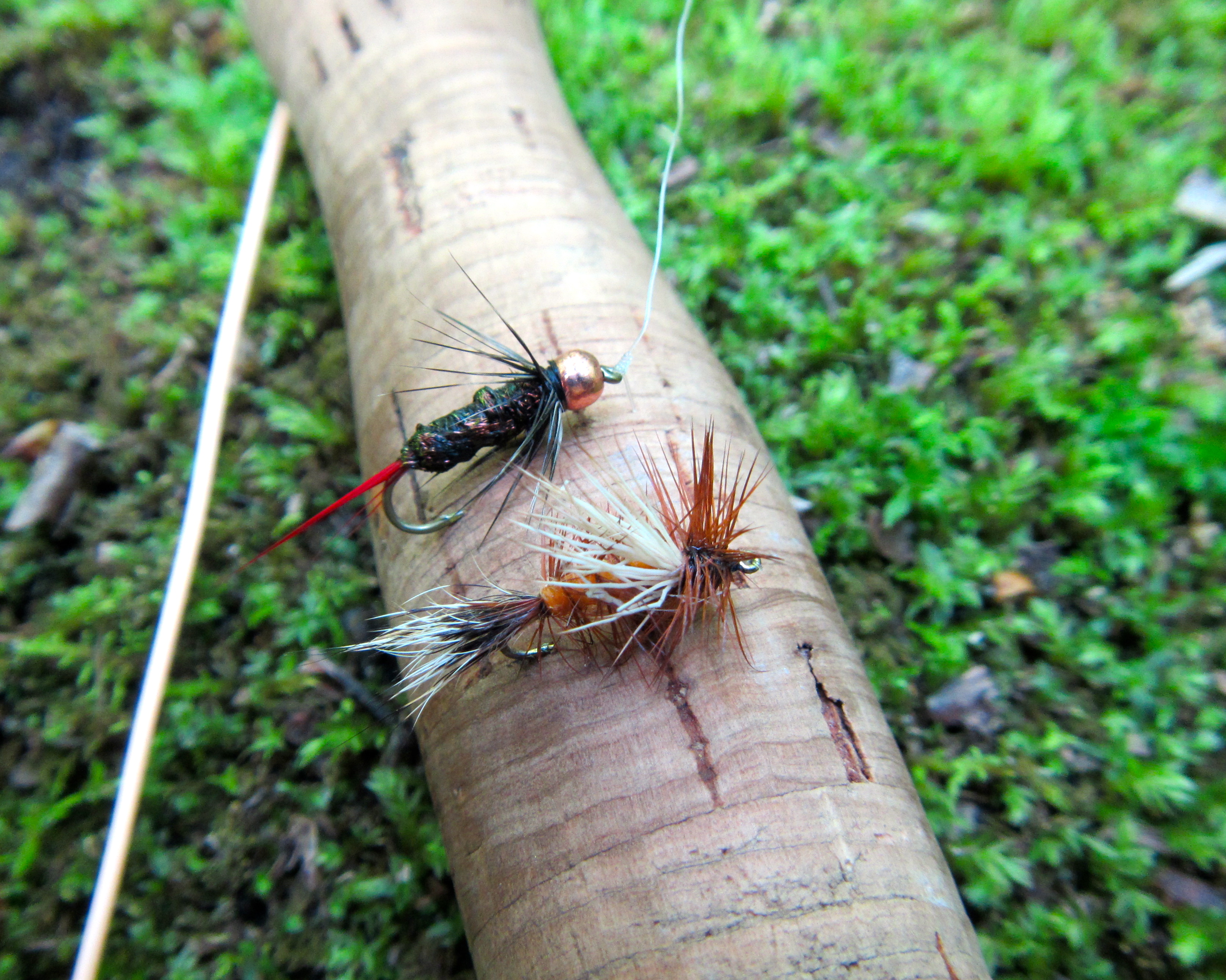
Fished a new dry today, the (Improved) Sofa Pillow in a size 16, along with a bead head Grey Hackle Peacock. The dry got the lion’s share of the action, fished mostly upstream. Pricked a good couple dozen trout, and lost many of them when the hookee ran into the omnipresent underwater stick pile. These twig and branch masses were everywhere. One of the pitfalls of fishing right after a big storm.

Today’s implements of destruction: A bead head version of the classic wet, the Grey Hackle Peacock, and the (Improved) Sofa Pillow.
Image

I held out on the cigar for as long as possible, but eventually the midges tipped the scales. Nonetheless, I declared victory as they scattered. Thank you, Romeo & Julieta Havoc Magnum. Besides, I managed to ignore work for the entire morning while catching wild trout. Clearly, that makes me the winner.

How does a stream stay cool in piss-stinking hot weather like today’s? Canopy. This photo was taken at high noon, yet virtually the entire stream is covered in shade. Nature finds a way.

Image

Chunky Farmington browns on streamers

On Thursday night, the Farmington crested in the upper TMA at around 1,500cfs. By this afternoon, is was still pumping out 750. Winds were gusting to 30mph. What a great day for some streamers.

I felt like fishing something new, so this morning I went down to the bench and pulled out a size 6 streamer hook. Since I didn’t know how much the water had cleared, I went for high-visibility. On went a gold bead, seated with some heavy wire. Made a tail out of marabou and gold Krystal flash, a body of gold mylar braid, and a doubled white marabou collar as long as the fly. On top, some silver Krystal flash. Any self-respecting ambush predator should be able to see that.

Line choice was a bit of a puzzler. I hemmed and hawed, and finally decided to go with an integrated full-sink tip, not so much to get the fly down — that would certainly be welcomed in areas where the current slowed — but mostly for casting in the banshee wind, and to keep the line below the flotsam that was sure to be bobbing merrily on its way downriver.

Yowzah, it was cold. I immediately regretted leaving my fleece vest in the truck. The wind chill had to be in the 40s or 30s. Some pinhole leaks in my waders and 53 degree water certainly didn’t help. But at least I was no longer slinging mulch in my garden. Even if I was able to do that in the comfort of a t-shirt.

The river was off-color, more of a tea-stain than muddy. As I suspected, lots of leaves/branches/twigs combos in the water. There were bugs out, but their presence was mostly belied by the legions of swallows working overhead. And yes, there were trout.

I spent most of my two hours working the banks, casting and stripping in short bursts. In my first cycle through the run, I took four browns and dropped a couple more. The trout weren’t particularly big, but most of them were chunky holdovers that fought well in the current. (Sorry, no pictures. Left the camera at home. Too cold/lazy to get the iPhone out.) I had a few swipe, miss, and come back for seconds. That’s always good for a thrill.

Dropped a handful more on my second and third go-rounds, and that was it. Pretty soon it will be time for streamers under cover of the night. And if I’m lucky, I’ll be fishing in shirtsleeves.

Paul’s First Brook Trout

I had the pleasure of guiding Paul for four hours today on the Farmington River. Paul told me he wanted to concentrate on fishing streamers, so we set off for the upper TMA rigged with a beadhead black and grey bunny thingy fly. Believe it or not, before today Paul had never caught a brook trout. We took care of that in the first half hour with a kype-jawed buck.

The size of the fins on this brookie lead me to believe that he’s lived in the Farmington his entire life.

Image

Today the trout took the fly on the dangle and on the strip. It rained on us, but we both found it relaxing and beautiful. Either way, it beats sitting at a desk. Adding a couple more notes: water was about 430cfs (that figure has gone way up with the afternoon rains), lightly stained, and temp was low/mid-fifties. Very little in the way of hatch activity: a few clunky light colored caddis and a smattering of tiny BWOs. We saw only one rise.

Farmington holdover browns on wet flies

Spent a few hours today doing some advance scouting for Saturday’s wet fly class. Found fish everywhere I went. Gloriously alone today, but that won’t be the case on Saturday. Water was a crisp 50 degrees, skies overcast, and a few showers here and there. We need more rain than this.

Not a lot going on bug or rising fish-wise, but I did see some light tan caddis, about a size 16, a few lonely Paralepts, and mounds of miniscule midges. I was fishing a Squirrel and Ginger as the top dropper, Leisenring’s classic Iron Blue Dun in the middle, and a black bead head grey soft-hackle nymph on point. The trout were split right down the middle, half of them on the Squirrel and Ginger, half on the point fly. They took the fly with gusto. Powerful, demonstrative hits.

A lovely Farmington River holdover brown that took the top dropper, a Squirrel and Ginger, on the dead drift.

Image

Two trout of note. The first came where a riffle dumps into a long, deep pool. I was being lazy, mindlessly fishing wets downstream, when I looked above me and saw this pocket that I’d swung flies through a thousand times before. I made an upstream cast to it, letting the flies dead drift, when I saw a trout flash at an emerger just below the surface. Just as my brain was forming the thought, “Must cast there again,” I realized the emerger was my Squirrel and Ginger. It was a  handsome holdover brown, metallic and buttery.

A little farther upstream, there’s a sapling that hangs over the river like a drunk caught in mid-stagger. Its branches drag in the current, and the shade from its leaves clouds the already mysterious waters beneath it. It’s one of those spots where there’s always a fish. But not today. Well, not on the upstream side. Just below, whack! This brown did her finest impersonation of a steelhead, cartwheeling out of the water multiple times. I could see it wasn’t a big trout, but I almost put her on the reel. Up and down the pool she went. Foul hooked, I wondered? Nope. Just a fat, obstreperous holdover brown, about 14″,  with the Squirrel and Ginger lodged neatly in the corner of her mouth.

For a moment, I considered putting her on the reel. She had some shoulders, this one.

Image

Now, if the trout will only cooperate Saturday.

It’s wildflower season on the Farmy. I don’t know what these are, but they’re everywhere.

Image

Last night, while you were sleeping…

…I was standing waist-deep in an estuary, searching for stripers.

33″ and well-fed. 15 pounds if she weighed an ounce. And a new personal best on the five-weight. She took a Striper Moon flatwing/bucktail hybrid about 8″ long on the dangle.

Image

The Daily Double: Farmington River trout and LIS stripers

No Hendricksons Monday on the Lower TMA of the Farmington River. At least not in the two spots I fished. It could have been the cool, overcast day (there were small olives). Or, perhaps things are simply winding down. One of the nice things about the Farmington is that the hatches move upstream; two friends that fished Monday just below the upper TMA reported good Hendrickson action. I swung a team of wets (Squirrel & Ginger caddis on top of two Dark Hendricksons) and 2/3 of the fish I caught took the caddis.

Back to work and family responsibilities for the afternoon and early evening. Then off to find some stripers at night with Dr. Griswold. There were some signs of herring, and while there were no bangs and pops on the surface, we did find some hungry fish. Bob brought his two-hander, and I went with the five-weight. We didn’t get anything super big, but there were some legal sized fish in the mix. I fished my Rock Island flatwing, which the bass again found to their liking.

Dr. Griswold with a nice 31-incher on the two-hander. Smile, Bob.

Image

Can’t let Bob have all the fun. A nice keeper bass on the five-weight for me.

Image

Farmington River Report: Fishing under the Hendrickson hatch with wet flies

After’s Wednesday’s hatchstravaganza, I decided it was a moral imperative the go back to the Farmington on Thursday. Unfortunately, the time-space continuum prevented me from attempting another daily double. So I sacrificed a repeat of the morning caddis frenzy for Hendricksons in the afternoon.

Got to my spot at 1pm. Not a bug in sight, not a fish rising, but the Hendrickson hatch on the Farmington is like clockwork. Even though you don’t see anything on the surface of the river or in the air, there’s a lot going on down below. First cast, a mend across some current seams into a pocket, and bam! Just like that, we’re catching trout on Hendrickson wets.

Like yesterday, a good mix of stocker browns, chubby rainbows, and holdovers. This brown has been in the river for a while. It took me several attempts to hook him, but it was well worth the wait.

Image

The hatch was even stronger today, and as it picked up in intensity, it was harder to catch trout, I think because of the sheer number of bugs in the water. Unlike yesterday, where all you had to do was pick a rise and put your flies over it, there were a good half dozen trout today that I could not entice to strike, and another half dozen that took repeated attempts over the course of an hour. Fortunately, there were plenty of wanton gluttons willing to jump on. I caught trout on the dead drift, the greased line swing, and the dangle.

My rig was a Squirrel and Ginger caddis as the top dropper, a Dark Hendrickson winged wet as the second dropper, and another Hendrickson below it. As the hatched waned, I did see some caddis start to come off, and a few of my last fish took the S&G caddis.

And, like clockwork, it was over by 3:30. Water temp was 53 degrees.

Spectacular wet fly action on the Farmington River

“People tell me I’m the world’s greatest comedian. Ask me why people tell me I’m the world’s greatest comedian.”

“Why do people tell you –“

“Timing!”

Sometimes it’s like that with wet flies. Time the hatch just right, and you can look like the second coming of Joe Brooks. Legions of obliging trout and the right fly don’t hurt, either.

Such was my good fortune on Wednesday. The DEEP had recently stocked the upper TMA with several thousand trout. Armed with this intelligence, I met Todd Kuhrt and his brother in New Hartford, and we were on the water by 10:30am. We had won the April weather lottery, with blazing, brilliant sunshine and temperatures that were supposed to climb into the low 60s. I was rigged up for nymphing, so I wandered off to the head of a deep run while Todd and his brother set up shop a hundred yards downstream.

 A nice holdover brown taken on a Dark Hendrickson winged wet.

Image

Catching nothing when you’re expecting to bail fish is lesson in humility, and I took my licks for an hour. By the time had I worked my way down to Todd and Scott, I still hadn’t had a touch. They had each taken three on nymphs. The ignominy.

But, sometimes you must endure such hardships to reach Nirvana. I realized that what I really wanted to do on this glorious spring day was swing wet flies, smoke cigars, and relish the fact that I was blowing off all the work to do. So I swapped out my nymph rig for a team of three wets I had tied up the night before: a size 14 Partridge and Green dropper, a size 12 Squirrel and Ginger caddis in the middle, and a classic Hendrickson Dark on point. I had just finished nymphing a run, and now I made a quartering cast downstream. The trout hit just after the third mend. First cast. Wet fly. Squirrel and Ginger.

Life was good again.

It was about to get great.

For the previous fifteen minutes, I had been eyeballing some splashy rises about 50 yards downstream from me. Unfortunately, a spin angler had the area on lockdown. But now he was packing up his gear. I coiled my line in my hand and made a beeline for the trail along the river’s edge. This being a gentleman’s sport, it’s probably uncouth for a middle-aged man to race through the woods with his fly rod just to secure a fishing spot. But sometime we must toss propriety to the wind and indulge our inner barbarian.

 The fly of the morning, my Squirrel and Ginger caddis wet.

Image

The air was teeming was caddis, and the surface film was being punctured by the slashes of feeding trout. I couldn’t see any bugs on the water, so I figured the trout were taking emergers just below the surface. That’s the cool thing about newly stocked fish on the Farmington. They discover pretty quickly that those food pellets aren’t on the menu anymore. I picked out a rise, and made a cast. Bap! On the caddis emerger. In fact, the first eight trout I caught all picked that Squirrel and Ginger out of my lineup of three. I clipped off the Hendrickson and tied another caddis on. I soon had my first double.

Crazy kids. My first double of 2013.

Image

OK, so they were just dumb stockers. But, it’s hard to embrace self-loathing when you’re having so much fun. I waved Todd and his brother down so they could get in on the caddis orgy that was – hard to believe – building in intensity. I can’t say it was a fish on every cast. But I also can’t remember too many drifts that didn’t draw a strike. All you had to do was look for a rise, then swing your fly over it.

It would have been unfair to expect a repeat on the lower TMA. I really just wanted to see if the Hendrickson hatch was in full swing. Turns out that it was. We got to our target pool around 2:00pm. Same intense, splashy rises, and the air thick with windblown Hendrickson duns. Same drill, too: find a rise. Swing your fly over it. Come tight to the take that was sure to follow. Unfortunately, Todd and his brother had to leave at the height of the action, but I stuck it out for another 45 minutes until the hatch wound down. Upstream, it had been all stocked browns; here, the fish were bigger, with a substantial number of fat rainbows and a few big holdover browns in the bargain.

 Ending on a high note: the best fish of the day was my last, this chubby holdover brown hen. 

Image

That night, I noticed a little sunburn on my hands. My arm was pretty sore, too. Life’s tough, you know?

A tale of two five-weights

All five weights are not created equal. I should know. I’ve got four of them. You may ask why I need four of the same rod. The answer is that while they’re all five-weights in name, they could not be more different. Each is a specialist in its field. The two I want to talk about here are my 6’ Fenwick glass rod and my 9’ TFO TiCr.

This all started with a steelhead trip I had planned with my ten year-old. We had to cancel due to weather, and we were were both a little bummed about it. But I told Cam that since we weren’t making the drive to Pulaski, we could spend the day fishing closer to home. I gave him options: trout on the Farmington, stripers on the Hous, or wild brook trout over the hills and far away. Cam decided on brookies. I thought that was a fine choice.

I’ve had the Fenwick for many years now. It’s a sweet 2-½ ounce stick that flexes down to the handle. A five-weight line works just fine on it, and like bamboo it’s an exceptionally easy rod to cast. Cam told me he wanted to do a little more of his own fly casting this year, and this would be a good starter setup for him. Unfortunately, the first stream we hit was turbid with runoff. So we hopped in the truck and took a little drive north. The second stream was in fine fettle, medium high, and clear as an aquarium.

 It took us several tries to hook this fish. She kept whacking the microbugger, but we couldn’t seem to get a good hookset. Classic haloes and Fontinalis fin.

Image

Cam got to work with on the surface with a size 14 Improved Sofa Pillow, but we had no takers, even over some confidence-is-high pools and runs. Undeterred, I tied on a blackish micro-bugger with a chartreuse bead head. That did the trick. Whereas the brookies were bashful about showing themselves on the surface, they were more than happy to nip and tug as soon as the fly settled beneath the surface. We landed four nice brook trout with glowing blue haloes and dropped a bunch more. It was a tired and hungry but happy hike out of the mid-April woods.

Eight hours later, I was swinging flatwings for stripers with my TFO TiCr five-weight. Where the Fenwick is a flexible birch sapling, the TFO is one of those redwoods you could drive your car through. I mate this rod with a 9-weight Rio Outbound floating line, and even with that night’s ten mile-per-hour crosswind, casting an eight inch fly was effortless – provided I found that sweet spot where the shooting head met the running line. Not easy on a moonless night.

I was mostly greased-line swinging, my favorite presentation with bigger flatwings. Sometimes the takes are nearly subliminal – instead of a tug, you feel a minute change in pressure that exponentially accelerates into mayhem. On this night it was different. The fish were taking the fly moments after I had completed my mends (I was fishing a narrows that only allowed two) and the takes were an adrenaline-produced amalgam of pull, boil, and surface thrash. I took three stripers on the greased-line swing; two of them in the double-digits pound class.

 31″ of pure pleasure on the five-weight. She fell for my Rock Island flatwing, tied about 8″ long.

Image

Both of those larger fish were quickly played and landed. Both tried to run upstream when I attempted to coax them onto the sandbar I was standing on, and the side pressure I applied with the butt of the rod easily dissuaded both.

Miss Cow never showed up. But she’s out there, somewhere. And one night, on a moon tide, she and I and one of my trusty five-weights are going to go for one hell of a ride.

Becoming an instant expert

I stole that phrase from Grady Allen, who used it to describe fishing on the Farmington after the stocking trucks had done their work. For a shining hour or two, it’s a fish on every cast. You can do no wrong. You savant, you.

It’s kind of the same with early season stripers. The water temp shoots up 10-15 degrees in the course of a month. The fish are on the move. And they’re hungry. All you need to do to catch bass is find them and put a fly in their area code. Find a big enough school, and your arm can get tired right quick. And the thumb on your landing hand looks like someone took a belt sander to it.

Like casting to freshly stocked trout, the fishing isn’t very technical. But for the first few trips, Lord is it fun.

Friend Todd with one of his 400,000 stripers. Dusk can be a magic time.

Image

Six of us ventured out to an old stomping ground to catch the bottom of the tide, which conveniently fell at dusk. We quickly found stripers, and the fishing was stupid good for several hours. I was using my 10 and 1/2-foot switch rod with a floating line and a 4-foot T-11 tip. Fly selection was irrelevant. I fished a Ray’s Fly-like bucktail till it was ground to kibble and a September Night. Everyone else used their own favorites. I caught them on the strip, the swing, and the dangle. Wonderfully easy to please, this lot. The only negative was a 10-15mph wind out of the northwest. But that’s the price of admission along the shore, isn’t it?

My original plan was to fish until full ebb, then seek my striper pleasures elsewhere. But the wind had picked up. And I had had my fill.

Besides, It’s good to go out on top.