Return of the Good Night For The Five Weight

Some day, I’ll have to tell you about the two nights in October many years ago when I caught seventy-five striped bass on the five-weight. But for Friday night, one was the number I happily settled for. It’s been a tough fall for me, with many hours put in for very few stripers. Such is the price of exploring uncharted potential big bass waters.

So Friday night I returned to some old haunts in Rhode Island. Even on the inside, a steady 15mph southwest blow made casting a chore. The first place I fished was a blank. I wasn’t feeling it from the start. So I went back to the truck for for Plan B, swapping out my three-fly rig for a single fly, a Crazy Menhaden flatwing/bucktail hybrid.

I spooked a bass on the wade out, so that was encouraging. Inside of five minutes, I had a follow and a missed hook set. Also encouraging. Then nothing during a half hour of casting, mending, swinging, and dangling. Weeds were a minor nuisance. Suddenly, bang. I was on. A twenty-four inch bass in a ripping current on a five-weight is about as much fun as you can have wearing nylon pants and rubber boots. If this were a Hardy Boys book, I’d say I chortled.

The last stop was anticlimactic. How far the mighty have fallen: this used to be a place I’d visit when I absolutely positively needed a striper. I don’t think I’ve taken a bass here for three years now. But the heavens were lovely and deep, and a shooting star was my reward for looking up at the right moment.

The wind was still blowing when I climbed into bed at 3am.

Crazy Menhaden flatwing/bucktail. Friday night, one of these in the 7″-8″ range made a crazy good-enough mullet.

Crazy CU

Fall colors

The woods were ablaze this late morning/early afternoon. A substantial leaf hatch, though, is a lot easier to deal with on a small stream. The char certainly had no problem picking out my size 16 Improved Sofa Pillow and size 16 Elk Hair Caddis.

Spooky fish today — most of them gave the fly a single whack, and that was it — no return business. Not surprising given the recent low water levels. A good number of them were hanging out in tailouts, making an upstream dry presentation challenging. Many more were locked into the whitewater plunges and deeper runs. I induced a few larger members of the tribe to strike, but most of what I raised was smaller, which I always like to see, recruitment being critical to the next few years’ outings.

Went subsurface on the way downstream, and as usual, stuck some brookies where none were forthcoming on the dry. Even after yesterday’s rains, the water was medium-low, cool, and clear. Creamy midges and size 18-20 tan caddis out today.

I am fortunate to be able to say, “I feel like going fishing today.” And then actually doing it. What a nifty little dark horse. He took the caddis in a seam just off a pocket plunge.

IMG_2458

Farmington River Report 10/14/14: Beware the leaf hatch

From my perch twenty-five feet above the river bank, I could tell I was going to be up against it. Hundreds and hundreds of orange and yellow swimmers. And that was just one run. Still, I was all in for swinging wets on this overcast, humid, decidedly August-in-October morning.

At first it seemed like I’d made a poor decision. Nearly every cast produced a hook-to-foliage connection. Finally, a bump that was readily distinguishable from the benign pressure of ex-flora. A recently stocked rainbow on the soft-hackled BHPT. Moving on, I was having a rather uncoordinated wading day. Even though the river was down, it seemed like it was my destiny to stumble. After recovering from one near swim, I discovered my rig was hung up on a submerged rock. I gave the line a roll cast to try and free it, but no. With a temper just short of rage, I gave the rod an upward set. The rock thrummed with energy. Now, surprised glee. Another rainbow, this one broad of shoulder and cantankerous, on the Hackled March Brown. One more trout a hundred feet down, then back to the truck to rig for depth charge.

They sure look pretty on the trees. But oh, what a pain-in-the-ass once they’re in the river.

Farmington Foliage

There was another angler in the run I wanted to nymph, so I watched him throw his streamer for a few minutes. As he moved a polite distance downstream, I entered the run where a disorganized series of riffles formed the head of the pool. First cast, the indicator stalled, I set, and an acrobatic rainbow cleared the water like a proper steelhead. Sadly, his leap was sans hook. I gave him a few minutes to rest, then went at him again. This time, hook set. Off he went, peeling line. I didn’t think he was fish-on-the-reel big. Turns out he wasn’t. Foul hooked just below a pectoral.

I was going to visit another spot in the TMA that I hadn’t fished all year, but you can’t lie to yourself. I wanted to go to that other place. So I hurried to a favorite deep, mysterious hole where, as the poet said, stone is dark under froth. Only a juvenile Salmon seemed willing to eat. Three more casts, I said. And on the second, the indicator dipped.  A wild Farmington River brown, some-teen inches long, on the size 16 soft-hackled Pheasant Tail dropper.

I valued that fish above all others today. But the rainbows reminded me that Pulaski and November are coming soon.

A credible summary of today’s conditions.

October Brown 2014

Farmington River Report 9/24/14: Move it

If you’ve seen my “Wet Flies 101” presentation or fished with me, you know I’m a proponent of moving along until you find fish. Yesterday was a perfect example of why.

I swung wets for two hours in three locations. My team was a size 12 Squirrel and Ginger on top, a size 10 Hackled March Brown in the middle, and a size 10 soft-hackled bead head Pheasant Tail on point. The first place I fished continues to vex me. It screams wet fly. I know there are trout that live there. And I still haven’t gotten a touch in three trips. Moving right along…the second place was a lot of walking for a single JV Atlantic salmon, Salar the Leaper Jr. though he was. Finally, the last spot — ding-ding-ding. A nice assortment of wild browns from the sub-foot to mid-teens class. They were all attractively colored up for fall. Such impressive fins and tails on these stream-born fish. The hands-down favorite fly was the SHBHPT, and every take came on the dead drift phase of the presentation.

This brown attacked from his ambush position between two boulders in a slick-surfaced run.

9:14 Brown

First stripers of (by the calendar) fall

My calendar is a little different from the rest of the world’s. For me, fall starts in early August, around the time of the Dog Days (another widely misunderstood meteorological phrase, but that’s for another post).

I have been getting my butt kicked on the striper front for the last several weeks, with not even a bump to show for the hours I’ve been putting in. It looked like more of the same last night. Spot  A was the outside of a jetty with the two-hander and an 8″ September Night variant. Bupkiss. I turned to the inside of the jetty, where I performed some greased line swings on the incoming tide that were utterly poetic in execution, if not result.

Got into my truck and drove to Spot B, a bottleneck on the inside. Pods of worried mullet, but nothing I could find that would cause them any kind of neurosis. (See “Spot A/Inside” above for summation of activity and results.)

I was getting a little bummed at this point.

Off to Spot C, a location on a different inside that was perfect for the five-weight. And there I found them. Scads of silversides and a several marauders willing to jump on. Sure, they were all south of 20″, but they hit with fierce conviction — and any striper is unequivocally joyous on the five-weight. I fished a three fly team of a small, sparse PB bucktail on the top dropper, a sparse Eelie on the the middle dropper, and a small September Night on point. I took fish on all three. I savored the romance of wet fly fishing for stripers with a five-weight rod on a lovely fall night with a JR Cuban Alternate Cohiba Esplendido.

Si. Muy bueno.

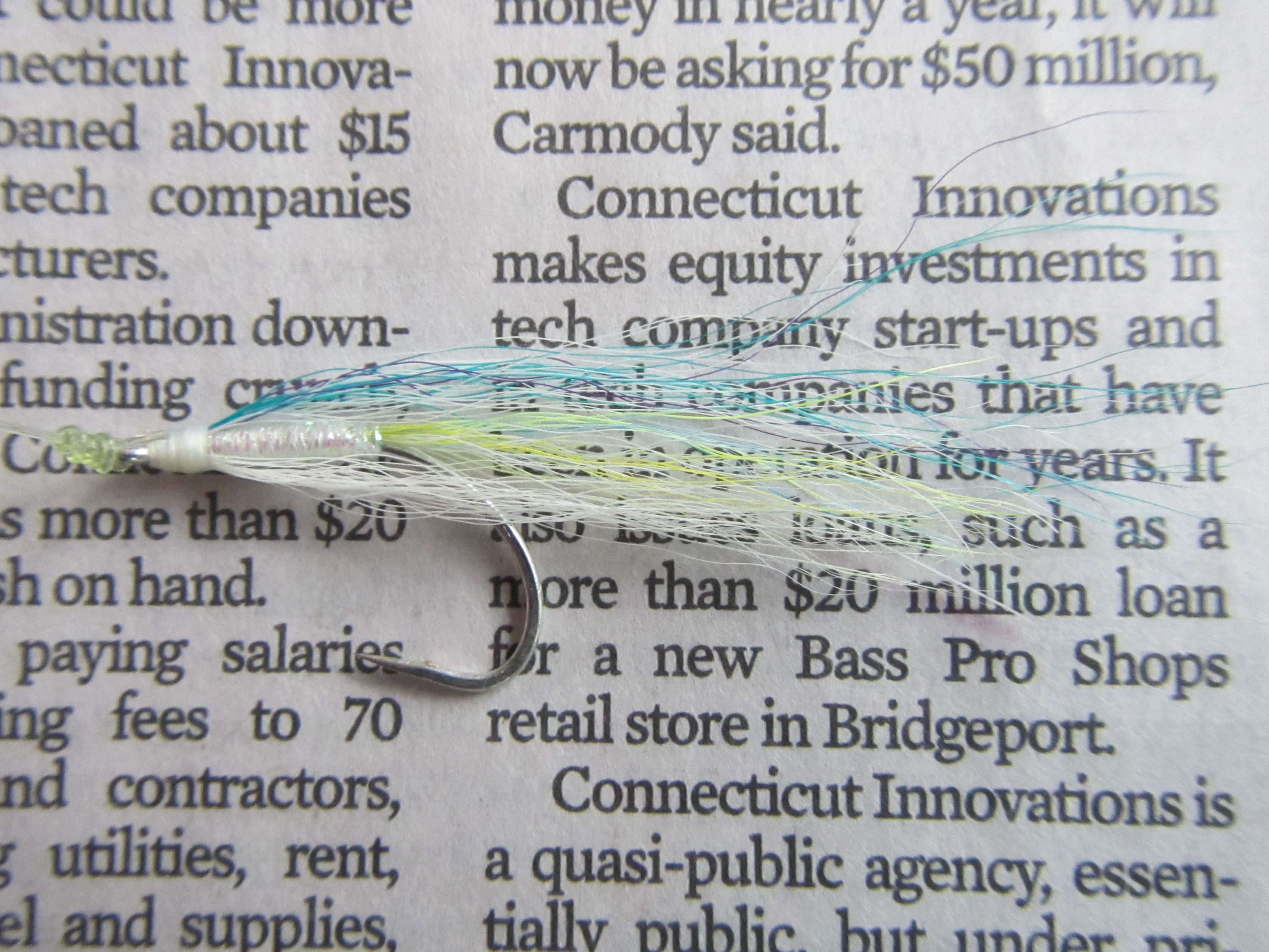
How sparse is sparse? If you can read a newspaper through the fly, it’s sparse. One of last night’s winning flies.

Sparse PB Bucktail

Farmington River Mini-Report 9/10/14: Getting there

The DEEP did their broodstock gathering/census on Tuesday, and this morning the flows were nearly back to normal. I fished four spots from 9am-1pm with varying degrees of success: a) one JV Atlantic Salmon, b) a nice assortment of wild browns in the 12″-14″ class, c) blank, d) a brown trout LDR. I stuck with the indicator nymphing thing, and I learned after my fifth (I was a little slow today) weight tag break off that one BB shot played nicer than two. The water was lower than it has been, albeit cool for early September, and it had a light stain. A bit of a funky pond smell in the air. All the takes today were nearly imperceptible; a subtle stall or shudder of the indicator, rather than its wholesale disappearance. Lift your rod, hook point finds insertion, and the dance begins. They liked the size 12 BH Squirrel and Ginger. Forgot my camera, so no photos. Sorry, Ansel.

I hope I enjoyed it, because tomorrow I shall be chained to a desk.

Farmington River Report 9/4/14: Delusions of Chrome

I don’t care how good an angler you are: sooner or later, you are going to make a mistake on the water. Sometimes you pay. Others, you still inherit the forune. On this morning, I got a little lucky.

It was another session dedicated to the nymphing cause. I hadn’t been doing any serious nymphing since there was ice along the river’s edge, and it felt good to be returning to my fly fishing roots. The first spot I visited was a blank. I fished it hard for 45 minutes, then decided to head upriver.

Another ten minutes without a take. Then down went the indicator. And this is where I messed up. I had been repeatedly reminding myself, “set downstream.” So what’d I do? I set upstream, as Eric M so eloquently expressed it, “instinctively doing the wrong thing.” Almost immediately, I corrected with a hard downstream set. Thus begineth the battle. I could see I had something good after his first impressive clear-the-water-by-a-few-body-lengths aerial, followed by one desperately ugly surface somersault. All worthy of fresh chrome. Eyeballing aside, I can always tell I have a good fish when I have an “I think I may be snagged on the bottom” moment. Then I feel that dampened head shake sensation as the fish yields to the pressure. This cantankerous creature did not want to come to net. After several runs and a short walk downstream, he was in.

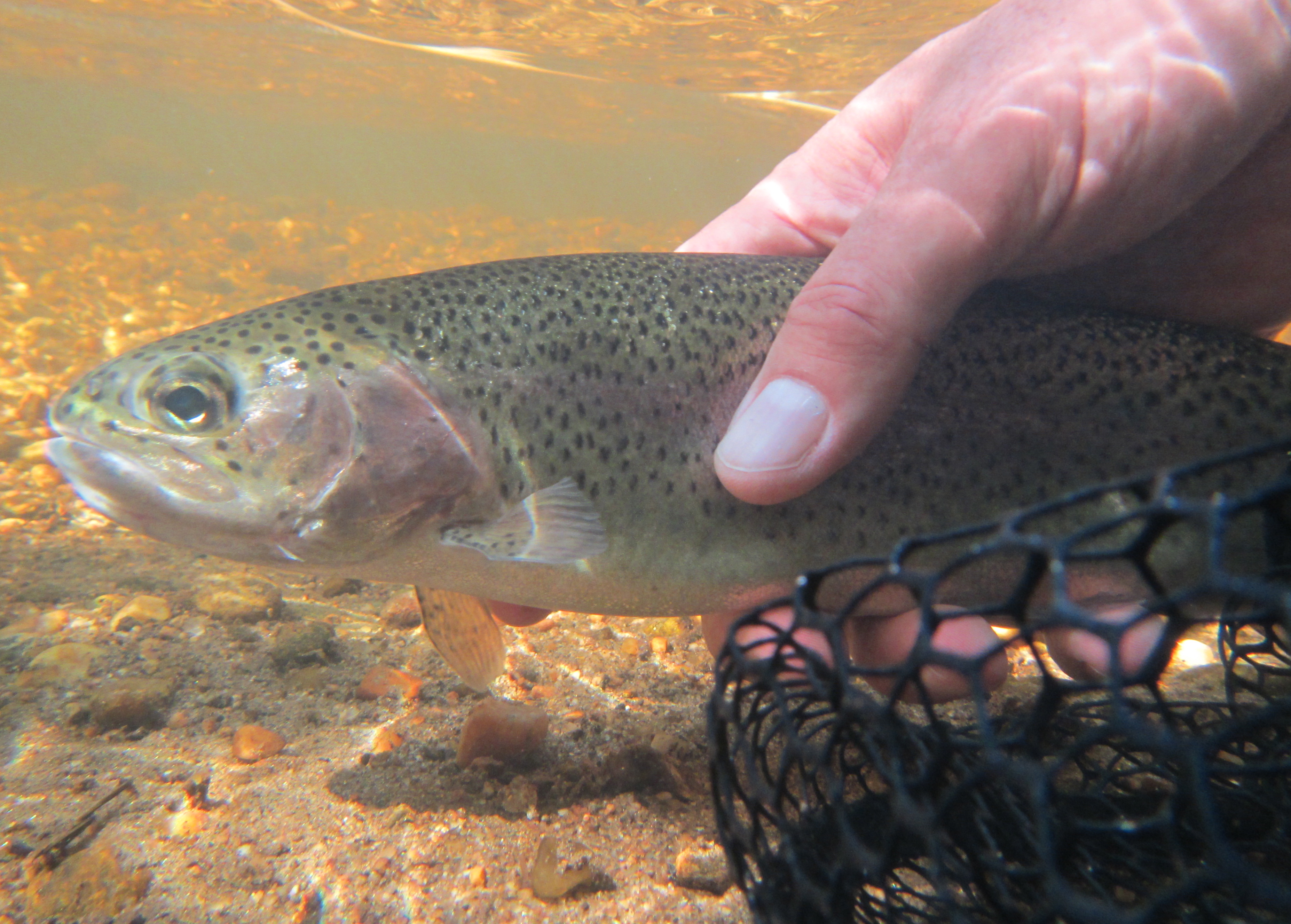
Another fish that clearly has been in the river for some time: wide pink banding, perfectly formed paddle tail, and just look at those fins. Fat, healthy, and powerful — he’s been eating well. A measurement placed it just a bit shy of the 20″ mark. No complaints here.

Big Rainbow 9-14

A few minutes later, I landed his younger brother. Then a wild brown. Spot C, another classic nymphing hole, delivered a few more wild browns. As the sun edged past its noon zenith, I fished Spot D, a collection of current seams (oh, that phrase), pockets, plunges and runs. Another brown, and then what I believe to be a brown/Atlantic salmon hybrid*. I am not exaggerating when I tell you this guy made head high aerials. (That is correct. Plural.) I figured rainbow, because of its color and acrobatics, but when I got it to hand it looked — well, different. Damn me, I didn’t think to get a picture. 

Here’s what was most fascinating to me today: I fished a two fly nymph rig with a size 12 bead head Squirrel and Ginger on point and a size 14 soft-hackle Pheasant Tail top dropper. The fish took both flies — but with one exception, all the wild browns took the soft-hackle. Again, some very subtle takes on the soft-hackle — almost like the indicator stalls for a microsecond. Set, and I was on.

The rainbows found the size 12 bead head Squirrel and Ginger to their liking.

BHS&G Nymph

*In conversations with DEEP Fisheries biologists, they’ve revealed that they think some of the more precocious Atlantics canoodle with browns. I believe this is the second such offspring I’ve caught.


Farmington River Mid-Labor Day Weekend Report

On Thursday I finally got around to making my first dedicated-to-the-nymphing-cause trip of the summer. As I was walking down to my first spot, an angler upstream — presumably trying to be helpful — shouted out, “There are no fish in there. They’re all gone.” Well, one of us is going to be wrong, I thought to myself. One hour and three trout later, I was pleased that it wasn’t me.

I fished a new nymph setup that day, a drop-shot rig. My version was a leader about 8 feet long, then an emerger-like nymph dropper on a tag of 4# Maxima, then 16″ of 5# Rio nylon, another nymph, then a 6″ tag of the 5# with 2 BB shot at the bottom. The shot tag is tied off the bottom nymph hook eye. (If I get enough interest, I will draw and post a diagram.) The point of the rig is to get the weight on the bottom where it should be, then suspend the flies at different heights just off the bottom. You can fish it neat or with an indicator. I went the indicator route. Obviously, you already know it worked. I did, however, drop three fish in the course of the day, and I wondered if that bottom fly is harder for a fish to grab since it isn’t swinging freely. More research is required. Lucky me!

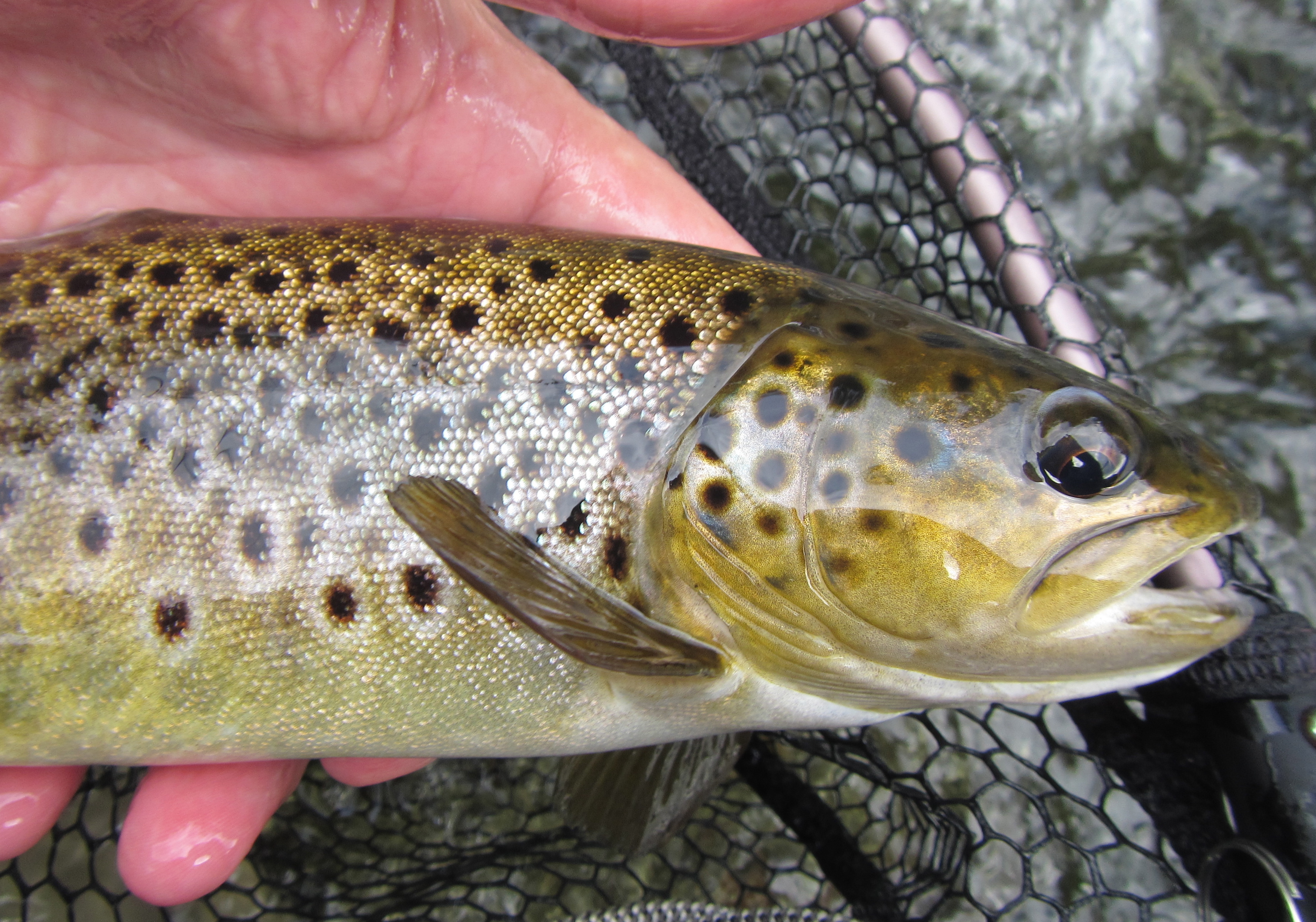
This rainbow has been in the river for a while. Well-defined pink lateral band, intact scale pattern, perfect fins.

Rainbow Release

Off to the second spot, where I landed a rotund wild brown (all the browns I took today were never wards of the state). Met up with friend Todd, and we each managed fish a ways downstream. By now, though, it was 11:00am and the bite had slowed. Away we went to Spot D, where we met up with Peter Jenkins of Saltwater Edge fame. Todd showed off by catching all the trout.

Mr. High Hook Spot D in action.

Todd Fish On

I dropped one more fish at Spot E before I had to make tracks toward responsibilities. The two flies I fished were a size 16 soft-hackled Pheasant Tail on the top dropper and a BH Squirrel and Ginger on bottom. The fish showed no preference, split right down the middle on the two.

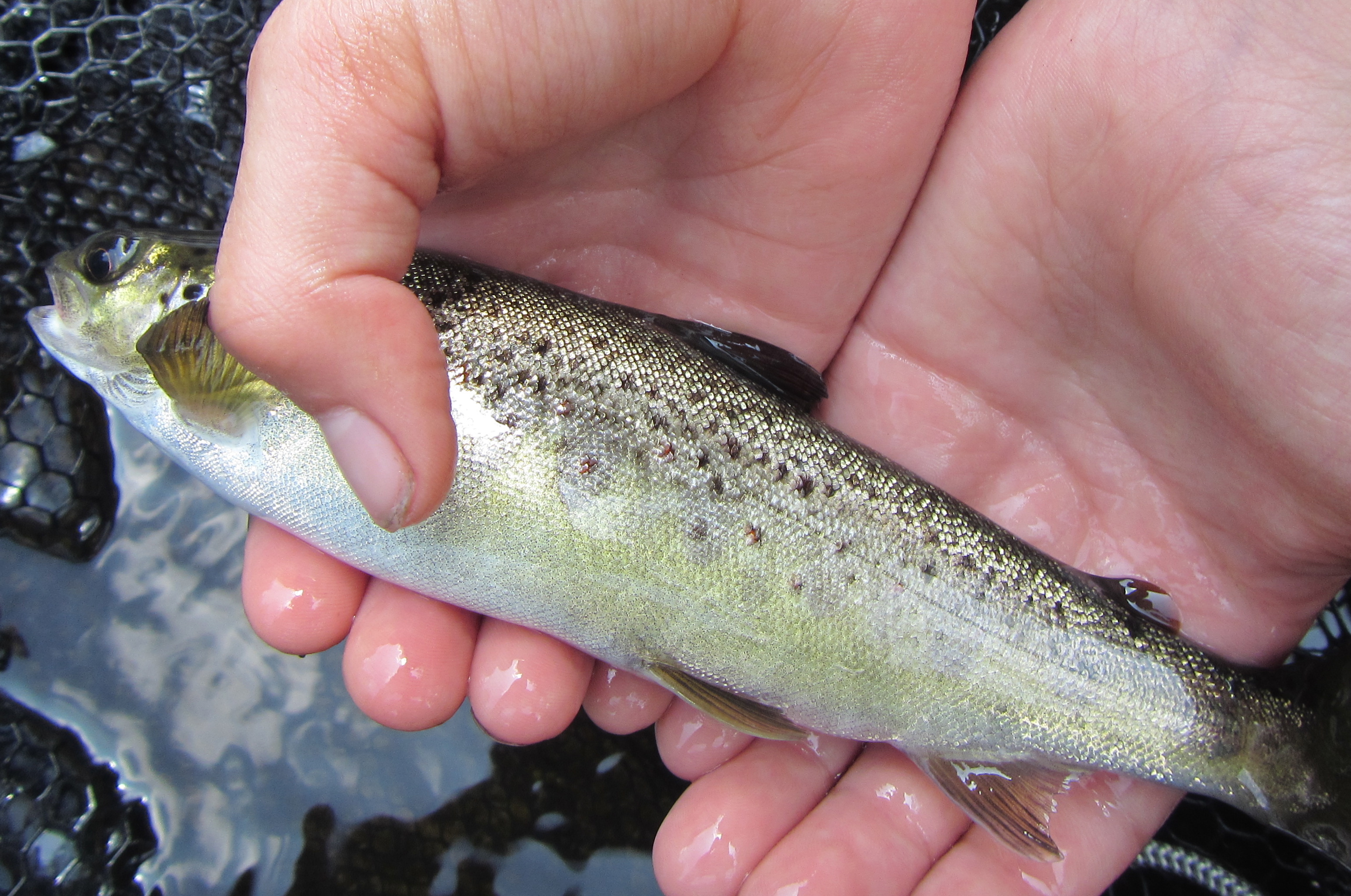
On Saturday, I was able to fish for two hours between games at my son’s soccer tournament. Wet fly was the method, and while I found plenty of fish willing to jump on, they were all juvenile Atlantic salmon. Still, a lovely interlude on the water.

I would not feel so all alone.

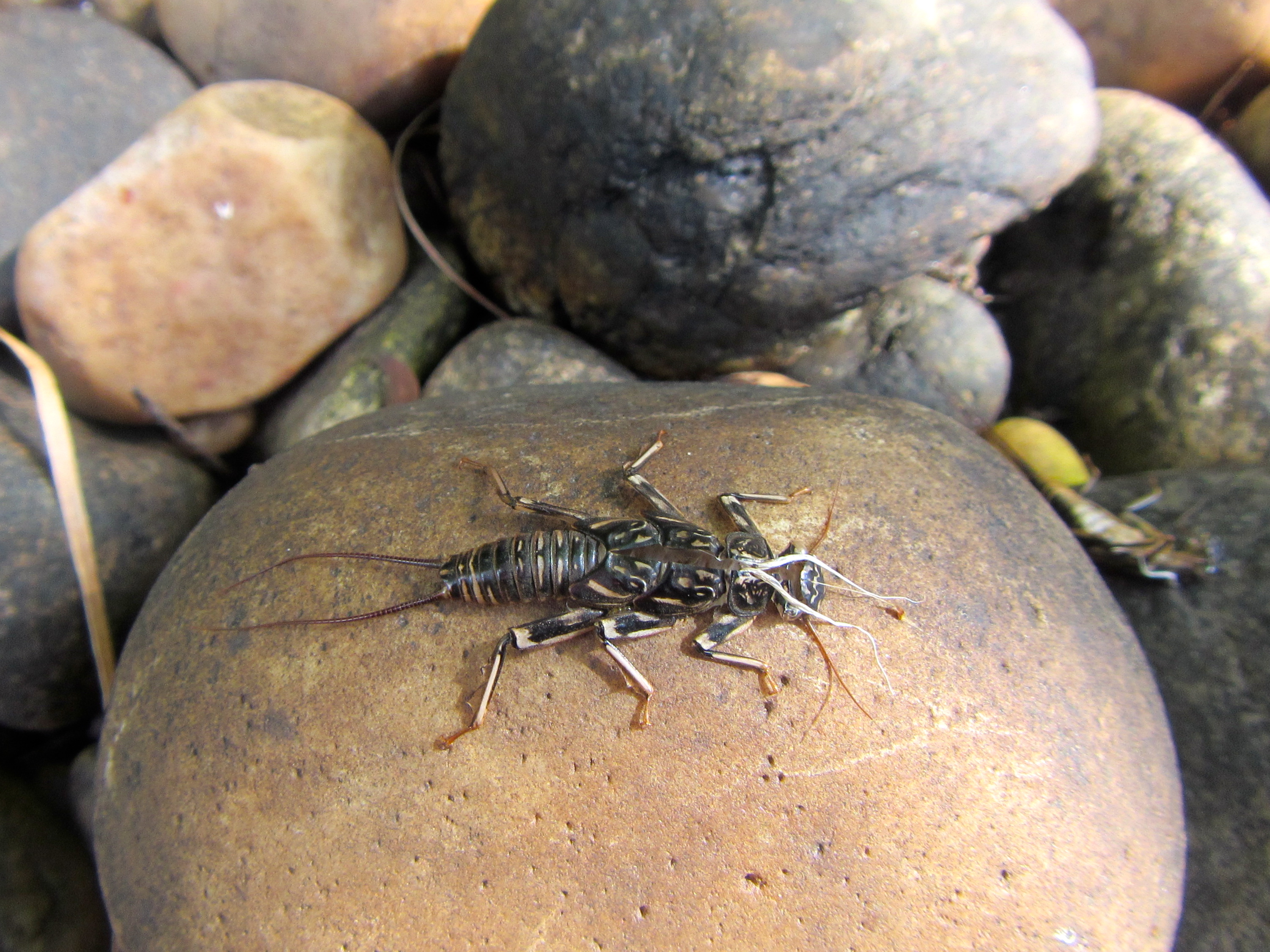
Stonefly Case

Reminder: Starting Monday, September 1, the lower TMA becomes catch-and-release.

Farmington River Mini-Report 8/22/14: Wet and wild

I had two hours to fish on Friday afternoon, so I jumped on it. I bounced around the lower river, visiting a few spots that I hadn’t fished all year. The air had a fall-like feel; it was overcast, and the river was running at 417cfs and 66 degrees. Bug activity was sparse and sporadic: a few small caddis, midges, and BWOs. 

This was a dedicated-to-the-wet-fly-cause outing. I swung a team of a sz 12 hackled March Brown on top, a sz 14 Drowned Ant in the middle, and the old reliable sz 12 soft-hackled BHPT on point. (I like a tungsten bead head fly on point when the water is running higher than normal. With a few strategic mends, it sinks the team faster, and also expedites deeper short line dead drift presentations.)

The PT was the runaway favorite fly. I hooked a nice assortment of wild browns with a few JV salmon in the mix. I had some hideous luck as well: not once, but twice I lost a good fish when he went deep and one of the flies on my team got entangled on rocks or vegetation. I lost two-thrids of my rig on the last one and called it a day.

Fat, healthy, and ready to rumble, these wild Farmington River browns are a treat to catch. Many of the takes today were subtle; more of a building of pressure on the mended swing than a clobbering hit. Good stuff.

IMG_2344

A team of three wet (fly fishermen)

And so it came to pass that the Culton men went forth on a crisp, sunny August afternoon and swung wet flies on the Farmington River. Okay. So Gordon was fishing a soft-hackled streamer, and was using a spinning rod. The point is — well, if you’ve ever taken your kids, or any kids fishing, you already know.

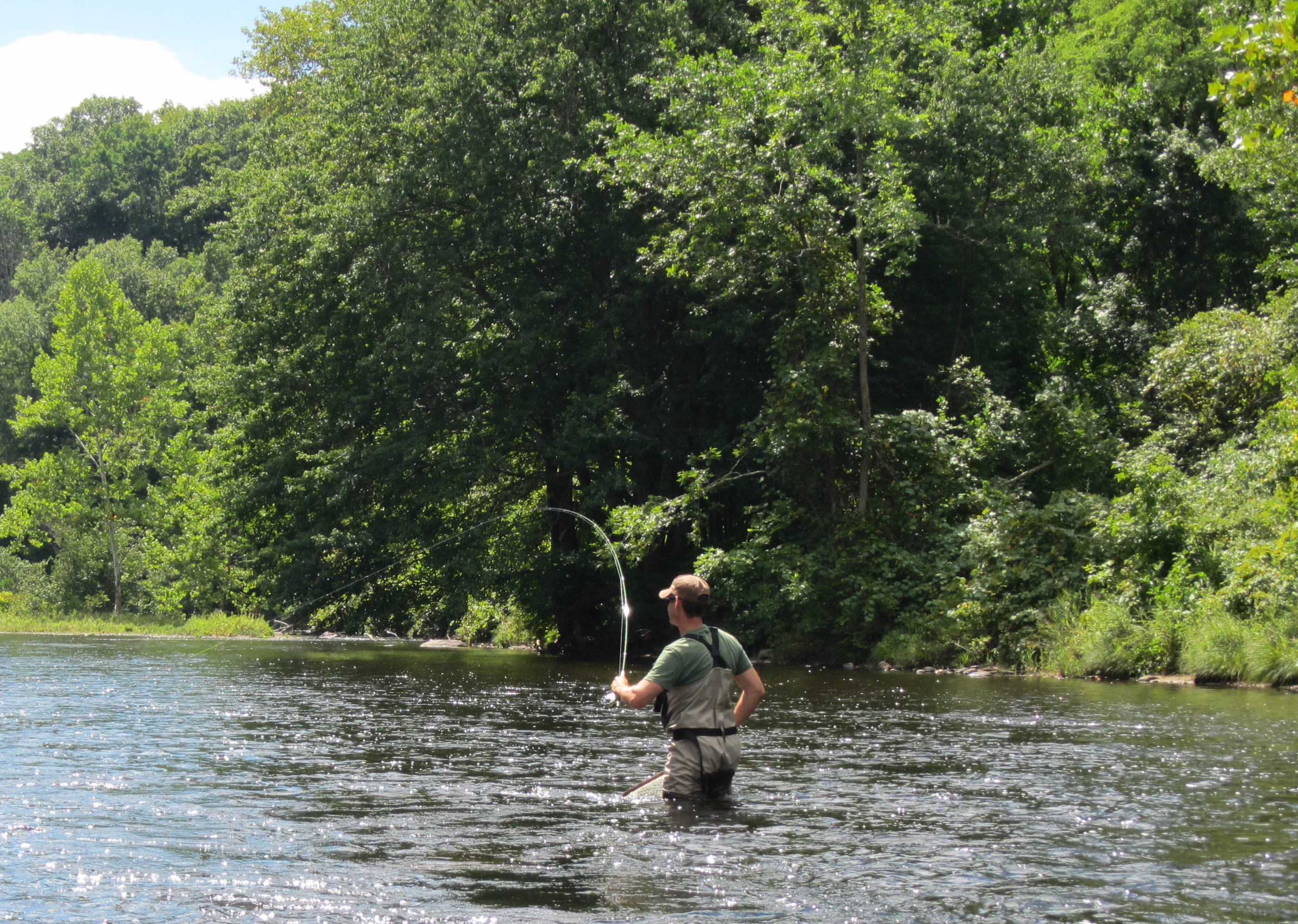
Watch out for those trees on the backcast. Cam didn’t catch anything, but he did a more than capable job casting and presenting his soft-hackles. Another place and time and he could have been well into some trout. A fly addict is born.

IMG_2334

Gordo’s juvenile Atlantic salmon. Dad hooked it on a hackled March Brown spider, Gordon landed it with the ten-and-a-half-foot rod. “Can I hold it?” he wanted to know. You betcha. Just get your hands wet, and watch out. They like to jump.

IMG_2329