I had big plans for this summer. I was going to go on smallmouth fishing binge the likes of which I’ve never experienced. I was going to conduct a bunch of experiments with presentation and techniques and different flies. I was going to find and learn some new water, and I was going to do some in-depth study of water I discovered last year.
And then the rains came. And came. And came. And kept coming. It was one of the wettest summers on record. The Housy was stuck on a black or blue dot on the USGS page for the entire month of July. August wasn’t much better.
But I’m a stubborn sort and I wanted to fish for smallmouth. I was damned if little things like flood stage and water the color of chocolate milk was going to stop me. So I went fishing. I managed well over a dozen outings, for which I am giving myself a gold star. I mostly had fun. I even got into fish. Here are some of the things I learned and re-learned.
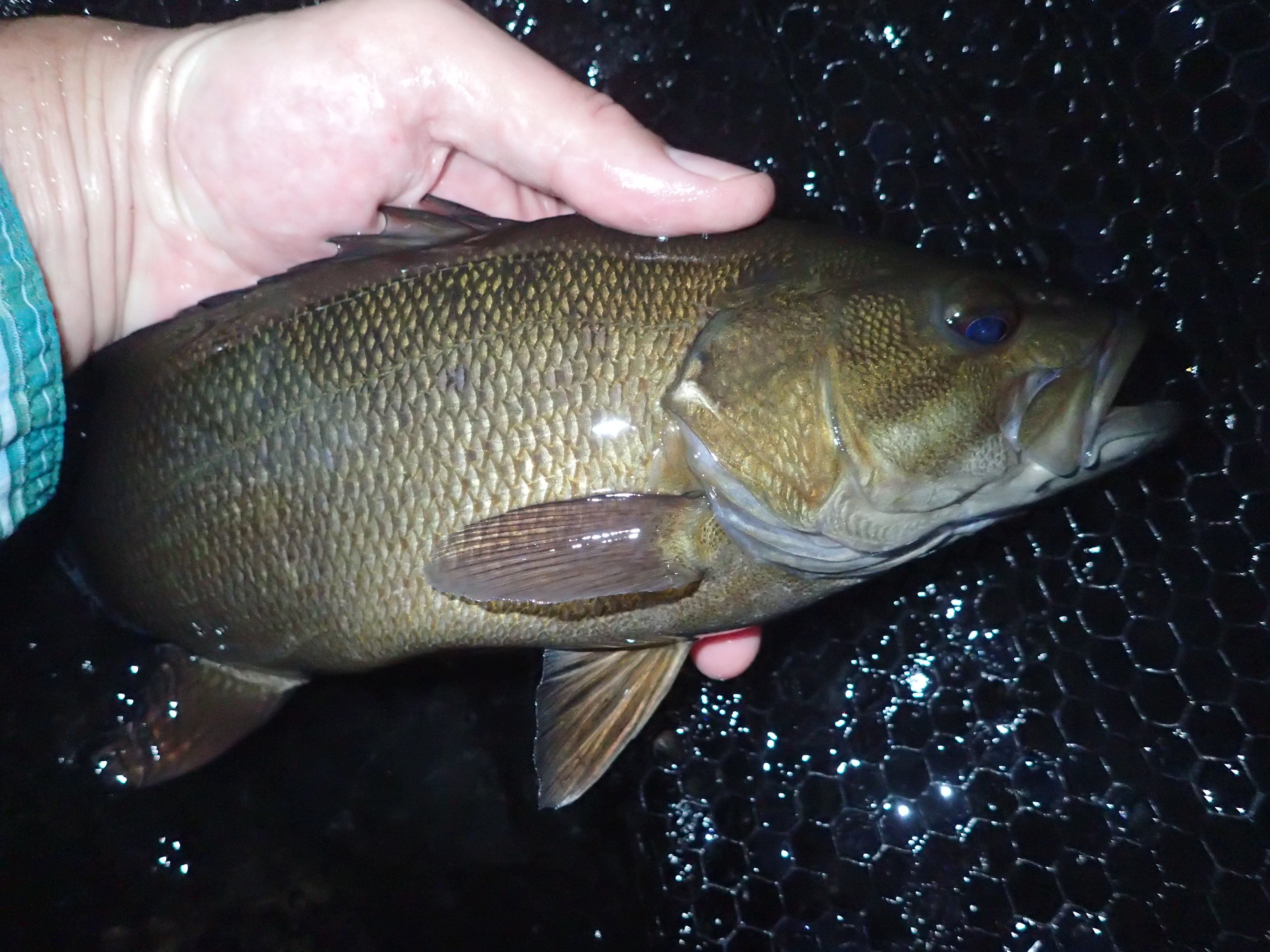
Not only can you catch fish in high, heavily stained water, you can catch some big fish in high, heavily stained water. This slob could be measured in pounds. It was one of three fish in the 16″ or bigger class that I landed, on — get this — surface bugs in a 2,300cfs flow. As it turns out, it was my biggest Housy bass of the summer. All fish were taken in water about three feet deep about a rod’s length from shore. I highly recommend that you don’t wade in water that you’re unfamiliar with if you can’t see the bottom. And don’t forget the wading staff! My apologies for the substandard photo. But it’s a nice smallie.I’d rather fish in very high or very low water than in medium-high to high flows. In the latter, there is no consistency to where the fish are from day to day, as they have enough water to virtually go anywhere. So one evening, I’d bang up a dozen quality fish in a pool. And the next, in the same mark, I’d blank or only get one or two. It’s also frustrating to have the river at a level where you just can’t wade into certain very fishy areas due to depth and current speed. I still managed to go exploring, and I fished two brand new marks with varying degrees of success. Pro tip: whether you’re fishing in high or low flows, structure is your friend, as are current breaks between faster water and slower water. Here’s the proof.In high water, hatches go on. Not only did this’s years White Fly hatch happen, it was one of the stronger showings I’ve witnessed, and it went well into August. Sadly, the surface action was virtually nil, although I did manage a few bass on dry flies over the course of the summer. Wet fly action was a little better, but if you know there’s likely to be a strong hatch, fishing well under it — AKA nymphing — will put a very big smile on your face. I didn’t see that many black caddis this summer, but there were a bazillion sedgy-white caddis, size 18, most afternoons and evenings. The bass liked them a lot. Some things didn’t change. There continued to be a shutdown moment right as dusk transitioned to darkness. And the Countermeasure continued to produce quality fish at that moment. I had several foot-plus bass on that fly as my last bass of the outing. Here’s to better conditions in 2022!
Just a quick report on a lovely small stream. I fished from noon to 2:30pm, not the best time of day, but since there was canopy and cloud cover I didn’t sweat it. That is, until I began hiking thought the woods. It wasn’t a particularly hot day, but I was drenched by the time I reached my starting point, and it wasn’t from rain. The brook was lower than I’d anticipated, but that just meant that most of the players were going to be found in the plunges and darker, moving-water sections. I committed to the dry fly cause, and I had more action than I did the last time I fished this stream back in the spring. The final tally was 10 pricked, 1 landed, and most of the fish were in the sub-4″ class. (I will purposely fish a larger dry so the little fish don’t get hooked or stressed. I’m all about the joy of fooling them.)
…and not much happens. Surfcaster extraordinaire Toby Lapinski and your humble scribe gave it the old college try last night for close to three hours. (Note the lack of large bass photos — heck, note the lack of any bass photos.) A couple small bumps for Toby and not even a courtesy tap for me. Although I did have a couple weird moments of pressure on the drift, my fly sweeping across a reef, no hooksets were forthcoming. It was probably something small. Light show: we were treated to a spectacular electrical display as a storm moved across western Long Island. Funny thing: that storm produced a sudden cold NE breeze and some raindrops on what was otherwise a calm night. So it goes. Round three to the bass. I gotta get some points on my card, so I’ll keep punching. This mark has yet to produce for me, but I believe it will. Then we’ll see some bass photos.
The main bait continues to be menhaden, juvenile and adult, and silversides. We also saw plenty of crabs, so there’s no shortage of food. The bass were simply somewhere else.
I fished the last two evenings at various marks in SoCo and enjoyed….not a touch. Well, that’s not entirely true. I felt every weed that brushed against my three fly team. Last night I accidentally snagged a few small menhaden. But nothing living that could be measured in pounds came in contact with my fly.
I fished inside a breachway in moving water, incoming and outgoing; in a pond area of an inflow; off a jetty; and from the beach. Not even a courtesy tap. I saw and heard a few stripers, but they were small and their presence fleeting, and I never really had a good shot at a target. Bait, on the other hand — wow! Masses of bait everywhere. Silversides, menhaden, and mullet in mother lode Vegas jackpot numbers everywhere. I don’t think I’ve ever seen such immense, dark clouds of menhaden.
The fighting is rounds. This was round one.
I’ll take menhaden. Look for an upcoming article from me in Field & Stream on matching fall run bait with classic striper flies.
I wish I had all good news for you, but once again we will be experiencing challenging conditions on the West Branch. Let’s start with flows. The Labor Day weekend party is over as they’ve jacked up the dam release to 1,100cfs:
And we’re back to water temperature rearing its ugly head. Look how the release temp spiked with the increased flow:
In a word, ugh. There’s nothing to be done about the flow increase, as the MDC needs to maintain a certain safe reservoir level in case of hurricanes. But the news isn’t all bad. Torrey Collins says the Still River is actually a cooling influence, and the long range forecast calls for overnight lows mostly in the upper 50s, so that’s going to help. Who knows when the DEEP will stock, or if they’ll even do a Survivor Strain broodstock gathering. I’ll do my best to keep you posted. In the meantime, I’m heading for the salt.
In a normal summer, August water temps are not an issue on a tailwater like the Farmington. When you get into an extended heat/drought matrix, it’s easy to see how water temperatures can get dangerously high for trout. Less obvious is our current situation. As a result of blowing so much water out of the reservoir — July was the third wettest month on record — the lake is now less temperature stratified. What’s coming out of the bottom isn’t in the upper 50s, but rather in the mid-60s. The issue becomes one of day and night-time air temperatures, and sunshine. Lower and lesser is better. The one current saving grace is that there is still a lot of water moving through the system, and more water means it’s harder to heat up. (Yesterday was 540cfs in the Permanent TMA, and 610cfs in Unionville.)
So, please try to use common sense. Check water temps before fishing, and pick and choose your locations (closer to the dam is better) and times (morning is best, cloudy days, and after the sun goes behind the hills also works) — not to mention your tippet and landing strategies. With that in mind, I was curious about both water temperatures and trout vitality. I fished a mark below the Permanent TMA for an hour yesterday, late afternoon. The water temp was below 70. It was a fast-moving, riffly/pocket water section that was sure to be highly oxygenated. I was fishing a team of three wets with Maxima Ultragreen 4#, which is strong enough to quickly land any Farmington River trout. Finally, I resolved to strip in anything I hooked fast. I stuck four fish and landed two. The two I landed were brought to net in under 15 seconds. They both looked and behaved like very healthy fish, with no signs of stress.
This was a surprise. Given the conditions, I debated the merits of taking a photo, but I can tell you this with certainty: the char was landed in 10 seconds, kept within the net in moving, oxygenated water, then removed for 3 seconds for the photo. All we can do is our best.
Drat this cursed rain! Last year the river was pathetically low. This year it’s disgustingly high. The upper Housatonic has been mostly unfishable this month, and as a result we’ve missed out on what’s normally a very productive period. I’ve been feeling bitter about the whole thing, so I decided to take a drive out to the river and see what the conditions were first-hand, and maybe even wet a line. You know — you don’t know if you don’t go.
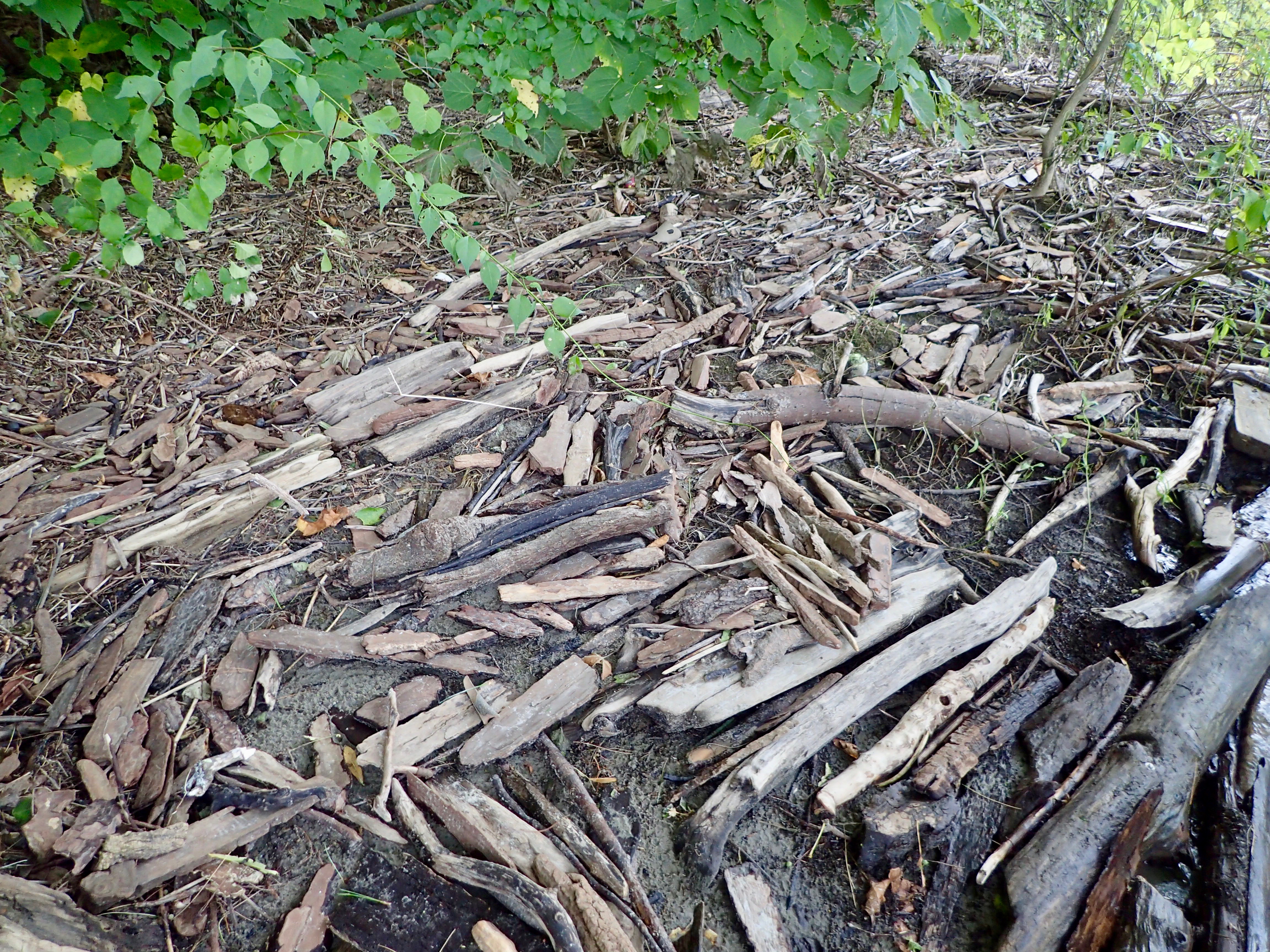
After peaking around 7K cfs, the river dropped about a thousand cfs a day in the trout TMA until it stalled at 2.1K. It’s holding there now (with more rain on the way, of course). At 2K+, the river is either raging whitewater or a vast, featureless glide. This mark is normally a series of riffles and pockets that dumps into a deeper run flanked by frog water on one side and a rocky flat on the other. Now it’s this garbage.Speaking of garbage, the shores are littered with debris. Most of it is natural, like this driftwood, but there are also tennis balls, plastic bottles, and other man-made crap. This photo was taken ten feet away from the present water line. My heart sank at my first sight of the river. I don’t know why, but I expected that perhaps the water would have cleared up a bit. Wrong. Depending on your location, its color ranges from tea-stain to chocolate milk. Visibility ranges from one to two feet. The culprit is silt, which is everywhere, particularly along the riverbanks. Your first couple steps off the bank will be a sinking experience. Never wade into low/no visibility water unless you know the bottom structure intimately, and then, never stray into the current. Studded boots and a wading staff are a must. Be smart and stay safe.Here’s the thing: fish don’t know that the river is flooded. They’ve still got to eat. While you can’t wade to places you’d normally fish in high water, the beauty is that the bass aren’t out in the raging torrents — they’re in the calmer water close to shore, particularly as the daylight transitions to dusk. I fished two evenings this week. One was not good — only one 8″ smallie to hand. The other was a little better, including this slob that could be measured in pounds. What a battle in a 2K flow!
After last year’s feast or famine full-moon struggle, I was really looking forward to fishing the dark of the moon on Block. To add to my excitement, the shore fishing in the weeks leading up to my trip was en fuego. I’ll quote Chris Willi of Block Island Fishworks: “I haven’t seen this much bait and bass and blues and shad in the pond in 20 years.” Captain Hank chimes in: “There’s life in the drink everywhere!”
By the time I arrived, it was all gone.
The front that came through on July 4th weekend sent everything packing. To add to the weather mischief, tropical storm remnants swept through mid-week and further cocked things up. The result was some of the poorest fishing on Block I’ve experienced in the last decade. A dozen fish over the course of seven nights was the best I could do, and I felt like I did really well given the conditions. To give you some perspective, I got a dozen fish or more on four different nights last year. I did not see another angler catch a striper from the shore, fly or spinning, for the entire trip. I did not speak to any anglers who managed more than two stripers the entire trip. Perhaps worst of all, this is now the third consecutive year that I have not caught a bass over 28″ on Block. Not good.
The Cut was a barren bait and striped bass wasteland. Charlestown Beach likewise. The flats fishing, my favorite form of Block Island fly fishing entertainment, stunk. Even the East side beaches were spotty, with a fish here, a fish there — and that’s if you could find a weed-free zone. And yes, I hit up the South side and SE sides. Blanks.
But enough kvetching. There were some positives. I did not blank on any night. I fished three marks that I’d never fished before, and found fish in two of them. (In fact, one of them became my defacto skunk saver.) I loved all three spots, and I will be adding them to my rotation. I spent more time fishing open beaches in wind and wave, and the two-handed cannon once again proved its mettle. On the opposite side of the rod spectrum, I finally baptized my five weight with a Block Island bass. And let’s face it: anyone who gets to spend a week banging around Block Island with a fly rod and a humidor full of premium cigars has a pretty good lot in life.
There’s always next year.
Now, if the rivers would just come down so I can harass some smallies.
I fished a mark on the Hous last night from 7pm to 9pm, and it was very, very slow. By the time I reached the water, there’d already been a strong caddis hatch (mottled light tan, size 16) and there were sulphur spinners in the water. A few smaller trout and smallmouth were eating bugs, but I they were in some deeper water, way out of casting range. The flow was medium and lightly stained; the water really hasn’t warmed up yet and I find the smallie fishing goes better when it does. Bugs I fished were the TeQueeley, Gurgler, Mini D&D, Wiggly, and Countermeasure. Well, I did try some nymphing, but I don’t think I got deep enough. I had a hysterical swipe at the indicator from a little fish as I was preparing to cast, but mostly I practiced presenting and conducting experiments. (I have a lot of experimenting to do this summer, and I’ll let you know at some point how it goes.)
It wasn’t until 8:30 that I connected with my first smallie, a respectable 10″ fish. Right at dark I started pounding the shallows with the Countermeasure, and I was rewarded with my first good smallmouth of the year. But that was it, leaving me alone on the river with the bugs and my cigar.
Not too shabby, just about two pounds, and a worthy opponent on a five-weight. I have only the utmost respect for the power and doggedness of these creatures. They just don’t want to come to net.
Forgive the brevity, but here’s what happened. I fished from 5:30pm-9:15pm. I started way far below the TMA in search of smallmouth. I managed one on a Gurgler, and a rather large fallfish on a wet fly. The river was lightly stained and running at a normal 575cfs. Water temp was upper 60s. After 90 minutes, I was unimpressed with this mark, so I headed up to the TMA. A massive caddis hatch had occurred, and size 16 tan caddis blanketed the rocks along the shore and swirled everywhere. They were soon joined by a strong showing of sulphurs and Cahills. I managed a stout smallie on a streamer, but the sight of trout eagerly snapping at emergers had me switching to wet fly in a hurry. First cast, bang, and it was all fantastic action until dark. I made the switch to dries around 8pm, and for a half hour it was a trout on every cast. They were greedily feeding just like they do during a Hendrickson emergence, mouths open, launching at the fly. It slowed a bit until I called it at dark, 9:15, but I was still catching on Light Cahill Catskills dries and Usuals. A few rainbows in the mix but mostly browns. With elevated water temps, I used 4x tippet so I could get the fish in fast. All of them looked very healthy. Hopefully they will find the thermal refuges before the water gets too warm.
One of many customers, all of which have been eating well. Spectacular dry fly action!







 currentseams.com