As the weather turns cooler, small stream anglers begin dreaming about their favorite thin blue lines. It should be a great fall season — we had a very wet summer and the natives and other wild fish are in great shape. But along with fishing for wild trout and char comes great responsibility, to both the fish and the resource. Here are three things you can do preserve and protect wild fish.
Minimize fish photos. Anglers with cameras have needlessly killed more small stream wild trout — intentionally or not — in the last 10 years than in the previous 100. You can blame it on the convenience and portability of digital devices. You can blame it on social media. Or angler narcissism. Or all of the above. One solutions is: take no photos, or Take The Wild Trout One Photo Challenge.
Accordingly, do you really think we need a photo of every wild fish you caught on your last outing? Dr. Rick gives the same answer: no.
Be on the lookout for redds. Fall is spawning time for wild brookies and brown trout. Learn how to identify a redd, the nesting area for spawning fish. And please, stay out of the water. The eggs you don’t crush will be the trout you’re catching in a couple years.
Keep Fish Wet. Catch-and-release is useless if you’re ignoring its fundamental best practices. Learn to do it right, and you’ll have more wild fish to catch on your next outing.
My deepest apologies for being Debbie Downer — if you’ve been following the Farmington River situation, you know it’s been a constant stream of un-good news — but the bureaucrats at the ASMFC are at it again. Instead of moving forward with Addendum II (the next step would be to release it for public comment) they’ve chosen to delay the process at this critical juncture.
Here are two resources to get you better better informed. The first is from our friends at the American Saltwater Guides Association. I encourage you to read Striped Bass Board Delays Addendum II in its entirety. Especially if you’re in a good mood and need a reason to get mad.
I’ve always liked horseshoe crabs. Not because they are living fossils that pre-date dinosaurs (the species is roughly 445 million years old). Not because they aren’t really crabs (they are in the spider and scorpion family). Not because their unique blue blood is used in critical biomedical testing. No, horseshoe crabs are just so gol’ dang awesome to look at.
Not that anyone reading this would, but it’s now illegal to harvest horseshoe crabs in Connecticut waters. They’ve been declared “functionally extinct” in Long Island Sound. You still see them — at least I do — so take care where you walk and wade. If they’re mating — you’ll see several males latched on to a female — let them do their thing.
Image courtesy of the National Wildlife Federation.
Most of all, if you see anyone harvesting horseshoe crabs in CT waters, it’s illegal. There is no longer a special license. Call EnCon Police at 860-424-3333. If you see a stranded horseshoe crab, you can gently lift it by its shell and return it to the water. Thank you.
If you woke up this morning and checked the Riverton gauge, you were greeted to the incredible sight of 1070cfs (now 1240cfs). This, of course, is due to the MDC, under the direction of the Army Corps of Engineers, needing to bleed water from an overfilled reservoir. We’ve been pounded with excessive rain in the last week, which is a good thing. Or is it?
It’s tricky. On the lemonade side, we have water volume just at the right time. 68cfs and an oppressive heat wave do not make a good mix for the survival of trout. From that perspective, this is a good thing. On the lemon side, we have an unusually high water dump that cannot be sustained. Those of us familiar with the total disregard the water gatekeepers have for the natural resource can easily imagine a sudden, catastrophic drop in water levels that will no doubt do damage to trout and invertebrates. The question must be asked: Could you not have released a steady 250cfs, the average release, for the entire month of June, with your already near-full reservoir, thereby avoiding this wasteful dump? (We’ll get to that answer in a moment.)
One thing is certain: a sustained 1K+ water dump is going to hemorrhage irreplaceable stores of cold water. In just one week, we’ve gained 5 degrees of released water temperature:
That sub-50 degree water isn’t coming back until we get some very cool fall nights. The reservoir simply cannot re-stratify in the heat of summer. It’s happened in recent years: the flow from the dam is robust, but it’s coming out at temperatures that are close or at the stressful threshhold for trout.
Never was this resource so ridiculously managed, and it’s all because of money. In what has to be one of the most absurd contracts in the history of water management, the MDC actually saves money by ignoring requests from downstream stakeholders for increased flow. At a recent meeting, the MDC head stated that they currently have no mechanism for releasing more water than the legal minimum or what the Army Corps orders for flood control. That’s not entirely true. They can release water called for for power generation downstream — and pay a fee of $1 million to do so — or ignore such requests and pay a fee of $250K. So MDC has decided to keep their $750K and screw everyone else who uses the river for recreation, screw the wildlife, and screw those of us who depend on the river for income.
To that last point: I should be on my way to the river right now to give a wet fly lesson, but I’m not. I had to cancel. So, I’m out a guide fee today. It’s not that big a deal to me. Because unlike the MDC, I’m not completely beholden to profit.
Spoiled, selfish children have a habit of poor behavior when the game isn’t going their way. Their frustration reaches a boiling point. Then they grab their ball and storm off in a petulant frenzy. The result is that the game is over and ruined for everyone. The spoiled child in this case is the person (or people) in charge of making the flow decisions for the West Branch of the Farmington River. And once again, they’ve decided that if they’re miserable, everyone who uses the river for recreation should be miserable.
For years, it’s been no secret that the MDC doesn’t care about managing the West Branch as a viable tailwater fishery and recreational resource. For over a year now, their unconscionably selfish reaction to not wanting any further financial responsibility for Hogback Dam has been to release only the minimum flow as-required-by-law. Anglers be damned. Canoeists, kayakers and tubers be damned. Business who depend on robust river flows be damned. Fish and wildlife be damned. It’s their ball, and they’re taking it away in the name of corporate greed.
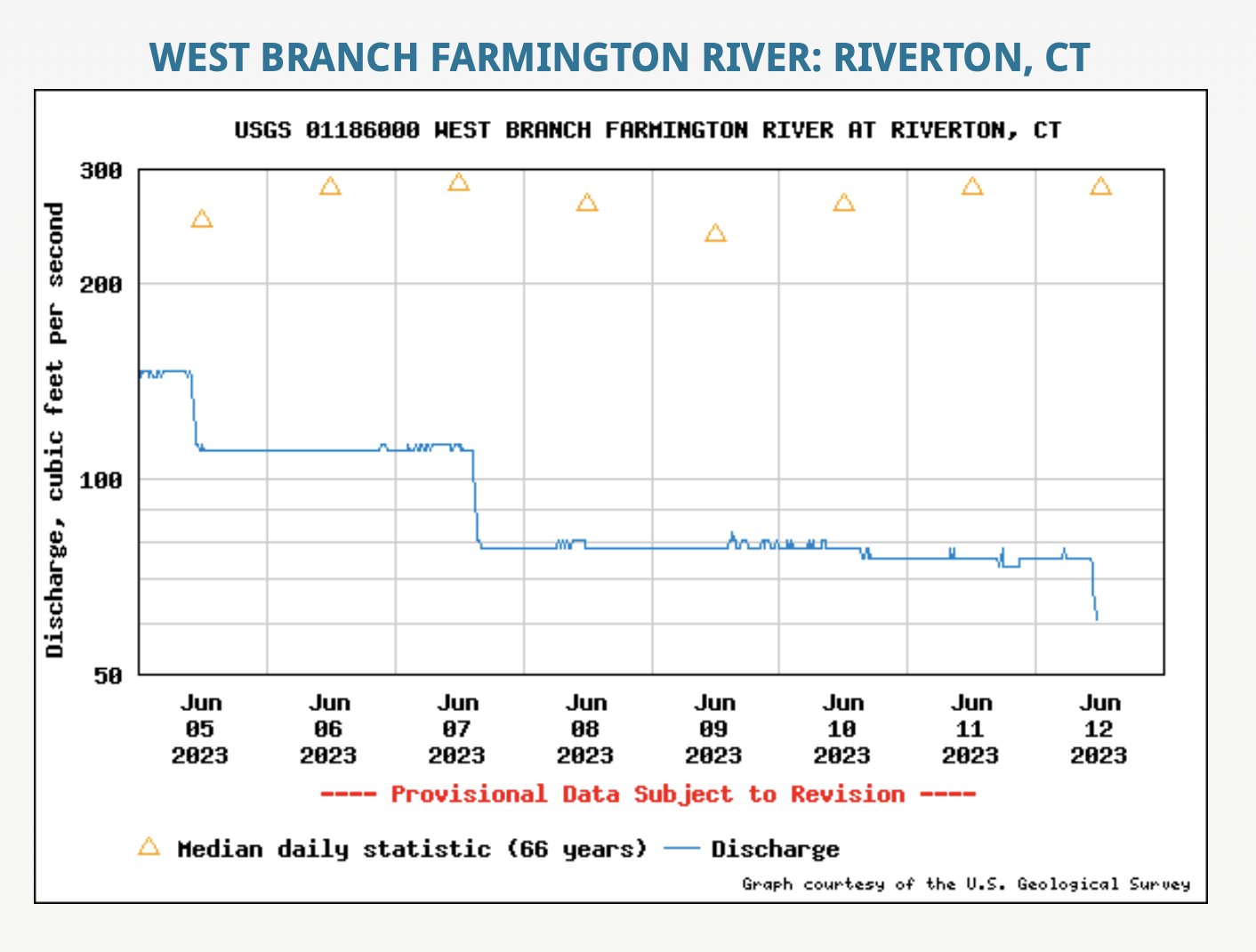
What’s wrong with this picture? As the flow drops like a stone toward the bare minimum — and let’s note that the reservoir is nearly full — you can see that the dicks at the MDC are releasing nearly 200cfs less than they normally do. Score one for corporate weasels!
If it’s all too confusing, this one-page, one-side sheet explains the legal flow requirements for both Colebrook and Goodwin dams. We thank the Farmington River Watershed Association for providing it. And we damn the MDC for reducing flows and damaging our river, simply because they can.
In the meantime, we can only hope for rain up north, which would require the MDC to release more water — and more rain locally, which would bump up the Still River.
Another appearance in the online bible/journal/diary of surfcasting! Out subject in Issue 78 of Surfcaster’s Journal is the two-handed fly rod — 2Her for all you cool kids — and a little bit about how I made the journey from single hand to being able to laugh at the wind. It’s part story, part how-two, and it’s all designed to help you eliminate some of the mistakes I made along the way. Oh. Yes. There are fish to be caught, too…Surfacster’s Journal is a pay-to-read e-zine. You can get a copy here.
Extra! Extra! Read all about it! CT man finds two-handed surf rod nirvana!What strange brew is striper addict and master tea boiler Mike Oliver concocting? It comes in the form of a two-handed cannon called the “Out Front.”
This weekend, I received a question about tying Leisenring’s March Brown Nymph. The reader wanted to know if I thought three pheasant tail fibers for the body was enough. As you can see from my original writeup, I had a few initial questions (or opinions) about the recipe as well. Here’s a little more about my M.O. when I’m tying a pattern for the first time.
I always like to honor the original recipe — at least in the beginning. I want to see what the the tier had in mind, what his or her vision of the pattern was, and perhaps try to figure out what they were trying to accomplish in terms of materials and look. In the case of Leisenring, a giant in the pantheon of American wet fly fishing, respect to the original was surely due. If Big Jim liked the pattern enough to include it in his book, that carried a significant weight. But, even if the pattern creator isn’t on the fly fishing Mount Rushmore, I still like to stick to the original design.
Now, there’s nothing that says you can’t improvise. Indeed, countless patterns have been improved upon because other tyers asked, “what if I?…” So, for example, if there’s a stone fly pattern I’m tying and I think — do I really need that wing case? — I might leave it out after a few iterations. If you’re really curious about discovering the necessity of certain elements or materials, use droppers. Tie one fly according to the original, and then tie one fly your way. Place them on droppers, change the positions frequently to keep it a fair fight, and see if the fish have any preference. Droppers are always the fastest way to find out what the fish want.
I hope this helps. Tie on, ladies and gentlemen.
The Steelhead Hammer (shown here) recipe I found all those years ago specified stretch floss for the underbody. I hated the stuff, so I don’t use it anymore. The original Tom’s 60-Second Redhead called for a mix of beaver, Angora, and flash. I use plain black rabbit fur, and the steelhead seem to like it. And so on…
Many thanks to my old friends at the Narragansett TU Chapter for hosting me last night. It’s so wonderful to see everyone again, and I thank TU225 for their continued support. The topic was fishing the Farmington River’s West Branch (the official title is: The West Branch — Southern New England’s Blue Ribbon Trout Stream). It’s an overview of the river that covers everything from popular pools to hatches to gear to when and how. If you’re looking to fill a presentation slot for your club this spring, I still have open dates. Here’s a link to my current presentation menu.
Speaking of the Farmington River, here’s an info sheet — one page, one side — that gives you some good, basic information on the Goodwin (AKA Hogback Dam) and Colebrook Dams. It doesn’t explain the dispute between the MDC and the ACE — or why the MDC is holding the river hostage — but at least you can understand why the water releases have been the way they have been. (What a shock! It’s all about money.) Many thanks to Farmington River Watershed Association for sharing!
In case you don’t know, here’s a micro-brief recap: since last summer, the MDC has, for whatever reason, been releasing only the minimum amount of cfs required by law from the Hogback dam. This has resulted in, at times, unnecessary ultra-low flows, transforming the Farmington River from a lush aquatic playground into a pathetic rock garden, and certainly damaging fish and wildlife populations. To my knowledge, no one knows what the MDC’s end game is.
Right now, a group of state senators is crafting legislation that seeks greater transparency from the MDC, albeit in the form of such things as an ethics code and approval on water rates. This doesn’t really help anglers; however, the Connecticut League of Conservation Voters and the Rivers Alliance of Connecticut are also involved. I plan to reach out to those groups and to the biartisan state senator group to voice my concerns. I’ll let you know what, if anything, I find out.
I do know there is going to be a specific forum in the future for concerned parties to express their concerns about the unconscionable way the MDC is treating the river. When I get data’s on that public comment event, you can be sure I’ll post more about it here.
Man, I really need to get out and fish.
The river should look like this. You know, where you can’t see the bottom half of those boulders…
I know from procrastination. I’m a professional writer. I’ve been procrastinating since my days at Roosevelt Junior High. I advanced my grasp of the art form in college. And perfected it as an adult.
But I’ve got nothing on the ASMFC’s Striped Bass Management Board.
My best attempt at situation distillation is this: the Board was meeting on the issue of allowing the transfer of commercial quotas between states. They put the issue out for public comment last year. Of the thousands of conscientious stakeholders who responded, a whopping 98% voted in favor of NOT allowing transfers. So the board decided to…(Don’t bother with a drum roll. You probably know where this is going.) …kick the can down the road. Do further studies on the impact of commercial transfers, then come back to the issue in May. Not necessarily awful. But they didn’t even mention the option that the vast majority of stakeholders favored. It’s as if we didn’t exist. Tone deaf, bad form, and so characteristic of a badly broken committtee.
There are two more detailed analyses that I encourage everyone to read. The first is from Charles Witek’s blog One Angler’s Voyage: The Fastest They’ve Ever Done Nothing. The second is from our friends at the American Saltwater Guides Association, Striped Bass Recap From ASMFC Hearing. Both are highly worthy of your time.
At this point it would be easy for all of us to throw up our hands in frustration and quit. I exhort you to not do it. In fact, this should only steel our resolve. Some day, and that day is coming, we are going to win. And so will the stripers.
Waves pounding on the shore. That’s what we need to be.





 currentseams.com