My second Symposium is in the books, and like last year, I had a most wonderful time. Saturday was the busiest of the two days, both in terms of my schedule and attendees. After getting set up and saying my pre-show hellos, I tied up a storm before my noon seminar.
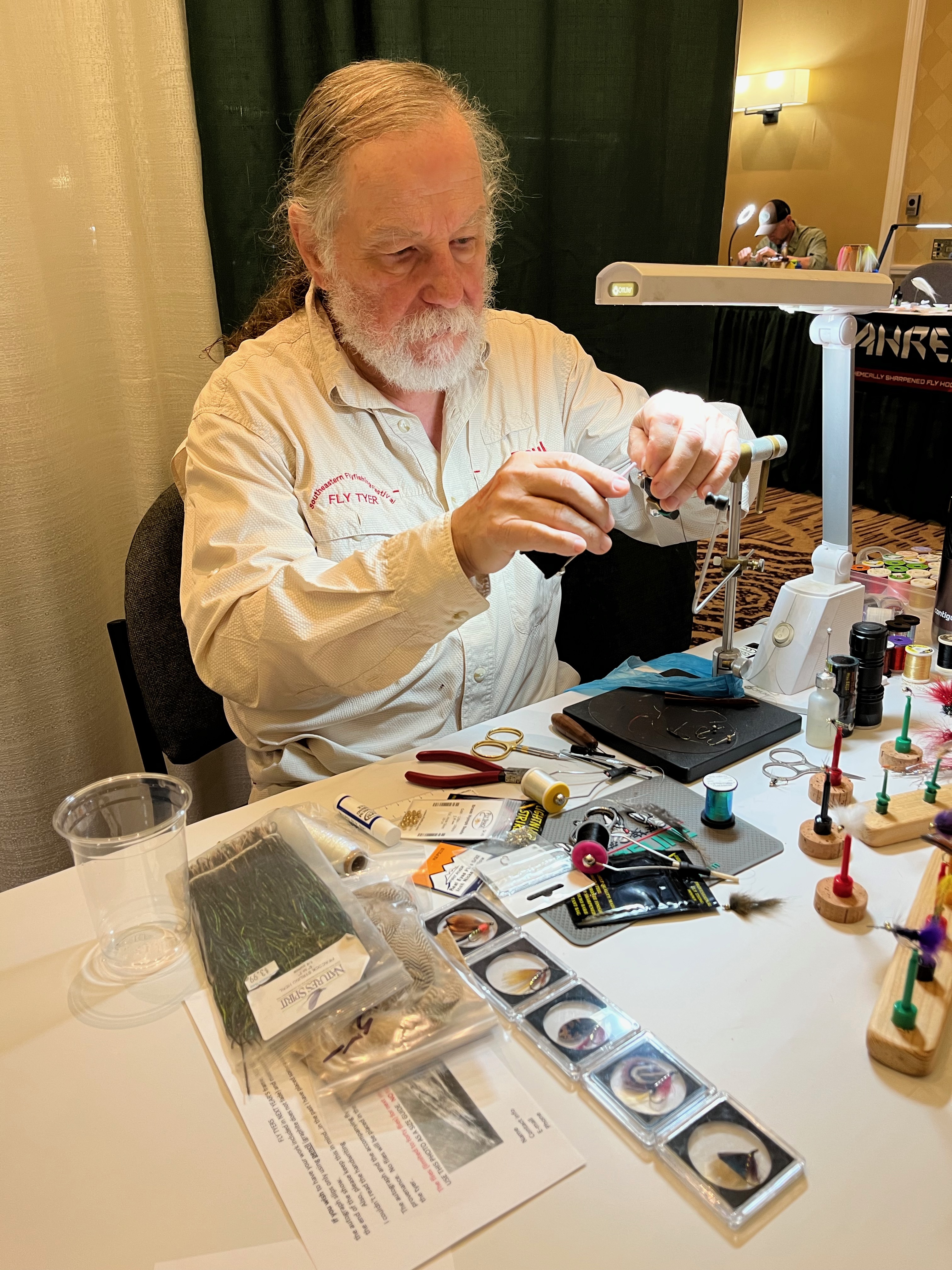
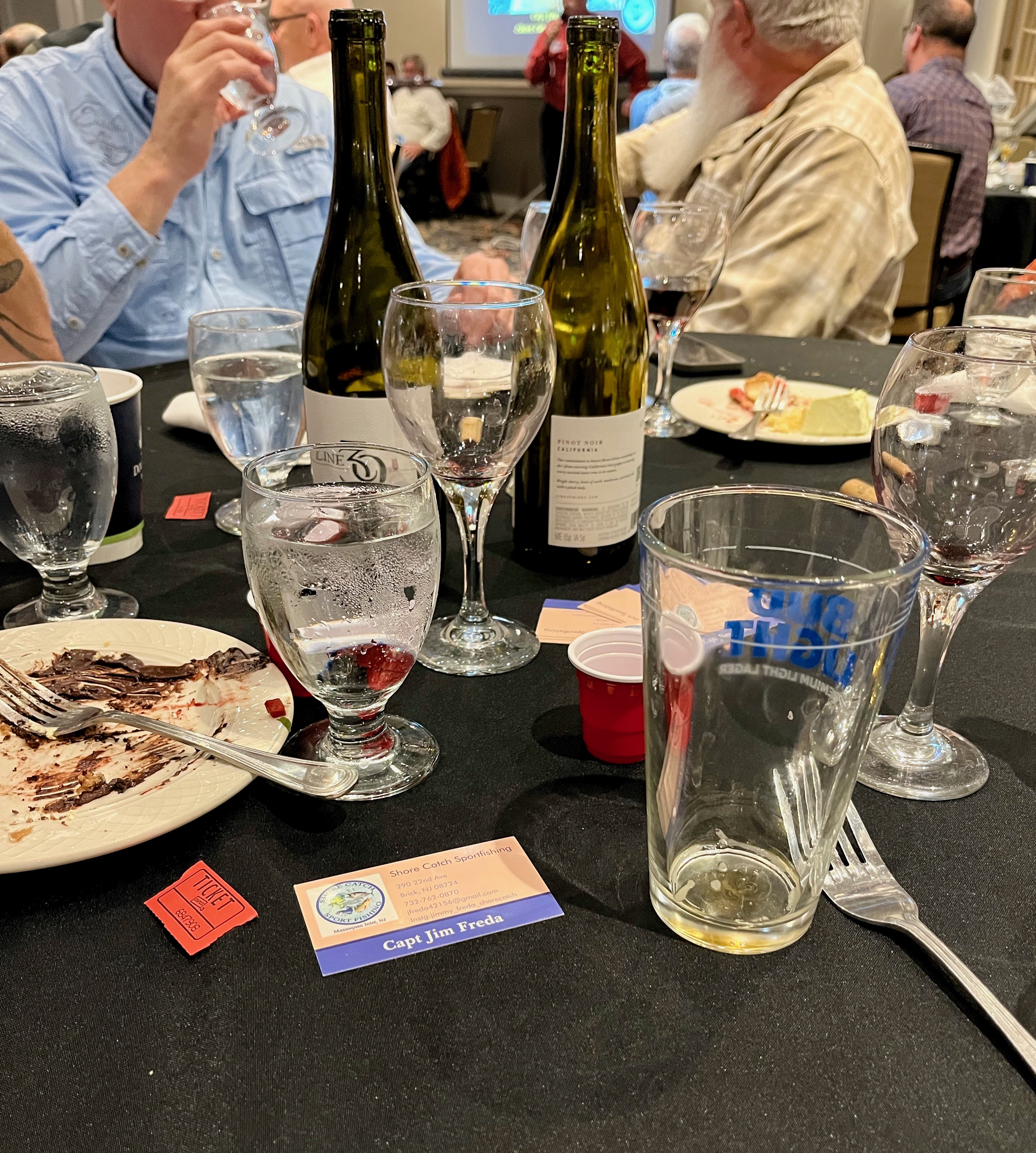
What an honor to be included in this slate of presenters. I was thrilled that my seminar was one of the better-attended talks for the weekend. If you were in the audience, thanks so much for coming, and I applaud the group for having so many excellent questions. I had to scoot to my 1pm wet fly tying class, which went very well. It’s always easy to teach people who are curious and enthusiastic.I’ve won the tying table-mate lottery for two years in a row. This is is Paul Gruver from Wake Forest, NC. He was kind and thoughtful and a pleasure to be with. At these event, there’s often a lot of fly swapping, so I’d like to thank Paul for the gifts, which I will fish with pleasure. One of the main points of a tying show is to learn, and I made sure to take the time to see what Paul was tying, and how he was doing it. What a master craftsman!The Saturday night banquet is always a high point of the show. In addition to dinner, you get a swag bag loaded with all kinds of useful tying stuff. Plus, there’s a raffle, and wouldn’t you know it? Mr. Someone-Who-Never-Wins-Anything won a fly box! I sat with luminaries like Tom Rosenbauer and Tim Flagler, but my newest bestest buddy is Lou DiGena, who had the planning skills and foresight to bring a couple of bottles of red wine to share with the table. Atta boy, Lou! Oh…did I mention he also brought a bottle of 10 year-old bourbon? Many thanks for your generosity.Some surprise guests, Bob and Andy! I didn’t recognize them without their waders. Bob and Andy are two Farmington River fishing buddies who, several years ago, graciously shared their water with me, a total stranger, during the Hendrickson hatch. We seem to have an unplanned reunion every year, since we all like this mark, but in April 2023 we missed each other. What an unexpected treat to get to see them.Lou DiGena and Tim Flagler doing their thing in the main hallway Sunday afternoon. I believe their table was the New Jersey Fly Tyers Guild. That a lot of talent representing.Barry Ord Clarke of The Featherbender fame working his magic. Barry has written, co-written and contributed to more than 30 books about fly tying. He has won medals in some of the worlds most prestigious fly tying competitions. So when I went to introduce myself, I was totally stoked to find out that not only did he already know who I am, he’s also a fan. Barry is supremely nice, and I thoroughly enjoyed watching him tie. See you next time, mate.
And there you have it. I can’t say this enough: if you’re not going to fly fishing and tying shows, you’re really missing out on the opportunity to meet, watch, and speak with some of the best fly anglers and tyers on the planet. Thank you to everyone who took the time to stop by my table, and I’ll see you at the Fly Fishing Shows in Marlborough and Edison in January 2024.
After fishing two Erie tribs in OH and PA last December, I knew I would have to get back there. Soon, nine-ish hour drive be damned. I had to wait a full 10 months to do it, but it was so worth the wait.
Unlike the northeast, Steelhead Alley has seen very little rain this summer and fall. The timing for my trip could not have been better, with a decent slug of rain before the weekend that marked the true start of the fall run for many tribs. Still, the water was on the high side of low — if that makes sense — meaning that 90% of the fish would be in 10% of the water. The spook factor would likely be very high, along with angler traffic.
Adding to my challenges was that I had zero experience fishing public waters. So I hired the guide I used last year, Bob Packey of Solitude Steelhead Guide Service. Bob focuses on fishing private water — an absolute treat — but that would do me no good when it came to public water. So we formed a game plan: fish Wednesday morning on private water for a few hours, catch a few fish, then bounce around to some public access marks so I could learn some spots. Since Bob has deep domain experience on Erie tribs, I knew I’d be in good hands.
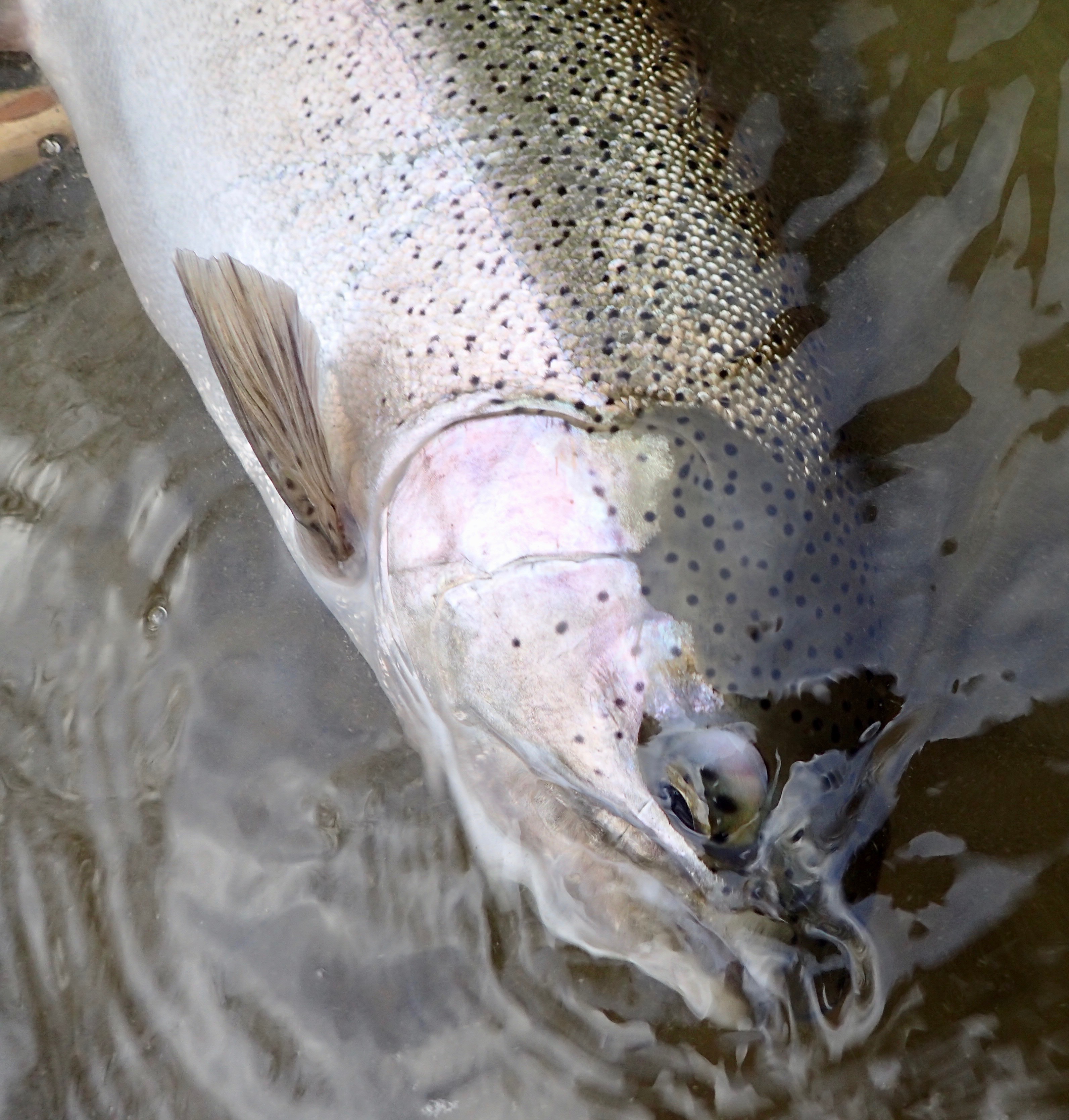
The dread cold front hit the night before day one, putting the steelhead in winter mode. We saw runs and slots that held dozens of steelhead, but even with precision casts and presentations, they were just not having it. Once the sun rose and the water inched up a precious degree or two, the natives decided to play. We had success with sz 14 Blood Dot eggs and sz 10 White Deaths fished as the point fly on a two-fly rig under an indicator. Switching to the White Death fly was a revelation, as fish that couldn’t be bothered with eggs suddenly opened their mouths and moved to take the fly. Bob is a terrific guide, and I’m learning so much from him about this unique fishery. Photo by Bob Packey.We had to work for our fish in the morning of day one, but beauties like this always make it a labor of love. I also stuck a big ol’ brown trout — funny how that’s considered by-catch when back home it would be a trophy. By 11:30am we were at a public access point on Elk Creek. Although there were plenty of anglers — “crowded” on Erie tribs is not the same as “crowded” on the Salmon River in Pulaski — we were able to find a half dozen highly productive marks because so many anglers were fishing in the wrong place. Cracking the Erie tribs fish-finding code is a major part of success. Once Bob showed me what to look for, finding the fish was much simpler task. The answer to the question, “Was that the bottom or a fish?” On all three mornings I fished, the steelhead were sluggish at first light. Once they turned on, there were far fewer fouls. When I foul a steelhead, I try to rope it in fast. I find I have very few breakoffs; most of the time, the hook comes away without breaking the tippet. I caught and released several fish that had hooks imbedded in their fins or bodies.What a rugby ball of a hen! She took the top fly on my rig, Clyde Murray’s Spider, size 12, in low light. My strategy on days two and three was to focus on a few marks and learn them cold (as much as I could in a few hours). Not all of the water was productive over the course of two days — steelhead are on the move this time of year — but I certainly had fun trying different flies and different combinations in different runs at different times of the day.So that’s why I lost that fish…Elk Creek living up to its name, a small window of wonder on an early morning when I was the only angler on the water for a few hundred yards. My final tally over 2 days and 3 hours was 20 steelhead landed, a bunch lost, and immeasurable fun. A little more rain, a little more flow, no bitter cold. Those are my hopes for December. Steelhead dreaming is a thoroughly enjoyable pastime.
Where did the time go? It’s almost here: the International Fly Tying Symposium, Nov 11 & 12 at the DoubleTree by Hilton Somerset, NJ. come see Tim Cammisa, Barry Orde Clarke, Bob Clouser, Joe Cordeiro, Pat and Forest Dorsey, Tim Flagler, Ben Furimsky, Cheech Pierce, Tom Rosenbauer, John Shaner, and even me, plus dozens of other talented people tying up a storm, demoing patterns, giving seminars, and teaching classes. What a tremendous opportunity to rub elbows with and learn from some of the best fly tyers on the planet!
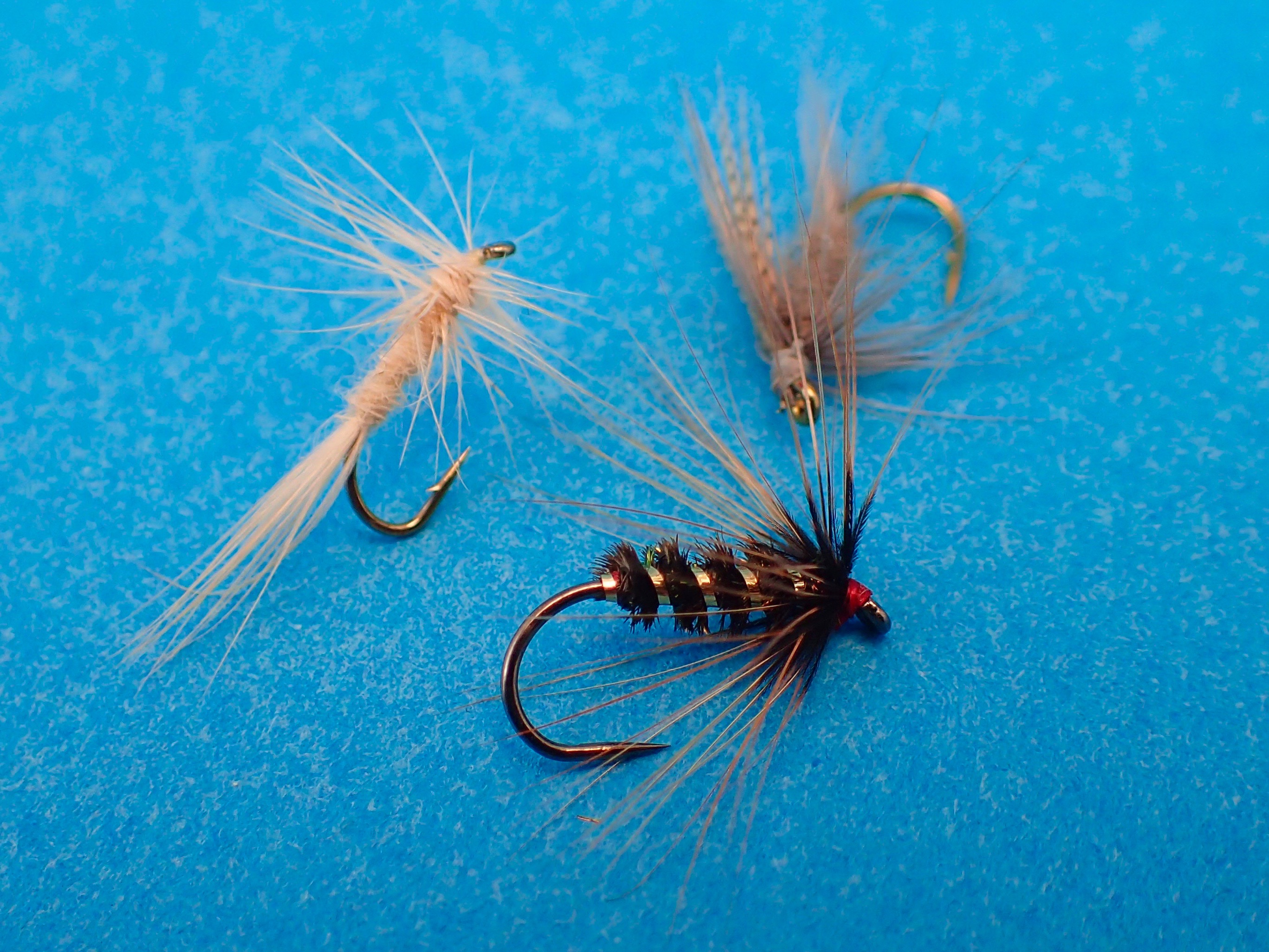
Watch me tie classic wet flies and soft hackles like these — or come see me speak — or take my wet fly tying class — or, better yet, all of the above.
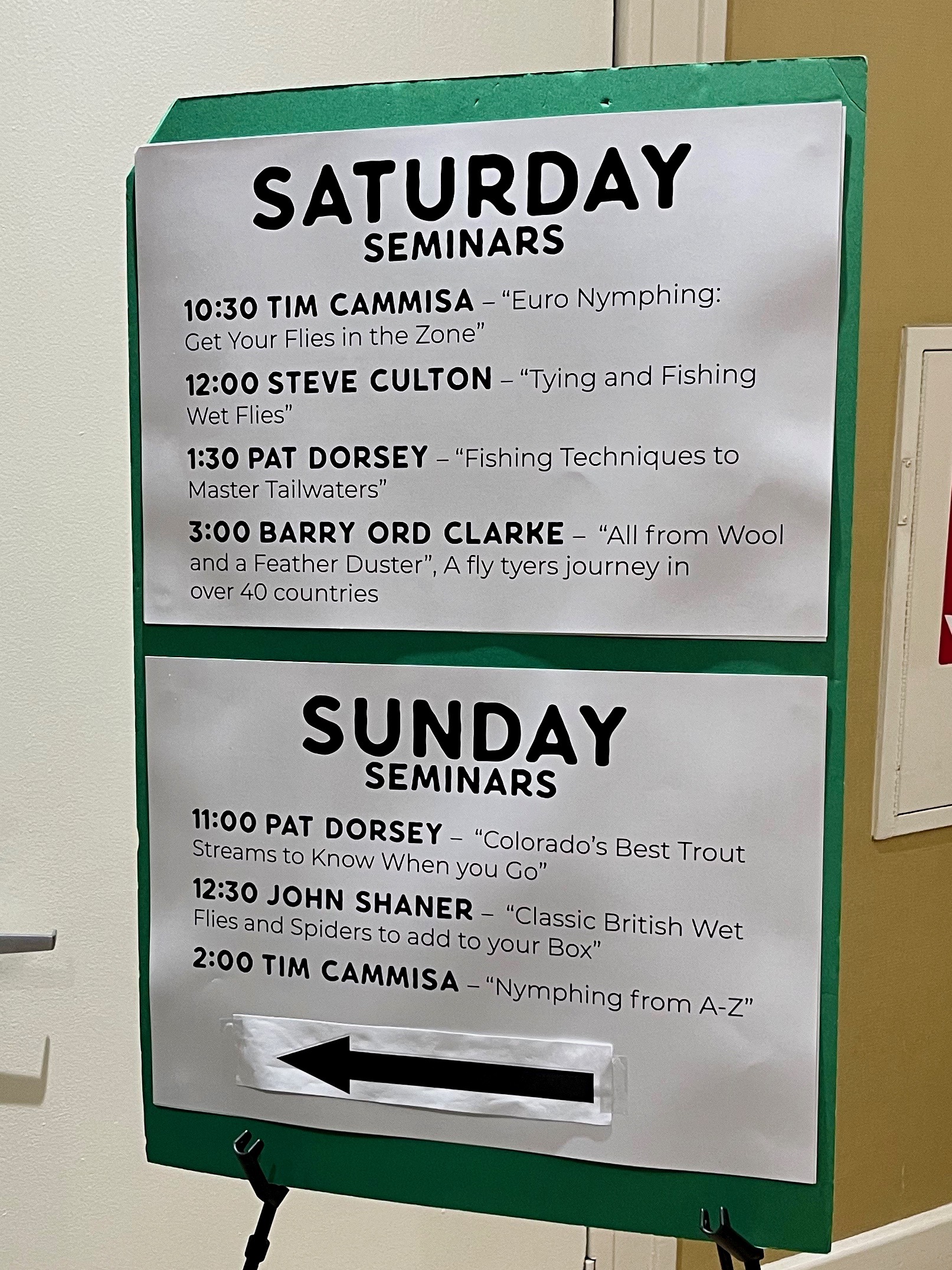
On Saturday, November 11 at noon, come to my seminar, Tying and Fishing Wet Flies. The seminar is included in the price of your admission ticket. Then, take my tying class, Soft Hackles, Winged, and Wingless Wets at 1pm. You need to register for the class, and you can do that here.
Don’t forget the vendors! Lots of good stuff to be had, and you better get to the soft hackle and ducktail bins before I do. See you there — and please come say hello.
Want to up your fly fishing game? Then come to these seminars! They’re all included in the price of your ticket.
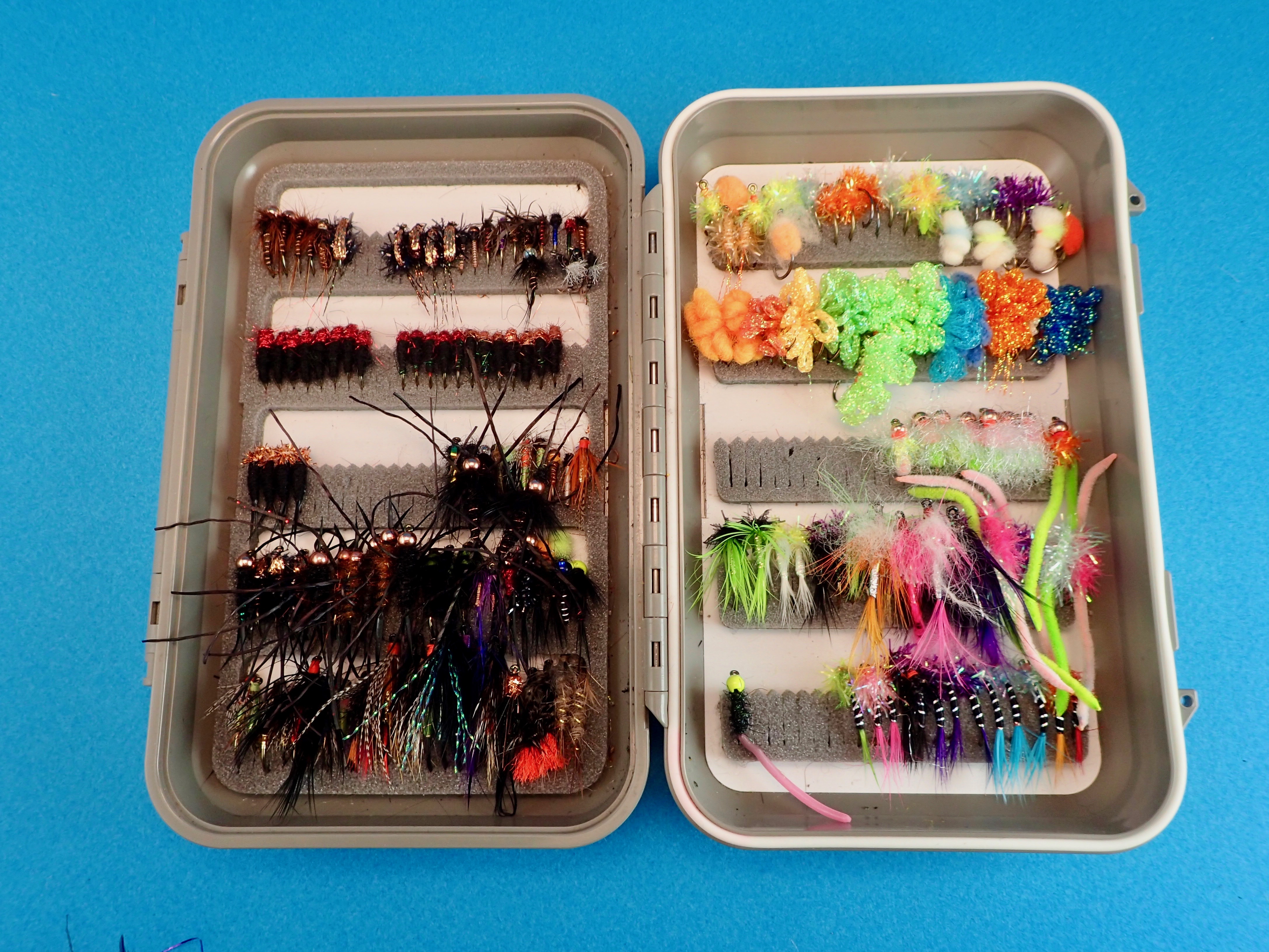
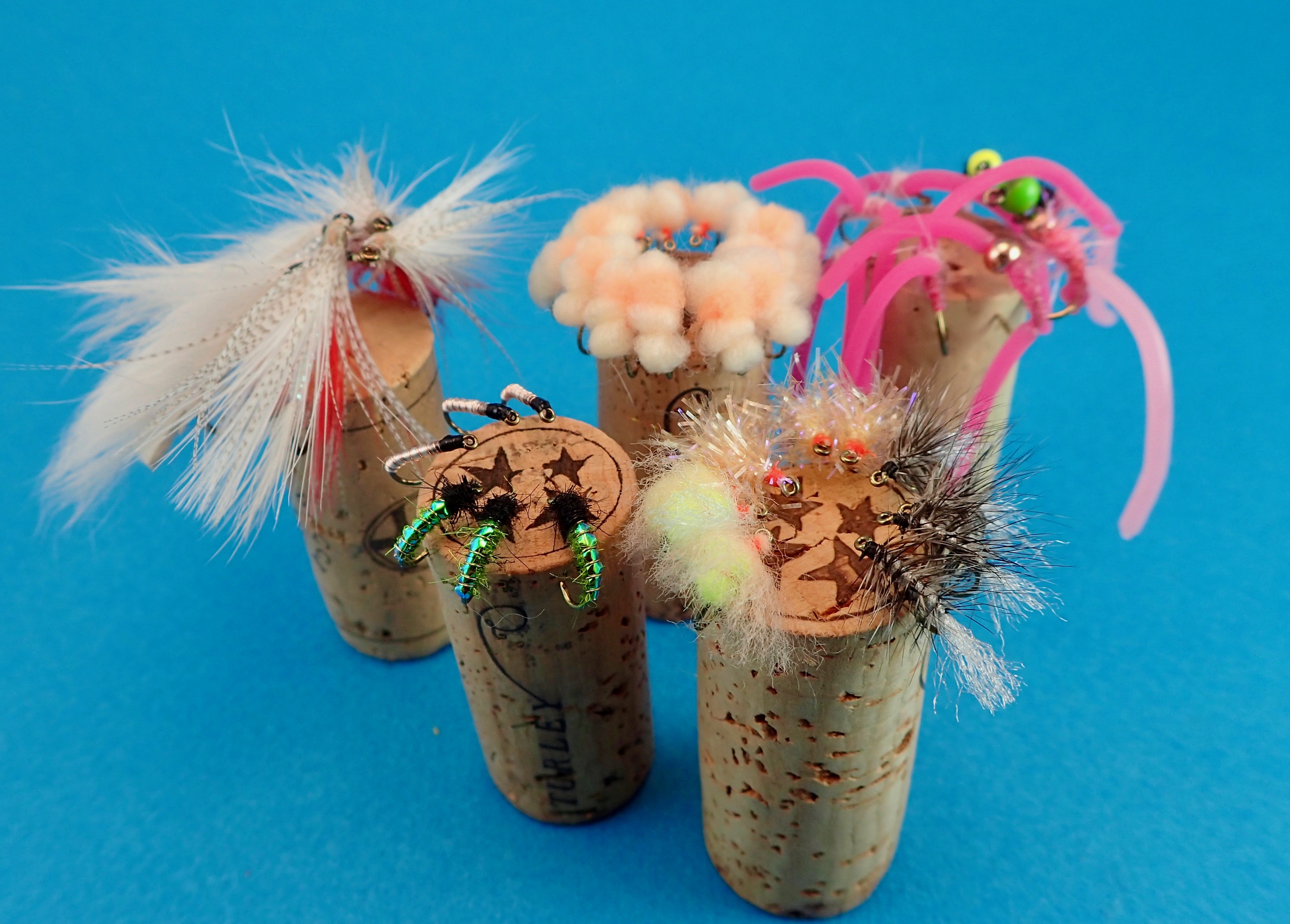
There are a few holes on the bug side that I’d normally fill with small, simple black stones for the Ontario tribs. The egg side is a little too large and loud, especially for the current low water.Time to fill some corks! Clockwise from lower left: sz 14 Electric Caddis and Yerger Miracle nymphs; Winger’s Mallard Minnow and Jeff Blood’s White Death, sz 10; egg/apricot supreme Blood Dots sz 14; various implements of Squirmy Wormy destruction; Kopczyk’s Super Fruit, and Murray’s Go-To and Mini-Bug, all sz 14. I got most of these patterns from John Nagy’s Steelhead Guide, the definitive work on Erie tribs steelhead. Let’s see where they fit in…Ready to go! I replaced the top egg row, which was mostly Estaz eggs, with more muted fare. The Blood Dots are a proven favorite. I love that you can fish a tandem rig in OH and PA, and I’m looking forward to giving the steelhead a choice. Steak? Or eggs? Both?…
I lost my fishing hat. I’ve no idea where, but it’s gone. And it’s not coming back.
Okay. So, it was on its last legs. So, it was decades old. So, it’s been fraying and worn and even threadbare in a couple places for years. But it was a constant companion from shoreline to mountain stream to steelhead alley and back. It fit just right. It worked in the summer and it worked in the winter. And now I don’t have it. Which makes me very sad.
Sure, I was going to replace it soon. But I would have liked to have archived it. L.L.Bean no longer makes that hat, so I can’t even replace it with something similar. It was lightweight and supremely comfortable. It was a wonderful understated earth tone color combination. I’ve got a ton of other hats, but none of them are MY hat, and I’m very particular about what I put on my head. What shall I do?
An exhaustive search lead me here. It’s an Orvis Battenkill cap, and it has a lot going for it. It’s a good earthy color. It’s simple. It’s not an obnoxious branding billboard. And what’s that fly?!? A bead head soft-hackled Pheasant Tail? I love that fly. I tie that fly. I fish that fly.
Hello, new friend. Let’s go on an adventure.
Official custom Currentseams hats, anyone? Because I’ve been thinking about it for a while now…
About this time every year, my thoughts turn to steelhead, and of course, steelhead fly tying. I pull out my steelhead chest pack and the two fly boxes within its zippered pouches. The “big box,” as I call it (both boxes are, in reality, the same size) doesn’t change much from season to season — it’s mostly streamers and experiments and one-offs and flesh flies. The nymph and egg box, however, gets a serious going over and then a restocking.
But, things are a little different this year. I’ve got plans for two sorties to Steelhead Alley. These rivers and creeks are a universe away from a big, brawling river like the Salmon in upstate New York. They’re smaller, with different bugs and different water color and clarity and flow (very low right now) and different bottom structure. So I should be thinking differently with my flies.
What I’m currently tying up is generally smaller and more muted. I’ll give you a closer look next week. But right now, I’ve got corks to fill.
Last night I presented The West Branch Farmington River — Southern New England’s Blue Ribbon Trout Stream to the New England Fly Tyers. NEFT operates out of central Massachusetts, and they are an enthusiastic, dedicated group of tiers and anglers. For understanding that a fed presenter is a happy presenter, I hereby award them the Legion of Potluck Yumminess with Homemade Brownie Clusters. Thank you again, and I hope you’ll invite me back!
A quick greetings and salutations before I dive into a sound bites — word bites? — edition of currentseams. Hope you had a swell weekend. Me, I took a beating in my NFL ATS pool but still managed to win. (Unlike my Dolphins, but that’s another story.)
Many thanks to the fine men & women of the Croton Watershed TU Chapter for hosting me Thursday night. The subject was “The Little Things 2.0” — the second chapter in my series of seemingly insignificant things that can have a huge impact on your fishing. And the pre-pres cheeseburger was delicious. Therefore, I bestow upon Croton TU the Order of the Cheeseburger with NE-style IPA Clusters for recognizing that a fed presenter is a happy presenter. I’m at the NE Fly Tyers tonight in Massachusetts, talking about the Farmington River.
I hit a small stream last week for a quick 90-minute session. I went bushy dry the whole way, and pricked a bunch of fish. None were brought to hand, and that was just fine with me. Water was low and clear and there were no signs yet of redds on this brook.
The Maryland Juvenile Striped Bass Index recently came out and the results were discouraging again:
The ASMFC Striped Bass Board will soon release Addendum II for public comment. You can read more about their annual meeting here from the American Saltwater Guides Association, who once again are doing so much of the striped bass conservation heavy lifting. We can’t thank them enough! Stay tuned for the official ASGA position on the commenting. We’ll need all hands on this one!
I just completed a piece for Surfcasters Journal. It’s about waiting out a slow spot or hour or night. Should you stay or should you go? You can read the answers in the November edition. Again, SJ is an e-zine that’s loaded with fantastic saltwater and surfcasting nuggets, and is a bargain to subscribe. If you’re not subscribing, you should be.
Tomorrow night, Thursday, October 19th, I’ll be presenting “The Little Things 2.0” to the Croton Watershed Chapter of TU. The meeting is open to the public, and you’re invited! Doors open at 6:30pm, and the meeting starts at 7pm. It’s all happening at the Emanuel Lutheran Church, 197 Manville Road, Pleasantville, NY. If you’re a currentseams follower, please come and say hello.
We’re all looking for an edge when it comes to catching more fish. It is my firm belief that the little things are largely responsible for the fabled 10% of the anglers who catch 90% of the fish. The Little Things 2.0 builds on the theme of seemingly insignificant things you can do make your time on the water more productive. As with all seminars in this series, the lessons apply to multiple species fly fishing in fresh or saltwater.
On Thursday I had the opportunity so spend a couple hours on small stream so I jumped on it. I hadn’t fished here since April and boy, did the heavy rains of the summer alter the streamscape. Entire pools were missing, and others were created. The fish were well spread out, and I did not see any signs of redds, nor of fish staging to spawn. Hatch activity was light with some lonely midges and a few stray small caddis. I fished downstream, subsurface, using a Squirmy Worm jig. I did tie on a bushy dry at the end just for fun.
It’s a good time to revisit some basic small stream best practices. First, learn to ID redds. It’s a good idea to stay our of the water from around now through mid-April. The lives you same may be the future of the brook you love to fish.
Please mash down your barbs or fish barbless hooks. You can also fish hook size that’s just a little too big, like a 12 or 14. This will self-eliminate smaller fish from eating the fly, and you’ll still have the sport of seeing them whack it and feeling their aggressive tugs.
Handle fish as little as possible. Keep them in the water if you can. The less exposure to air, the better. Reduce potentially damage to fish by taking the Wild Trout One Photo Challenge.
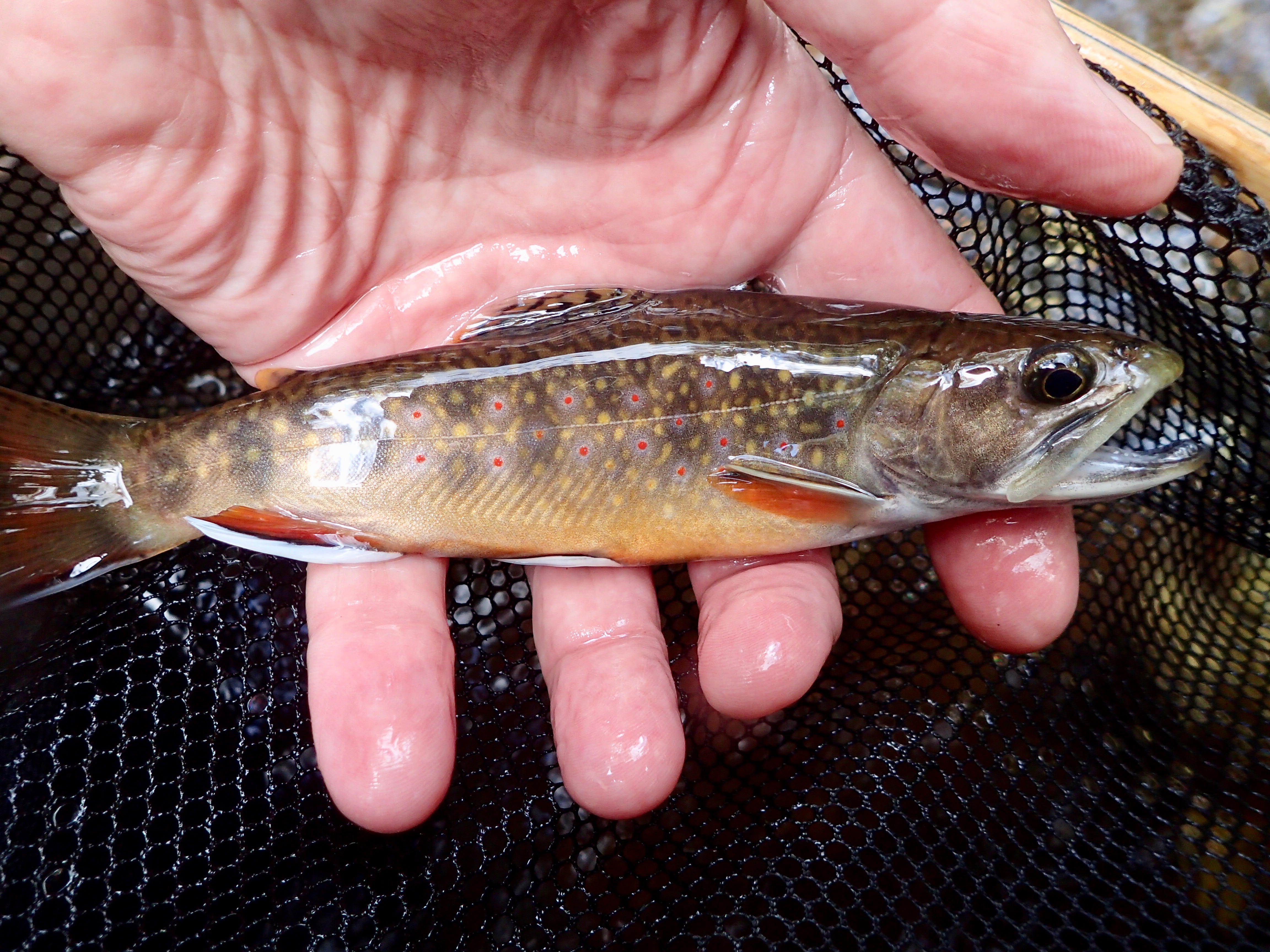
This was my first brookie to net, and it was an easy decision to make this my One Photo Challenge fish. I’m telling you, those blue haloed dots were positively glowing! I lost a few char bigger than this one, and a bunch of smaller ones, and that’s all just fine with me.







 currentseams.com