Part of my wet fly lessons includes leader construction. As we’re building a team of three flies, I tell students that the single best material I’ve found for dropper rigs is 4-lb. Maxima Ultragreen. In fact, I tell them, it’s the only stuff I use. But every once in a while, I try to cheat the process and make the tag with some other stuff, thinking it will be OK. And it usually isn’t.
The most recent incident came last week when I tied a simple two-fly wet fly team for smallmouth. I lazily decided to attach a piece of Maxima Ultragreen to the end of the tapered 3x leader. A few casts into my fishing, the non-Maxima tag section was already tangling. What do you know? I re-rigged the leader with Maxima Ultragreen 4lb for the dropper tag and point fly, and suddenly all was right with the world.
The one, the only. Accept no subsitutes.
How much do I love and use this stuff? I buy it in the One Shot spool size, which gets you 280 yards of glorious green dropper goodness. I just wrap 30 yards of it around a smaller spool, and it fits easily into my pack or on my tippet holder. It’s so true: confidence catches fish.
Holy mixed metaphors, Batman! Or would that be idioms? Either way, I wanted to talk about terrestrials today, specifically wet or sunken flies.
It’s prime terrestrial season in these parts. Hoppers, Stimulators, beetles, crickets, ants, flying ants — they’re all fair game. I believe most anglers think of terrestrials as dry flies, and that’s not surprising. Watching a trout stomp a hopper or sip an ant from the surface is one of the big bonuses of summer fishing. Terrestrials also make great floaters for dry-dropper combos, whether it’s a single wet or nymph dropped off a hook bend, or a classic three-fly rig like the hopper-copper-dropper. I like to wander the Farmington’s riffles, runs, and glides on a breezy summer afternoon and prospect with a terrestrial dry and dropper.
But sometimes, I’ll do my terrestrial fishing subsurface. Consider this: what happens to all those hapless land insects that fall into the river? They struggle, and some get eaten. I think most don’t — get eaten — at least not on the surface. All that unconsumed biomass eventually sinks, and becomes a new item on the subsurface menu. Drowned bugs are easier to eat, and require less risk for the trout to dine. Winner: you.
Was a big golden stone. Now, it’s a hapless hopper.
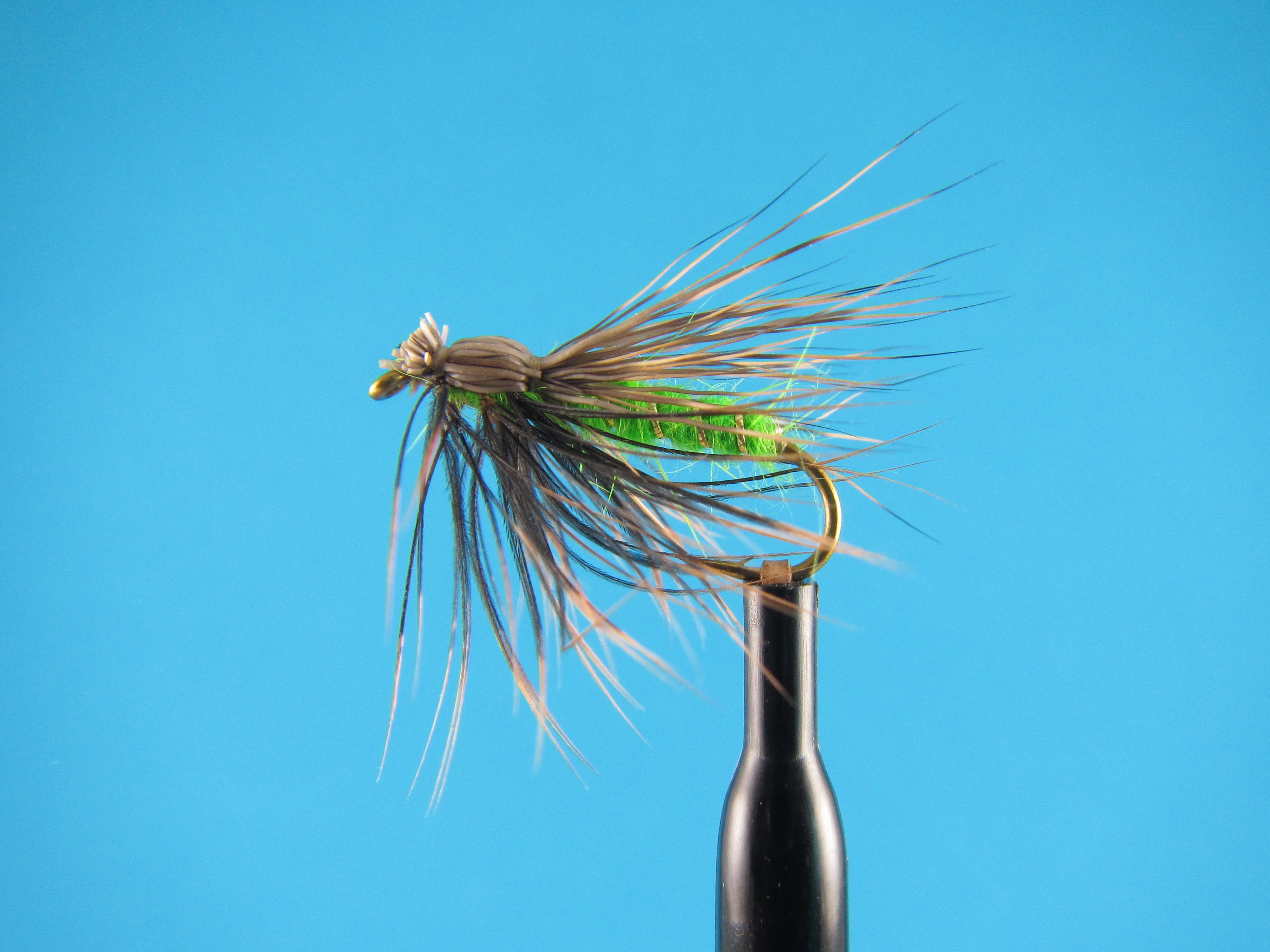
Here are a couple wet flies to get you started on your summer terrestrial wetstravaganza. The Drowned Ant is an old favorite, not too hard to tie, and can be completed with very easy-to get materials. It’s been one of my most consistent producers since I created it. If you’re a fan of the oddball and obscure, try the Hopper Hammerdown, which is based on a steelhead stonefly by Dave Hall. The hits are electric.
Just make sure you have plenty of 4lb. Maxima Ultragreen.
I tend to look at fly fishing as one big, fun, science project. Figuring things out, making new discoveries, trying a new fly or method that produces good results — these are just a few of the rewards that await the curious angler. As most of you know, I’m a teaching guide, and my guide trips are lesson-based. The guides I use when I fish for pleasure know the marching orders: tell me when I’m doing something wrong, show me how I could do it better, teach me things I don’t know (or have forgotten). No matter how good you think you are, we all have something to learn. That’s how you get better.
Since I’m a put your money where your mouth is kind of guy, on Monday I accepted 2025 Orvis Guide of the Year Antoine Bissieux’s gracious invitation to tag along and participate in his class with French world champion Bertrand Jaquemin. We won the weather lottery with a good flow and gorgeous weather. The class began at Orvis in Avon at 10am, and we were on the river about 12:30pm. It was gratifying to see that other people include off-the-water classroom as part of their lessons.
I can see this method working for pressured or skittish steelhead in low, clear water. Hmmmmmm……
The focus of the class was long-leader upstream presentations to pressured trout. Although the business end of the rig is a small nymph, the presentation and drift management was not unlike an upstream dry or wet fly drift. I’m guessing after the fact — I don’t have the leader with me — that the leader was about 15 feet long. It includes a sighter, which I had trouble seeing — that’s a problem with a sighter — until Bertrand ran it along a knife edge to curly pigtail it. Visual acquired! While I didn’t connect with a fish, I did see the benefits of this style of fishing. More practice time on the water is needed before I can render a better judgement on the method. (I prefer to be lazy and work downstream. This is upstream, and requires stealth and vigilance.) I’m not arguing that it’s not productive; I’m just not sure it’s right for me. And happiness and confidence catches fish.
I was dopey enough not to take pictures, so my bad. Many thanks to Bertrand and Antoine for sharing their knowledge.
Call immediately: DEEP Law Enforcement at 860-424-3333 or Turn in Poachers (TIP) at 800-842-4357. Program it into your phone. Make the call.
Yes, I know. It’s frustrating. You can’t get a cell signal. EnCon never shows up. Nobody ever does anything about it. It’s too much trouble. Call immediately: DEEP Law Enforcement at 860-424-3333 or Turn in Poachers (TIP) at 800-842-4357.
Poachers making an illegal harvest? People fishing barbed trebles in a Class 1 WTMA? People using saltwater boat rods in FFO areas? One person fishing, followed by a second with a bulging trash bag? Call immediately: DEEP Law Enforcement at 860-424-3333 or Turn in Poachers (TIP) at 800-842-4357.
No spinning gear allowed.
If all of it makes you seething-rage mad, I get it. It pisses me off, too. I can’t stand the lack of respect for the rules or the environment. I loathe the selfish, boorish behavior. I’m frustrated as hell that I’ve never seen an EnCon officer anywhere near the Housatonic in summer, the ground-zero Mecca for poaching and other illegal activity. Nonetheless:
Call immediately: DEEP Law Enforcement at 860-424-3333 or Turn in Poachers (TIP) at 800-842-4357. Program it into your phone. Make the call.
Although I’ve been fishing for over five decades, I didn’t start keeping a fishing log until the summer of 2004. At this point in my life, I was seriously devoted to fly fishing. Being an autodidact, I reckoned that I’d learn more, quicker, and retain more if I could journal and reference my outings. I wasn’t wrong.
Since then, I have logged every fishing trip and every lesson I’ve given. I’ve filled six 192-page books with all kinds of data: place, time, date, water and air conditions, and then a journal-style description of the outing: what worked, what didn’t, what I think I could have done better, etc. What were the hatches/bait, and how strong were they? How were other people doing? What did I do well?
My O.G. log entry about a Farmington River outing with old pal Paul Kingsford. I didn’t even know some of the proper names of the pools; that’s Hawes, aka Bikini Rock, that I called “the big rock boulders/cliffs.” I haven’t changed the format all that much in the last 20+ years.
About 10 years ago, when life seemed to get exponentially busier, I got into a good/bad habit: voice recording my outings, then transcribing them into the journal. It was good because I didn’t have to write it all down immediately; the recording was made minutes after getting off the water, so everything was fresh in my memory. Later, during transcription, I might remember additional details. The bad habit part began when I would get lazy and not fill the pages with reports for weeks. I beg to report that my sloth has gotten so profound that I am now two years — you read that right — behind on my transcriptions. I’ll be getting to that shortly after I post this.
Some of you may wonder why, with today’s e-tech, I even bother handwriting it. Fair point. But I’m an analog guy at heart, and there’s something about my own script that adds humanity to what would otherwise be a cold, antiseptic printed document. Besides, I like my leather-bound hardcover books.
These books are more than a nostalgic preservation of memories. They’re a detailed roadmap to success. I can watch my progression as a fly fisher. I can observe how my best practices evolve. Not everyone’s a writer, but my journals were an invaluable resource when I was writing my Farmington River book. And these journals serve as a bittersweet reminder of what we’ve lost: the epic blitzes on Block Island, the prodigious power of the W/S Caddis hatch, the 50 smallmouth nights on the Housatonic. I still have it all at my fingertips.
I like to say during a lesson or a presentation that I’m not right. But I’ll stand by this statement: if you want to become a better angler — and catch more fish — you should be keeping a log.
Here we are, already at the mid-point of July. Blink, and you might miss summer. We really don’t have much to complain about weather-wise — it’s standard-issue hot and humid, there have been rains (but nothing catastrophic [he said, knocking on wood]), and the reservoirs are full. The Farmington is running clear and cold — in the 50s coming out of the dam — and at a terrific summer height. Please be sure to carry and use a thermometer, and make your cutoff 67 degrees. You should be able to find ample cold water from the PTMA and points north. Tip of the week: ants, beetles, crickets, and small hoppers, fished in faster water and languid currents under trees and shade. Oh. And small nymphs. You can thank me next time you see me.
I owe you a Block Island report, and spoiler alert: it’s not good. Locally, I know a few surfcasters who are doing OK. Things may pick up in another 30 days or so.
Meanwhile, I’m trying to play catch-up with my fishing. The yard work is settling down a bit, the garden’s in good shape, and the book is off with others. I think I’ll smoke a few cigars while I’m at it.
John and Chris took a wet fly lesson with me on Tuesday, and we were having grand old time — a little streamside classroom action, a leader tying clinic, lots of fantastic Q&A (very inquisitive minds, these two, which I loved). When we finally got into the water, darkness fell across the land, and the thunder rumbles began.
This is good time to say this: get out of the water and seek shelter if there’s a threat of electrical storms. I am routinely astonished that some people still don’t do that. End of public service announcement.
We drove along the river trying in vain to find sunshine, which took about an hour. By then, the storm was over, and we had blue skies and hot weather. We headed north to fish above the PTMA. Finally able to wet a line, we got into some fish, although in the bright sunshine they didn’t come easy. It wasn’t until after the session ended that John and Chris were able to test their new wet fly skills. Both took multiple trout during the evening rise. Tremendous job, gentlemen. Your instructor couldn’t be prouder!
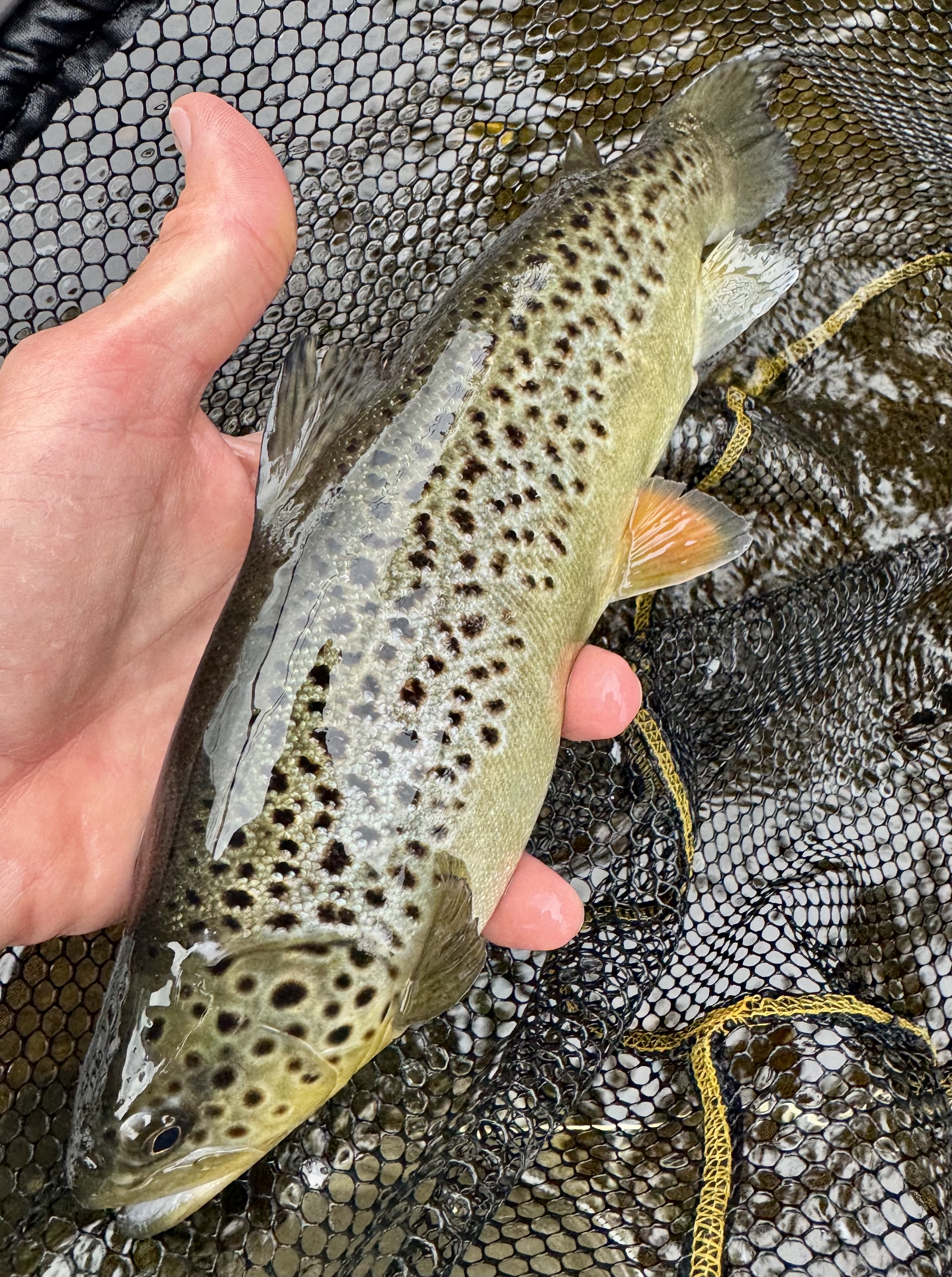
This brown fell for my Partridge and Light Cahill soft hackle. So simple and so effective! John Ryan photo
By now, I’d hoped to be back to my normal routine on these pages. But every time I think I’m in the clear, the book comes a callin’. So that’s why posts have been so spotty. All I can tell you is that when things do return to normal, you’ll be the first to know.
I just finished an article for Surcasters’ Journal. I’ll letcha know when it comes out.
It’s getting steamy out there. Time for the summer under-waders kit.
Fishing in brief: Block Island stunk again this year: slow, slower, slowest. Then there was last week on the Farmington. I gave Andrew a wet fly lesson, and it was likewise a non-action fest. We fished three marks, and it wasn’t until the last one that we found some fish. But Andrew was enthusiastic and persistent, and we ended up with two in the hoop for the win. Great job Andrew! I stayed to fish the evening rise. The location was above the PTMA, and the hatch and rise activity was one of the worst I’ve experienced in a decade. Very little hatching (mostly dorothea) and, almost impossibly, nothing on it except for a few small fish. Highly disappointing. I managed two small wild browns on wet flies and one stocker rainbow on the way out after I could no longer see my fly. Blech!
Of course, we hav the blank canvas of this week, upon which we may paint spectacular fishing images. Yeah. Let’s go with that.




 currentseams.com