Last week I mentioned that I was testing a “new” Isonychia wet fly. (I placed the word in parentheses, because so much of modern fly tying is derivative, riffing off countless other patterns that came before. Not that that’s a bad thing! Rock ‘n’ rollers and jazz hepcats have been doing the same for decades.) Of course, I didn’t expect that mention to go unnoticed; in fact, I received multiple requests for more details.
But to quote Don Vito Corleone, my answer is no…and I will give you my reasons.
For me, a new fly pattern is a multi-faceted process. I start with the creative spark, and determining the need for a new pattern. That need can be as simple as, “I want my own fly,” or that I just don’t like what others have done before me. Then, I go the vise and build prototypes. Next comes testing. I may refine the fly and make small or large changes, depending on the pattern. The most important part is the conclusion. Does this fly work? Do I enjoy fishing it? And most of all, do the fish eat it?
All of this can take weeks, and usually months or years.
So, my apologies. No new Isonychia pattern for you…yet. I can share with you that so far it looks like a winner. Once it gets the seal of approval, you’ll all be the first to know. Not to drive anyone further bonkers, but I’ve also got a LaFontaine-inspired version of the Squirrel and Ginger in the works, and the early results are also very favorable. Plus that Henry’s Fork cripple (not a new pattern, and not mine, but worthy of inclusion in your box). It’s a crazy few weeks so I beg your pardon and ask for patience. Remember the sage words of Hannibal to Clarice…
On Thursday I guided Michael and Al from 2pm-6pm. My original plan was to explore some of the faster water in the PTMA, but an accident closed part of Rt. 44. So we decided to seek our pleasure downriver.
The stretch of water between Collinsville and Unionville is starting to warm up, but it’s still within an acceptable temperature range for trout (at least it was on Thursday). Depending on where you fish — i.e. below a long, pond-like stretch — you may find warmer water temperatures than in faster, deeper runs. Unless we get rain and a flow bump, the first real heat wave will torch this stretch. (Thanks, MDC, for your outstanding stewardship of the river, and genuine concern for preserving the resource…he said, dripping with sarcasm.)
We started in a run where I’d had some recent success, and while the action wasn’t hot and heavy, there were a few active fish to play with. We got into a mix of rainbows and juvenile Atlantic salmon, and it was gratifying to see two new wet fly anglers experience the thrill of the tug on a soft-hackled fly.
Al struck first, connecting with this lovely rainbow. How wonderful it is when theory is put into practice, and the trout do the rest of the heavy lifting. Both anglers did a great job, and enthusiastically embraced fishing under the hatch with wet flies.Same fish, heading for home. Most of our action came on creamy sulphury mayfly soft hackles and wingless wets.Does this guy look like he’s having fun? Al had to leave, so Michael and I walked a boulder field, picking pockets with wet flies. Today’s lesson is: When the water is low, look for the fastest, deepest water you can find, and cover every pocket, slot, and seam. By using this method, Michael found multiple trout willing to jump on. I loved his enthusiasm.
I finished the day fishing upriver. I swung wets from 7pm to around 7:30, and I managed three hookups in faster water, sadly losing a pig of wild brown when he wrapped the leader around a boulder. I’m still stinging from that loss, as it would have been my biggest Farmington fish this year. The good news was that he took a new Isonychia soft hackle prototype…and I know where he lives. I spent the next hour stubbornly swinging wets amidst a sulphur hatch that really never got going. I had two half-hearted touches, so I wasn’t sorry when I made the decision to switch to dry. I got three more fish in the next half hour, the first on a size 20 Magic Fly, the last two on Classic Catskills Light Cahill dries, sz 14-12. Even though the water was low, I used 5x tippet as part of a long leader, about 14 feet total length.
Looks like some much-needed rain over the next few days.
Moriel took a wet fly lesson with me yesterday from 2pm-6pm, and we were faced with the lowest flows I’ve encountered this year (thanks, MDC!) We started off in the PTMA, running just under 100cfs. By covering some fast water, we were able to conjure up a few hits, putting one juvenile Atlantic salmon in the hoop. Off to mark number two, below the PTMA. That was a major disappointment: zero-point-zero touches, no bugs, maybe 3-4 total rises in an hour. All the while, I was telling Moriel that he was producing many, many fish-worthy drifts, and that if he kept it up, he would some day-some time have one of those sessions we all dream about.
Two outs, bottom of the ninth found us way downstream. And just like that, trout began to materialize on our three fly team. We took them on a prototype Squirrel-Ginger-Sparkle diving caddis and our creamy mayflies. A gorgeous wild brown, stocked brook trout, grievously bird-wounded rainbow, and all of a sudden, our slow day turns into the grand salami. Today’s lesson: when the bite is slow, move around, cover water, and find the fish. Great job Moriel, and you excelled at letting the fish set the hook.
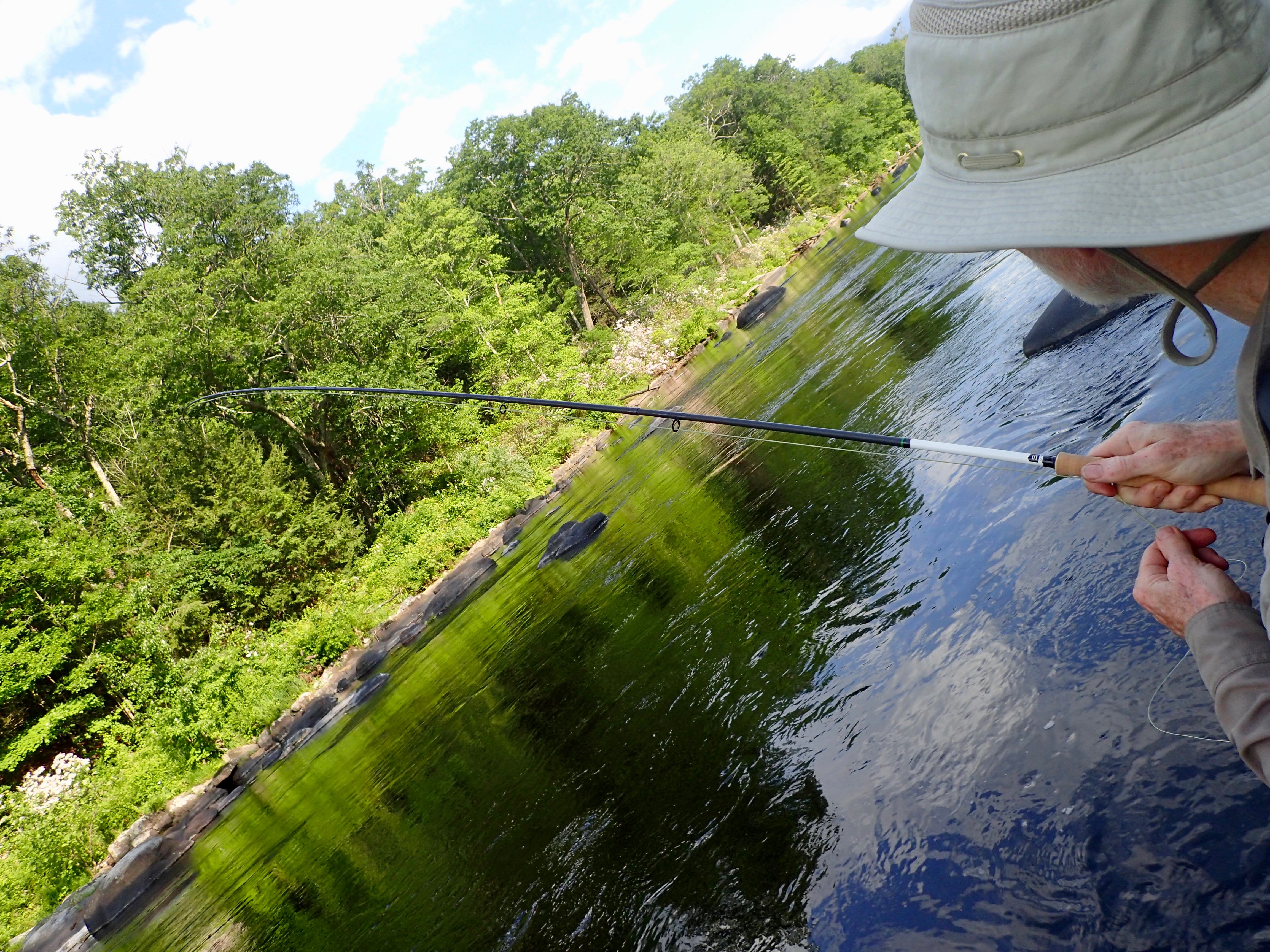
Tight lines and bent rods are a beautiful thing. A fine way to baptize a new stick. Well done, Moriel!
I decided to stay and fish the evening rise. When I arrived at 7pm, precious little was happening. I saw the first sulphur emerge at 7:10pm, but things really didn’t get going until 8:30pm. This mark had some faster water that held trout feeding on emergers and spinners; below me was a quasi-frog water stretch with very little current, and there the trout were smutting. The fish in the faster water were maddening; they’d go on a feed in one section, then stop. It would pick up in a completely different section, then stop. I never really got a handle on those fish, sticking two and dropping one in 90 minutes. I hooked and landed three more in the last half hour on classic Catskills-style Light Cahills, size 12-14. The last one came when I could no longersee the fly, so I used the bucket method of strike detection. It was my best fish of the evening, a 15″ rainbow who’s been eating well.
Currentseams now has over 1,000 official subscribers — and it’s all your fault. Really, I can’t thank all of you enough for your interest, your readership, your passion, your enthusiasm, your comments, and especially for your kind, giving nature. I like very much what this site has become, and that’s in a large part due to your participation. Yeah, I wish I had more tying videos. Yeah, I wish I had more essays and articles. Yeah, I need to update some stuff (like my wet fly team diagram). But that’s something to aspire to.
Of course, we’ll have a drawing to celebrate. But not right now. Summer is upon us, and we’ve all got cookouts to attend, vacations to go on, and fish to catch. My plan is for something later in summer. Of course, as a subscriber you’ll see it first here. In the meantime, if you’re not a subscriber — ten lashed with a cane rod — now’s a great time to sign up. Be sure to follow me on Instagram @stevecultonflyfishing, too. Again, thank you, thank you, thank you!
It’s as easy as that. (Sorry, this isn’t a live link. The real one is off to the side or the top or the bottom, depending on your device.) Who’s going to be 1,012?
I fished for pleasure Wednesday evening, timing it so that I arrived at the mark on the lower river just as the thunderstorms were ending. There were a few small branches littering the roadway, but the water was surprisingly clear and free of debris. As I’d guessed would happen, I beat everyone else to the water and was able to secure some prime real estate. The river was quiet as I entered at 6pm, but the surface soon became dimpled by the tells of feeding fish.
This particular mark appeals to me because it’s a mix of moving runs and seams, eddying pockets, and a glassy pool bordering frog water. All of these places hold trout, and you’ve got to tailor your presentation, leader & tippet, and fly selection to meet the needs of each. Oh, and it all shifts and changes as daylight fades. It’s a difficult mark to get right, but when you figure it out, the rewards are great.
A healthy mid-teens Farmington brown taken on Mike Lawson’s Mayfly Cripple.
Wednesday night’s hatch window was textbook early summer. I had trout sipping spinners until dark, and I had trout slashing at emergers from 7:30pm until 8:45pm. I took fish on five different flies: Usual size 20, Magic Fly size 16 &18, Sulphur spinner size 20, classic Catskills Light Cahill size 12 & 14; and a new pattern I’d never fished before, Mike Lawson’s Mayfly Cripple in sulphur colors, size 16. I’ve never really gotten into the whole cripple thing, and the two times I’d fished this fly this year, the trout have largely ignored it. Not on this night. I stuck three good fish on it, and now it’s in my top rotation. The pattern is basically a Pheasant Tail bottom half with a sulphur dry top half that includes a thorax, hackle, and synthetic wing. (I’ll give you a pic and recipe soon.)
Say howdy to Mister White-Gloved. Iso time is a good time for all. This time of year, if you hear a take that sounds like someone threw a bowling ball into the river, chance are it was a trout feeding on Isonychia. Try a Hackled March Brown wet on point.
On Thursday I gave Brett a wet fly lesson. What a difference a day makes! We got a late start, so our window was 3:45-7:45, which should have meant a ton of bugs and visibly feeding fish. The bugs barely materialized; we saw a few sulphur, some tan caddis, and a couple Isos. Rises were few and far between, and none of the fish was in a regular feeding rhythm. Nonetheless, Brett slayed ’em. We stuck four at the first mark and I don’t know how many at the second — we easily put a double digits in the hoop. They ate every fly on the team (top dropper, Magic Fly size 14; middle dropper, new Squirrel and Ginger diving caddis prototype size 14; point fly tailed Partridge and Light Cahill size 14). We experienced a sequence where four consecutive fish took the diving caddis. More and more, I’m seeing evidence that this is a critical component of the three fly team. Brett did a fantastic job with his presentations and hook sets. If I were the trout, I’d be concerned.
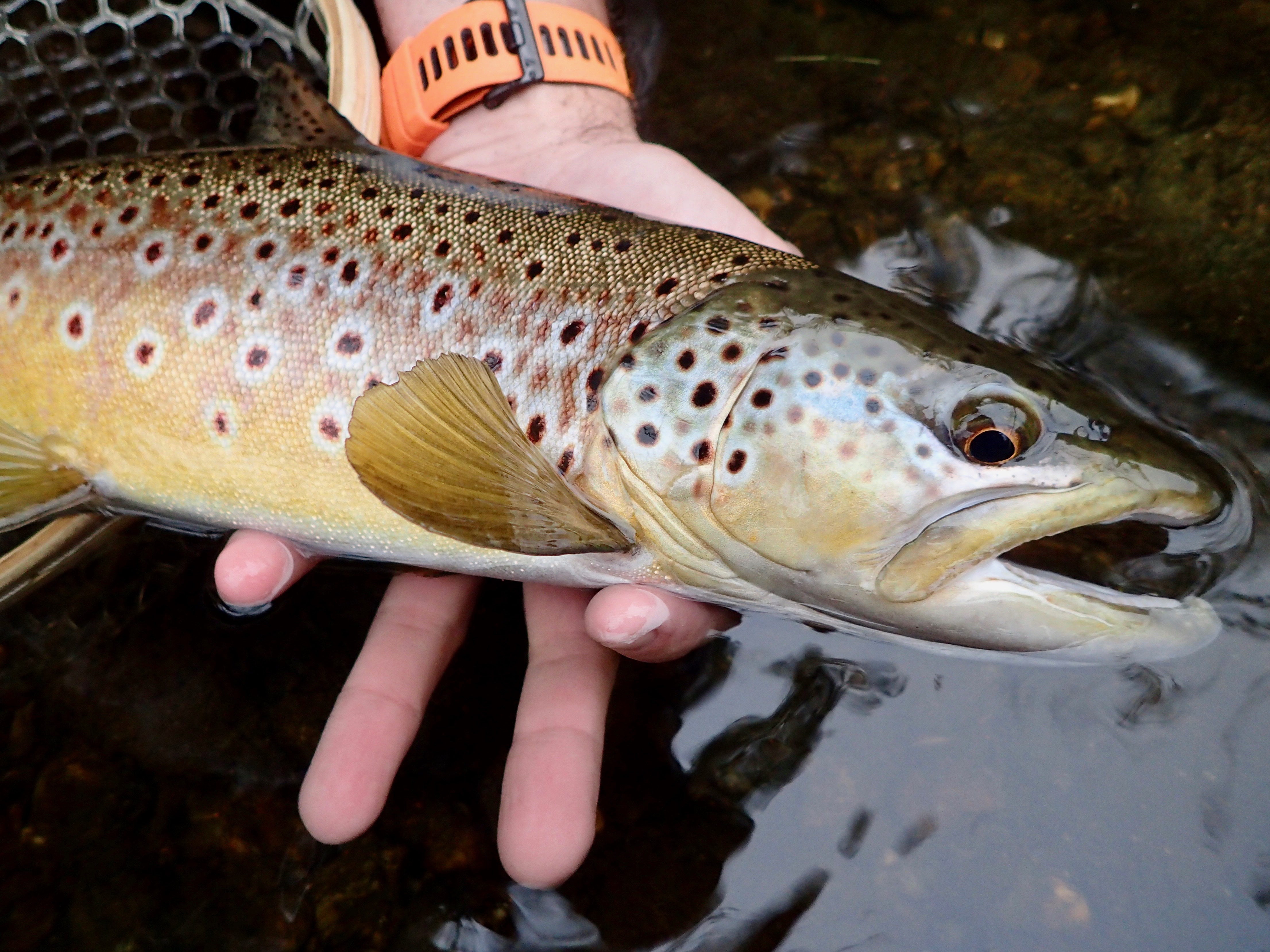
I often hear apocryphal, unsubstantiated reports of wild rainbows on the Farmington River. So when Brett landed this fish, my curiosity was off the charts. Vivid coloration, unique spotting, minimal scale damage, parr marks…could it be?Could be…but isn’t. A closer look at the tail reveals a structure far too short and stubby for a wild fish. The anal fin also reveals the kind of shredding you’d find from repeated scraping against the bottom of a tank. Still, a striking creature.
Back in the lonesome, isolated days of the pandemic, I mentioned that I’d never read Gary LaFontaine’s masterwork, Caddisflies. Currentseams subscriber Mayson Neel would have none of that. So he found a used hardcover copy of Caddisflies in fantastic condition (the book is out of print) and had it shipped to me. I started reading it, was intrigued, but like so many other projects, finishing it just fell by the wayside.
Cut to this winter, where I cracked it open, found my trusty yellow highlighter, and started anew. I’m happy I did, because I can tell you that what I’ve learned has resulted in dozens of trout caught, for both me and my clients.
I have so much to share about Caddisflies — I really can’t believe I ignored this book for so long — but I’d like to start with LaFontaine’s Diving Caddis wet fly. The female of many caddis species dive to the streamed to lay their eggs, encased in a gleaming bubble. LaFontaine writes, “Both the brightness and the action of the diving female are enough to make a wet fly imitation necessary…(the fly’s) pure Antron filaments, hanging free over the back, reflect more light.” He goes on to list four primary patterns, plus eleven secondary ones. I was dumbfounded to see that there isn’t a tan caddis pattern in the group; the closest we get is a tan/pale green version. So I made up my own tan diving caddis variant:
LaFontaine Tan Diving Caddis (Steve Culton variant)Hook: Standard wet fly size 14-20; Thread: Tan UNI 6/0; Body: Tan Caddis LifeCycle dubbing, small gold wire rib; Underwing: brown partridge feather fibers; Overwing: 20-30 tan sparkle yarn filaments; Hackle: One turn brown rooster hackle
Tying notes: LaFontaine specified the Mustard 7957-B hook; I went with my standard issue heavy wet fly hook, the TMC 3769, size 14. He doesn’t include a rib, but I like the segmented look it creates. While he specifies Sparkle yarn for the body, the LifeCycle dubbing makes a fine stand-in with its blend of natural and synthetic fibers. I plan on trying a few without the rib, and using the sparkle yarn, chopped up, to create a rougher, buggier body. I found it curious that he chose stiff rooster hackle, but LaFontaine explains that the fibers “Stand out from the body and add vibrancy to the moving wet fly.” Many of the photos I’ve seen of other ties feature a collar using several turns of hackle, but LaFontaine is adamant that the collar be kept sparse.
Although I’ve only been fishing this fly for a month, I’ve had several outings where it was the only fly on the team of three that was getting eaten…or the fish chose it by a wide margin over the other patterns.
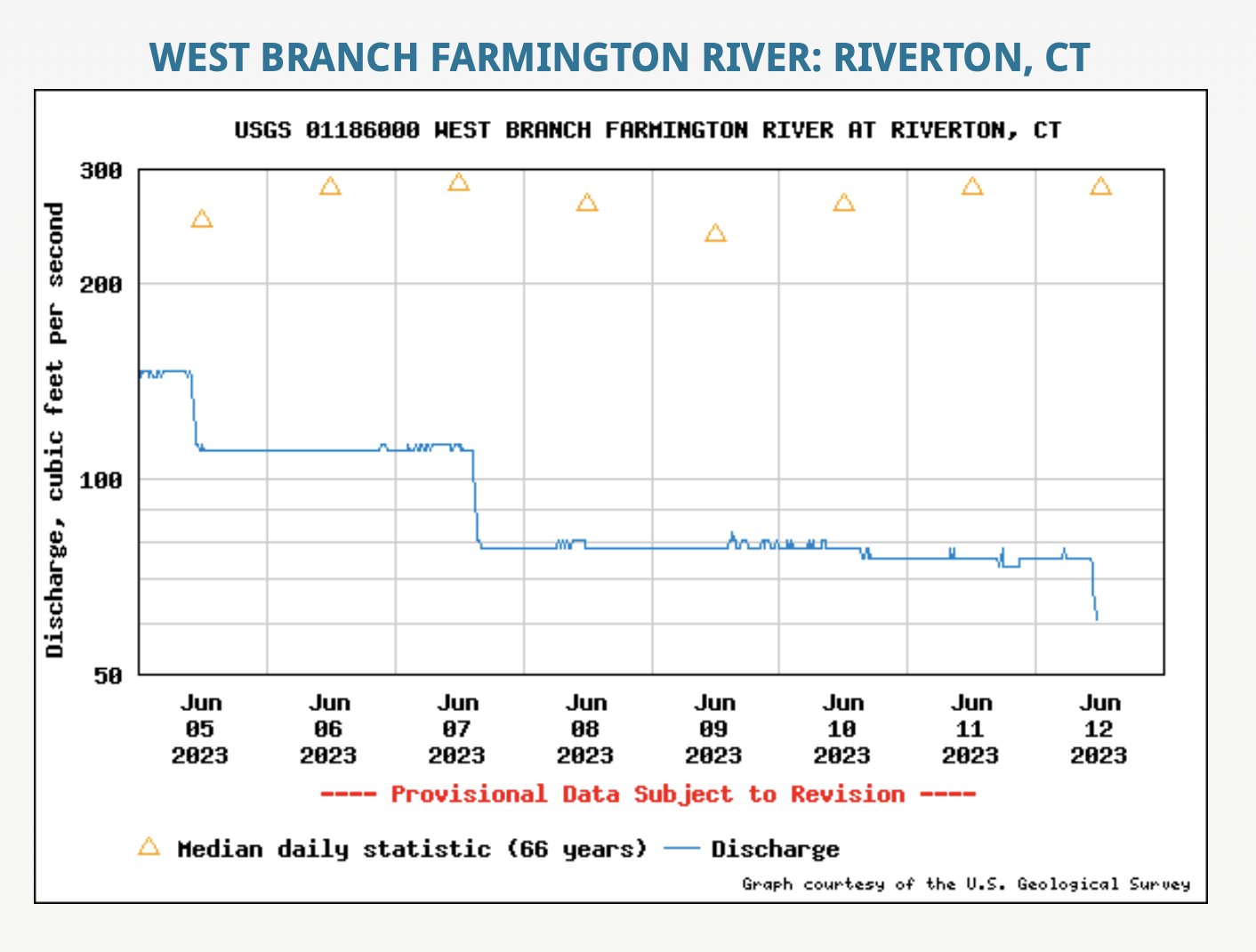
Spoiled, selfish children have a habit of poor behavior when the game isn’t going their way. Their frustration reaches a boiling point. Then they grab their ball and storm off in a petulant frenzy. The result is that the game is over and ruined for everyone. The spoiled child in this case is the person (or people) in charge of making the flow decisions for the West Branch of the Farmington River. And once again, they’ve decided that if they’re miserable, everyone who uses the river for recreation should be miserable.
For years, it’s been no secret that the MDC doesn’t care about managing the West Branch as a viable tailwater fishery and recreational resource. For over a year now, their unconscionably selfish reaction to not wanting any further financial responsibility for Hogback Dam has been to release only the minimum flow as-required-by-law. Anglers be damned. Canoeists, kayakers and tubers be damned. Business who depend on robust river flows be damned. Fish and wildlife be damned. It’s their ball, and they’re taking it away in the name of corporate greed.
What’s wrong with this picture? As the flow drops like a stone toward the bare minimum — and let’s note that the reservoir is nearly full — you can see that the dicks at the MDC are releasing nearly 200cfs less than they normally do. Score one for corporate weasels!
If it’s all too confusing, this one-page, one-side sheet explains the legal flow requirements for both Colebrook and Goodwin dams. We thank the Farmington River Watershed Association for providing it. And we damn the MDC for reducing flows and damaging our river, simply because they can.
In the meantime, we can only hope for rain up north, which would require the MDC to release more water — and more rain locally, which would bump up the Still River.
You haven’t heard from me this week because I’ve been busy. Some family stuff, some business stuff, and, oh, by the way, fly fishing the Farmington River. I fished Monday late afternoon into dark; Tuesday 7pm-dark; and yesterday I guided Max in the afternoon, then finished off the day all by myself till dark. Rather than divy the days up, I’ll give you some hard data to digest. But first, yesterday’s session with Max.
Max wanted to learn the ancient and traditional art of wet flies, and after several years of missed connections, we finally made it happen. It was worth the wait, as conditions were nearly ideal for wet fly: 165cfs in the PTMA and 247cfs downriver, water running clear and cold and plenty of bugs. We started off in the PTMA, and sulphurs were the story. We spent the first hour doing a streamside classroom, then entered the water around 3pm. In the space of an hour we stuck six fish. Like many anglers new to swinging wets, Max found the hook-setting process a challenge — you’ve got to wait before you set and let the fish do most of the work. We moved downstream below the PTMA and once Max found his “are-you-still-there?” equilibrium it was lights out. We stuck a bunch more, and Max did a great job of getting his flies over feeding fish and managing his drifts. Well done!
Not the river’s prettiest rainbow, but a good fish nonetheless. She actually went 15″ and gave us a proper display of mykiss obstreperousness. She was feeding in about 18″ of moving water; we saw the rise, and Max delivered a perfect strike over her lie. Three of the last four fish we connected with, including this one, took a size 14 tan LaFontaine Diving Caddis. (Droppers are the fastest way to find out what the fish want.) Be advised, trout, there’s another wet fly flinging fish-catching machine in the making.
Now to my observations. This is a wonderful time to be fishing the Farmington. You’ve got actively feeding fish and bugs from daylight to dark. Witnessed: sulphurs, tan caddis, dark grey caddis, March Browns, Isonychia (well below the PTMA) midges, BWOs. All three days saw a prodigious number of sulphurs on the water and in the air from late afternoon to about 8pm.
The lower water and cooler temps aren’t hurting the wet fly fishing; but you’ve got to pick and choose your locations. Any wet fly success I witnessed and experienced came in broken water 1-3 feet deep that was moving at a brisk walking pace. Slower, languid water, even when loaded with active feeders, proved unproductive. The trout in the slower water seemed to be be keyed on spinners (present even in the late afternoon) and I had only a few half-hearted tugs to show for my wet fly efforts. Faster water was money, even when there were no visibly feeding fish.
Surfcaster Extraordinaire Toby Lapinski scored this 20+” wild brown on a Light Cahill soft hackle in — you guessed it — faster water. A lovely fish, and nice pecs! It was one of two large browns he picked up on Tuesday swinging wet flies.
Finally, the evening dry fly bite was been vexing me (says the guy who was featured in a movie about dry fly fishing on the Farmington). We all put our waders on one leg at a time, folks, and I’m your proof. Monday, it was a lot of bad luck: I had about a dozen swings and misses by the trout, connecting with and landing only three. Tuesday, I hooked and landed a trout on my first dry fly cast; it was all downhill after that. The slot I was fishing was far less populated with rising fish than the night before; there were more swings and misses, and I only stuck one more fish into dark. Then a wind and rain squall blew in and stopped the feeding dead in its tracks.
And for dessert, we have…
Last night, I had the place all to myself…and about 400,000 size 16 Sulphur duns and spinners that littered the surface of the run I was fishing. My target drift lane bordered frog water and classic glassy dry water. The fish seemed to move at will from sipping spinners to slashing at emergers, and sometimes doing both. Duns were everywhere on the water and were largely ignored. With so much food in the water, I again had trouble buying a strike, let alone trying to figure out what they wanted. In 90 minutes I was able to hook and land two trout, one on a size 16 Magic Fly fished dry and the other on a size 14 Light Cahill. At 8:45pm, the feed went from an 11 to 1-and-done. I think the cold weather has changed the usual pattern of feeding long after you can see your fly.
Get out there, folks. It’s really, really good, even when it seems like it isn’t.
On Thursday I had the pleasure of fishing with Andrew. Andrew had asked for a wet fly lesson, and he couldn’t have picked a better day: water on the low side of medium and clear & cold, hot, sunny weather…well, maybe it could have been a little bit better on the hatch intensity scale, as we really didn’t see much aerial bug activity, nor actively feeding fish. Nonetheless, the subsurface bite was tremendous. We started off in the PTMA with a stream-side Wet Flies 101 lesson, then headed to the water. In one hour we stuck six fish (while the anglers above and below us blanked). We finished up below the PTMA and were faced with the same situation: very little bug activity and virtually no active feeders. But the bite was off the charts! I have no idea how many trout we stuck. Like many new wet fly anglers, Andrew found it challenging to let the fish set the hook. But he did a great job of casting and presentation. Awwwright, Andrew!
The first of many for Andrew. We fished a three fly team consisting of a sz 16 Magic Fly top dropper, sz 14 tan Diving Caddis middle dropper, and sz 14 tailed Partridge and Light Cahill on point. Unlike my experience Tuesday night, all Andrew’s fish came on the creamy mayflies.A historical — and hysterical — moment. Andrew took a spunky rainbow, and as we were admiring it in the net, he haphazardly let his leader dangle in the current a rod’s length away. Bang! Another rainbow took the point fly with fierce conviction. I’ve experienced many wet fly doubles, but none like this one!
After our session ended, I headed downstream to meet surfcaster extraordinaire Toby Lapinski for the evening rise. The mark was basically dead at 7pm, which did not bode well — it should have been simmering with rises and the air should have been dotted with creamy mayflies. Absent any action, I headed upriver to swing a team through a snotty run, and was rewarded with 8 fish in a half hour. As with Andrew, all of the action came on the creamy mayflies. The dry fly bite finally happened at 8pm, but it was probably a 3-out-of 10 on the scale, and there was no real dusk feeding frenzy. I’d ended up in the some frog water where the majority of risers were smutting on tiny flies and spinners. Since I was feeling lazy, I didn’t bother tailoring my leader and flies to that situation; as a result, I rose only 7 trout on my size 16 Magic Fly, Usual, and sz 12 Catskills Light Cahill, sticking 2 and landing 1. But that was fine with me. Toby had similar results. This weekend cold front won’t help matters, but I expect the Sulphur hatch to build over the next week. Hopefully, before long, we’ll be in that early summer dry fly nirvana.
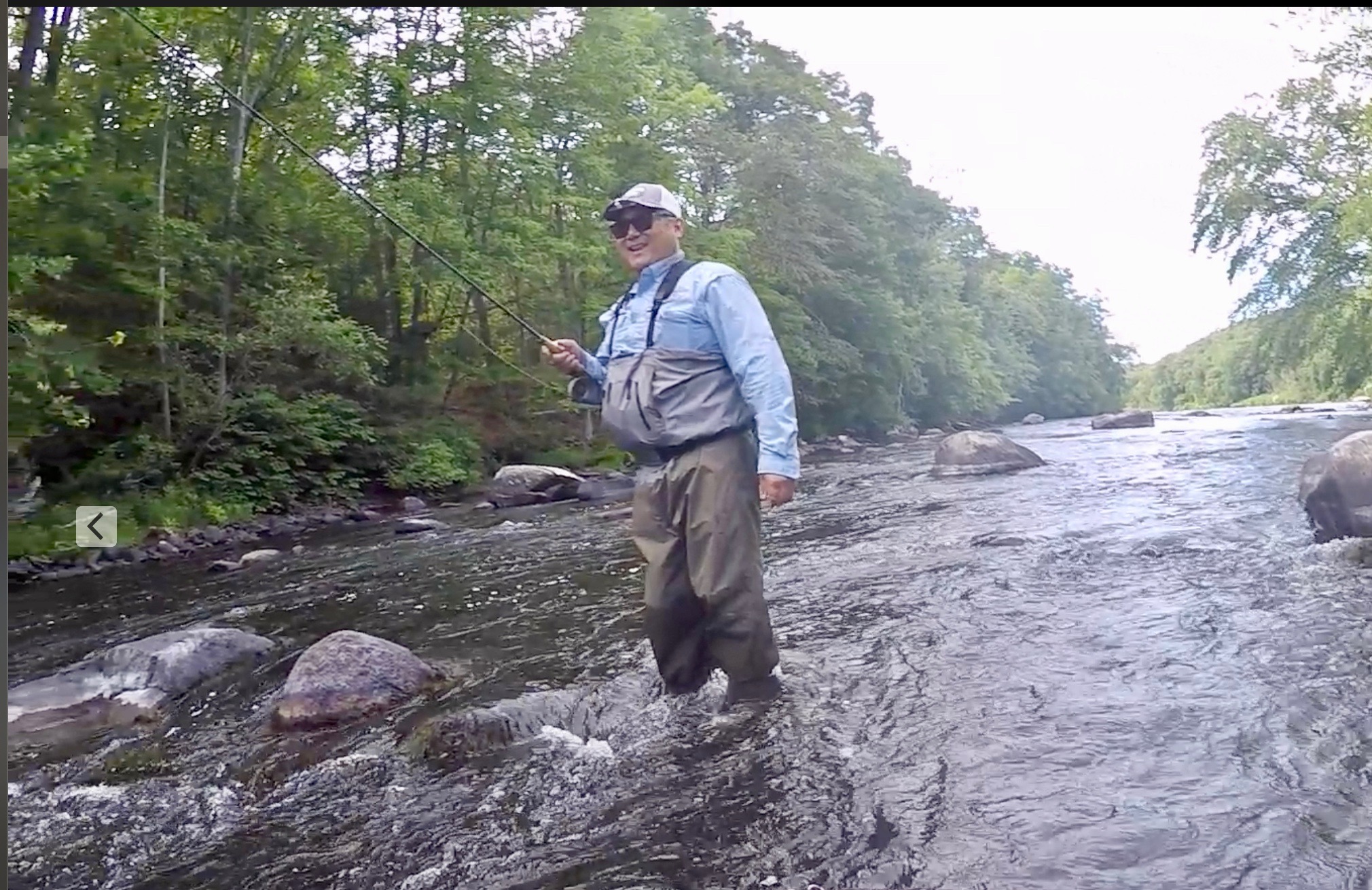
Neville has been following me for some time now, all the way from England. While he’s on holiday in the States this week, we had the time to meet up in Rhode Island for a lesson. We met at his rental in Point Judith, and tied a deer hair shrimp, my Grass Shrimp Solution, a Big Eelie, and then a Mutable Squid. That kept us busy for a couple of hours. Then we geared up and headed to an estuary to practice the greased line swing and its associated tactics. The tide was wrong, but we had moving water, and we even had a swing and a miss when Nev was stripping in his line to make another cast. (Teaching moment: the bass that chased his Ray’s Fly was small. Stripping a fly is a great way to attract small striped bass.) Neville is a very enthusiastic learner (he recorded much of our session on his phone) and I have only the highest amount of respect for those who dive into a subject with such eagerness and passion. Well done, Nev!
All the way from Merry Old England! Here’s Nev putting his TFO TiCr five-weight through its paces. He’s well on his way to becoming a dangerous striper-catching machine.








 currentseams.com