The more you fish wet flies, the more you’re going to encounter situations where you want your team of three to behave in a very specific way. This can happen from day to day, location to location, and even from moment to moment within a single run. As always, ask yourself the question “What do I want the fly to do?” Let the answer be your guide.
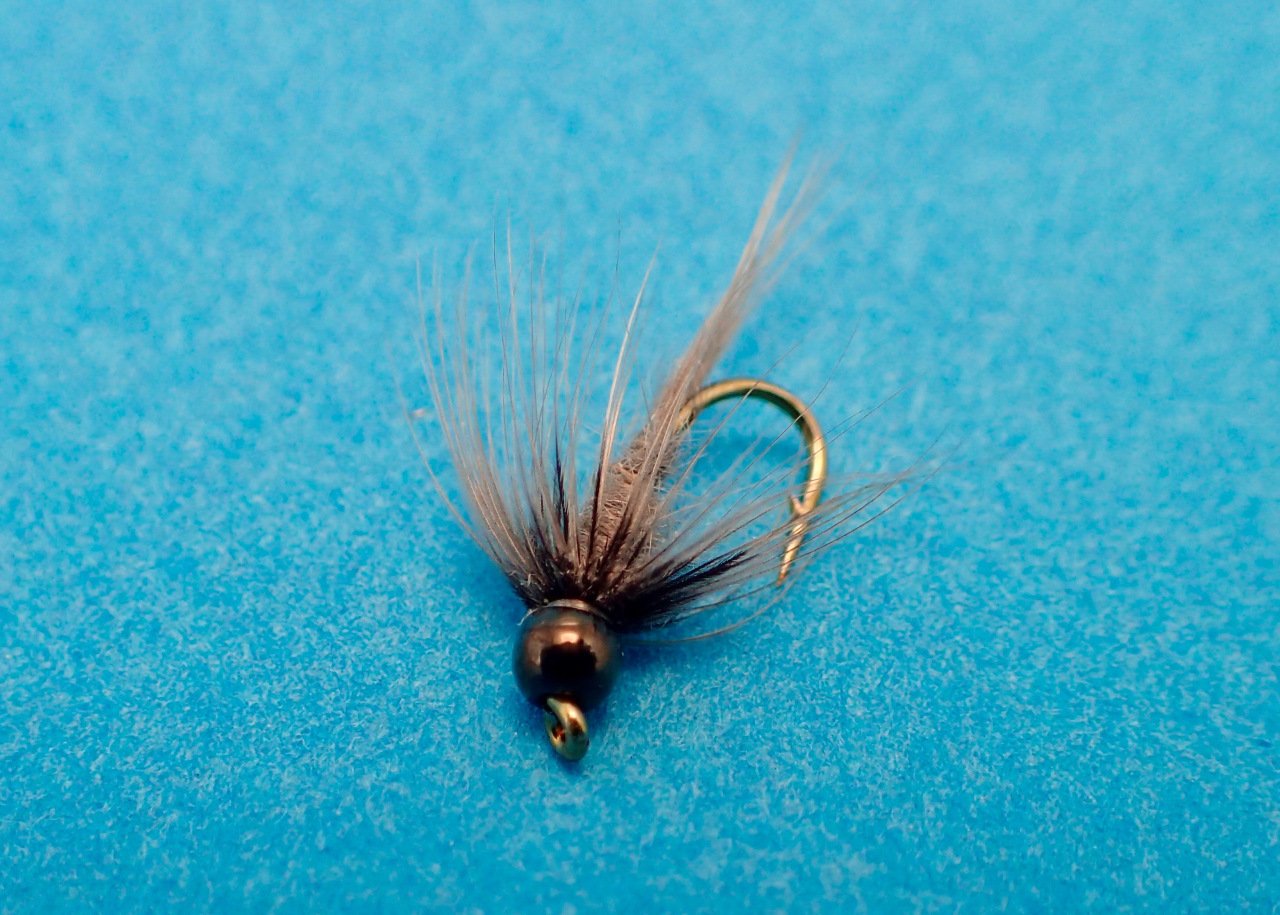
If you want to sink your rig, then a bead head on point is good choice. Of course, the size of the bead, the material (brass or tungsten), the speed of the current, your leader length, and your mending skills will all factor into how much depth you can achieve. I’ll use red thread at the head to help me identify the tungsten beads in my fly box should I choose to go heavy. I like to keep the heaviest fly on point; I find it easier to cast, and as the heaviest member of the team it will want to pull the entire rig down.
Say you’re fishing a bead head pattern on point, and you notice an active riser above your position. The fish is taking emergers just below the surface. In this case, a sinking rig may not be to your advantage — you want to make it easier for the buyer to buy.
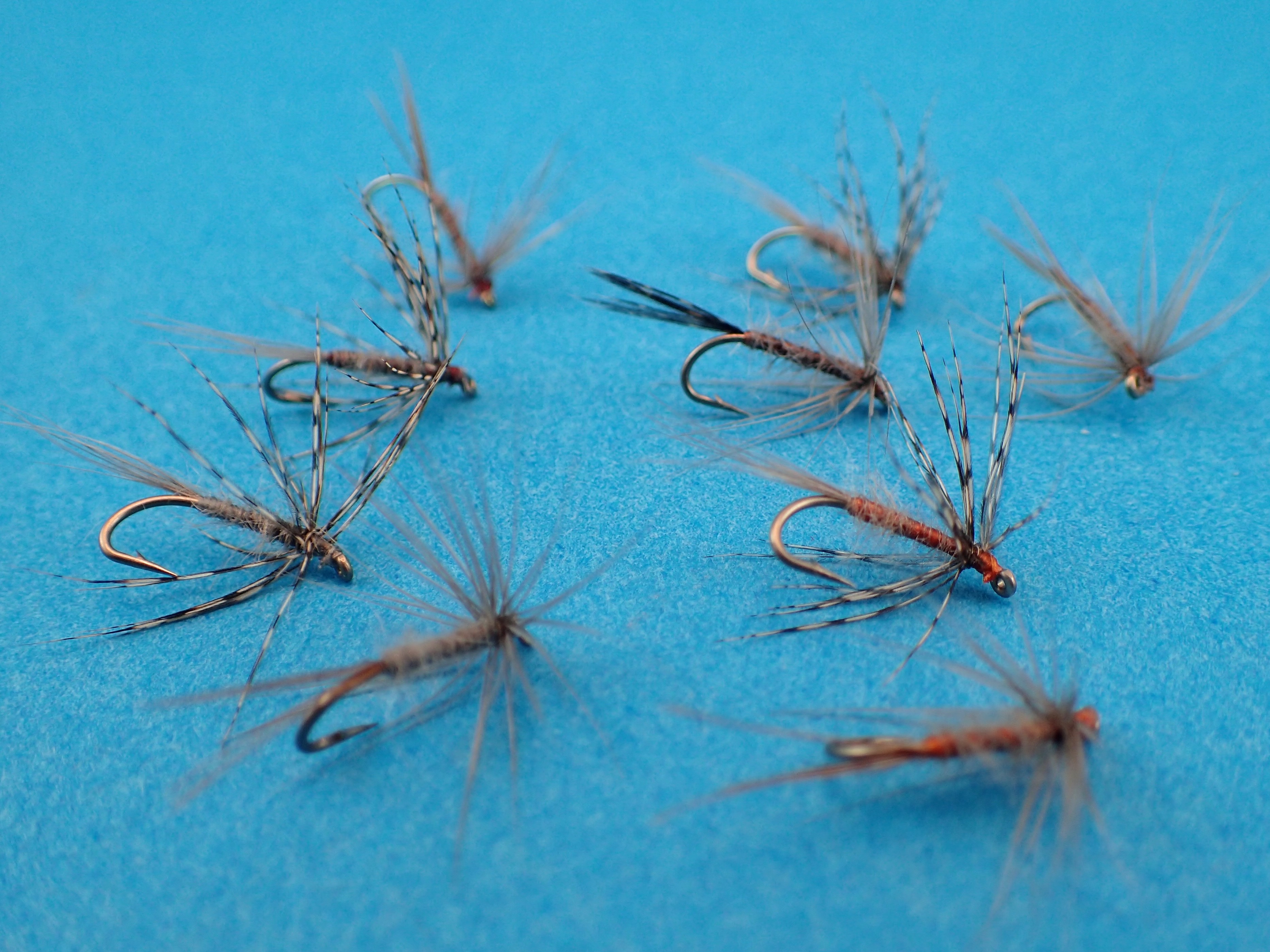
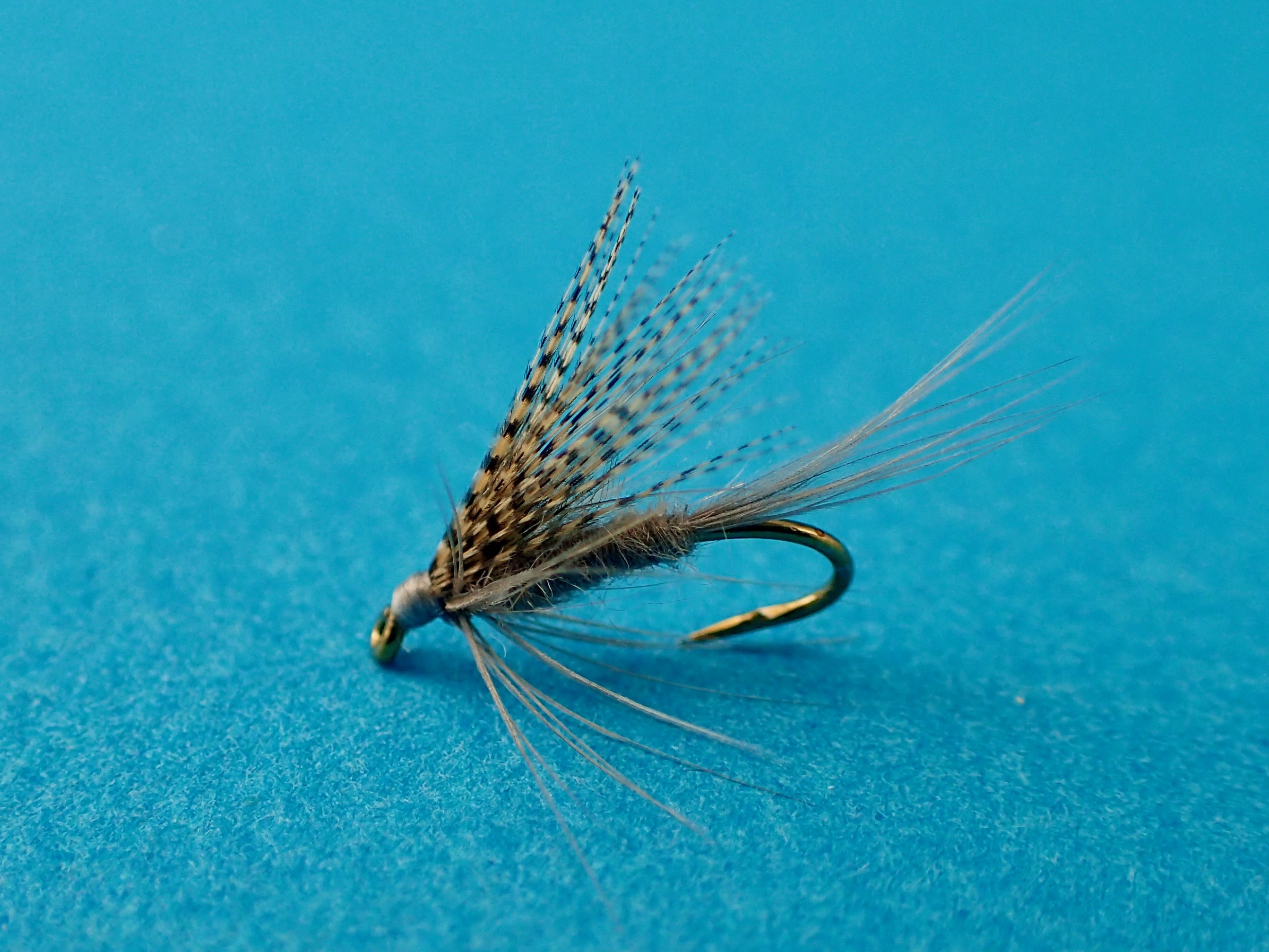
To keep the team of three near the surface, I’ll switch out a bead head point fly for a soft hackle. If I’m making an upstream presentation to a fish that’s feeding just below the surface, I want the flies on my team likewise just below the surface. Of course, match the hatch if you can. We did this yesterday with a trout that was feeding on caddis in some slower, shallower water. Off came the bead head point fly, on went the unweighted caddis, and a few well-placed casts later, bingo! Fish on.
Mark contacted me over the winter about learning the ways of the wet fly. He booked two half day sessions, a brilliant move on his part, as we experienced a mixed bag of weather and catching on the first day, and then the Farmington River at its finest today. We fished both days from 11am-3pm. Water was 425cfs in the Permanent TMA, and 600cfs below it. The water is a little colder than usual, due to not only the weather but also the greater percentage influx of water from the dam. Caddis is king right now, and we saw good numbers both days, particularly today. Midges, too, and some tiny olives on Monday, par for the damp day course.
Monday 5/17: We started out with brilliant sunshine, then got poured on. Our first mark had the dreaded guide-catches-on-the-demo-cast (I’d rather the client do that), but we eventually connected with a couple fish, though none of them made it to the hoop. There was a decent amount of bug activity, but little in the way of consistent risers.
We had our first taste of success at Spot #2 with a gorgeous little wild brown. I never get tired of these jewels, or the way they attack a wet fly with primal fury.
Thunder eventually drove us off the water. Rather than wait it out, we solved the problem by driving miles away from it. We finished up below the Permanent TMA, and this set the stage for Tuesday. We found some trout that were willing to eat, and even though the numbers were not what I expected, the day absolutely qualified as a good one. Mark was a solid caster, a dedicated student, and best of all, a strong wader. That meant we could get into some areas that many anglers would find a challenge to navigate.
This is how we do it. One of the biggest challenges a new wet fly fisher faces is how to let the trout do the hook-setting work. After dropping a few fish Monday, Mark began to figure it out. By the time we finished up on Tuesday, he was sticking every trout. Awesome job, Mark! I spent Monday night ruminating where we should fish Tuesday, and decided that on…
…Tuesday 5/18, we would pick up at the same mark where we left off Monday. I wanted to see if the warmer air temps and sunshine would kickstart the hatches –and the trout — and that’s exactly what happened. Caddis, caddis, everywhere, size 12-14 — and then huge swarms of micro caddis. We didn’t fret about those, since the trout were more than eager to jump on the bigger flies. We took them on Squirrel and Gingers (top dropper), Starling and Herl (middle dropper), and generic bead head gray soft hackles on point. We took them on the dead drift, the mended swing, the dangle, and with upstream presentations. I lost track of how many trout, which is always a good day on the river. On Monday, I had kept telling Mark, “You’re doing everything right. You just need to find some cooperative trout.” I’ve made that speech to numerous clients, so it was gratifying to be there when the cooperative trout showed up. We played through the run, then walked 500 yards upstream where Mark — now a dangerous wet fly machine — connected with a spunky rainbow. Great job, Mark!
Mark’s best fish of the trip was this mid-teens wild brown that we witnessed repeatedly slashing at caddis in a feeding lane. Or, as Mark said: See the fish. Present to the fish. Catch the fish. He did just that, and his instructor couldn’t have been prouder. A Squirrel and Ginger did the trick.
I guided Andrew and Brett yesterday and they wanted to focus on wet flies. Monday’s rain was more than I expected, and I didn’t like the height or the color of the Permanent TMA. So we headed north to the friendly confines of WBATSR (West Branch Above The Still River. I just made that up.) This was a good call as the water was running a crystal clear and very wadeable 200cfs. I really liked that height, and I thought there were dozens, if not hundreds of pockets and seams and slots and riffles that would hold trout. Sadly, the trout didn’t get the memo, and we had a very slow day. (We didn’t see any angler other than our group hook and land a fish.) It was the kind of day where I find the next great piece of water, and think to myself, “this is going to be it,” and then nothing happens. These episodes make me throw up my hands and say, “I quit.” Of course, I don’t really mean it, and of course we don’t quit, but I get frustrated just like everyone else.
Andrew had fished with me before, and on that day we had far more active fish than today. Brett is a relative newcomer to fly fishing, and once we smoothed out a few wrinkles he was swinging like a pro. I alternated between both anglers, and we worked downstream, covering several hundred yards of water. Bug activity was very light, with two confirmed Hendricksons and a handful of BWOs, but that was it. As you can imagine, angler traffic was heavy, especially with that section of river the only clear water game in town. With today’s rain and increased flows, I would guess that streamers and nymphing will be, by far, the most productive methods for a few days.
Andrew doing battle with a chunky rainbow. He scored two trout, both on the bead head soft hackle I had tied on in the point position. In my experience, wet fly can be challenging in high flows, so I’d wait for the water to get down to 500 or less before swinging. Great job, Brett and Andrew, for persevering though some tough fishing conditions!
“What are the best soft hackles (or wet flies) for fishing the Hendrickson hatch?” is one of those questions I get a lot this time of year. As always, the best flies are the ones in which you have the most confidence. I should also make this clarification: technically, with Hendricksons you’re fishing wet flies under the hatch. On the Farmington River, prime time for swinging Hendrickson wets is generally in the 11 am-to-3 pm window. Every day is different. Once you see duns on the water, and trout snapping at them, the wet fly game is all but over. But if you want to catch more trout, you should be swinging wets in this pre-hatch time frame. (Of course, you’re fishing a team of three wets. Here’s how to build a wet fly leader.) And so, in no particular order, these are some of my favorite Hendrickson wet fly and soft-hackled patterns.
Bead Head Soft-Hackled Dark HendricksonDark Hendrickson winged wetHendrickson Spiders. Size 12, wet or dry fly hook, gray or rusty brown thread, tail material of your choice, a dusting of muskrat fur or dubbing, then brown partridge or dark dun hen hackle.Bead Head Soft-Hackled Pheasant TailOld Blue DunSquirrel and Ginger. Yeah, I know. Not a Hendrickson pattern. But on the Farmington, we often get a strong caddis hatch around Hendrickson time. If you place this as your top dropper, you’ll be covered if the trout are selectively feeding on the caddis.
Monday’s Hendrickson hatch in the lower end of the Permanent TMA was a solid 8 out of 10. (The pre-hatch bite was slow, and the duration of the duns-on-the-surface feeding frenzy was brief, otherwise I would have graded it higher.) So I headed back yesterday to see what secrets the river would reveal. Crowds continue to be a factor; if you’re looking for solitude within the Permanent TMA, you will be disappointed. I chatted up my new buddies from yesterday, Andy and Bob, who were likewise back for more, and when some water opened up — people do leave — I jumped on it. Conditions were as nice as you could hope for, with a clear flow of 275cfs and hazy sun and far less wind than Monday.
The section I fished was perfect wet fly water: moving at a brisk pace, mottled, multiple current seams. Wet fly continues to be a highly productive method for fishing under the Hendrickson hatch, especially when it appears as though nothing is going on. While many other anglers are lounging on the river bank, or standing mid-stream like statues, I am working the water with a team of three wet flies. Wet fly anglers will always discover that something is afoot subsurface before dry fly anglers, and that was proved again yesterday. Around 1pm, I had an intense flurry of activity for 15 minutes, including hits on four consecutive casts. Then the action slowed.
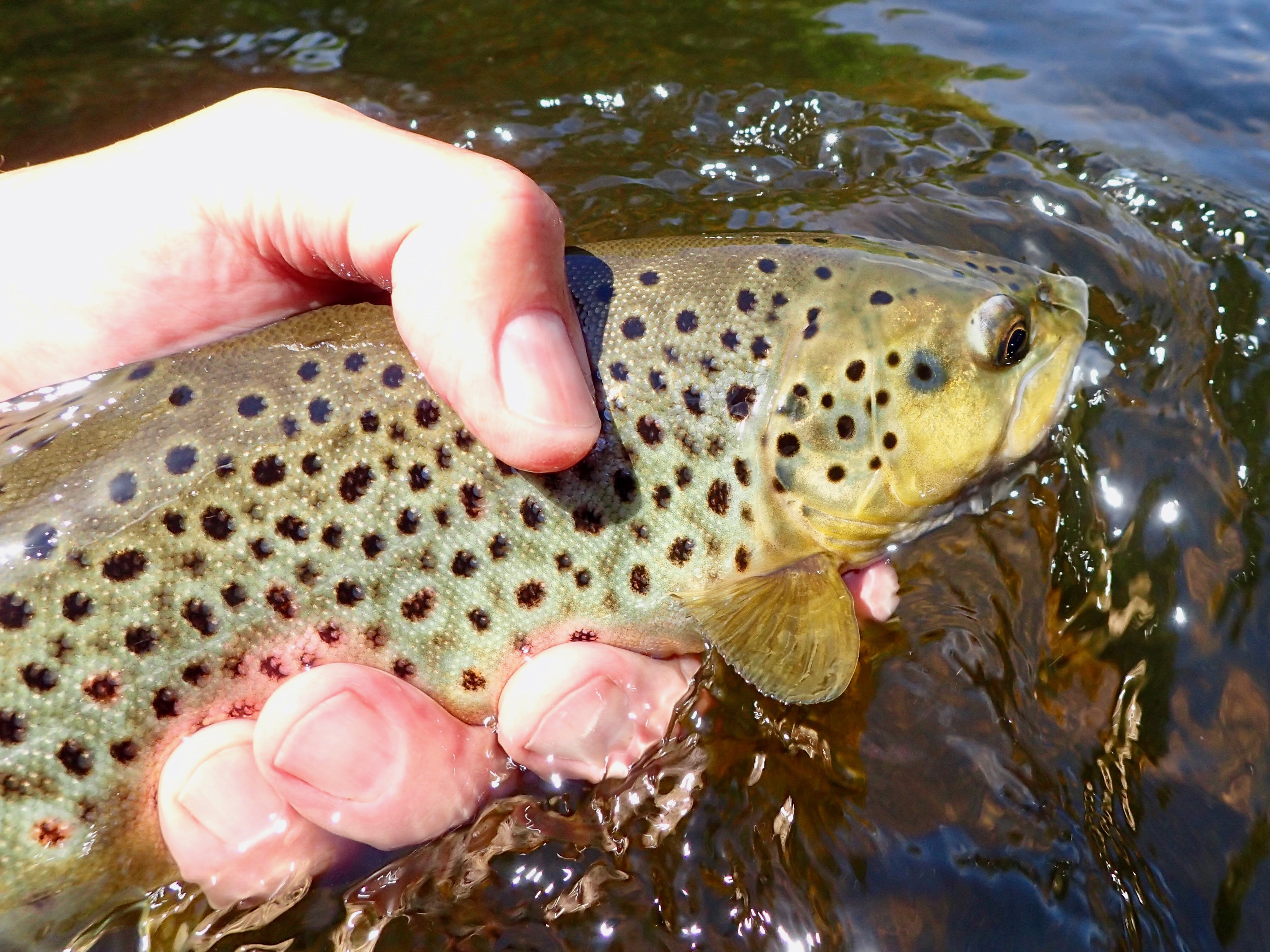
This 16″ Survivor Strain brown crushed my BH Hendrickson soft-hackle on the mended swing. In heavier current, trout will set the hook if you let them; you feel the hit, wait, and ask “Are you still there?” The answer will always be yes.
Then, just like that, it was over. I added a shot above my middle dropper to see if I could tight line nymph up some trout, but they weren’t having it. (This is something I teach my clients: when you walk into a pool, you simply don’t know what’s been happening. The trout may have had the feed bags on for the previous hour, and now they’re simply just done.) So I got out of the river to warm up a bit. With the pool rested and my legs a little less frozen, I waded back in around 2pm.
Since I was hoping to find the fish that were already looking up, I switched out the bead head on point for a fly I’d never fished before. It was the Old Blue Dun, one of Leisenring’s favorite twelve. I’d always thought it would make a fine Hendrickson, and since to this point I’d seen more olives in the air than Hendricksons, it seemed like a proper why not? moment. It was a good decision, as a rugby ball-shaped survivor strain brown hammered the fly on the dangle.
With superabundance of meat on his flanks, this 16″ Survivor Strain brown gave me a challenging battle in the swift, cool waters of the Farmington River.
On Monday, the Hendrickson duns were on the surface thick by 3pm. That was not the case yesterday; we probably had about two-thirds less mayflies. Still, I brought several trout to net on Hendrickson Usuals and Comparaduns, two patterns I like in choppy water as they provide a good profile when viewed from below. I had to be off the water by 3:30, so reluctantly, I pulled myself away from pleasure and headed off toward responsibility.
I only had 90 minutes to fish, so I chose the lower Farmington because it was closer to my house, and also to where I needed to be at 2pm. Plus, there was that front bearing down on us. Didn’t want to get stuck in that mess, especially after witnessing a foreboding fork of lightning slicing through the sky. After waiting for the dark clouds to disperse, I was on the water a little before noon. The plan was to swing wets and see if there was any Hendrickson action. Conditions weren’t great — 600cfs is a little high on the Farmington for wet fly, so I used a tungsten bead head Pheasant Tail soft hackle on point to sink things a bit. Still, the water I fished was fast and heavy, and if I was interested in numbers, nymphing would have been the way to go. I had a half dozen whacks in the fast water, with no hook sets, before I connected in a deeper slot. The wind was also a factor — forget roll casting for any distance — and I had to be vigilant to keep the rig from tangling. But by the end of the outing, I had three trout to hand, two on the BHSHPT and another, the biggest, on the top dropper, a Squirrel and Ginger. A My Father Le Bijou 1922 Gran Robusto proved to be a fine companion. Speaking of fronts, I can’t believe how much the temperature has dropped.
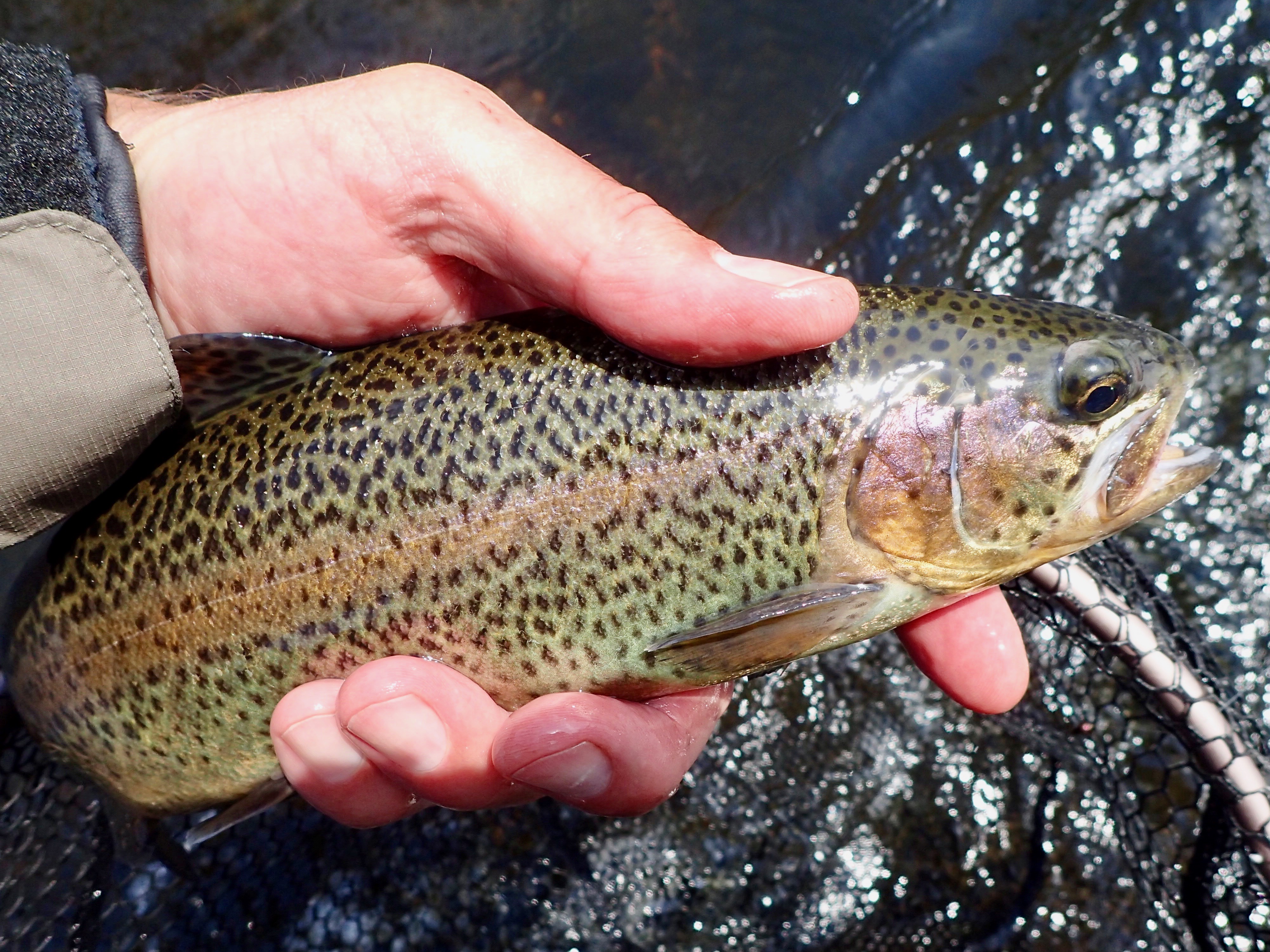
It always feels good to land the first wet fly trout of the year, even if it is a stocker rainbow. This one treated me to two aerials. The last two were fatter, and took a bit of forceful coaxing to come to net. I didn’t see any Hendricksons or caddis, but then again I only fished until 1:30pm. My wet fly box desperately needs a restocking!
When I give a wet fly lesson, I always tell my clients this: “If you hit a hatch just right, you can have one of those days you’ll never forget.” And it so it was for me on a cool afternoon in April. Hendrickson season can be tough on the Farmington, especially if you’re looking for an unoccupied mark. But sometimes luck smiles upon you, and on this day it was so. The run I wanted to fish was on lockdown, but just as I arrived, an angler left, leaving a prime lie open. Armed with a three fly team of wets, I proceeded to wreak havoc upon the residents. This was one of those days where I quickly lost count of fish, but it was easily in the multiple dozens range. (Fresh fish + epic Hendrickson hatch + wet flies = stupid good.) I had doubles galore. I finally quit because it was so ridiculous for so long. Really. You can read about it here.
I had several evenings of spectacular wet fly action during the sulphur hatches of 2020, but nothing that equaled the craziness of this day of Hendrickson mania! If the water is 450cfs+, or if you want to sink your team a little more, try this tungsten bead head Dark Hendrickson soft hackle on point.
This evening I presented to the Anglers’ Club of Philadelphia via Zoom. Although it was a cocktail hour (5:00pm start), I remained steadfastly professional with my tall glass of lime seltzer. The topic was “Wet Flies 101,” and I had as much fun presenting it for the umpteenth time as I did the first! As many of you know, I’m passionate about wet flies, and especially teaching others this ancient and traditional art.
The Leisenring Spider, an homage to the Pennsylvanian roots of American wet fly fishing. An oldie, and a goodie. If you’re looking for speakers for your next club Zoom meeting, wet flies or otherwise, here I am.
Hot’s got nothing to do with water temperature. Thankfully, the Farmington is running cool even thought they’ve dropped the level (currently about 170cfs in the Permanent TMA). No, I’m talking about the bubbling, boiling (figuratively), riffly whitewater sections of the Farmington. That water is is oxygenated and loaded with food. It’s also studded with small pockets and micro boulders — places trout like to hang out. If it’s at least a foot deep, it’s fair game, and you might be surprised to discover what’s living there. Swing wets, drift nymphs (no indicator), hopper/dropper — all of those are good choices for covering the hot water. Oh. And hold on. The chance of a big fish is always there.
This is what I’m talking about. The angler is one of my clients from a few years ago. On this day the water was far lower than it is today — I think the flow was only double digits, and the riffle was barely a foot deep. Normally you’d shoot past it without another look. But on this day we banged up trout after trout. Note the method: tight line nymphing. Indicators aren’t necessary here because of the water depth; plus, you’ll feel the strike or see your sighter lag a bit. That’s when you set hard downstream. Please use the strongest tippet you can, and get those fish in fast.
While it’s positively tropical across the rest of the state, the Farmington continues to offer respite. True, they’ve lowered the flow (165cfs within the Permanent TMA) but the water is plenty cold. This can be a tough time of year to fish: hatches are sporadic and sometimes light at best; and in flows this low the fish are concentrated in certain areas and can be downright spooky. Nonetheless, Dave wanted a wet fly lesson, and off we went.
At this height, the river is still quite agreeable to the wet fly. You’ve got water that’s deep enough to swing, enough water to create a good current, and as a bonus the fish are always looking up. Dave did a great job, and his enthusiasm was palpable. We fished three marks, and found players in one of them, a nice mix of brook trout and a jewel of a wild brown. All of our fish came in faster water/riffles. Dave is awarded the Currentseams Order of the Straight Line: he is my only student this year to make it through a wet fly session without a tangled leader! Well done, good sir, under some challenging conditions (we did not see another fish caught all day).
Guides love bent rods (although I must’ve got him between strips). Fish on, baby!
~
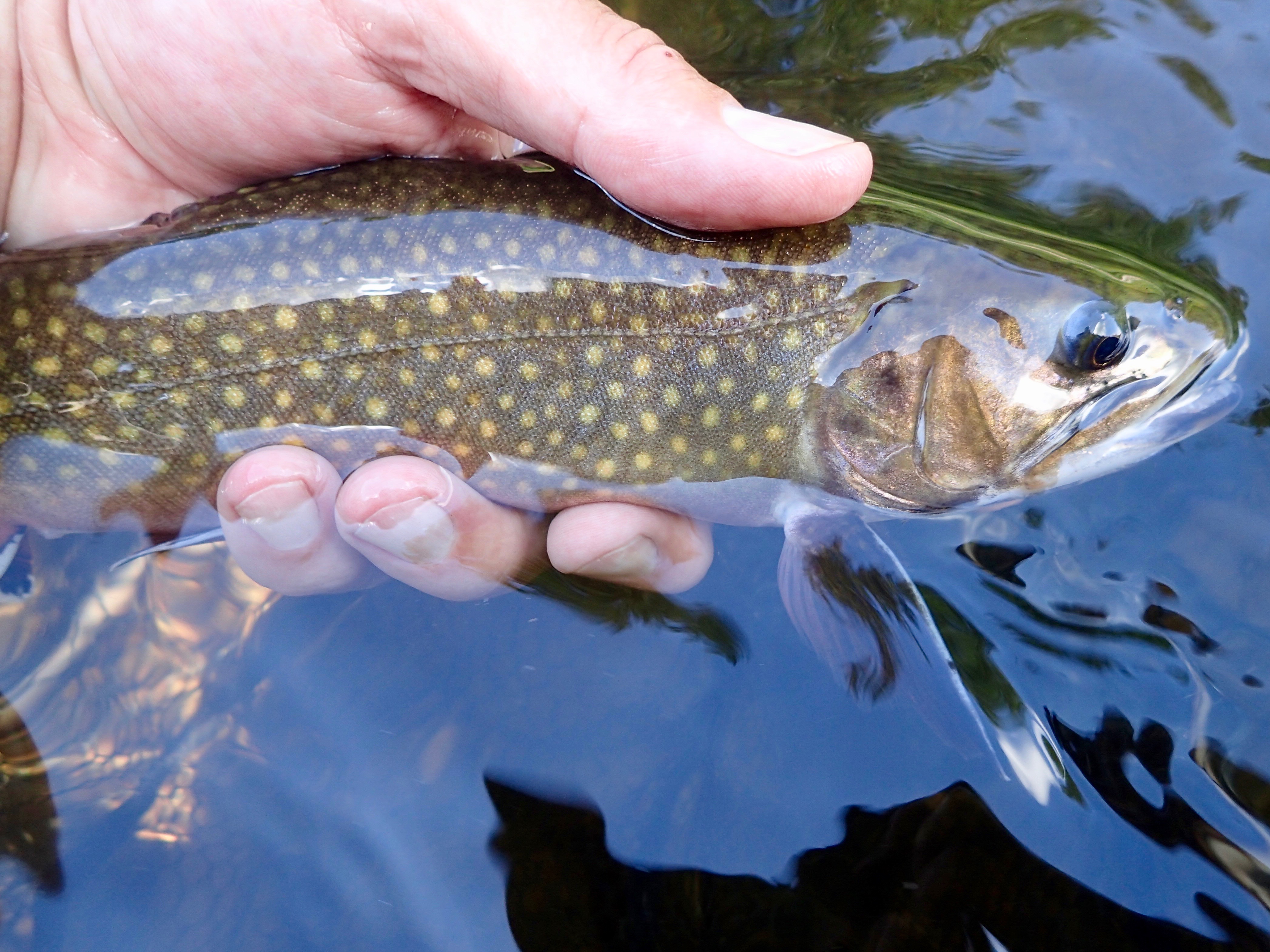
This was a stocked brookie, but he’s been in the river long enough to regain some lost lustre and begin to grow some proper Fontinalis fins.







 currentseams.com