I hope this Monday finds you happy and healthy and ready to fish! Or, at least think about fishing. I believe we’ve all had enough of this particularly loathsome winter, and the warmer weather this week should continue the melting trend. I haven’t fished since the first week of January, and I could really use some time on the water. The Farmington River beckons….
No fishing doesn’t mean I haven’t been busy. I spent most of last week working on my tying area, cleaning and organizing, and I think I’m in a place where I’m ready to tie with a minimum of frustration (where the heck is my patch of rusty deer belly hair?) You’ll get to see it all in a future post/video etc. I’m also gearing up for the Lancaster, PA, Fly Fishing Show, now less than four weeks away, so for those of you in the area, be there or be square. Talks, classes, tying — I’m going to be doing it all. This will be my first time at this show, so I’m hoping for a strong turnout.
I’m looking forward to reconnecting with my friends at the FVTU Chapter this week. Note also the rescheduling of the Cape Cod presentation. If you’re the person in charge of hiring speakers for your club, I do in-person and Zoom presentations. Send me an email or call me, and we’ll get the ball rolling.
I’ll be posting more details on Lancaster here and on Instagram — @stevecultonflyfishing if you’re not already following — in the coming weeks. Thanks as always for reading, and for your enthusiasm.
My apologies or not getting this out last week. I’ll try to be a little more timely. The good news is that the terrible weekend rains mostly missed the Farmington, and the river has been fishing very well. Last week I guided Dan for a late afternoon-into evening session. The focus was on dry flies, and we started off with a hopper/dropper system. (‘Tis the season! And I promise, no more parenthetical statements.) We discovered a pod of trout taking emergers in a shallow run in bright sunshine. When Dan dialed in his cast and drift, his hopper got crushed by a very respectable mid-teens brown. We found another run formed by the confluence of two sections of river, but we couldn’t buy a hit. Even when we switched to wets, it was no dice. My best guess is that they were feeding on something far smaller than what we were throwing.
We ended the session at a classic dry fly pool within the PTMA. Hatch activity (22-24 BWOs, 18-20 Summer Stenos, and later, 12-14 Light Cahills and an absurd number of midges…and I guess I fibbed about the parenthetical statements) was light until 8:30pm, but Dan managed to stick a nice fish on a 22 BWO dry. We used a 14-foot leader-tippet system terminating in 6x to get better drifts in the languid, glassy pool. At 7:30 I was able to join in the fun. As predicted, that wild brown feeding just off the rock in the frog water got stupid as it got dark, and I took him — with great delight — on a size 16 Catskills Light Cahill dry. Both Dan and I had good action until we could no longer see our flies.
The next day, I shot some drone photos for the book with filmmaker extraordinaire Matthew Vinick. I fished for about 45 minutes below and within the PTMA until he arrived.
I was fishing some water in the PTMA I really haven’t spent any time in for at least five years when I connected with this gorgeous creature. She was part of a pod of trout taking emergers, and she chose my Squirrel and Ginger top dropper. Matt and I went to a couple other pools in the PTMA to shoot, and then we had places to be.
~
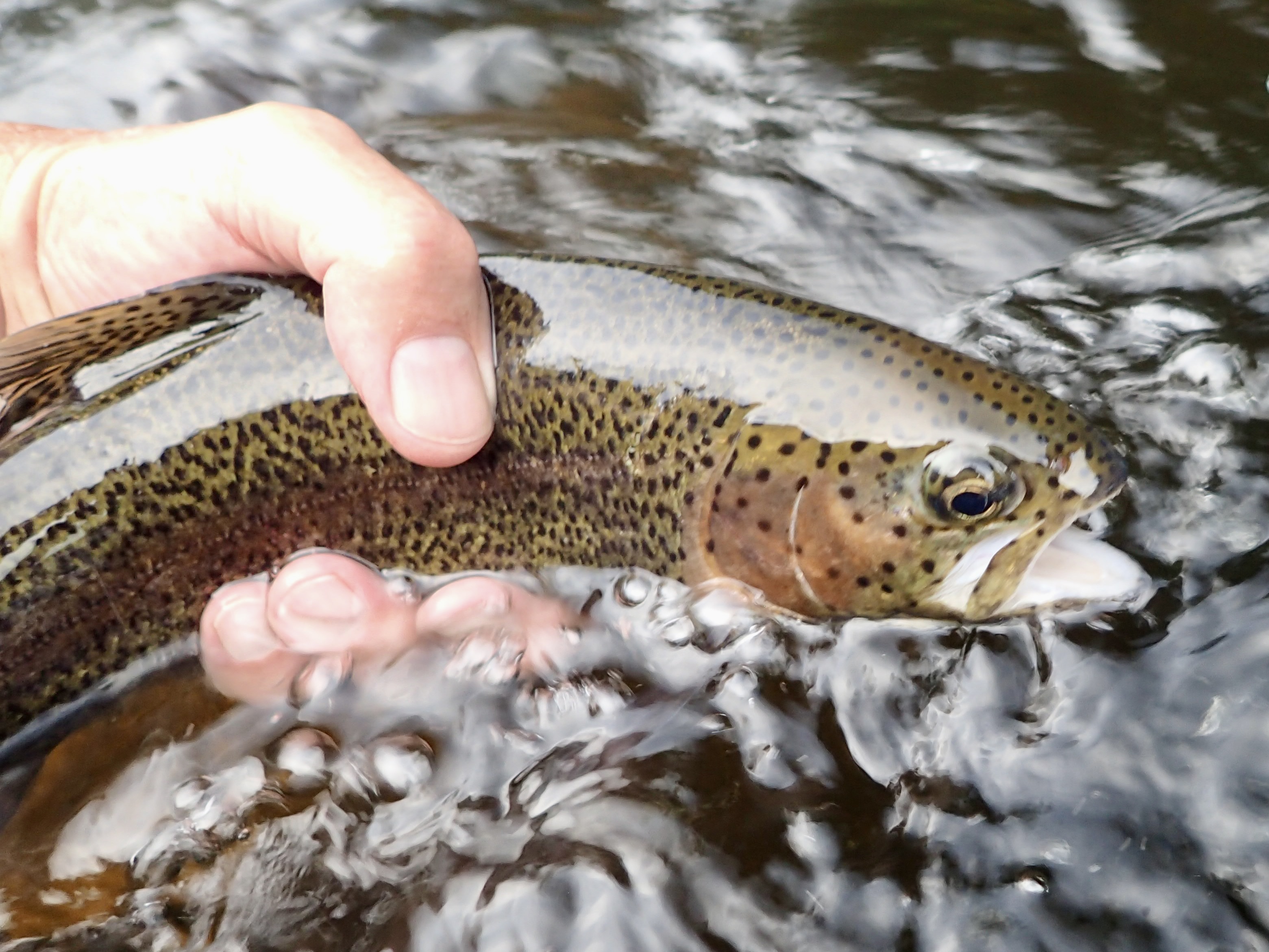
I had 30 minutes to fish before I had to pick up my son at Bradley. So I ventured into some snotty, treacherous water that’s rarely fished. This rainbow hit the Squirrel and Ginger so hard that she peeled off 20 feet of line before I could adjust my drag. The photo really doesn’t do her justice — she was fat and powerful and wonderful, and she just wouldn’t sit still for a picture.
~
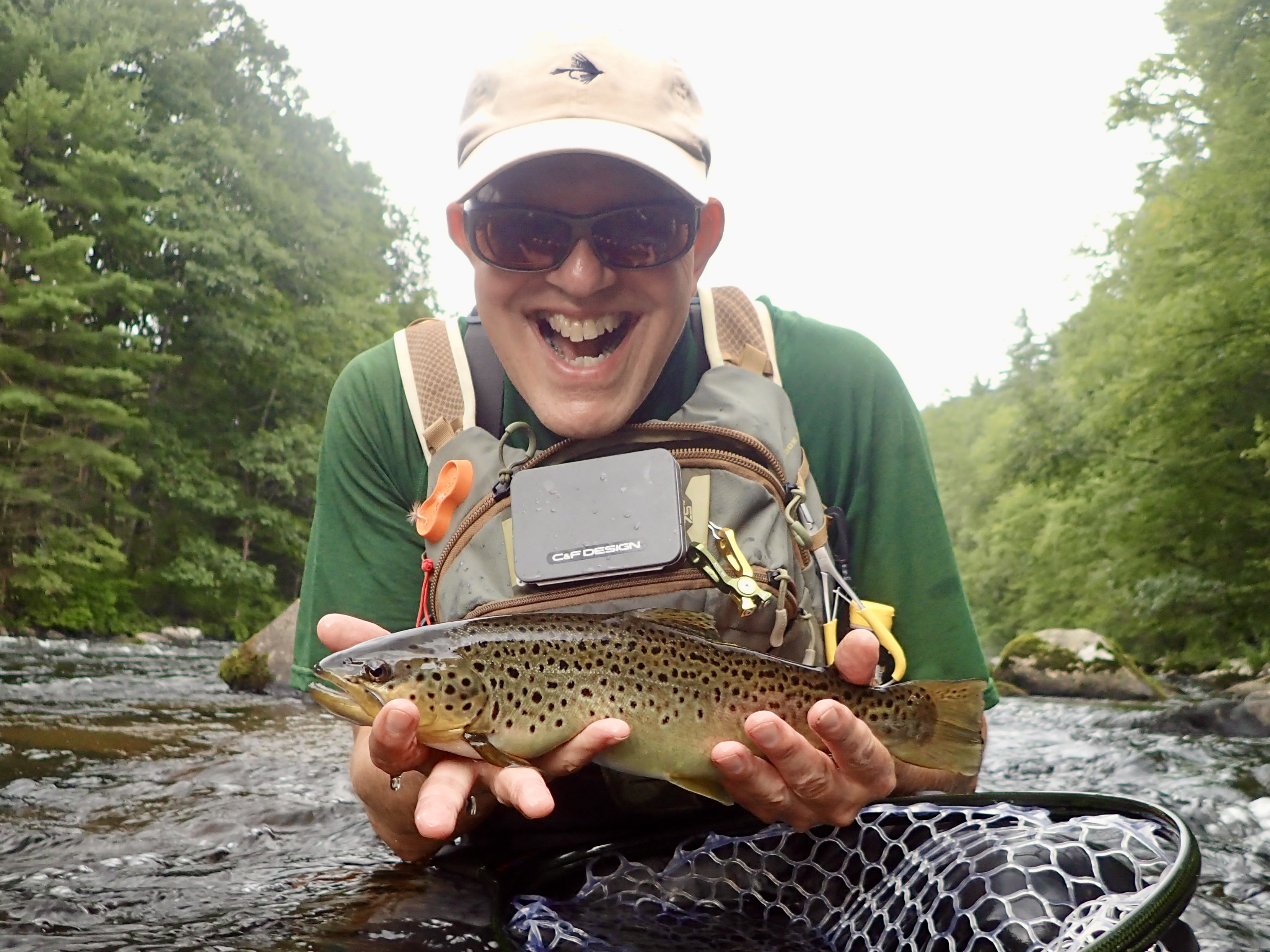
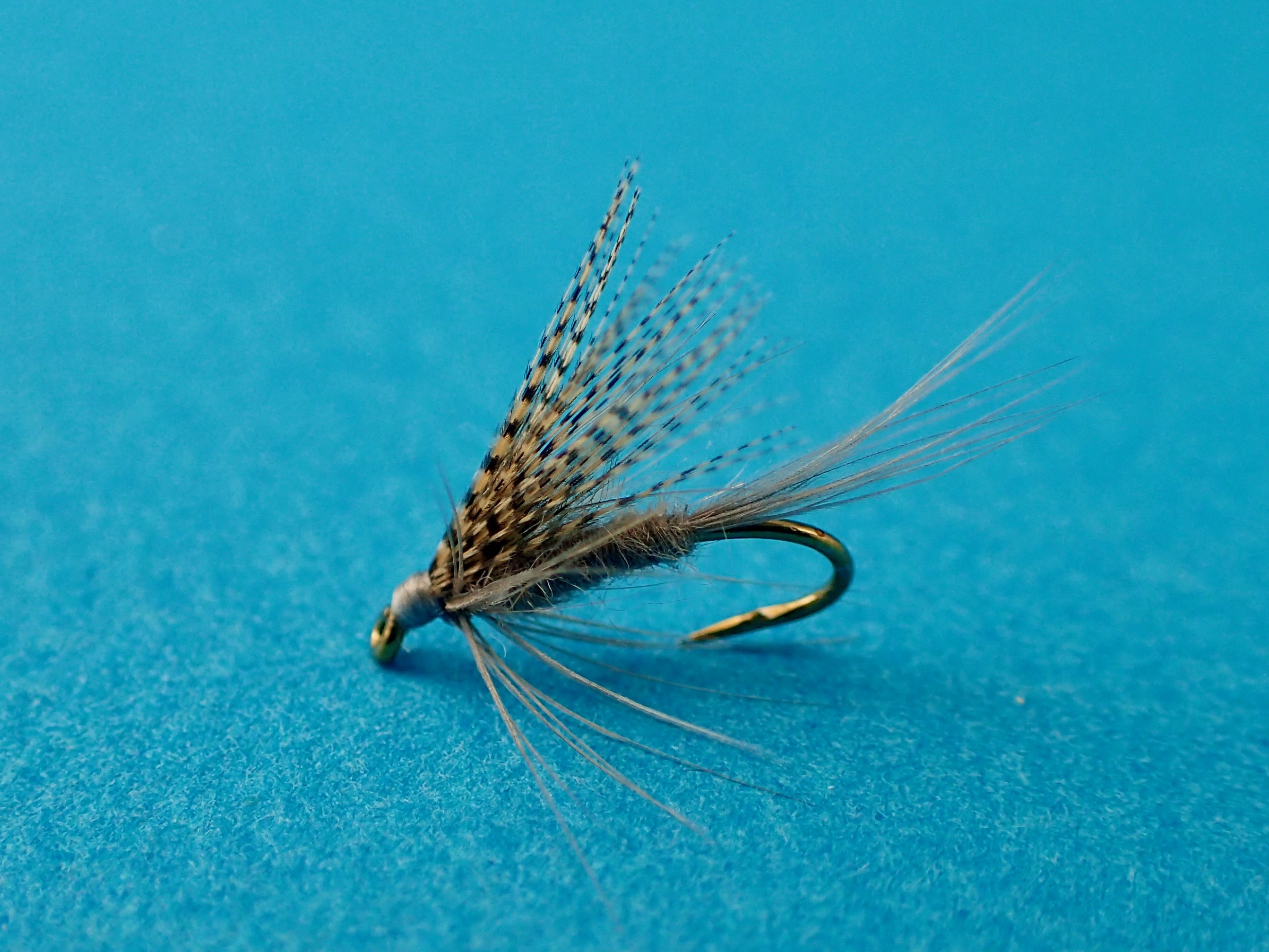
There’s a happy guy! My last customer of the day was the best. She was feeding in a slot near the shore, and it took some maneuvering to get into a good position to present my team of three. This is where it helps to be physically fit (and carry a wading staff). There’s no way I could have reached her without being willing to wade into some dicey currents. Measured against my net, this is a high teens fish (I refuse to thrust a fish at arm’s length into the camera) that took an Isonychia soft hackle I’ve been prototyping for a year. I’ll publish that pattern soon, but in the meantime, I can tell you this: big fish like that fly. You can see a fly-in-mouth shot on Instagram, probably Tuesday.
This one’s only about a year old, but in case you missed it, it’s certainly a must-listen — especially if you like to swing wets, if you’re considering learning how to do so, or even if you need a refresher course. Here’s the link to the original post, and within that you’ll find a link to the podcast. Enjoy, and beware: you’re about to start catching more fish.
You should be fishing this pattern, the Dark Hendrickson winged wet, right now.
When I went back to this oldie-but-goodie article, I was struck by two things. First, I love how Leisenring incorporated the soft hackle into these nymph patters. And second, I have not fished these patterns nearly enough, whether on a dead drift near the bottom or as a swung wet fly. None of them have beads or UV dubbing or special sparkle flash, but they all look like they’re alive and something fish would like to eat. To the vise (again)!
Q: Do you ever use the Rio Versileaders with differing sink rates when fishing wets? I have used the 1.5 inches per second w some success but wanted to get your thoughts. Am I better off just adjusting sink rate by the size of the point fly? A: I do not. I adjust my sink rate and depth by adding weight to the point fly in the form of a brass or, most frequently, a tungsten bead. (Of course, strategic mends with a floating line are an important part of the process.) Sometimes I add weight, usually a single split shot, to the leader. That’s simply how I do it, and it works for me. I don’t know if you’re better off using my system — if you’re fishing happy with your Versileader, and your flies are where you want them, and the fish are eating them, that’s what I’d recommend. Confidence catches fish.
This is nymphing, but as with wet flies, if you’re hooking up, you’re fishing at the right depth.
Q: If you are on an a new stream with no intel, what is your go-to 3 fly set up? (Do you look under rocks first and just match size of nymphs?) I know where he’s going with this. Is there a default wet fly setup that works everywhere? Maybe, but that’s not how I would approach the problem. My go-to wet fly setup would be three bugs that I think are most likely to be hatching or present in the current system. This would vary from season to season, time of day, and certainly by geographical region. For example, if it’s summer in southern New England at noon, I might go with a caddis, a terrestrial, and an Isonychia-type on point. If it were the same region in the evening, I might switch out the terrestrial for a creamy mayfly. And of course, I would be watching for any kind of hatch or rise activity for clues. Then I’d have intel, plus whatever the fish were telling me. Remember, droppers are the fastest way to find out what the fish want. The looking under the rocks solution is also a good one.
Q: I don’t tie. Recommendations for high quality wets? I wish I could give you a name or a place, but sadly I don’t have one. A good wet fly selection is hard to find these days, which is why I always recommend that wet fly aficionados learn to tie. I sometimes do custom orders, but right now I am not taking any orders for a few months. Your best bet is to do an internet search and see what you can find. Good luck!
Chances are slim that you’ll find LaFontaine’s Diving Caddis in tan, size 14, at your local fly shop. If you learn to tie your own, you’ll have a constant supply.
#4: Wesley’s First Trout on the Fly. Helping someone learn how to catch more fish is the non-monetary reward for being a guide. Helping someone catch their first trout on the fly, doubly so. But when it’s an eight-year-old kid doing it in front of his father, well, that’s something special. Wesley, who just about came up to my chest, was an unsure wader, and who can blame him on a big river like the Farmington? But once he found his “happy feet” place, he took direction supremely well, especially the part — we were indicator nymphing — about looking for a reason to set the hook on every drift. Suddenly, it wasn’t the bottom, and next thing you know, the rainbow is in the hoop. Fantastic job, Wesley!
One rainbow trout, two very big smiles.
~
#3: Guiding Members of Project Healing Waters. When PHW — here’s their website if you want to learn more or donate — reached out to book me for a large group outing over several days, I said yes. But I wasn’t sure how it would all go down. I wanted it to be good for everyone, and for everyone to feel like they got something out of it. And then, there was the weather and the flows to worry about. As it turns out, much fretting over nothing. What a great group of enthusiastic anglers. The energy was: we are happy just to be here, standing in a river, learning from you. Any fish hooked and landed are gravy. Well, we did some campsite picnic table classroom stuff. We did on-the-water lessons. We did small talk and life stories and fishing stories. And yes, we caught some fish. Thank you, PHW, for making my job not only easy, but also enjoyable. And thank you for your service.
Me and some of the gang. The fish were more cooperative later on this day, but we had a few players during out morning session.
~
#2: Appearing on the Orvis Podcast. It’s the gold standard of fly fishing podcasts. So when Tom Rosenbauer called me to set up a recording date, I was only slightly delirious. We recorded “How To Swing Soft Hackle Wet Flies with Steve Culton” one day, and a week later it was live on the air. In case you missed it, you can find it somewhere here. It’s the next best thing to taking a wet fly lesson on the river with me. And right now, a heckuva lot warmer. If you like it, send Tom and email and tell him.
I fished for pleasure Wednesday evening, timing it so that I arrived at the mark on the lower river just as the thunderstorms were ending. There were a few small branches littering the roadway, but the water was surprisingly clear and free of debris. As I’d guessed would happen, I beat everyone else to the water and was able to secure some prime real estate. The river was quiet as I entered at 6pm, but the surface soon became dimpled by the tells of feeding fish.
This particular mark appeals to me because it’s a mix of moving runs and seams, eddying pockets, and a glassy pool bordering frog water. All of these places hold trout, and you’ve got to tailor your presentation, leader & tippet, and fly selection to meet the needs of each. Oh, and it all shifts and changes as daylight fades. It’s a difficult mark to get right, but when you figure it out, the rewards are great.
A healthy mid-teens Farmington brown taken on Mike Lawson’s Mayfly Cripple.
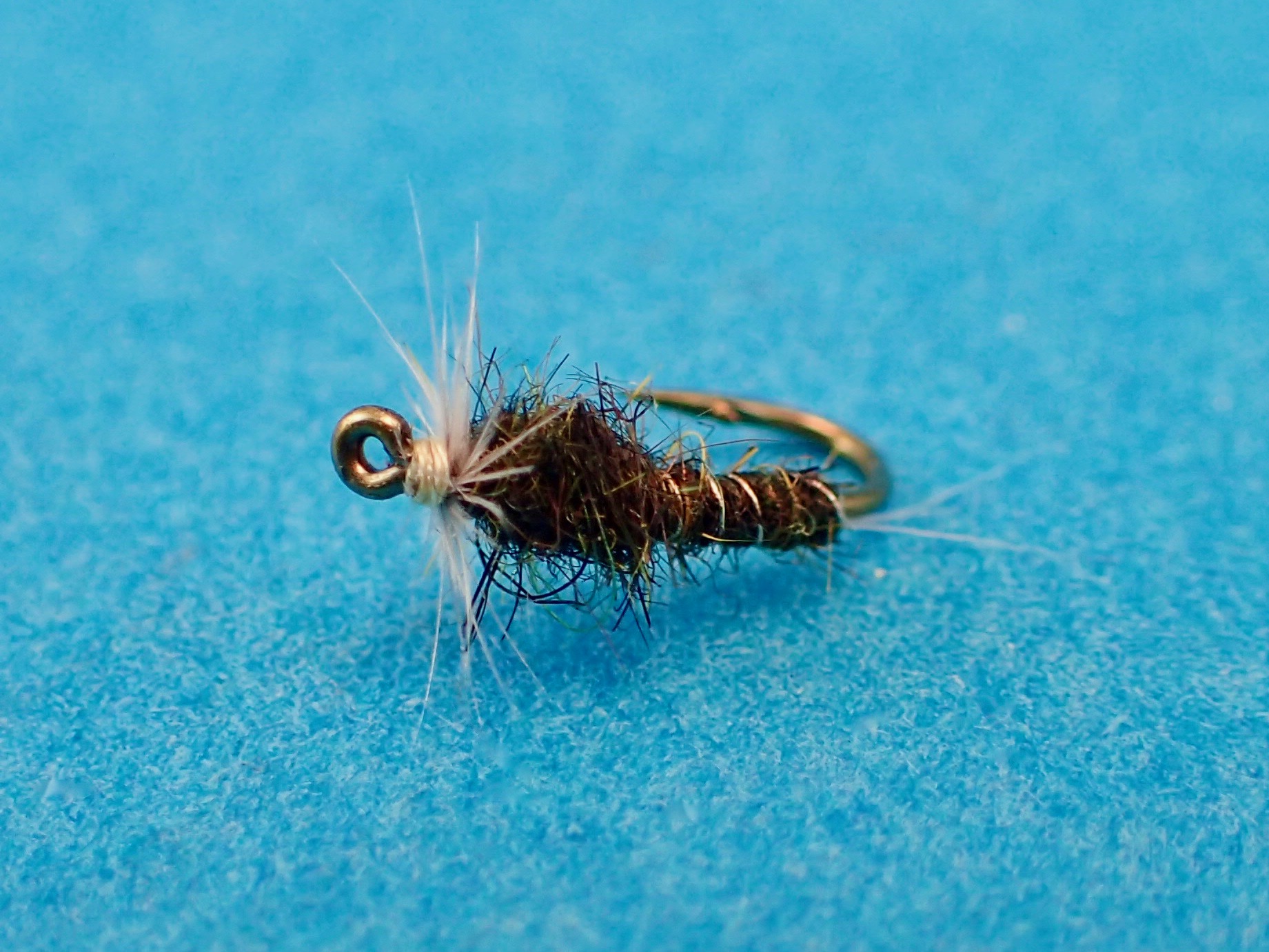
Wednesday night’s hatch window was textbook early summer. I had trout sipping spinners until dark, and I had trout slashing at emergers from 7:30pm until 8:45pm. I took fish on five different flies: Usual size 20, Magic Fly size 16 &18, Sulphur spinner size 20, classic Catskills Light Cahill size 12 & 14; and a new pattern I’d never fished before, Mike Lawson’s Mayfly Cripple in sulphur colors, size 16. I’ve never really gotten into the whole cripple thing, and the two times I’d fished this fly this year, the trout have largely ignored it. Not on this night. I stuck three good fish on it, and now it’s in my top rotation. The pattern is basically a Pheasant Tail bottom half with a sulphur dry top half that includes a thorax, hackle, and synthetic wing. (I’ll give you a pic and recipe soon.)
Say howdy to Mister White-Gloved. Iso time is a good time for all. This time of year, if you hear a take that sounds like someone threw a bowling ball into the river, chance are it was a trout feeding on Isonychia. Try a Hackled March Brown wet on point.
On Thursday I gave Brett a wet fly lesson. What a difference a day makes! We got a late start, so our window was 3:45-7:45, which should have meant a ton of bugs and visibly feeding fish. The bugs barely materialized; we saw a few sulphur, some tan caddis, and a couple Isos. Rises were few and far between, and none of the fish was in a regular feeding rhythm. Nonetheless, Brett slayed ’em. We stuck four at the first mark and I don’t know how many at the second — we easily put a double digits in the hoop. They ate every fly on the team (top dropper, Magic Fly size 14; middle dropper, new Squirrel and Ginger diving caddis prototype size 14; point fly tailed Partridge and Light Cahill size 14). We experienced a sequence where four consecutive fish took the diving caddis. More and more, I’m seeing evidence that this is a critical component of the three fly team. Brett did a fantastic job with his presentations and hook sets. If I were the trout, I’d be concerned.
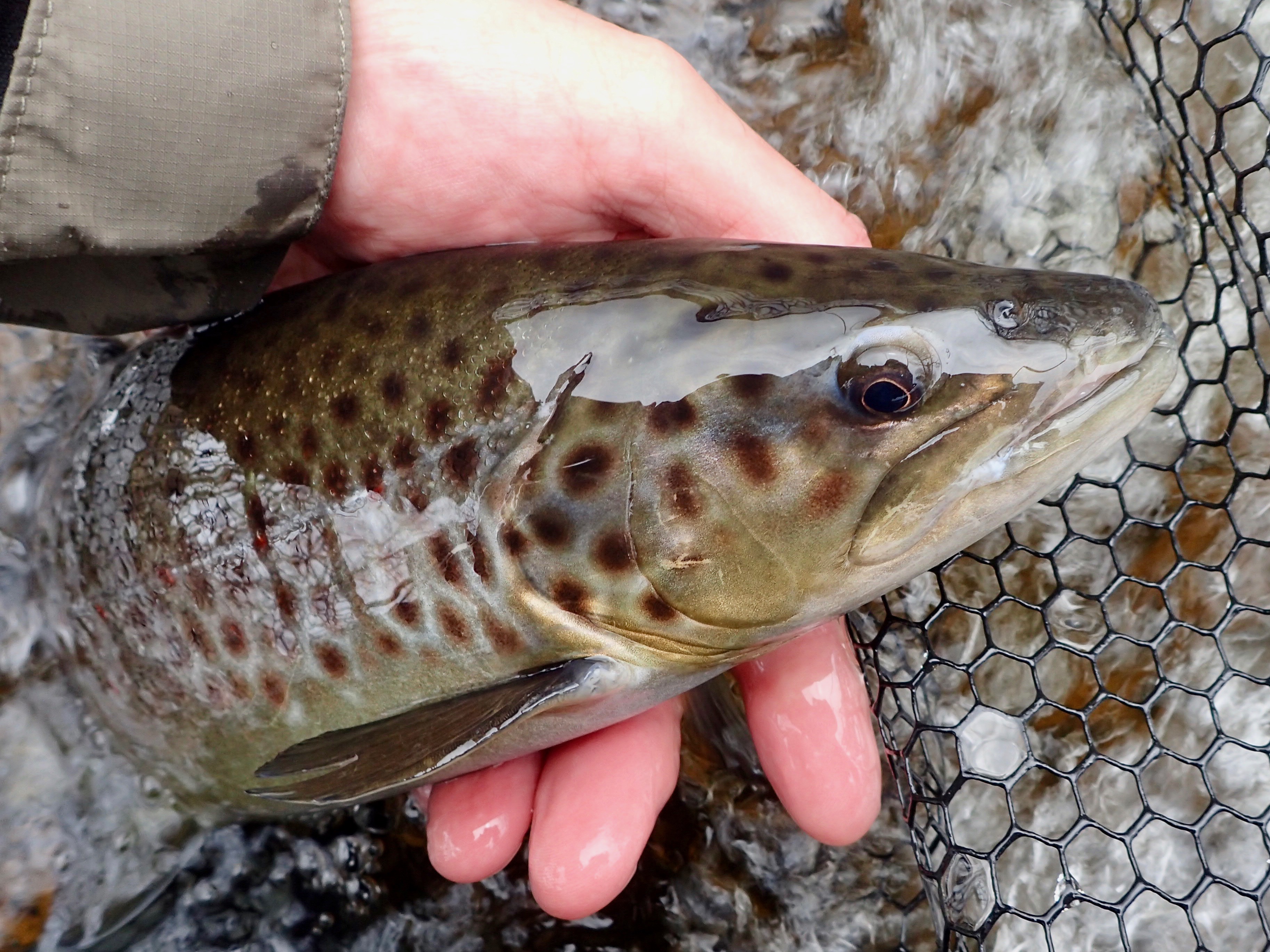
I often hear apocryphal, unsubstantiated reports of wild rainbows on the Farmington River. So when Brett landed this fish, my curiosity was off the charts. Vivid coloration, unique spotting, minimal scale damage, parr marks…could it be?Could be…but isn’t. A closer look at the tail reveals a structure far too short and stubby for a wild fish. The anal fin also reveals the kind of shredding you’d find from repeated scraping against the bottom of a tank. Still, a striking creature.
I fished the lower end of the Permanent TMA yesterday afternoon and we had much better flows (under 400cfs) for swinging wet flies. So much, in fact, that after a while I replaced my tungsten bead head soft hackles with non-weighted bugs, the better to target all the slashing risers. Atmospheric conditions were as they have been: chilly, windy, and uncomfortable.
I arrived late, about 1:30pm, and as I approached the mark, I recognized the faces of the two anglers who had beaten me to it. It was Bob and Andy. I’d seen them here last year, introduced myself, and we shared the water. These guys are very giving, and a pleasure to fish next to. I’d like to thank them again for being so matey and kind.
Right away, I was into fish. I’d made the comment earlier to Torrey Collins at UpCountry that if you hit this hatch right, fishing with wets is almost unfair. I took them on the swing. I took them on the Leisenring Lift. I took them dead drifted deep on a short line. Active feeders almost always hit on the first cast. I even managed my first double of the year.
Then, the bugs came. Lots and lots of Hendricksons. I’d give this hatch an 8 out of 10. The point where the trout would no longer take the wet came at 2:45pm. Once I figured out what they wanted — it wasn’t, to my surprise, The Usual, with which I usually do boffo box office — I managed a bunch on the surface. (The winning fly was a Comparadun.) Dry fly was very much a challenge in the fierce gusts. But it’s supposed to moderate, so tight lines to those brave souls venturing out this weekend. I expect the hatch to continue to ramp up and move upriver. Enjoy!
‘Nuff said.
To this week’s mystery bug. I appreciate everyone’s input and guesses. My first thought when I observed them was some kind of early BWO. They were clearly too small for Hendricksons. After I captured a couple specimens, I was able to see that they all had only two tails. I ended up going to two people who have a far deeper technical knowledge of these things than I, and they both independently identified the creature as a Baetis. That’s good enough for me! (In case you’re wondering, my panel of experts consisted of Torrey Collins and Derrick Kirkpatrick. Those guys have forgotten more about Farmington River hatches than I currently know.)
Hoping for Hendricksons, I was on the water before noon. I chose a mark near the bottom of the Permanent TMA. Although ’tis the season, the weather has been most unseasonable; the flows higher (627cfs) and colder than I prefer; and the Hendrickson hatch non-existent. Still, there were mucho midges — signs of life — and there were trout.
I’d decided on a three-fly team of a Squirrel & Ginger on top dropper, with black tungsten beadhead Hendrickson soft-hackles in the middle and on point. The plan was to cast slightly upstream or across, and mend like crazy to help sink the rig before coming tight on the dangle. That worked well enough, although a proper hatch and active feeders (I saw only two rises during the session) would have made the catching easier. The highlight of the outing for me were the two trout I fooled using the Leisenring Lift. I don’t often use that presentation, but there are times when it is lethal. It’s an arrow any serious wet fly angler should have in their quiver.
On a whim, I drove a good ways downstream, below Collinsville, to see if there were any H-Bombs flying around. Negative. I took a couple what-the-heck-I’m-here casts, but at over 1,000cfs it’s a most decidedly wet fly-unfriendly flow. It’s supposed to remain cold this week, so we’ll see how the hatch unfolds.
A hefty 16″ buck that crushed the fly, a beadhead Hendrickson soft hackle, on the Leisenring Lift. He provided fantastic sport in the over 600cfs flows.
With the Edison Fly Fishing Show in the books, I thought it deserved a detailed re-cap. The bad news was that not only did the show have to contend with the still-looming specter of Covid, it lock had a double whammy of an incoming snowstorm Friday night into all day Saturday. The good news is that The Fly Fishing Show continues to be a tremendous experience regardless of what’s going on in the outside world. Where else can you meet and speak to and learn from some of the best tyers and anglers on the planet?
Being a risk-averse kind of guy, I wore my N95 mask both days, even when I was presenting. (I’d say the majority of people attending were masked.) The exhibitor turnout was smaller than usual. (Since I’m not a gear junkie, this didn’t really affect my experience. Give me the Keough booth and Badger Creek, both present this year, and I’m happy.) After a year’s hiatus, it was great to see old friends, and have the opportunity to make new ones. The Friday crowd was lighter than usual due to the impending storm. Saturday’s crowd was small, but surprisingly larger than I’d expected, what with much of the northeast locked down in a blizzard. Sunday was predictably busy, by far the best crowd of the weekend. Looking back, I wish I’d taken more photos. But here are a few to tide you over.
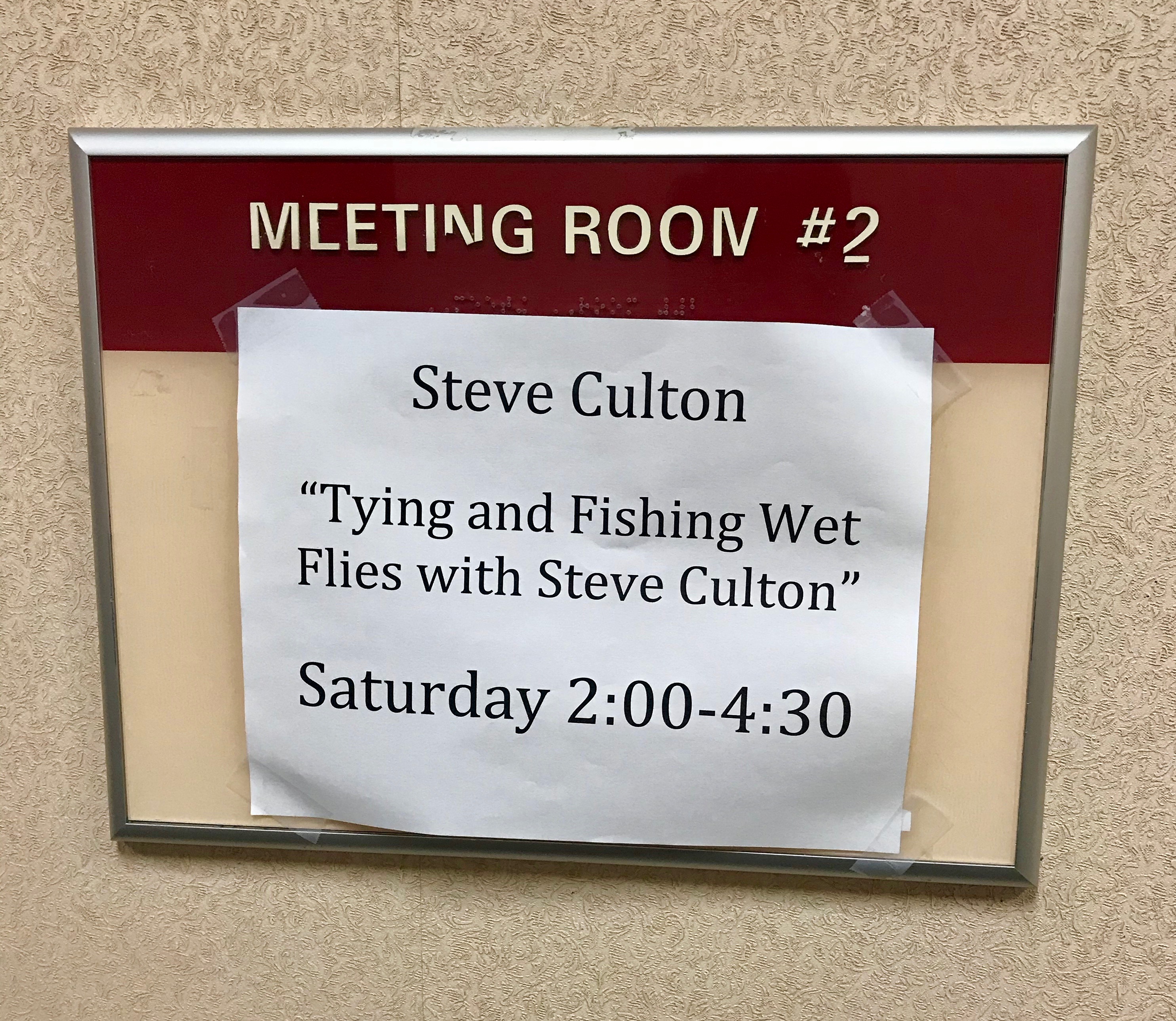
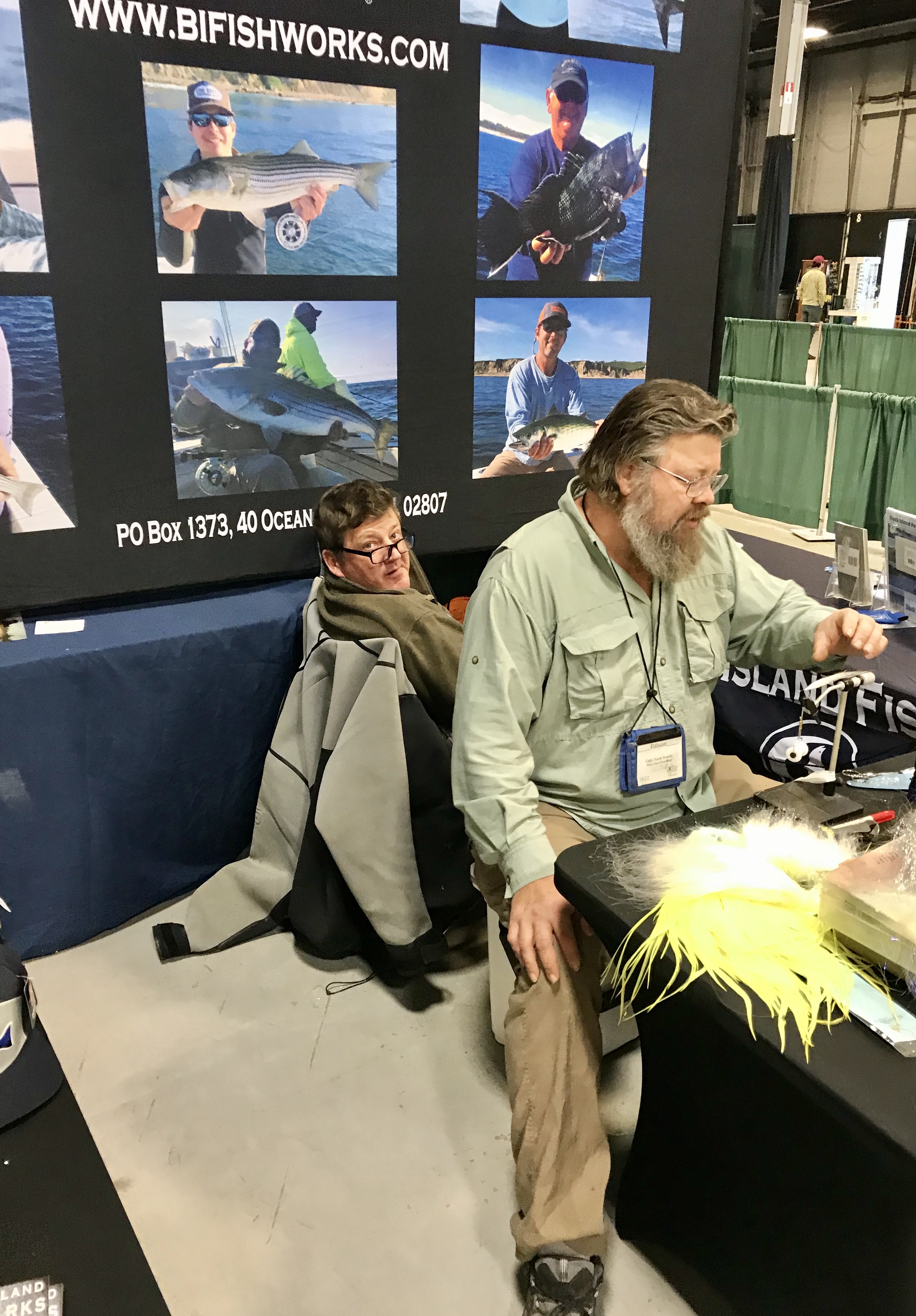
Not a bad lineup! This was Saturday’s schedule in just one of the seminar rooms. Seriously, this has to be the best bargain in all of fly fishing. For the price of admission you get to see and talk to George Daniel, Pat Dorsey, Andy Mill, Ed Engle, Tim Flagler, Joe Cordeiro, and a whole bunch of other great anglers I didn’t mention. I debuted my seminar Modern Wet Fly Strategies on Friday, drew a decent crowd, and we followed it up with some engaging Q&A. Shades of the Sunday ice storm in Marlborough three years ago: I feared that no one would show up for my Finding Small Stream Nirvana gig on Saturday (I had the first slot of the day). Not to worry! Thanks so much to everyone who attended.The flatwing dudes, Joe and Greg Cordeiro, had a great stash of saddles and longer peacock herl. Since it was a slow day, they helped me rummage through the Keough bins in my never-ending search for a decent red grizzly saddle, which, I’m delighted to say, Joe found for me. I wish I had a photo of my first ever tying demo at The Fly Fishing Show. Being a Featured Fly Tier was a great experience. You’re mic’d up, you’re on a large screen TV, and the audience sits in front of you. You basically have an hour, and I managed to cover a spider/soft hackle, wingless wet, and winged wet. Since this all happened on Saturday at the height of the storm, I was again concerned that no one would show. Once again, not to worry! I had one of the better crowds, and I believe we all had a good time. Another pleasant surprise was my Saturday class. Since it was a smaller group (thanks again everyone for showing up!) we were able to tailor it to meet everyone’s needs, which was very gratifying. I can’t remember a faster 150 minutes.The guide booths also represent a tremendous opportunity to learn about a specific fishery. I’m already what you’d call Block Island-savvy, but if you’re not, my buddies Captain Hank (foreground) and Captain Willi from Block Island Fishworks are a fantastic resource for all things Block. We spent a good chunk of time on Friday talking about last year’s fishing, and salivating at the prospects for this year. They do spin fishing, too. A family charter is a most excellent way to spend a day.
And that about wraps it up. Don’t forget that the Marlborough show was postponed to April 22-23-24. I know it’s right when we’d all like to be out fishing, but I encourage everyone to support the show, and take advantage of its opportunities.





 currentseams.com