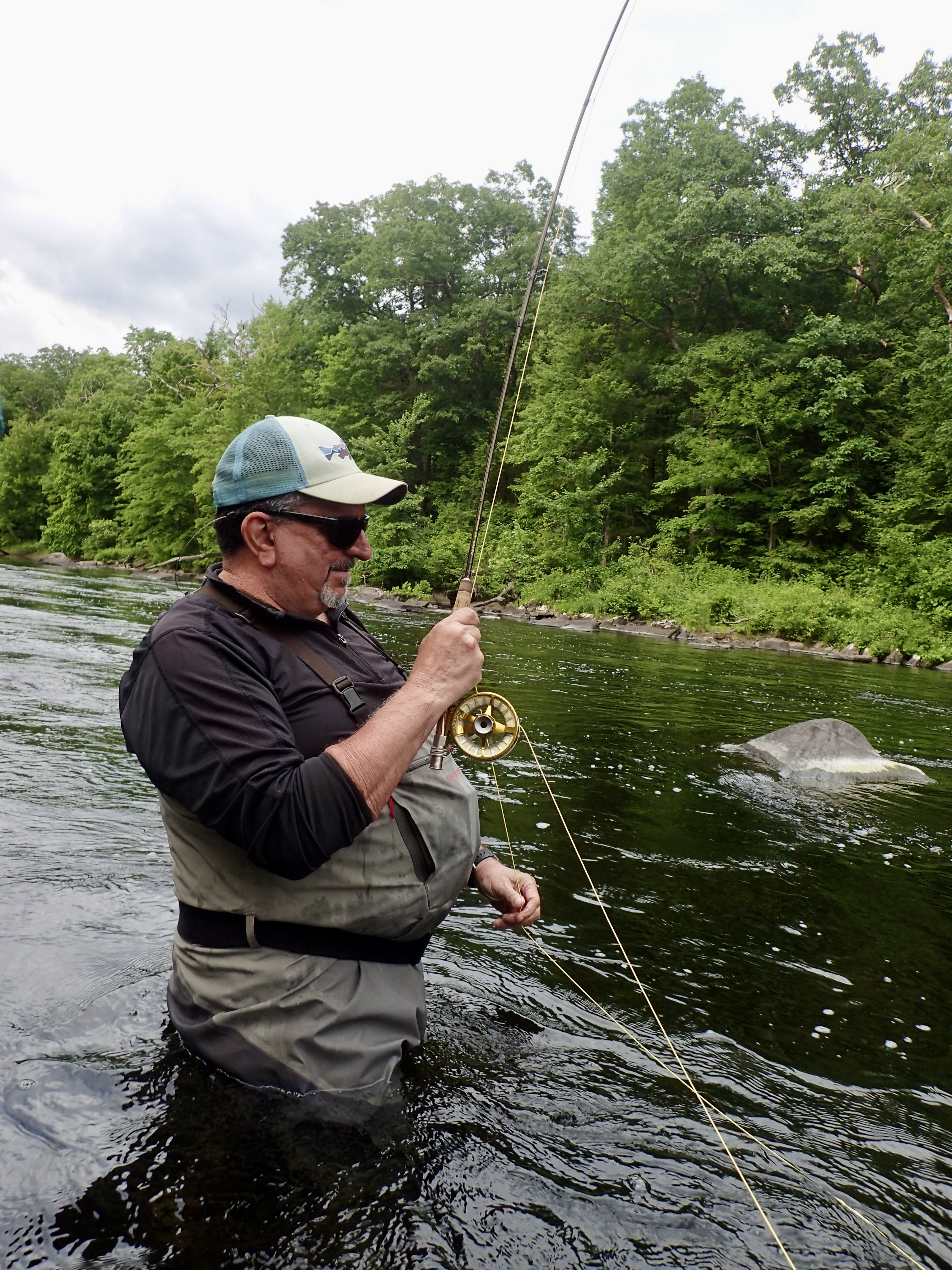
We had a fishing trip/photo shoot on Wednesday from 3:30-9pm. Delaware River guide extraordinaire Bob Lindquist came down to take pics for the book and an article he’s writing. We (filmmaker Matthew Vinick of “Summer on the Farmington” fame) started off at the bottom end of the PTMA and the action was slow. Little to no hatch activity, and precious few risers. Matthew and I had to work our butts off (he was nymphing then dry flying, I was swinging wets) to put a few in the hoop over 90 minutes. Both of my trout took a large Iso soft hackle.
Matthew had to skedaddle, so Bob and I moved up to a dry fly pool above the PTMA. As I was wading in, an old crusty angler (meant as a compliment) was leaving, commenting that the sulphur hatch was not good. He was right. It never really got started, even later in the evening as sunset transitioned into dark. Id like to blame it all on the hatch, but I don’t think I fished particularly well, mostly because I was being stubborn. Let me explain.
I saw that the sulphurs that were on the water were an 18-20. But I wanted to see if I could get them to take the 16. They generally wouldn’t, and when I put a 20 on I had double the action. I was also committed to fishing the water in front of me, which, due to varying currents seams and speeds, was difficult to maintain a quality drift. Sometimes I like a challenge, you know? But my fish worthy-drifts were few, and even when I did fool fish, I came away with nothing. I rose six trout and stuck none of them. Ugh! Finally, I moved down a few feet to more drift-friendly water, but by then it was too late. (Stubborn Steve pays the price.)
I should mention that I had some surprising success on wet flies in some very slow-moving water pre-7pm. Two trout, two crushing hits, both on LaFontaine’s Diving Caddis size 14. Later, the pattern that the trout seemed to like best was a size 20 sulphur comparadun. As it got darker, I switched over to a size 12 Usual. Unfortunately, the typical dusk feeding orgy never manifested, and both Bob and I commented about the lack of spinners on the water at dark. So it goes.
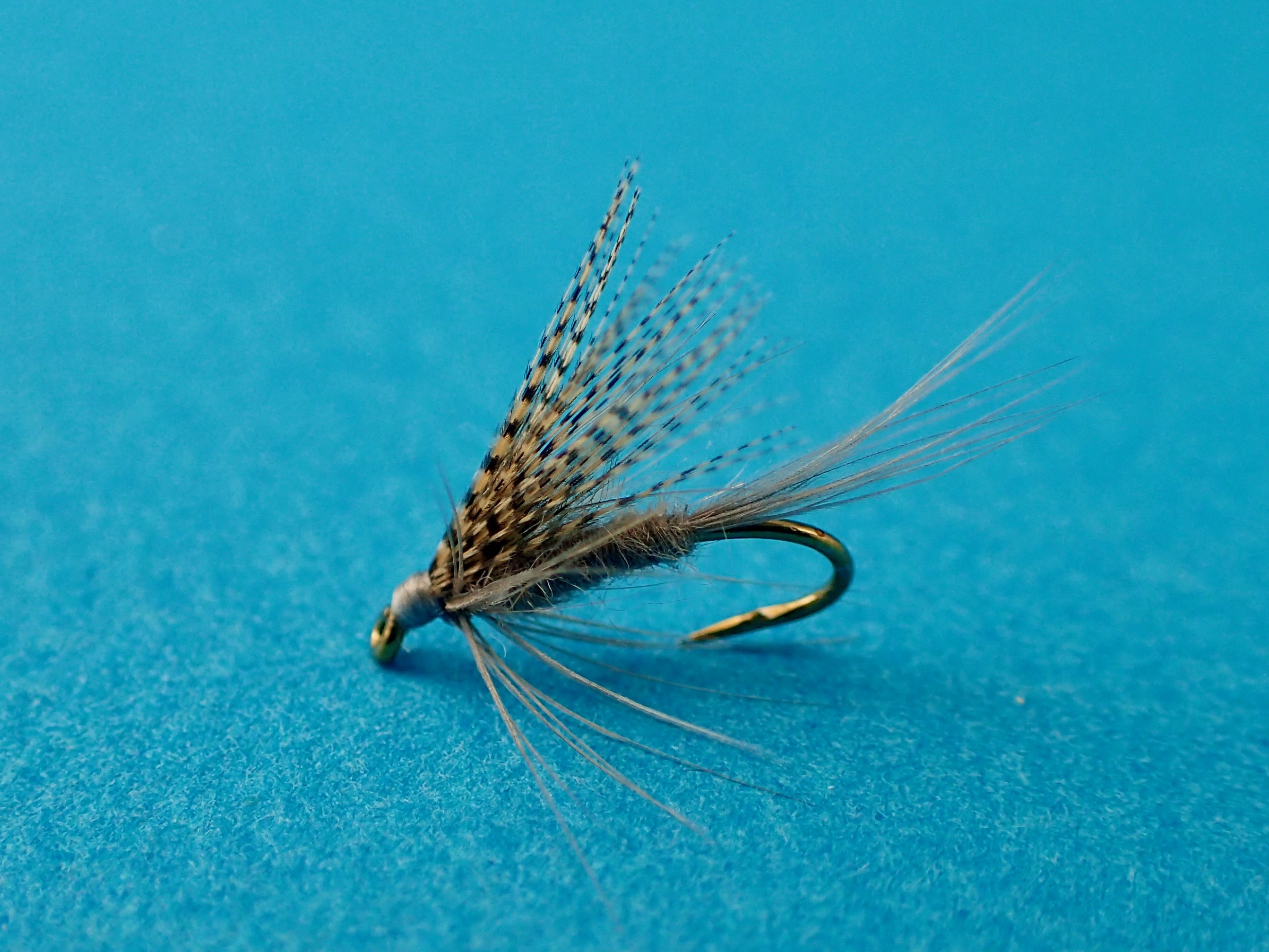
The Diving Caddis wet. I’ve been tying these without the rib, and using tan caddis Prism dub for the body. The trout are all in favor.
George and Michele took a wet fly lesson with me on Tuesday, and deserved much better than what they put into it. We started out in the lower end of the PTMA. The water was perfect for wet flies, but there was no hatch activity and virtually no visible feeding. We had a good, long streamside classroom session, but we had to scrap for the few touches we received. George and Michele both did an excellent job of getting their flies where they needed to be, but you can’t catch what doesn’t want to eat.
So we zipped down below the PTMA and were greeted by: more of the same. The fish were a little more active, but still no real hatch, nor feeding. Although both George and Michele put trout in the hoop, they didn’t get rewarded for the fine level they wet fly fished at. Our fishing window was 1pm-5pm, and to prove it wasn’t them, I swung wets for 90 minutes, 6pm-7:30pm, above the PTMA, and managed only two trout. Not good. At 7:30 I switched to dry, and proceeded to….wait. Nothing happened. 8pm. Still no rises. Finally, I moved downstream 200 feet, where I found a couple risers and landed them both. From 8:30-9:15pm, all hell broke loose, and it was a trout on every cast, even after I could no longer see the fly. Caddis 16-18, little Sulphurs 16-18, and midges filled the air and littered the surface of the water.
This is typical for this time of year when the hatch is delayed. If you want to catch fish, my best advice is to wait it out, then take advantage of the dusk feeding frenzy.
This was the scene on the walk out. The photo really doesn’t do it justice; there were thousands of bugs in the air and on the water, and the trout were eagerly gulping them down. Fly selection was irrelevant; I took them on 16 The Magic Fly, 12 and 16 The Usual, and 12 and 16 Catskills Light Cahill.
I fished the lower river Monday evening. The weather was vastly different than today’s; it was overcast and downright chilly for June. I swung wets for a couple hours, and the action was disappointing. Three trout on wets late afternoon this time of year ain’t exactly lighting it up. Part of that had to do with a sub-par hatch and very little visible feeding activity. Then, there was the cursing incident. Another angler thought I was bogarting his water; instead of talking to me about it, I was treated to a torrent of f-bombs and called various other unpleasant names that use slang to describe parts of the human body. Even though I thought he was being unreasonable (given the size and popularity of the pool) I apologized and backed away — and still, the venom and vitriol rain down upon me. Here’s the punch line: before I entered the water, I’d spent a few minutes asking where he was going to be fishing (he had been sitting on a log, taking a break), talking about flies, and I’d even gave him one of my favorite patterns. No good deed, etc.
To top it off, the fishing mostly stunk. I fooled a good number of fish on dries, and came away with no purchase on the hook set. I did eventually catch fish, but it wasn’t the lights out feeding orgy I had hoped for. Observed: midges, small caddis, a few sulphurs, a couple bigger Light Cahills.
But, every day is different, and Tuesday serves as the proof. I guided Brian from 1pm to 5pm, and he basically slayed them. We did our streamside classroom — this was a wet fly lesson — then we got into the water and began catching trout. The run we fished in the PTMA had a few risers, but nothing really consistent. Still, he got two in the hoop before we moved on to the lower river.
The pool we fished was a dream scenario for a wet fly lesson. You instruct the client; the client listens and executes, and the trout reward his efforts by jumping on with gusto. I don’t know how many trout we caught, but they smashed every fly on our team of three (sz 14 Squirrel and Ginger, sz 14 tan LF Diving Caddis, sz 12 BHSHPT multiple times. The rainbows offered tremendous sport; several of them performed cartwheels and aerials that would do any steelhead proud. Brian did a fantastic job of casting, mending, presenting, and covering water. Yet another Dangerous Wet Fly Machine has been created!
Hook. Play. Land. Repeat. Brian crushed them, and I was particularly impressed with how fast he landed his fish. Get ’em in, get ’em off — that’s the way to do it when you’re playing the catch-and-release game. Well done, Brian!
After our lesson, I was feeling ambivalent about fishing, but I had plans to meet “Summer on the Farmington” film director Matthew Vinick, so I headed up to the PTMA. I found him in a snotty boulder field, and while my plan was to start by swinging wets, there was no one(!) in one of the most popular dry fly pools on the river. So I jumped on that.
Within 15 minutes, there were five other anglers in the run. Funny thing! We all managed to share the water (and we were all significantly closer together than I was to the Monday Night Curser) without anyone getting upset.
Even though I was the first in the pool, I made the wrong choice of real estate. Has this ever happened to you? You pick your water and the trout are rising above you, and below you, but not in front of you. I did catch a few fish on The Usual sz 16 and the Magic Fly size 16, but when the gentleman below me left around 7:45 pm, I eagerly moved into his slot. And that was the right call, because there were far more active feeders in that area. The trout were taking sulphur emergers and the occasional straggling sulphur dun, and on this night it was just like the early June Farmington River dry fly playbook said it would be: match the hatch in size and color, make a good drift over a feeding lane, and the trout will eat the fly. I have no idea how many eats I had, but it was a lot.
At 8:15 I switched over to a sz 16 Light Cahill Catskills style dry, and it took about 10 minutes of fading light for the trout to want to eat that fly. By 8:40 I had upped to a size 12, same fly, and it was a fish on every cast until I could no longer see the fly and the frenzy began to wane. I went 10 casts without a take, then called it.
I couldn’t remember the last time I left the river so happy.
I’ve been having a tough time with lessons this year. Not the clients! All have been enthusiastic learners and a treat to coach and teach. Rather, the bite windows have generally stunk (and they really shouldn’t be stinking). Yesterday’s lesson was a case in point. Craig did an outstanding job casting and mending and presenting and hunting and covering water. The last couple hours in particular, you could really see him taking to the wet fly. He never got discouraged, and he deserved a lot better than four touches and two in the hoop. But I’m happy to declare that Craig is going to be a certified Wet Fly Dangerous Machine if he keeps on keeping on! Great job, Craig.
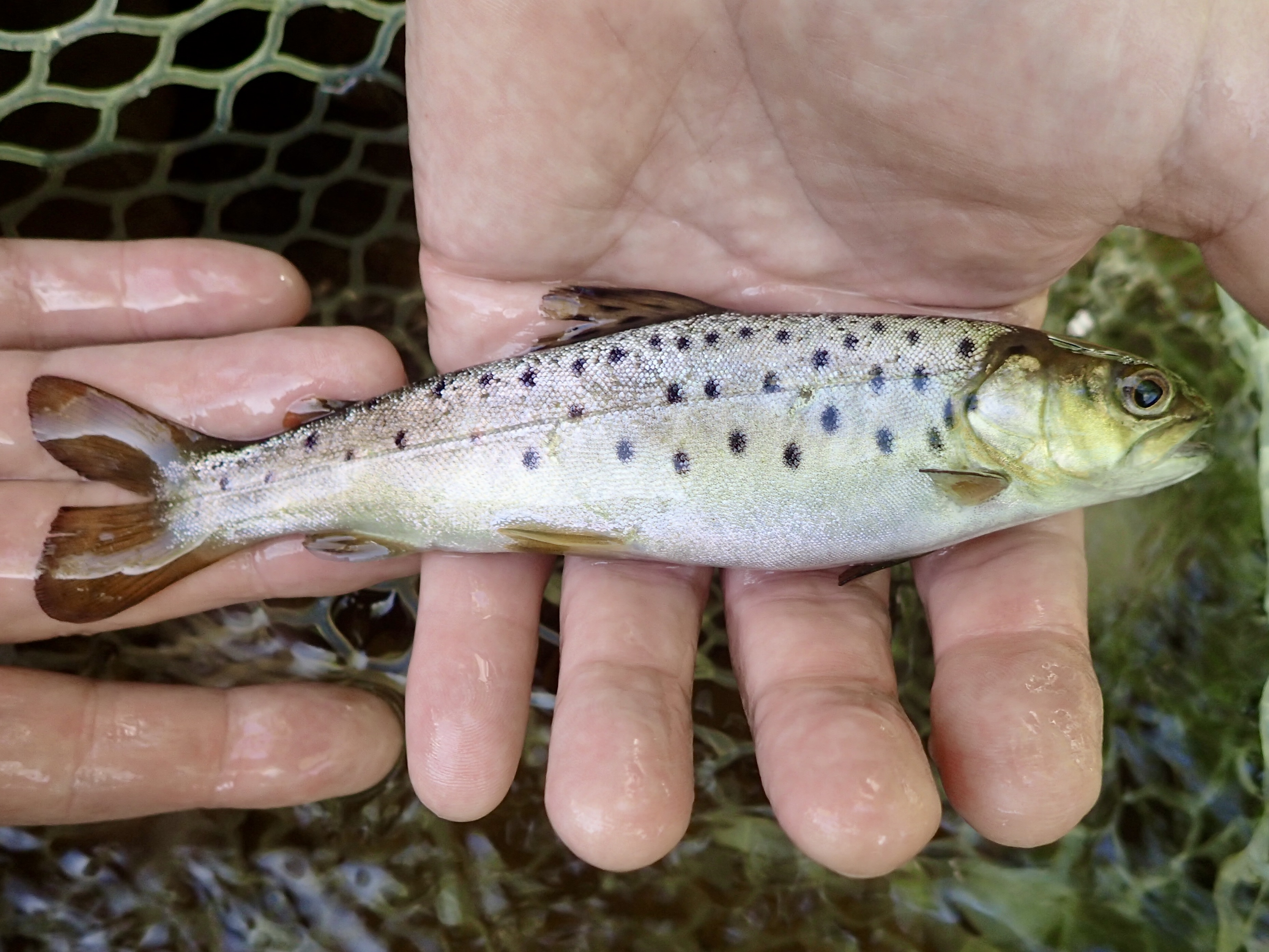
The river was up from the rains, but in the 400s of cfs it was not too high for the wet fly. Weather was perfect, save for some breezy moments. No, I think the main culprit was the almost total lack of hatch activity, and zero visible feeding. I think I saw a half dozen(!) caddis in four hours. This was Craig’s first fish. I thought at first it might be a salmon/trout half-breed, but after closer inspection the maxillary is all brown trout. What threw me off was the tail, but I believe the fork is created by rending of the tissue. Whatever it is, it smacked the fly with gusto, and is a beautiful creature worthy of the wet fly.
I had a window of opportunity, so I decided to try my luck with the evening rise, although, between you and me, I didn’t think there would be much of one. Turns out I was right. Kindof. I wanted to fish the lower river, which was running much higher at 730cfs. It was, to say the least, a tricky wade. I was in the water fishing at 6:15, and for quite a while, absolutely nothing was happening. I started debating the merits of fishing vs. having a couch date with my wife, but decided to stick it out, if for no other reason than scientific curiosity. Then I got into a fish. And another. It wasn’t gangbusters, and still nothing was happening bug- or hatch- or rise-wise, but I was catching trout and having fun. I stuck it out to 8:30. Moments before, I had declared that it was over, when a big wild brown slammed by fly. I don’t usually put fish on the reel, but this hefty brown told me I really should. Final tally was 15 hooked and 12 in the hoop. Not bad for high water and nothing going on.
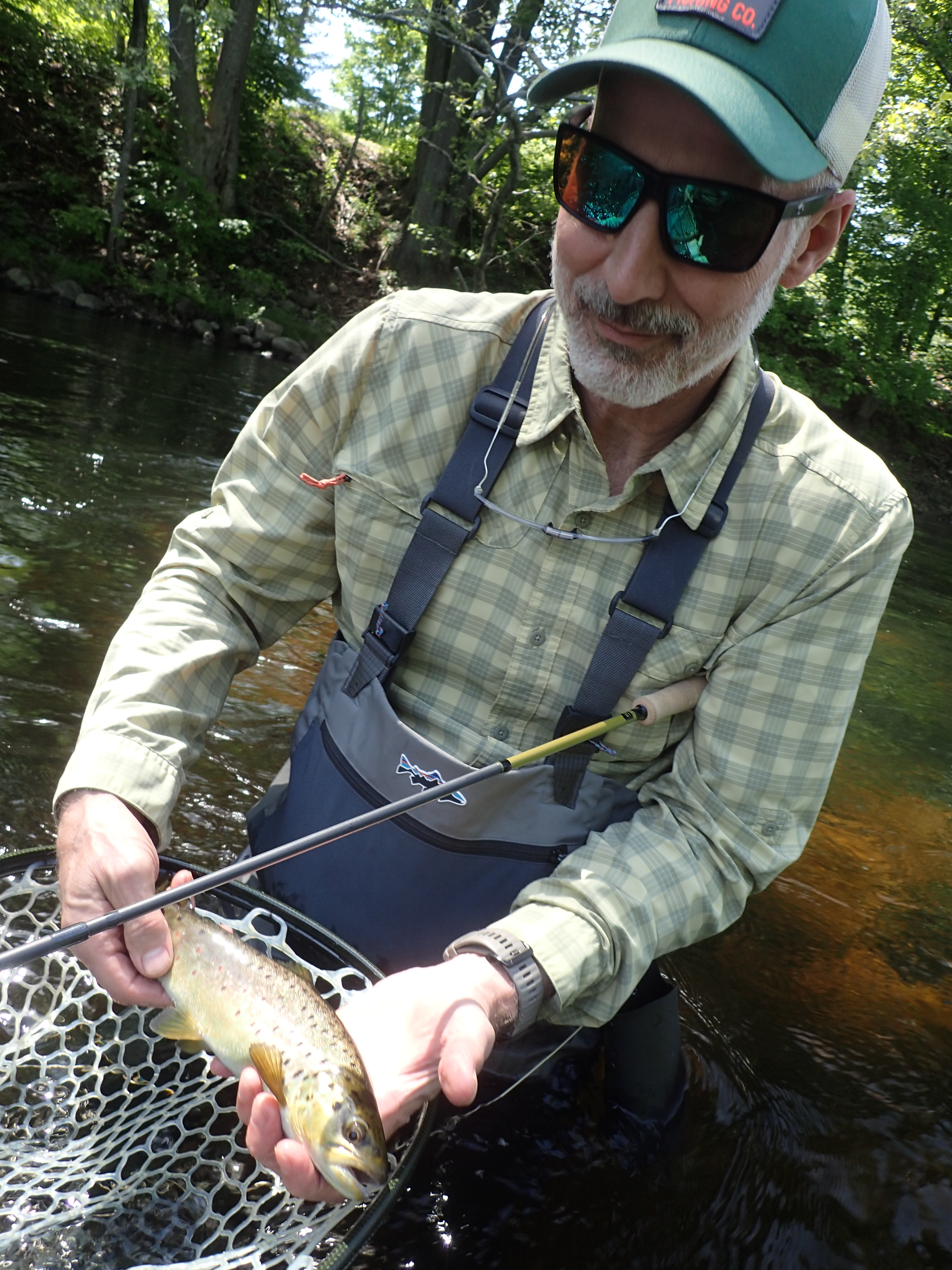
Of the dozen to net, 9 were stocked rainbows, a few of which thought they were steelhead, with multiple gravity-defying aerials. Three were wild browns: the big guy, a little guy, and this mid-range guy. This is significant because I was fishing in an area that would have been torched last summer in the heat and low flows. Nature finds a way. For those keeping score at home, the big one took LaFontaine’s Diving Caddis winged wet, middle dropper, which you should be fishing right now late afternoons into dusk.
I guided Doug on Monday and Tuesday, and the results were fascinating. (At least they were to me.) Doug, who’s from northern Michigan, drove all the way to Connecticut for a wet fly lesson after hearing me talk about wet flies with Tom Rosenbauer on the Orvis podcast. We fished within the PTMA on Monday, and conditions were pretty spiffy: 330cfs, clear, cold, and a good caddis hatch, mostly tan, sz 16-20. The problem was uncooperative fish. We had a few risers to target, but nothing was coming up consistently. It was a struggle to put a couple in the hoop. Like many anglers new to the way of the wet fly, Doug needed some time to adjust to the casting, the mending and presentation, and waiting for the fish to do the hook setting.
Day one: Doug scores a lovely Farmington wild brown, taken on a BHSH Hendrickson, sz 12. He went out after our lesson and stuck a few more fish. Little did we know he was just warming up for Tuesday.
We fished the same time frame on Tuesday, 11am-3pm, only this time we headed to the lower river. 565cfs, clear, 55 degree water and glorious 80 degree sunshine. We focused on dialing in his presentation, covering water, and targeting fishy areas in some classic pocket water. What a difference a day makes! Doug stuck nine and landed eight. It was really cool to see him gaining confidence and making so many eat-worthy drifts. Fantastic job, Doug, and he scored a Farmington Hat Trick with browns, rainbows, and a brookie to hand.
About three hours into our session, I told Alan that of all the lessons I’d given over the years, if you asked me to pick the absolute worst days for catching, this would easily be in the top three. Or would that be bottom three?
It didn’t start that way: reduced flow (425cfs in the PTMA), warm air, bright sunshine, and bugs everywhere, bugs being caddis and midges. (Also witnessed: crane flies.) The midges floated by in mats and clusters, the caddis emerged and danced on the water and flitted through the air…and nothing was on them. I saw two rises in four hours. And so it turned out that it was a terrible day for catching fish on wet flies.
I leave the why to those who are wiser than I, but among my guesses were high pressure, a sudden change in flow, and (most likely) trout eating the caddis larva and emergent pupa near the bottom and at the mid depths. This last scenario manifested when we took our only fish of the day on a tungsten bead head Hendrickson soft hackle fished on point.
It wasn’t just us. We saw or encountered over a half dozen other anglers, and none of them had hooked up. Some days, the fish win. But Alan kept at it, making hundreds of fish-worthy presentations, and there will come the day when he does that and he’s hooking up on every cast. Well done, Alan!
Salvation comes to us in the form of a lovely parr-marked rainbow. She slammed the point fly on the dangle so hard, the Alan never had time to set the hook. Thanks, you beauty, for doing all the work, and to Alan for his positive perseverance.
On Monday I had the opportunity to fish a private stream, so naturally I jumped on it. This is a lovely brook that wants to be a river, and it’s not easy water. Its banks are overgrown, and there’s often a three foot drop from terra firma to water. The first beat we fished was particularly challenging; a lot of the water crawls along, creating glassy pools where any movement sends the fish into flight toward the nearest cut bank. I was instructed to stay out of the water as much as possible, but when did I ever follow directions when I wanted to do my thing? I decided that I needed to get in, summon my inner stealth ninja, and fish downstream.
Sure enough, I crept up on pool that had risers. The hatch was midges and caddis, and there were a few stray Hendrickson spinners. Some of the takes were more emergery, some gentle sips. I had two fish slam the fly the moment it hit the water, and a few more that required a little coaxing. I took six fish, which I was told was pretty darned good, a nice mix of stocked and wild brookies and some chunky rainbows. All three flies were eaten: Squirrel and Ginger (sparkle variant — more on that soon!), Hendrickson spider, and LaFontaine’s diving caddis, tan.
The second beat was not as kind. It began good enough, with my biggest fish of the day, a rainbow with a dramatic pink band (you can see it on Instagram @stevecultonflyfishing) on the second cast. But even though this mark was far better suited for wet flies, I only managed one more trout (do creek chubs count?), and even with that one, I had to wait a half hour and go back after I missed her the first time. I think the lack of activity was due to the hatches being over, and everyone with fins being well fed. Or, maybe I just stunk. Or maybe it was just fishing. No matter. It was just capital to be out fishing. Thank you. Peter G., for your most generous invitation.
It’s almost never a bad idea to swing wet flies when you see feeding fish, especially during an emergence. However, be advised: if the trout aren’t feeding regularly and rhythmically, and you don’t get hit after three good presentations, you may be in for a bit of a wait…
Meanwhile, nose to the grindstone on the book. As far guide trips go, I am not taking any more dates in May. If you see me on the river, please come say hello.
Then, of course, there’s the new house and vegetable garden, which won’t plant itself. What a wonderful collection of obligations.
This one’s only about a year old, but in case you missed it, it’s certainly a must-listen — especially if you like to swing wets, if you’re considering learning how to do so, or even if you need a refresher course. Here’s the link to the original post, and within that you’ll find a link to the podcast. Enjoy, and beware: you’re about to start catching more fish.
You should be fishing this pattern, the Dark Hendrickson winged wet, right now.
Yeah, baby, it’s getting to be about that time. OK, maybe not for a couple more weeks. We’ll see what Ma Nature has in mind as far as warmth and rain are concerned. But indeed it is coming. And right now is the perfect time for you to stock the box with your favorite Hendrickson patterns.
If you’re not fishing under the Hendrickson hatch with wet flies, you’re missing out. In fact, you’re missing out on some of the best trout-on-the-fly action of the year. Tie these up, place them over a rise, and hold on. Oh. And be prepared to clip one or two flies off your three-fly team. Such are the travails of the angler getting doubles and triples!
On the surface, you may be unthrilled (rather than enthralled) by this topic. But I think it’s worth your time, especially if you tie soft hackles. I get a lot of questions about hen hackle types, and this article covers the subject nicely.
There’s something very satisfying about finding a top-shelf hen cape. While the price of both has gone up, you still occasionally see these in deep discount fly shop and show bins..







 currentseams.com