Until today. Back in November when I made my debut at the International Fly Tying Symposium, there was a Saturday night banquet. If you attended, you received an amazing fly tying swag bag courtesy of the IFTS, Keough Hackles, Hareline, Ahrex, and Core. And here it is!
What an amazing bounty! Most of this will get put to good use. Thanks again to the show and the suppliers/vendors who made this possible.
This weekend, I received a question about tying Leisenring’s March Brown Nymph. The reader wanted to know if I thought three pheasant tail fibers for the body was enough. As you can see from my original writeup, I had a few initial questions (or opinions) about the recipe as well. Here’s a little more about my M.O. when I’m tying a pattern for the first time.
I always like to honor the original recipe — at least in the beginning. I want to see what the the tier had in mind, what his or her vision of the pattern was, and perhaps try to figure out what they were trying to accomplish in terms of materials and look. In the case of Leisenring, a giant in the pantheon of American wet fly fishing, respect to the original was surely due. If Big Jim liked the pattern enough to include it in his book, that carried a significant weight. But, even if the pattern creator isn’t on the fly fishing Mount Rushmore, I still like to stick to the original design.
Now, there’s nothing that says you can’t improvise. Indeed, countless patterns have been improved upon because other tyers asked, “what if I?…” So, for example, if there’s a stone fly pattern I’m tying and I think — do I really need that wing case? — I might leave it out after a few iterations. If you’re really curious about discovering the necessity of certain elements or materials, use droppers. Tie one fly according to the original, and then tie one fly your way. Place them on droppers, change the positions frequently to keep it a fair fight, and see if the fish have any preference. Droppers are always the fastest way to find out what the fish want.
I hope this helps. Tie on, ladies and gentlemen.
The Steelhead Hammer (shown here) recipe I found all those years ago specified stretch floss for the underbody. I hated the stuff, so I don’t use it anymore. The original Tom’s 60-Second Redhead called for a mix of beaver, Angora, and flash. I use plain black rabbit fur, and the steelhead seem to like it. And so on…
Zip it. Hush. Shaddup. Small streams and wild trout are a finite resource — and more pressure is usually a very bad thing. So for goodness’ sake, never post stream names and locations on social media. Never take photos that clearly identify your location. (Picture this scenario: you make a video and post it on YouTube. The brook is clearly identifiable. Someone sees it and comments on how beautiful the place is. Someone else comments, “I know where that is!” Someone 1 reaches out to Someone 2, and the location is revealed. Someone 2 likes to share locations with his friends, and the cascade begins. Don’t laugh — I’ve seen it happen.)
And if someone asks, you can always use my line: “I won’t even tell my mother where I fish.”
We continue “Wild Trout/Small Stream Week” on currentseams with a deep dive into the archives. Stalking Wild Trout on Connecticut’s Small Streams was one of the first articles I wrote for myself. That is, not for a specific publisher or editor, but for my own personal use. Although it’s nearly 20 years old, and some of the information is out of date, the piece remains worthy. And I’m guessing that many of you newer subscribers have yet to see it. In case you missed the link above, you can find the article here.
To give you an update: I never did catch Gus. But I did catch and release a few of his relations. Sadly, the pool Gus lived in disappeared not long after I wrote the article. Small streams are highly susceptible to change during high water events.
Anglers wielding cameras have killed more small stream wild trout — intentionally or not — in the last 10 years than in the previous 100. You can blame it on the convenience and portability of digital devices. You can blame it on social media. You can blame it on anglers. Or narcissism. Or all of the above.
Whatever the root cause, I still see far too many images on social media of mishandled wild trout. Fish being held in dry hands. Fish thrashing around in landing nets, airborne, nowhere near the water. Fish photographed laying on grass, twigs, leaves, rocks, and other substrate no wild trout that’s going to be released should ever touch.
Let’s assume for a moment that I’m not talking about you. You’ve visited keepfishwet.org. You know the drill for ensuring more favorable catch and release outcomes. I applaud you. And now, I’d like to ask you a small favor.
Stop taking so many pictures of wild trout.
We all agree: wild trout are beautiful. The delicate parr marks, breathtaking halos, and butter-yellow hues of wild browns. The intricate, Faberge Egg-like designs and vivid colors on wild char. They’re all a wonder, and a marvel to look at. But do we need to see a photo of 2…4….6…and more… wild fish from your most recent small stream outing? The answer, I believe, is no.
So next time you’re on your favorite brook, take the Wild Trout One Photo Challenge: You photograph one fish, and one fish only. That’s it. All the others go quickly back into the stream, and you get bonus points if those non-photo subjects never leave the water. Think of how many wild fish you’re not subjecting to additional stress. It’s a win for you. It’s a win for the next angler. And most of all, it’s a win for the fish. Remember, the stocking truck isn’t coming back to replace what wild fish we kill, accidental or not.
I truly thank you for your consideration.
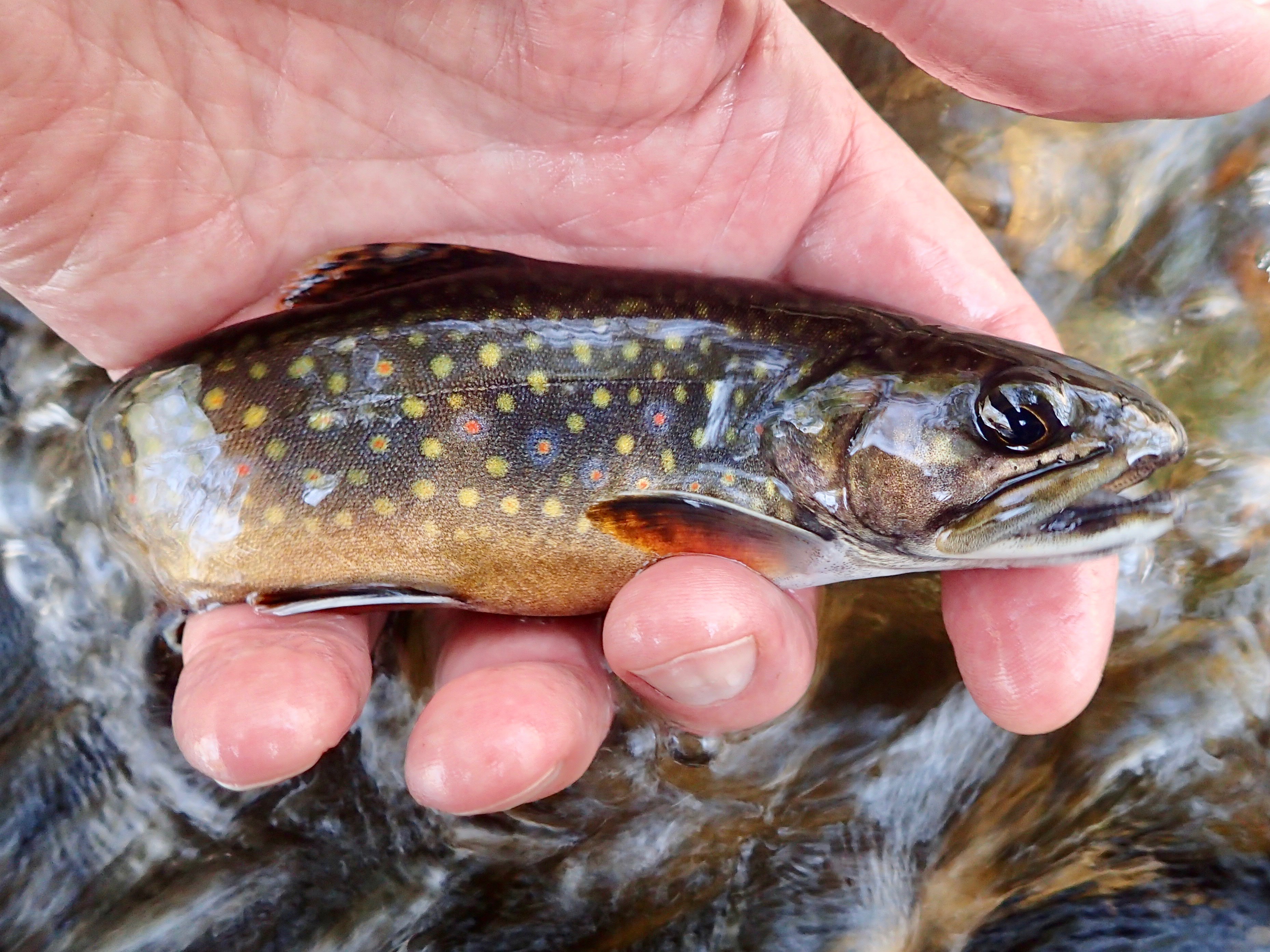
I don’t know how many wild brookies I landed on this day, but I do know that this was the only one I photographed. 1-2-3-lift-shoot, then back into the water. Less isn’t always more, but it usually is when it comes to small streams and wild trout.
If you love and value wild fish — especially native fish — you have a responsibility to preserve and protect the resource. Yes, fishing is a blood sport. Yes, no matter how careful we are, some of what we catch may perish. But there are ways to dramatically minimize loss. And there are certainly ways to ensure the next angler has the opportunity to enjoy the stream as much as you.
So, I’m declaring this “Wild Trout/Small Stream Week” on currentseams.com. As you know, small stream fishing is an experience that is sacred to me. My goal this week is to educate and inform as much as possible. And this wonderful essay by a Pennsylvania angler named “Fly Tier Mike” is a good place to start. In The Responsibilites of Chasing Wild Trout, Mike outlines four best practices for those who fish for wild trout on small streams: Proper wading techniques (staying off of redds); proper fish handling; minimizing damage while taking photos/videos; and the pitfalls of social media that can lead to over-pressuring a stream.
Anyone who fishes for wild trout should read it, if only as a refresher. Thanks for your consideration.
I was gratified and encouraged to see someone else taking a stand for small streams and wild trout. Way to go, Mike!
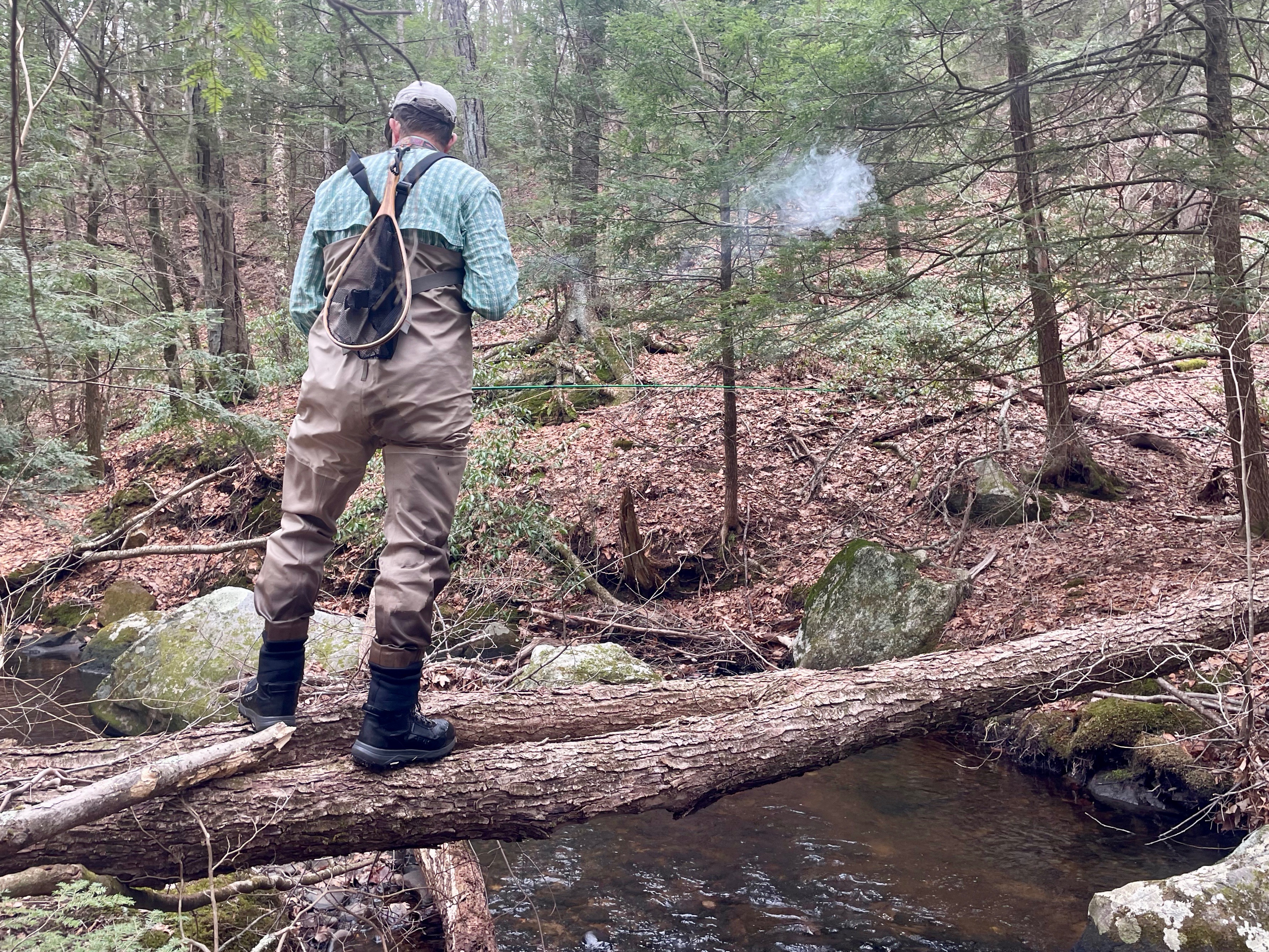
Having not gone fishing for weeks, I sought the cure for my ills in a small stream outing this past Wednesday. I was going to visit an old favorite, but instead I decided check out a new section of stream that I’d never fished before. So, armed with my camera and pack and rod and cigar, I had at it. While the fishing was great, the catching was non-existent. So thought you might be interested in how I approached some of the water.
Let’s start here. Why was the fishing so poor? It could have been any or all of these: a cold front approaching; far cooler temperatures than the previous week; trout not yet spread out in the system; complete lack of hatch activity or visible feeding; low, clear, spooky water; or just nobody home. (Sometimes when I ‘m fishing new water for the first time, I’ll stand up and make dramatic movements in an attempt to spook fish I might have missed. In two hours, I rousted only one 3″ char.)
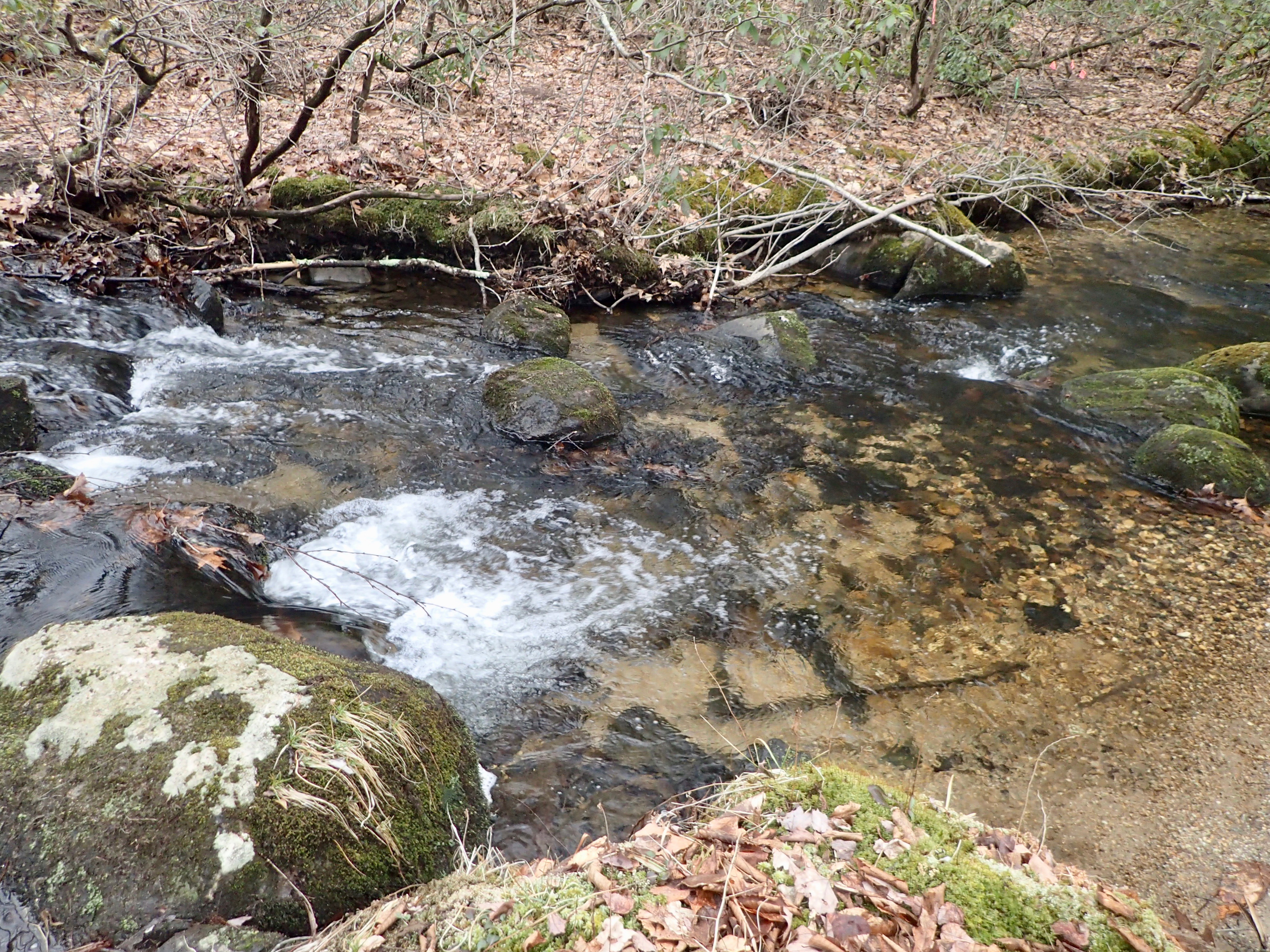
Exhibit A: the long flat pool. This brook had earth banks, so it was essential to walk very slowly and softly near the water. Always assume that stealth is critical. Also, stay out of the water! I began on my knees along the bank in the upper left side of the photo, drifting my flies (dry/nymph dropper, almost never a bad idea for searching) through the wrinkled water to the right of the rock with the large flat face. Looks can be deceiving; the water depth to the right of the rock was over a foot, plenty deep for char to hide out. Having blanked there, I crawled up behind the large rock and had at the main current seam. Still, nothing. Note the cut banks on the left side of the photo; I pounded those and was stunned that I got no love. Perhaps next time. I purposefully fished this pool from an upstream position, as I didn’t want to spook any fish with a fly line landing on the water. Presenting downstream means that any fish will always see your fly first.Exhibit B: the small, wrinkled plunge. This pool is immediately below the previous pool, and I had high hopes for it. To start, many times in low, clear flows, fish will be far more willing to show themselves in moving, wrinkled water, and especially whitewater. (Insert “You Lose” game show buzzer sound here.) Once again, not a touch. I didn’t fish from this position, which could easily spook any wary char; rather, I fished it from just above, again on my knees and using only bow casts to deliver the flies. Late April sounds about right for a return, or perhaps before if we get a good rainfall and the river is up and lightly stained. One thing’s for sure: it’s a very pretty stream.
Many thanks to my old friends at the Narragansett TU Chapter for hosting me last night. It’s so wonderful to see everyone again, and I thank TU225 for their continued support. The topic was fishing the Farmington River’s West Branch (the official title is: The West Branch — Southern New England’s Blue Ribbon Trout Stream). It’s an overview of the river that covers everything from popular pools to hatches to gear to when and how. If you’re looking to fill a presentation slot for your club this spring, I still have open dates. Here’s a link to my current presentation menu.
Speaking of the Farmington River, here’s an info sheet — one page, one side — that gives you some good, basic information on the Goodwin (AKA Hogback Dam) and Colebrook Dams. It doesn’t explain the dispute between the MDC and the ACE — or why the MDC is holding the river hostage — but at least you can understand why the water releases have been the way they have been. (What a shock! It’s all about money.) Many thanks to Farmington River Watershed Association for sharing!
In case you don’t know, here’s a micro-brief recap: since last summer, the MDC has, for whatever reason, been releasing only the minimum amount of cfs required by law from the Hogback dam. This has resulted in, at times, unnecessary ultra-low flows, transforming the Farmington River from a lush aquatic playground into a pathetic rock garden, and certainly damaging fish and wildlife populations. To my knowledge, no one knows what the MDC’s end game is.
Right now, a group of state senators is crafting legislation that seeks greater transparency from the MDC, albeit in the form of such things as an ethics code and approval on water rates. This doesn’t really help anglers; however, the Connecticut League of Conservation Voters and the Rivers Alliance of Connecticut are also involved. I plan to reach out to those groups and to the biartisan state senator group to voice my concerns. I’ll let you know what, if anything, I find out.
I do know there is going to be a specific forum in the future for concerned parties to express their concerns about the unconscionable way the MDC is treating the river. When I get data’s on that public comment event, you can be sure I’ll post more about it here.
Man, I really need to get out and fish.
The river should look like this. You know, where you can’t see the bottom half of those boulders…





 currentseams.com