Farmington River Report 5/28/24: A tale of two outings

I’ve been having a tough time with lessons this year. Not the clients! All have been enthusiastic learners and a treat to coach and teach. Rather, the bite windows have generally stunk (and they really shouldn’t be stinking). Yesterday’s lesson was a case in point. Craig did an outstanding job casting and mending and presenting and hunting and covering water. The last couple hours in particular, you could really see him taking to the wet fly. He never got discouraged, and he deserved a lot better than four touches and two in the hoop. But I’m happy to declare that Craig is going to be a certified Wet Fly Dangerous Machine if he keeps on keeping on! Great job, Craig.

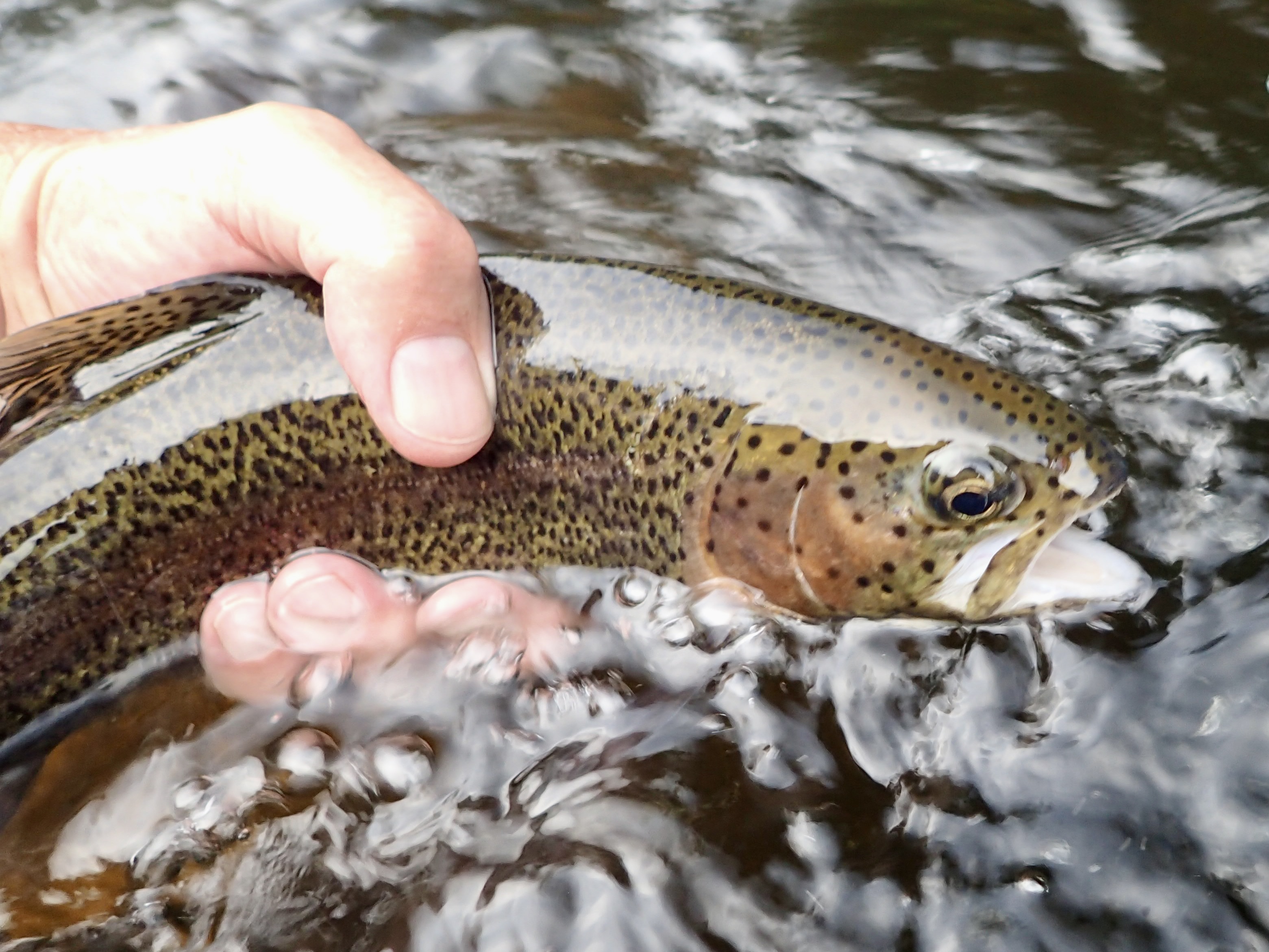
The river was up from the rains, but in the 400s of cfs it was not too high for the wet fly. Weather was perfect, save for some breezy moments. No, I think the main culprit was the almost total lack of hatch activity, and zero visible feeding. I think I saw a half dozen(!) caddis in four hours. This was Craig’s first fish. I thought at first it might be a salmon/trout half-breed, but after closer inspection the maxillary is all brown trout. What threw me off was the tail, but I believe the fork is created by rending of the tissue. Whatever it is, it smacked the fly with gusto, and is a beautiful creature worthy of the wet fly.

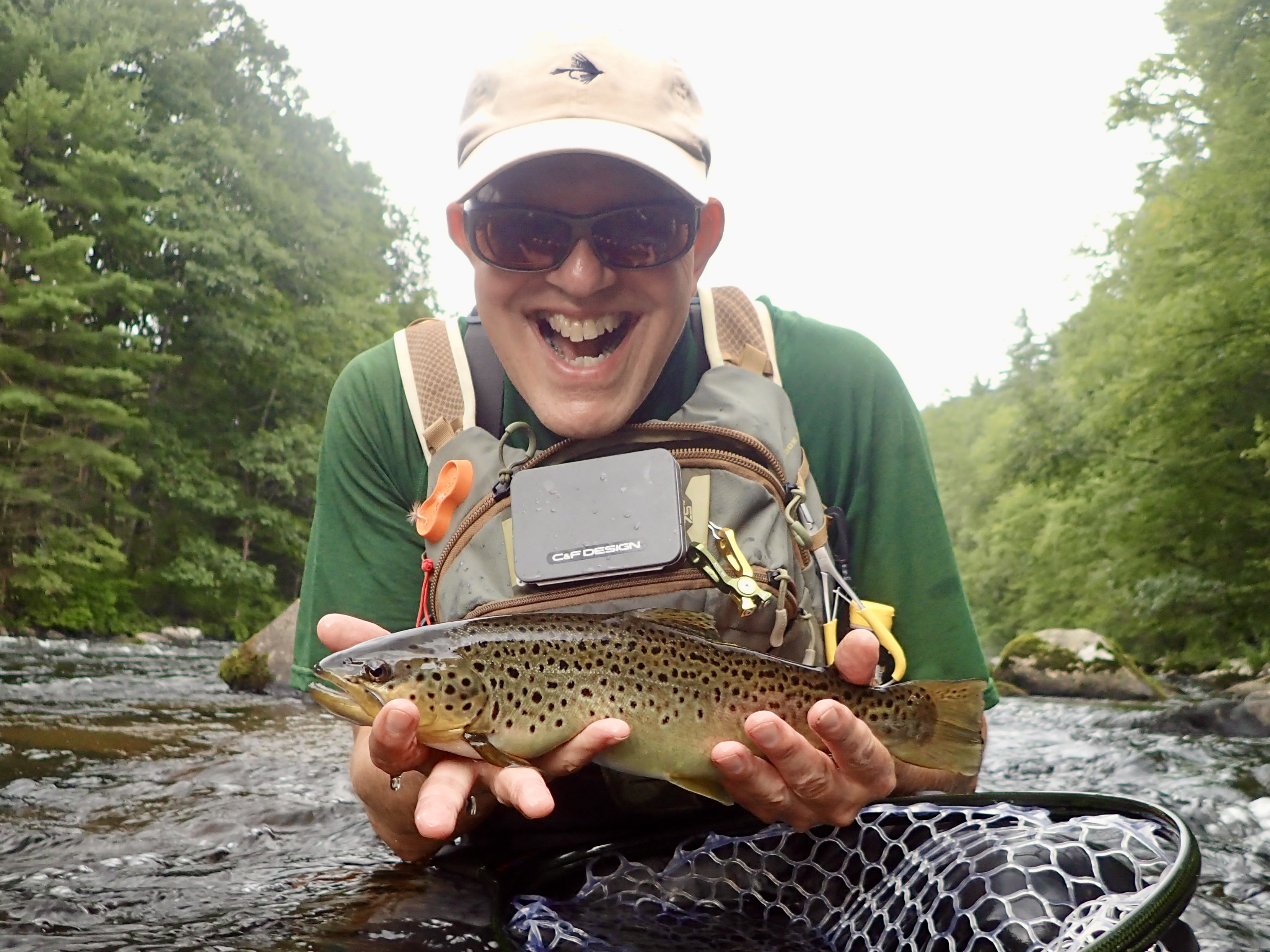
I had a window of opportunity, so I decided to try my luck with the evening rise, although, between you and me, I didn’t think there would be much of one. Turns out I was right. Kindof. I wanted to fish the lower river, which was running much higher at 730cfs. It was, to say the least, a tricky wade. I was in the water fishing at 6:15, and for quite a while, absolutely nothing was happening. I started debating the merits of fishing vs. having a couch date with my wife, but decided to stick it out, if for no other reason than scientific curiosity. Then I got into a fish. And another. It wasn’t gangbusters, and still nothing was happening bug- or hatch- or rise-wise, but I was catching trout and having fun. I stuck it out to 8:30. Moments before, I had declared that it was over, when a big wild brown slammed by fly. I don’t usually put fish on the reel, but this hefty brown told me I really should. Final tally was 15 hooked and 12 in the hoop. Not bad for high water and nothing going on.

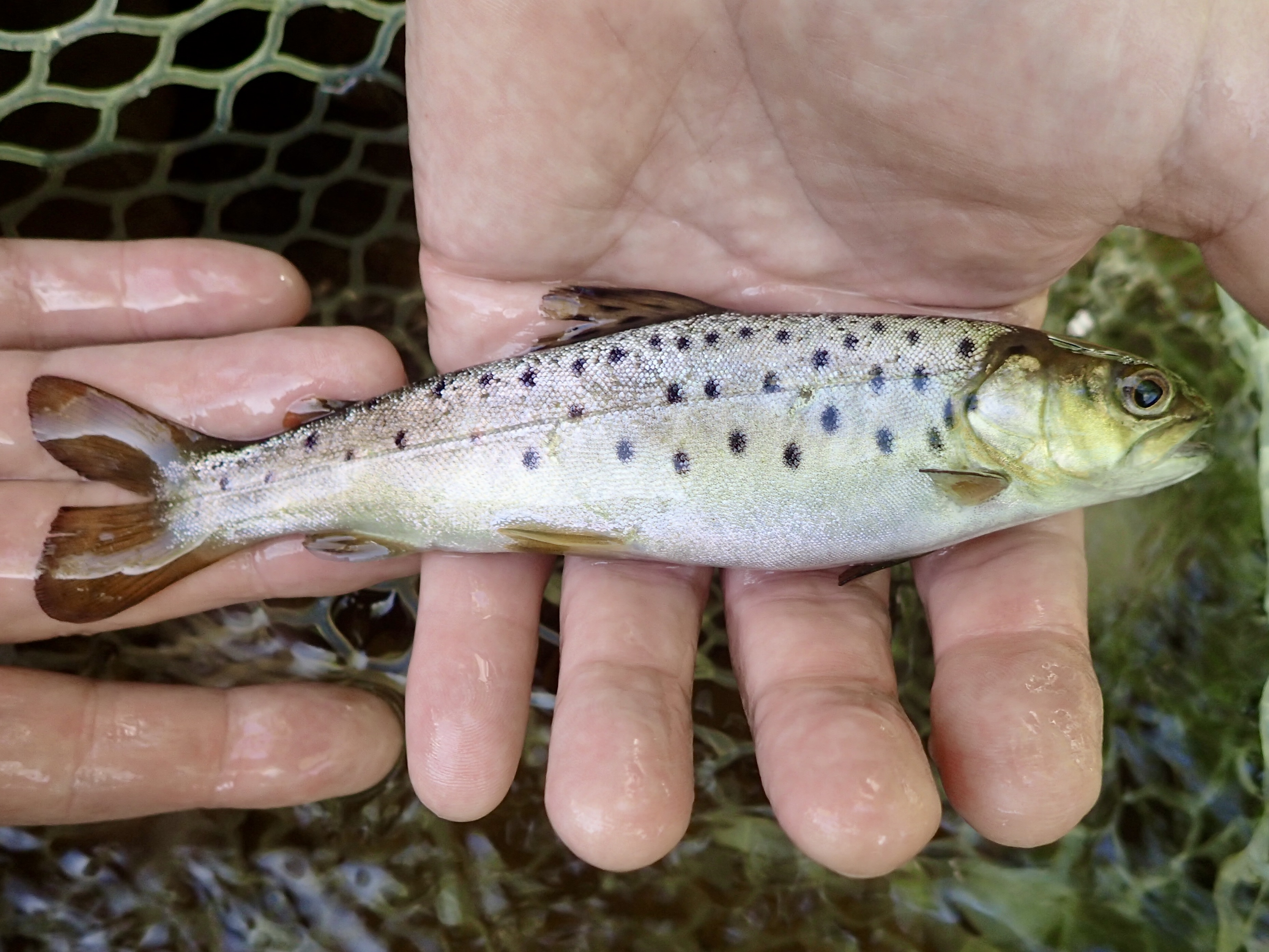
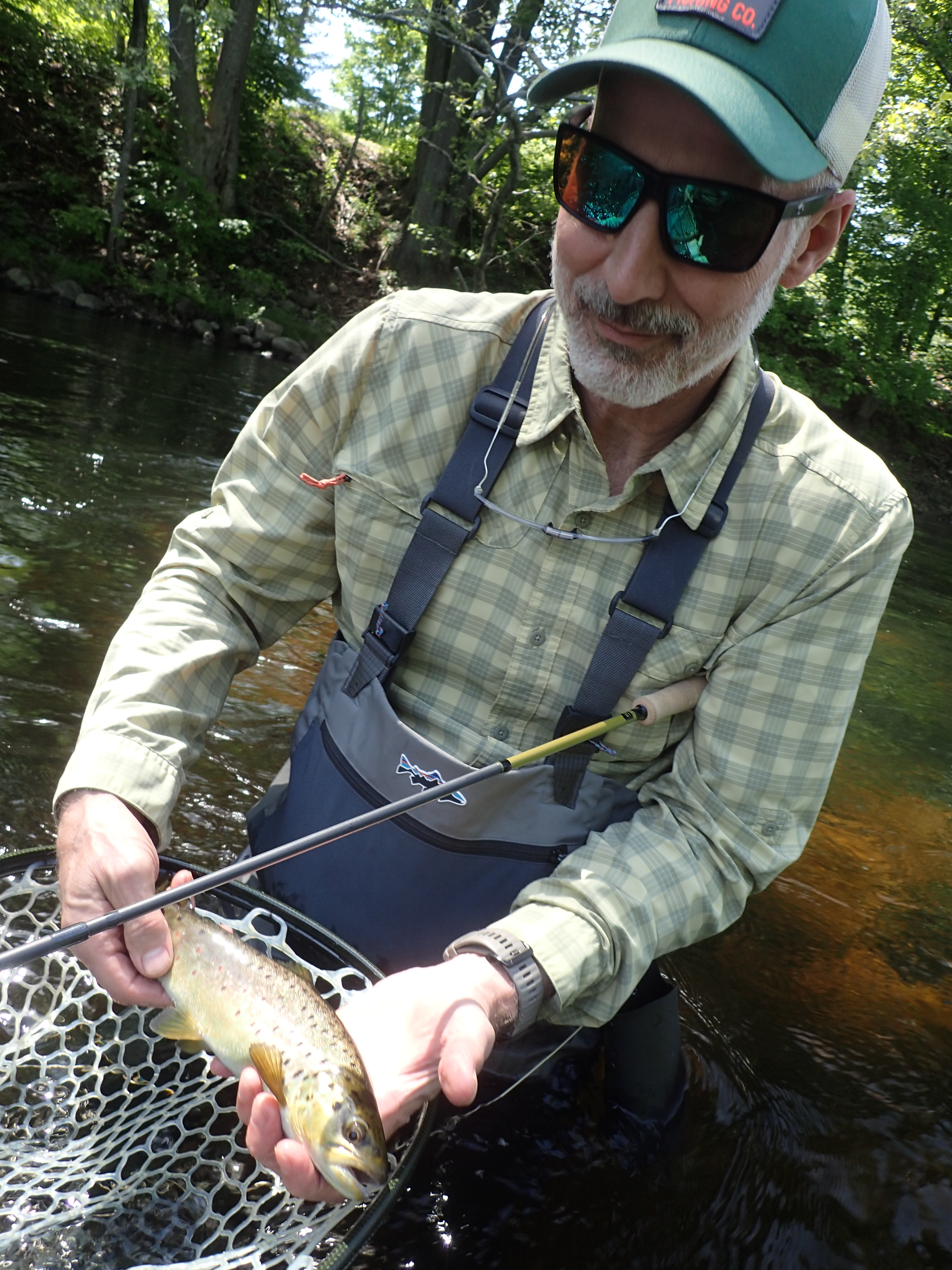
Of the dozen to net, 9 were stocked rainbows, a few of which thought they were steelhead, with multiple gravity-defying aerials. Three were wild browns: the big guy, a little guy, and this mid-range guy. This is significant because I was fishing in an area that would have been torched last summer in the heat and low flows. Nature finds a way. For those keeping score at home, the big one took LaFontaine’s Diving Caddis winged wet, middle dropper, which you should be fishing right now late afternoons into dusk.

Farmington River Report 5/20 & 5/21/24: Creating another Dangerous Wet Fly Machine

I guided Doug on Monday and Tuesday, and the results were fascinating. (At least they were to me.) Doug, who’s from northern Michigan, drove all the way to Connecticut for a wet fly lesson after hearing me talk about wet flies with Tom Rosenbauer on the Orvis podcast. We fished within the PTMA on Monday, and conditions were pretty spiffy: 330cfs, clear, cold, and a good caddis hatch, mostly tan, sz 16-20. The problem was uncooperative fish. We had a few risers to target, but nothing was coming up consistently. It was a struggle to put a couple in the hoop. Like many anglers new to the way of the wet fly, Doug needed some time to adjust to the casting, the mending and presentation, and waiting for the fish to do the hook setting.

Day one: Doug scores a lovely Farmington wild brown, taken on a BHSH Hendrickson, sz 12. He went out after our lesson and stuck a few more fish. Little did we know he was just warming up for Tuesday.

We fished the same time frame on Tuesday, 11am-3pm, only this time we headed to the lower river. 565cfs, clear, 55 degree water and glorious 80 degree sunshine. We focused on dialing in his presentation, covering water, and targeting fishy areas in some classic pocket water. What a difference a day makes! Doug stuck nine and landed eight. It was really cool to see him gaining confidence and making so many eat-worthy drifts. Fantastic job, Doug, and he scored a Farmington Hat Trick with browns, rainbows, and a brookie to hand.

A brief wet fly outing on private waters and other notes of interest

On Monday I had the opportunity to fish a private stream, so naturally I jumped on it. This is a lovely brook that wants to be a river, and it’s not easy water. Its banks are overgrown, and there’s often a three foot drop from terra firma to water. The first beat we fished was particularly challenging; a lot of the water crawls along, creating glassy pools where any movement sends the fish into flight toward the nearest cut bank. I was instructed to stay out of the water as much as possible, but when did I ever follow directions when I wanted to do my thing? I decided that I needed to get in, summon my inner stealth ninja, and fish downstream.

Sure enough, I crept up on pool that had risers. The hatch was midges and caddis, and there were a few stray Hendrickson spinners. Some of the takes were more emergery, some gentle sips. I had two fish slam the fly the moment it hit the water, and a few more that required a little coaxing. I took six fish, which I was told was pretty darned good, a nice mix of stocked and wild brookies and some chunky rainbows. All three flies were eaten: Squirrel and Ginger (sparkle variant — more on that soon!), Hendrickson spider, and LaFontaine’s diving caddis, tan.

The second beat was not as kind. It began good enough, with my biggest fish of the day, a rainbow with a dramatic pink band (you can see it on Instagram @stevecultonflyfishing) on the second cast. But even though this mark was far better suited for wet flies, I only managed one more trout (do creek chubs count?), and even with that one, I had to wait a half hour and go back after I missed her the first time. I think the lack of activity was due to the hatches being over, and everyone with fins being well fed. Or, maybe I just stunk. Or maybe it was just fishing. No matter. It was just capital to be out fishing. Thank you. Peter G., for your most generous invitation.

It’s almost never a bad idea to swing wet flies when you see feeding fish, especially during an emergence. However, be advised: if the trout aren’t feeding regularly and rhythmically, and you don’t get hit after three good presentations, you may be in for a bit of a wait…

Meanwhile, nose to the grindstone on the book. As far guide trips go, I am not taking any more dates in May. If you see me on the river, please come say hello.

Then, of course, there’s the new house and vegetable garden, which won’t plant itself. What a wonderful collection of obligations.

From the Archives: The best soft hackles and wet flies for the Hendrickson hatch

Yeah, baby, it’s getting to be about that time. OK, maybe not for a couple more weeks. We’ll see what Ma Nature has in mind as far as warmth and rain are concerned. But indeed it is coming. And right now is the perfect time for you to stock the box with your favorite Hendrickson patterns.

If you’re not fishing under the Hendrickson hatch with wet flies, you’re missing out. In fact, you’re missing out on some of the best trout-on-the-fly action of the year. Tie these up, place them over a rise, and hold on. Oh. And be prepared to clip one or two flies off your three-fly team. Such are the travails of the angler getting doubles and triples!

The Best Soft Hackles and Wet Flies for Fishing the Hendrickson Hatch.

Mssr. H awaits your pleasure…

Striper report: If you want to catch big bass on a consistent basis, do this

Anyone can luck into a big fish. Way back when, when I was just starting out, I wanted no part of that. I wanted to be able to consistently catch big stripers.

If you want to catch big bass — and make it repeatable — you don’t need a casting lesson. You don’t need to be able to reach 90 feet. You don’t need the latest in intermediate line technology. You don’t need a huge monstrosity that looks more like a plug than a fly.

You need to study. And ask questions. Why would there be a big striped bass where I’m fishing? Is there current, cover, and food? Is it pre-spawn? Is it migration time? Is the bait spawning (and therefore gathering in large numbers)? Is it dark, so the fish feels comfortable coming in close? What’s the barometer doing? Which way is the wind blowing? What’s the tide, and how is it moving? These are all part of the equation.

Then, you need the right fly. Something that looks like the bait, or what the bait should be at this time and place. Does the fly look alive and like something good to eat, even when at rest?

Don’t forget presentation. You need to learn that, too. Big fish are lazy, and frequently unwilling to chase. How can you present the fly in a way that makes it easy for the striper to eat?

Last but not least, you need to put in your time. There is no substitute for time on the water. You can do all of the above, check all the boxes, and still blank. (Ask me how I know.) Nevermind, I’ll just tell you. Last year, I fished the mark I fished last week six times and had only two tiny bass nibbles and no bass to hand for my efforts. But every year is different, and this is what I found on a greased line swing with an 11″ Bombardier flatwing in March of 2024:

Miss Piggy went 25 pounds and taped 39 inches. This was one of the best fights I’ve ever had with a bass, and I hope to write about it sometime soon. I am humbled and grateful for the chance to hook, land, and release this fish. I’ve been doing this for years, folks, and I was so pumped with adrenaline that my hand was shaking as I took this photo.

Small Stream Report 2/27/24: The kids are all right

I didn’t really have the time yesterday, but since my default setting is when in doubt, go fishing, I did. The venue was a small woodland stream, and the time frame was 3:45pm-5:30pm. It was mostly cloudy and very warm for February, with a water temp of 48 degrees. The stream was running medium-low and clear. No hatch activity, although I did see one lonesome sz 600 midge flitting about.

I’ve written before that I’m a massive creature of habit, but on this outing I decided to explore about 100 yards of new water. I was glad I did, as that turned out to be my most productive stretch. I fished mostly subsurface with the Squirmy Worm Jiggy Thingy, but I did get a hysterical swing and miss on a bushy dry for the 5 minutes I fished it. All told, I pricked about 18 and brought probably a third of them to hand. I did catch the same beautifully spotted hen I took in January at the same hole. She really clobbered the fly.

A few of my favorite things: a cigar, a glass rod, and a small stream, and if I can get them all at once that’s even better. What a glorious day to play hooky for a few hours and lose myself in a babbling brook.

Currentseams Q&A: Wet fly leaders and fly choices

Welcome to a snow day edition of Currentseams Q&A. Yesterday I received an email from Bill who’d heard me on the Orvis Podcast How to Swing Soft Hackle Wet Flies with Steve Culton. His questions — and my answers — may be of interest to you. And here they are.

Q: Do you ever use the Rio Versileaders with differing sink rates when fishing wets?  I have used the 1.5 inches per second w some success but wanted to get your thoughts. Am I better off just adjusting sink rate by the size of the point fly? A: I do not. I adjust my sink rate and depth by adding weight to the point fly in the form of a brass or, most frequently, a tungsten bead. (Of course, strategic mends with a floating line are an important part of the process.) Sometimes I add weight, usually a single split shot, to the leader. That’s simply how I do it, and it works for me. I don’t know if you’re better off using my system — if you’re fishing happy with your Versileader, and your flies are where you want them, and the fish are eating them, that’s what I’d recommend. Confidence catches fish.

This is nymphing, but as with wet flies, if you’re hooking up, you’re fishing at the right depth.

Q: If you are on an a new stream with no intel, what is your go-to 3 fly set up? (Do you look under rocks first and just match size of nymphs?) I know where he’s going with this. Is there a default wet fly setup that works everywhere? Maybe, but that’s not how I would approach the problem. My go-to wet fly setup would be three bugs that I think are most likely to be hatching or present in the current system. This would vary from season to season, time of day, and certainly by geographical region. For example, if it’s summer in southern New England at noon, I might go with a caddis, a terrestrial, and an Isonychia-type on point. If it were the same region in the evening, I might switch out the terrestrial for a creamy mayfly. And of course, I would be watching for any kind of hatch or rise activity for clues. Then I’d have intel, plus whatever the fish were telling me. Remember, droppers are the fastest way to find out what the fish want. The looking under the rocks solution is also a good one.

Q: I don’t tie.  Recommendations for high quality wets? I wish I could give you a name or a place, but sadly I don’t have one. A good wet fly selection is hard to find these days, which is why I always recommend that wet fly aficionados learn to tie. I sometimes do custom orders, but right now I am not taking any orders for a few months. Your best bet is to do an internet search and see what you can find. Good luck!

Chances are slim that you’ll find LaFontaine’s Diving Caddis in tan, size 14, at your local fly shop. If you learn to tie your own, you’ll have a constant supply.

Happy Monday and the current currentseams situation

I’ve always tried to make currentseams worthy of your time. My goal has been to make three posts a week, all original content, stuff that you can’t get anywhere else. I know, sometimes in winter currentseams feels like the very big Steve Culton promotional machine, but after all, it is show season, and I like to keep you up to date on what I’m doing and where because you might want to catch a good presentation. It benefits everyone, yes?

So: right now, we’re in the process of getting our house ready for sale. Happy-happy-fun-joy, all the packing and organizing and culling and painting and cleaning we’re doing. As you can imagine, this leaves less time for fishing and writing. But the good news is it’s only temporary. Normally this time of year I get into a writing and content wheelhouse. That’s going into a holding pattern. I’ll still be posting, but it may not be three times a week. My current thinking is that some of those posts may be revisits of good stuff from the archives. I’m guessing that many of my readers haven’t seen some of the older published articles, or some of the wet fly series I’ve done, just to name a couple. If the planets align and I go fishing, I’ll surely let you know. I appreciate both your patience and your readership.

It’s all got to get packed up. And this just the tip of the iceberg.

On a positive local fishing note, the Farmington River is finally down to an angler-friendly level. Moderate weather is forecast through the week, so it’s a good time to take advantage if you’re not stuck inside packing up your house. I would think that nymphing would be the most productive method. Try an attractor like an egg or a junk fly on the bottom with a tiny soft-hackle dropper or midge pattern above. No need to be fishing at first light — let the water temp come up and enjoy a leisurely afternoon on the water. And of course, there’s always the streamer option…enjoy!

Small Stream Report, or: I finally go fishing!

We all know the scientific certainty that all work and no play makes Jack a dull boy. But add a bout with Covid, a never-ending string of home improvement projects, change Jack’s name to Steve, and holy cow, the dullness is magnified when there’s no fishing in January.

So, I snuck out during the last few hours of the month to visit a small stream. It was chilly and overcast, but the water was a good medium height, running clear with an occasional bit of decaying vegetation detritus tumbling by, and a surprisingly warm 42 degrees. Here are some details.

I pricked four and landed three, all on a swung/dangled/stripped Squirmy Worm jig. They had no interest in the dry nor tiny nymph dropper.

I interested, but did not hook, two behemoths (for this size stream) in separate locations. Both fish came out from their holes to inspect the fly, follow it, and then ultimately reject it. In both cases, I tied on, then offered, a larger micro Woolly Bugger in black, but neither fish reappeared. Round 1 to them. (Be advised, fishies, that I know where you live.)

Most of the fish came in water moving at a moderate pace, and all of those locations offered both depth and some form of cover, be it logjams, cutbacks, boulders, etc. Another smaller guy repeatedly whacked the fly as it dangled near his hideout beneath a cutbank.

The last fish was a spawned out female, 8″-9″. Please take care not to wade in gravel beds until mid spring s that the next generation can get a healthy start.

On the board for 2024, and my first fish was a beauty. Please consider taking the Wild Trout One Photo Challenge. It’s better for the fish, the resource, and you’ll feel good about it, too.

Edison Fly Fishing Show 2024: Best show ever?

I always have a good time at the Fly Fishing Show. But looking back at this year’s Edison show, it might have been my favorite — ever. I think it’s because I reconnected with so many old friends, strengthened some newer friendships, and had more first-time meetings. I gave away and traded a bunch of flies. My classes drew well, and I had some impressive crowds for my talks. Oh. I also bought stuff — some I wanted, some I needed, all of it putting a smile on my face. Here’s my show experience in pictures.

I knew Jeff Currier was an exceptional angler. I didn’t know that he’s one of the best — really — on the planet. I’ve been saying hi to and chatting with Jeff and his significant other, Granny, at these shows for a couple years, but at Marlborough I spent more time hanging out, getting to know him, and giving him some wet flies. At Edison, I gave him some smallmouth flies to try, and I bought one of his mugs. You see, in addition to being a world-class angler, Jeff is also a talented artist. The mug isn’t for coffee. I’m going to put it on my fly tying bench and use it as a stash container. (I bought the striped bass mug, not pictured.) I also picked up a new chest pack for guiding on the Farmington, the Umpqua Overlook, and some zingers and a fly box and some spiffy new Dr. Slick nippers that are way too expensive for nippers — but they look so damn good. Reviews on all to come.
I also picked up Joe Cordero’s new flatwing book, Colors In The Current. You can get it from his website, and I will be reviewing here in the future. Here’s Joe signing my copy. Speaking of signing, I also finally got Ed Engle to sign my copy of Trout Lessons, and Landon Mayer to sign my copy of The Hunt For Giant Trout. Yes, I’m a total fan boy. Dang! I missed George Daniel.
Not a bad lineup to bat leadoff. I had a nearly packed house for my Friday talk, Modern Wet Fly Strategies. The 9:45am slot is the first seminar of the day, and it can be a tough draw. At 9:30am, the room was empty save for me. I needn’t have worried. A trickle became a steady stream, and 15 minutes later I had another strong audience. If you came out to see me, I want to thank you. I’m truly grateful for your attendance and your enthusiasm.
Jonny King as featured fly tyer. I always tell people to come say hello on the river or at these shows, and I was delighted by the number of people who did so at Edison. Jonny was one of them, and now I have a new friend. Author John Field, whom I’ve spoken to, but never met, also tracked me down. He said he’d tried to get my attention earlier, but I hadn’t heard his shouts. Rats! I’m hearing impaired, and on a busy show floor, even with my hearing aid, a lot of audio information gets lost. So If I breeze on by, my apologies, and please don’t take it personally. I probably never heard you.
Dinner time in Edison means a trip to my favorite Chinese restaurant, Shanghai Dumpling. It doesn’t get much more authentic than this. Tim Flagler turned me on to it a few years back, and I always get and extra order or two to bring home. Besides the dumplings, the spicy pork Udon is the bomb.
We all like spending money on shiny new gear, but classes are a much better investment if you want to become a better angler. Thank you so much to the keen students and enthusiastic anglers who took this class and my wet fly class on Saturday. Fish on!
All good things must end, so I left the show the way I started it: at the Blue Quill Angler booth. Pat Dorsey and Chris Steinbeck, on the bookends L and R, have become good friends. They let me park my stuff at their booth when I wanted to wander the floor, and I’m grateful for that. I got to know Landon Mayer better at Marlborough and this show — we trade flies like kids trade baseball cards — and he is an exceptional tier and so enthusiastic about fly fishing. I wish I was heading out west some time soon to see my friends and fish, but that will have to wait. So I’ll console myself with a little Colorado dreaming…and chuckle at Pat and Landon Bogarting my wet fly presentation board.