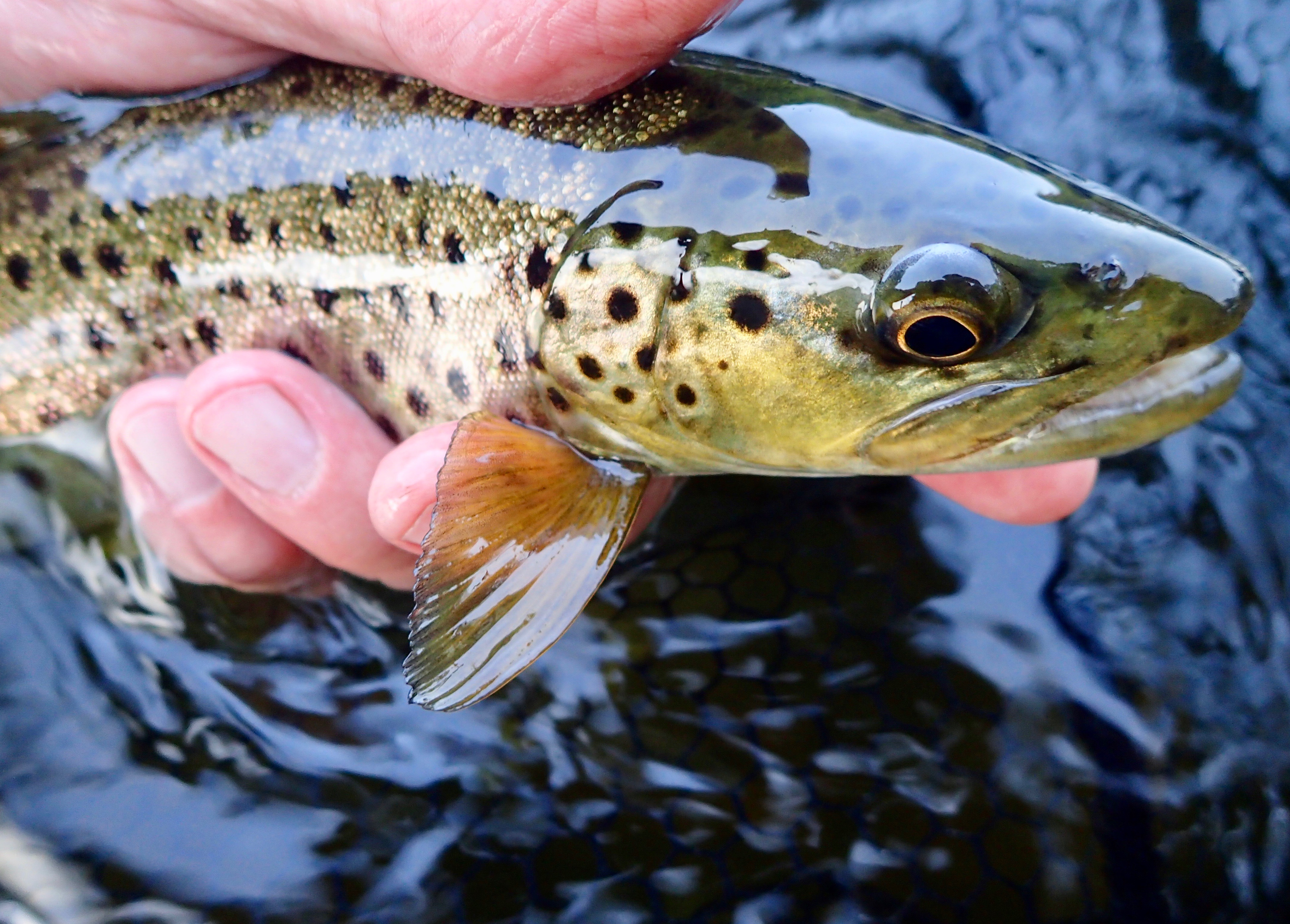
Farmington River Report and Tip of the Week

There are precious few absolutes – like gravity or the firmness of the earth – in fly fishing. But certainly this one is unimpeachable: wet flies in the water catch more fish. This is why I recommend that you keep your wet fly team in the water as much as possible, especially when you’re wading to a new position up or down or across stream.

The value of this practice, which I teach in every wet fly lesson, was driven home to me on Wednesday when I was out on shooting photos for the Farmington River book with Derrick Kirkpatrick and Joey Takeman. We’d just returned to the river after a thunderstorm delay, and were crossing a shallow (1-2 feet) riffle. I hadn’t fished yet, but this time I had my rod with me, and while I intended to take more photos, I couldn’t resist stripping out ten feet of line and dangling my team of three (16 Sulphur soft hackle, 16 Diving Caddis, 12 Isonychia soft hackle) in the current below me. Whack! I felt a sharp tug, and although the hook found no purchase, I’d already proven my point. It was a quality take, more like a loud foul than a swing and a miss.

An hour later, on another part of the river, we were walking upstream when I spotted a pod of rising trout across the stream. I told the guys that I had to take a few casts at them. I did, landed two, then began to cross back to the other side — team of three, naturally, dangling in the current below me. Wham! Another hit, and this time a hook set.

As dusk deepened, I left Joey and Derrick to return to the area where I’d seen the pod of trout. As I started to cross the river, a large trout delivered a thunderous hit on one of my flies. It immediately put itself on the reel, and peeled off 30 feet of line as by drag was not set for such a creature. In the gloaming, a spectacular aerial revealed that I had indeed hooked one of the FRAA-stocked 5-7 pound trophy rainbows. Another run, then another aerial, and as I tried to regain some line, yet another aerial. Tremendous sport! 

I wasn’t worried about the hook set as the fish clobbered the fly. I had fresh Maxima 4-pound as my tippet. I was going to land this mini-steelhead. I wish Chad a better picture for you, but I wanted to get her back to swimming. Besides, the light was lousy. And so, off she went.

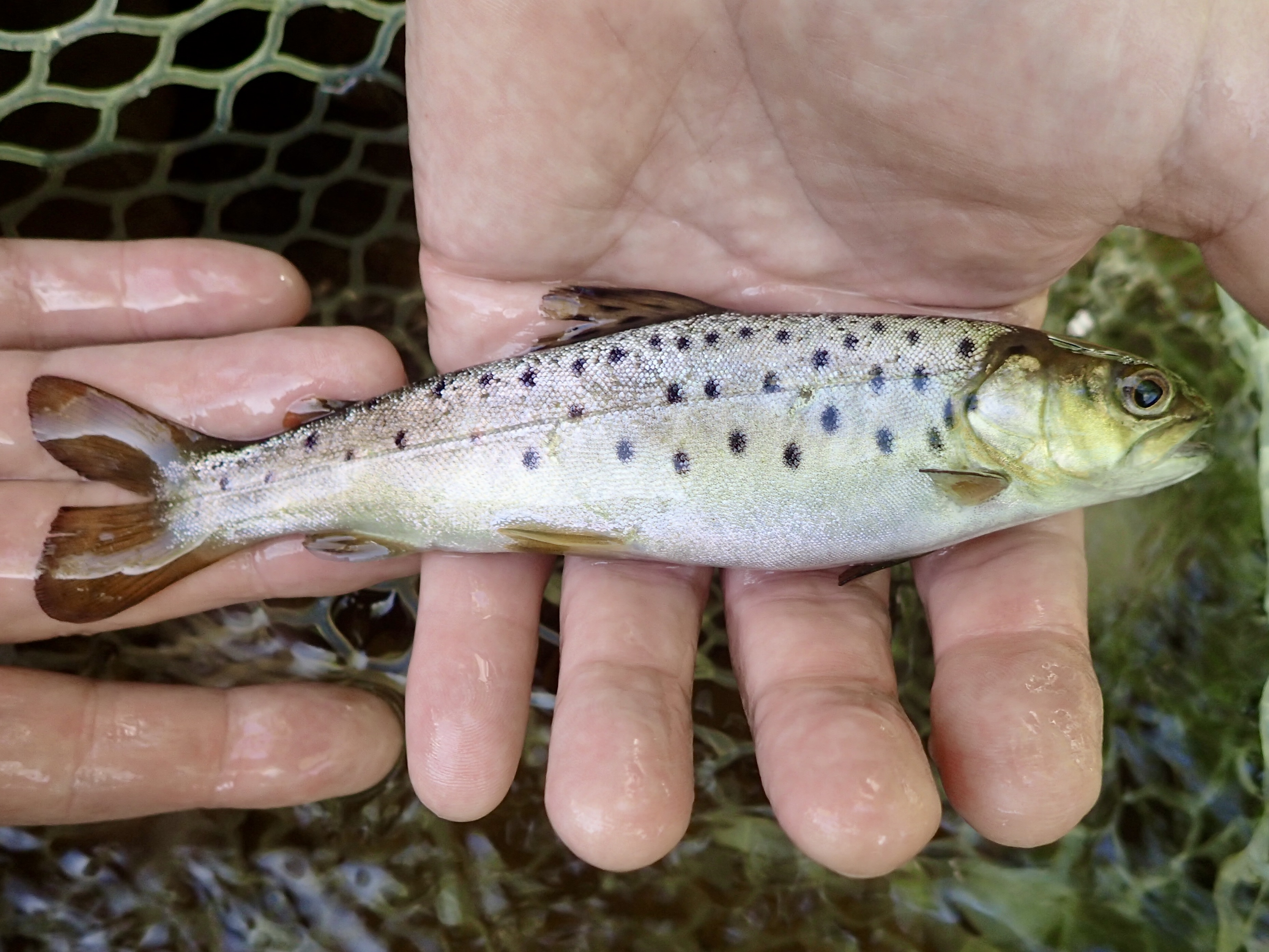
Great rainbow trout, lousy photo. My net length is 19″ and she did not come close to fitting. I’d guess 22 inches or so. For those who want to know, she took the Diving Caddis. Now, repeat after me: flies in the water catch more fish…

Farmington River Report 5/28/24: A tale of two outings

I’ve been having a tough time with lessons this year. Not the clients! All have been enthusiastic learners and a treat to coach and teach. Rather, the bite windows have generally stunk (and they really shouldn’t be stinking). Yesterday’s lesson was a case in point. Craig did an outstanding job casting and mending and presenting and hunting and covering water. The last couple hours in particular, you could really see him taking to the wet fly. He never got discouraged, and he deserved a lot better than four touches and two in the hoop. But I’m happy to declare that Craig is going to be a certified Wet Fly Dangerous Machine if he keeps on keeping on! Great job, Craig.

The river was up from the rains, but in the 400s of cfs it was not too high for the wet fly. Weather was perfect, save for some breezy moments. No, I think the main culprit was the almost total lack of hatch activity, and zero visible feeding. I think I saw a half dozen(!) caddis in four hours. This was Craig’s first fish. I thought at first it might be a salmon/trout half-breed, but after closer inspection the maxillary is all brown trout. What threw me off was the tail, but I believe the fork is created by rending of the tissue. Whatever it is, it smacked the fly with gusto, and is a beautiful creature worthy of the wet fly.

I had a window of opportunity, so I decided to try my luck with the evening rise, although, between you and me, I didn’t think there would be much of one. Turns out I was right. Kindof. I wanted to fish the lower river, which was running much higher at 730cfs. It was, to say the least, a tricky wade. I was in the water fishing at 6:15, and for quite a while, absolutely nothing was happening. I started debating the merits of fishing vs. having a couch date with my wife, but decided to stick it out, if for no other reason than scientific curiosity. Then I got into a fish. And another. It wasn’t gangbusters, and still nothing was happening bug- or hatch- or rise-wise, but I was catching trout and having fun. I stuck it out to 8:30. Moments before, I had declared that it was over, when a big wild brown slammed by fly. I don’t usually put fish on the reel, but this hefty brown told me I really should. Final tally was 15 hooked and 12 in the hoop. Not bad for high water and nothing going on.

Of the dozen to net, 9 were stocked rainbows, a few of which thought they were steelhead, with multiple gravity-defying aerials. Three were wild browns: the big guy, a little guy, and this mid-range guy. This is significant because I was fishing in an area that would have been torched last summer in the heat and low flows. Nature finds a way. For those keeping score at home, the big one took LaFontaine’s Diving Caddis winged wet, middle dropper, which you should be fishing right now late afternoons into dusk.

Farmington River Report 5/30/23, or: Gary LaFontaine, you magnificent bastard, I read your book!

Fans of the movie Patton will instantly get the reference. In this case, I’m not talking about military literature, but rather LaFontaine’s fly fishing masterwork Caddisflies, which I have been studying the last couple months with renewed vigor. We’ll get to that in a moment.

I fished last night for less than two hours, but it was almost non-stop, spectacular wet fly action from start to finish. The mark was a section of the lower river, running at 328cfs and about 60 degrees. Hatch activity was at best moderate. Observed: Vitreus size 12, Sulphur size 14-16, midges, and tan caddis size 14-16. Rise activity was minimal. I fished a three fly team of a Magic Fly (heavy hook) size 14 top dropper, a LaFontaine Diving Caddis tan variant size 14 middle dropper, and a tailed Partridge and Light Cahill size 14 on point. My first three fish took one of each. From about 7:15-8:30, I have no idea how many trout I hooked. It was one of those nights where if I made three drifts without a tug, I wondered if maybe it was over. (The the answer was always no, it isn’t.) Here is the magic of the evening: this was the first time I fished the Diving Caddis, and of the over two dozen trout I landed, the vast majority came on the caddis.

Also noteworthy: there were very few visible rises, and not a ton of bugs. But clearly, there was a significant feeding event taking place subsurface — and the featured entree was egg-laying tan caddis.

The idea behind the Diving Caddis is to emulate a female egg layer, encased in a silvery bubble of air. This specific pattern is not in Caddisflies, but obviously the trout appreciated my creativity. My variant was tied with tan thread on a size 14 hook. Body was tan Lifecycle Caddis with a small gold wire rib. Underwing was brown partridge. Overwing 30 fibers of tan sparkle yarn. One turn brown rooster hackle tied hanging back to ward the bend.
I had the Farmington hat trick. Most of the fish were stocked rainbows, but there was also a hefty stocked brook trout, along with a bonus 6″ wild brookie. I also had four wild browns, which was gratifying since this section of river no doubt got torched during last summer’s heat and drought. Love me some paddle pecs! Almost all of the takes came in swirling pocket water on the dead drift, although I did have a bunch on the dangle, too.