A shout out to the Squan-a-Tissit Chapter of TU (northern MA) for virtually hosting me last night. We Zoomed and boomed and I presented The West Branch Farmington River: Southern New England’s Blue-Ribbon Trout Stream. A reminder to all the long and longer-distance fly fishing clubs out there: Zoom is great way to get acquainted. If you”re in charge of booking speakers, here’s a link to my current presentation menu.
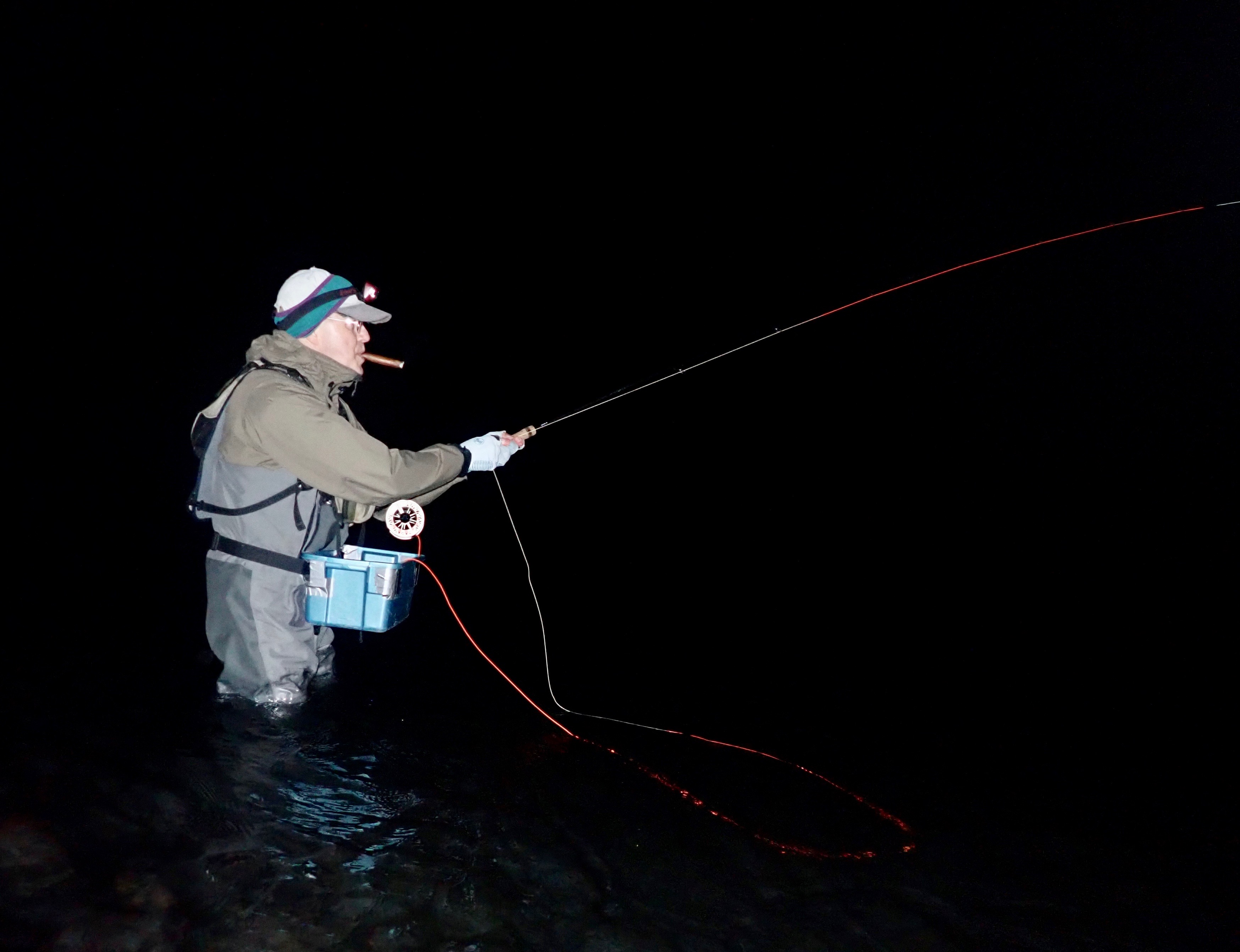
The question of the day is certainly a fun one. I don’t think I’ve ever had this one before last night. You may find it tongue-in-cheek, but I took it seriously, and there’s a little bonus wisdom in the answer. Q: What’s your favorite fishing cigar and do you find that certain brands help you catch more fish?A: Without getting into specific brands, I like fuller bodied cigars that have a lot of taste complexity. I’m an espresso/dark chocolate/spicy/earthy flavor profile kind of guy. Now, this next bit is true. If I’m having a tough go when I’m fishing wets or streamers (or striper fishing), sometimes I’ll tuck the rod under my arm, leave the fly dangling in the water, and get out a cigar. Several times a year, I hook up when I’m lighting the cigar, doing nothing else. That’s clue #1. Clue #2 is that sometimes when you’re dealing with a riser that won’t bite, rest the fish. Take out a cigar, cut and light it — or, if you don’t partake, take couple minutes to organize your box — and then make a cast and see what happens.
It takes a rare talent to enjoy a cigar while you’re doing battle with a steelhead. OK, not really, but I do enjoy the connection between partaking and hooking up. Sometimes it seems that the cigar is the wild card that gets the bite going. I can’t explain it, but it happens an awful lot.
I guided Jon yesterday from late morning to mid-afternoon. We had abundant sunshine, the air was crisp and chilly, and we had a bit of a breeze to contend with. But by far the most challenging part was the sheer volume of leaves in the water. It was never-ending. Still, the trout have to eat. The trick is to keep at it, and I like to use flies that offer some contrast to all the yellow and orange and red in the water. We fished four marks in the lower river, which was running about 225cfs, a very respectable height, and far better than the double-digit CFSs we’ve had to suffer though in the Permanent TMA.
So: Jon is a beginning fly angler. We spent the session drop-shot nymphing under an indicator. Jon did a great job sticking with it despite all the infernal flora. And what do you know? The indicator dipped, the hook was set, the battle won, and…Jon’s first Farmington River trout was wild brown! Way to go, Jon!
Sparse spotting, lovely halos, perfect rays on the fins, no edge damage to the fins, intact adipose — and a stubborn unwillingness to come to net — all hallmarks of a stream-born wild brown. It was especially gratifying to find this fish in an area of the river that got torched this summer. Nature finds a way (again). A tremendous first Farmington River trout for Jon.
Surfcasting Around The Block II — Forty Years of Striped Bass Surfcasting Stories, Articles and Legends from the Islands of Block and Aquidneck is on the shelves! Dennis Zambrotta’s much-anticipated follow-up to his out-of-print classic Surfcasting Around The Block is actually a group effort with multiple contributing authors — many of them Block Island surfcasting legends. Although the focus is on fishing the island with spinning gear, the astute fly caster will be able to glean a treasure trove of information on fishing the island.
Sitting in my favorite reading chair, looking for intel from Campo, McKenna, Abate, Winters, and that Zambrotta guy…
And yes, there are two chapters devoted to fly fishing Block Island authored by yours truly. The first part is a story about a particularly memorable Block Island All-Nighter. The second covers gearing up for fly fishing on Block Island. Where can you get Surfcasting Around The Block II (ISBN979-8-218-07120-2)? The Saltwater Edge. The Island Bound Bookstore. And The Surfcaster. Happy reading!
What a football of a Block Island bass! This is a really good story. I think you’re going to like it.
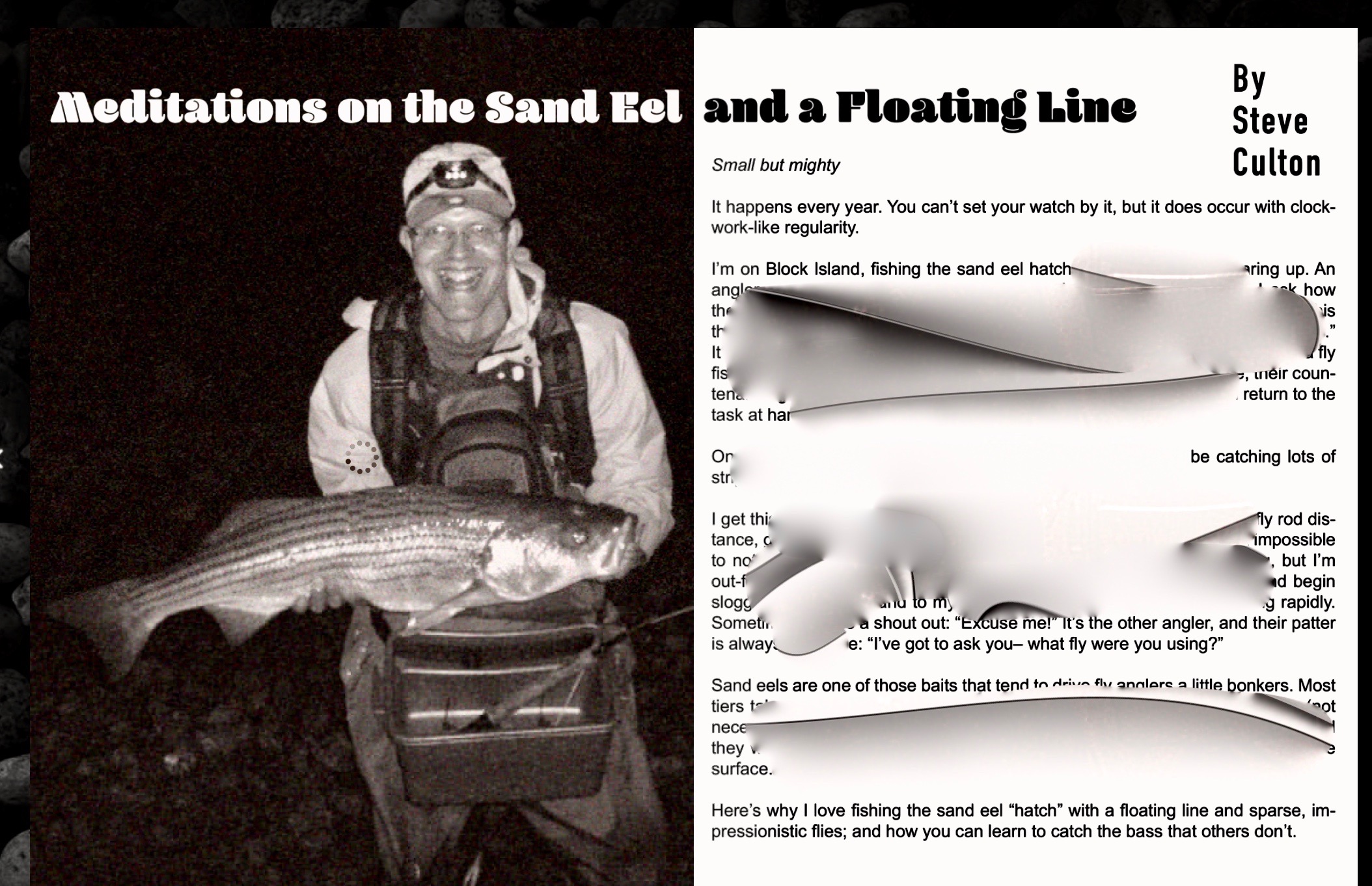
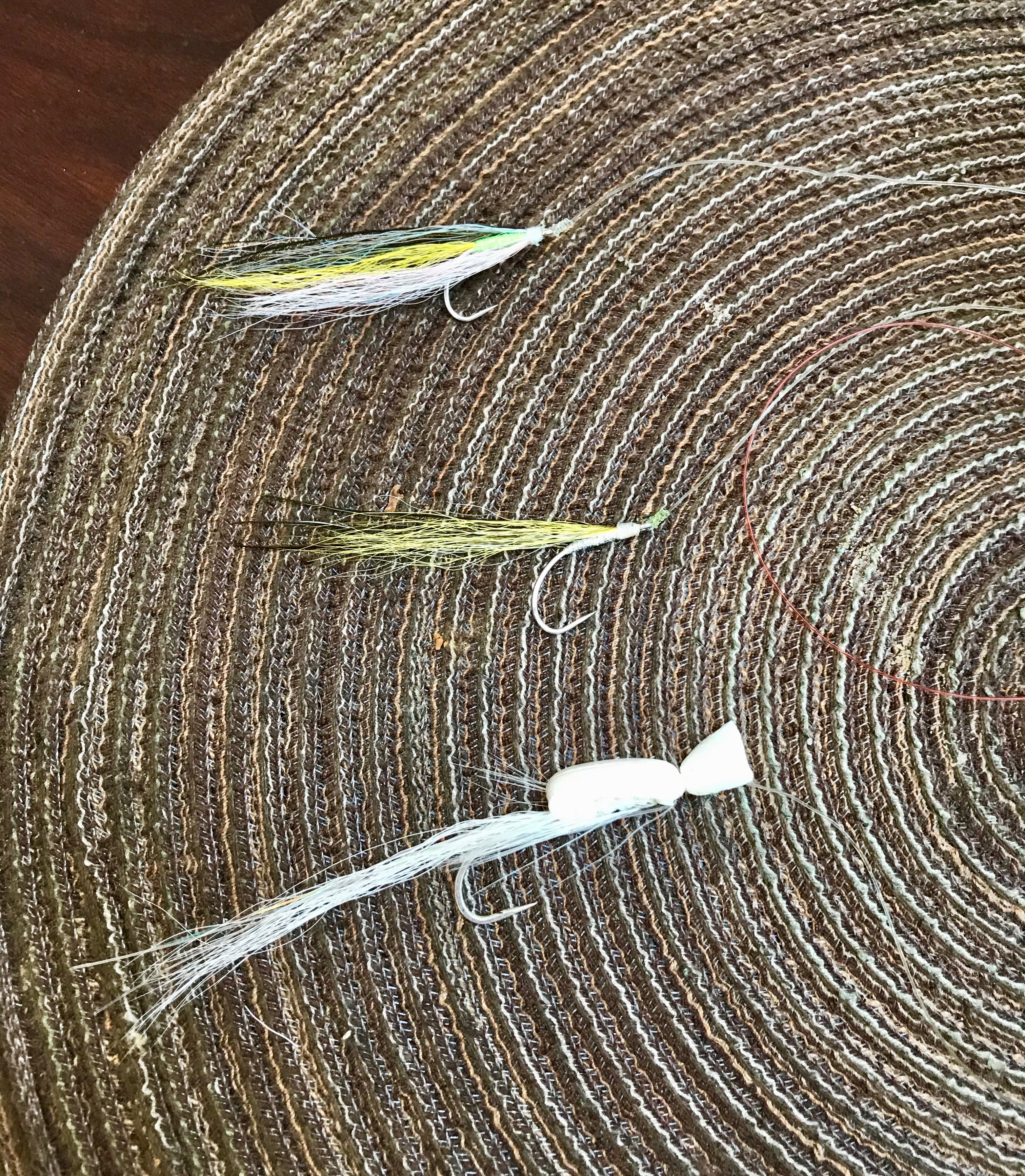
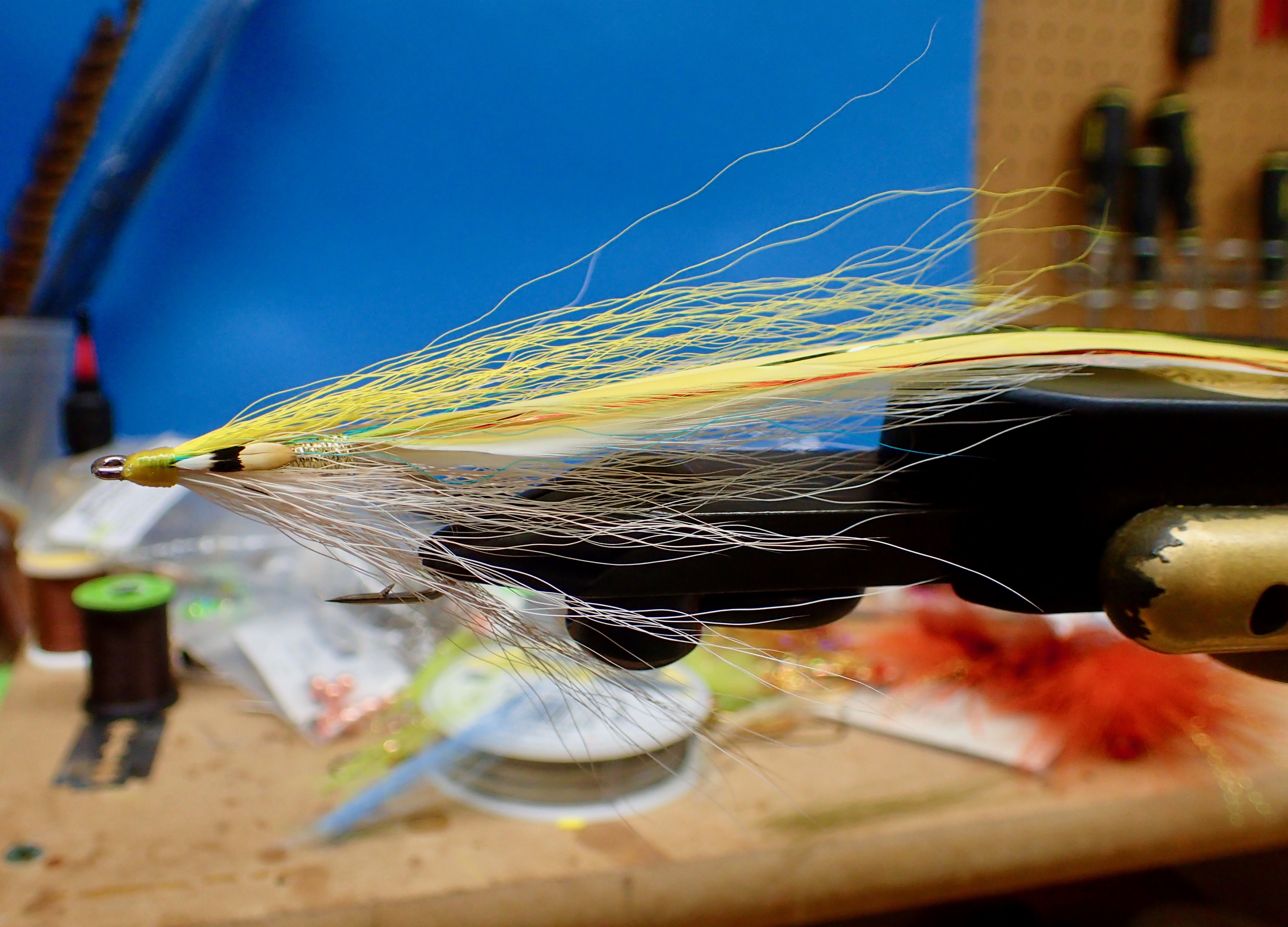
I’m delighted to have piece in the diamond issue of Surfcaster’s Journal. Meditations on the Sand Eel and a Floating Line is exactly what it sounds like: my thoughts on fishing this important bait using traditional patterns and salmonid tactics — and catching more striped bass. Most anglers I see targeting stripers feeding on sand eels use intermediate lines and weighted flies. They’re missing out, and typically only catching the stripers that are willing to chase. Some of the answers to the mysteries of “How come I can’t catch those bass?” when they’re feeding on sand eels are unveiled within.
Surfcaster’s Journal is an online e-zine. If you’re not reading it, you should be. Although the focus is primarily on using spinning gear, there is some in-depth fly casting content (like this piece) — and there is plenty of invaluable information that may be gleaned from the traditional surfcasting articles. It’s only 20 bucks for a year. You can subscribe here.
I remember this night like it was just a few months ago: Block Island, July, and a school of 15-20 pound bass were in close harassing sand eels for several hours. The stripers were very willing to jump on. But what about those frustrating nights when you can’t buy a hit? Read Meditations on the Sand Eel and a Floating Line and become a closer.
Mini-striper report 10/16/22: I fished for several hours last night with surfcaster extraordinaire Toby Lapinski. He was plugging and I was on the 2H fly rod. Conditions appeared to be perfect, but the neither the bass not the bait got the memo. Toby managed two school bass and yours truly took the skunk. Toby had a trenchant analysis of the evening, which, as you have not yet heard it, I will now precede to relate: “Bleaaahhhh.” That’s a direct quote.
The spawn is taking place on some northeastern wild brook trout streams. I recently fished a brook on consecutive Thursdays, and the changes over the course of a week were dramatic. Seven days ago, there were only a few leaves in the water and no visible signs of spawning activity. A week later, the brook was congested with foliage and several redds were apparent. I spotted a large hen on one, and a few active fish on another.
In case you don’t know, a redd is a spawning bed. The fish select an area with enough water and current and the right size gravel, then clear the area of debris and other sediment before depositing eggs and spreading milt. (This is why spawning and post-spawn fish often present with scraped bellies and frayed fins.) Redds are fairly easy to spot; they look like light colored patches contrasting against much darker substrate. On a small stream, redds may be anywhere from a couple of square feet in area to significantly larger. A distinct light colored patch with fish darting about on the bottom nearby is a sure sign that you’ve discovered a redd.
Every small stream angler should know how to identify a redd, or spawning bed. Here’s a classic, can’t-miss-it redd: A dramatically lighter patch of gravelly stream bottom surrounded by darker substrate. There were a few fish milling about, but they scattered when I stood up to take this photo.
Maintaining the integrity of redds and protecting spawning fish is vital to the future of any wild trout stream. The stocking truck is not coming to replenish what humans destroy! Here’s what to do if you see a redd: First, leave it and the fish that are near it alone. Don’t try to catch spawning fish. Let nature take its course. Next, make a mental note of the location. Chances are that the fish have been using the general area to spawn for dozens or hundreds or thousands of generations. Finally, stay out of the water near the redd for the remainder of the fall, winter, and early spring. If you crush the eggs or the developing fry, that would be bad.
Besides, it’s pretty cool to simply sit on a rock and watch the beginnings of the next generation of Salvelinus fontinalis.
Steve Culton will be making his first appearance at the 2022 International Fly Tying Symposium, November 12-13 in Somerset, NJ. (I know, sounds like a press release, but this kind of is.) In case you haven’t visited, and are looking for more information, the Symposium site is live. There was a glitch yesterday in the class registration link; that has been fixed. So, if you want to attend my class, Tying Soft Hackles, Winged and Wingless Wets, Saturday Nov 12 from 1pm-3:30pm, you can register here.
I’m currently working on two new seminars that will debut at the Symposium. The first, on Saturday at 10:30, is Tying and Fishing Wet Flies. This will cover some basic wet fly construction, theory, and how to present and fish wet flies — and you’ll also get to see some of my favorite patterns. On Sunday at 11am, it’s Beyond Cast and Strip: Presentation Flies for Stripers. I’ll be covering fly design, use of natural materials, sparseness in design, and — drum roll — presentations other than cast and strip. If you want to attend either or both, you just show up, and I’m hoping for a good turnout from currentseams followers. And of course, I’ll be at a tying table when I’m not teaching and presenting.
If you’re just casting and stripping, a spinning rod is a much better tool for that job. Find out why I tie striper flies the way I do, the secret ingredient in all my patterns, and how to present them — at this year’s International Fly Tying Symposium.
On page 77 of my copy of A Perfect Fish, scribbled in the margin just to the right of the recipe for the R.L.S. Sure Thing, is a single word. Fall. Then, below that, in smaller letters, 8-9″, night time when there’s a little moonlight KA 3/12/10. These are the notes I took from a phone conversation I was having Ken Abrames on that date. If you went through my copy of the book, you’d find notations like this one sprinkled throughout. Such are the benefits of befriending the author.
The funny thing about the Sure Thing is that up until last week, the only thing that was certain about that pattern was that I would blank when I fished it. To be fair, I didn’t fish it a lot. But over the years it got enough time in my rotation to cause a chuckle whenever I thought of the name. Pshaw! Sure thing, indeed.
Nonetheless, I tied one up last Thursday because I was going out in the fall with a little moonlight, just after dusk. I made it 9″ long like the man said. And I remember thinking, as I lashed feather to hook “If not tonight, when?” Besides, Toby (Lapinski, surfcaster extraordinaire) had done well his previous outing at this mark with a yellow needlefish. The Sure Thing is a three-feather flatwing with at least one yellow saddle and plenty of yellow bucktail. It would be a very reasonable facsimile of Toby’s plug.
My newly minted R.L.S. Sure Thing, as yet unshaped, but ready to hunt. I’ll try to remember to feature this pattern and recipe in a future post.
We settled in and began to cast, me with my two-hander and floating line and Sure Thing, Toby with his surf rod and bag of plugs. Right away Toby was into stripers. Nothing too big by his standards, but enough to whet our big bass appetites. Even though it was early in the incoming, the current was already beginning to pick up speed as it rushed across the rocky bottom. This was my second time here, and I knew what I had to do: make a cast, immediately throw a large upcurrent mend, gather in the slack, and let the fly greased line swing over the bar.
Big fish don’t miss, and this one drilled the Sure Thing with precision accuracy. The beauty of the greased line swing manifests with such takes; you feel the heaviness of the fish, see the surface erupt in a chaotic whitewater geyser, and hear the distinct sound made by a large object as it thrashes on the surface. My cast had only been about 70 feet, and I quickly came tight to the striper.
I set the hook. Then again, and once more. Normally, I’d put a bass this size on the reel, but I’d already begun stripping her in. It wasn’t until she was about 25 feet out that I questioned my decision. I let her take a little line from hands, and used the rod tip to deflect the more frantic short bursts. She was close now.
Always fight a big fish from the bottom third of the rod. Note that the rod angle is below 45 degrees. I was confident in my hook set, and the fact that I had a sticky sharp 3/0 hook and a 30-pound mono leader. It’s only when I feel the fish is running out of fight that I raise the rod tip to lift its head and lip it. The raised rod tip also cushions any sudden late bursts by the fish, which are sometimes difficult to manage when you’re hand stripping a larger bass. Photo by Toby Lapinski
Twice I thought I was in a good position to lip her. Twice she refused. And then it was over. The camera was readied, rod tucked under arm, fish supported — she never left the water — and then the most satisfying part. Release. Watching her melt into the dark waters of Long Island Sound, knowing you may catch her again some day. Perhaps it’s the fist bump from the friend who was there to share it with you that is the most satisfying. Or, maybe the victory cigar.
Whatever. It doesn’t have to be a sure thing.
38″, 20-pound class, R.L.S. Sure Thing. This has been my best year since 2018 for bigger bass.Photo by Toby Lapinski
Bert took a striper lesson with me on Monday. We banged around two different tidal marks near Long Island Sound. The wind made for a few casting and mending challenges, and the water was heavily stained. Bert learned about non-stripping presentations where the angler brings the fly to the fish. The greased line swing, the dangle, strategic mends — these are all now part of Bert’s striper fly fishing vocabulary. We even had a tug in the midst of this mid-day maelstrom. We also covered fly selection, dropper rig construction and presentation, and baitfish ID. If you want to catch those hard-to-catch, unwilling-to-chase, and (most of all) bigger striped bass on a regular basis, you need to learn presentation. Great job, Bert!
Despite the low visibility, we saw several bait balls of juvenile Atlantic Menhaden. Nice loops!
Then, Monday night, I ventured to the Ocean State. It never occurred to me that the entire southern New England coastal waters might be stirred up by the blow. Yep, the estuary I fished was the same sandy mess and weed farm. Bait was everywhere — mullet, peanuts, silversides — but the only thing that was on them were a few bass in the 12″-16″ range. In a little over two hours I managed a couple hits from these smaller guys, but no hookups. I stayed out way later than I should have, and I didn’t hit the pillow until after 3am. Maybe next time.
A late but hearty and heartfelt thank you to the Basil Woods TU chapter from central New Hampshire for hosting me via Zoom last Thursday! I presented my original “The Little Things” to a very enthusiastic group. More and more fly fishing clubs and TU chapters are taking advantage of technologies like Zoom to hire guest speakers like me. If you’re outside reasonable driving distance, you can do the same. For more information on programs, visit my Presentation Menu page here.
Here’s a brief Q&A segment from post-show. Q: Do you arrive at the river rigged for streamers or do you start with emergers? A: It depends. Sometimes I make up my mind well in advance that I’m going to fish a specific method, consequences be damned. For example, there are days in the winter when I’ve decided that I’m going to fish streamers solely because I’m willing to risk catching one large trout — I hope — rather than a bunch of smaller ones. Or maybe I just don’t feel like nymphing. There are times in the spring and summer when I’ll plan to swing wets, and then, as the hatch moves out of the emerger stage, switch to dries. Other times I’ll get on a nymphing kick, and that’s how I’m going to fish — simply because that’s what I feel like doing. So, fish the method that pleases you most. And know that if you want to catch more fish, you’ll need to be fluid in your choice of methods as conditions and time of day/year dictate.
Happy angler syndrome occurs when you a) Fish the way you like; b) Fish the method that is most productive for the conditions; or c) ideally, both.
The rockabilly music scholars among you will no doubt recognize the title as the Eddie Fontaine classic (or the Beatles’ excellent BBC cover, for bonus points). But for our purposes, it’s an apt description of my Wednesday night outing. Surfcaster extraordinaire Toby Lapinski reported several hours of similar non-action the night before, but that was many miles east of the mark I fished. Besides, this was an entirely different type of water (estuary). I fished 90 minutes of incoming, then outgoing tide. Not. A. Touch. No menhaden (juvenile or adult). Only a handful of silversides. I heard three pops and saw one small bass holding in the current. In desperation, I zipped over to another mark, which was also dead as Julius Caesar. So it goes.
Ever feel like this is message the bass are sending you? But, you keep at it. Toby. did, and Thursday night at another coastal mark he was into over a dozen stripers in the 20+ pound range. He was plugging, and he told me that most of the bass were at the extreme edge of his casting range. I suppose that made me feel a little better!





 currentseams.com