We continue “Wild Trout/Small Stream Week” on currentseams with a deep dive into the archives. Stalking Wild Trout on Connecticut’s Small Streams was one of the first articles I wrote for myself. That is, not for a specific publisher or editor, but for my own personal use. Although it’s nearly 20 years old, and some of the information is out of date, the piece remains worthy. And I’m guessing that many of you newer subscribers have yet to see it. In case you missed the link above, you can find the article here.
To give you an update: I never did catch Gus. But I did catch and release a few of his relations. Sadly, the pool Gus lived in disappeared not long after I wrote the article. Small streams are highly susceptible to change during high water events.
Anglers wielding cameras have killed more small stream wild trout — intentionally or not — in the last 10 years than in the previous 100. You can blame it on the convenience and portability of digital devices. You can blame it on social media. You can blame it on anglers. Or narcissism. Or all of the above.
Whatever the root cause, I still see far too many images on social media of mishandled wild trout. Fish being held in dry hands. Fish thrashing around in landing nets, airborne, nowhere near the water. Fish photographed laying on grass, twigs, leaves, rocks, and other substrate no wild trout that’s going to be released should ever touch.
Let’s assume for a moment that I’m not talking about you. You’ve visited keepfishwet.org. You know the drill for ensuring more favorable catch and release outcomes. I applaud you. And now, I’d like to ask you a small favor.
Stop taking so many pictures of wild trout.
We all agree: wild trout are beautiful. The delicate parr marks, breathtaking halos, and butter-yellow hues of wild browns. The intricate, Faberge Egg-like designs and vivid colors on wild char. They’re all a wonder, and a marvel to look at. But do we need to see a photo of 2…4….6…and more… wild fish from your most recent small stream outing? The answer, I believe, is no.
So next time you’re on your favorite brook, take the Wild Trout One Photo Challenge: You photograph one fish, and one fish only. That’s it. All the others go quickly back into the stream, and you get bonus points if those non-photo subjects never leave the water. Think of how many wild fish you’re not subjecting to additional stress. It’s a win for you. It’s a win for the next angler. And most of all, it’s a win for the fish. Remember, the stocking truck isn’t coming back to replace what wild fish we kill, accidental or not.
I truly thank you for your consideration.
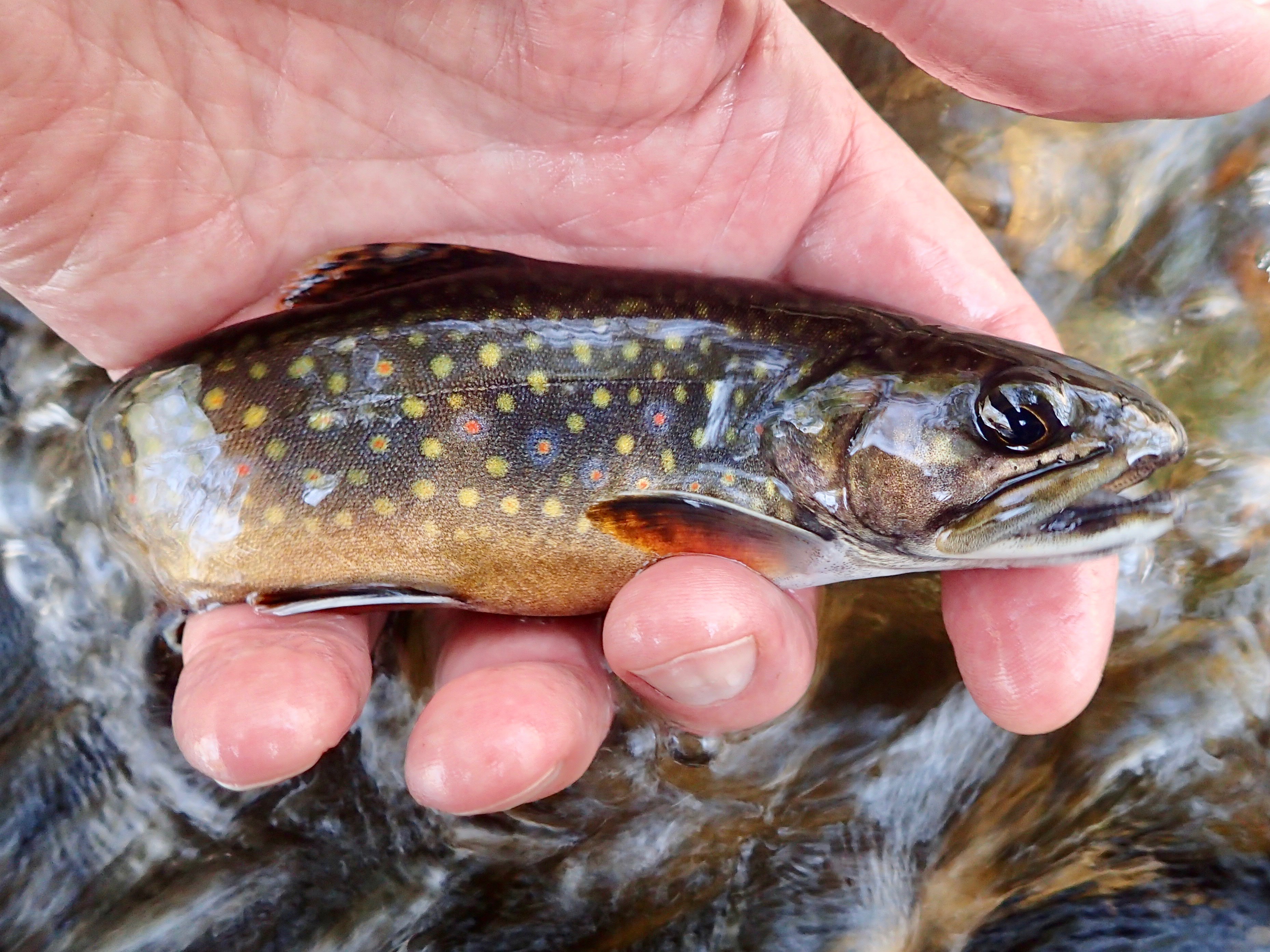
I don’t know how many wild brookies I landed on this day, but I do know that this was the only one I photographed. 1-2-3-lift-shoot, then back into the water. Less isn’t always more, but it usually is when it comes to small streams and wild trout.
If you love and value wild fish — especially native fish — you have a responsibility to preserve and protect the resource. Yes, fishing is a blood sport. Yes, no matter how careful we are, some of what we catch may perish. But there are ways to dramatically minimize loss. And there are certainly ways to ensure the next angler has the opportunity to enjoy the stream as much as you.
So, I’m declaring this “Wild Trout/Small Stream Week” on currentseams.com. As you know, small stream fishing is an experience that is sacred to me. My goal this week is to educate and inform as much as possible. And this wonderful essay by a Pennsylvania angler named “Fly Tier Mike” is a good place to start. In The Responsibilites of Chasing Wild Trout, Mike outlines four best practices for those who fish for wild trout on small streams: Proper wading techniques (staying off of redds); proper fish handling; minimizing damage while taking photos/videos; and the pitfalls of social media that can lead to over-pressuring a stream.
Anyone who fishes for wild trout should read it, if only as a refresher. Thanks for your consideration.
I was gratified and encouraged to see someone else taking a stand for small streams and wild trout. Way to go, Mike!
In case you don’t know, here’s a micro-brief recap: since last summer, the MDC has, for whatever reason, been releasing only the minimum amount of cfs required by law from the Hogback dam. This has resulted in, at times, unnecessary ultra-low flows, transforming the Farmington River from a lush aquatic playground into a pathetic rock garden, and certainly damaging fish and wildlife populations. To my knowledge, no one knows what the MDC’s end game is.
Right now, a group of state senators is crafting legislation that seeks greater transparency from the MDC, albeit in the form of such things as an ethics code and approval on water rates. This doesn’t really help anglers; however, the Connecticut League of Conservation Voters and the Rivers Alliance of Connecticut are also involved. I plan to reach out to those groups and to the biartisan state senator group to voice my concerns. I’ll let you know what, if anything, I find out.
I do know there is going to be a specific forum in the future for concerned parties to express their concerns about the unconscionable way the MDC is treating the river. When I get data’s on that public comment event, you can be sure I’ll post more about it here.
Man, I really need to get out and fish.
The river should look like this. You know, where you can’t see the bottom half of those boulders…
Today is potpourri post day. To start, other paying work has been getting in the way of posting here — and it’s been getting in the way of fishing. That’s just fundamentally wrong, man. Remedies are being planned and schemed as you read this.
So let’s start with fishing. The Farmington River flows are just about perfect at about 300cfs in the PTMA. Two sections of the river were stocked this week, so there’s a whole crew of newbies in the system. My spies tell me that the more experienced anglers are getting into some nice wild and holdover fish, mostly with nymphs. This can be a tough time of year to fish, but with all this warm weather it could be a better than average March.
The book project continues to chug along. I’m talking to a publisher, and am working on some sample chapters for their review. You can be sure I’ll give you updates as they happen.
While my show season is over, I’m still out and about presenting. My next gig is next Wednesday at TU225 in Rhode Island. The topic is the Farmington River.
I’ve also got an upcoming article for Surfcasters Journal on fishing two-handed rods in the salt.
I hope all is well with you, and that you’re getting a chance to fish.
Class was in session last night on the historic Yale University campus. Only instead of pencils and books, there were vises and hooks. And pizza. What would a little Monday night fly tying be without pizza? Anyway, I did two tying sessions with the members of the Yale Fishing Club. We started each one with an abbreviated version of my seminar, “Wet Flies 101.” And then, we hit the vises and tied a simple soft hackle in the traditional North Country Spider format. Some of the members had only rudimentary tying skills, but we made it a no-fail, no-worry zone, and I think everyone had a swell time. I know the instructor did!
The first session was SRO. I’d like to the thank the Yale Fishing Club again for being so enthusiastic and welcoming. Special thanks to their advisor, my friend Sean Callinan, for the invite. This is my second time presenting to the YFC, and I’m already looking forward to the next one.
I get “When are you going to write a book?” all the time. Trust me, it’s something I’ve asked myself just about every week for the last however many years. It’s not a question to be taken lightly, given the commitment, time suck, and high standards I’d be setting for the finished product. But I’m pleased to say that I am officially getting started.
While I’m not ready to go into specifics, I can tell you that I have decided on a subject. It will be freshwater oriented, and it will be a fly pattern book. Right now I’m in the research and development phase. After that, an outline, a few sample chapters, and the details of publishing. I’m going to do my best to devote a substantial amount of my time for the rest of this month to the project, so that may mean only a couple posts per week on currentseams.
It’s all very exciting, and of course I’ll give you updates with milestones as they happen. Thank you everyone for your continued readership and support!
Here’s another clue for you all…the walrus was not the Pale Watery Wingless variant, AKA the Magic Fly. I apologize for all the mystery. Once I get a bit more organized, I’ll tell you more.
I know from procrastination. I’m a professional writer. I’ve been procrastinating since my days at Roosevelt Junior High. I advanced my grasp of the art form in college. And perfected it as an adult.
But I’ve got nothing on the ASMFC’s Striped Bass Management Board.
My best attempt at situation distillation is this: the Board was meeting on the issue of allowing the transfer of commercial quotas between states. They put the issue out for public comment last year. Of the thousands of conscientious stakeholders who responded, a whopping 98% voted in favor of NOT allowing transfers. So the board decided to…(Don’t bother with a drum roll. You probably know where this is going.) …kick the can down the road. Do further studies on the impact of commercial transfers, then come back to the issue in May. Not necessarily awful. But they didn’t even mention the option that the vast majority of stakeholders favored. It’s as if we didn’t exist. Tone deaf, bad form, and so characteristic of a badly broken committtee.
There are two more detailed analyses that I encourage everyone to read. The first is from Charles Witek’s blog One Angler’s Voyage: The Fastest They’ve Ever Done Nothing. The second is from our friends at the American Saltwater Guides Association, Striped Bass Recap From ASMFC Hearing. Both are highly worthy of your time.
At this point it would be easy for all of us to throw up our hands in frustration and quit. I exhort you to not do it. In fact, this should only steel our resolve. Some day, and that day is coming, we are going to win. And so will the stripers.
Waves pounding on the shore. That’s what we need to be.
The best little fly fishing show in New England made its triumphant return last Saturday, and I was proud to be a part of it. Long held at Maneely’s in South Windsor, the CFFA shifted the Expo this year to Nomads. What the new venue lacks in coziness is made up for in space and a large casting area. It was gratifying to see so many familiar faces — even if I am terrible at remembering everyone’s name (a never-ending source of embarrassment for me). Thanks to everyone for your patience!
As usual with the CFFA Show, I had a space on Tyer’s Row. You generally don’t get the chance to do much tying — it’s mostly meeting and greeting and talking — but when I did get to work, I was focusing on soft hackles. (I’m tying a Hendrickson spider here, and you can see a cork of Squirrel & Gingers in front of the vise.) If you stopped by, thanks for taking the time. If you watched me tie, I hope it was useful. Many thanks to Phil Sheffield for taking this shot.I took this shot around 11am with the show in full swing. What a great turnout! This angler does not live by tying alone, so I took a break and walked the floor. My purpose was twofold: meet and greet, and to do some shopping. I scored a couple patches of deer hair and some slotted tungsten beads from Nick Masi, and then two Whiting/Hebert Miner wet fly hen capes for just 10 bucks each. These capes were only bronze grade, but still, that’s a darn good deal.I finished up with my 12:45 presentation, Fly Fishing CT’s Small Streams. How gratifying to not only fill every seat, but also have an SRO audience. This ends my show schedule for the season, but I’m still doing talks at clubs around the northeast. You can see me at TU225 in Rhode Island later this month.
What a fantastic Fly Fishing Show in Edison! I was there for two whirlwind days, stretching the space-time continuum and pushing the fun barrier to its limits. Many, many thanks to everyone who came to a seminar, took a class, watched me tie, or simply stopped to say hello. My apologies if I had to rush off mid-conversation — my schedule was literally back-to-back on both days. If I didn’t get to answer a question or talk fly fishing, you know where to find me.
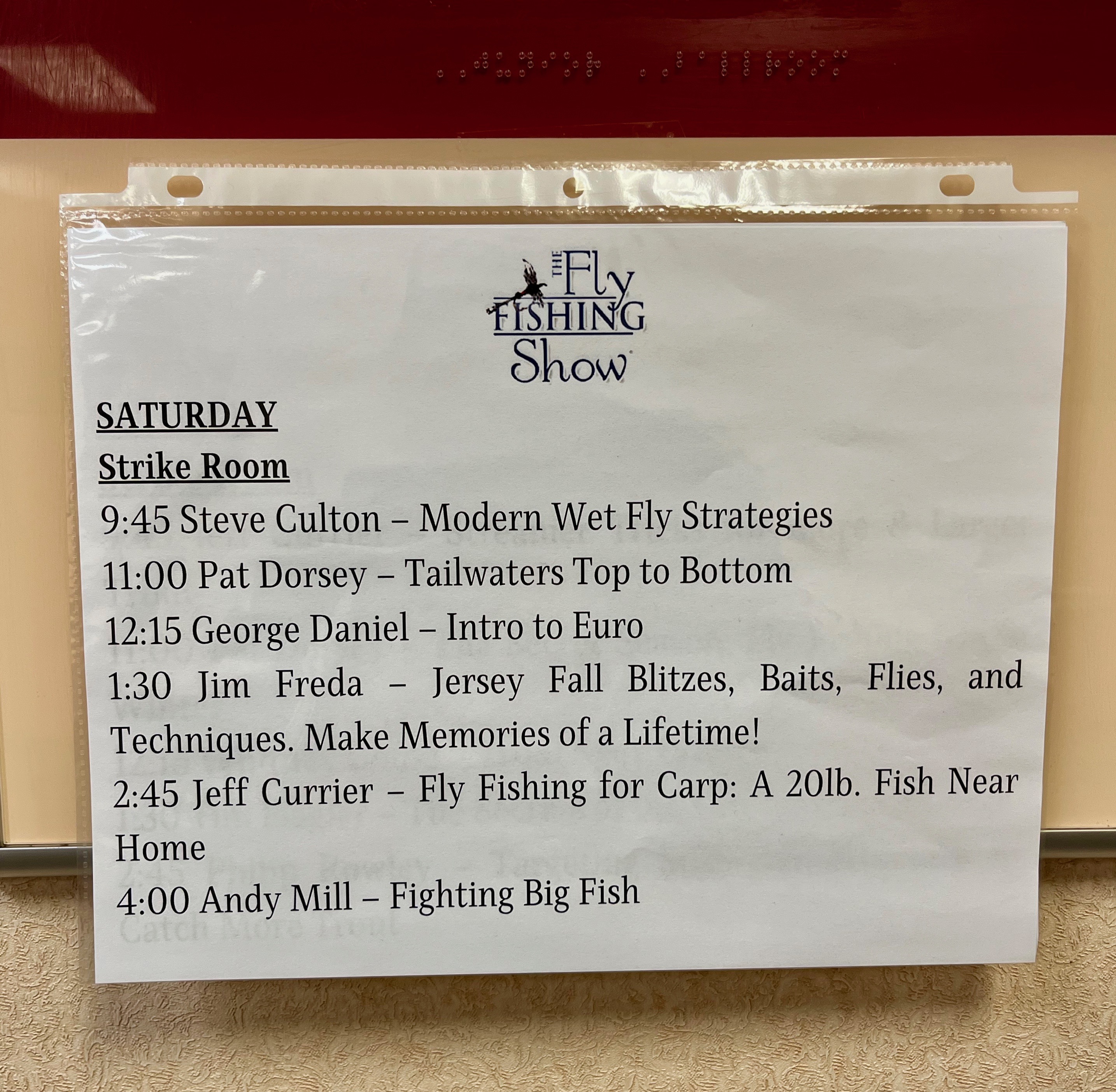
One of the things I look forward to most is reconnecting with old and new friends. So the first thing I did Friday morning was head straight for the Blue Quill Angler booth to hang out with Chris Steinbeck and Pat Dorsey. I’ve only known Pat for a year, and Chris for even less, but I can tell you these are two people who make the fly fishing world a better place. Chris was my guide in Colorado in August and he taught me a lot. Highly recommended if you’re ever fishing the South Platte.Walking Tyers’ Row is always a good use of your time. I can’t tell you the number of patterns or techniques that I see every show that I want to try. Like Celebrities, all the tyers are very approachable and ready to discuss tying and fishing. This is Chester Rosocha, my tying tablemate from the International Fly Tying Symposium back in November.Not a bad lineup! What an honor to be on the same list as these luminaries. Friday was the “easier” of my two days — a seminar, then a Destination Theater talk, then a class. I had a good crowd for the seminar, Finding Small Stream Nirvana, and we had a long follow-up discussion. The DT talk, Wet Flies 101, was also well-attended. I’ve hopefully created some more dangerous wet fly machines. Saturday I was literally running from one place to the next. I got so caught up in the Modern Wet Fly Strategies Q&A session that I forgot I had to be in the DT in five minutes. I was thrilled to have such a large crowd watch me as Featured Fly Tier, and even more thrilled that every hackle I selected for my wet flies and spiders behaved. A shout out and thanks you to everyone who saw me speak, and to those who took my classes. I hope you hit the water this year ready to try some new ideas and new flies.It’s hard to make out that guy on the left, but yes, it’s me, doing what I love most — helping people become better anglers.This is from Modern Wet Fly Strategies. See you at the CFFA Show this Saturday!




 currentseams.com