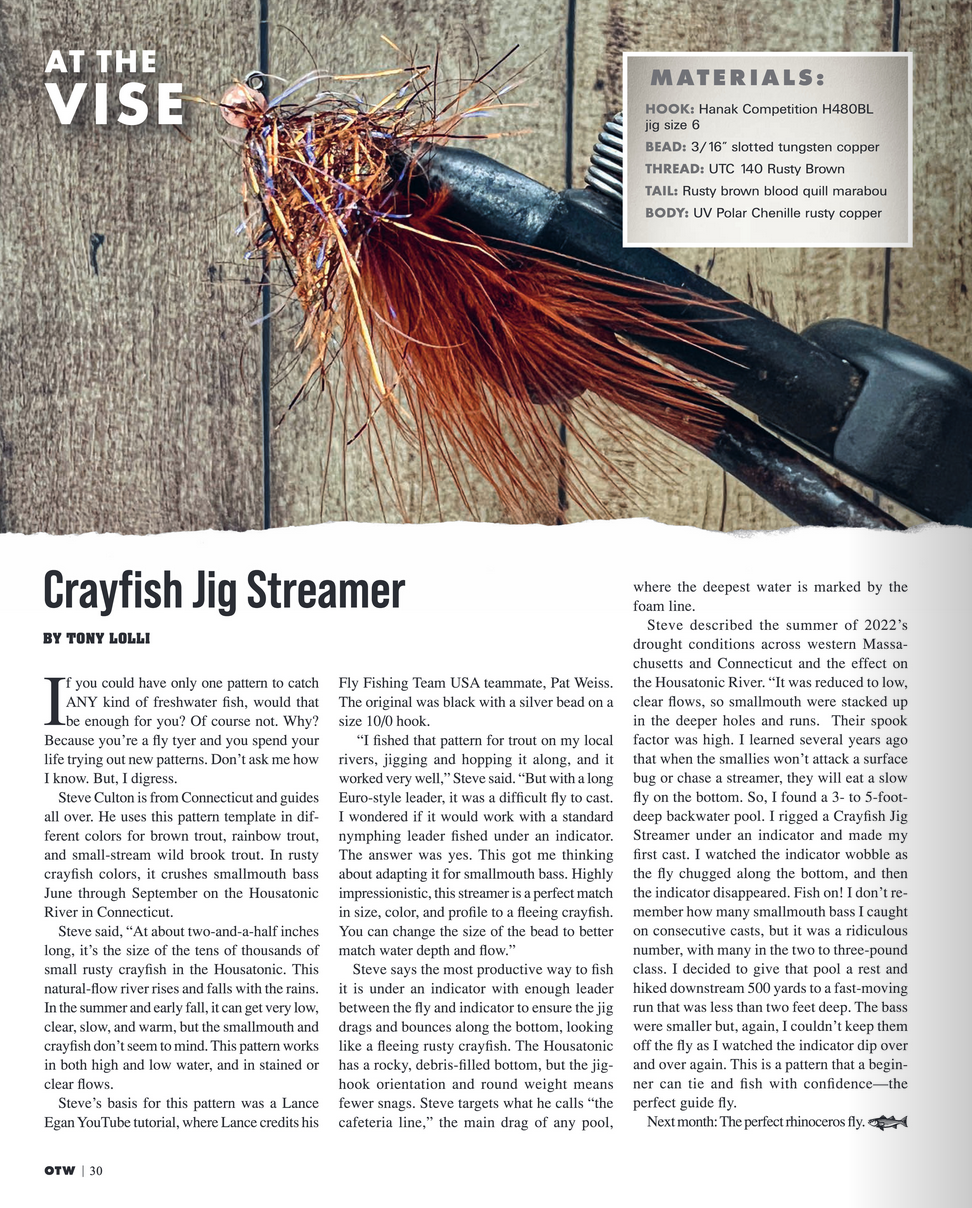
The Crayfish Jig Streamer is another impressionistic pattern that imitates a small rusty crayfish. It’s currently featured in On The Water magazine‘s “Guide Flies” column, written by Tony Lolli. (Thanks again, Tony, for letting me play!) Now, let’s get this out of the way: this pattern is not some genius inspiration from the mind of yours truly. It’s based on a template I first saw in a Lance Egan YouTube video, and Lance said he got the idea from Pat Weiss. I just adapted it for a very specific smallmouth situation. It’s a classic guide fly — ridiculously simple to tie, and a consistent producer. Fish it in low summer water under an indicator, dragging along the bottom bumpety-bump. And be ready to set the hook!
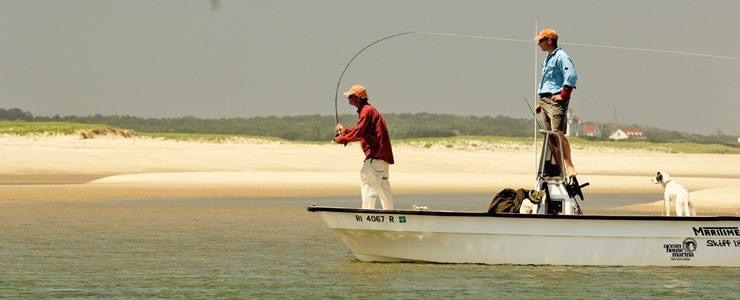
I recently came across this wonderful photo of Ken Abrames taken by fly fishing shooters extraordinaire Barry and Cathy Beck. It was posted by Tom Keer on one of his social media feeds. I don’t know where the shot was taken, but it’s a great look at an extraordinary fly caster. I remember seeing Ken in a parking lot in Watch Hill with my Salmo Sax #3 and a Rio Outbound long head 9-weight line. He held the rod in his right hand; his left hand was stuffed into the front pocket of his khakis. One false cast…waaay back….then one smooth, yet powerful stroke forward, and out went the entire length of line. (That’s 100 feet for those of you keeping score at home.) There are those who will tell you that the double haul — or as Ken liked to call it, “high line speed gymnastics” — is essential to being able to fly fish in saltwater. They never saw Ken cast. I’ve still never double hauled in my life — thanks to Ken.
Photo courtesy of Tom Keer and taken by Barry and Cathy Beck.
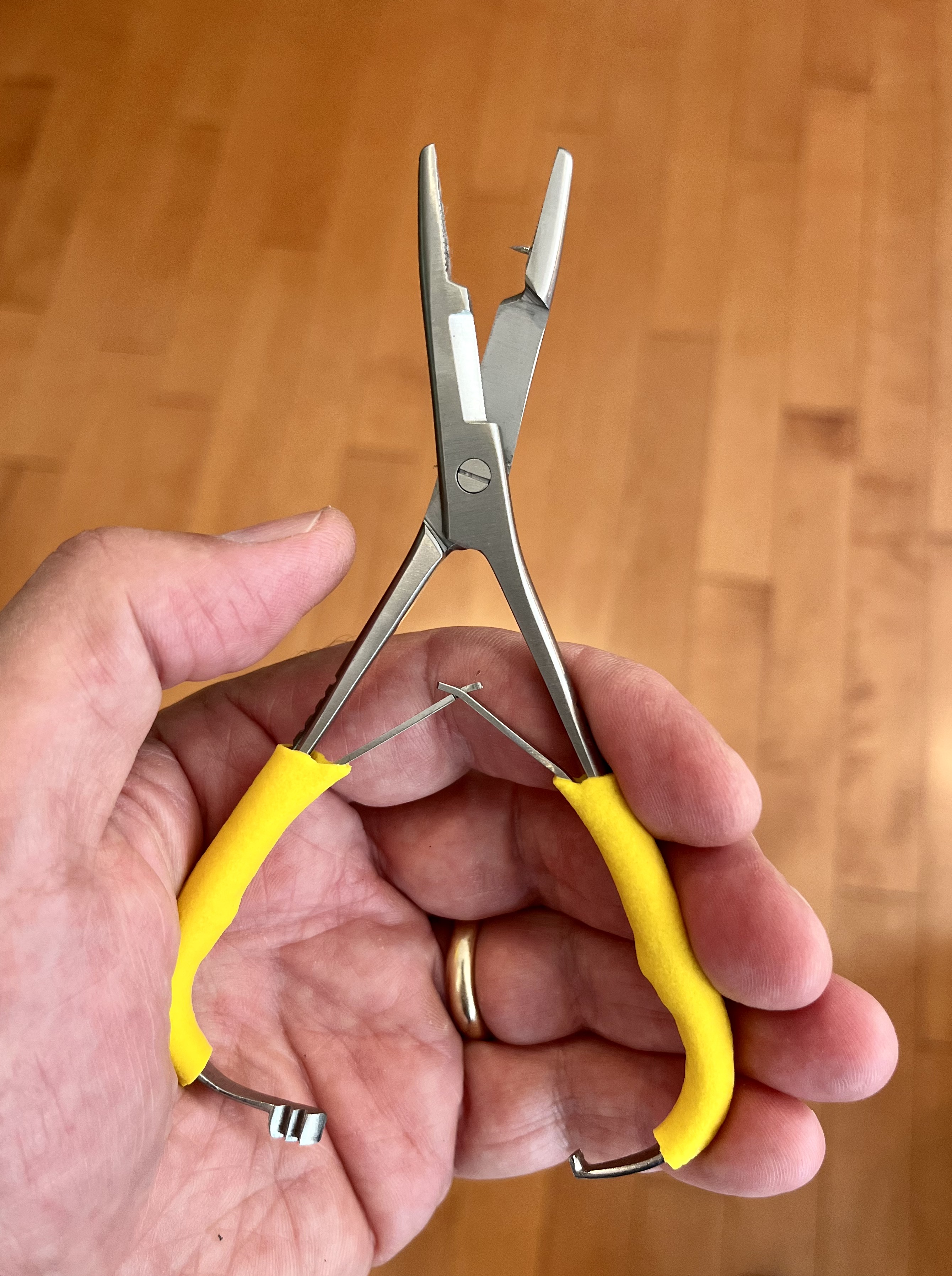
The best fly fishing clamps are the ones that you use without having to fret about the product design or the procedure you’re about to perform. Like the Loon Outdoors Classic Mitten Scissor Clamps.
For years, I carried a hemostat. For years, I was frustrated and bothered by their unidextrous design. I’m a lefty, the hemos were righty, and if you’ve ever suffered through an elementary school art class as a southpaw who was forced to use right-handed scissors, you feel my pain. As a remedy, I carried small needle nose pliers. Those worked, but if they’re buried in a pocket, they’re not handy when you need them — if you’ll pardon the expression — in a pinch.
Enter the Loon Outdoors Classic Mitten Scissor Clamps. They fit neatly in the palm of your hand, and they work whether you’re a lefty or a righty. They work in the gloveless dog days of summer, and in the mitten-encased dead of winter. They lock with a snap — hear them click! — onto a tab or loop on your vest or pack, and they’re not coming off unless you want them to. Best of all, they seamlessly meld form and function, so you’re not thinking, “Here we go again,” when you grab for them. Bravo, Loon Outdoors!
The Loon Outdoors Classic Mitten Scissor Clamps are 6″ long, and are constructed of surgical quality stainless steel. They feature a half smooth/half serrated jaw; hook eye-clearing needle; comfy grip with just the right amount of tack; and locking handles. I own several. Best 23 bucks you’ll ever spend.
It’s a warm, humid Block Island night, the kind you get in early summer when the mainland is baking. Dark of the moon. Surf on the low side of moderate, but enough to create a wash zone and necessitate mends over the tops of incoming waves. I’ve scoured the trough of this beach for over an hour with a Big Eelie, and made the decision that it’s not happening. I glance at my watch. 11:25pm. Normally, I’d be all fired up, knowing that if there are no bass here, they’ll be somewhere else, and — best of all — I have another two hours to fish. Maybe three, if the bite is good. But I’m about to do something extraordinary. I catch the fly in the hook holder, reel up, and head back to the Jeep. I’m done. Heading back to the cottage.
What’s extraordinary about this is that in all my decades of fishing Block Island, I’ve never quit a night session before midnight.
This makes three consecutive years of disappointing fishing from the shore on Block Island, and this was the worst by far. The story is one I could tell you in numbers: Seven nights. Five striped bass. Four skunks (six if you count my two daytime sight fishing blanks). No fish over 22″. And the third straight year I’ve failed to land a bass of 10 pounds of better.
What’s behind all this? I can give you my best guesses. A burgeoning grey seal population. Warming inshore waters. Bass that never showed up inshore in numbers in June, so why would they show up now? An abundance of food and cooler water offshore. Dwindling striper stocks. I can tell tell you with fierce conviction that the patterns from ten years ago are a distant, bittersweet memory. Fish are aren’t where they were a decade ago (and don’t get me started on 15-20 years ago). It’s enough to make me heave a rueful sigh.
It’s not for lack of bait. Crabs everywhere. More sand eels than I’ve seen in recent summers, although they were much smaller (1″-2″) than usual. Squid galore. In fact, four nights into the trip, I’d landed as many squid as bass. To amuse myself, I turned on my light and watched the squid attack my sand eel fly. Squid generally muddle along, but their closing speed is impressive. And the bite is not. I sight fished two days on Crescent Beach and blanked on both. The first day I only saw a total of six cruising targets, and some of those may have been the same fish. The second day, in 90 minutes, I didn’t see a single bass(!). Really? Then there was plain old bad luck. I had confirmed reports of smaller bass blitzing sand eels at dusk on two consecutive nights. The first night, I’d gotten a late start, and I caught the last remaining bass of that feed. The next night, I missed it entirely. Not to be denied, I showed up at the mark the third night ready to fish at 8:30pm. Same tide window, same wind direction, same barometer, and…nothing. No bass, no blitz. You really can’t make this garbage up.A rocky point, structure, and wash over a sandy bottom holding bait. Scouting mission complete, I headed back after dark to fish the same tide. 15 years ago, I’d be posting pictures of one of the 20-pounders I released. This year, you get a nice seascape. That’s all there is to see here, folks.Mr. Dour out for an evening stroll. By the end of the week, I was rationalizing my existence by viewing my time as enjoying a good cigar, and oh, by the way, I’ll also be doing this casting and mending thing, too. Mid-week, there was a Steve Culton sighting. An angler was coming out as I was going in, and exclaimed, “I know you! You’re the Block Island fly fishing guy. Steve.” Turns out he’d never fished the Island before, and came across some of the articles I’d written while doing a search. As always, if you see me out and about, please come say hello. I highly recommend ‘Gansett tall boys, fresh steamers, and Ballard’s famous lobster as a consolation prize. And don’t forget Aldo’s ice cream!
Happy Monday. This morning, Hogback dam is still pumping out nearly 1.2K. According to Torrey Collins, 50cfs is coming from the bottom and the bulk from the over-the-top-spillway. The upshot is a lot of water leaving the reservoir, and not much of it cold. If you choose to fish, please be vigilant about water temperature — and of course, be careful!
As far as the flows getting back to normal: this water dump will continue until the reservoir reaches a level deemed safe by the Army Corps of Engineers. Meanwhile, the CT DPH has ruled that the MDC can be released from their drinking water obligation. This is encouraging as it means the MDC gets their way, and should no longer have a reason to be a dick about releasing a minimal amount of water. But “should” doesn’t mean “can,” or even “will.” Once the ACE determines the reservoir as at a proper level, we’ll see what the MDC does with the bottom release flows. For now, I like that the MDC is releasing only a minimal amount from the bottom, as this will help with restratification. Stay tuned on this one.
So, how about some confirmed good news? The MDC has agreed to a conservation easement that will assure 5,500 acres of land around the watershed will remain undeveloped. You can read more about that here and here.
I know, I know, it’s July. It’s hot and the sun is shining and even though your favorite river may be blown out, we’re all still thinking about — if not actually doing — fly fishing. Since it’s never too early to plan, mark your calendars for the 2024 Fly Fishing Show in Marlborough and Edison. Note the new time frame for Marlborough — it’s earlier in the month than usual. I don’t have a schedule yet, but assume I’ll be doing talks and classes and demos as usual. I’ll likely be in Marlborough all three days and in Edison Friday & Saturday. Hope to see you there!
I feel like my current fishing world can be best summed up by Ray Davies, who wrote, “The news was so bad that I fell out of bed.”
The fishing on Block was soul-crushingly bad. This is the third straight down year, and I felt lucky to have landed five stripers in seven nights. (Yes, you read that correctly.) Four skunks in the mix. (Really?) My biggest fish was 22″, bringing my streak of not landing a keeper or better to three years. How far that shore fishery has fallen!
Back on the home front, Mother Nature and the MDC are wreaking havoc upon the Farmington River. A couple days from now is my traditional date to go fish the dorothea at a favorite mark, but that’s obviously not going to happen. To add insult to injury, I’ve had to cancel both wet fly lessons scheduled for this week.
Normally, I’d console myself by heading to the Housatonic, but that river is also experiencing catastrophic water levels. No smallmouth for you! And no smallmouth for me, either. The white fly hatch will come and go, and none of us will be able to enjoy fishing it. Maybe the Hous will come down to a dry/wet fly fishable level in 2-3 weeks. That’s assuming we don’t get pounded by rain…again. This is now four consecutive alternating years of flood, then drought. It’s the new normal, and it sucks for all of us. What’s worse, it can’t be good for the ecosystem. Would a happy medium be too much to ask? Perhaps the silver lining will be more trout holding over to this fall. We shall see.
Bloody hell! 5,500cfs is a long way from being even remotely fishable.
Finally, good reader, I must apologize for all this doom and gloom. I try to be a positive force, but I also feel compelled to tell it like it is. I suppose I could use this time to prep my fall striper box, or my winter nymph box, or even get a head start on some steelhead flies. Maybe some bluegills down at the pond on Elk Hair Caddis and a six-foot glass rod would cheer me up? Now there’s a thought…
It’s been a few years since I first published the Steve Culton’s Drowned Ant tying video, and with so many new subscribers — particularly those of you who have a keen interest in wet flies — this seemed like a good time to revisit the pattern. I like this as my middle dropper on summer team of three wets. To the vise!
Once again, I’ll be appearing as a celebrity tier at the 32nd International Fly Tying Symposium. That means in addition to having a tying table on the main floor, I’ll potentially be leading classes, teaching seminars, and appearing as a featured tier. I don’t have any details yet, other than to tell you that my contract is signed and in the mail. Once I find out more, I’ll let you know here.
Here’s what I do know: the IFTS is at the Doubletree by Hilton Somerset Hotel and Conference Center. The dates are Saturday, November 11 and Sunday, November 12, 2023. Last year’s show was a blast; you get vendors, tiers, and the chance to see some of the most talented people in fly tying do their thing. Classes are $80; seminars are included in the price of your ticket. Pen those dates in your calendar now!
Last week I mentioned that I was testing a “new” Isonychia wet fly. (I placed the word in parentheses, because so much of modern fly tying is derivative, riffing off countless other patterns that came before. Not that that’s a bad thing! Rock ‘n’ rollers and jazz hepcats have been doing the same for decades.) Of course, I didn’t expect that mention to go unnoticed; in fact, I received multiple requests for more details.
But to quote Don Vito Corleone, my answer is no…and I will give you my reasons.
For me, a new fly pattern is a multi-faceted process. I start with the creative spark, and determining the need for a new pattern. That need can be as simple as, “I want my own fly,” or that I just don’t like what others have done before me. Then, I go the vise and build prototypes. Next comes testing. I may refine the fly and make small or large changes, depending on the pattern. The most important part is the conclusion. Does this fly work? Do I enjoy fishing it? And most of all, do the fish eat it?
All of this can take weeks, and usually months or years.
So, my apologies. No new Isonychia pattern for you…yet. I can share with you that so far it looks like a winner. Once it gets the seal of approval, you’ll all be the first to know. Not to drive anyone further bonkers, but I’ve also got a LaFontaine-inspired version of the Squirrel and Ginger in the works, and the early results are also very favorable. Plus that Henry’s Fork cripple (not a new pattern, and not mine, but worthy of inclusion in your box). It’s a crazy few weeks so I beg your pardon and ask for patience. Remember the sage words of Hannibal to Clarice…






 currentseams.com