The Sports Illustrated Book of Wet-Fly Fishing came in the mail last week. I’ve wanted to track down a copy for years, and finally got round to it. It’s written by Leisenring’s disciple Vern Hidy, and it lists tying instructions for three patterns, one of which is Leisenring’s Spider.
They (very literally) don’t make ’em like this anymore. A little dog-eared but just as relevant today as it was in 1961.
~
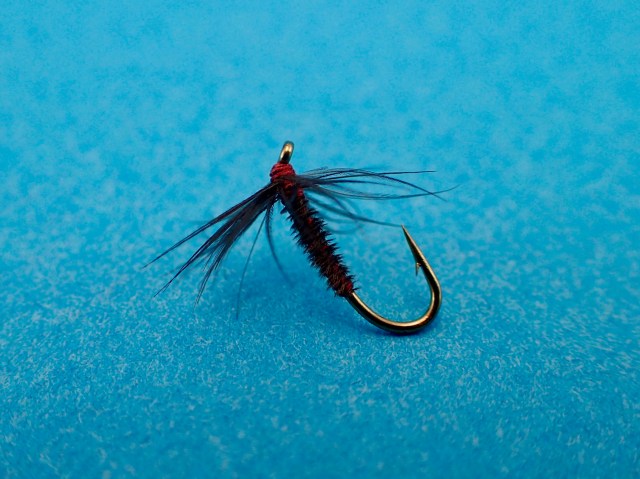
You don’t hear much about Leisenring’s Spider today. (I first encountered it in a Wingless Wets piece written by Mark Libertone almost 15 years ago.) It’s not listed in his book, which is strange considering it’s got fish magnet written all over it. Leisenring used his version of a dubbing loop to form the body, and I suspect buggier and nastier is better than perfect. A so-simple soft-hackle to help you clean up during the next caddis hatch. Hang on!
The Leisenring Spider
~
Hook: Wet or dry fly 12-16 (this is a Partridge SUD2)
Happy Sunday. Hope everyone is enjoying the warmer weather. I am not, as I am STILL under the weather. I’ve got the cold that my doctor tells me is “lasting for up to month.” I’m now on week 3. Happy-happy-fun-joy, and I haven’t been fishing since early January. Bleah.
Capt. Hank Hewitt of Block Island Fishworks says, “Steve’s cold sucks THIS much!”
So, here’s a good, short read from our good friends at the American Saltwater Guides Association. This group continues to fight the good fight, and is being relentless even in the face of disappointing news. Please consider showing your support for their efforts with a donation. You can effort that on their website.
~
Many of you noticed my recent post on Stewart’s Black Spider. I’m hoping to cover his Red and Dun spiders next. Then, some more of Leisenring’s flies. Last winter I did a highly popular series of posts on Leisenring’s Favorite Dozen wet flies. Now I want to take a closer look at patterns he describes as nymphs.
Baron von Black Gnatgenstein.
~
Speaking of wet flies, stay tuned this week for special offer/event on a wet fly tying and fishing class I’ll be leading in March! In the meantime, I hope somebody’s fishing…
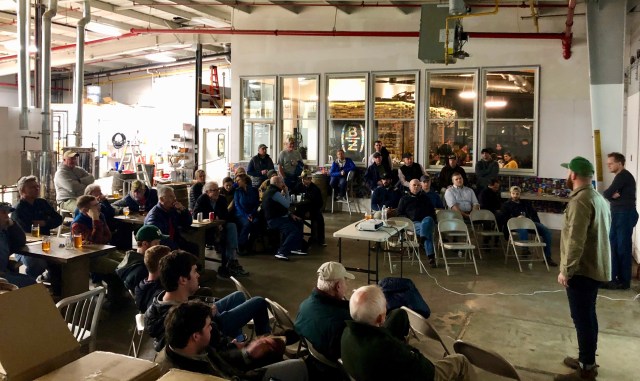
A hale and hearty shout out to the South Shore Fly Casters, who most graciously asked me to speak at their February meeting. The topic was “Trout Fishing for Striped Bass,” which focuses on traditional flies and presentation methods you can use to catch the stripers that everyone can’t. Let’s start with the venue. Any club that holds their meetings at a craft brewery gets bonus pints — er, points — from me. The turnout was strong (almost 50) and it was very passionate, interested group. I appreciated your welcoming nature and for all the kind things you had to say about me and my writing (and the SSFC club swag). Hoping to come back soon!
A very cool space for a meeting. In case you’re wondering, it’s Barrel House Z in Weymouth. That’s my double IPA near the projector. Yummy. (Photo Dan Wells.)
~
Three Q&A highlights: Q: What knot do you use to build your three-fly team? A: Triple surgeons. But you should use the knot with which you are most comfortable (a lot of people like the blood knot). I also mentioned that I never go below 20# mono for the rig, and that if bass over 15lbs are in the mix, I’ll typically fish only one fly.
Q: Do you ever tie droppers off the bend of the leading hook? A: Never for striper fishing. I don’t want anything getting in the way of a hookup, but most of all I want the dropper fly to able to swim freely on its own tag.
Q: How do you use a floating line to present an unweighted fly deep? A: I’ll either add a 3/0 shot (or two) to the leader (and I may also lengthen the leader from, say, 7 feet to 10 feet), but most often I’ll use of the following: 1) homemade T-11 sink tips (I carry a bunch from 2-8 feet long in 2-foot increments; or 2) I’ll use an integrated sink-tip line that has a floating running line. Of course, with either of these solutions, you must mend if there is current to help the fly sink. I’ll also shorten the leader to 3 feet.
Tomorrow, February 19, I’ll be presenting “Trout Fishing For Striped Bass — How to catch the stripers that everyone can’t” to the South Shore Fly Casters. SSFC is a newly formed group, and they’ve done a terrific job of getting their club up and running in a short amount of time. The gig is from 6pm-9pm at Barrel House Z, Weymouth, MA. Come on down…or up…or across…and you might win this spiffy little collection in their raffle. As always, please come say hello!
When the stripers are keyed on small stuff, it’s hard to go wrong with a well presented team of three. Four options here, clockwise from top: Deer Hair Grass Shrimp, Micro Shrimp Gurgler, Orange Ruthless Clamworm, Eelie. Good luck!
It’s easy to see why New Jersey is nicknamed “the Garden State:” It’s from all the bullshit.
The manure was flying even before Thursday night’s “public” comment (say the P-word with your tongue planted firmly in cheek) session for the New Jersey Marine Fisheries Council.
Tony Friedrich of the American Saltwater Guides Association wrote a scathing summary that outlines the (Corrupt? Rigged? Incompetent? All of the above?) outrageous behavior of the Council. You can read it here.
Fish are considered stupid because they have small brains. However, all stupidity is not limited to small-brained creatures.
W.C. Stewart was a Scottish lawyer and soft hackle aficionado. In 1857 he published the highly popular fly fishing book The Practical Angler. Though long out of print, you can easily find an archival copy online, or even a dog-eared used volume.
Today, Stewart is most remembered for his three spiders. These sparse, impressionistic soft-hackles wouldn’t get a second look in the modern fly shop’s bins. That these patterns would wantonly be ignored is, of course, a huge mistake. Let’s see if we can remedy that.
In a recent column, George Will referenced a line from an Alan Bennett play: “Standards are always out of date — that’s why we call them standards.” Don’t be dismayed by the absence of tungsten beads or UV mega-super-duper-sparkle flash. This pattern has been fooling trout for centuries. And the fish aren’t getting any smarter. Three cheers for James Baillie!
W.C. Stewart’s Black Spider
Hook: 14-15 (from Leisenring). I used a Partridge SUD2 #14.
Silk: Brown
Hackle: Cock starling
Body: Working silk
~
Tying Notes: This pattern is widely interpreted, as evidenced by an image search. The good news is that the design is so simple, it’s probably hard to tie one “wrong.” Let’s start here: I’ve always found it curious that a pattern titled “Black Spider” doesn’t contain anything purely black; I suppose “Dark Spider” doesn’t have the same swagger. The silk body should cover only the front half of the shank. Select a purplish-black hackle from a starling skin, fibers about as long as the shank. To make a more durable fly, Stewart suggested twisting the hackle around a silk tag before winding. Here’s how I did that: Start the silk at the head, winding rearward. Leave a 3″ tag about 3/4 of the way down the body. Continue winding the working silk. At the halfway point of the shank, proceed back toward the head. When you get to the silk tag, tie in the feather at its tip, and continue winding your working silk toward the head. Now, twist the feather around the silk tag, taking care not to break the spine (starling is fragile!). Wrap the feather toward the head, 3-4 turns, preening the fibers so they don’t get covered (a bodkin or needle may help). Tie down the feather and whip finish.
~
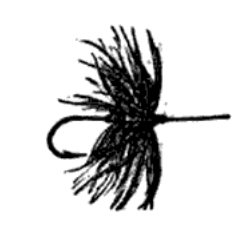
James Leisenring was a big fan of the style, writing, “I have found W.C.Stewart’s spiders to be a deadly combination on every stream I have ever fished.” Many iterations have the hackle wound along the length of the shaft, producing a hyper-sparse look, but as you can see from this drawing from The Practical Angler, the hackle is condensed and confined to the front half of the fly.
Now available to your club or group! The long-awaited follow-up to Wet Flies 101, Wet Flies 2.0 takes a deeper dive into wet flies and wet fly fishing. Starting with the essential wet fly tackle and toolbox, Wet Flies 2.0 explores topics like matching hatches with wet flies (from caddis to mayflies to midges to stoneflies to terrestrials); searching tactics with wet flies; presentation and rigging options to match conditions and situations; fishing wet flies as nymphs or dry flies; wet flies on small streams; and much more. You can find my full presentation menu here.
By learning the mystical arts of the wet fly, you may, as Leisenring said, “soon acquire the reputation of a fish hog!”
If you don’t know who Charles Witek is, don’t feel bad. (I didn’t know who he was before last year.) So. Charles Witek is a very good friend of striped bass. He’s articulate, knowledgeable, and — well, heck, you can find all that out for yourself when you read his excellent essay, “But…Aren’t Those The ASMFC’s Most Important Jobs?”
It it, Witek takes a quick look at a recent survey of ASMFC commissioners. As Charles says, it turns out that the commissioners, “think that the Commission is least successful in managing rebuilt stocks, ending overfishing, and having commissioners cooperate with one another to manage fisheries. But aren’t those three things the whole point?”
Captain John McMurray (NY), to whom I gave high marks as I listened to the chaos of the webinar, has put together a wonderful synopsis of Tuesday’s meeting. John had the advantage (or as some wags might suggest, disadvantage) of being there, witnessing, and participating in the entire process. This is a must-read, folks. You can find it here.
In the meantime, if you fish for stripers in Rhode Island, please send an email to RI commissioner Jason McNamee asking to reconsider voting in favor of the 28″-35″ slot limit. Ask for your comment to be entered into the public record. They’re meeting on it this Monday! I’d like to see a roll call of everyone who sends an email in the comments section.
It wasn’t as bad as I’d feared. It wasn’t as good as I’d hoped. Welcome to the wonderful world of the Atlantic States Marine Fisheries Commission winter meetings. Yesterday’s focus was on discussing and formalizing each state’s Conservation Equivalency proposals. Almost 24 hours later, here are three big takeaways.
Settle in for a cup of tea. This might take a while.
The ASMFC is structurally and procedurally bloated. An efficient organization this is not. The webinar was audio only, so it made a helter-skelter meeting like this one even more challenging to follow. At times it was like watching a Bergman film — you try your best to keep up but you’re never really sure what’s going on. And I’m not the only one who saw it that way — the chairman of the meeting described it, and I’ll quote, as “chaotic.” Maybe it’s just as well that the meeting wasn’t video broadcast — surely you could lump the ASMFC Winter 2020 CE decisions along with laws and sausages as things you should never see being made.
~
My reaction to some states’ CE proposals can best be summed up by Otto, who so eloquently stated: “Disappointed!!!” (That includes you, Rhode Island.)
Beware of rogue states within the ASMFC. North Korea, Iran, Syria, Sudan, and…New Jersey? Let’s not forget Maryland, who along with New Jersey have some rather — ahem — creative ideas on how to best conserve and restore our rapidly dwindling stocks of striped bass. Remember in “A Fish Called Wanda,” when Wanda reminds Otto that the central message of Buddhism is not “Every man for himself?” Someone should point out to Maryland and New Jersey that the ASMFC mission is not, “Kill as many striped bass as you can under the cloak of conservation.” Nope, those emperors don’t have new clothes. They’re wearing the same crappy, poorly camouflaged outfits they’ve been sporting for years. Kudos to those who saw through their charades, like…
~
Some ASMFC Commissioners get it. If a state’s CE proposal fails to achieve target results, that state should be held accountable, right? High fives to those commissioners who called out certain CE proposals, effectively telling those states to behave and eat its broccoli. Apologies in advance to those I missed, but here are a few of the people who fought the good fight yesterday: Justin Davis (CT). Capt. John McMurray (NY). Ritchie White (NH). Pat Keliher (ME). Again, these are only a few of the people I could positively identify. A very sincere thank you to all of you who are trying to save our stripers. If you’re reading this, why not take a few minutes to send them an email of thanks and support. You can find that list here.
Is anybody there? Does anybody care? Some commissioners clearly do.Especially those who understand that killing this fish now doesn’t bode well for the future.









 currentseams.com