Coastal Flyrodders awarded the Order of the Burrito with Negra Modelo clusters

Many thanks to the Coastal Flyrodders of Wyckoff, New Jersey for their hospitality last night. The pre-game Mexican dinner was terrific, as were the libations. I presented  The Little Things, and I’m pretty sure we all had a swell time. Not only do the Coastal Flyrodders understand that a fed presenter is a happy presenter — they have also set the questions bar at a new height. I don’t remember ever getting so many good questions, or having such engaging post-presentation discussions. Well done, all!

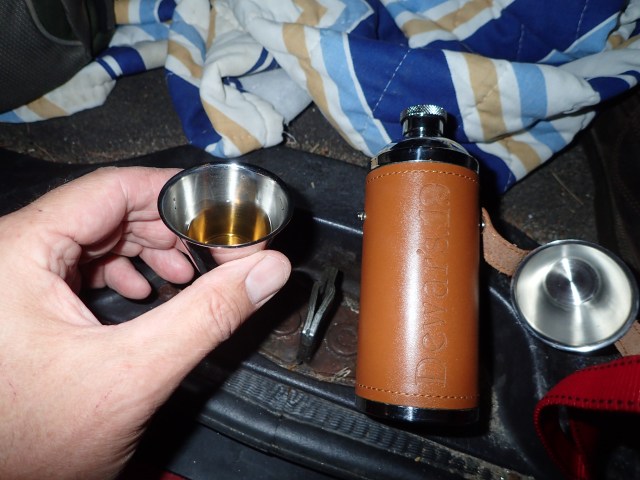
A beer for breakfast after a night of striper fishing doesn’t suck. But it doesn’t beat a beer with dinner.

Block Island All-Nighter Beer

Later this week: The Fly Fishing Show in Marlborough, MA. I will be appearing at the Destination Theater on Friday, January 22 and Saturday, January 23 and presenting “Wet Flies 101.” This is one of my more popular presentations, and as the title suggests, it serves as a wet fly primer. Presentation times are as follows: Friday, January 22, 2:00pm, Destination Theater Room A. Saturday, January 23, 10:00am, Destination Theater Room A. The show takes place at the Royal Plaza Trade Center in Marlborough. For more information, visit http://flyfishingshow.com/marlborough-ma/

Date change: my tying demo at The Compleat Angler in Darien has been moved from March 5 to February 27. It will focus on flatwings, bucktails, and soft hackles for striped bass.

How To Tie And Fish Dropper Rigs For Stripers

“How to Tie and Fish Dropper Rigs for Stripers” first appeared in a 2010 issue of Mid Atlantic Fly Fishing Guide

Not every day is April on the lower Housatonic when the stripers are ready to pounce on your fly with reckless abandon. No, this was an August evening in Rhode Island, and while the bass were open for business, hookups were few and far between.

I was fishing a spot where a rocky bar merged with a shallow sand flat before dropping off into a deep channel. Pop! Tock! Every few minutes, I could hear the distinctive tells of feeding fish, all within casting range. The water was loaded with dense schools of silversides. Peanut bunker were in the mix, and I had even seen clamworms earlier in the week. But what were the stripers feeding on tonight? Within a few minutes, I would have my answer. I cast my dropper rig into a surface seam, and started mending for a greased line swing.

As the flies swam across the current, the water exploded. I set the hook, and soon a fine striped bass was in my hands. With the dropper rig, he had three fly choices: a clamworm, a small bucktail menhaden, and a Ray’s Fly. He chose the menhaden. A few casts later, bap! Another striper on the menhaden. Satisfied, I clipped the other flies off the leader. Once again, droppers had proven to be the fastest way to find out what the fish wanted.

Dropper rigs take a little more effort than store-bought tapered leaders, but they’re easy to tie and the rewards can be great. A dropper rig is a terrific searching tool, giving the bass multiple targets, and letting you present at different depths on a single drift. I’ve always been the curious sort, and I like the surprise a dropper rig provides when I discover which fly fooled the fish. And, as an angler who embraces traditional methods, the dropper rig has proven itself — you’ve heard of a brace of wet flies — over the course of hundreds of years.

The original article had an illustration of a three fly team by Ken Abrames;  I’m replacing it with a detailed rigging diagram. It’s a simple leader — you’re basically making a triple surgeon’s loop and then tying two triple surgeon’s knots.

OLYMPUS DIGITAL CAMERA

Here’s a pdf: Striper Dropper Rig

A basic dropper rig is about seven to eight feet long, with two dropper flies and one fly on point. The flies are spaced 18 to 24 inches apart, and the dropper flies are tied on tags that extend a few inches out from the leader. I use 20, 25, or 30 pound mono to build my dropper rigs. Start with a length of mono a little over four feet long. Tie a loop about the circumference of a baseball at one end; this will be the butt of the leader. I use a triple surgeon’s knot, but you can use the knot of your choice. Always wet the mono before you tighten your knots, and remember the wisdom that no knot is worthy of your trust. I test every knot I make before I fish any leader system.

Next, take a three-foot section of mono and attach it to the butt section with a triple surgeon’s or double uni-knot. The tag of the butt section will form the first dropper, so be sure to leave plenty of material (about 8”) for it. Snug that knot up good and tight, then repeat the process to form the second dropper. You should now have a length of mono with two tags, spaced about two feet apart, extending toward the point fly end of the leader. All you need to do now is tie on some flies. I like them between four and six inches away from the leader.

What flies? Think different: Different sizes. Different colors. Different species. Give the fish a choice. They will tell you when you’ve made the right one. In my experience, this rig fishes and casts best with the largest fly in the point position. Don’t be afraid of fouling or tangles. You can cut down on their incidence by slowing down your casting stroke, and making sure the line straightens out on your back cast before making the forward stroke.

Here are a few simple guidelines to help you decide if a dropper rig is a good idea. Use one when:
• You’re searching for fish.
• There are multiple baits in the water and you’re not sure what the stripers are feeding on.
• There is an abundance of small bait in the water, i.e. anchovies, grass shrimp, clam worms, sand eels.

A dropper rig might not be the best choice if:
• There are bigger fish about (landing multiple large fish on a single leader can be a dicey proposition).
• You’re having difficulty casting into a strong wind (use a shorter leader and a single fly).
• You start consistently hooking doubles or triples.

Droppers aren’t a magic bullet solution. But if you want to catch more fish, they are an excellent arrow to have in your quiver.

Fear and loathing in fly fishing

Legendary ad man Bill Bernbach once handed each of his employees a card printed with the words Maybe he is right. The idea was to encourage his staff to give new or foreign ideas a fair shake.

I think fly fishing needs an equivalent. Especially striper fly fishing.

The populist culture is that of the nine-weight rod, the intermediate line, the rapidly sinking single fly, and the cast-and-strip presentation.  Deviate from those paths, and you are greeted with alarm by the collective. Conformity is encouraged. It is your safety net. Without it, you’ll be sorry. You’ll see.

This pack mentality is frequently observed on internet forums. Mention fishing for stripers with more than one fly, and you can almost see the eyes glazing over and the heads spinning. Tangles! Hard to cast! Is that even fly fishing?

Thankfully, striped bass don’t read internet forums. Unlike people, they are immune to fear (it won’t work) and loathing (I’ll look stupid).

There are so few absolutes in fishing. There are, on the other hand, many, many ways. So if you don’t aspire to fish like everyone else, open doors. Ask questions. Find out. Try new things. How does that guy fish? Does he catch a lot? Does it look like fun?

Maybe he is right.

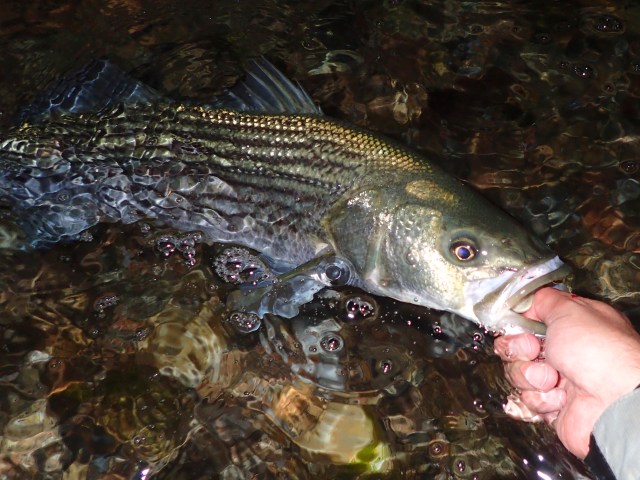
No wrong answers. Only the right ones for you. On this night, the striped bass repeatedly picked out the middle dropper, a chartreuse and olive Eelie between 2″-3″.

Block Island Bass

Your official Get Your 2016 CT Fishing License reminder

I used to be so good about getting next year’s license the last week of December. Not so much in recent years. So, here’s a reminder for all of us. Talk about money well spent — a fishing license remains a tremendous value in Connecticut. Now, if we could only get the pols to stop futzing with the hatcheries…

Support your local trout.

DCIM100GOPROG0020591.


January appearances and classes

Lots going on this winter, and I hope to see you during my travels. Also, thanks to everyone who joined the follow list over the holidays. I’m grateful for your support. If you’re new (or fairly new) please say hello in the comments section below. Tell me a little about yourself, what you like to fish for, how you like to fish, etc. I will of course be doing another fly package giveaway once we hit 400 followers. Onward and upward!

We kick off the 2016 appearances calendar in New Jersey. I’ll be presenting “The Little Things” to the Coastal Flyrodders on Tuesday, January 19, at Larkin House, 380 Godwin Ave, Wyckoff, NJ, at 7:30PM. Their mission statement says their primary goal is to have fun. My kind of group. For directions and details, visit coastalflyrodders.com.

Next up is the Fly Fishing Show in Marlborough, MA. I will be appearing at the Destination Theater on Friday, January 22 and Saturday, January 23 and presenting “Wet Flies 101.” This is one of my more popular presentations, and as the title suggests, it serves as a wet fly primer. Presentation times are as follows: Friday, January 22, 2:00pm, Destination Theater Room A. Saturday, January 23, 10:00am, Destination Theater Room A. The show takes place at the Royal Plaza Trade Center in Marlborough. For more information, visit http://flyfishingshow.com/marlborough-ma/

As Mister Sullivan might say, it’s a really big shew.

OLYMPUS DIGITAL CAMERA


We close out the month with “Wet Flies and Fuzzy Nymphs for the Farmington” on Saturday 1/30 at UpCountry Sportfishing. This is a fly tying class, but you cannot sign up for it until they post it on their website.  Last year’s class sold out in no time flat, so keep your eyes peeled on the UpCountry site.

More, more, more: I’ll be tying at the CFFA Show Saturday, February 6, at the Compleat Angler on Saturday, March 5, and at the CFFA Tyers’ Roundtable in April. Stay tuned to your favorite fly fishing magazines, as the word machine has been humming along. Plus fly tying videos, Currentseams Q&A (thanks for all the terrific suggestions) and of course, fishing reports.


The Last Blast of 2015

Any year that I get to fish over a hundred days is by definition a good one. So be it with 2015.

There are far worse ways to close out a fishing season than by walking a small stream, alone with your thoughts and a Oliva V Melanio. An ideal day for a winter outing, with temperatures in the low 40s, gray skies, and enough snow to make things pretty without gumming up the walk. I fished downstream with a bushy dry, and I added a tiny BHSHPT dropper off the hook bend halfway through the session. I found a half dozen small wild brookies willing to slash at the dry, but the only one I brought to net took the nymph dropper.

Merry Christmas, Charlie Brown.

OLYMPUS DIGITAL CAMERA

Then I got greedy. A half hour after leaving Ye Olde Brook Trout Emporium, I was wading into the bracing waters of the Farmington River. For some time now I’d had it in my mind to fish a certain stretch with streamers (I’d never done so in the winter). Bingo. Three bumps, and although there were no hook sets, I know where they live. Fished the full-sink line and some Deep Threats.

And so, on to 2016. If you’re new to currentseams, thanks for subscribing, and welcome. I have quite a few appearances and classes scheduled this winter, and I’ll post those soon. Hope to see you at one or more of them. And of course, if our paths cross on the river, please come say hi.


Take the Stripers Forever 2015 Angler Survey

The following (within quotes) is a cut-and-paste from  Stripers Forever:

“If you have not filled out your 2015 Angler Survey please do it right now.  We are going to stop taking responses on January 7. This survey is the largest and longest-running gauge of striped bass angler sentiment. It is important for fishery managers to know how the angling public perceives the quality of striped bass fishing. We’re using an online survey from SurveyMonkey to make it easy to complete. The link below will take you directly to the survey. It will only take you a couple of minutes to fill in and submit your answers.
Your input is more valuable than ever. Please take the time to take the survey; your response plays an important role in the protection of Striped Bass. The more completed surveys we receive the better. This year we’ve added an important new question to gauge your perception if the 2011 year class lives up to what is supposed to be the third largest year class in history.”
`
Who’s got her back?
Block Island All-Nighter first keeper

Trout Streamer Leaders for Floating and Full-Sink Lines

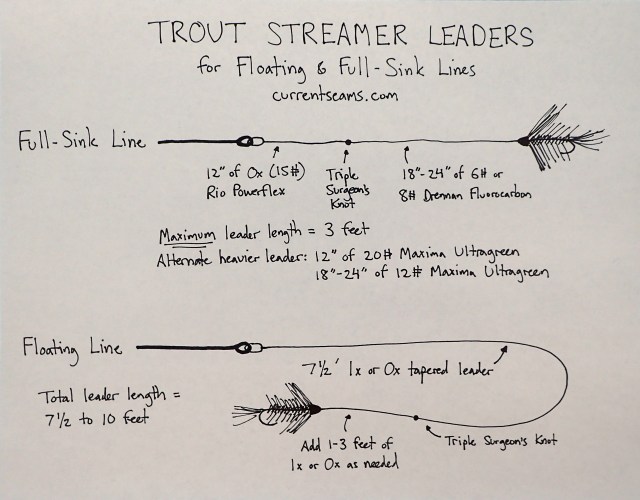
One of the most frequent questions I get asked is, “What’s your streamer leader formula?” The answer depends on two factors: the kind of line I’m using, and what I want the fly to do.

When I’m fishing streamers for trout, I fish two kinds of lines: either an integrated full-sink line or a floater. Let’s start with the full sink.

OLYMPUS DIGITAL CAMERA

Here’s a pdf: Trout Streamer Leaders

I use the full sink mostly in winter. Sometimes I’ll use it during warmer weather if the river is running high. I choose the full sink when I want the line to help the fly get down; consequently, the leader is kept short, three feet or less. Anything over three feet and you begin to defeat the purpose of the full-sink line. Don’t worry about the fly being so close to that heavy, dark string — the last thing a predatory brown is focusing on is your line.

There are a few deep holes in the Farmington that I like to dredge in winter. Unfortunately, bottom structure — snags — is often part of the cost of admission to those lairs. That’s when I’ll use the lighter of the two sinking line leader systems, simply because it’s easier to break off the snag from hell.

As you can see, the floating line system is likewise simple. A standard-issue Ox or lx tapered leader does the job nicely. This is what I’ll use for the vast majority of my streamer fishing, or when I am fishing a big floating fly like a mouse pattern. I’ll add tippet material that matches the terminal end of the taper if the leader gets too short. I will also add tippet material if I want to get my fly down deeper. A floating line gives you the ability to mend, and consequently harness the power of the current or sink your fly. So, about 7 1/2 feet for most applications, and about 10 feet to help get the fly deep.

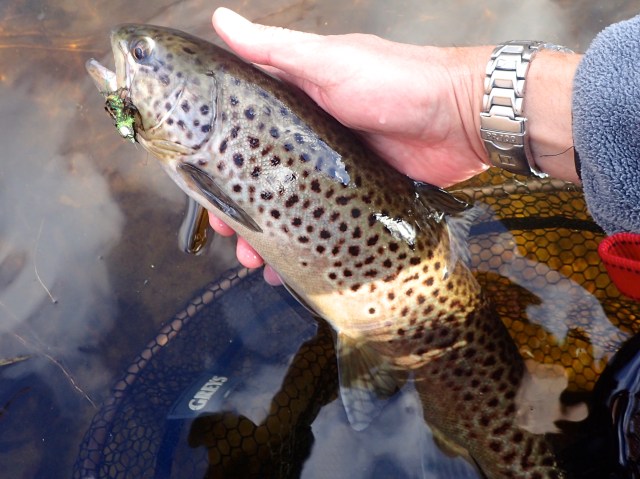
Big trout don’t care about that heavy black string snaking through the water ahead of your fly. Taken on a Deep Threat streamer and a full-sink line.

OLYMPUS DIGITAL CAMERA

~

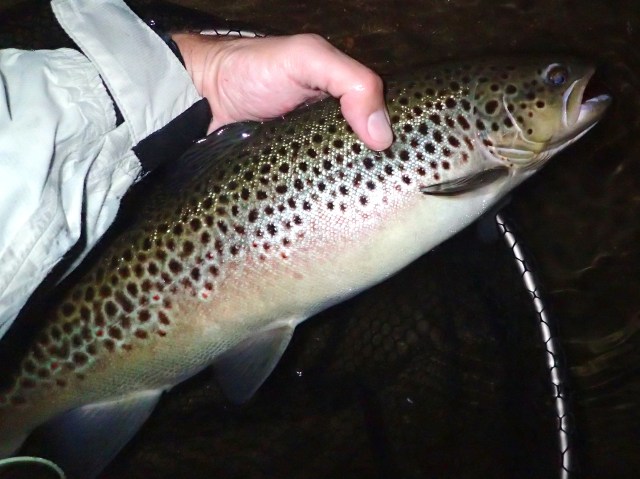
A floating line, a 7 1/2 foot leader, a presentation near the surface, and all is right in the streamer world.

Big wild brown hen 8-2015


Many thanks to CWTU and Orvis

What a great turnout last night, generated by the membership of Croton Watershed Trout Unlimited Chapter. It’s always easier — for me, at least — to present in front of a larger group. Thanks also to Orvis in Yonkers for the venue. There’s something comforting about giving a talk while surrounded by fly rods and reels.

Thus closeth my speaking engagements for 2015. If you took the time to come out and see me, thank you. I truly appreciate it. Lots more coming up in 2016, so stay tuned.

Here’s to you!

Block Island All-Nighter Wee Drop