Farmington River Report 2/10/16: A few extra foot-pounds per second

Maybe if I had applied that measured pressure to my gas pedal, I would have gotten to the river sooner. But here I was, and the prime water — where I got all my fish Tuesday — was on lockdown. (So much for inclement weather and mid-week timing. Bah. I liked winter fishing better when you could expect half-miles of the TMA to yourself.) I decided to make do with points elsewhere in the same run, usually a fair bet. But today that water was the difference between fishing and catching. I fished hard, and I fished well, but whatever was seeing my flies wasn’t eating. Silver linings? There’s something about cigar smoke twisting through snowflakes that brings out the romantic in me. River was 230cfs in the permanent TMA, very lightly stained and cold.

Jack explains the finer points of winter nymphing to Lloyd.

Jack Torrance

Survivor: Farmington (Browns Built To Last)

“Survivor: Farmington,” an essay about the CT DEEP’s Farmington River Survivor Strain Program, first appeared in the Spring 2014 issue of The Drake. The photo and caption did not appear in the article, and this is my original text. 

by Steve Culton

They took her from the river in September, 2012. She was chosen for her wild traits and rounded belly that indicated a healthy female ready to spawn. Once her eggs were harvested, she was returned to her home waters. But not before a red elastomer was inserted near her left eye. That color and placement would forever identify her as a broodstock female, one of many mothers of the Farmington River Survivor Strain Class of 2013.

The next April, I fished the West Branch of the Farmington. The Hendrickson hatch was winding down, and the trout were transitioning from taking emergers in the film to picking off duns that haphazardly lingered on the surface. Her take was powerful enough to rip the line from my fingertips and cause my drag to buzz in protest. I rarely put trout on the reel; this was going to be my first of 2013. What’s more, this fish was not going to come easy. I ended up walking a fair distance downstream to land her. It wasn’t until I was reviewing the day’s photos that I noticed the elastomer. I had sensed there was something readily distinguishable about the way she hit, bulldogged, and refused to come quietly. Now, it all fell into place. Survivor Strain.

Here she is in all her glory: the actual fish I was writing about.

Big Survivor Strain brown hen

The Farmington River Survivor Strain program was initiated in 1993 by what is now known as the Connecticut Department of Energy & Environmental Protection (DEEP). Neal Hagstrom, DEEP Senior Fisheries Biologist, describes the program as, “an attempt to use the river to select the best possible animals for that environment. We take certain trout to the hatchery, spawn them, then put their progeny back in the river, assuming that those fish will be best adapted for the conditions they’ll face.”

Survivor Strain’s inaugural class were descendants of stocked Cortland, Rome, Bitterroot, and Seeforellen browns. “The hope was that we would get improvements in production and survival,” says Hagstrom, “and we saw that in the first year. We went from about a 20% holdover rate to about 50%. We now find fish in the West Branch that are upwards of eight years old.”

Broodstock for the program are collected through electroshocking. Each September, the Metropolitan District Commission draws down the flow from Hogback Dam so that DEEP crews can complete their harvest. Their goal: one hundred brown trout worthy of producing the next generation of Survivor Strain. Like an NFL scout on draft day, Hagstrom explains the DEEP’s talent evaluation process. “We try to get fish that have spent at least a year in the river. We want genetic diversity. We want browns from multiple age classes, and multiple sources like Survivor Strain, and most importantly, wild fish. We want a lot of different parents to get as many possible combinations of genetic material.”

The DEEP harvested approximately 80,000 eggs in 2013. That biomass will generate 70,000 fry. In keeping with the tenet of genetic strength and diversity, the hatchery will set up dozens of parental combinations for the young ‘uns: wild mother/ wild father; wild mother/Survivor father; small wild father/large Survivor mother; and so on. This elasticity creates a population that is well equipped for the natural challenges of the river – not to mention heavy fishing pressure. Young-of-year Survivor Strain are wary of humans, even in their hatchery pens. Where standard-issue stockers are indifferent to people, Survivor Strain fish will dart away. “When we first saw it, it was like, wow, this is really cool!” says Hagstrom. “We had two tanks together, and their behavior was like night and day.”

To facilitate their annual trout census – and inadvertently, enable you to track your catch – the DEEP color codes Survivor Strain trout with elastomers. Left eye placement means the fish is an adult; right eye, a yearling. Colors change every year; 2011 yearlings received red or yellow, while 2012 yearlings received green. Thankfully, for those of us who are color blind, Survivors also have their adipose fin clipped off.

Not surprisingly, anglers are the program’s biggest fans. What’s not to like about cantankerous trout with breathtaking colors that grow to trophy size? As a bonus, the West Branch has seen an explosion in the wild brown population since the introduction of the program. A new record was set in 2013 of just over fifty percent of trout that were naturally spawned in the river. That bodes well for those of us who live for chasing gator browns. Mike Humphries, DEEP Inland Fisheries Biologist, says it’s a myth that the river’s lunkers are pen raised. “The highest percentage of big trout on the Farmington aren’t hatchery fish. They’re wild.”

And to think it all started with one tough mother of a stocked brown.

The CFFA Expo: Pull up a chair and set a spell

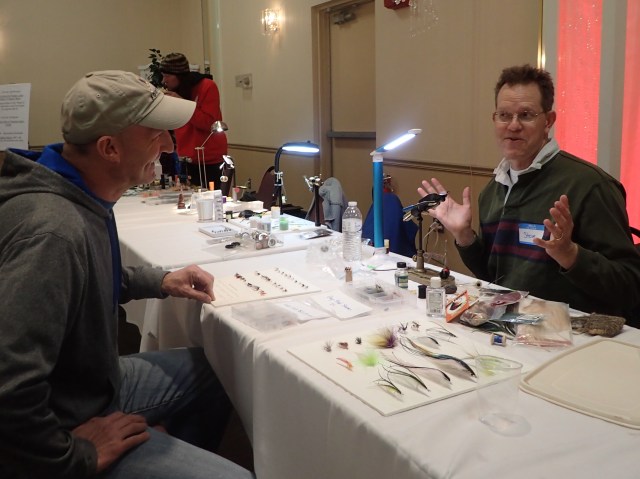
I only had four hours — Squirt hockey game in Avon at 3pm — but I made the most of it on Tyers’ Row at yesterday’s CFFA Expo. It really is the best little fly fishing show around (Somerset, eat your heart out). Thanks to the CFFA for hosting, thanks to everyone for stopping by, and my apologies to the gentleman who wanted to see me tie the Usual — you never came back, and I had to roll at 1pm. We’ll shoot for next time.

“I’m telling you, Mark, I’m going to catch a fish this big on this fly.” 

OLYMPUS DIGITAL CAMERA


Next up: Flatwings, Soft Hackles and Bucktails for Striped Bass tying demo at The Compleat Angler, 541 Post Road, Darien, CT, Saturday, February 27. I think in years past it’s been 10am-2pm, so I’ll go with that. For more information/directions, visit http://www.compleatangleronline.com


Farmington River Report 2/4/16: Ixnay on the Unkskay

There’s a time and a place to be an intrepid explorer, and that time was…Tuesday. Today I wanted to catch some trout. Winter fishing being like buying real estate — location, location, location — I headed for the retail district. Not too crowded, and people willing to share the water (thanks, Zach and friend).

So it wasn’t stupid good, but it was good enough that after 90 minutes I had enough house money to want to go spend it elsewhere. A few notes about the river and fishing:

The permanent TMA was about 400cfs and slightly off-color. The closer you got to the Still, the murkier the water. And it was cold. I’m guessing 34/35 degrees.

Indicator nymphing was the method. The water I fished was neither slow nor deep, but I decided early on to fish two BB shot on my drop shot rig to slow the drift. It seemed to work.

I took several trout in what I would describe as “softer water,” that transition zone between current seam and frog water.

The takes were on the subtle side. No indicator screeching to a halt, or dramatically plummeting to the depths; it was the equivalent of a trout sipping a midge off the surface. It was simply no longer there. Hook set downstream, and off we go.

All my fish today had an intact adipose and were in the 12″-15″ class. I fished a size 12 (2x short) SHBHPT on bottom, and a size 16 (2x short) new midge emerger/nymph thingy I made up last night on the dropper. I am mildly depressed to report that there was no interest in the new fly. But I’m confident that some day there will be.

OLYMPUS DIGITAL CAMERA


See you Saturday!


A belated birthday and the CFFA Show Saturday 2/6

Last week currentseams.com quietly celebrated its third birthday. The site has now grown to nearly 375 followers, and I can’t thank you enough for your readership and your support. Of course, when we reach our 400th follower, we’ll do a fly giveaway drawing. (If you’ve won in the past you know that a currentseams fly goody package doesn’t suck.)

Speaking of flies, I’ll be on Fly Tyers’ Row at the CFFA Show on Saturday, February 6, Maneely’s Banquet Facility, 65 Rye St., South Windsor, CT. I’ll be there from 9am – 1pm. This is one of the best local shows anywhere. For more information and directions, visit http://www.ctflyfish.org.

If you are planning on attending, and there’s something specific you’d like to see me tie, please let me know now so I can pack the appropriate materials. I’ve already had one request for the Squirrel and Ginger wet, and we’ll make it so.

Always a popular pattern. Especially with trout.

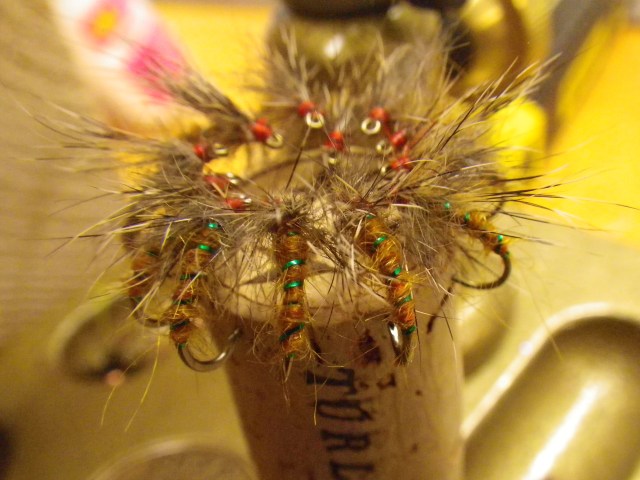
Squirrel and Ginger cork


Farmington River Report 2/2/16: Blankety-blank

I’ll make a long story short: I blanked today. In keeping with the time-honored tradition of making excuses, I spent most of the day out of the permanent TMA, fishing in spots I don’t usually fish in the winter. Serves me right for wanting to explore and avoid the crowds. So while the catching stunk, the fishing was extraordinary. Mostly nymphing, but I tried streamers as well. I know I was getting deep enough, as several rigs and flies were donated to the river gods. We’ll get ’em next time. Rain on the way. That’s good, because I don’t like the river at this height (205cfs/305cfs).

I know where you live. I just didn’t visit today.

DCIM100GOPROG0020591.


A record-setting wet fly class

Many thanks to the six soon-to-be-dangerous-wet-fly-machines who took yesterday’s Wet Flies and Fuzzy Nymphs for the Farmington River tying class — and thanks to UpCountry Sportfishing for hosting.

Leading a tying class is fun because your pupils are usually eager and engaged. Leading a wet fly tying class even more so because if the fly comes out a little messed up — and the first attempt at a pattern often does — the trout are probably still going to love it.

We covered eight patterns and a bunch of new techniques yesterday. The eight flies is the most I’ve ever covered in a four-hour class. The credit goes to the tiers, who did a tremendous job at their vises. Well done, all!

The aftermath of the tying storm.

IMG_2124

Farmington River Report 1/26/16: Avoiding crowds — and fish

Where there’s one trout, there’s probably a bunch more. That’s a fair statement for winter fishing on the Farmington, and one that Torrey Collins reiterated to me as I walked out the door of UpCountry. But you could also say the same for winter trout fishers. And today I wanted to avoid crowds. If there were any fish in that bargain, I would embrace it as a bonus.

I’ve been fairly stubborn about Spot A this winter. I know there’s a healthy population of trout, but I’ve only hit them in the mood to eat once. I spent ninety obstinate minutes bouncing nymphs along the bottom (I had too many false positives to count) and swinging/stripping streamers before I decided enough.

Spot B was a what-the-heck roll of the dice. I don’t like it in lower water (230 cfs, 35 degrees in the permanent TMA) but you don’t know if you don’t go. Ten minutes was all I gave it. Blanked.

The run in Spot C is deep and moving at a good walking pace. The yarn went under with the speed and depth that indicates a substantial fish has committed to your fly. Or you’ve found a fly-eating rock. Bottom 1, Steve 0, and I set about re-tying my rig. Thirty minutes later, another blank.

And that’s when you realize that solitude is nice, but you should probably just deal with whoever’s there and go fishing where the willing-to-eat fish are. Third cast, the indicator goes under and the bottom fights back.

Clearly, this calls for a second cigar.

Down periscope. A nice kype beginning to form on this some-teen inch brown that took a size 12 (2x short) SHBHPT, the day’s clear favorite (they showed no interest in eggs or SH Zebra Midges).

OLYMPUS DIGITAL CAMERA


The Marlborough Man

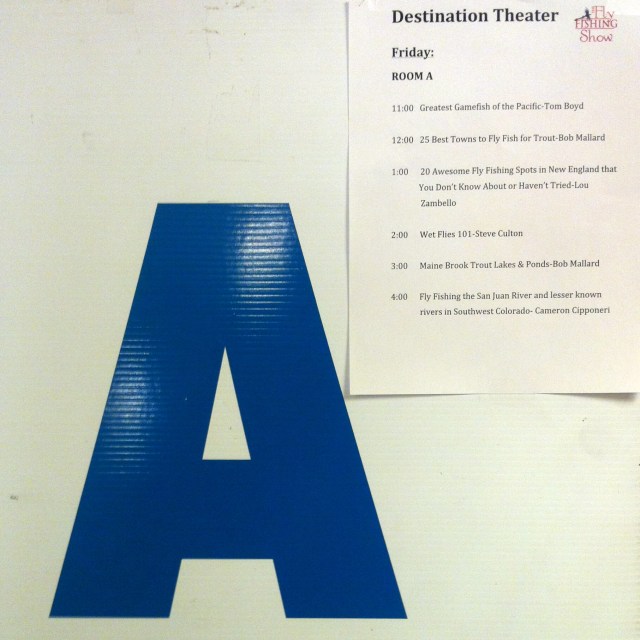
I hadn’t been to the Fly Fishing Show in years. It wasn’t due to indifference — mostly it was scheduling, and that I had made up my mind that my next visit would be in a professional capacity. This year the stars aligned (thanks for squeezing me in, Ben) and I did two days as a Destination Theater presenter in Marlborough, MA. (Cue up the “Theme from The Magnificent Seven”.)

My first gig was Friday at 2pm, and I got there early enough to be able to take a quick walk around the show floor, say hi to some old friends, and make some introductions to new ones. I also wanted to support my fellow local presenters, so I caught most of Rich Strolis’ Tying Flies for the Toughest Fish, and Strategies for Fishing Them. Rich likes to fish a basic emerger template for rising trout; he simply varies the size and color of the pattern to match the hatch. As a wet fly (and snowshoe rabbit fur) aficionado, I liked that.

Having no idea what to expect, I was pleasantly surprised by the crowd that gathered to see and hear Wet Flies 101. I counted close to forty people. If you were in attendance, thanks so much for coming out, and especially for laughing at all my jokes.

On the A Team. Good room, and an even better audience.

IMG_2115

Saturday was a little dicey because of the impending doom generated by the approaching storm. However, fortune smiled upon me as the drive up and back were relatively snow-free. As I set up in an empty room at 9:45am, I realized that I might be presenting to just a few hardy souls. Not a chance. What started as a flurry turned into a measurable accumulation by showtime, and I want to thank everyone again for taking the time to come out. I stuck around to see some of Marla Blair’s The Hatch & Body Language of Trout for Choosing the Right Patterns. Marla’s explanation of how the rise forms translate into the feeding attitude of trout is something I have long embraced (and I think we both love stupid fish).

Can’t say you properly attended a show without buying something, so at 1pm I was walking back to my truck with a gorgeous red flatwing saddle I found buried in the piles at the Keough booth.

See you next year.

Upcoming events:

Still a couple slots open for next Saturday’s (January 30) tying class at UpCountry, “Wet Flies and Fuzzy Nymphs for the Farmington.” Call the store to register at 860-379-1952.

I’ll be on Fly Tyers’ Row at the CFFA Show on Saturday, February 6, Maneely’s Banquet Facility, 65 Rye St., South Windsor, CT. I’ll be there from show open until early afternoon. This is one of the best local shows anywhere. For more information and directions, visit http://www.ctflyfish.org.


Still room in the 1/30 Wet Fly tying class at UpCountry

UpCountry called today and said they still have some slots open for next Saturday’s (January 30) tying class, “Wet Flies and Fuzzy Nymphs for the Farmington.” Call the store to register at 860-379-1952.

Had a tremendous turnout at Marlborough today for “Wet Flies 101” — thanks to everyone who attended. More on the show later.

Space still available. Jump on it like this hefty Farmington rainbow did with a Squirrel and Ginger nymph.

Big Rainbow 9-14