Leisenring’s Favorite Twelve Wets: Coachman

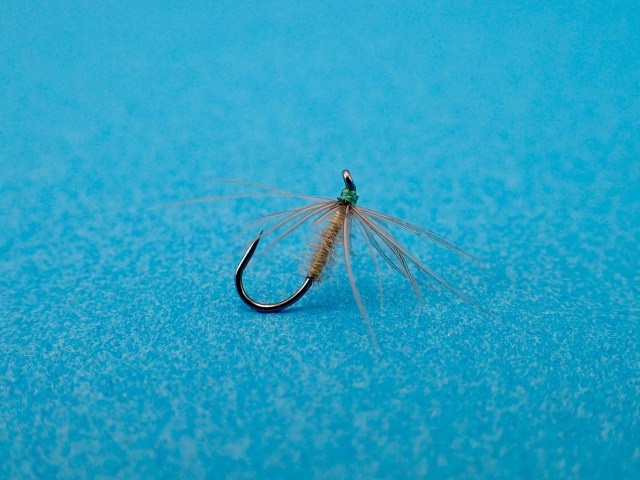
Not to be confused with the classic Leadwing Coachman — this fly is decidedly in the red/orange end of the color wheel. I tend to view the Coachman as an attractor, but in the interest of full disclosure I don’t often fish quill winged wets. On the other hand, it’s hard to go wrong with a peacock herl body.

Coachman

OLYMPUS DIGITAL CAMERA

~

Hook: Dry or wet fly, 12-13
Silk: Orange
Hackle: Bright red cockerel
Body: Bronze-colored peacock herl
Wings: Land rail, primary or secondary
~
Tying Notes: You’re going to need to dip into your improvisation quiver for some of these materials. No cockerel in my feather bins, so I used a small feather from a red saddle. And land rail? Good luck. I substituted an orange-red dyed starling skin I picked up from Badger Creek a few shows ago. When I tie in a quill wing, I’ll hold it in place between my thumb and middle finger. Three taught wraps, then tighter wraps to finish. Like anything, it takes practice — I hadn’t tied a quill wing in about a year and I needed two tries to get this one right.

Leisenring’s Favorite Twelve Wets: Blue Dun Hackle

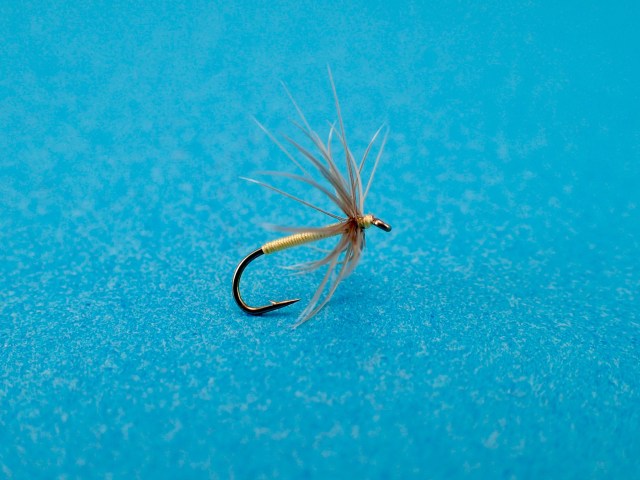
First cousin to the Old Blue Dun, the Blue Dun Hackle trades buttonhole twist for gold tinsel and muskrat for mole fur. While the North Country spider influence is readily visible, you can see how Leisenring is taking these flies firmly into wingless wet territory with the spikey body and prominent ribbing. Imitator or attractor…or both? You decide, and let the trout kibbitz.

Blue Dun Hackle

OLYMPUS DIGITAL CAMERA

~

Hook: Dry or wet fly, 12-14
Silk: Primrose yellow
Hackle: Light blue dun hen
Tail: 2-3 blue dun fibers optional
Rib: Very narrow flat gold tinsel
Body: Mole fur spun on primrose yellow silk, a little of the silk exposed at the tail
~
Tying Notes: A mole skin is pretty cheap and will keep you in wet flies and nymphs for years. You want a natural colored fur (kind of a dark blue-grey dun), not a dyed skin. XS tinsel works. I did a better job on this fly of letting the yellow silk show through at the tail.

Leisenring’s Favorite Twelve Wets: Old Blue Dun

The Old Blue Dun would make a fine representation of those bigger early season BWOs we get on the Farmington. Use a darker blue dun hackle and it’s easy to imagine it as a Hendrickson. Clearly, Leisenring thought highly of this pattern. And the trout you present it to will, too.

Old Blue Dun

OLYMPUS DIGITAL CAMERA

~

Hook: Dry or wet fly, 12-14
Silk: Primrose yellow
Hackle: Blue dun hen
Tail: 2-3 glassy fibers from a rusty blue dun cock hackle
Rib: One strand yellow buttonhole twist
Body: Muskrat underfur spun on primrose yellow silk, a little of the silk showing through at the tail
Wings: Starling (optional)
~
Tying Notes: We’re back to the DMC embroidery floss (#744) as our buttonhole twist substitute. Make sure you pick out the muskrat guard hair — you want the soft, dark underfur. I didn’t leave a lot of the yellow silk showing through at the tail here; I wonder if Leisenring’s intention was to craft the illusion of an egg-layer? Nonetheless, this fly will hunt.

Leisenring’s Favorite Twelve Wets: Gray Hackle

Some questions simply cannot be answered by mortal man: Why do fools fall in love? Should I stay or should I go? But I digress. Consider Leisenring’s Gray Hackle. Why would you specify “yellow or white creamy furnace hackle” and then name the fly…well, you can see where this is going. Maybe Big Jim’s stash of said hackle had a gray cast to it. Maybe it looked a certain way when wet. We may never know. But we do know that there’s a little magic in this design. See for yourself.

Gray Hackle

OLYMPUS DIGITAL CAMERA

~

Hook: Dry or wet fly, 12-14
Silk: Primrose yellow
Hackle: Yellow or white creamy furnace
Rib: Narrow gold tinsel
Body: Bronze peacock herl
~
Tying Notes: This hackle came from a bag of strung feathers I bought a long time ago for probably a couple bucks. I used two strands of herl to wind the body, and I used the technique of pressure from the thread in front of the herl to make a nice, compact wind (you can see that technique in Tim Flagler’s excellent Squirrel and Herl video.)

Leisenring’s Favorite Twelve Wets: Brown or Red Hackle

I can’t make up my mind whether this is a beetle or an attractor. Leisenring must have had some trouble deciding on the pattern as well. Brown hackle? Or red hackle? Ah, what the heck. While we’re pondering these delicious mysteries, let’s go with this: the Brown or Red Hackle looks like something that’s alive and good to eat.

Brown or Red Hackle

OLYMPUS DIGITAL CAMERA

~

Hook: Dry or wet fly, 12-14
Silk: Crimson or claret
Hackle: Red furnace
Rib: Narrow gold tinsel
Body: Bronze peacock herl
~
Tying Notes: I have a nice reddish brown Whiting wet fly hen neck. It’s more badger (feathers with a dark center, lighter toward the tips) than furnace (dark center, lighter middle, dark tips) but it’s close enough. I used two strands of herl to wind the body, and I used the technique of pressure from the thread in front of the herl to make a nice, compact wind (you can see that technique in Tim Flagler’s excellent Squirrel and Herl video.)

Leisenring’s Favorite Twelve Wets: Light Snipe and Yellow

Inspired by classic North Country flies, James Leisenring developed an arsenal of reliable patterns to match the hatches of his beloved local streams. You can clearly see the Snipe Bloa and Poult Bloa influence in the Light Snipe and Yellow. Farmington River trout love this fly, a lesson that is repeated on cool June nights when Light Cahills or Sulphurs are emerging and the water surface is boiling.

Light Snipe and Yellow

OLYMPUS DIGITAL CAMERA

~

Hook: Dry or wet fly, 14
Silk: Primrose yellow
Hackle: Snipe undercovert
Rib: Fine gold wire
Body: Primrose yellow buttonhole twist
~
Tying Notes: Instead of working silk, Leisenring used buttonhole twist (the thread that’s used on the borders of buttonholes) for the body. You don’t need to do that — your favorite silk or thread will work. But if you’re shooting for authenticity and can’t find buttonhole twist, try DMC embroidery floss. It comes in a bazillion colors (this is #744). It’s multi stranded, so cut a length then separate a single strand for the body. No snipe? Try starling or woodcock undercovert. You can find a general North Country spider video tutorial here.

Best of North Country Spiders: Waterhen Bloa

You’ll often find BWOs on the greyest of days, so ’tis fitting that this ancient-and-tradtional Olive pattern sports the same somber hues. It also makes a fine Early Grey Stone.

Waterhen Bloa

OLYMPUS DIGITAL CAMERA

~

Hook: Dry or wet fly, 14-18
Silk: Yellow
Body: Silk dubbed with water rat (muskrat) or mole fur
Hackle: Waterhen under covert feather
~
Tying Notes: Waterhen is difficult to track down. Starling or blue-grey dun hen are suitable replacements. You should be able to see the thread clearly through the dubbing — I call it “dusting the thread.” This fellow is slightly on the heavy side of dubbing. Keep enough thread waxed (I used cobbler’s wax) to avoid having a bright yellow head. You can find a general North Country spider video tutorial here.

Best of North Country Spiders: Orange Partridge

What’s the difference between a Partridge and Orange and an Orange Partridge? Not much. And everything. Sure, the gold rib provides segmentation and a hint of flash. But for me, it’s the brown speckled hackle that gives the Orange Partridge an entirely different energy. They liked this pattern for olives on the streams of Yorkshire; I’m seeing caddis all the way. Tell you what: let the trout decide what it is. And hold on tight.

Orange Partridge

OLYMPUS DIGITAL CAMERA

~

Hook: Dry or wet fly, 14-16
Silk: Orange
Rib: Fine gold wire
Hackle: Brown speckled feather from a partridge’s back
~
Tying Notes: Another straightforward tie. You can find a general North Country spider video tutorial here.

Best of North Country Spiders: Snipe Bloa

The Snipe Bloa is one of those flies that has a palpable energy, even when it’s resting in the palm of your hand. I think I prefer James Leisenring’s take on this pattern, the Light Snipe and Yellow, which uses Primrose silk, a fine gold wire rib, and snipe undercovert. This version (you can find many iterations of the Snipe Bloa; Pritt lists two) is taken from Sylvester Lister. It’s also called the Snipe and Yellow. Yellow Sallies, Sulphurs, Dorothea, Summer Stenos — the answer is “yes.”

Snipe Bloa

OLYMPUS DIGITAL CAMERA

~

Hook: Dry or wet fly, 16-20
Silk: Yellow
Hackle: Small darkish feather from under snipe’s wing
~
Tying Notes: No snipe? No worries. Starling is your friend. This is a fast, simple tie. You can find a general North Country spider video tutorial here.

Best of North Country Spiders: Grey Partridge (Grey Watchet)

My interest in North Country Spiders is twofold: that they’re cool (traditional, sparse, elegant, simple), and that so many of them translate well to our streams here in the U.S. Like the Grey Partridge. I first saw this pattern in Syl Nemes’ Two Centuries of Soft-Hackled Flies. Nemes saw it in T.E. Pritt’s North Country Flies. Now I’m sharing it with you. This pattern doesn’t get a lot of juice, but it makes a darned good Light Cahill. Just ask the trout.

Grey Partridge (Grey Watchet)

OLYMPUS DIGITAL CAMERA

Hook: Dry or wet fly, 12-16
Silk: Straw
Hackle: A light feather from a Partridge’s breast
Head: Peacock herl
~
Tying Notes: If you’re going for authenticity, tie the head in first and finish the fly behind the hackle. I used two strands of herl spun on thread for this fly; you can see the technique in my Drowned Ant video here. Next, attach and wind the hackle rearward. (It take s little practice.) Wind the silk body and finish. You can find a general North Country spider video tutorial here.