A Classic Bergman Wet: The Fontinalis Fin

This is a fly with a great backstory.

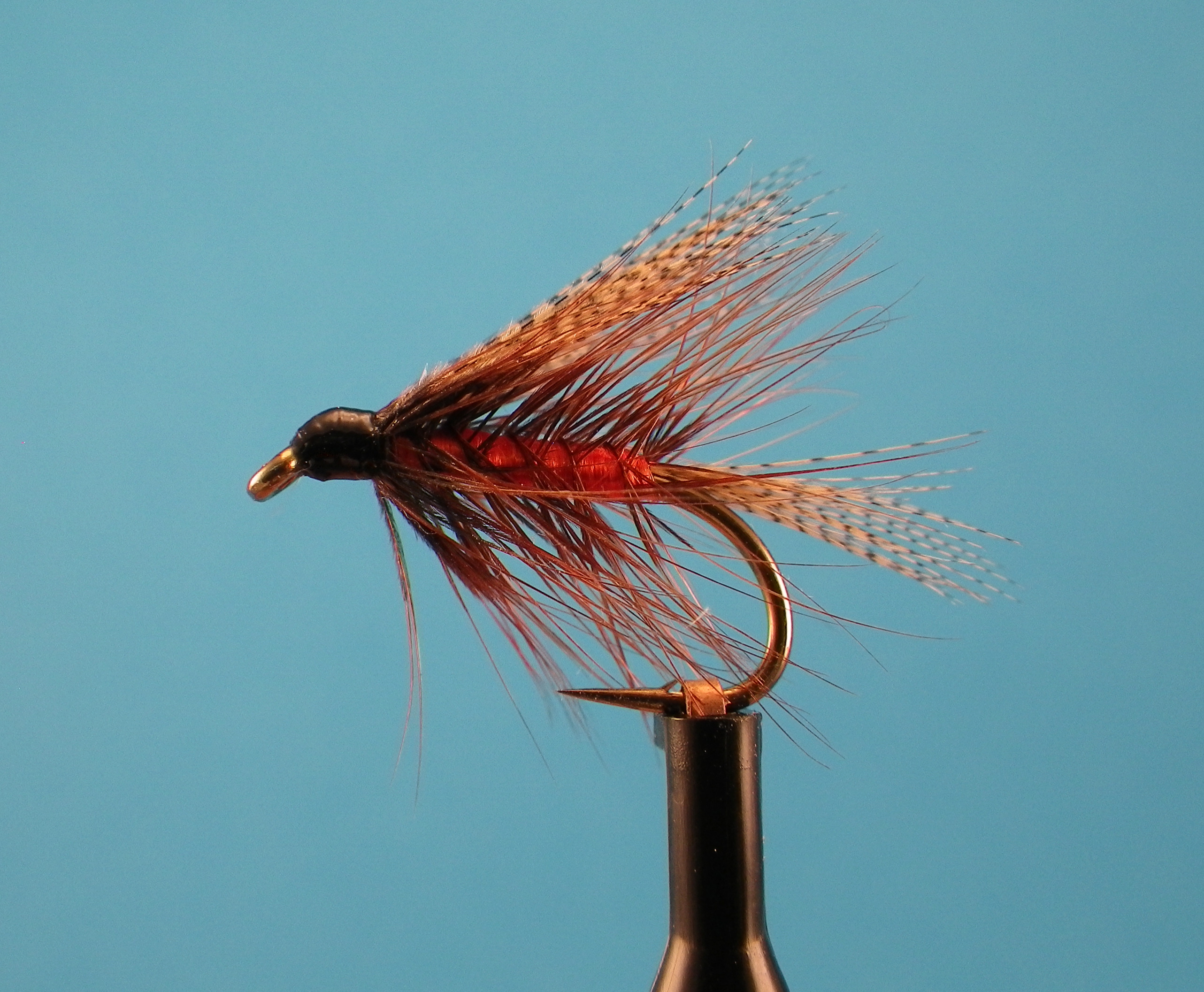
The Fontinalis Fin Wet Fly

Image

Hook: 6-16 (this is a 1x short, 2x strong Orvis 1641 size 10)
Thread: Black
Tail: White hackle fibers
Body: Orange wool with fine gold tinsel rib
Throat: Furnace hackle fibers
Wing: Orange mallard married to a thin strip of black or natural grey mallard, then a slightly thicker strip of white mallard

The old-timers up in Maine (or down East, if you’re going for authenticity) who were fishing for brookies thought their quarry was highly territorial. So after they creeled a fish, they’d clip off one of the fins and use it for bait. And what an attractive bait it was: shiny, deep orange, contrasted against dramatic black and white bands.

An enterprising fly tyer named Phil Armstrong realized he could replicate this bait in the form of a married-quill wing wet fly. And thus was born the Fontinalis Fin. “Fontinalis” from the second half of the brook trout’s taxonomic name, Salvelinus fontinalis. “Fin” for rather obvious reasons. What a brilliant concept.

The real McCoy

Image

While it’s tempting to look at the flies featured in the color plates of Berman’s Trout (this fly appears on plate 10) as more of an exercise in tying legerdemain than practical fish catchers, I can tell you from experience that this fly does work. It’s pretty simple as far as married quill wings go, and the rest of the pattern is something anyone with basic tying skills can do.

Tying notes: If you’ve never tied a quill wing, don’t start. Your first quill wing can be the fly-tying equivalent of the Bataan Death March. While I was kidding (mostly) about not starting, I think it took me over a half hour to tie my first quill wing — and that was accompanied by a generous use of rather colorful language. Once you get it, though, the process becomes easier. I’m often asked at classes and demos, ‘How do you glue the different quill sections together?” You don’t. The edges of quill fibers are like velcro — they stick together quite nicely. There’s a specific technique to matching quills (the wings should be a mirror reflection of one another) and marrying the sections. Perhaps someday I’ll post them. In the meantime, you can probably find a good how-to by doing a web search. Also, the quill wings should sit a little higher on the shank so as to not hide the body; I was in a rush to finish this fly, so I plead sloth.
The Catskill Wet Fly

I first learned of the Catskill when I read Ray Bergman’s classic, Trout. While it lacks the garish palette of the majority of the flies that appear on the color plates at the beginning of the book, the Catskill is nonetheless an attractive fly – albeit in a rather understated way.

There’s something seductive and buggy about wood duck. The soft brown hen hackle will collapse and pulse in the current, contrasting nicely against the orange floss body. It’s easy to imagine this as an over-sized caddis. Or at least as something that looks alive, and good to eat.

I tied it large, but I can see going down to about a 16 or so with this fly. Although I have not yet fished it, I already have supreme confidence that it will be a fish catcher.

You can, too.

The Catskill

Image

Hook: 1x short, 2x strong size 8-16 (this is an Orvis 1641 size 10)
Thread: Black
Tail: Wood duck
Body: Orange floss under brown hen, palmered
Wing: Wood duck

The Kate McLaren Wet Fly

Ah, Kate-O, my little not-so-yellow friend.

Every year, I’m on the lookout for new flies to tie and fish. My friend Jon, who’s been wet fly-fishing forever, also happens to be from the UK. So he’s been exposed to a broad cross-cultural mix of patterns. When I asked him for some suggestions, he immediately offered up the Kate McLaren. It’s fair to say that I liked Kate the moment I laid eyes on her.

The Kate McLaren is a Scottish loch fly, intended to be the top dropper (or bob fly) on a team of three. While its traditional use is on still water, I’m going to be fishing this on rivers. And while I might give it some time as a top dropper, it’s going to get the lion’s share of action on point.

There’s something about the contrast of the golden pheasant crest tail and the dark body that I find magnetically appealing. Golden pheasant crest almost glows when wet. Who knows what a fish will think this fly is – perhaps a flash of spotted salamander, or a chubby stonefly – but I can’t wait to feel that first take.

Kate McLaren

Image

Hook: 8-14 (this is a 1x short, 2x strong Orvis 1641 size 10)
Thread: Black
Tail:  Golden pheasant crest
Body: Black seal fur (I used angora goat)
Rib:  Fine oval silver tinsel
Body Hackle: Black rooster (I used soft hen)
Head hackle:  Brown rooster (ditto on the hen)

Tying notes: Technically, this is a Kate McLaren variant since I used soft hen instead of stiffer rooster hackle. Since I primarily intend to fish this fly subsurface, I wanted the action the soft hackle would provide. When finishing the body, I tied the black hackle in near the head, leaving the thread at the tie-in point, and then wound the hackle backwards toward the tail. I then secured the hackle with the tinsel, and wrapped it forward to the thread. Also note that the black hackle is smaller than the brown. Some of the Kates I’ve seen have a longer tail, but I like the proportions of this one. I got lazy on the head and left it rough. As Dave Hughes said, trout aren’t interested in neatness.