Farmington River Report 8/14/23: In which we remain in a holding pattern.

I wish I had better news for you, but the Farmington River continues to flow within the risky margins of trout-friendly/trout dangerous temperatures. It’s a tantalizing balancing act; at 70 or 72 degrees, brown trout are probably OK, and not in any real danger. Unless you hook them and subject them to stress — stress that may ultimately kill them. Here’s some up-to-date information from Torrey Collins, the shop manager at UpCountry Sprotfishing:

“Water temps remain marginal with water coming out of the dam at about 66 degrees all day long, and then warming up during the day and as you move downstream. Coolest water temps and the longest fishable window is early to mid mornings. Look for water temps 68 degrees and below, and DO NOT fish in 70 degree plus water or you will stress the trout out and can potentially kill them by catching and releasing at 70+ degrees (not enough oxygen in warmer water). If you are fishing in Church Pool in the afternoons, you are 100% fishing in 70+ degree water. Don’t be that guy. If you have a thermometer, please use it- it will show you where & when you can and cannot fish. Pretty much on sunny days by about 10am you better be up in Riverton above the Still River (it’s a warming influence that dumps in warm to hot water in the summer), and you may need to move even closer to the dam release to stay in cool enough water. When water temps move into the mid 60’s, many trout will hold in the faster water due to the higher oxygen content.Rain in the forecast for tonight & tomorrow will raise the Still River, which means that from there down the river will be even warmer, so be careful and take water temps. FYI when you take the water temp, make sure you are in the current and your thermometer is shaded, otherwise it will give you a reading higher than the actual temp.”

Very not good. Ixnay on the ishingfay.

I’m continuing to place my Farmington River guide trips on hold until temperatures moderate.  We’re getting rain tonight and the MDC is lowering the flow. What we really need are cooler days and some early fall chilly nights!

TBT on Wednesday: Kenney Casting

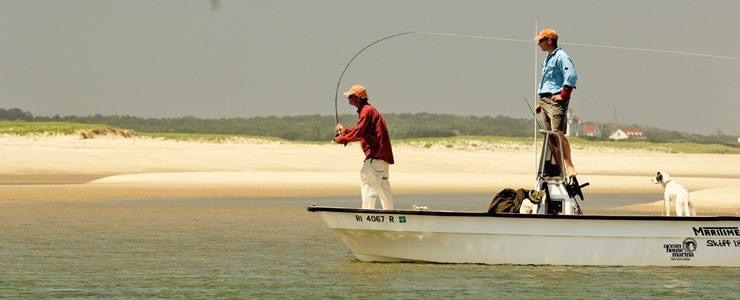
I recently came across this wonderful photo of Ken Abrames taken by fly fishing shooters extraordinaire Barry and Cathy Beck. It was posted by Tom Keer on one of his social media feeds. I don’t know where the shot was taken, but it’s a great look at an extraordinary fly caster. I remember seeing Ken in a parking lot in Watch Hill with my Salmo Sax #3 and a Rio Outbound long head 9-weight line. He held the rod in his right hand; his left hand was stuffed into the front pocket of his khakis. One false cast…waaay back….then one smooth, yet powerful stroke forward, and out went the entire length of line. (That’s 100 feet for those of you keeping score at home.) There are those who will tell you that the double haul — or as Ken liked to call it, “high line speed gymnastics” — is essential to being able to fly fish in saltwater. They never saw Ken cast. I’ve still never double hauled in my life — thanks to Ken.

Photo courtesy of Tom Keer and taken by Barry and Cathy Beck.

Farmington River update: flows and land and maybe some non-sucky news for a change

Happy Monday. This morning, Hogback dam is still pumping out nearly 1.2K. According to Torrey Collins, 50cfs is coming from the bottom and the bulk from the over-the-top-spillway. The upshot is a lot of water leaving the reservoir, and not much of it cold. If you choose to fish, please be vigilant about water temperature — and of course, be careful!

As far as the flows getting back to normal: this water dump will continue until the reservoir reaches a level deemed safe by the Army Corps of Engineers. Meanwhile, the CT DPH has ruled that the MDC can be released from their drinking water obligation. This is encouraging as it means the MDC gets their way, and should no longer have a reason to be a dick about releasing a minimal amount of water. But “should” doesn’t mean “can,” or even “will.” Once the ACE determines the reservoir as at a proper level, we’ll see what the MDC does with the bottom release flows. For now, I like that the MDC is releasing only a minimal amount from the bottom, as this will help with restratification. Stay tuned on this one.

So, how about some confirmed good news? The MDC has agreed to a conservation easement that will assure 5,500 acres of land around the watershed will remain undeveloped. You can read more about that here and here.

Up next: the Block Island report.

Let’s try to keep it that way!

Back from Block, water woes, and a lost season

I feel like my current fishing world can be best summed up by Ray Davies, who wrote, “The news was so bad that I fell out of bed.”

The fishing on Block was soul-crushingly bad. This is the third straight down year, and I felt lucky to have landed five stripers in seven nights. (Yes, you read that correctly.) Four skunks in the mix. (Really?) My biggest fish was 22″, bringing my streak of not landing a keeper or better to three years. How far that shore fishery has fallen!

Back on the home front, Mother Nature and the MDC are wreaking havoc upon the Farmington River. A couple days from now is my traditional date to go fish the dorothea at a favorite mark, but that’s obviously not going to happen. To add insult to injury, I’ve had to cancel both wet fly lessons scheduled for this week.

Normally, I’d console myself by heading to the Housatonic, but that river is also experiencing catastrophic water levels. No smallmouth for you! And no smallmouth for me, either. The white fly hatch will come and go, and none of us will be able to enjoy fishing it. Maybe the Hous will come down to a dry/wet fly fishable level in 2-3 weeks. That’s assuming we don’t get pounded by rain…again. This is now four consecutive alternating years of flood, then drought. It’s the new normal, and it sucks for all of us. What’s worse, it can’t be good for the ecosystem. Would a happy medium be too much to ask? Perhaps the silver lining will be more trout holding over to this fall. We shall see.

Bloody hell! 5,500cfs is a long way from being even remotely fishable.

Finally, good reader, I must apologize for all this doom and gloom. I try to be a positive force, but I also feel compelled to tell it like it is. I suppose I could use this time to prep my fall striper box, or my winter nymph box, or even get a head start on some steelhead flies. Maybe some bluegills down at the pond on Elk Hair Caddis and a six-foot glass rod would cheer me up? Now there’s a thought…

Farmington River Flow Update: And then, there was water

No, you’re not seeing things. Yes, there is water again in the PTMA and even in Unionville. Last Monday, the upper Farmington River, its reservoirs, and watershed in southern MA got deluged, with some areas receiving inches of rain. Now that the Colebrook Reservoir is at 100% capacity, the Army Corps of Engineers has instructed the MDC to dump water and reduce the level. That’s why the gauge looks like this:

While this is better than the paltry 60cfs MDC was releasing, it’s a perfect illustration of how poorly this resource is managed. Instead of dumping 340 extra cfs of water en masse, why couldn’t the flows have been set to 150cfs for weeks? Better yet, how about the historical median flow? You know what’s going to happen next: the flows will go back to a trickle, and we’ll have the Farmington Rock Garden River. Again. There is no word on when those flows will be cut, but it is surely coming. So get out and enjoy the water while you can.

I’m still waiting to get you some better information on how this will all shake out, and what can be done about it. There are forces at work for better stewardship of the river. Stay tuned.

Creating, developing, and testing a new fly

Last week I mentioned that I was testing a “new” Isonychia wet fly. (I placed the word in parentheses, because so much of modern fly tying is derivative, riffing off countless other patterns that came before. Not that that’s a bad thing! Rock ‘n’ rollers and jazz hepcats have been doing the same for decades.) Of course, I didn’t expect that mention to go unnoticed; in fact, I received multiple requests for more details.

But to quote Don Vito Corleone, my answer is no…and I will give you my reasons.

For me, a new fly pattern is a multi-faceted process. I start with the creative spark, and determining the need for a new pattern. That need can be as simple as, “I want my own fly,” or that I just don’t like what others have done before me. Then, I go the vise and build prototypes. Next comes testing. I may refine the fly and make small or large changes, depending on the pattern. The most important part is the conclusion. Does this fly work? Do I enjoy fishing it? And most of all, do the fish eat it?

All of this can take weeks, and usually months or years.

So, my apologies. No new Isonychia pattern for you…yet. I can share with you that so far it looks like a winner. Once it gets the seal of approval, you’ll all be the first to know. Not to drive anyone further bonkers, but I’ve also got a LaFontaine-inspired version of the Squirrel and Ginger in the works, and the early results are also very favorable. Plus that Henry’s Fork cripple (not a new pattern, and not mine, but worthy of inclusion in your box). It’s a crazy few weeks so I beg your pardon and ask for patience. Remember the sage words of Hannibal to Clarice…

Currentseams Now Has Over 1,000 Subscribers!

Currentseams now has over 1,000 official subscribers — and it’s all your fault. Really, I can’t thank all of you enough for your interest, your readership, your passion, your enthusiasm, your comments, and especially for your kind, giving nature. I like very much what this site has become, and that’s in a large part due to your participation. Yeah, I wish I had more tying videos. Yeah, I wish I had more essays and articles. Yeah, I need to update some stuff (like my wet fly team diagram). But that’s something to aspire to.

Of course, we’ll have a drawing to celebrate. But not right now. Summer is upon us, and we’ve all got cookouts to attend, vacations to go on, and fish to catch. My plan is for something later in summer. Of course, as a subscriber you’ll see it first here. In the meantime, if you’re not a subscriber — ten lashed with a cane rod — now’s a great time to sign up. Be sure to follow me on Instagram @stevecultonflyfishing, too. Again, thank you, thank you, thank you!

It’s as easy as that. (Sorry, this isn’t a live link. The real one is off to the side or the top or the bottom, depending on your device.) Who’s going to be 1,012?

Reminder: New CT Striper Slot Starts May 26

This is from an email sent out today by the CT DEEP:

“Greetings fellow fishing enthusiasts. CT DEEP is sending you this email to let you know that the Atlantic States Marine Fisheries Commission (ASMFC) took emergency action earlier this month to implement a 31-inch maximum size limit on recreational striped bass fisheries along the Atlantic coast. For more information about the ASMFC emergency action, please read the ASMFC news release available at http://www.asmfc.org/uploads/file/64529753pr10AtlSripedBassEmergencyAction.pdf as well as the informative FAQ page that was compiled by the Massachusetts Division of Marine Fisheries available at https://www.mass.gov/info-details/striped-bass-emergency-action-frequently-asked-questions-faq

To come into compliance with the ASMFC emergency action, CT DEEP will implement a new 28-31” harvest slot limit for striped bass effective May 26, 2023. The new 28-31” harvest slot limit that will become effective on May 26th means that any striped bass that is less than 28 inches or greater than or equal to 31 inches must be released without avoidable injury. This regulation will apply to all waters of the state (marine and inland district).

Questions on the new striped bass harvest slot regulation can be sent via e-mail to deep.marine.fisheries@ct.gov , or call 860-434-6043 and leave a voicemail and someone from DEEP Marine Fisheries will return your call as soon as possible.

ASMFC is required to hold four public hearings within 30 days of any emergency action to provide information on the action and obtain public comment. ASMFC will hold four virtual hearings and has released a hearing schedule. Members of the public may also submit written comments by sending an e-mail to comments@asmfc.org or by mail to:

Emilie Franke

Atlantic States Marine Fisheries Commission

1050 N. Highland Street, Suite 200 A-N

Arlington, VA 22201

The virtual public hearing schedule is as follows:

Wednesday, May 17 5:00 – 7:00 p.m. (Completed)

Monday, May 22 6:00 – 8:00 p.m.

Tuesday, May 23 5:00 – 7:00 p.m.

Wednesday, May 31 6:00 – 8:00 p.m.

To register for a virtual hearing, please go to this link:

https://register.gotowebinar.com/#rt/454738649028335194

and use the dropdown menu to select the hearing date you plan to attend. Hearings will be held via GoToWebinar, and you can join the webinar from your computer, tablet or smartphone. If you are new to GoToWebinar, you can download the software by (https://support.goto.com/webinar/help/how-do-i-download-goto-webinar) or via the App store under GoToWebinar. We recommend you register for the hearing well in advance of the hearing since GoToWebinar will provide you with a link to test your device’s compatibility with the webinar. If you find your device is not compatible in advance of the hearing, please contact ASMFC at info@asmfc.org (subject line: GoToWebinar help) and we will try to get you connected. We also strongly encourage participants to use the computer voice over internet protocol (VoIP) so you can ask questions and provide input at the hearing.”

Gotta let the big girls go.

Wait…WHAT?!? Or, the ASMFC actually does its job

Wicked sarcasm aside, I am delighted to report — in case you have not yet heard — a major victory for striped bass conservation. We — those who understand the calamitous state of the striped bass fishery and the need to manage the resource sustainably — won, and won big. This week the ASMFC’s Striped Bass Board approved two historic actions to conserve the prolific 2015-year class and to improve the probability of rebuilding the striped bass stock by 2029. The Board initiated Addendum II and enacted an Emergency Action, which will implement a 28-31” slot for the entire coast effective as soon as possible and no later than July 2nd, 2023.

A hale and hearty thank you to all who have been sending in letters and emails and making their voices heard!

Here are more details, taken from a release from our friends at the American Saltwater Guides Association:

The Atlantic States Marine Fisheries Commission’s Striped Bass Board Takes Decisive Action to Ensure Striped Bass Rebuild by 2029

ASGA applauds The Striped Bass Board’s unprecedented action to implement emergency action to address 2023 fishing season.

Arlington, VA—Earlier today, the Atlantic States Marine Fisheries Management Commission’s Striped Bass Board approved two historic actions to conserve the prolific 2015-year class and to improve the probability of rebuilding the striped bass stock by 2029. The Board initiated Addendum II and enacted an Emergency Action, which will implement a 28-31” slot for the entire coast effective as soon as possible and no later than July 2nd, 2023. Development of Addendum II will progress throughout the summer, but the included language has great promise. Had the Board not acted today, the odds of rebuilding would have remained unacceptably low at around 11-15% due to the dramatic increase in recreational harvest in 2022. While the road to striped bass recovery is still a long one, the Board’s strong conservation-minded action today can give the entire striped bass community hope that this stock will rebuild and that the Board can make the hard but necessary decisions to manage striped bass.

ASGA is incredibly thankful for the thousands of anglers, brands, and fishing guides who spoke up for the health of the stock and called on the Striped Bass Board to take action. The Striped Bass Board was not required to make any changes today—the Board’s action today represents an incredible moment for conserving and effectively managing the striped bass fishery.

“The conservation community spoke, and our voice was heard”, said Tony Friedrich, ASGA’s VP and Policy Director. “Fisheries management is a long arduous process. Science informed us that there was little to no chance of rebuilding the stock under the current system. We unified the community with one voice that demanded a better future for the resource and our children. Thanks to every angler, brand, and guide who spoke up and to the conservation-minded Striped Bass Board members who voted for the health of the resource.”

Over the next few months, ASGA will continue to monitor and provide updates on the ASMFC’s work on Addendum II. Rest assured, the striped bass stock is in a far better place today than a month ago, but it is far from rebuilt and out of the weeds. Thank you to everyone who shared their voice throughout this process and to those on the Striped Bass Board who took the bold step to ensure this iconic species remains on track to rebuild. ASGA will be following every step of the Addendum II process this summer and keep the entire striped bass community updated.

Sincerely,

The Entire ASGA Team”

Not to worry, ma’am. You’re safe for now.

Today: recording an Orvis Fly Fishing Podcast episode on wet fly fishing

I’m excited to tell you that today I’m going to be recording a future episode of the Orvis Fly Fishing Podcast with Tom Rosenbauer. I’ve only recently met Tom, but I’m a little beyond thrilled to have this opportunity. We’re going to be talking about tying and fishing wet flies. Of course, I’ll let you know about the release date. Off I go to prep…