By popular demand:
You can find my original currentseams write-up on the Drowned Ant here.
By popular demand:
You can find my original currentseams write-up on the Drowned Ant here.
It’s a nymph! It’s an egg! It’s an egg-sucking nymph! Whatever it is, steelhead like the Steelhead Hammer. And that’s half the battle, isn’t it?
There are two versions of the Steelhead Hammer that I’m aware of. The first is commonly referred to as “the Orvis version.” It features a woven body and an Estaz thorax that extends east-to-west from under a case back, much like Rusher’s Steelhead Nymph. The version I’m featuring here is a much simpler tie. (I’m all for simple when there’s a good chance my fly will be sacrificed to the river bottom gods.) Canadian tyer Darren MacEachern did an online SBS on this fly several years ago, and that’s where I first learned of it. I’ve been fishing it ever since.
~


Consider the humble Pheasant Tail. Basic brown. Unpretentious. Traditional. Looks like nothing specific and a lot of things in general. Add a bead head — copper, if you please, which feels more understated than gold. But let’s not stop there. Let’s give our fly the breath of life. A soft hackle will do. Webby brown hen that pulses and moves and whispers to the fish, “I’m alive.”
If you told me I had to choose one fly to fish for trout for the rest of my life, it would be a soft-hackled bead head Pheasant Tail. You can fish it like a nymph, fish it like a wet, or do both. All on the same drift. Woo-hoo!

I have an emotional connection to this pattern — it’s the fly I used to land my first steelhead. It was given to me on the river with the guarantee that I would hook a steelhead. And so it came to pass.

I kept that fly so I could duplicate it at home. The original had a black wool tag that extended a few turns below the tail; I have eliminated it, apparently with no ill effects.
This modern take on the traditional template is one of my favorite steelhead patterns.
Here’s what I wrote about the North-Country Spider Egg in the Jan/Feb 2015 issue of American Angler:
T.E. Pritt never chased chrome, but his renowned North-Country spiders make for fine steelhead soft-hackles. I’ve had even more success with the spider template by adding a tail and using bright colors and modern materials. Pritt may be rolling over in his grave at the liberties I’ve taken, but he could not argue with the results: steelhead love this fly.
Classic North-Country patterns like the Winter Brown and the Grey Partridge sport a head of wound peacock herl. In the Spider Egg, I’m simply using a few turns of Estaz Petite. The Estaz should be a contrasting color to the monochromatic body, wing, and tail. I like black/chartreuse; chartreuse/black; chartreuse/white; black/purple; and metallic copper/black. You can and should experiment with different color combinations.
~
The North-Country Spider Egg Rogues’ Gallery:
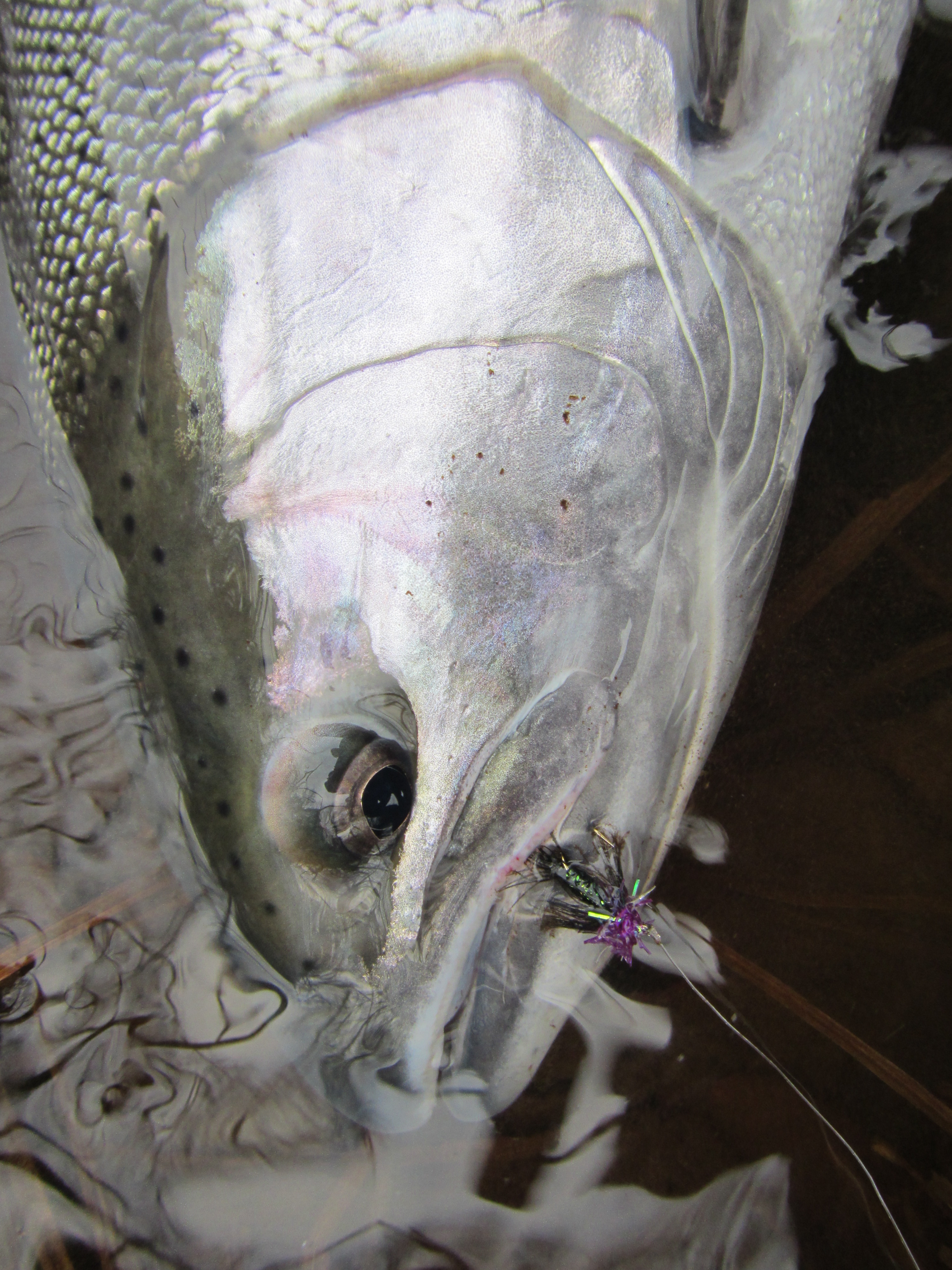
Fresh chrome, Salmon River, 11/2014
I’m gotten a lot of requests to do a video on my soft-hackled streamers, so here you go with the Hi-Liter.
The following content draws from my original post on the Hi-Liter:
It was the mid 1980s. I’d just landed that coveted first job as a junior copywriter at a mid-sized Connecticut advertising agency. Every job that came across my desk included a creative brief: the background, current situation, brand essence, single most important thought, and support points for what I’d ultimately be creating. I’d pore over the brief with the eagerness of the cub writer I was. But then, I’d want that brief to be even briefer. So I’d reach into my drawer and pull out a highlighter marker. Usually bright green or fluorescent yellow. Sometimes pink. When I was done, that brief would be focused on the essentials. I could see at a glance what was really important.
That’s the energy behind the Hi-Liter streamer.
The moment it hits the water, trout can see what the most important object in the pool is. It’s that thing. That bright, moving, flowing thing. Can’t miss it. There it is. Never seen a baitfish in those colors. But oh, look how it moves and pulses and flashes. The heck with those little black stones. I want that thing. Now. Better eat it before it gets away.
I’d like to tell you that I thought long and hard about the Hi-Liter, and that I field tested it for months. But the truth is that I made it up on the spur of the moment several years ago just hours before I stepped into the river. The trout liked it that day. And they still do.
The Hi-Liter. It looks substantial here, but it casts small, and slims down dramatically in the water.

~
A wallflower this streamer is not. Subtlety escapes it. See how the colors pop against muted earth tones? I love the Hi-Liter on bright, sunny days.

All wet. My original prototype from years ago.

Tying notes: With the bead head and the wire seating, the fly will ride hook point up. The weight addition is subtle; this is not intended as a “carpet bomb the bottom” fly. For a more traditional style streamer, skip the bead and the wire. Besides the marking pen reference, the original color scheme draws from the extensive use of chartreuse and pink in striper files. I also tie this fly with a fluorescent yellow or chartreuse tail, and a white hackle. Try not to over-dress the fly; you want the hackle to act as a veil, creating a translucent effect against the body.
~
The Hi-Liter Rogues’ Gallery:
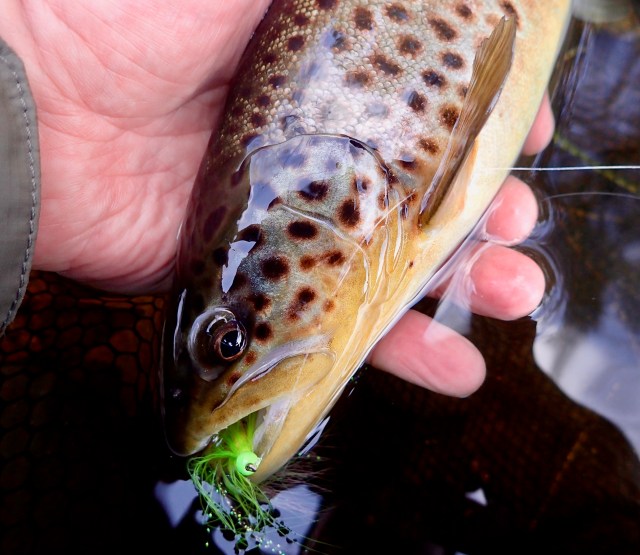
Farmington River someteen-inch brown, 3/13/15

~
Farmington River, 1/21/15

~
Farmington River, 12/19/17
OLYMPUS DIGITAL CAMERA
When it comes to soft-hackles, feathers get all the juice. That’s perfectly understandable. But certain furs – like fox squirrel – make excellent hackling material. The results are often deliciously buggy.
Such is the case with the Squirrel and Ginger caddis emerger. This humble creation is something I made up a few summers ago. I took the Ginger Caddis Larva fuzzy nymph and swapped out the standard wet fly hook for a scud hook. Added a flashy rib. And replaced the rabbit fur thorax with a hackle of fox squirrel.
The first time I fished this fly was on a brilliant July day that was devoid of hatch activity or rising fish. The sun was high, the air was steamy, and felt a little foolish for making the drive to the Farmington. Until I started hooking fish after fish on this little caddis emerger. It was the middle fly in a team of three, and the trout stated in no uncertain terms that this was their favorite.
The Squirrel and Ginger is a fine introduction to fur-hackled flies. It is fairly easy to tie. Best of all, it’s a wet fly you can have confidence in.
The Squirrel and Ginger Rogues’ Gallery
7/8/13, Farmington River

4/24/13, Farmington River

7/31/13, wild brown, Farmington River

4/29/15, 17″ holdover brown, Farmington River

10/8/19, 20″ holdover brown, Housatonic River

I’m not sure this really needs a how-to video, but the 60 Second Redhead is such an amazingly productive steelhead fly that I had to share it.
The Magic Fly (Pale Watery wingless wet variant)
Hook: 1x fine, size 16-20
Thread: Pearsall’s Gossamer silk, primrose yellow
Hackle: Light ginger hen
Tail: Light ginger hen hackle fibers
Body: Rabbit fur, color to match the natural
I will be the first to tell you that I don’t believe in magic flies – you know, flies that you tie on and you automatically start bailing fish. This pattern is the closest I’ve found to being the exception. The Sulphur hatch is notorious for producing stillborn flies and frustrated anglers. The same could be said of the summer stenos, which have left me muttering to myself and spitting oaths on numerous occasions. The first time I fished this fly, it was a classic June Sulphur night on the Farmington. I had a whole pool of trout at my command. They rose to the fly with such confidence that I couldn’t believe what was happening. It must be magic! I treat this fly with silica floatant (my favorite is Frog’s Fanny) and fish it like a dry, on a long leader on a dead drift. The soft hackles and spikey body create a must-eat-me-now illusion that turns trout stupid. Alter the size and color and you’ve got a fine match for dorotheas and stenos.
The Magic Fly is based on the old English Pale Watery wingless wet pattern.
If there is a downside to this fly, it’s that it is a victim of the materials that make it such a success. The wet fly hackle quickly absorbs water, sinking the fly deeper into the film. Sometimes this is a good thing. Most nights, though, I find the trout want the fly a little higher on the surface. Even repeated shakes in a floatant canister and a re-dusting of silica won’t keep the fly where it needs to be. So make sure you tie up a half dozen in each size. Speaking of size, of the trout aren’t taking the fly, try going down one size. Sometimes that makes all the difference.
~
The Magic Fly Rogues’ Gallery:

~
High-teens long, fat Farmington brown taken 7/21/14 on a size 20 Magic Fly
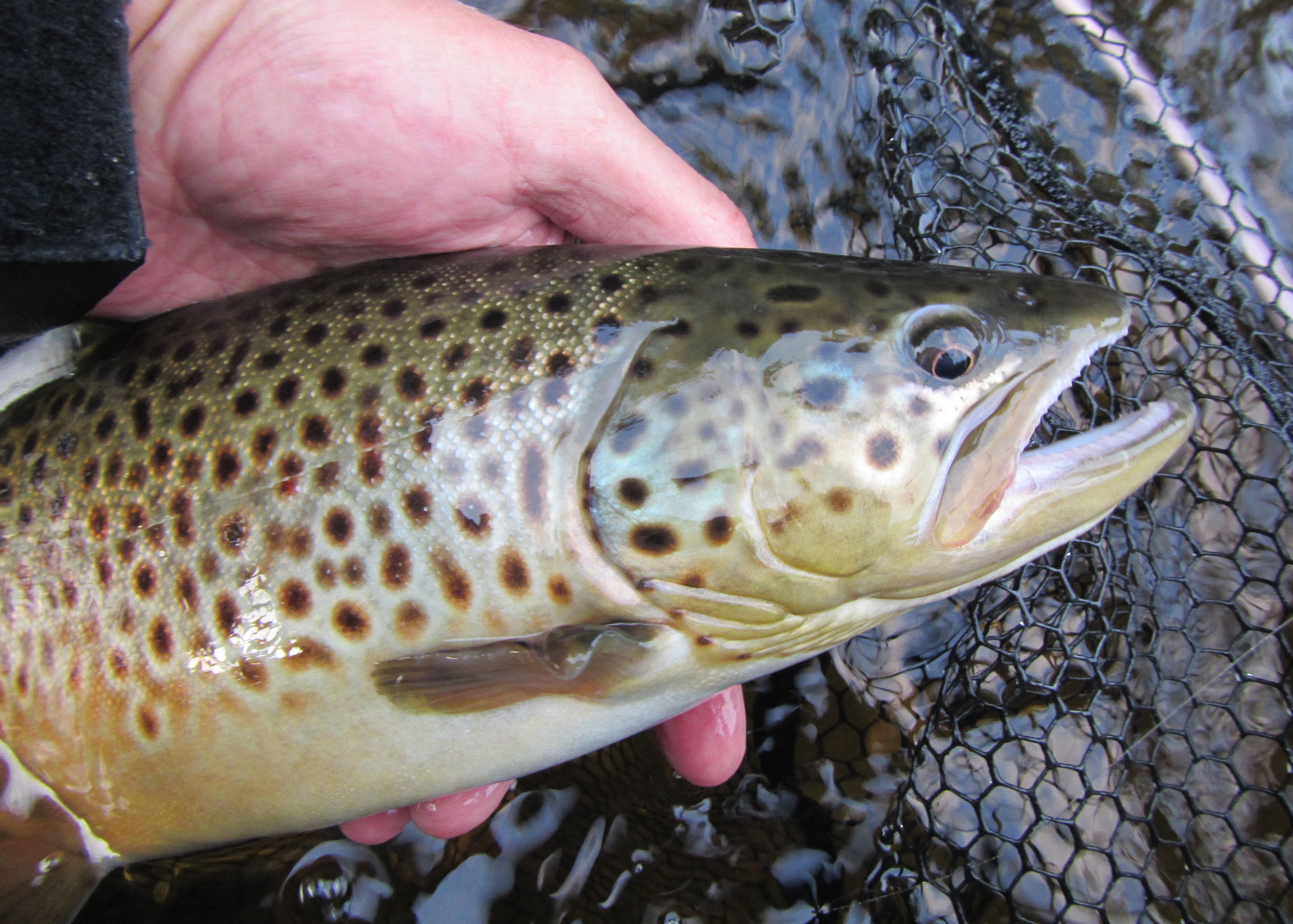
The Dark Hendrickson Winged Wet is a fairly easy tie that uses readily available materials. Best of all, it is a real fish catcher. I couldn’t possibly tell you how many trout I’ve taken on the Dark Hendrickson over the past few years. Match the size to the naturals on the river, pick out a rising trout, drift or swing the fly over its position, and hold on.
 currentseams.com