I guided Doug on Monday and Tuesday, and the results were fascinating. (At least they were to me.) Doug, who’s from northern Michigan, drove all the way to Connecticut for a wet fly lesson after hearing me talk about wet flies with Tom Rosenbauer on the Orvis podcast. We fished within the PTMA on Monday, and conditions were pretty spiffy: 330cfs, clear, cold, and a good caddis hatch, mostly tan, sz 16-20. The problem was uncooperative fish. We had a few risers to target, but nothing was coming up consistently. It was a struggle to put a couple in the hoop. Like many anglers new to the way of the wet fly, Doug needed some time to adjust to the casting, the mending and presentation, and waiting for the fish to do the hook setting.
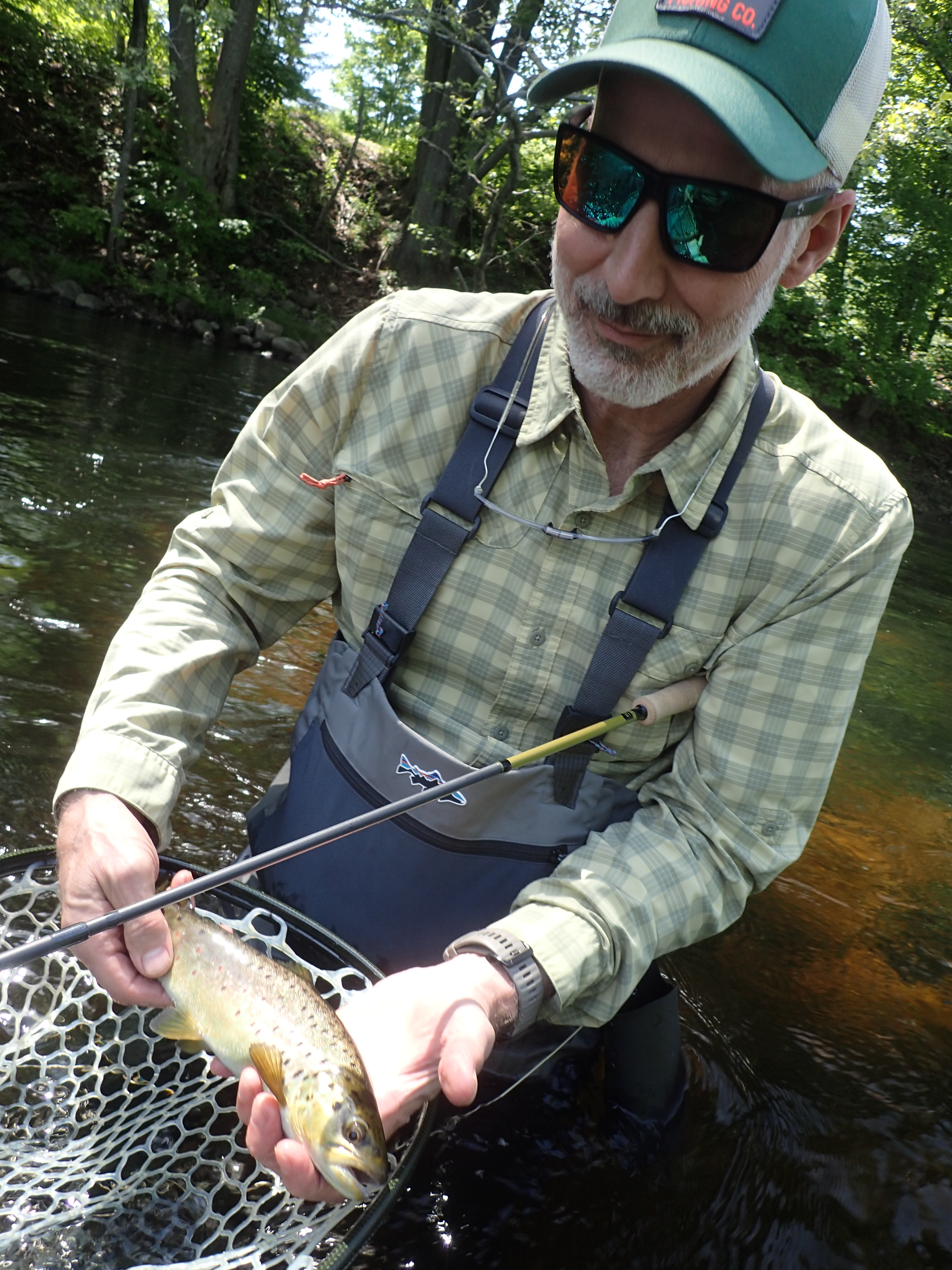
Day one: Doug scores a lovely Farmington wild brown, taken on a BHSH Hendrickson, sz 12. He went out after our lesson and stuck a few more fish. Little did we know he was just warming up for Tuesday.
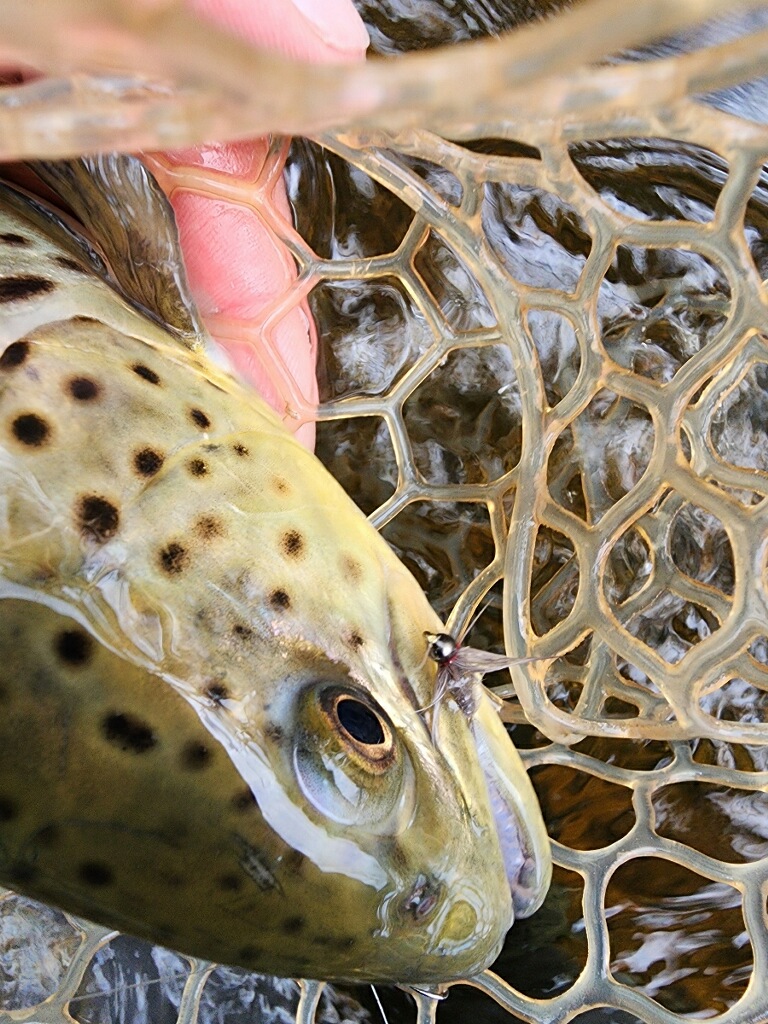
We fished the same time frame on Tuesday, 11am-3pm, only this time we headed to the lower river. 565cfs, clear, 55 degree water and glorious 80 degree sunshine. We focused on dialing in his presentation, covering water, and targeting fishy areas in some classic pocket water. What a difference a day makes! Doug stuck nine and landed eight. It was really cool to see him gaining confidence and making so many eat-worthy drifts. Fantastic job, Doug, and he scored a Farmington Hat Trick with browns, rainbows, and a brookie to hand.
About three hours into our session, I told Alan that of all the lessons I’d given over the years, if you asked me to pick the absolute worst days for catching, this would easily be in the top three. Or would that be bottom three?
It didn’t start that way: reduced flow (425cfs in the PTMA), warm air, bright sunshine, and bugs everywhere, bugs being caddis and midges. (Also witnessed: crane flies.) The midges floated by in mats and clusters, the caddis emerged and danced on the water and flitted through the air…and nothing was on them. I saw two rises in four hours. And so it turned out that it was a terrible day for catching fish on wet flies.
I leave the why to those who are wiser than I, but among my guesses were high pressure, a sudden change in flow, and (most likely) trout eating the caddis larva and emergent pupa near the bottom and at the mid depths. This last scenario manifested when we took our only fish of the day on a tungsten bead head Hendrickson soft hackle fished on point.
It wasn’t just us. We saw or encountered over a half dozen other anglers, and none of them had hooked up. Some days, the fish win. But Alan kept at it, making hundreds of fish-worthy presentations, and there will come the day when he does that and he’s hooking up on every cast. Well done, Alan!
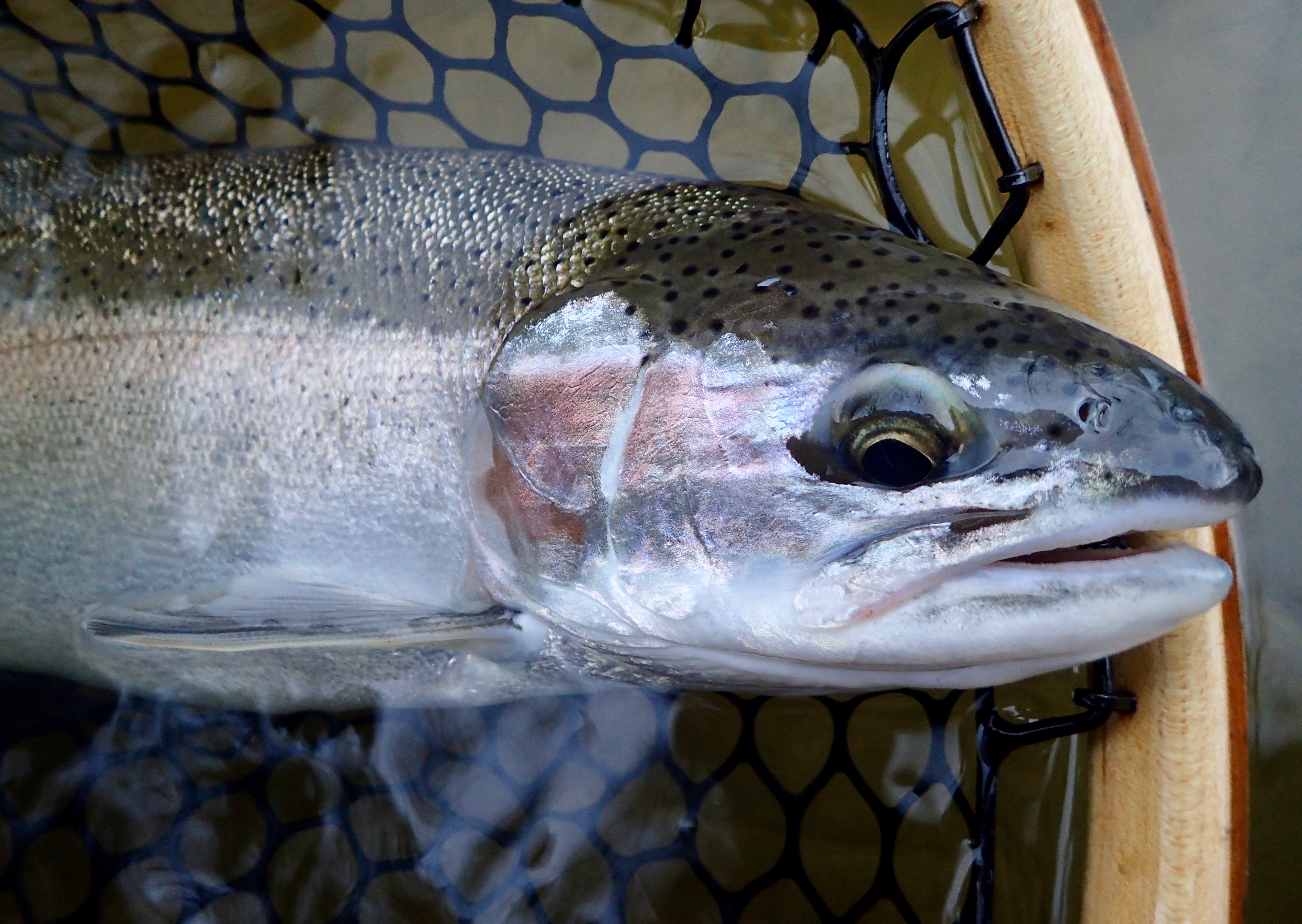
Salvation comes to us in the form of a lovely parr-marked rainbow. She slammed the point fly on the dangle so hard, the Alan never had time to set the hook. Thanks, you beauty, for doing all the work, and to Alan for his positive perseverance.
On Monday I had the opportunity to fish a private stream, so naturally I jumped on it. This is a lovely brook that wants to be a river, and it’s not easy water. Its banks are overgrown, and there’s often a three foot drop from terra firma to water. The first beat we fished was particularly challenging; a lot of the water crawls along, creating glassy pools where any movement sends the fish into flight toward the nearest cut bank. I was instructed to stay out of the water as much as possible, but when did I ever follow directions when I wanted to do my thing? I decided that I needed to get in, summon my inner stealth ninja, and fish downstream.
Sure enough, I crept up on pool that had risers. The hatch was midges and caddis, and there were a few stray Hendrickson spinners. Some of the takes were more emergery, some gentle sips. I had two fish slam the fly the moment it hit the water, and a few more that required a little coaxing. I took six fish, which I was told was pretty darned good, a nice mix of stocked and wild brookies and some chunky rainbows. All three flies were eaten: Squirrel and Ginger (sparkle variant — more on that soon!), Hendrickson spider, and LaFontaine’s diving caddis, tan.
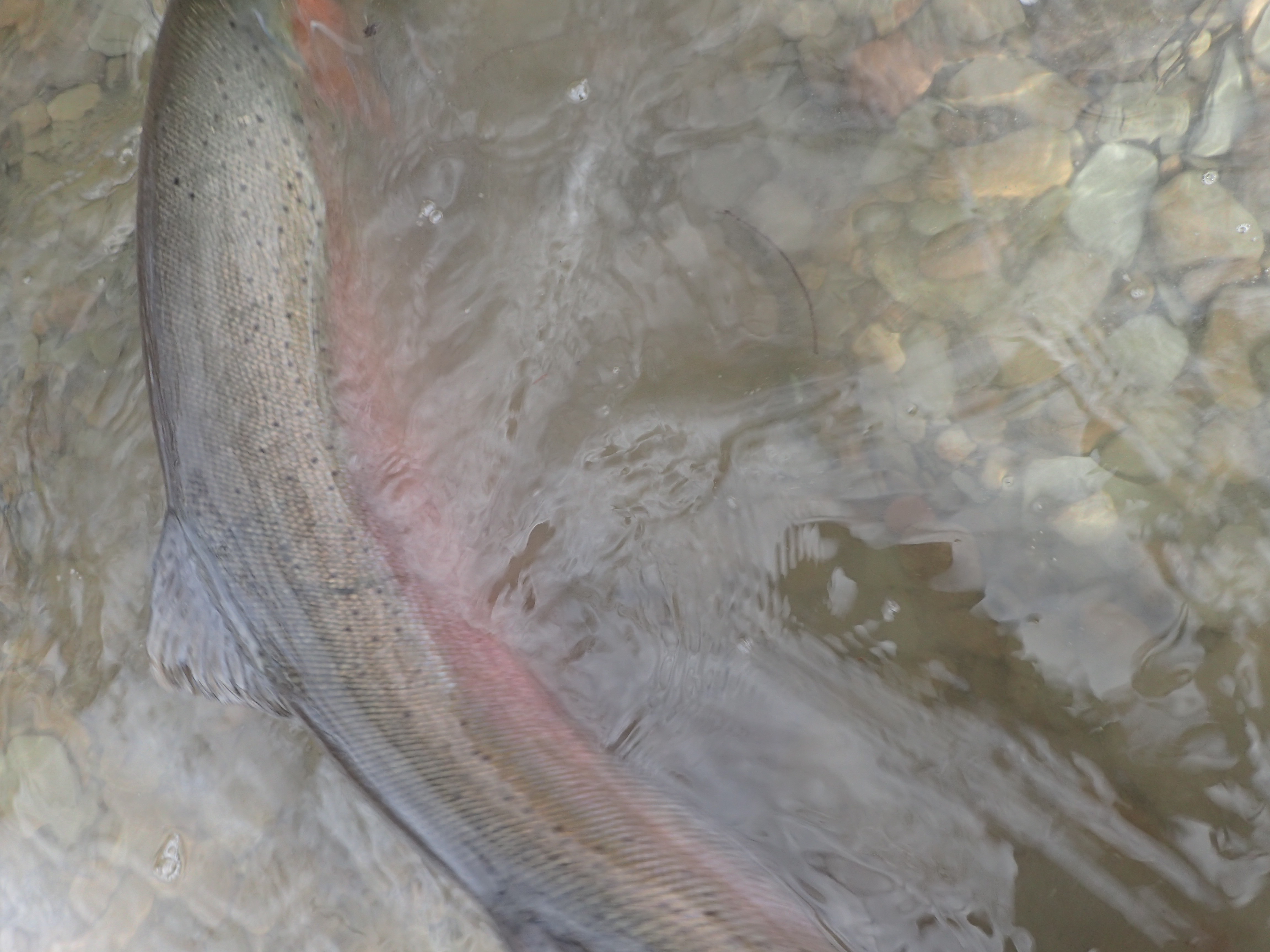
The second beat was not as kind. It began good enough, with my biggest fish of the day, a rainbow with a dramatic pink band (you can see it on Instagram @stevecultonflyfishing) on the second cast. But even though this mark was far better suited for wet flies, I only managed one more trout (do creek chubs count?), and even with that one, I had to wait a half hour and go back after I missed her the first time. I think the lack of activity was due to the hatches being over, and everyone with fins being well fed. Or, maybe I just stunk. Or maybe it was just fishing. No matter. It was just capital to be out fishing. Thank you. Peter G., for your most generous invitation.
It’s almost never a bad idea to swing wet flies when you see feeding fish, especially during an emergence. However, be advised: if the trout aren’t feeding regularly and rhythmically, and you don’t get hit after three good presentations, you may be in for a bit of a wait…
Meanwhile, nose to the grindstone on the book. As far guide trips go, I am not taking any more dates in May. If you see me on the river, please come say hello.
Then, of course, there’s the new house and vegetable garden, which won’t plant itself. What a wonderful collection of obligations.
It’s hard to believe, but yesterday was the first time this year I got out on the Farmington River — and most of the afternoon was dedicated not to fishing, but errands and work. Poor me, having to spend an afternoon in an office that included shirtsleeve weather, sunshine, Hendricksons, trout, and good company!
Besides fishing errands — new boots and two nets on the item list — I spent some time distributing info sheets on gathering fly patterns and photos for the book. Then I hightailed it to the river to get some shots of guide Steve Hogan with his client. Finally, I spent an hour idly swinging a team of three wets. I’d missed the earlier hatch window, but I stuck a pile of juvy Atlantic salmon and then finally a rambunctious stocker rainbow.
I’d given Steve a tungsten bead head soft-hackled Hendrickson, and later in the day he sent me this photo, taken upriver. Well done, Mark! While there were some Hendricksons in the air, the hatch has progressed to north of the PTMA. Church Pool was devoid of anglers at 3pm, so there’s your proof.(Photo by Steve Hogan)
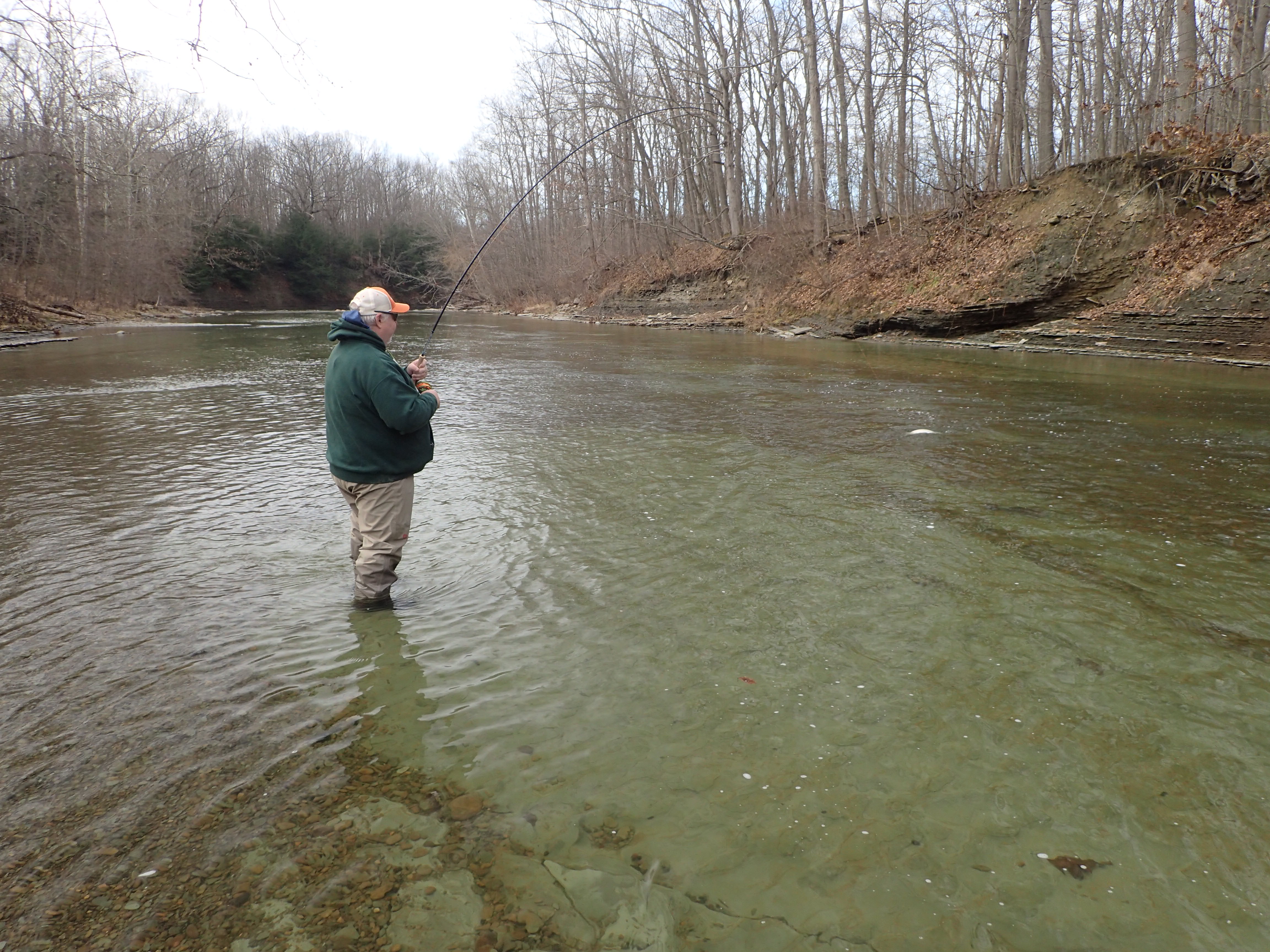
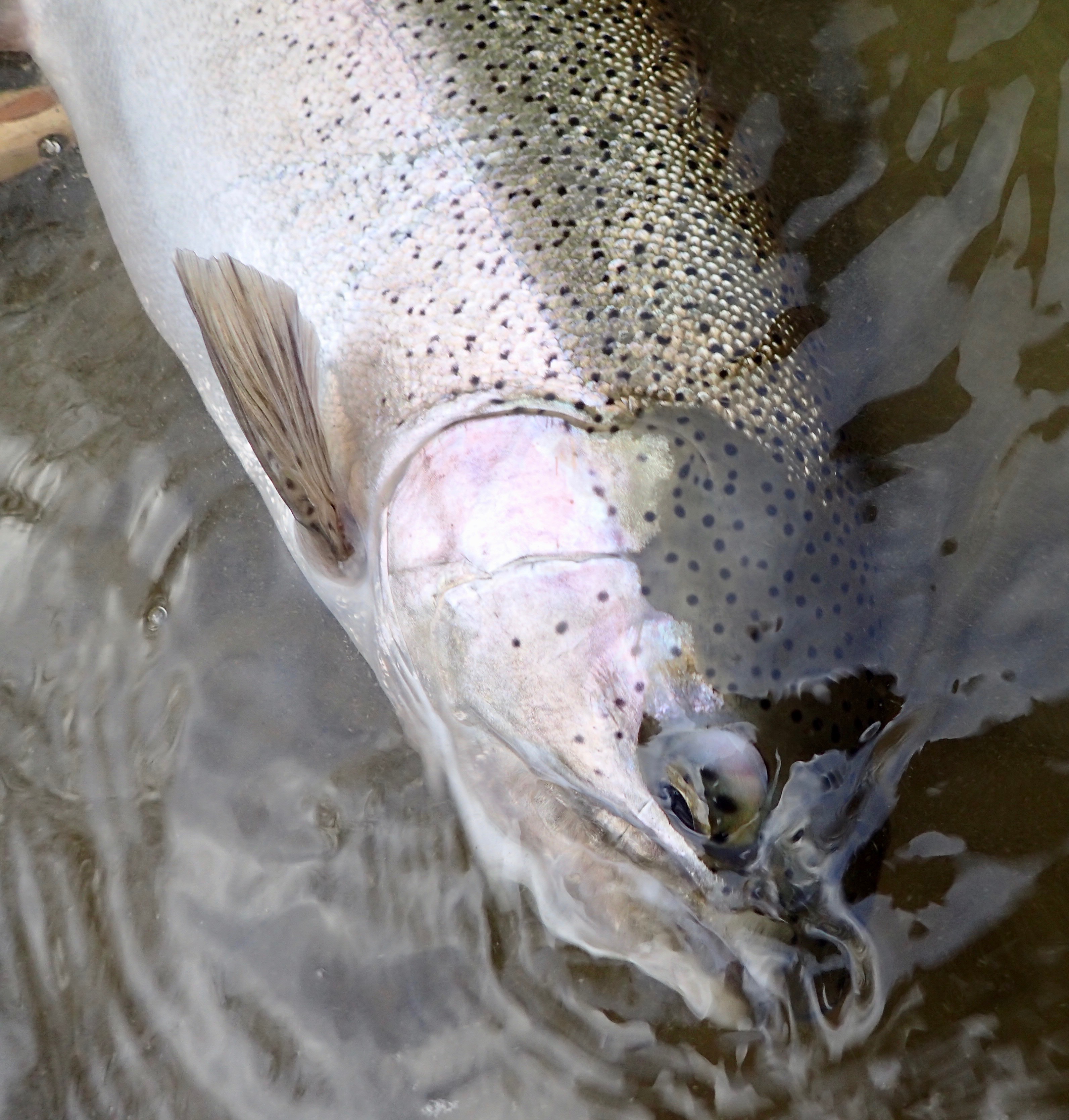
I ventured with #3 Son Gordo to ye olde steelhead mill, AKA Pulaski, NY’s Salmon River, for two days of post-spawn steelhead fishing. Due to an unusually mild winter, the spawn was very early this year. what should have been prime time numbers was picking away and scrapping for every fish. The weather was chilly, but bright and sunny, and predictably the fish were holding in the deepest, fastest, most bubbly water they could find. I was 2-for-3 on Monday and 3-for-4 on Tuesday with a couple skippers in the mix. Gordo, who was spin fishing under a float, put one in the hoop each day. All steelhead are special, so it was a treat to have our hard work and persistence rewarded. See you in November!
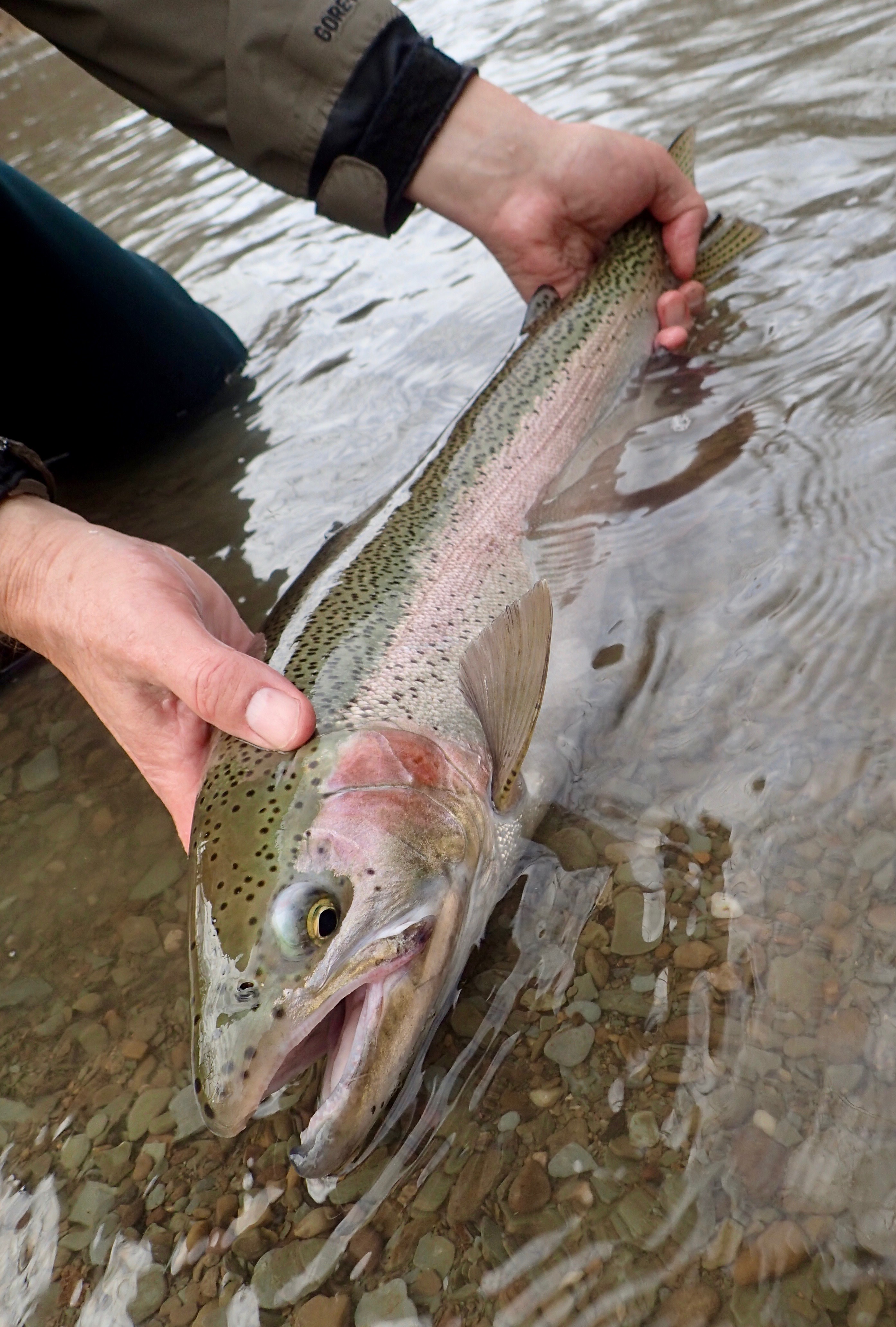
This post-spawn hen slammed a size 6 olive Woolly Bugger in a fast-moving slot near the head of the run. Moments before, I’d taken a two-pound skipper on the same fly as I was stripping it in to recast. Thank you both for playing!
I didn’t think I would land 17 steelhead today, but you never know. Crazier things have happened. We — Number 2 Son Cam was joining me today, along with our guide Bob Packey — would be fishing Conneaut Creek in Ohio. I love this stretch of Conneaut. It’s got the ubiquitous sheer shale cliff faces you associate with Erie tribs, and while it does have its share of shallow, easy-to-read flat bottom, much of it resembles a traditional trout stream like you’d find back east.
The weather was cooperating. At least at first it was. Overcast, which was nice, but then it began to shower, building to you-need-a-raincoat strength. Then, the wind picked up, whipping piles of leaves into the water. That was a wee bit of a problem. But when it comes to steelheading, you get what you get and you don’t get upset. The water was lightly stained, and with the leaves, increasingly tannic. Not necessarily a bad thing.
We started off at the tailout of a deep pool, hard against a shale ledge. We fished this mark last year, and did very well, but for the first 10 minutes this year the fish weren’t having it. Finally, they began eating. This is a challenging place to play a fish, as the tailout dumps into a series of rapids and pockets. If the steelhead goes down the chute, you’re either chasing after it, which can be dicey, or breaking it off, which is lose-lose for all parties. Fortunately, the steehead gods smiled upon us. Conneaut has several sections where playing a fish is difficult due to swift currents and rocky substrate. Landing fish on this day was far more challenging than yesterday at Elk. I felt like I earned every fish.
~
Adding to the challenge was a mix of fresher fish, and water temps that were a decidedly un-December-like 47 degrees. Many of the fish, like this one, were hot players not long from Erie. But I like a challenge. It sweetens the pot.
~
We worked our way downstream, banging away at pockets and runs that looked like good holding water. This lovely hen came out of a swirling pocket at the edge of a waterfall. I can’t say enough about the fine coaching Cam received from Bob Packey — and about Cam’s fly fishing. You see, Cam really doesn’t fly fish. But he gets it. Sure, he’s had experience landing steelhead on the fly rod (I used to hand my rod off to him when he was little and let him have at it) but as anyone who’s done it can attest, steelheading isn’t easy! Great job, Cam.
And so, dear reader, this is where the story gets interesting. We fished a tailout that held dozens of steelhead last year. This year, not so much. Only two touches, and zero fish landed. However, the run below was Yahtzee. At one point I hooked up on six consecutive casts. My landing percentage was good. Some quick math, and I was at 198.
Two to go.
And then, the steelhead gods stepped in and waved their collective index finger at me. Now, now. Not so fast, Steve. I had a chrome skipper just at the net before it bolted, ran between two rocks and wiggled off. I got snagged on the bottom and could not free it. A walk upstream and some direct pressure and…the bottom fought back. Big steelehead. Battle ensues. The fish spit the hook and got fouled on the dropper. Off it went. We made the command decision to stay a little later and finish the job. Again, the steelhead gods with their wagging fingers. Foul hooks, tippet failure, bad luck, no fish where they should be…200 would have to wait for another day.
I can’t say that I was mortally disappointed. 15 in the hoop is very, very good day.
I don’t normally count fish. But steelhead are a special case. They can be hard to find, hard to hook, and hard to land. You can do everything right, and still lose the fish. So every one you bring to the hoop and safely release is to be savored, even treasured.
Last Friday morning found me on Elk Creek in western PA at first light. The tally at that point was 175. I figured that 200 might be in reach on this three-day trip, and that five on day one would be reasonable. (In retrospect, it’s a little foolish to plan on catching a certain number of steelhead. You just never know what stream conditions, the elements, or the fish will throw at you.) I was flying solo, and got to the creek early enough to secure a prime mark. Within ten minutes, I was one-for-one. Then things slowed. I worked down the run and bagged another, a shiny fresh hen just in from the lake. Then nothing. By now the sun was up and I could clearly see into the tailout. It looked barren.
Every substrate is different, and ever-changing light also affects how well you can spot fish. As you can see, steelhead are masters at adapting their coloration to the environment. Sometimes you see them; sometimes you don’t. Learning to determine where they might be holding in any given condition, especially when you can’t see them, goes a long way toward improving your catch rate. I fished a couple pools and runs that certainly must have held fish — except they didn’t. At least not on that day and hour. If you’re not catching and you’re not snagging the bottom, you’re not fishing deep enough. And if you are fishing deep enough, and you’re not fouling a fish or two, there probably aren’t any steelhead in the pool. I lost many a rig in one indescribably sexy pool without a single hookup. But once I found the fish, it was go time.
Since another angler had jumped into my original spot, I decided to take a chance and walk upstream. As I neared some prime water, a guide materialized from the river banks to deter me from slipping in below his client. I gave them both a friendly wave, and announced that I had no intention of crowding them. This put everyone at ease, and I struck up a conversation with Glen, the client, and T (dagnabbit, I forget his name) the guide. Cigars were offered, flies and pleasantries exchanged, and before you know it I was fishing in a nifty slot above their pool. Funny how kindness and politeness goes a long way!
Friday was a tricky day. Whether due to pressure or other environmental factors, the steelhead went through stretches where they just would not eat. I got pretty good at recognizing early if a fish was fouled, and at taking steps to quickly de-hook the fish. I did land every fair-hooked fish, and on a challenging day where many anglers reported slow-to-no action, I was delighted to land eight steelhead. Many thanks to Glen for taking net duty, then this photo.Glen’s on! I can’t say enough kind words about Glen and T, who were kind, matey, and so generous with their water. In a matter of minutes, it was as if we were all old fishing buddies . You can see the different colored strata on the stream bed. The basic rule of thumb on a creek like this is to fish in the dark water, and near the edge of ledges. I hooked up several times by targeting a deeper, darker slot just downstream of a ledge. I’d toss my rig onto the ledge upstream, then let it drift down into the hole. If there was a player steelhead holding there, it would eat the egg fly the moment it dropped off the ledge.
I gave myself a hard stop of 1:30pm. I had to drive to OH to pick up Cam at college. Tomorrow, we’d be fishing in OH with a guide, and I wanted to be rested and ready. 183. We’re getting there.
I haven’t done a winter lesson in years, which is too bad. Winter can be a great time to fish the Farmington, especially if you like walking into any hole you damn well please because no one else is fishing. OK, so it’s not always like that, but with Monday’s cold front coming through — the mercury dropped 13 degrees in a matter of 10 minutes — and Tuesday’s forecast for gusty winds and snow showers — anglers were few and far between.
We fished from 11am-3pm, a good winter window. The method was drop-shot nymphing under an indicator, two-fly dropper system. The first mark was a popular spot within the PTMA. We had it all to ourselves for a half hour, then two more anglers showed up. The four of us managed one take in an hour, so I made the decision to head up to Riverton, where we’d find lover flows (PTMA was about 500cfs, Riverton 250cfs) and warmer water.
We also had solitude. The angler fishing 100 yards downstream from us left after 20 minutes. We stuck two fish at the the first place, one on the first cast, but then the action slowed. With 45 minutes left in our session, we moved upstream a quarter mile. Both Andy and Ross connected here, too, but sadly both trout wriggled off. With ice in the guides and the sun falling farther below the tree line, we called it a day.
Both Andy and Ross made significant, noticeable improvements over the course of the session, from casting to presentation. Lessons that bear repeating: it’s a bunch of little things that draw the line between fishing and catching. Drag-free drifts, false positives that let us know our flies are on the bottom, line management and mends, and especially looking for a reason to set the hook on every drift are all crucial to success. Well done, Andy and Ross!
I was so into the teaching thing that I didn’t get any shots of the lads in action. Here’s a sample of some of the bugs were were using.
Finally, a reminder that I do guide year-round. If you want to take advantage of reduced angler traffic, a winter lesson — it really is a different game than spring-fall-summer — will start you on the way.
After fishing two Erie tribs in OH and PA last December, I knew I would have to get back there. Soon, nine-ish hour drive be damned. I had to wait a full 10 months to do it, but it was so worth the wait.
Unlike the northeast, Steelhead Alley has seen very little rain this summer and fall. The timing for my trip could not have been better, with a decent slug of rain before the weekend that marked the true start of the fall run for many tribs. Still, the water was on the high side of low — if that makes sense — meaning that 90% of the fish would be in 10% of the water. The spook factor would likely be very high, along with angler traffic.
Adding to my challenges was that I had zero experience fishing public waters. So I hired the guide I used last year, Bob Packey of Solitude Steelhead Guide Service. Bob focuses on fishing private water — an absolute treat — but that would do me no good when it came to public water. So we formed a game plan: fish Wednesday morning on private water for a few hours, catch a few fish, then bounce around to some public access marks so I could learn some spots. Since Bob has deep domain experience on Erie tribs, I knew I’d be in good hands.
The dread cold front hit the night before day one, putting the steelhead in winter mode. We saw runs and slots that held dozens of steelhead, but even with precision casts and presentations, they were just not having it. Once the sun rose and the water inched up a precious degree or two, the natives decided to play. We had success with sz 14 Blood Dot eggs and sz 10 White Deaths fished as the point fly on a two-fly rig under an indicator. Switching to the White Death fly was a revelation, as fish that couldn’t be bothered with eggs suddenly opened their mouths and moved to take the fly. Bob is a terrific guide, and I’m learning so much from him about this unique fishery. Photo by Bob Packey.We had to work for our fish in the morning of day one, but beauties like this always make it a labor of love. I also stuck a big ol’ brown trout — funny how that’s considered by-catch when back home it would be a trophy. By 11:30am we were at a public access point on Elk Creek. Although there were plenty of anglers — “crowded” on Erie tribs is not the same as “crowded” on the Salmon River in Pulaski — we were able to find a half dozen highly productive marks because so many anglers were fishing in the wrong place. Cracking the Erie tribs fish-finding code is a major part of success. Once Bob showed me what to look for, finding the fish was much simpler task. The answer to the question, “Was that the bottom or a fish?” On all three mornings I fished, the steelhead were sluggish at first light. Once they turned on, there were far fewer fouls. When I foul a steelhead, I try to rope it in fast. I find I have very few breakoffs; most of the time, the hook comes away without breaking the tippet. I caught and released several fish that had hooks imbedded in their fins or bodies.What a rugby ball of a hen! She took the top fly on my rig, Clyde Murray’s Spider, size 12, in low light. My strategy on days two and three was to focus on a few marks and learn them cold (as much as I could in a few hours). Not all of the water was productive over the course of two days — steelhead are on the move this time of year — but I certainly had fun trying different flies and different combinations in different runs at different times of the day.So that’s why I lost that fish…Elk Creek living up to its name, a small window of wonder on an early morning when I was the only angler on the water for a few hundred yards. My final tally over 2 days and 3 hours was 20 steelhead landed, a bunch lost, and immeasurable fun. A little more rain, a little more flow, no bitter cold. Those are my hopes for December. Steelhead dreaming is a thoroughly enjoyable pastime.
If you fish for striped bass with a fly rod, you’re operating under an unimpeachable assumption: whatever you hook must be within close range. Fly casting range. Not practice casting on a lawn with just a fly line. I’m talking standing thigh-deep in the ocean with a line and leader and fly and waves and wind and if it’s the dark of the moon, limited vision. You might get 100 feet if you’re a tournament-level caster, or have a two-handed surf rod. For most folks in standard conditions, it’s probably 75 feet or less. If the wind is honking in your face, you might be talking well under 50.
Sometimes, distance just doesn’t matter. (The last striper I caught took the fly under a rod’s length away from me.) And sometimes, like Wednesday night, distance is everything.
I fished with surfcaster extraordinaire Toby Lapinski, and it was a tale of the tape. Toby got into a half-dozen-plus fish ranging from 5 to 15+ pounds, and I blanked. Oh, I had a few pulls from squid, a solo sharp rap, and then later, a momentary hookup. But the spelling of the word of the number of bass I landed begins with a Z. Toby was launching his wares way over 100 feet, and that’s where all the action was. I had my two-handed surf cannon with me, but I was well short of where the fish were holding and feeding. I saw one of Toby’s hookups, and it was a good 50 feet beyond what I was making. (And I was having a very good casting night, bottoming out on just about every cast.)
A cast, a mend, a slow gathering of the line, and….nothing. (Photo by Toby Lapinski)
You might think I was discouraged, but that wasn’t the case. I was delighted that Toby was getting into fish. Most of all, it served as proof that I wasn’t fishing poorly. I just couldn’t get the fly out far enough. Nobody could have. Thank goodness those nights are the exception.
Out thinking as we trudged back along the beach was to try a different, earlier stage of the tide, when the fish might be in closer. It’s all one huge science experiment, with your lab report being graded by the fish. So I’ll be looking to bump that C up to an A.