Striper Report 9/20/23, or: The One Where Casting Distance Made All The Difference

If you fish for striped bass with a fly rod, you’re operating under an unimpeachable assumption: whatever you hook must be within close range. Fly casting range. Not practice casting on a lawn with just a fly line. I’m talking standing thigh-deep in the ocean with a line and leader and fly and waves and wind and if it’s the dark of the moon, limited vision. You might get 100 feet if you’re a tournament-level caster, or have a two-handed surf rod. For most folks in standard conditions, it’s probably 75 feet or less. If the wind is honking in your face, you might be talking well under 50.

Sometimes, distance just doesn’t matter. (The last striper I caught took the fly under a rod’s length away from me.) And sometimes, like Wednesday night, distance is everything.

I fished with surfcaster extraordinaire Toby Lapinski, and it was a tale of the tape. Toby got into a half-dozen-plus fish ranging from 5 to 15+ pounds, and I blanked. Oh, I had a few pulls from squid, a solo sharp rap, and then later, a momentary hookup. But the spelling of the word of the number of bass I landed begins with a Z. Toby was launching his wares way over 100 feet, and that’s where all the action was. I had my two-handed surf cannon with me, but I was well short of where the fish were holding and feeding. I saw one of Toby’s hookups, and it was a good 50 feet beyond what I was making. (And I was having a very good casting night, bottoming out on just about every cast.)

A cast, a mend, a slow gathering of the line, and….nothing. (Photo by Toby Lapinski)

You might think I was discouraged, but that wasn’t the case. I was delighted that Toby was getting into fish. Most of all, it served as proof that I wasn’t fishing poorly. I just couldn’t get the fly out far enough. Nobody could have. Thank goodness those nights are the exception.

Out thinking as we trudged back along the beach was to try a different, earlier stage of the tide, when the fish might be in closer. It’s all one huge science experiment, with your lab report being graded by the fish. So I’ll be looking to bump that C up to an A.

When you’re expecting small, be prepared for big

If you’ve taken a lesson with me or attended one of my presentations, you’ve heard me say that we all put our waders one leg at a time. So, even though I may be considered an authority of sorts, I’m still human — and I still make mistakes on the water.

Twice now, on my last two trips to the Cape, the catch has been trending small. Twice, I’ve subsequently hooked into something very large, and lost the fish.

Now, you could make a case that I was a little unlucky. There’s probably some truth to that. But the single biggest reason I lost those potential cows is because I wasn’t ready for them. I didn’t make a powerful initial hookset. And by the time I realized what was happening, I’d already lost the fish.

Gordo hooking up. At least someone on this crew knows what they’re doing.

My most recent tale of woe came earlier this week on the Brewster Flats. I was fishing a small weighted crab pattern, probably on a size 4 hook, letting it bounce along the bottom, then swing up at the end of the drift. It had been a slow morning — Gordo, who was spin fishing with a jig head small soft plastic, had connected with two smaller bass. So that’s what I was expecting. I hadn’t had a touch all morning, and had been cycling through patterns in a desperate attempt to find something the fish might eat. The crab fly was on the dangle below me just over a deep hole, and I was daydreaming.

WHACK! The bass hit the fly like a bullet train. Immediately, line began screaming off the reel. The fish made a textbook striper series of runs: one good, long one, then a pause (where I attempted to reset the hook and gain some line). Then a second powerful, albeit shorter run. I reset again, but it felt wrong. I was furiously cranking the reel when the line went slack. Heartbreak.

So. I hoping that I’ve learned my lesson. It’s OK to expect small, but be prepared for big. I certainly will be.

Next time.

Farmington River Report: Not to sound like a broken record, but…

Even though we’re haven’t experienced a heat wave in weeks, water temps on the West Branch continue to play spoilsport. As I write this at 12:30pm, it’s already close to 70 degrees(!) in Riverton. Not good. With the warm, damp late summer weather, it’s no surprise that flying ants have been out with trout eating them. But, as UpCountry Sportfishing’s Torrey Collins writes, “you need to be very careful about water temps in the afternoons. This means you may need to fish between Canal/Beaver Pools and the dam to stay in water temps of 68 degrees or less.” As of late, the cutoff point for safe fishing above Riverton has been around 10am.

So: my guide trips remain in limbo. Patience will be our virtue. Although, if you want to curse and mutter under your breath, I certainly won’t stop you.

Thanks also to everyone who started following me on Instagram.

This was my client Michael on the Lower River in late June, late afternoon, 100cfs, and believe it or not, the water was colder there and then than it is coming out of the dam right now!

Another crappy striper report, fishing by feeling, and a good surfcasting podcast with Jerry Audet.

I’m really not in a bad mood about it, but yeesh! I have been getting my butt kicked in the salt since June. Granted, it’s been a trip here, a trip there. Wednesday night I fished a top-secret mark with surfcaster extraordinaire Toby Lapinski. We both agreed that it looked fishy as hell: moon going behind a cloud bank for good, light winds making just the right amount of chop, falling barometer, moving tide, and….no bait. What?!? No legions of silversides? No juvenile menhaden? Toby managed a few courtesy bumps and a husky 8-10lb bluefish; all I could muster was a lightning fast double-blip hit that I suspect was a smaller blue. We only gave it 90 minutes, but we just weren’t feeling it.

Which brings us to the second part of this post. Dennis Zambrotta wrote that when he fishes the west side beaches of Block Island, he gives a mark 10 casts or so and then moves on. I don’t have any hard and fast rules like that, other than when I’m fishing by feeling, I get into a yeah or nay mindset. And on this night, the nays were screaming out loud. I was the one who formally called it, and Toby later confessed that he was ready to leave even before that. I guess when you reach a certain level, and have a certain familiarity with a mark and its patterns, you’re either feeling it or you’re not. Maybe if we stayed another hour, we’d have gotten into some fish. We did agree that if fellow surfcaster extraordinaire Jerry Audet was with us, he’d still be out there.

Jerry is a wonderful example of an angler with a plan. He knows who he is and how he wants to fish and he does it with consistently great results. You could learn a lot from a guy like Jerry — even if you never pick up a spinning rod — and a good place to start is last month’s Anglers Journal Podcast, Surfcasting With Jerry Audet. Give it a listen. Take notes. Appreciate his knowledge and passion.

Even if you’re inclined to get the hell off the reef and get to bed before 2am.

Farmington River Report: A glimmer of hope in this warm water purgatory

It seems never-ending, this stuck-inside-of-Riverton-with-the-New Hartford-blues-again feeling. But a glance at the current temperatures coming out of the dam offers some positive traction for the glass-half full crowd.

This weekend saw the coldest temps out of the gate since August 3rd. If we continue to have cool nights in the 50s, that bodes well for a reduction of a few precious degrees. Of course, sunlight and hot air can quickly defeat those few precious degrees. But better times and lower water temps are coming.

In the meantime, I am continuing to put all my Farmington River lessons and guide trips on hold. Like trout, the Farmington’s aquatic insects are shocked as well. My spies tell me hatch activity has been minimal at best. If you must fish the Farmington, please do it from Riverton northward, and do it from first light to mid-morning. Please carry a thermometer and do not fish in water above 67 degrees. Right now is great time to visit the bluegill pond with for 6-foot glass rod and some poppers or a size 18 Elk Hair Caddis. Panfish fight way outside their weight class (ask me how I know!).

Farmington River Report: Potentially dangerous temps for trout

The flows have come down on the West Branch (about 325cfs from the dam and about 450cfs in the PTMA). But all’s not well. As predicted, the ridiculous volume released by the MDC burned through the colder stores at the bottom of the reservoir, and those won’t be replaced for months. Right now, the dam release is about 64 degrees, which is barely trout friendly. The problem is, the farther you go downstream, and the warmer the air temp and the more intense the sunshine, the warmer the water gets.

This is from Torrey Collins on this morning’s UpCountry Sportfishing river report: “(water temperature) rises varying amounts depending upon the day, time of day, and distance from the dam (it reached a peak of 67 degrees in Riverton in the late afternoon yesterday). With a much cooler forecast this week and cooler nights, I’d say you can safely fish downriver as far as New Hartford in the mornings, but by noonish I’d be up at People’s Forest/Mathie’s Grove/Campground & upstream in Riverton where the water temps will be a little cooler as the day progresses and water temps rise a bit. Bring a thermometer with you and actually use it.”

So if you choose to fish for trout on the Farmington, please consult this infographic from ColoradoTU.org:

Block Island Report July 2023: The downward spiral continues

It’s a warm, humid Block Island night, the kind you get in early summer when the mainland is baking. Dark of the moon. Surf on the low side of moderate, but enough to create a wash zone and necessitate mends over the tops of incoming waves. I’ve scoured the trough of this beach for over an hour with a Big Eelie, and made the decision that it’s not happening. I glance at my watch. 11:25pm. Normally, I’d be all fired up, knowing that if there are no bass here, they’ll be somewhere else, and — best of all — I have another two hours to fish. Maybe three, if the bite is good. But I’m about to do something extraordinary. I catch the fly in the hook holder, reel up, and head back to the Jeep. I’m done. Heading back to the cottage.

What’s extraordinary about this is that in all my decades of fishing Block Island, I’ve never quit a night session before midnight.

This makes three consecutive years of disappointing fishing from the shore on Block Island, and this was the worst by far. The story is one I could tell you in numbers: Seven nights. Five striped bass. Four skunks (six if you count my two daytime sight fishing blanks). No fish over 22″. And the third straight year I’ve failed to land a bass of 10 pounds of better.

What’s behind all this? I can give you my best guesses. A burgeoning grey seal population. Warming inshore waters. Bass that never showed up inshore in numbers in June, so why would they show up now? An abundance of food and cooler water offshore. Dwindling striper stocks. I can tell tell you with fierce conviction that the patterns from ten years ago are a distant, bittersweet memory. Fish are aren’t where they were a decade ago (and don’t get me started on 15-20 years ago). It’s enough to make me heave a rueful sigh.

It’s not for lack of bait. Crabs everywhere. More sand eels than I’ve seen in recent summers, although they were much smaller (1″-2″) than usual. Squid galore. In fact, four nights into the trip, I’d landed as many squid as bass. To amuse myself, I turned on my light and watched the squid attack my sand eel fly. Squid generally muddle along, but their closing speed is impressive.
And the bite is not. I sight fished two days on Crescent Beach and blanked on both. The first day I only saw a total of six cruising targets, and some of those may have been the same fish. The second day, in 90 minutes, I didn’t see a single bass(!). Really? Then there was plain old bad luck. I had confirmed reports of smaller bass blitzing sand eels at dusk on two consecutive nights. The first night, I’d gotten a late start, and I caught the last remaining bass of that feed. The next night, I missed it entirely. Not to be denied, I showed up at the mark the third night ready to fish at 8:30pm. Same tide window, same wind direction, same barometer, and…nothing. No bass, no blitz. You really can’t make this garbage up.
A rocky point, structure, and wash over a sandy bottom holding bait. Scouting mission complete, I headed back after dark to fish the same tide. 15 years ago, I’d be posting pictures of one of the 20-pounders I released. This year, you get a nice seascape. That’s all there is to see here, folks.
Mr. Dour out for an evening stroll. By the end of the week, I was rationalizing my existence by viewing my time as enjoying a good cigar, and oh, by the way, I’ll also be doing this casting and mending thing, too. Mid-week, there was a Steve Culton sighting. An angler was coming out as I was going in, and exclaimed, “I know you! You’re the Block Island fly fishing guy. Steve.” Turns out he’d never fished the Island before, and came across some of the articles I’d written while doing a search. As always, if you see me out and about, please come say hello.
I highly recommend ‘Gansett tall boys, fresh steamers, and Ballard’s famous lobster as a consolation prize. And don’t forget Aldo’s ice cream!

Farmington River Report 6/27 & 28: Low Flows and Project Healing Waters

I was both humbled and honored to have the opportunity to guide three groups from Project Healing Waters. Over the course of two days, we fished, learned, talked, and just plain enjoyed being out on the water. On Tuesday afternoon, I did a streamside classroom for everybody, Wet Flies 101. OK, to be technical, it was at a picnic table at their campsite, but you could hear the river, so that counts for something.

This was the day after those torrential rains, so I gave the first group the option of streamers below the Still River or wet flies above Riverton. Option B was the choice, and off we went. That section was, not surprisingly, loaded with anglers. (Many thanks to those who shared the water both days and were so giving once they learned who we were and what we were doing. True, small kindness is vastly underrated.) The water was bracingly cold, and we had between 70-80cfs of flow to work with — not great, but doable. We found a few fish willing to jump on, but as I heard from the guys multiple times, it really isn’t about putting fish in the hoop. And in this case, they’re mighty right.

Not a bad day at the office! Time flies when you’re having fun, and on both days I frequently lost track of time.

For Wednesday AM, we stuck close to home, fishing water adjacent to the campground. The river had come down a bit, and cleared some, but we still had the challenge of mid-day summer fishing. Nonetheless, by covering water as best we could, we found a few feeding fish. The warmth of the sun on our shoulders and the cool of the river at our feet reminded us that were in a really good place. I had the group fishing a two-fly wet fly team, a fine compromise when not everyone is a great caster. Hatch activity on both days was minimal, and with the recent down and then up flows, I’m sure the insects were as discombobulated as we were.

We finished up Wednesday above the Still River in some gorgeous dry fly water. So, naturally, I suggested we fish dries. I rigged everyone up with a long leader system — minimum 13 feet — and we had at it. What a fantastic job this group did in some fairly technical water. While the trout were feeding — somewhat irregularly on emergers, but mostly spinners, the hatch (sulphurs size 14-16) wasn’t going to break any records for volume. But we stuck with it, and before too long, my man Guppy connected with a nice rainbow on a size 20 Usual.

I’d just seen a trout nail a skittering sulphur on top, so when Guppy’s fly began to drag at drift’s end, I told him to let it be. Moments later, whack! How exhilarating when it all works out just like you drew it up in your mind.

I stayed to fish after our session, but the evening rise never materialized in any big way. There were far more emergers and duns in the late afternoon than in the evening, and no spinner fall to speak of. I managed to stick three trout in about two hours. When I climbed out of the river at 9pm, my legs felt like cold, semi-unresponsive lumps. I was shivering. The fishing had been disappointing. But it hadn’t rained. It hadn’t stormed. And I realized that just being there did indeed count for something.

Farmington River Report 6/22/23: Finding the fish with wet flies, then drying off

On Thursday I guided Michael and Al from 2pm-6pm. My original plan was to explore some of the faster water in the PTMA, but an accident closed part of Rt. 44. So we decided to seek our pleasure downriver.

The stretch of water between Collinsville and Unionville is starting to warm up, but it’s still within an acceptable temperature range for trout (at least it was on Thursday). Depending on where you fish — i.e. below a long, pond-like stretch — you may find warmer water temperatures than in faster, deeper runs. Unless we get rain and a flow bump, the first real heat wave will torch this stretch. (Thanks, MDC, for your outstanding stewardship of the river, and genuine concern for preserving the resource…he said, dripping with sarcasm.)

We started in a run where I’d had some recent success, and while the action wasn’t hot and heavy, there were a few active fish to play with. We got into a mix of rainbows and juvenile Atlantic salmon, and it was gratifying to see two new wet fly anglers experience the thrill of the tug on a soft-hackled fly.

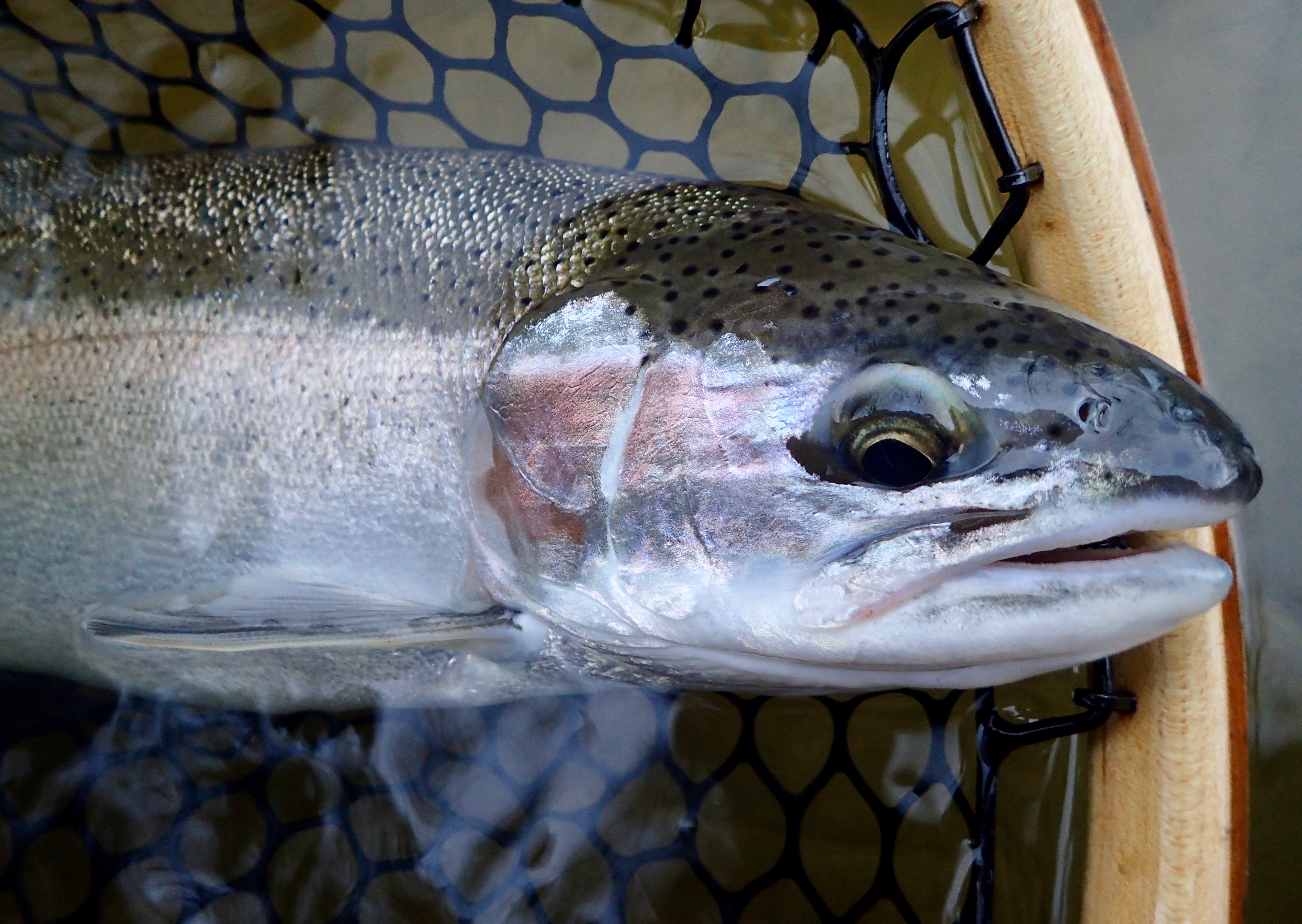
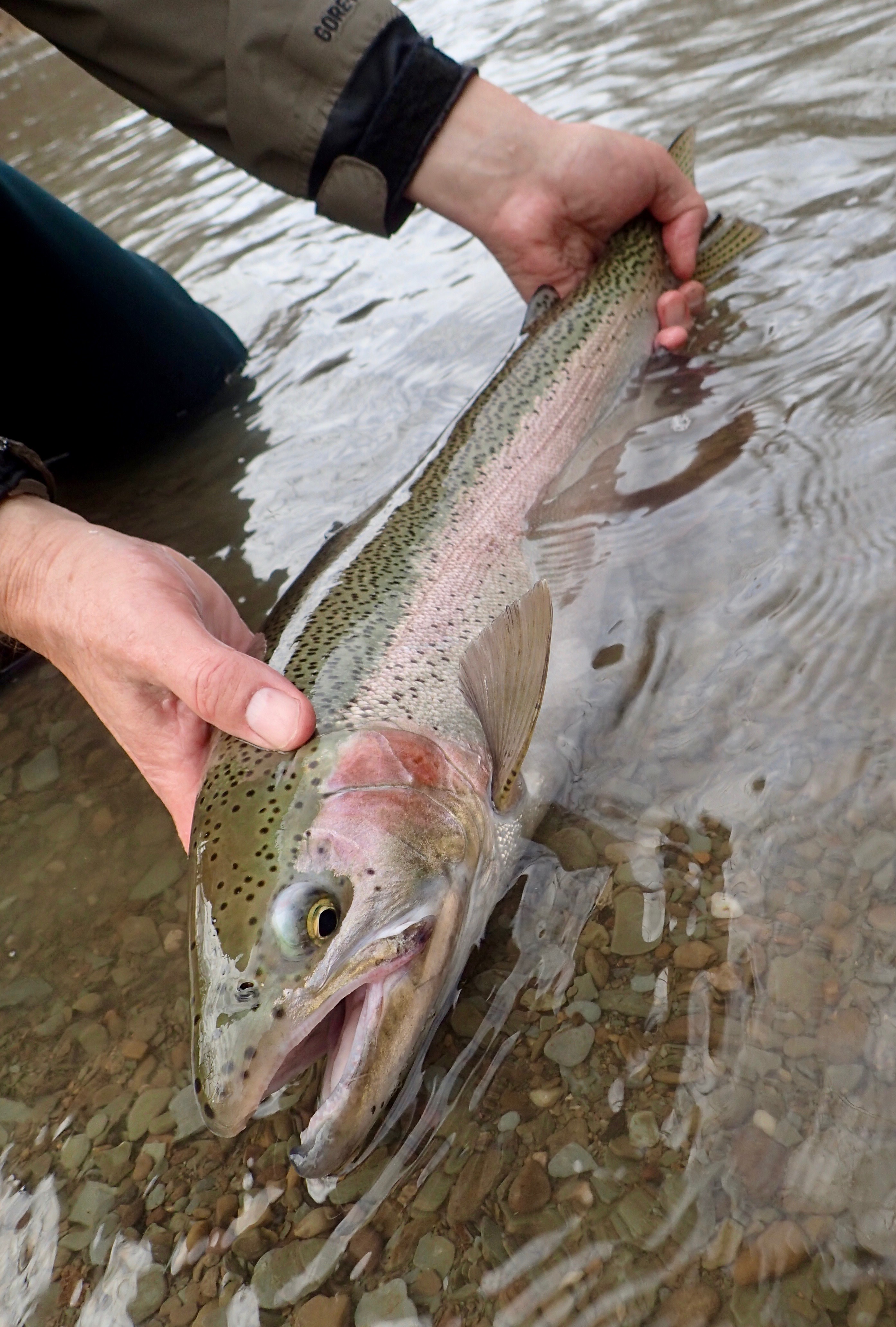
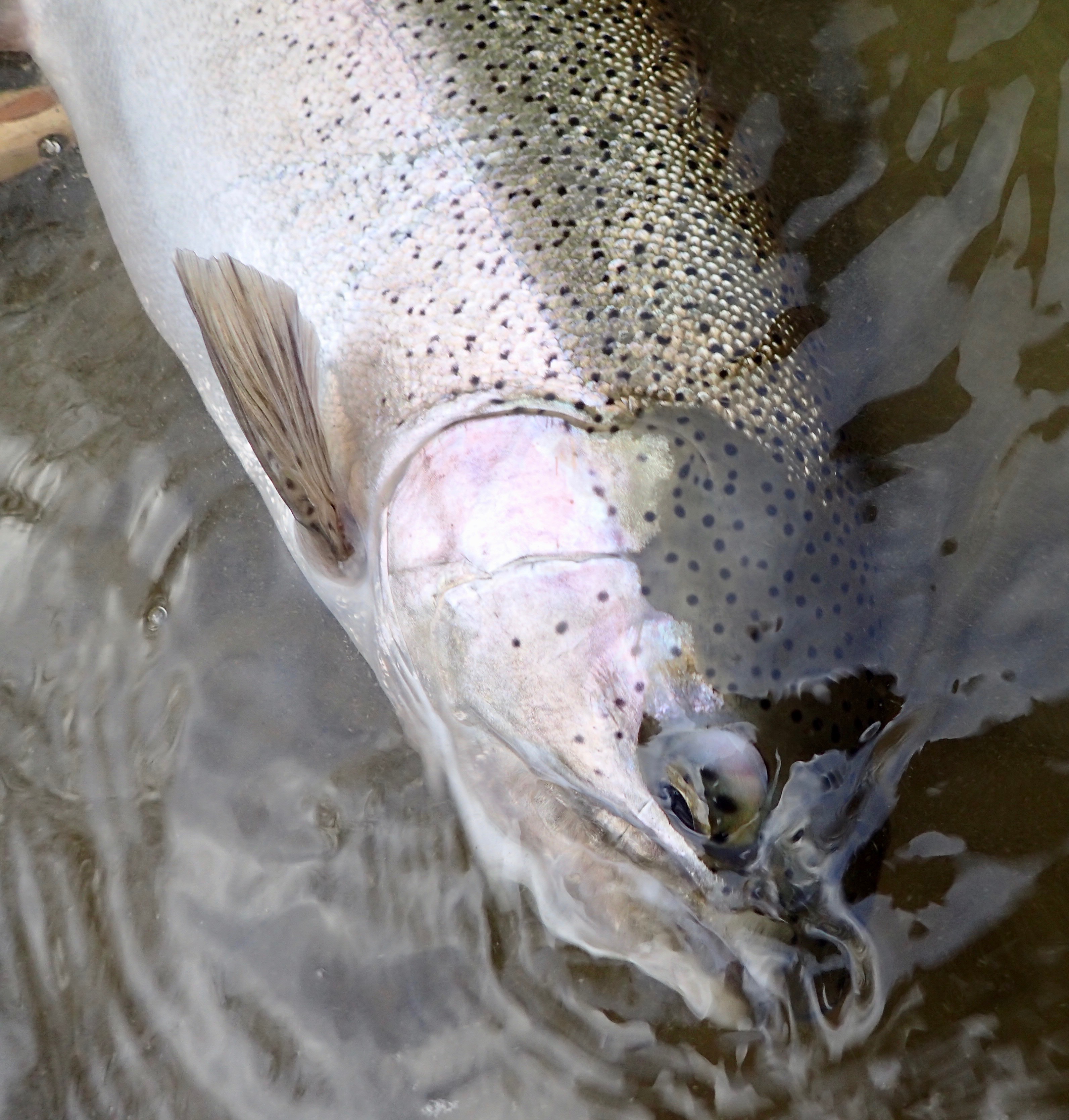
Al struck first, connecting with this lovely rainbow. How wonderful it is when theory is put into practice, and the trout do the rest of the heavy lifting. Both anglers did a great job, and enthusiastically embraced fishing under the hatch with wet flies.
Same fish, heading for home. Most of our action came on creamy sulphury mayfly soft hackles and wingless wets.
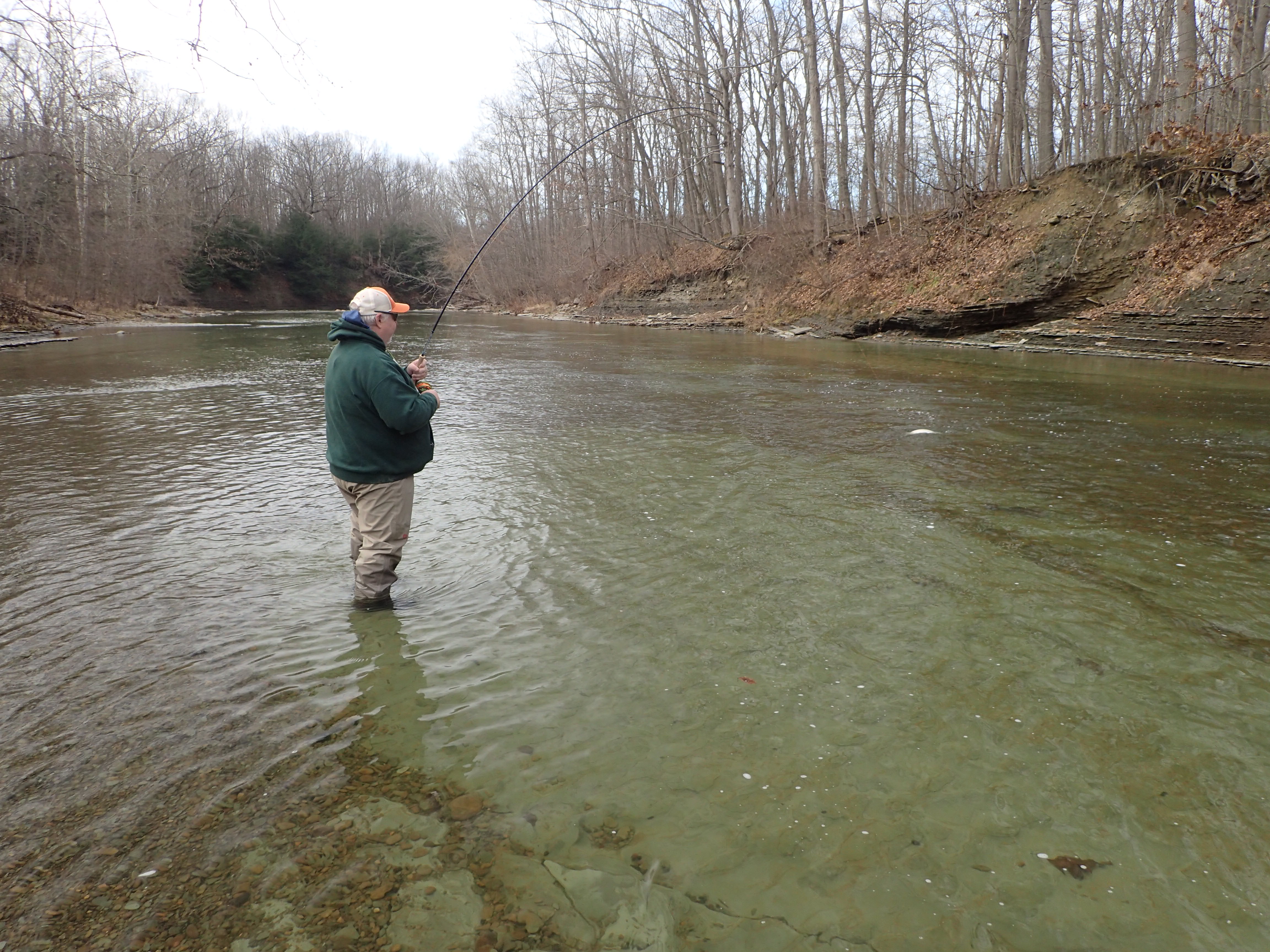
Does this guy look like he’s having fun? Al had to leave, so Michael and I walked a boulder field, picking pockets with wet flies. Today’s lesson is: When the water is low, look for the fastest, deepest water you can find, and cover every pocket, slot, and seam. By using this method, Michael found multiple trout willing to jump on. I loved his enthusiasm.

I finished the day fishing upriver. I swung wets from 7pm to around 7:30, and I managed three hookups in faster water, sadly losing a pig of wild brown when he wrapped the leader around a boulder. I’m still stinging from that loss, as it would have been my biggest Farmington fish this year. The good news was that he took a new Isonychia soft hackle prototype…and I know where he lives. I spent the next hour stubbornly swinging wets amidst a sulphur hatch that really never got going. I had two half-hearted touches, so I wasn’t sorry when I made the decision to switch to dry. I got three more fish in the next half hour, the first on a size 20 Magic Fly, the last two on Classic Catskills Light Cahill dries, sz 14-12. Even though the water was low, I used 5x tippet as part of a long leader, about 14 feet total length.

Looks like some much-needed rain over the next few days.

Farmington River Report 6/19/23: Despite low and slow, Moriel crushes a Farmy Grand Slam

Moriel took a wet fly lesson with me yesterday from 2pm-6pm, and we were faced with the lowest flows I’ve encountered this year (thanks, MDC!) We started off in the PTMA, running just under 100cfs. By covering some fast water, we were able to conjure up a few hits, putting one juvenile Atlantic salmon in the hoop. Off to mark number two, below the PTMA. That was a major disappointment: zero-point-zero touches, no bugs, maybe 3-4 total rises in an hour. All the while, I was telling Moriel that he was producing many, many fish-worthy drifts, and that if he kept it up, he would some day-some time have one of those sessions we all dream about.

Two outs, bottom of the ninth found us way downstream. And just like that, trout began to materialize on our three fly team. We took them on a prototype Squirrel-Ginger-Sparkle diving caddis and our creamy mayflies. A gorgeous wild brown, stocked brook trout, grievously bird-wounded rainbow, and all of a sudden, our slow day turns into the grand salami. Today’s lesson: when the bite is slow, move around, cover water, and find the fish. Great job Moriel, and you excelled at letting the fish set the hook.

Tight lines and bent rods are a beautiful thing. A fine way to baptize a new stick. Well done, Moriel!

I decided to stay and fish the evening rise. When I arrived at 7pm, precious little was happening. I saw the first sulphur emerge at 7:10pm, but things really didn’t get going until 8:30pm. This mark had some faster water that held trout feeding on emergers and spinners; below me was a quasi-frog water stretch with very little current, and there the trout were smutting. The fish in the faster water were maddening; they’d go on a feed in one section, then stop. It would pick up in a completely different section, then stop. I never really got a handle on those fish, sticking two and dropping one in 90 minutes. I hooked and landed three more in the last half hour on classic Catskills-style Light Cahills, size 12-14. The last one came when I could no longersee the fly, so I used the bucket method of strike detection. It was my best fish of the evening, a 15″ rainbow who’s been eating well.

We need rain!