I’m a lucky guy to have so many people who look forward to reading what I have to say. You’ve been so patient with me as I’ve navigated the twists and turns of my first book project, and for that I am truly grateful. So many of you have come to see me tie, teach, and talk at shows or club meetings — so I’m sending more gratitude your way. And it’s a thrill to be spotted out on the river when I’m fishing (as happened this week in Pulaski multiple times — yes, the book is coming!) by people who follow currentseams. Always, always, please come say hello.
Wishing you a happy, healthy Thanksgiving. Dig in and enjoy the food. Savor your beverage of choice. Smoke ’em if you’ve got ’em. And I’ll see you next week with my Pulaski steelhead report.
I’m thankful for every steelhead I release. May we meet again!
Much to talk about today. I’m currently recovering from last weekend’s International Fly Tying Symposium. That is, I’ve unpacked everything, gotten back to my regular sleep and eating (and coffee!) schedule, and here I am, clacking away at my keyboard on currentseams.com.
While this is the largest fly tying show in the world, there’s a sense of intimacy about IFTS that resonates with me. (If Goldilocks tied flies, she’d be all over this show.) I behaved myself wallet-wise, coming away only with a pack of size 14 Ahrex North Country Spider hooks (LE810). My Saturday seminar on Tying and Fishing Wet Flies was very well-attended, and I want to thank everyone for showing up and for asking so many thoughtful questions. I couldn’t have asked for a better tying bench mate than Peter Simonson, who specializes in classic Carrie Stevens-style streamers. I spent the rest of the day tying wet flies and soft hackles and socializing and answering questions about the Farmington River book.
The view from my bench Saturday morning. What a treat to reconnect with so many old and newer friends, and to put faces to names of currentseams subscribers.
After a delicious banquet Saturday evening — complete with a wonderful fly tying swag bag from show sponsor J.Stockard — I was featured fly tier Sunday morning. The subject was Farmington River Favorites, and we managed to get through each of the four food groups (nymph, wet, dry, streamer). Again, many thanks to everyone who attended. I truly appreciate your support.
But the highlight of the show for me was formally becoming a member of the Regal Pro Staff. I’ve been tying on a custom Regal Revolution for years, so this was particularly gratifying. Those of you who know me know that I don’t endorse anything on these pages that I don’t use and love, and I’ll be talking more about my Regal vise in future posts.
And now, me too! There are so many incredibly talented tiers in this group, and I’m honored to be a part of the team.
Finally, I’m back on the book for a bit: page proofs are in! These are basically an e-version of the layout of the book, complete with photos and other visual reference. I go through it, make minor corrections as needed, send it back to the publisher, and the whole shebang goes to press early next year. Exciting times! People stopping by the table showed a lot of interest in the book, and even if you don’t fish the Farmington a lot, I’m comfortable telling you that much of it — fly patterns, how to, hatches — is applicable to southern New England trout streams.
We had a quarter inch of rain overnight, so we decided to roll the dice on some fresh fish entering the system. Sometimes, it doesn’t take much to trigger a migration in steelhead alley. So we headed to a spot in PA about a mile away from the lake. We had to move well upstream to distance ourselves from the crowds, but we were in position at 6:45am, normally a little late but just right for today. We strategically carpet bombed a deeper hole, but that turned up blank. (We saw only one other fish landed the entire time we fished this general section, and it came from this hole.) Undaunted, we moved downstream to a swift run, more of a slot, that bordered a bleached tree trunk which created an enticing current break.
I had just made the comment that, with the climbing sun in my face, it was a wee bit difficult to see the indicator — but not to worry, because with the current moving so fast, the fish would set themselves. On cue, indicator down and fish on! I lost this steelhead to a snapped tippet, another when it ran between a pinch point of two submerged boulders, and two more to the whims of the steelhead gods. But I brought three to net, and, bad luck aside, considered myself ahead in the bargain.
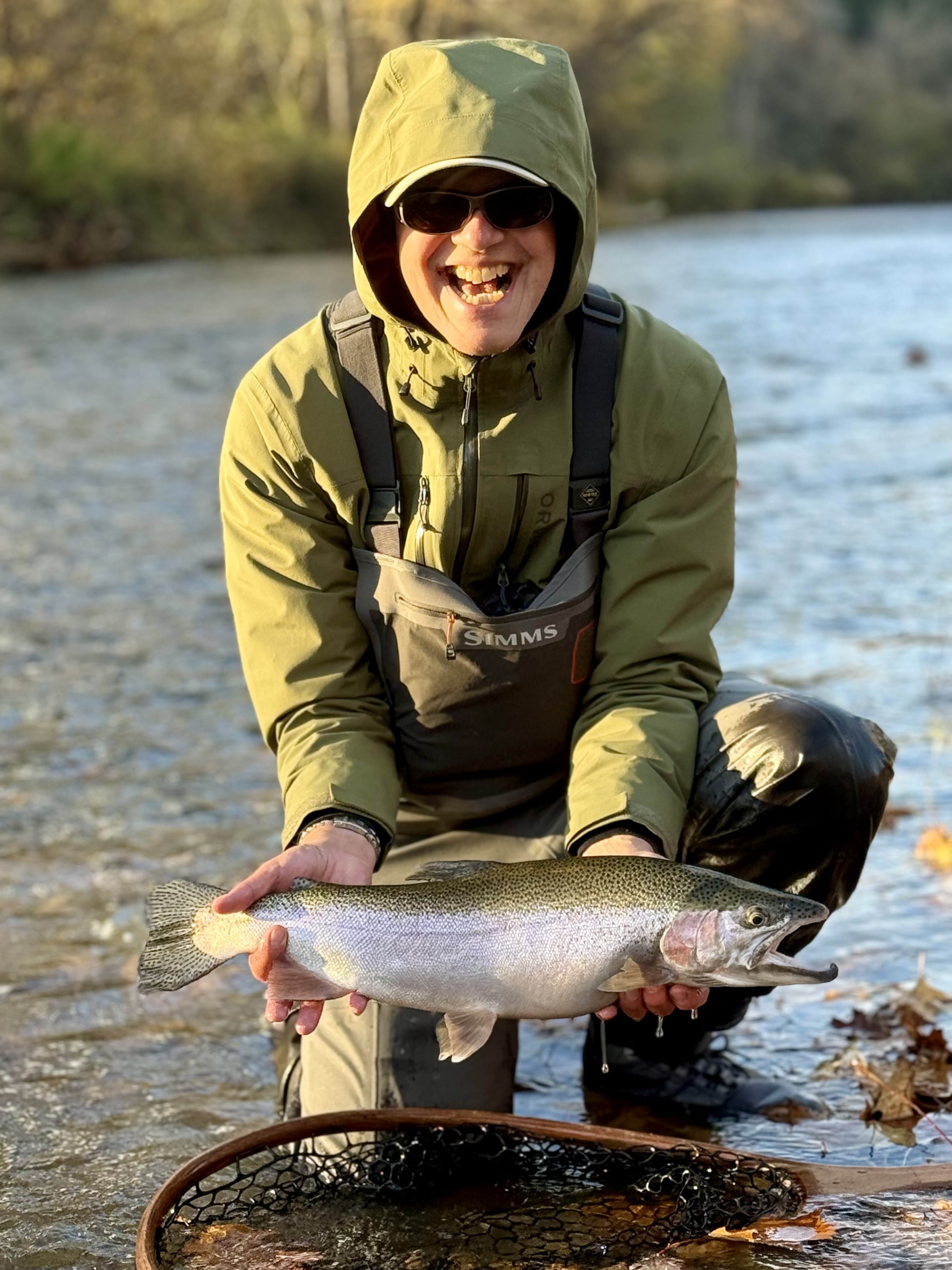
Silver in the gold of the morning light. Clearly, this first pod of fish came in from the lake overnight — newly-minted coin bright, aggressive takes, and spirited runs. Their freshness, the speed of the water, and the rocky bottom made for some challenging landing conditions. They weren’t bashful about leaping out of the water, or peeling off line in a hurry. Each one brought to net was a hard fought victory; each release a moment to savor, coupled with the thought that we might cross paths again this winter.
As the action tapered off, we declared victory, and headed to Ohio. The rains had missed there, and the water was low but fishable. Unfortunately, the low flows meant far fewer fish in the system; Holes, pools, slots, and runs that normally would have at least a few occupants were barren.
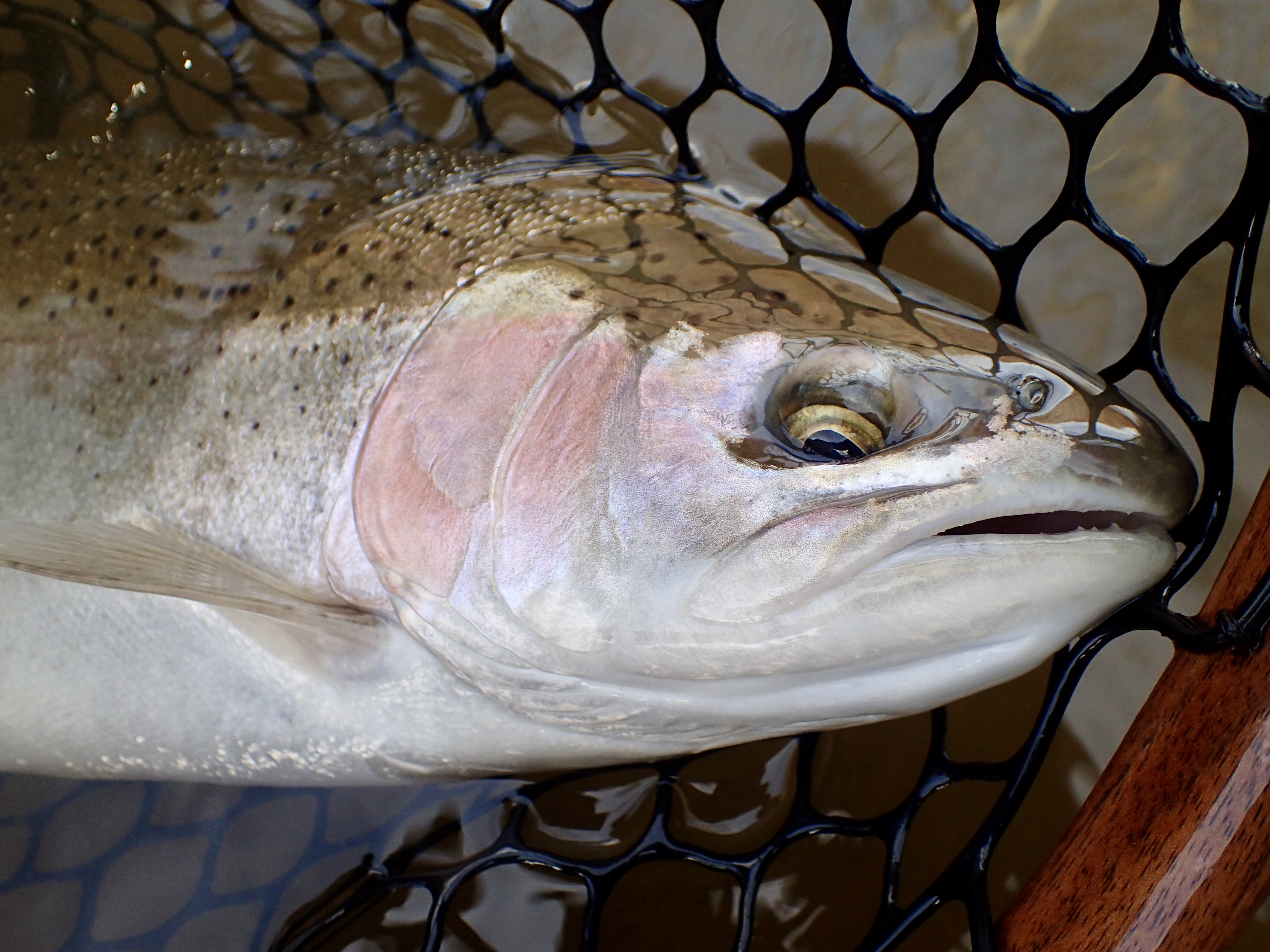
This steelhead was part of a pod of a half dozen fish that we rousted from beneath a ledge. We let them resettle, and came back a hour later to fish for them. She was the only one we could get to eat. The Ohio fish were far more dour than the morning group in PA; I had as many fouls as fair eats. We managed four properly hooked fish, and three cigars. That’s a win.
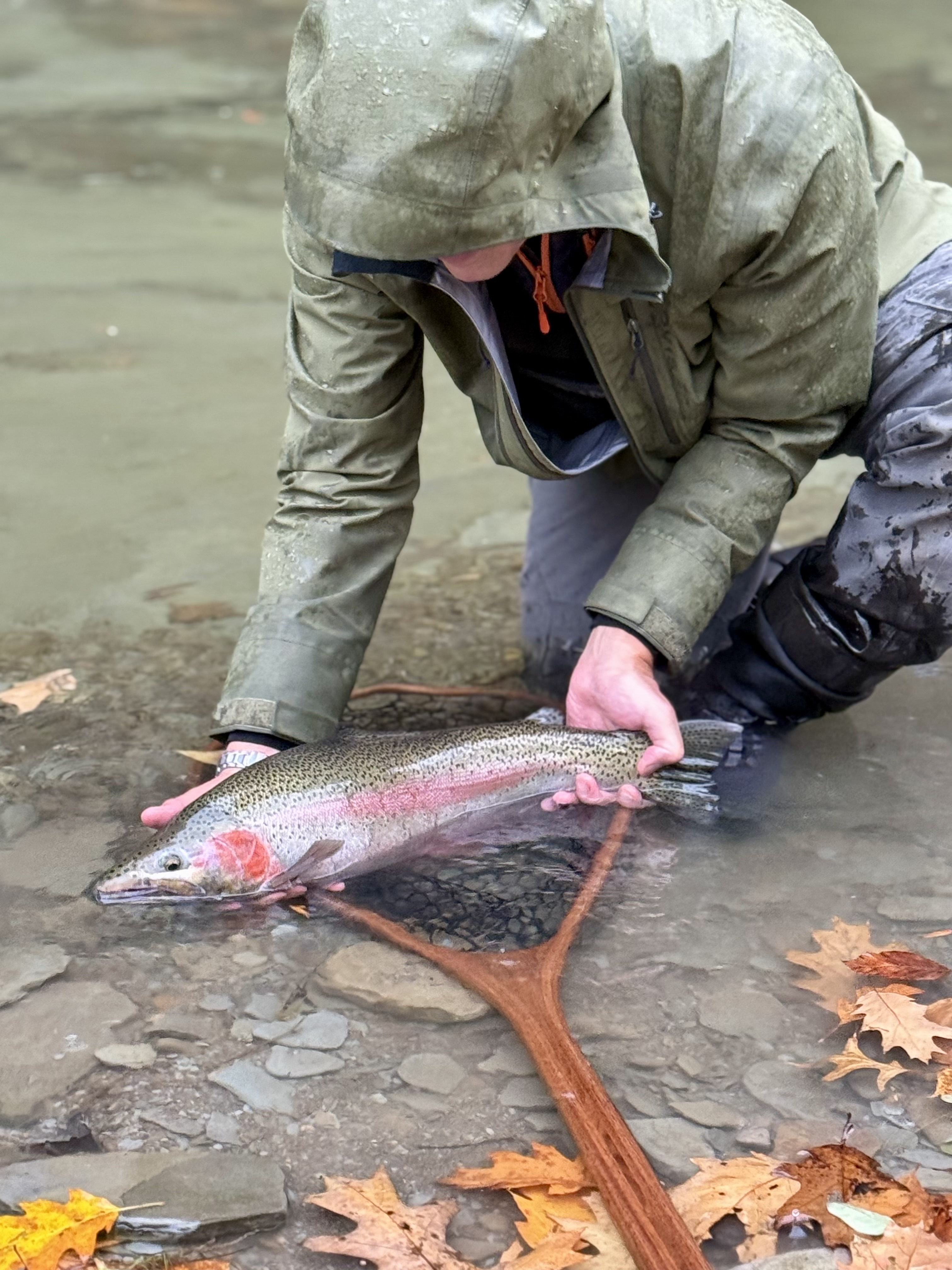
My intention was to get up early and fish a few hours before driving back to Connecticut. But I was dragging. What’s more, I was dreading having to battle crowds and jockey for position. So I made the command decision to head back to PA and fish until dark. At first, it seemed like I’d sent myself on a futile excursion. I couldn’t find fish in any of the usual places. The water is a highly popular mark, but I only encountered three anglers over a 750 yard stretch; as it grew darker, I had the whole place to myself. Being the stubborn sort, I went back a favorite slot hard against a submerged ledge beneath a fly-eating tree. Second cast, the indicator disappeared, and I buried the hook in the steelhead’s jaw. A fine, fresh camera-shy hen who bolted the moment I removed the hook.
I’m not sure what I liked more: catching that fish, or sleeping in the next morning.
In the UK, they celebrate November 5th — Guy Fawkes Day — with fireworks. In western PA, the day wasn’t nearly as explosive. Low, clear water; the approaching cold front lockjaw syndrome; wind and leaves; and the need for highly technical presentations were all formidable obstacles. But I can be the kind of angler who likes a challenge, even more so when I know the fish are there.
We fished Elk Creek, and the good news/bad news was significantly more water than this time last year, but far fewer fish. Places last year where the steelhead were wedged in like sardines were this year distressingly empty. Low, clear flows on these creeks require a certain level of stealth, and technical casts and drifts. To get dour, on-high-alert steelhead to eat, you’ve got to nail a perfect cast, then make all kinds of technical mends to keep the fly on target. Weight and indicator adjustments are a constant dance you perform until the judges tell you that you’ve got it right.
The first fish in the hoop is always a relief. I’ve been known to say that all I need is one steelhead to make me happy, and on most days that’s true. I had seven eats in the first three hours, and sealed the deal on three. Not a great batting average, but I did have some bad luck in the form of a snapped tippet, and another that mysteriously wriggled off after I slammed it with a powerful hookset. Blood Dot eggs, size 14, were the menu item of choice. By late morning, we decided to take a break and seek our pleasures elsewhere.
We did a bit of walking to try to get away from other anglers, but the story on new ground was the same: low, clear flows, leaves, and precious few fish that we could see. We finally located a pod of about a dozen fish, but in addition to the previously mentioned lockjaw, these steelhead seemed more interested in canoodling than eating. Two darker alpha males set the tone in the pool, chasing fish away from their lies, with the pod constantly shifting position after their antics.
Then, the rains came. This was a boon to the bite; the fouler the weather, the more takes. When bite windows open, you’ve got to jump on them, and so we did. I had one epic eat from a fish that was part of pod hiding under a ledge. The presentation was tricky. I had to cast into the main current, then drag the flies toward the ledge in front of me, resume dead drift, and hope the team of two would pass through the strike zone unimpeded by the edge of the shale barrier. As the flies moved into position, I had to switch to a quasi tight-line presentation. Of the dozens of attempts I made throughout the afternoon, one worked. That was my favorite fish of the day.
One of the alpha males that — finally! — made a mistake. Guy’s got some shoulders, and clearly, he’s been in the system for a few weeks. I lost a substantial chrome hen to a hysterical display of leaps and rolls. When I stuck the hookset, she bolted upstream like a dragster coming off the line. One, two, then three spectacular leaps worthy of a tarpon had us cackling with delight. She made a beeline for a shale ledge and rolled, then did it again, and on the second one she spit the hook. What tremendous sport! I finished the day with nine to hand, which I considered a major victory given the conditions. Yup. I love steelheading.
I’m thrilled and honored to again be named as a Featured Tier at the International Fly Tying Symposium. This year’s IFTS is Nov. 15-16, and I’ll be Featured Tier on Sunday at 10:15am. The subject is “Farmington River Favorites,” but the patterns I’ll be tying will work throughout the northeast. The morning slot gives you plenty of time to see me, hit the show floor, grab some swag, and be back in time for the second half of the 1pm NFL games!
I’m humbled to be a part of this lineup. But you can also see any of the dozens of other master fly tyers on the show floor any time over the weekend.
“Farmington River Favorites” will detail four patterns — more if time allows — that cover major hatches and fly styles. You’ll get a wet fly, a dry, a nymph, and a streamer. All are high-confidence, proven guide flies, fairly simple to tie, and staples in my box. As I mentioned, there’s an excellent chance these patterns will shine on your home waters. I’m looking forward to seeing you, so please be sure to come say hello.
You can see me live, and on the big screen! We’ll do Q&A, and if you want to hear about my new book, “Fly Fishing Guide to the Farmington River,” we can do that, too.
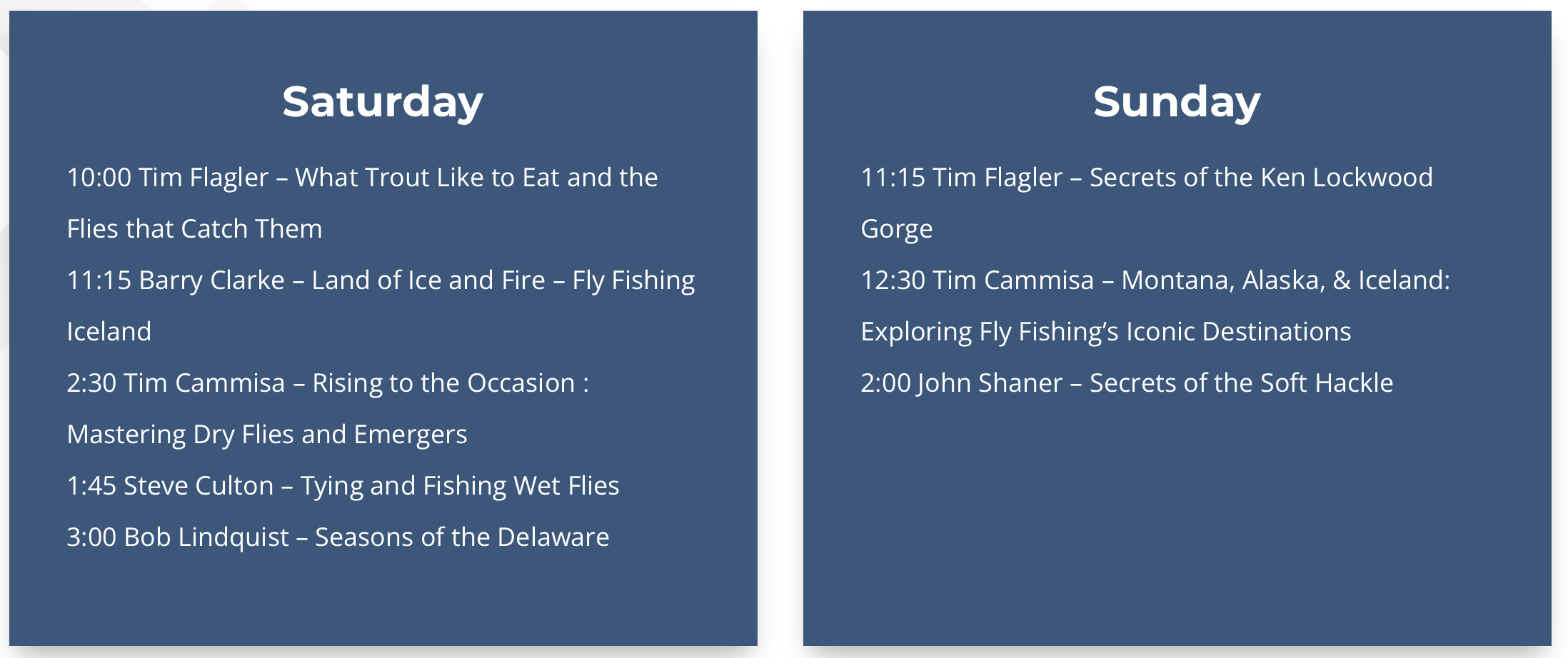
One of the better values in fly fishing is the admission price you pay at the Fly Fishing Show — and in this case, its sister show, the International Fly Tying Symposium. IFTS is Nov. 15-16 in Somerset, NJ. For just 20 bucks –15 on Sunday — you get the chance to learn how to tie and fish from some of the best fly anglers around. In addition to formal tying demos, you can walk the show floor and see so many masters of the craft spinning up wondrous creations. And then, there are the seminars, which are included in your admission price.
Not a bad lineup. Think you could learn something from these people? Although, I’d watch out for that Culton guy….
On Saturday, Nov. 15 at 1:45pm, I’ll be presenting “Tying and Fishing Wet Flies.” This seminar is exactly what its title suggests. I’ll teach you about wet fly types, and the kinds of feathers, furs, and materials you’ll need to tie them (and where you can find them on the show floor). Then, we’ll do the next best thing to going on a stream, as I take you through some basic wet fly presentations, strategies, and tactics. You’ll want to know how to build a wet fly team leader, and I’ve got you covered. And of course, we’ll do Q&A after.
If you’re not fishing wet flies, you’re not catching nearly as many fish as you could be. Even if you currently tie and fish wet flies, I guarantee you’ll learn something new. See you there!





 currentseams.com