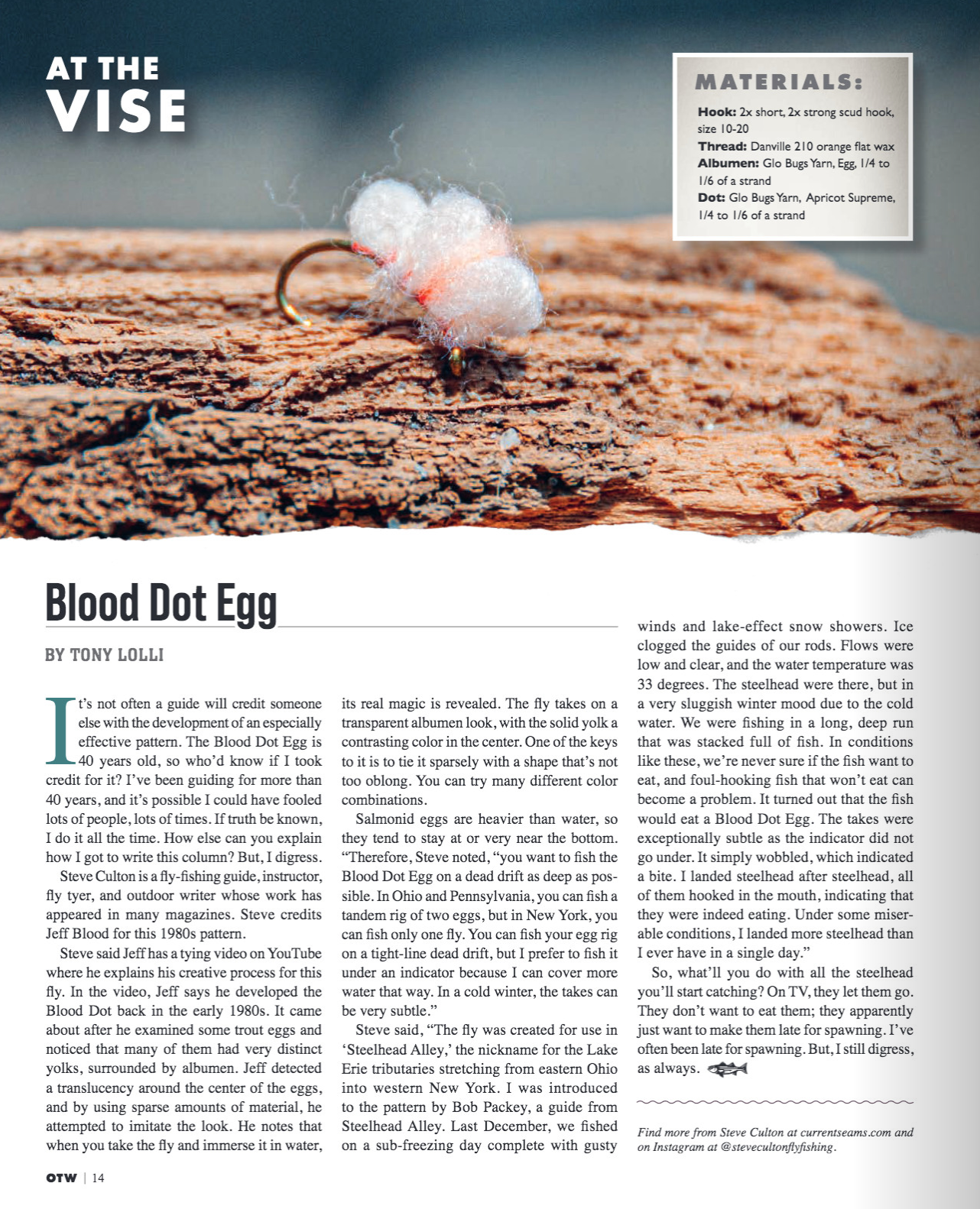
Ok, so it’s not my pattern — it’s Jeff Blood’s pattern. But the Blood Dot Egg is a classic guide fly, and I was delighted to share it with the readers of On The Water magazine‘s “Guide Flies” column, written by Tony Lolli. (Thanks again, Tony, for letting me play!) This is the single best egg pattern out there, and it’s so ridiculously easy to tie that you won’t fret when you sacrifice one or three or a dozen to the bottom gods. Steelhead season is upon us. Now, if we can only get some rain.
Fear not, this isn’t your weekly post. But I need help. I can’t for the life of me remember my old once-a-year-fishing buddy’s last name. First name Pete, loved wet flies, frequented the old FlyAddict forums, loved CT WTMAs, and his license plate was TROUTI. Anyone?
I got this question when I spoke earlier this month the EJTU meeting. It’s a good one. I’d just shown the group a video of trout taking sulphur emergers. The rises were regularly timed and showy/splashy. You could also see the bugs in the air.
The question was: When you get to the river and you see a scene like that, do you automatically go to a a dry/dropper? A: No. I will start with a wet fly team of three, and two of them will likely be sulphur patterns. There’s a lot to unpack here in terms of that decision. In this particular video, it was late afternoon in June. The rise forms clearly said the fish were on emergers. The time of year, time of day, rise forms, and visible bugs (sulphurs, whose nymphs are in the drift a good long time before emergence) indicated that the trout were taking their food just below the surface. A dry/dropper might get you some takes, but why not feed the fish like they’re already eating? Which is, subsurface, just below the film. A wet fly team of three fits that bill perfectly.
A splashy, emerger rise form (upper left) still taken from the video. You can also confirm that the trout are taking the emerger by the lack of duns on the surface. This doesn’t mean you can’t catch fish on the surface. It just means the dry fly may not be the most efficient method.
Note that a dry-dropper may be a better method for presenting just under the surface with different hatches. A midge pupa in winter would be a good example of that.
Hello, fellow fly fishers and readers! I ‘ve been on an intense writing jag this week, trying to finish up the bug and food forage sections of the book. I think it’s going to be very helpful. It’s divided into mayflies, caddisflies, stoneflies, midges, and other stuff trout like to eat. There will be some hatch details (although it’s not meant to be a biology or Latin names monograph). And then, for you fly tyers, there will be photos and recipes of some essential, proven fly patterns, mostly from local experts, guides, and anglers.
Current situation…add the sfx of fingers on keyboard…
To the Farmington we go! Water remains low, but fishable. It’s plenty cold and that’s the good news. Caddis is the main hatch right now, soon to be joined by Tiny BWOs. We’re getting near spawning time, so if you see a redd — a light oval shaped patch is gravelly riffles — keep your distance. Mark its location in your memory so you don’t walk through it in the winter and accidentally wipe out the next generation of wild browns. Please do not target trout on redds — it’s bad form.
Two more notes: as we get deeper into fall, streamers will increasingly come into play as a primary fishing method, as will egg patterns. Try an egg this winter as an attractor on a two fly nymph rig, and make the top dropper something small and match-the-hatch. And remember that the entire river from the dam down to the steel bridge in Unionville is catch-and-release. If you see poaching, please call the TIP line: 800-424-HELP. Program it into your phone so you’ll have it ready when you need it.
Forgive the brevity, but I’m up against it today. First: thank you EJTU for hosting me on Wednesday night. I presented Wet Flies 2.0, the turnout was excellent, and we had an engaging post-talk Q&A.
Gadzooks! Fishing twice in one week? It’s true. On Tuesday night I braved a snotty surf and 10mph wind with surfcaster extraordinaire Toby Lapinski. We fished a top secret rocky reef, and although the conditions seemed perfect for fall bassin’, we managed just one touch before we decided that it wasn’t happening. Yesterday, I headed to points far away to fish a thin blue line with #2 Son Cam. The water was painfully low, and leaves were a constant issue. The action was slow, but we had fun fooling wild brook trout on dry flies and deep jigs.
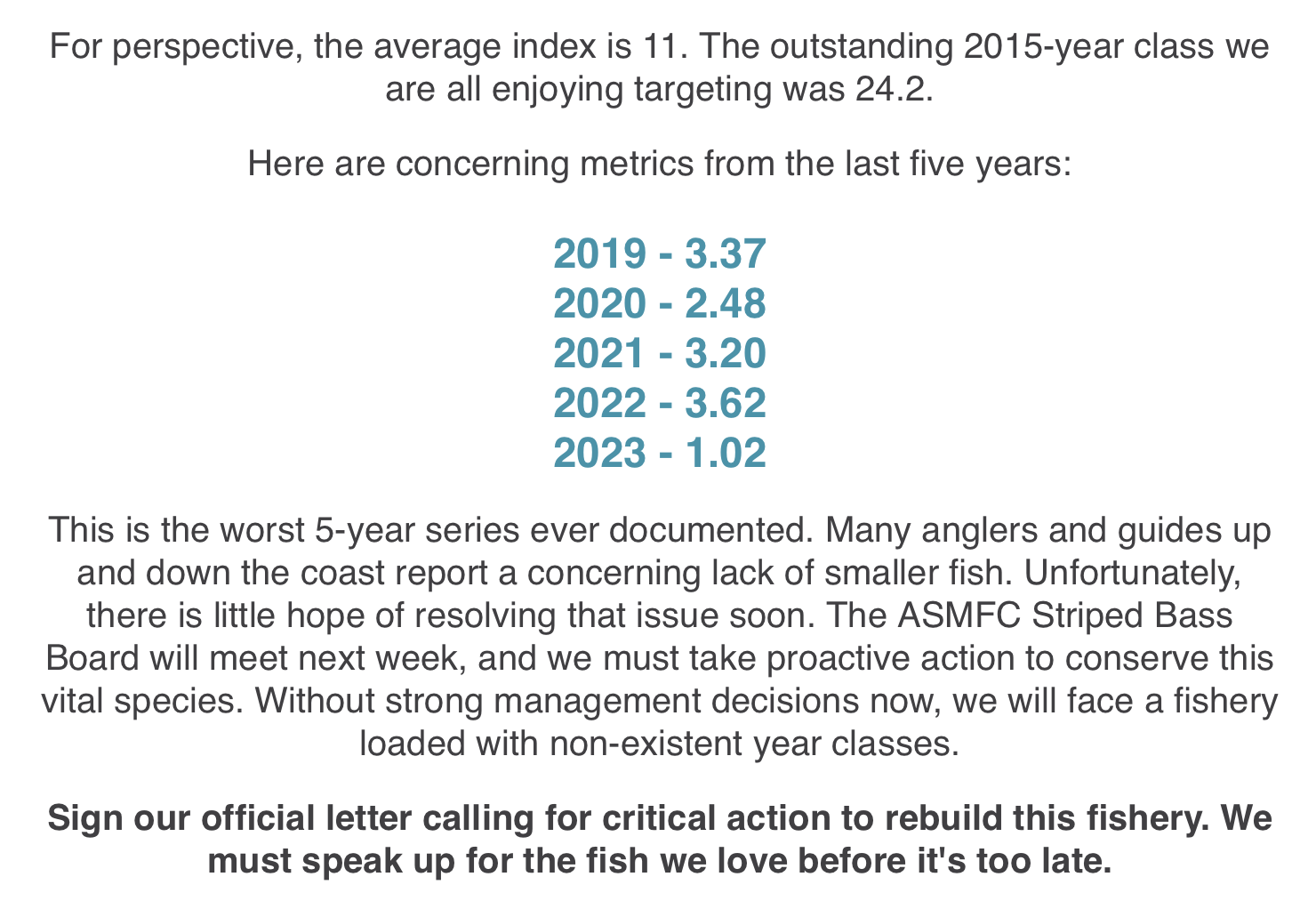
Finally, please take a minute out of your busy day to sign the ASGA letter to the ASMFC. Striped bass desperately need us to take action now. The following graphic on the Juvenile Abundance Index tells a dire story:
I played in a charity golf event today — “played” meaning “participated” — not my finest hours, although I did sink a very nice 21-foot putt for our team. Tomorrow’s a writing day, and — drum roll — maybe a night sortie to the salt.
Wednesday, October 9, I’ll be celebrating John Lennon’s birthday with an appearance at the East Jersey TU chapter in Rochelle Park, NJ. The meeting starts at 7:30, and I’ll be presenting “Wet Flies 2.0.” If you’re there, please say hello. I might even get out for some wild brookies on Thursday.
A quick thank you to the Bucks County TU group for hosting me last week. for understanding that a fed presenter is a happy presenter, they were awarded the Legion of the Cheeseburger with NE-style IPA Clusters. A great group, and we had an excellent Q&A session. Thank you again!
I hope you’ve been able to get out and do some fishing. We got poured on this morning in Durham, good enough to green up the lawns, but it had no substantial effect on our streams. The Farmington River remains low and clear at about 120cfs in the PTMA. Caddis is the main course right now, and we do have the blessing of cooler days and nights.
The spawn will be here soon, although this guy won’t be partaking — at least not in the Farmington River. As you read this, he’s back at the hatchery, swimming in a tank, ready to do his part to help make the next generation of Survivor Strain browns.
I just finished the chapter in the Farmington River book on caddisflies, and right now is one of those times when it doesn’t seem like much is hatching — and then, there are the caddis, ready to save the day. The truly are an underrated bug, and one of my favorite hatches to fish on the Farmington.
Greetings, fellow currentseamsers. I wish I could tell you that I’ve been out fishing, but alas, no. I’m nearing the home stretch for the first deadline for the Farmington River book, and that’s been my focus. I was visiting #2 son in Ohio over the weekend, took the train, and was able to bang out thousands of words. (I love writing on the train.) I’m really liking what I’ve written so far, and I think you will, too. I appreciate your loyalty and I’m looking forward to not only finishing the book, but getting back a normal posting schedule on currentseams.
On Thursday, October 3 (tomorrow) I’ll be speaking at the Bucks County (PA) Chapter of TU. If you’re in the Philadelphia area, come join the party. The topic is “The Little Things 2.0.”
Next week, October 9, I’ll be celebrating John Lennon’s birthday with an appearance at the East Jersey TU chapter in Rochelle Park, NJ. The meeting starts at 7:30, and I’ll be presenting “Wet Flies 2.0.” If you’re there, please say hello.
The Farmington River continues to run at a very low level. We need rain! The good news is that the water is plenty cold. Lower light will be your best time to fish.
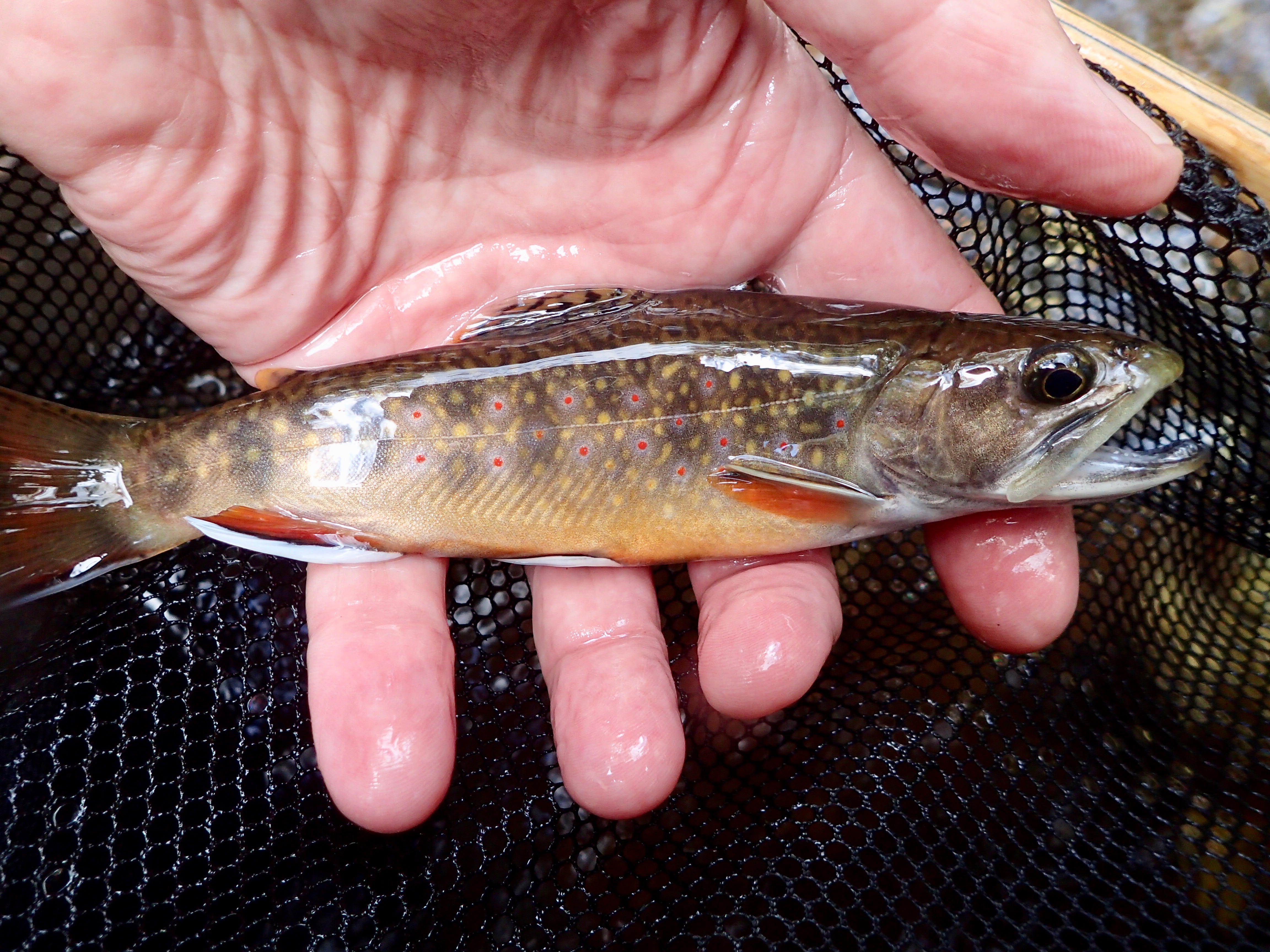
Love me some fall wild brookies. I crossed paths with this handsome char just about one year ago. Those fins! Those haloed spots! Those parr marks! Yeah, I’m a big fan.
Finally, it’s fall, which is a great time to be fishing wild brook trout streams. If you’re going to partake, please read this quick article from the archives, Three Small Stream/Wild Trout Best Practices.



 currentseams.com