I get a lot of questions on the river and at shows and here on this site, and now I need to ask all of you a question. There’s an old fly fishing joke about two anglers. One is all into latin names and esoteric dry fly types and tells the other angler about his efforts trying to match the hatch. The punch line is that the other angler tells him he caught all his fish on “this little grey bastard”. I’m looking for the specific telling of the joke. I know I’ve seen it online, but I can’t find it. Anyone know it by heart, or have an online reference?
Monthly Archives: August 2024
(Late) Farmington River Report: Trout (mostly) open for business!
My apologies or not getting this out last week. I’ll try to be a little more timely. The good news is that the terrible weekend rains mostly missed the Farmington, and the river has been fishing very well. Last week I guided Dan for a late afternoon-into evening session. The focus was on dry flies, and we started off with a hopper/dropper system. (‘Tis the season! And I promise, no more parenthetical statements.) We discovered a pod of trout taking emergers in a shallow run in bright sunshine. When Dan dialed in his cast and drift, his hopper got crushed by a very respectable mid-teens brown. We found another run formed by the confluence of two sections of river, but we couldn’t buy a hit. Even when we switched to wets, it was no dice. My best guess is that they were feeding on something far smaller than what we were throwing.
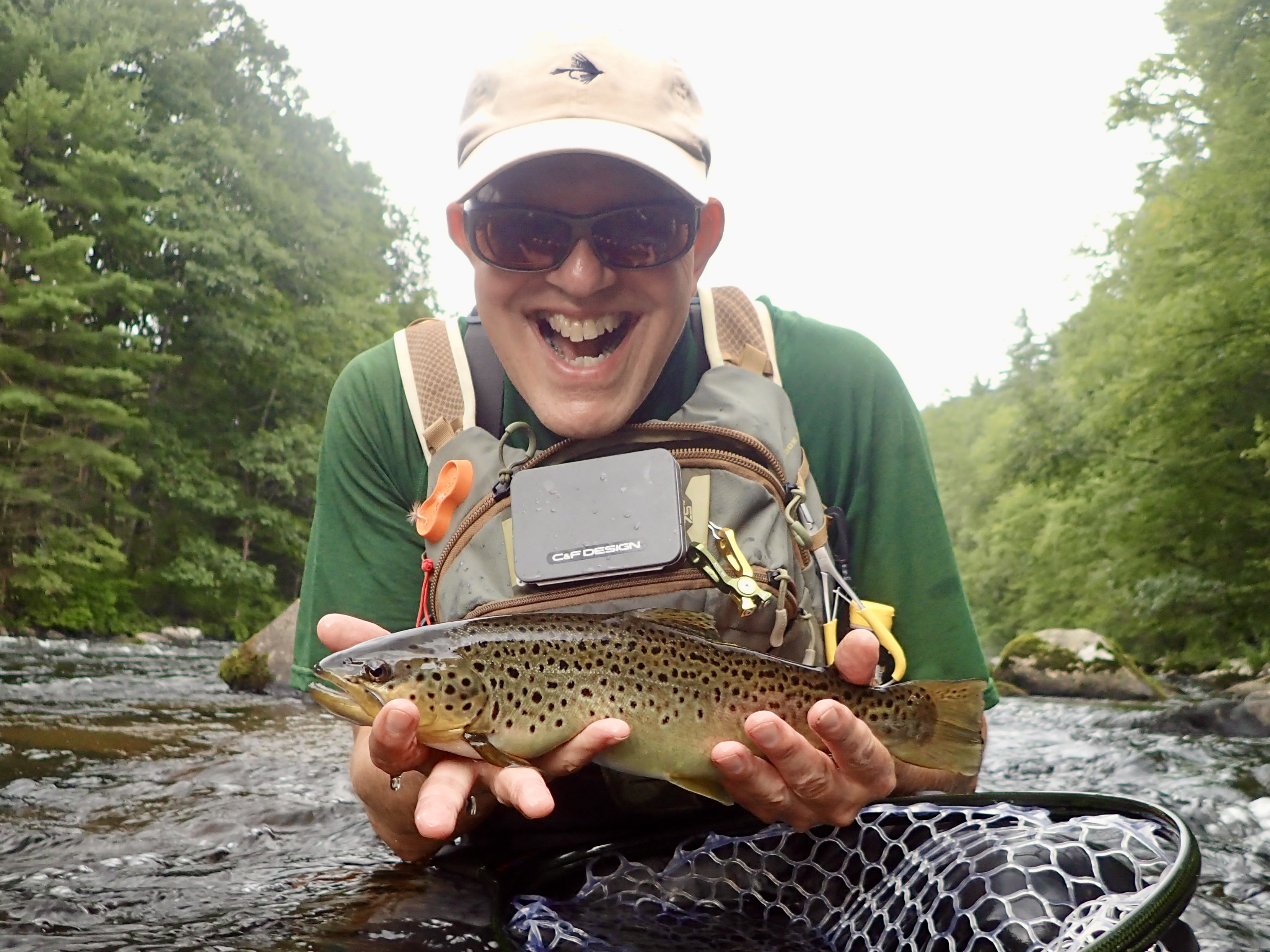
We ended the session at a classic dry fly pool within the PTMA. Hatch activity (22-24 BWOs, 18-20 Summer Stenos, and later, 12-14 Light Cahills and an absurd number of midges…and I guess I fibbed about the parenthetical statements) was light until 8:30pm, but Dan managed to stick a nice fish on a 22 BWO dry. We used a 14-foot leader-tippet system terminating in 6x to get better drifts in the languid, glassy pool. At 7:30 I was able to join in the fun. As predicted, that wild brown feeding just off the rock in the frog water got stupid as it got dark, and I took him — with great delight — on a size 16 Catskills Light Cahill dry. Both Dan and I had good action until we could no longer see our flies.
The next day, I shot some drone photos for the book with filmmaker extraordinaire Matthew Vinick. I fished for about 45 minutes below and within the PTMA until he arrived.

~
~
Farmington River Report: What a difference a day makes
I fished twice this week, Tuesday and Wednesday, and the days could not have been more different. On Tuesday, I hosted fly tier extraordinaire Lou DiGena from New Jersey. You may have seen Lou at the Fly Fishing Show, or at the IFTS. The river was up a bit, 406cfs in the PTMA and stained from rain. We started off below the PTMA and found some eaters, me with wet flies and Lou Euronymphing. Because of the stain and cloud cover, we decided to give streamers a shot in a popular pool within the PTMA. That was a total blank. Not knowing if there would be crowds for the evening rise (as it turned out, there were not) we headed to a dry fly mark above the PTMA.
I’ve been fishing this pool for a very long time, and I’m here to tell you that the bug activity and rising fish quotient were among the worst I’ve ever experienced. We kept waiting for a hatch that never really materialized. Lou did well to stick a nice brown sipping in some frog water, and I took another at dark when I suddenly saw a riser, but that was it. On the walk out, there were a few midges in the air, but water that is normally littered with spinners was strangely barren. I did see a few bigger Light Cahills and smaller Summer Steno spinners, but no real biomass like you’d expect.
Wednesday, the weather forecasters blanked. They called for showers and light rain starting at 6pm. The showers started at 1:30pm, and evolved into a steady rain that went on the rest of the day. That didn’t dampen the spirits of Kevin, who was taking a wet fly lesson with me. The water in the PTMA was down 50cfs and had cleaned up considerably. We arrived at the spot to see fish rising, and we connected within a few first casts. A couple more bumps and a juvey Atlantic salmon, and then it was over.


Farmington River Report and Tip of the Week
There are precious few absolutes – like gravity or the firmness of the earth – in fly fishing. But certainly this one is unimpeachable: wet flies in the water catch more fish. This is why I recommend that you keep your wet fly team in the water as much as possible, especially when you’re wading to a new position up or down or across stream.
The value of this practice, which I teach in every wet fly lesson, was driven home to me on Wednesday when I was out on shooting photos for the Farmington River book with Derrick Kirkpatrick and Joey Takeman. We’d just returned to the river after a thunderstorm delay, and were crossing a shallow (1-2 feet) riffle. I hadn’t fished yet, but this time I had my rod with me, and while I intended to take more photos, I couldn’t resist stripping out ten feet of line and dangling my team of three (16 Sulphur soft hackle, 16 Diving Caddis, 12 Isonychia soft hackle) in the current below me. Whack! I felt a sharp tug, and although the hook found no purchase, I’d already proven my point. It was a quality take, more like a loud foul than a swing and a miss.
An hour later, on another part of the river, we were walking upstream when I spotted a pod of rising trout across the stream. I told the guys that I had to take a few casts at them. I did, landed two, then began to cross back to the other side — team of three, naturally, dangling in the current below me. Wham! Another hit, and this time a hook set.
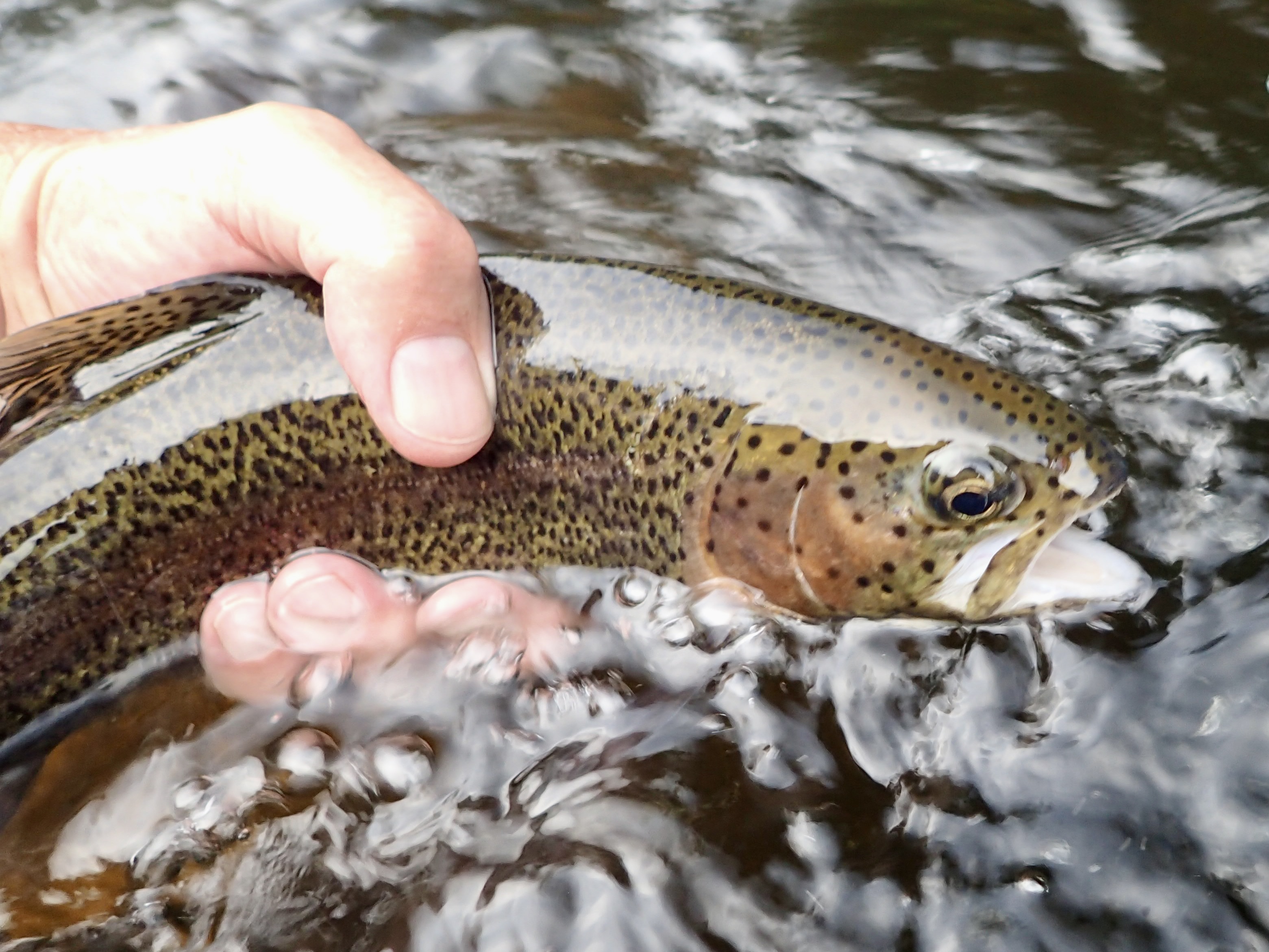
As dusk deepened, I left Joey and Derrick to return to the area where I’d seen the pod of trout. As I started to cross the river, a large trout delivered a thunderous hit on one of my flies. It immediately put itself on the reel, and peeled off 30 feet of line as by drag was not set for such a creature. In the gloaming, a spectacular aerial revealed that I had indeed hooked one of the FRAA-stocked 5-7 pound trophy rainbows. Another run, then another aerial, and as I tried to regain some line, yet another aerial. Tremendous sport!
I wasn’t worried about the hook set as the fish clobbered the fly. I had fresh Maxima 4-pound as my tippet. I was going to land this mini-steelhead. I wish Chad a better picture for you, but I wanted to get her back to swimming. Besides, the light was lousy. And so, off she went.

 currentseams.com