I don’t know if The Clash ever fished for striped bass, but they might as well have been singing about it in their early 80s hit. So, when do you admit defeat and leave a mark? When do you stick it out? These questions and more are addressed in “Should I Stay or Should I Go?” written by yours truly. You can read it in the current issue #81 of Surfcasters Journal. This e-zine is available by online subscription only, and its written by some of the best surf anglers in the Northeast. Oh! it’s only 20 bucks a year! You can subscribe here.
If you’re not reading Surfcasters Journal, you should be. Even if you’re a fly-only angler like me, there is an insane amount of useful intel contained within. $20 for one year.
I haven’t done a winter lesson in years, which is too bad. Winter can be a great time to fish the Farmington, especially if you like walking into any hole you damn well please because no one else is fishing. OK, so it’s not always like that, but with Monday’s cold front coming through — the mercury dropped 13 degrees in a matter of 10 minutes — and Tuesday’s forecast for gusty winds and snow showers — anglers were few and far between.
We fished from 11am-3pm, a good winter window. The method was drop-shot nymphing under an indicator, two-fly dropper system. The first mark was a popular spot within the PTMA. We had it all to ourselves for a half hour, then two more anglers showed up. The four of us managed one take in an hour, so I made the decision to head up to Riverton, where we’d find lover flows (PTMA was about 500cfs, Riverton 250cfs) and warmer water.
We also had solitude. The angler fishing 100 yards downstream from us left after 20 minutes. We stuck two fish at the the first place, one on the first cast, but then the action slowed. With 45 minutes left in our session, we moved upstream a quarter mile. Both Andy and Ross connected here, too, but sadly both trout wriggled off. With ice in the guides and the sun falling farther below the tree line, we called it a day.
Both Andy and Ross made significant, noticeable improvements over the course of the session, from casting to presentation. Lessons that bear repeating: it’s a bunch of little things that draw the line between fishing and catching. Drag-free drifts, false positives that let us know our flies are on the bottom, line management and mends, and especially looking for a reason to set the hook on every drift are all crucial to success. Well done, Andy and Ross!
I was so into the teaching thing that I didn’t get any shots of the lads in action. Here’s a sample of some of the bugs were were using.
Finally, a reminder that I do guide year-round. If you want to take advantage of reduced angler traffic, a winter lesson — it really is a different game than spring-fall-summer — will start you on the way.
It’s time once again to make our voices heard for the conservation and preservation of striped bass. There are two ways you can help.
Go to the Connecticut public hearing this Thursday, Nov. 30. CT DEEP has now scheduled an additional in-person hearing on Draft Addendum 2 on Thursday November 30, 2023, from 6:00 – 8:00 PM in Milford, CT. The hearing will be held at the Connecticut Audubon Society Coastal Center at Milford Point, 1 Milford Point Road, Milford, CT 06460. The November 30th hearing in Milford will provide identical information as that presented at the November 16th hearing in Old Lyme and is intended to provide an additional opportunity for the public to comment on Draft Addendum 2.
Send email comments to ASMFC by December 23: Public comment will be accepted until 11:59 PM (EST) on December 22, 2023 and should be sent to comments@asmfc.org (Subject line: Striped Bass Draft Addendum II).
What to say. The draft is a ponderous document. No need to wade through it! Here are the American Saltwater Guides Association’s positions: 3.1.1 Ocean Recreational Options: Option B—1-fish at 28-31″ with 2022 seasons (all modes); 3.1.2 Chesapeake Bay Recreational Options: Option B1—1 fish at 19-23” across all CBAY jurisdictions with the same 2022 seasons; 3.2.1 Commercial Quota Reduction Options: Option B with a 14.5% reduction to both the Ocean and Chesapeake Bay Quotas; 3.3 Response to Stock Assessment: Option B—Board Action.
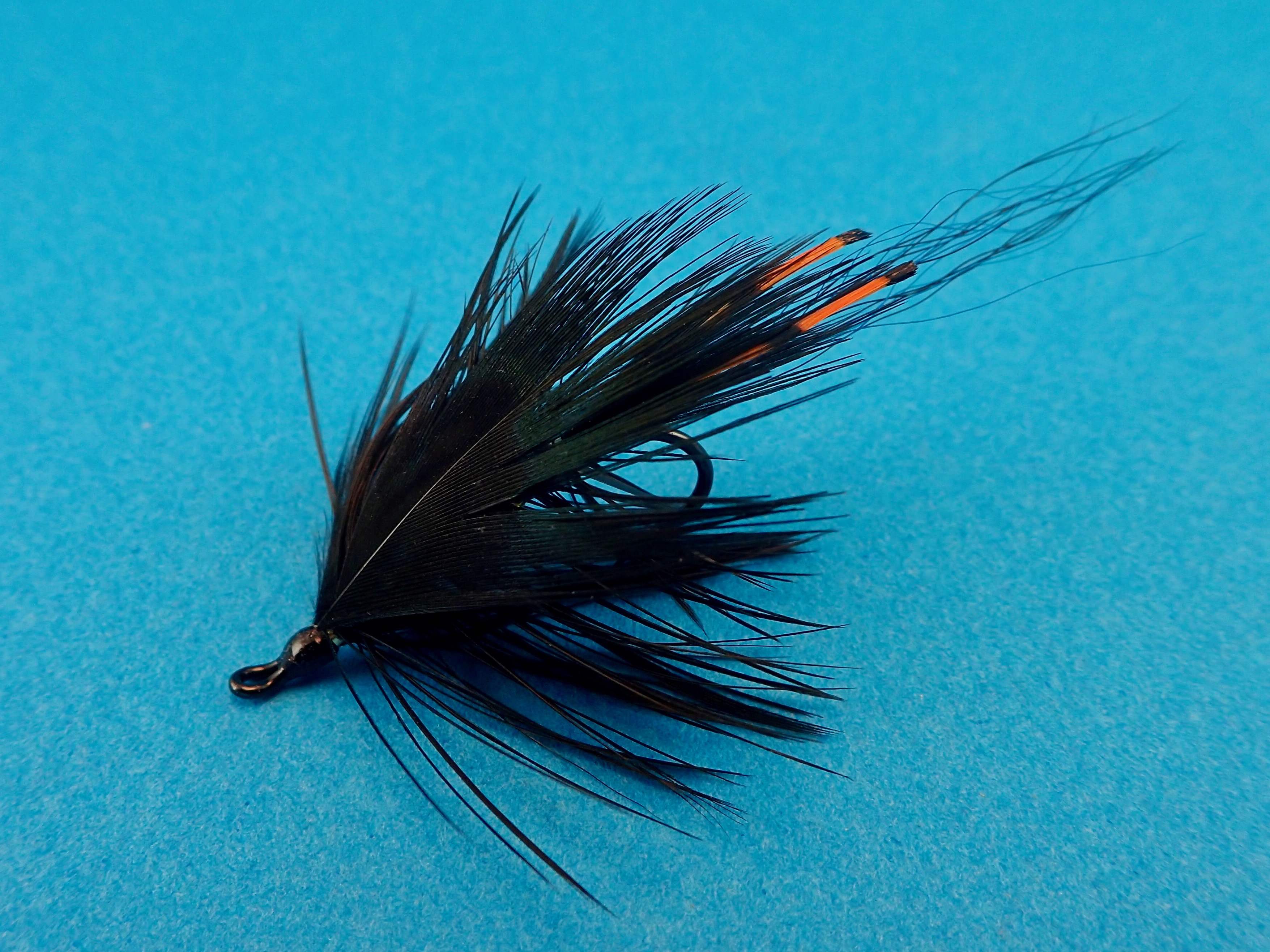
If you’ll pardon the wordplay, I offer relief to those who are already weary of the crass holiday commercialism that seems to start earlier each year. Here are three favorite patterns that feature basic black. Give yourself the gift of tight lines, and tie one on.
The Bombardier Flatwing. Treat yourself to an explosion when you swing this big flatwing in the wee hours of a chilly April very early morning.
The Bruiser Big Eelie. Unlike the unis of the New Zealand All Blacks rugby side, this lethal sand eel sports some blurple. Perfect for getting into a scrum with some stripers on a moonless night.
You go on a fishing trip to unknown waters where there are going to be crowds. You’re unsure about what the energy will be. Competitive? Territorial? Downright rude? I must confess that I have a tendency to expect the worst from my fellow man (or woman). But, we can always hope for the best. And on my first solo run to the Erie tribs for steelhead, I got hopes and dreams and better angels.
It started Thursday morning when I was speed wading in the dark to the mark I wanted to fish. I could see headlamps bobbing in the woods upstream. I could tell they were moving at a slower pace, and as I closed ground I could see it was a guide with three clients. I caught up to them, and asked the guide where he was heading; in my mind, they were there first and would get dibs. I reassured him that I wasn’t going to race ahead and Bogart their water. The guide was appreciative, so much in fact that he asked for my cell number. His idea was that if I was blanking and they were pounding them, I could fish near them. Or if vice versa, we could share water.
It was a most excellent way to start a day. I was so excited by this conversation that I suddenly realized I was 100 yards past my mark. (I suspect the pre-daylight savings darkness had something to do with it, too.)
Cut to an hour later. First light. I saw Chris wading upstream toward me. I’d met Chris the day before when I came to the creek to scout some water with my guide, Bob Packey. Chris was new to fly fishing and had a positive energy and friendly spirit. He remarked how he’d seen me pounding fish up yesterday, and that he was having a tougher go of it. So I told him that if he was blanking, come find me later and we’ll see what we can do about it.
Around 11am, Chris shows up. I could tell from the look on his face that he had been struggling. He confirmed that he hadn’t had a touch. Come on in here, Chris, and let’s take a look at your rig. I didn’t like the size or placement of his shot, so we re-rigged. I told him what I’d learned about the 50-foot run I’d been working, how I had been approaching it, and where I thought he’d have success.
You can imagine how cool it must have been for Chris to hook up within a few casts. All told, he got into four steelhead in about a half hour. Chris’ excitement was matched only by the positive wave of sheer enjoyment that washed over me as I watched him do battle.
Chris getting acquainted with one of the locals. Sometimes a little instruction goes a long way.
The next day, I fished for just over two hours. I saw an angler looking for space, and I told him if he cared to wait, he could have my spot in 10 minutes. He did, and I ended that session with a smile on my face.
Thanksgiving is a season when we acknowledge the many blessings we have. I’m thankful to have met some nice people on the river. I’m thankful for the opportunity to give to someone in need. I’m a confident person, but I am humbled by this experience. Thank you for reading, and please do likewise the next time you fish.
You gotta love the jolly old yo-ho-ho State of Connecticut.
Seems that there was all kinds of after-hours nonsense, vandalism, law-breaking and other nefarious acts involving human waste going on this summer, at and near the parking area on Comstock Bridge Road in Colchester. The lot happens to be a popular access point for anglers on the Salmon River. The neighbors were unhappy, and justifiably so. The State DEEP Parks Division — this is taking place in Salmon River State Forest — decided to take action.
Did they dispatch ENCON officers to arrest the perps at the next sign of trouble? Did they plan a stakeout to catch the offenders in the act? Were the scofflaws arrested and prosecuted to the full extent of the law? No, no, and no.
In its infinite wisdom and sagacity, the state decided to — wait for it — punish the innocent! Yes, by jove, we’ve got it! Let’s block off the entire parking area so no one can access it. Law-abiding anglers be damned. License-buying anglers be damned. Tax-paying public be damned. Up went some gleaming new guardrails, because, you know, shiny aluminum is a known deterrent to criminals and people who play with their poo. Nature abhors a vacuum. The Connecticut State DEEP Parks Division shares a similar aversion to fair-minded thinking.
Photo by Rick Liegl.
I asked Connecticut Fish and Wildlife via their Facebook page for a reason behind their decision. Their response was, and I quote: “The DEEP Parks Division determined that steps needed to be taken to address ongoing issues involving illegal parking, littering, noise, illegal camping, groundfires, and after hours use. During summer months daily complaints have been received from neighbors and Parks Division staff had to visit the site daily to pick up and remove large amounts trash, including human waste.”
So, let’s get this straight: you have the time and the resources to visit the site daily to clean up after the slobs — but not to be there nightly — presumably when this ruckus is going on — to arrest them? There must be a well-known witticism about enabling, but at the moment it escapes me. I’ll have to settle for Schiller’s classic, “Against stupidity, even the gods contend in vain.”
As you can tell, I’m a wee bit pissed off. The Salmon River is sacred water to me. My father taught me to trout fish there. I’ve been fishing it for over a half-century. Putting on our cooler heads, I think we can all agree that the crimes against nature and disrespect for residents and users of state land are appalling. But there has to be a better solution than punishing the innocent.
I floated mid-river with Row Jimmy, guide to the stars, and the day can be summed up in two words: bite window. But let’s back up. Even though a 24-hour run up/fish/run back isn’t the most logical use of time, I was thrilled just to be there. It had originally looked like I wouldn’t be able to fish with Jim this fall, due to a comedy of scheduling errors. So when he texted me a few weeks earlier that Wednesday had opened up, I jumped on it.
To the fishing. We had a fly in the water by 7am, but the steelhead were unmotivated to strike. After banging away at a few different holding slots, we finally connected with a mint coin-bright skipper. I wish now that I’d taken a photo of that fish, because that was one of the most breathtakingly gleaming steelhead I’ve ever landed. I truly appreciate these junior-sized fish. They’re rambunctious and fun to play and land.
Mid-morning was the aforementioned bite window. I was three-for-four at one point, then the action slowed. One more in the hoop, and the bite vanished. We knew the fish were still in the run, although we couldn’t see them; unlike many Erie tribs, the dark substrate of the Salmon makes sight fishing a little tricky. No, we knew the fish were there because I started fouled them. You can’t catch what doesn’t want to eat, and sadly, that played out for the entire afternoon, save for one more 11th hour take that I never really had on.
This buck-of-the-big-shoulders took me for a ride. We decided the best way to land him was to get out of the boat and maneuver him into the shallows. They increased the dam release to 500cfs; the Pineville gauge read about 675. Water temp was 44 degrees. The steelhead will soon be transitioning from faster water into the slower cold water lies.
The final tally was four: one on a bead, two on Apricot Supreme Blood Dot Eggs, one on a 60-Second Copperhead. Our decision to escape the madness of the masses on the upper river was validated by long stretches of fishing without another angler or drift boat in sight. What we lacked in numbers was made for in sheer enjoyment and camaraderie.
Hot on the heels of the International Fly Tying Symposium, I made an overnight run to the Salmon River in Pulaski. I left Tuesday afternoon and was back home by 9pm Wednesday. I’ll post a more detailed report soon, but I ran the middle river with Row Jimmy. We had decent action in the mid-to-late morning, but then the bite tailed off and I had to be content with four in the hoop.
Another satisfied customer. I like the transparency of the tail on this one.
If you won flies from the 1k Followers contest, and you’re wondering where they are, I’ll tell you. I haven’t tied them yet. You have my apologies for the delay, and you’ll be pleased to know that it’s on my sooner-rather-than later list of things to do.
In the striped bass management world, ASMFC is soliciting public comment on Draft Addendum 2 to Amendment 7. Your participation and comment is important, so look for a post from me soon with my thoughts and the ASGA’s party line on the subject. We need to keep hammering ASMFC until they get it.
I’m still guiding if you’re interested in a late fall/early winter outing. This can be a very productive time to fish. Not to mention it’s less crowded!
Finally, my latest article for Surfcasters Journal should drop any day now. When it does, I’ll let you know.
My second Symposium is in the books, and like last year, I had a most wonderful time. Saturday was the busiest of the two days, both in terms of my schedule and attendees. After getting set up and saying my pre-show hellos, I tied up a storm before my noon seminar.
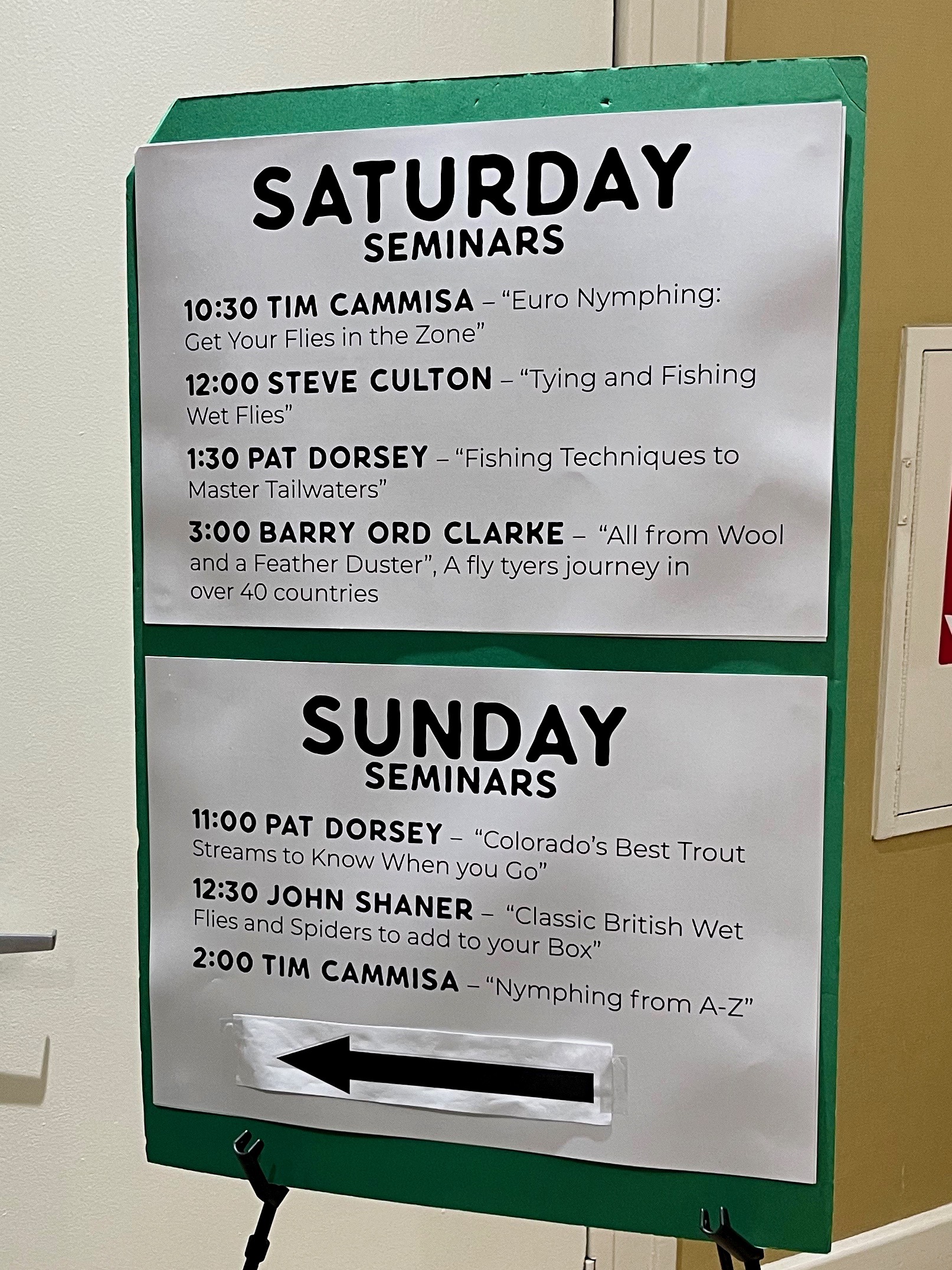
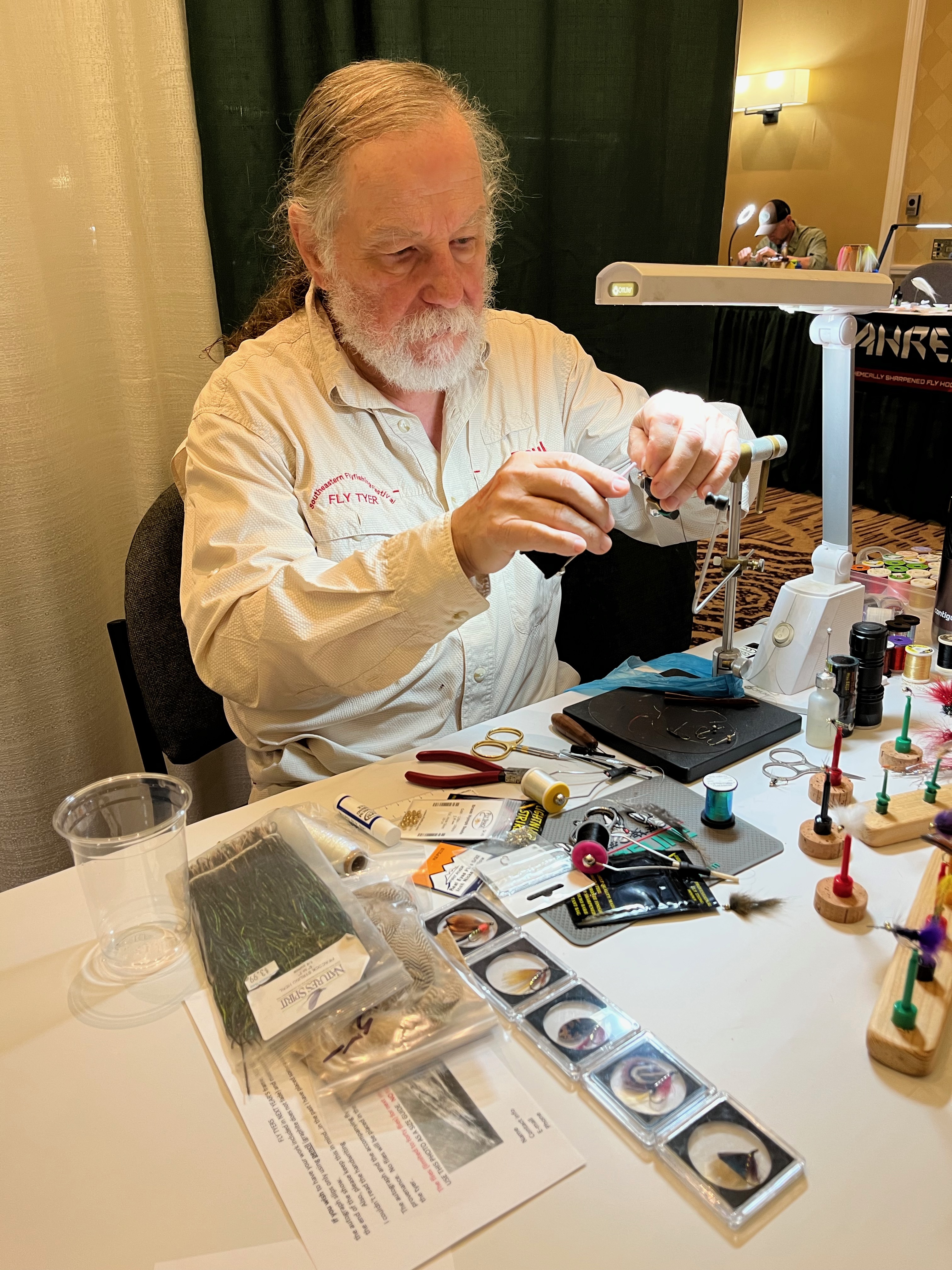
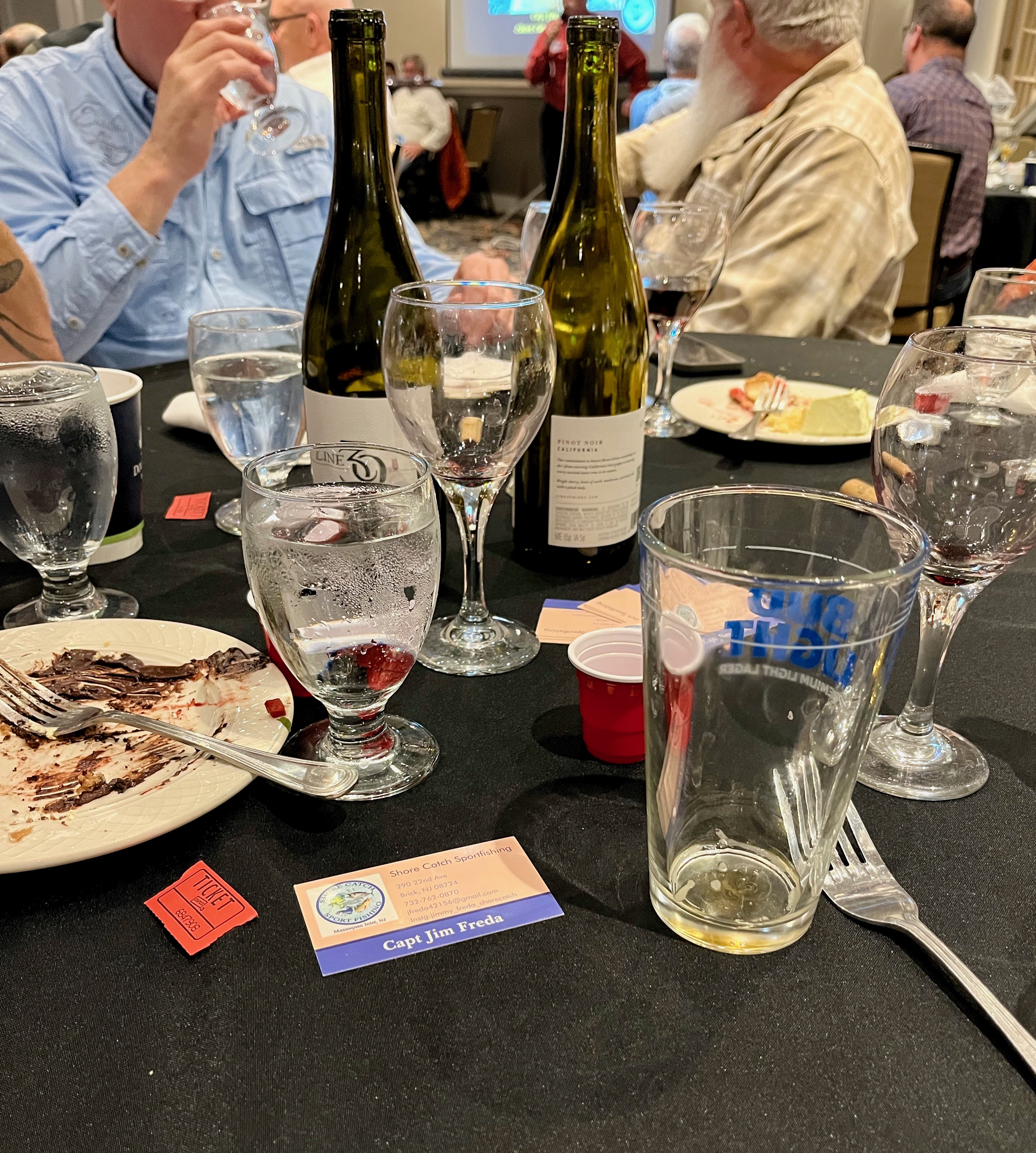
What an honor to be included in this slate of presenters. I was thrilled that my seminar was one of the better-attended talks for the weekend. If you were in the audience, thanks so much for coming, and I applaud the group for having so many excellent questions. I had to scoot to my 1pm wet fly tying class, which went very well. It’s always easy to teach people who are curious and enthusiastic.I’ve won the tying table-mate lottery for two years in a row. This is is Paul Gruver from Wake Forest, NC. He was kind and thoughtful and a pleasure to be with. At these event, there’s often a lot of fly swapping, so I’d like to thank Paul for the gifts, which I will fish with pleasure. One of the main points of a tying show is to learn, and I made sure to take the time to see what Paul was tying, and how he was doing it. What a master craftsman!The Saturday night banquet is always a high point of the show. In addition to dinner, you get a swag bag loaded with all kinds of useful tying stuff. Plus, there’s a raffle, and wouldn’t you know it? Mr. Someone-Who-Never-Wins-Anything won a fly box! I sat with luminaries like Tom Rosenbauer and Tim Flagler, but my newest bestest buddy is Lou DiGena, who had the planning skills and foresight to bring a couple of bottles of red wine to share with the table. Atta boy, Lou! Oh…did I mention he also brought a bottle of 10 year-old bourbon? Many thanks for your generosity.Some surprise guests, Bob and Andy! I didn’t recognize them without their waders. Bob and Andy are two Farmington River fishing buddies who, several years ago, graciously shared their water with me, a total stranger, during the Hendrickson hatch. We seem to have an unplanned reunion every year, since we all like this mark, but in April 2023 we missed each other. What an unexpected treat to get to see them.Lou DiGena and Tim Flagler doing their thing in the main hallway Sunday afternoon. I believe their table was the New Jersey Fly Tyers Guild. That a lot of talent representing.Barry Ord Clarke of The Featherbender fame working his magic. Barry has written, co-written and contributed to more than 30 books about fly tying. He has won medals in some of the worlds most prestigious fly tying competitions. So when I went to introduce myself, I was totally stoked to find out that not only did he already know who I am, he’s also a fan. Barry is supremely nice, and I thoroughly enjoyed watching him tie. See you next time, mate.
And there you have it. I can’t say this enough: if you’re not going to fly fishing and tying shows, you’re really missing out on the opportunity to meet, watch, and speak with some of the best fly anglers and tyers on the planet. Thank you to everyone who took the time to stop by my table, and I’ll see you at the Fly Fishing Shows in Marlborough and Edison in January 2024.
After fishing two Erie tribs in OH and PA last December, I knew I would have to get back there. Soon, nine-ish hour drive be damned. I had to wait a full 10 months to do it, but it was so worth the wait.
Unlike the northeast, Steelhead Alley has seen very little rain this summer and fall. The timing for my trip could not have been better, with a decent slug of rain before the weekend that marked the true start of the fall run for many tribs. Still, the water was on the high side of low — if that makes sense — meaning that 90% of the fish would be in 10% of the water. The spook factor would likely be very high, along with angler traffic.
Adding to my challenges was that I had zero experience fishing public waters. So I hired the guide I used last year, Bob Packey of Solitude Steelhead Guide Service. Bob focuses on fishing private water — an absolute treat — but that would do me no good when it came to public water. So we formed a game plan: fish Wednesday morning on private water for a few hours, catch a few fish, then bounce around to some public access marks so I could learn some spots. Since Bob has deep domain experience on Erie tribs, I knew I’d be in good hands.
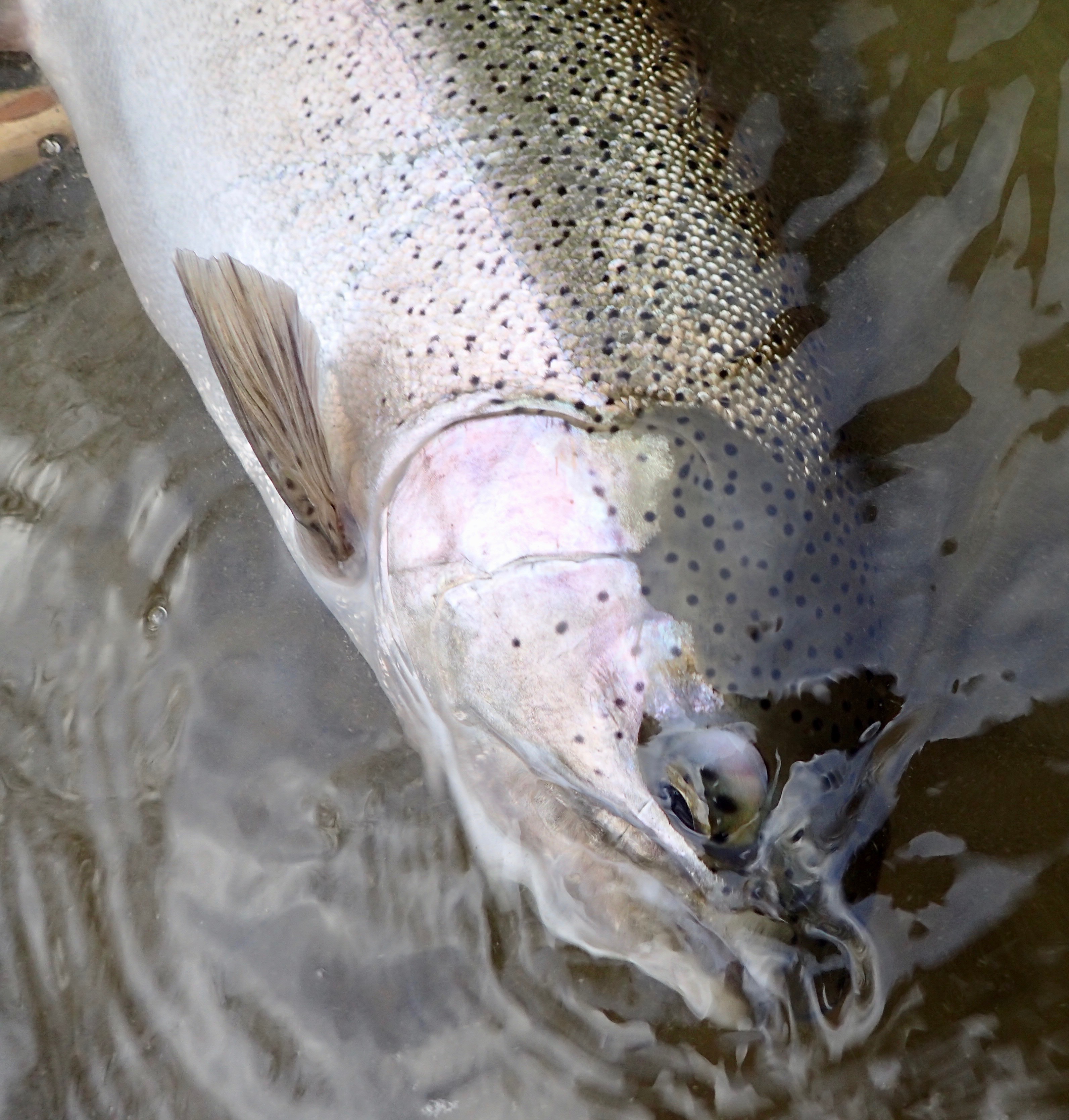
The dread cold front hit the night before day one, putting the steelhead in winter mode. We saw runs and slots that held dozens of steelhead, but even with precision casts and presentations, they were just not having it. Once the sun rose and the water inched up a precious degree or two, the natives decided to play. We had success with sz 14 Blood Dot eggs and sz 10 White Deaths fished as the point fly on a two-fly rig under an indicator. Switching to the White Death fly was a revelation, as fish that couldn’t be bothered with eggs suddenly opened their mouths and moved to take the fly. Bob is a terrific guide, and I’m learning so much from him about this unique fishery. Photo by Bob Packey.We had to work for our fish in the morning of day one, but beauties like this always make it a labor of love. I also stuck a big ol’ brown trout — funny how that’s considered by-catch when back home it would be a trophy. By 11:30am we were at a public access point on Elk Creek. Although there were plenty of anglers — “crowded” on Erie tribs is not the same as “crowded” on the Salmon River in Pulaski — we were able to find a half dozen highly productive marks because so many anglers were fishing in the wrong place. Cracking the Erie tribs fish-finding code is a major part of success. Once Bob showed me what to look for, finding the fish was much simpler task. The answer to the question, “Was that the bottom or a fish?” On all three mornings I fished, the steelhead were sluggish at first light. Once they turned on, there were far fewer fouls. When I foul a steelhead, I try to rope it in fast. I find I have very few breakoffs; most of the time, the hook comes away without breaking the tippet. I caught and released several fish that had hooks imbedded in their fins or bodies.What a rugby ball of a hen! She took the top fly on my rig, Clyde Murray’s Spider, size 12, in low light. My strategy on days two and three was to focus on a few marks and learn them cold (as much as I could in a few hours). Not all of the water was productive over the course of two days — steelhead are on the move this time of year — but I certainly had fun trying different flies and different combinations in different runs at different times of the day.So that’s why I lost that fish…Elk Creek living up to its name, a small window of wonder on an early morning when I was the only angler on the water for a few hundred yards. My final tally over 2 days and 3 hours was 20 steelhead landed, a bunch lost, and immeasurable fun. A little more rain, a little more flow, no bitter cold. Those are my hopes for December. Steelhead dreaming is a thoroughly enjoyable pastime.








 currentseams.com