A lot of anglers leave the river after a nymphing session wondering why they dropped so many fish. It’s the hook set, baby! This is such a simple principle. Adhering to it will result in a noticeable increase in your catch rate. Check out this diagram:
A proper nymphing hook set goes downstream, into the mouth and the mass of the fish.
If you accept the proposition — and I feel strongly about this — that most fish are won and lost at hook set — a good set is critical to nymphing success. Picture your fly moving downstream, a few inches off the bottom. The trout is facing upstream, sees the nymph, and decides to eat. You detect the strike (look for a reason to set the hook on every drift) and set the hook. Don’t set upstream. Doing so essentially takes the fly away from a fish that has said “yes” to your offering. Instead, drive the hook point home into the fish’s mouth — downstream — using the mass of the fish against itself. What if you’re indicator nymphing and your drift has the fly 30 feet below you? On the take, sweep set off to one side.
Do this every time and you’ll be netting a lot more fish. And of course, you’re constantly checking your hook points to make sure they’re sticky sharp…right?
For those new to currentseams (or those who simply forgot or missed the original message) a reminder that I’ll be presenting “The Little Things 3.0” via Zoom on Wednesday, October 14, at 7:00pm. This Zoom is part of the Russell Library One Book series, and you need to pre-register through the library. The event is limited to 48 participants — at last count there were less than 20 spaces remaining — and you must pre-register here. You cannot register through me or this website, and this is not part of the Zoom series I conducted earlier this year. Hope to see you virtually there!
Rich rewards await those anglers who pay attention to the little things.
Don took a wet fly lesson with me in July, and while the bugs and trout weren’t very cooperative, we still had enough action to make things interesting. I always tell my students that if they keep on with this wet fly thing, good things will follow. Don has been in touch since then, asking questions, practicing and tying, and most importantly, spending time with a team of three on the water. That’s how you become a better wet fly angler.
In my report from that day, I stated that if Don learned wet flies, he would become a dangerous fish-catching machine. Although conditions have been challenging in the last couple months, Don has kept at it. Last week he scored this gorgeous brown on a Squirrel and Ginger. I think it’s a Survivor Strain broodstock — that looks like a left-eye elastomer and clipped adipose. Way to go, Don!
The hunt for big bass continues…slowly. I’ll make this brief. I fished last night with Toby Lapinski for about two hours at mark in southeast CT. Toby was on spin gear, I had the big two-hander. Not a touch for me, and Toby managed a single hello tap from a smaller fish. And that’s about all I have to say about that, other than this: the more you put in your time, and the more you learn the particulars of a potential big bass spot, the more big bass you’re going to catch. Looking forward to round three.
The water was a little milky due to surf/sand/wind, but plenty of visibility; certainly enough to see a fly like this. Mmmmmm. Squidcicle.
It’s fall on the Farmington, and that means it’s time for tiny Blue-Winged Olives. Depending on your point-of-view, this hatch can be a blast or a scourge. The flies are small (20-26), but when conditions are right (frequently overcast, damp days), the trout will line up and sip them for hours.
So, what do you do when you’ve got the hatch matched, the right leader/tippet (12-15 feet is a good length to start), your presentation is spot on a feeding lane, drift is drag-free, and you get…nothing? Or worse, a refusal? It might be that you’ve got the wrong fly. Experience has taught me that sometimes the same size fly in a different style makes all the difference. So carry a bunch of different style dries, and enjoy the tiny BWOs of fall.
My tiny BWO dry fly arsenal includes, from left, comparadun, comparadun with Z-lon shuck, parachute, Pat Torrey’s Tiny BWO soft hackle, and foam wing. The trout sometimes favor one of these over another, and the only way to figure it out is to cycle through patterns. By the way, this concept applies to other tiny hatches, like midges.
It’s said that for every problem, there is a solution. The problem: any nighttime session with my two-handed rod quickly produced a wet handle, wet line, and wet hands — not a good combination when you’re relying on a firm grip to operate. Compounding the situation was the thin running line (the one I’m currently using is .042″). You’re holding it against the rod handle when you cast, and with any hookup over 40 feet away, you’re stripping that running line during a fight.
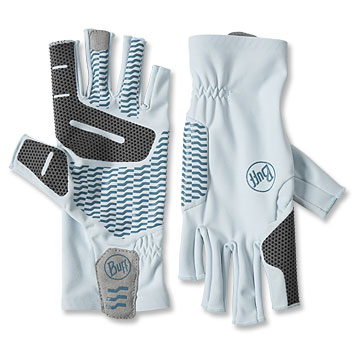
Clearly, needed to get a grip. Enter Buff Eclipse gloves. Partially designed for UV protection (not an issue at 1am), these gloves also feature a combination silicone dot pattern and an abrasion-resistant film on the palm that “maximizes grip while minimizing wear.” I also liked that these have three-quarter length fingers, which leaves your fingertips free. Bonus: if you’re having one of those really good nights, the gloves also minimize the red badge of courage (AKA striper thumb). I used them extensively this summer and I’m happy to report that they performed as expected. I bought my pair from Orvis.
Buff Eclipse gloves keep you grippin’ so you can give stripers a whippin’ (with apologies to Timex watches).
This evening I presented to the Anglers’ Club of Philadelphia via Zoom. Although it was a cocktail hour (5:00pm start), I remained steadfastly professional with my tall glass of lime seltzer. The topic was “Wet Flies 101,” and I had as much fun presenting it for the umpteenth time as I did the first! As many of you know, I’m passionate about wet flies, and especially teaching others this ancient and traditional art.
The Leisenring Spider, an homage to the Pennsylvanian roots of American wet fly fishing. An oldie, and a goodie. If you’re looking for speakers for your next club Zoom meeting, wet flies or otherwise, here I am.
Yesterday was a spectacular day for the tiny blue winged olives of fall: overcast, cool, drizzly. The bugs were out in force, and they had neither avian nor aquatic predators to contend with.
I guided Matt and his son Theo from 10am to 2pm. I know the fishing has been slow, but yesterday was ridiculous given the conditions and the hatch activity. We hit three marks, and managed only one 11th-hour hookup (which went quickly south when the trout melted the 5x leader I had tied on). Ugh. We focused on nymphing, and I had Theo doing some wet fly swinging and dangling when we saw some all-too-brief surface action. They both did a great job working hard, covering water, persevering, and I hope they’ll come back for a chance at revenge in the spring. It’s great to see a young generation fly angler who’s so enthusiastic!
Theo’s indicator dipped, and he set the hook. Not a fish, but rather this rig. I’ll give the creator bonus points for ingenuity, but I must also deduct points for using braid. Oops! That’s also a barbed hook, verboten within the permanent TMA. Boo-hiss on you.
I did a series of lightning raids on three spots yesterday within the permanent TMA. (I only had 90 minutes to fish.) The method was nymphing, both indicator and tight line. I found one fish that wanted to jump on. The other two marks were blanks. Even in these low, slow conditions there were anglers everywhere. Usually this time of year, on a weekday, I might see three or four angler cars during my travels. I saw three or four cars in several dirt pulloffs, and multiple solo vehicles. Fishing the Hous the last couple months has clearly spoiled me, as I’ve become accustomed to sharing the water with herons only.
Good news is that the water was nice and cool and there were bugs about. Even with all those other anglers, this was the only trout I saw hooked all day. Lovely halos. She took the Frenchie Nymph variant.Leaves were an issue, and will continue to be with this early foliage drop.
“Can you recommend three flies for me to fish on a dropper rig right now?”
I get this question a lot. Of course the answer depends on many, many factors. Since I enjoy helping people figure out this whole fly fishing thing, I thought I’d give you some simple guidelines — the goal being that you’ll eventually be able figure it out on your own.
If you know that tiny BWOs are likely to be out on a overcast, damp fall afternoon, you’re already ahead of the game.
Know what’s hatching or swimming. You should familiarize yourself with local hatches and baits. Know that when the Hendricksons are out on the Farmington in late April, so are caddis. Know that in early fall in SoCo, baits may include silversides, anchovies, peanut bunker, and finger mullet. Get to the river or estuary or beach and do some good old-fashioned observing. What’s flying around? What’s on the water? Bring a net and find out what’s in the water. For years, I’ve been pre-tying teams of three (sometimes 24 hours or more in advance) for where I’m going to be fishing. I’ve simply gotten dialed in to what’s happening and when. It is not a special talent. You can do the same.
Hedge your bets. Cover your bases. Blackjack players know there are certain hands on which to double down, essentially giving them a chance to multiply their winnings. Likewise, if you absolutely, positively know what’s on the menu, offer up seconds or even thirds. So, using the Hendrickson/caddis scenario, my team of three will have two of one and a single of the other, depending on what I’ve observed. If it’s July on Block Island, I may have three sand eel flies, or two sand eels and a squid. If I have multiple baits or bugs and no hard confirmation of what’s the featured entree, I’ll give the fish a choice: different sizes, species, colors — and let them make the call. Droppers are always the fastest way to find out what the fish want.
Which fly goes where depends on what you want the rig to do. If you’re fishing a team of three in a traditional way — a swing or mended swing followed by a dangle — your top dropper should be an emerger (soft hackles excel in this position) or a bait that’s likely to be near the surface, like a cinder worm or a grass shrimp. If you’re trying to get some depth to start — then let the entire rig swing up toward the surface — then your point fly should be weighted. If you want to manage the team of three like a single unit, dead drifting at or very near the surface, then your point fly should float. I almost always place the largest or heaviest fly on point. It’s not rocket science, and once you get out on the water and see how all these flies interact with water and current, you’ll have a better appreciation for the awesome power you wield with a team of three.
One last thing. You’re using a floating line, right?
Pop quiz, true or false: If trout are feeding on little dark stones or midges near the surface, Stewart’s Black Spider would be a good choice because it matches size, color, and presented an emerging profile.




 currentseams.com