Tying the Gurgling Sand Eel

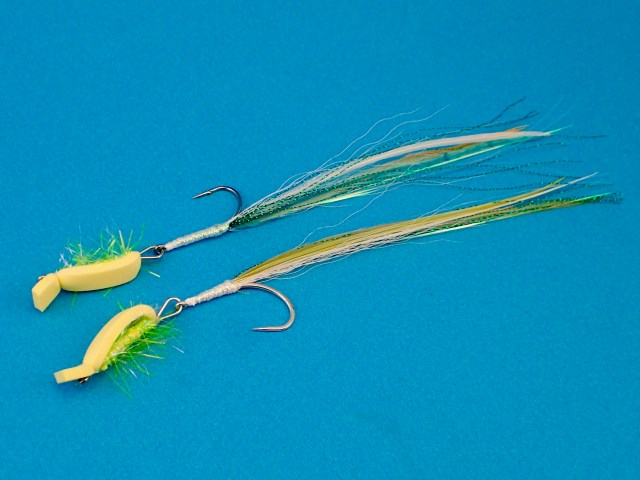
By popular demand, I present the recipe for the Gurgling Sand Eel — a kind of love child of Ken Abrames, Jack Gartside, and Kelly Galloup.

Here’s the backstory. A couple years ago, the guys at Block Island Fishworks (either Hank or Eliot, I can’t remember, but I think it was Eliot) showed me a prototype of an articulated sand eel Gurgler at the Edison Fly Fishing Show. I was given one, fished it that summer, and I resolved to tie a few of my own.

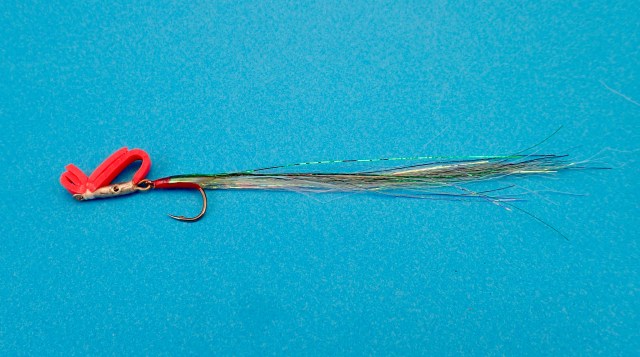
Here’s the prototype from Fishworks. Their shank is a little shorter, and the stinger hook smaller. I used a longer shank and a bigger stinger hoping that they would discourage dink hookups; I’m pleased to say that that was the result during this summer’s field testing. They use a strategically placed double layer of foam; I went for the simplicity of one (although Jack Gartside’s Sand Eel Gurgler uses the double layer). I deemed the eyes unnecessary. And since I like the action of saddle hackles — think Abrames’ Big Eelie — I incorporated them into my variant.
OLYMPUS DIGITAL CAMERA

~

The Gurgling Sand Eel

OLYMPUS DIGITAL CAMERA

Thread: 6/0, tyer’s choice of color
Stinger hook: Eagle Claw 253 1/0 or Gamakatsu SC15 2/0
Tail: 30 hairs bucktail; next, a 4″ pencil-thin saddle; next, 4 strands Flashabou; next, two 4″ pencil-thin saddles; next, 6 strands Krystal Flash. Tyer’s choice of colors.
Body: Pearl braid
Front shank: Fish Skull 35mm articulated shank
Underbody: Medium Polar Chenille
Shell: 3mm fly foam trimmed 1/4″-5/8″ wide, tyer’s choice of color

~

Tying notes: Tie the stinger assembly first. If you want to reinforce the thread wraps on the articulated shank, you can add cement. Start the shell just behind the eye, and bind down well. Attach the Polar Chenille near the butt end, and wind forward. Pull the foam over the top of the shank and secure with three wraps of thread just behind the eye.  Bring the thread underneath the lip and whip finish. Trim lip.

Yup. It works. I think the articulation adds another layer of action when you fish this with short, jerky strips. Bonus: it also works on the dead drift or on long pauses between strip sequences.

OLYMPUS DIGITAL CAMERA


Farmington River Report 8/5/20: the last second winning drive

I guided Abe yesterday from 2:45-6:45pm. Abe, who said he’d never done particularly well on the Farmington, wanted to focus on wet flies. For the longest time it looked like we’d picked the wrong day. The river was in fine shape, no worse for the wear after the storm. They lowered the flow out of the gate to 160cfs, but the Still was adding another 100 or so to make an ideal summer level, and the water was plenty cold. Getting there was an issue for me: closed roads in Bristol and Farmington turned a 50 minute drive into 90.

We hit four marks and found spotty action at best. Hatch activity was virtually nil, a 1 out of 10. I don’t need to tell you that that meant a paucity of active visible feeders. Nonetheless, we stuck a few fish in the first mark and had an LDR. The second mark was a bust, with only a couple courtesy taps. The third was even worse, without a single fine how-do-you-do? But the fourth…ah, the fourth. We broke out the wading staff and ventured into a snotty, pocketed, riffly run that always holds fish this time of year. I switched out the Hackled March Brown on point for a SHBHPT to give us a little more weight. Time was running out on our session. Whack! Mid-teens rainbow. Bang! Gorgeous wild brown. Bap! JV Atlantic salmon. Three fish in 15 minutes made for a very satisfying end to our session. Kudos to Abe for fishing hard, fishing well, and never giving up!

You’d be smiling, too, if you’d just landed a quality trout on a wet fly on such a slow day. Our quarry was camera shy. Thankfully, Abe isn’t. While angler traffic was light, we didn’t see anyone else hook up all day.

OLYMPUS DIGITAL CAMERA


Another terrific Witek striper/ASMFC essay, that fly you asked for, the 800 contest, and smallies on the brain

Out favorite dysfunctional — or is that non-functional? — committee met this week to begin formulating its future plans for striped bass. In another insightful essay, Charles Witek asks the question, “How Do you Define Success?” Suffice to say, the ASMFC grades itself on an absurdly low curve.

So where’s that Gurgling Sand Eel pattern you asked for? On its way. No, really. I’m hoping by the weekend.

Also coming soon: the official 800 followers celebration. Get your comments ready!

Last but not least, it’s been a tough summer due to drought and heat, but I fish in cycles, and right now I’ve got smallmouth on the brain. Big time. Nonetheless, to the Farmington I go. Guiding today.

Warm, low water doesn’t bother him. He liked the look of a TeQueely.

SummerSmallie


Some wet fly notes and lessons from recent outings

If you want to catch more fish, pay attention to the little things. You’ve heard that from me before — heck, I’ve got three presentations and written several articles on the subject — but it bears repeating. Here are a few lessons I hammered home to both clients and myself (we all have to pay attention to the little things) on some recent wet fly outings.

On the swing and especially the dangle, don’t set the hook. Let the fish set itself. When you feel the strike, ask yourself, “Are you still there?” The answer will always be yes, if you allow the fish to turn away and drive the hook point home.

Look for consistent, active feeders on emergers. You’ll know the bug/feeding stage from the rise form (slashy, splashy, showy) and that there are no duns visible on top of the water. Those are the fish that will rush to eat your wet flies. Just left of center in this photo is what I’m talking about.

Screen Shot 2020-07-19 at 11.15.14 PM

Match the hatch! If you see size 16 creamy/sulphury mayflies coming off, and you don’t have anything like that on your leader, get some on. Now.

Give the fish a choice. Droppers are always the fastest way to find out what the fish want. Different sizes, colors, species, life stages. The fish will always tell you when you get it right.

The Hackled March Brown continues to be a consistent summer big fish producer. It’ll be my default point fly pattern through August.

OLYMPUS DIGITAL CAMERA