Farmington River Report 9/24/14: Move it

If you’ve seen my “Wet Flies 101” presentation or fished with me, you know I’m a proponent of moving along until you find fish. Yesterday was a perfect example of why.

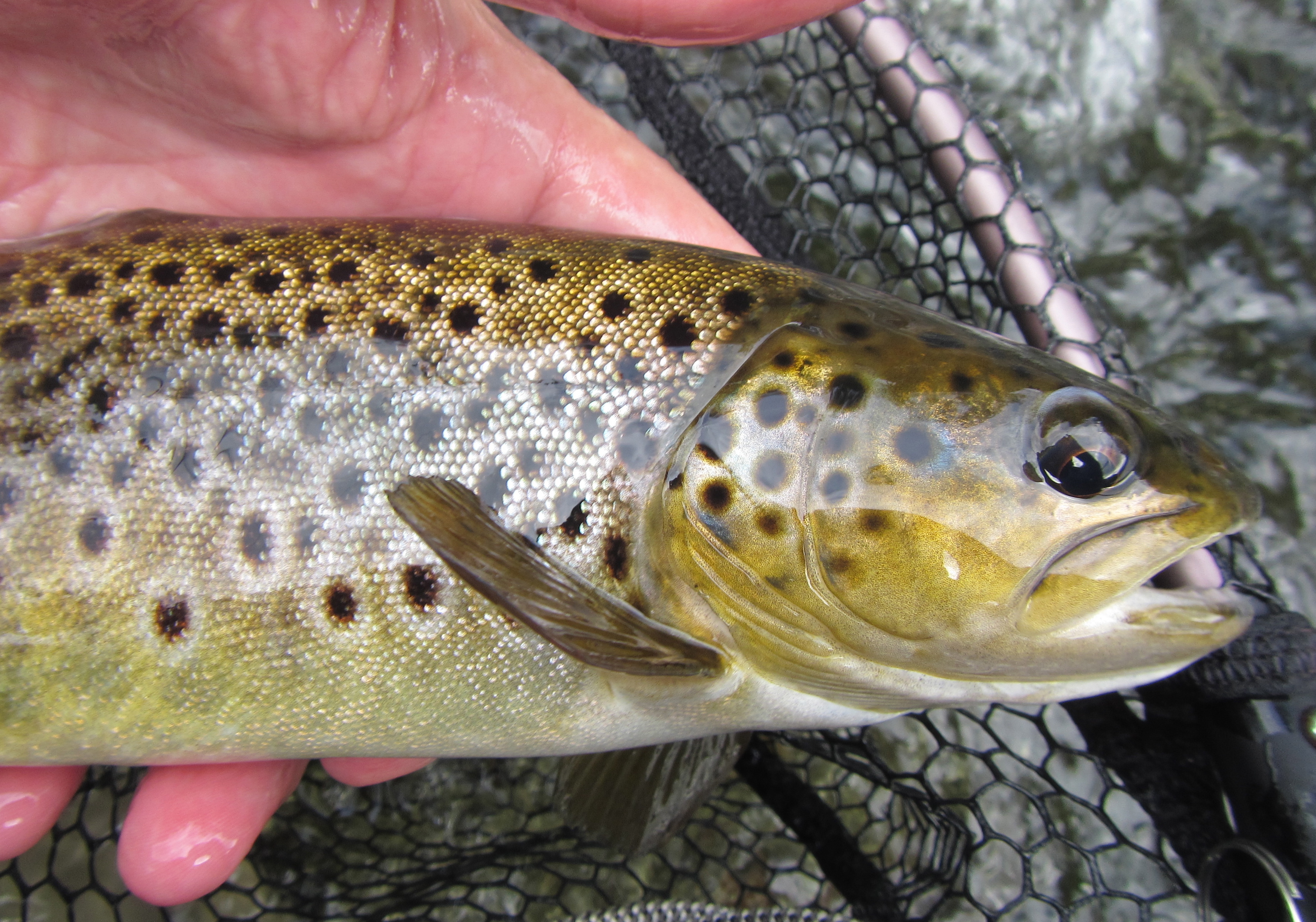
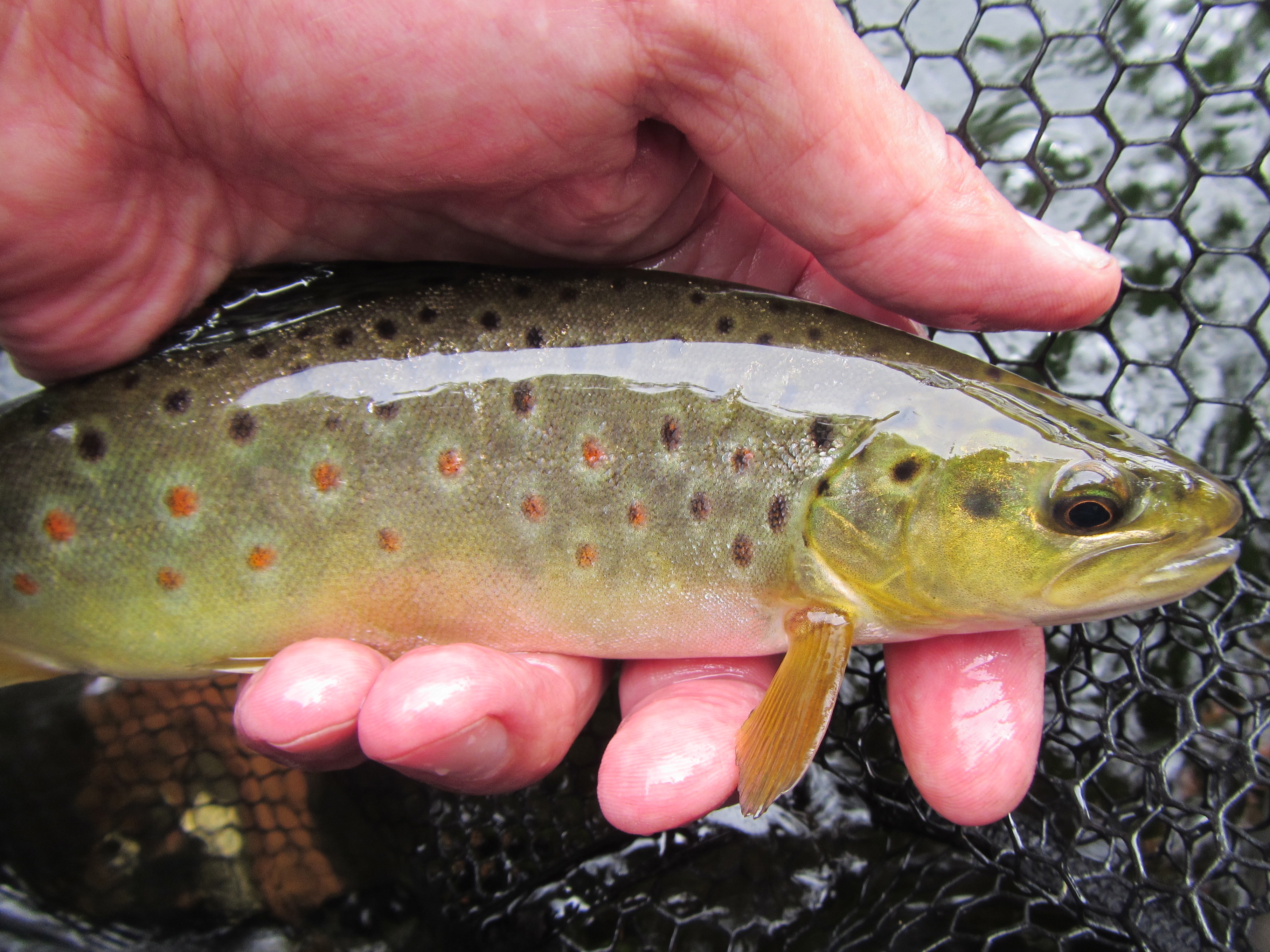
I swung wets for two hours in three locations. My team was a size 12 Squirrel and Ginger on top, a size 10 Hackled March Brown in the middle, and a size 10 soft-hackled bead head Pheasant Tail on point. The first place I fished continues to vex me. It screams wet fly. I know there are trout that live there. And I still haven’t gotten a touch in three trips. Moving right along…the second place was a lot of walking for a single JV Atlantic salmon, Salar the Leaper Jr. though he was. Finally, the last spot — ding-ding-ding. A nice assortment of wild browns from the sub-foot to mid-teens class. They were all attractively colored up for fall. Such impressive fins and tails on these stream-born fish. The hands-down favorite fly was the SHBHPT, and every take came on the dead drift phase of the presentation.

This brown attacked from his ambush position between two boulders in a slick-surfaced run.

9:14 Brown

Farmington River Mini-Report 8/22/14: Wet and wild

I had two hours to fish on Friday afternoon, so I jumped on it. I bounced around the lower river, visiting a few spots that I hadn’t fished all year. The air had a fall-like feel; it was overcast, and the river was running at 417cfs and 66 degrees. Bug activity was sparse and sporadic: a few small caddis, midges, and BWOs. 

This was a dedicated-to-the-wet-fly-cause outing. I swung a team of a sz 12 hackled March Brown on top, a sz 14 Drowned Ant in the middle, and the old reliable sz 12 soft-hackled BHPT on point. (I like a tungsten bead head fly on point when the water is running higher than normal. With a few strategic mends, it sinks the team faster, and also expedites deeper short line dead drift presentations.)

The PT was the runaway favorite fly. I hooked a nice assortment of wild browns with a few JV salmon in the mix. I had some hideous luck as well: not once, but twice I lost a good fish when he went deep and one of the flies on my team got entangled on rocks or vegetation. I lost two-thrids of my rig on the last one and called it a day.

Fat, healthy, and ready to rumble, these wild Farmington River browns are a treat to catch. Many of the takes today were subtle; more of a building of pressure on the mended swing than a clobbering hit. Good stuff.

IMG_2344

Farmington River Report 8/12/14: Before the rains came

It’s been a slow summer for me swinging wets on the Farmington. Until today.

They dropped the flow from the dam to 340cfs, placing the upper river at a near-ideal 375cfs, and the lower river at 400cfs. Water temp on the lower river at 2pm was 66 degrees, darn good for mid-August, and no doubt cooler still at the bottom.

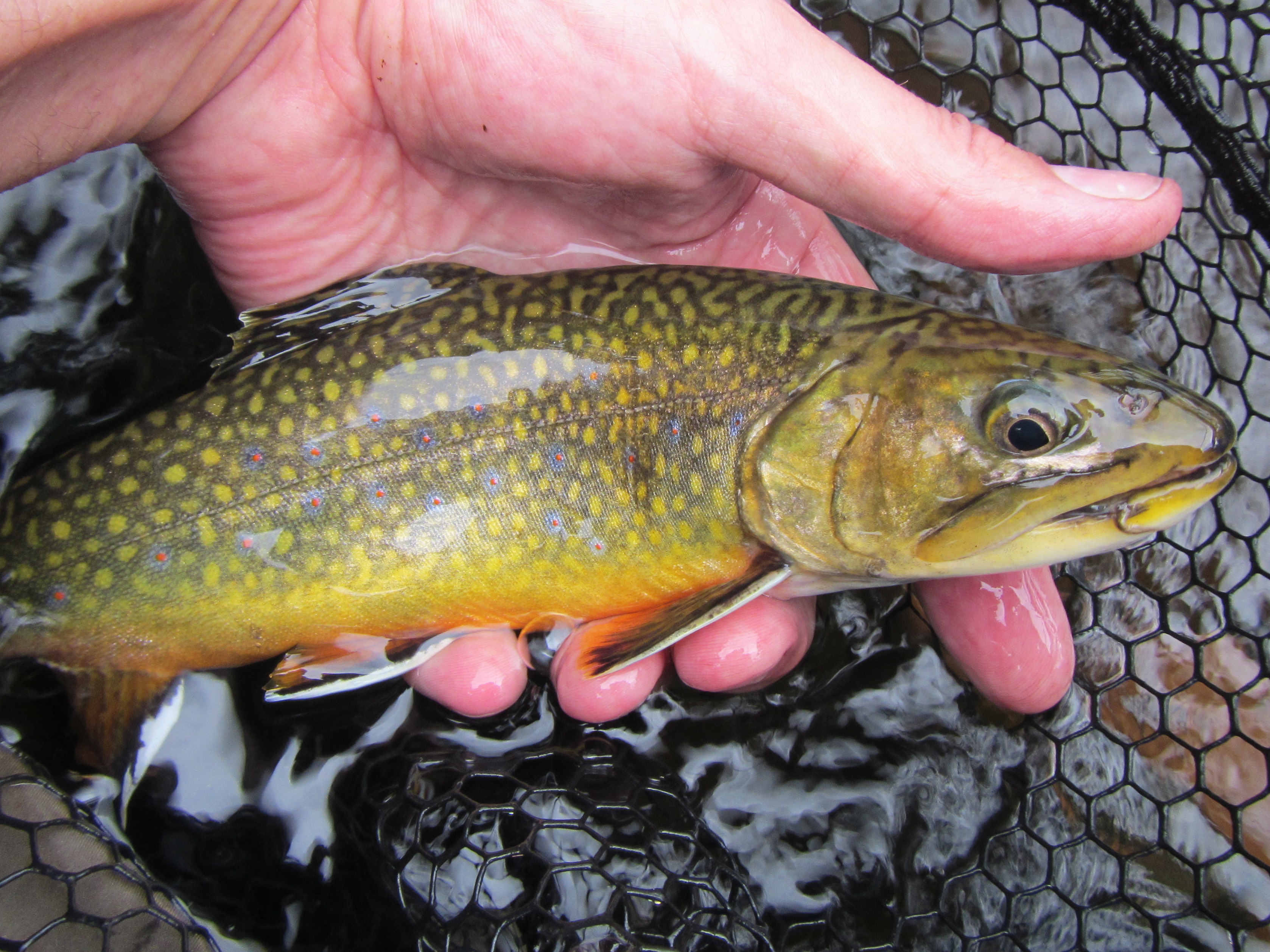
I visited several locations today on both ends of the river and found plenty of trout willing to jump on the wet fly. I fished my usual three-fly team; today it was a size 12 Squirrel and Ginger top dropper, a size 14 Drowned Ant in the middle, and a size 12 soft-hackle BHPT on point. I caught trout on all three flies, and even had a Farmington River Grand Slam with at least one brown, brookie, rainbow, and Atlantic salmon in the mix. One of today’s salmon was approaching the double-digit inches mark. Salar the Leaper indeed.

A staggeringly beautiful wild Farmington brookie who took a Drowned Ant on a mended swing. This is one of the best fish I’ve ever landed on this river, a tremendous fighter worthy of your applause. Also note the classic contrasting colors of the fontinalis fin.

IMG_2314

With the lower flows, my focus was on exploring some treacherous snotty water that had been previously out of reach. I almost went swimming a few times, and I even breached my waders when I stepped into a chest-high hole. (Please use a wading staff when you’re wading swift or difficult sections.)

Very little in the way of hatch activity today, although the Cedar Waxwings were busy.

The big one — 20+ inches —  on a wet fly still eludes me this year. But with a bounty of wild browns like this one, I’m not complaining.

IMG_2303

Farmington River Report 8/6/14: Follow the Heinie Trail

It seemed stupid to spend close to two hours driving to fish for only seventy-five minutes. But I did it anyway.

I turned my attentions to a snotty section of the lower river. At 510 cfs it was a challenging wade. I didn’t bring my thermometer, but it felt about 65 degrees at index finger depth. Not bad for early afternoon on a sunny day in August.

This year, the wet fly fishing has been slower than usual for me. I think some of it has to do with the elevated flows. I probably should be doing more nymphing. At least the trout are happy. I fished size 12 Squirrel and Ginger on top dropper, a sz 12 Drowned Ant in the middle, and a size 12 soft-hackleBHPT (tungsten bead) on point. I had several raps from those pesky JV salmon; I landed one of them. What a tub of fish flesh. Almost perch-shaped. I dropped a brown who was hiding behind a rock with a dopey reaction hook set. The one brown that came to hand was wild and in the foot-long class. He was quite exuberant in his reluctance to come to net.

That one fish was just enough to cover my lack of good judgement.

Classy litterers only leave premium cans behind. This says, “I’m not just a rude, ill-bred person; I’m a rude, ill-bred person with exceptional taste.” 

IMG_2295


Someone enjoying a snack in the cool shade of the tree-lined riverbank.

IMG_2300


Currentseams Q&A: The Leisenring Lift

Q: Fished White Clay in Pennsylvania, after April and May. I tied some size 18, 20 wet flies using just yellow or orange floss and light Hungarian partridge or grouse. I noticed that the trout either hammer the wet fly as it swings; or, after it swings, as I pick up the line trout hit it and I didn’t know they were on it? Is this the idea of Leisenring Lift? Just finished reading your article (“Wet Fly 101”) in the Nov/Dec 2013 American Angler. Good stuff!!!

A: Thanks for your kind words, and thanks for reading. The Leisenring Lift is one of the most misunderstood of the wet fly methods. According to Dave Hughes, Leisenring would present to a fish, or to a lie that was in the two-to-four-foot depth range, in a slow-moving current. He’d make his cast 10-20 feet above the lie. He kept tight to the fly, tracking the drift with his rod, making sure that the line and the fly weren’t dragging. At the point of where he thought the take would occur, he’d stop tracking with his rod. This would cause the fly, which had been naturally sinking (Leisenring did not use weighted flies) to come off the bottom and start swimming toward the surface. So the lift comes from the physics of the fly lifting off the bottom due to drag, not from the physics of actually lifting the rod. What I think is happening in your case is a trout is following the fly subsurface — or holding at the point where your fly dangles — and as you begin to lift your rod, it sees a potential meal escaping (much like it does an emerging caddis). The trout decides, “I want that!” and you’ve got a fish on. Good for you. 🙂


Farmington River Report: Wet, dry, hot, cold

On Saturday I guided Randy and John from noon to evening. We spent the bulk of our time walking a long stretch of the upper TMA swinging wets. The fishing was great — we barely saw another soul (contrast to Church Pool, populated by a good dozen-and-half anglers when we drove over the bridge). The catching, not so much. Despite the cloud cover and the threat of precipitation, the BWO hatch never really got going. We pricked a few fish, and John lost a pig in a secluded side stem, but other than that it was a lot of casting and wading. That we had such a good time anyway is a testament to my two clients: they fished hard, they fished well, and they realized that some days the bear eats you.

John exploring the nooks and crannies of one of the Farmington’s many side stems.

IMG_2259

Randy working the seams, ready for a take that never came.

IMG_2261

On to Plan B: catch the evening rise. We found some lovely dry fly water at 5pm that we had all to ourselves. By 7pm it looked like we had been teleported to Church Pool. Where the heck did all those people come from? Our focus was on fishing wets like dries, particularly the Magic Fly. The bugs certainly cooperated: sulphurs (size 14 and 18), March Browns, 16-18 BWOs and some size 16 tan caddis. For two-and-a-half hours, it was JV salmon city. Then the trout came out to play. When our time wound up, John and Randy graciously shared the water with your humble scribe. I was fortunate to connect with four lovely wild browns, cookie cutter in their length (10-12″) and unique in their markings: one had an odd scarcity of spots; another was rainbow-like in the density of his spotting; yet another still had faint traces of parr marks. Exquisite.

~

Sunday night I ventured to a different spot to check out the summer steno situation. They did their part, but sadly the trout didn’t cooperate. I had fair enough action from about 5:45pm-7pm (size 16 sulphurs hatching). Past 7pm it was total shutdown, even during the magic hour of 8-9pm. The summer stenos were out in force, but the trout weren’t interested. Massive spinner fall at dark with nothing on it. Perhaps when the water warms and drops a bit more (last night 57 degrees and 516 cfs).

An abundance of spent mayflies on the surface Sunday night, but a strange lack of sippers.

IMG_2268

It’s sum, sum, summertime on the Farmington

Now that we’re well into July, the Farmington has settled nicely into its usual summer patterns. The fish are spread out, and we’ll start to see some of the bigger guns moving into the fast water. Terrestrials are a good bet in daylight hours, for prospecting, or during periods when there is no hatch activity. Nymphing deep pockets and fast water can be very rewarding. This is the time of year when I love to walk the river and lazily swing wet flies over fishily-looking lies, or drift them hard against the riverbank.

Current hatches include tiny BWOs, smaller sulphurs and other yellow/creamy bugs (16-20), the omnipresent tan caddis, and for those of us who enjoy fishing minuscule patterns that blend in perfectly with the river bottom, Needhami. In my experience, sparser is better with the Needhami — I use a fly that’s basically some fine thread on a 22-26 hook with a CDC puff wing. At the opposite end of the fly size spectrum, it’s a good time to crack open the hoppers box, or swing and strip big streamers after dark. (And let’s not forget the mouse patterns.) If you’re going the after dark route, be sure to stay off MDC property. They can and will ticket you.

Now, if I could only get out there.

A big ‘ole Farmington River summertime brown, taken on a March Brown hackled wet.

IMG_0865

“A Team of Three Wets” in the current issue of Mid Atlantic Fly Fishing Guide

Calling all wet fly junkies! This article discusses the how and why of fishing a three-fly team of wet flies. It includes a diagram that shows you how to build a three-fly leader. MAFFG is distributed free in fly shops all over the — well, Mid-Atlanctic area. Who knew?

This magazine is an underrated gem.

Image

Farmington River Report 6/16/14: Business (almost) as usual

Since I didn’t get to go fishing on Father’s Day, Monday was my night. I was sure with the warmer weather the bugs would be thick. I was wrong. I arrived a popular dry fly pool on the upper TMA at 5pm. (Thanks to Ed and his friend, whose name I didn’t catch, for sharing the water.) Very little action for the first hour. Even when the hatch picked up (I’d rate the sulphur hatch a four on a scale of ten points) there were few fish rising, and most of them only sporadically. Every trout I hooked over the course of the evening was an active feeder. I fished the first hour with a size 18 cream Usual and landed three browns. Then I switched over to the Magic Fly, size 18. The fly was refused three times, but after I moved down to a 20, no more refusals (the naturals were probably a 16). Once darkness enveloped me, it was the classic Catskill Light Cahill, size 12. Two more on that. On the last one, I completely missed the take. I was picking up the line to recast, and I noticed the leader moving upstream. So, while the hatch wasn’t epic, I managed about a dozen fish. Which is a darn good way to spend the day after Father’s Day.

And still: what’s with everyone leaving once the game gets going? I had the whole pool to myself from 8:15-9:00pm.

Today’s lesson: that tiny rise ring that could only have been formed by a juvey Atlantic salmon that you cast to anyway because there were no other targets? It’s really a well-fed, 14″ wild brown. Happened to me twice.

River stats: 400cfs, 53 degrees, sulphurs, lots of midges (grey and cream), a few small size 18 tan caddis and a few size 16 black caddis.

You find irises like these everywhere on the Farmington River. They’re really quite lovely.

Image

The Black Caddis Spider

Last week on the Farmington I noted a substantial number of black caddis, about a size 16, hatching in the afternoon. I’d never seen them in that number before. While I had some patterns in my box (Stewart’s Black Spider, Starling and Herl) that matched the hatch, I wanted to tie up something that I could pretend was my own. This borrows from Leisenring’s Black Gnat and the S&H. On a stouter hook –and with a bead head — it would make a fine steelhead fly as well.

Black Caddis Spider

Image

Hook: Size 14-16 wet fly
Thread: Black
Body: Black pheasant tail
Rib: Extra fine copper
Hackle: Starling
Tying notes: A very simple tie. I used three pheasant tail fibers for the body. Counter-wrap the rib to reinforce the body, and play around with different color wires. I went for a longer-fibered starling hackle with this fly.