An exquisite jewel of a Farmington River brown, taken on a tiny soft-hackled bead head pheasant tail nymph. Although I was nymphing under an indicator, I was letting the flies swing up at the end of the drift. That’s when this fish hit. What a gorgeous creature.
Last week, someone used the search term “wet flies tied with jungle cock” to find currentseams. I found that intriguing because I had never tied a wet fly with jungle cock in my life. Sure, I’d done classic steelhead patterns. And untold numbers of flatwings and bucktails for stripers. But not a single wet with that most enchanting of feathers, the enameled nail from the cape of the male junglefowl.
Well, if someone took the trouble to navigate all the way to my humble site, they must have been disappointed when their search came up empty. And so, lonely internet sojourner, I took to the vise just for you. I have no idea who you are. But I hope you come back some day and find the little gift I left for you. And I thank you for the one you gave to me.
Here are four wets from Bergman’s classic, Trout. Clockwise from upper left: Silver Jungle Cock, Dr. Burke, Lord Baltimore, and Secret Pool No. 1. They are all tied on a size 8 1x short, 2x strong hook, the Orvis 1641.
(upper left)
Silver Jungle Cock
Tail: Golden pheasant crest
Body: Silver tinsel
Shoulder: Orange floss, palmered with grizzly hackle
Wing: Jungle cock
~
(upper right)
Dr. Burke
Tail: Peacock sword
Body: Flat silver tinsel with oval silver tinsel rib
Hackle: Yellow
Wing: White with jungle cock
~
(lower right)
Lord Baltimore
Tail: Black quill
Body: Orange floss with black floss rib
Hackle: Black
Wing: Black with jungle cock
~
(lower left)
Secret Pool No. 1
Tail: Golden pheasant tippet
Body: Peacock herl butt and shoulder with gold tinsel center
Hackle: Claret
Wing: Slate with jungle coc
Tying notes: Some tie the Silver Jungle Cock with a longer shoulder; I kept mine more thorax-like. I think this would make a great steelhead fly. It was the easiest of the four to tie.
You can tie the Dr. Burke with as many or as few peacock sword hackles as you like. I chose four for this size. Trivia: Dr. Burke is Dr. Edgar Burke, the man who painted all the files in the color plates at the beginning of Trout. Dr. Burke is credited with creating the Secret Pool No. 1 pattern.
The Lord Baltimore is the first Bergman-style wet I tied with a quill tail. It was far less intimidating than I imagined.
I didn’t have any claret hackle for the Secret Pool, so I used wine marabou. I also tend to use more golden pheasant tippet fibers in my tails; again, that’s an individual choice for each tyer. No matter how many fibers you use, I like to show the second black band.
My name is Steve Culton, and I’ve been fishing Connecticut’s Farmington and Salmon Rivers for nearly 50 years. My areas of specialization include wet fly fishing, dry fly fishing, streamer fishing (fresh and salt), and indicator nymph fishing. Small streams are also a passion, as they give us an opportunity to catch wild trout in a natural, more intimate setting. And let’s not forget those cantankerous Housatonic River smallmouth bass. My approach to fly fishing for striped bass is quite different from most other anglers’: I use a floating line, traditional trout and salmon presentation methods, and sparse, impressionistic flies like flatwings and soft hackles.
I am a teaching guide. (I have had many clients ask me if I am a teacher for my regular job. The answer is no, but I am flattered by the question.) We all like to catch fish, but if your immediate goal is sheer numbers you’ll probably be happier with another guide. If you’re interested in learning new methods, building your skill sets, fishing new flies, expanding your general knowledge, or exploring a river, small stream, or salt pond, I might be the right guide for you. Of course, I will do my best to put you onto fish. I think you learn more when you’re catching.
My teaching philosophy is pretty straightforward. There are no experts — we all have something to learn. I’m really just a guy who loves to fly fish. I’ve done a lot of it, read a lot about it, written a lot about it, and I’m very enthusiastic about sharing what I’ve learned with others. I sometimes take a spiritual, zen approach to the lessons of the day. Fly fishing has a soul, and I encourage my clients to explore and expand upon whatever that means to them. There are many, many ways to catch fish on a fly rod. People fish best when they use methods and flies they have confidence in. Since I am a self-taught fly fisherman, I know the struggles of learning the game. When you’re fishing with me, there are no such things as dumb questions – or for that matter, too many questions.
Above all, we’re out to have fun. James Leisenring wrote, “We fish for pleasure; I for mine, you for yours.” It is important to me that you enjoy yourself during our time on the water. Before any outing, I like to talk to my clients so I have a clear understanding of what their goals and expectations are.
So – let’s go fishing. You can reach me at 860-918-0228 or at swculton (at) yahoo.com.
For information on striped bass guiding and lessons, click here.
Due to other commitments, my weekends are almost always booked. The good news is that weekdays usually mean far fewer anglers.
2026 Rate Schedule(Subject to change. Does not include gratuity.) Rates may vary for non-Farmington River outings. Clients are responsible for their own gear (rod, reel, leaders, waders, boots, etc.), food, and drink. For lessons, I strongly suggest half-day sessions.
Half day (4 hours) Full day (7 hours)
One person $350 $450
Two persons $400 $500
For client testimonials, click on the comments button below.
Hook: 6-16 (this is a 1x short, 2x strong Orvis 1641 size 10)
Thread: Black
Tail: White hackle fibers
Body: Orange wool with fine gold tinsel rib
Throat: Furnace hackle fibers
Wing: Orange mallard married to a thin strip of black or natural grey mallard, then a slightly thicker strip of white mallard
The old-timers up in Maine (or down East, if you’re going for authenticity) who were fishing for brookies thought their quarry was highly territorial. So after they creeled a fish, they’d clip off one of the fins and use it for bait. And what an attractive bait it was: shiny, deep orange, contrasted against dramatic black and white bands.
An enterprising fly tyer named Phil Armstrong realized he could replicate this bait in the form of a married-quill wing wet fly. And thus was born the Fontinalis Fin. “Fontinalis” from the second half of the brook trout’s taxonomic name, Salvelinus fontinalis. “Fin” for rather obvious reasons. What a brilliant concept.
The real McCoy
While it’s tempting to look at the flies featured in the color plates of Berman’s Trout (this fly appears on plate 10) as more of an exercise in tying legerdemain than practical fish catchers, I can tell you from experience that this fly does work. It’s pretty simple as far as married quill wings go, and the rest of the pattern is something anyone with basic tying skills can do.
Tying notes: If you’ve never tied a quill wing, don’t start. Your first quill wing can be the fly-tying equivalent of the Bataan Death March. While I was kidding (mostly) about not starting, I think it took me over a half hour to tie my first quill wing — and that was accompanied by a generous use of rather colorful language. Once you get it, though, the process becomes easier. I’m often asked at classes and demos, ‘How do you glue the different quill sections together?” You don’t. The edges of quill fibers are like velcro — they stick together quite nicely. There’s a specific technique to matching quills (the wings should be a mirror reflection of one another) and marrying the sections. Perhaps someday I’ll post them. In the meantime, you can probably find a good how-to by doing a web search. Also, the quill wings should sit a little higher on the shank so as to not hide the body; I was in a rush to finish this fly, so I plead sloth.
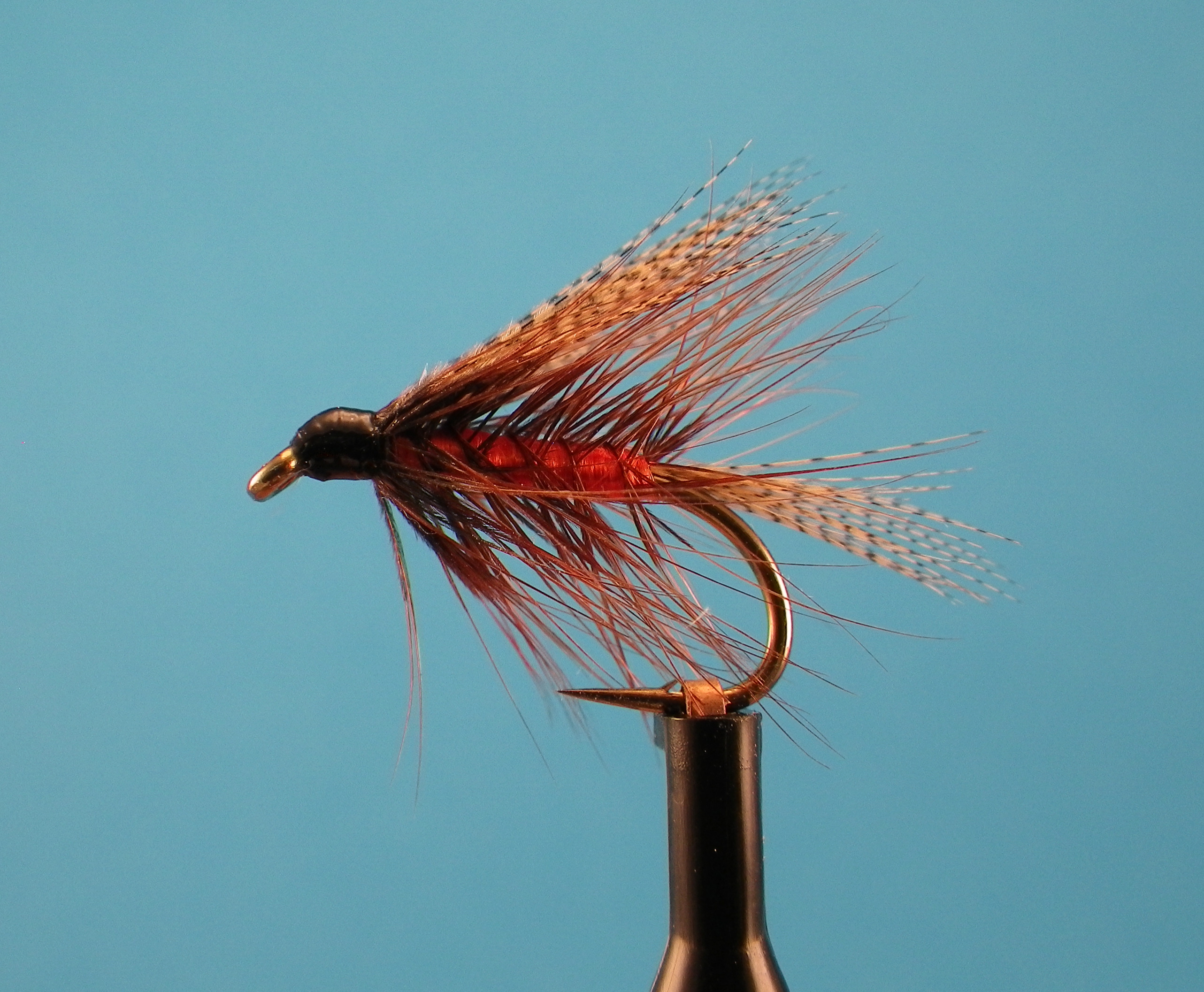
I first learned of the Catskill when I read Ray Bergman’s classic, Trout. While it lacks the garish palette of the majority of the flies that appear on the color plates at the beginning of the book, the Catskill is nonetheless an attractive fly – albeit in a rather understated way.
There’s something seductive and buggy about wood duck. The soft brown hen hackle will collapse and pulse in the current, contrasting nicely against the orange floss body. It’s easy to imagine this as an over-sized caddis. Or at least as something that looks alive, and good to eat.
I tied it large, but I can see going down to about a 16 or so with this fly. Although I have not yet fished it, I already have supreme confidence that it will be a fish catcher.
You can, too.
The Catskill
Hook: 1x short, 2x strong size 8-16 (this is an Orvis 1641 size 10)




 currentseams.com