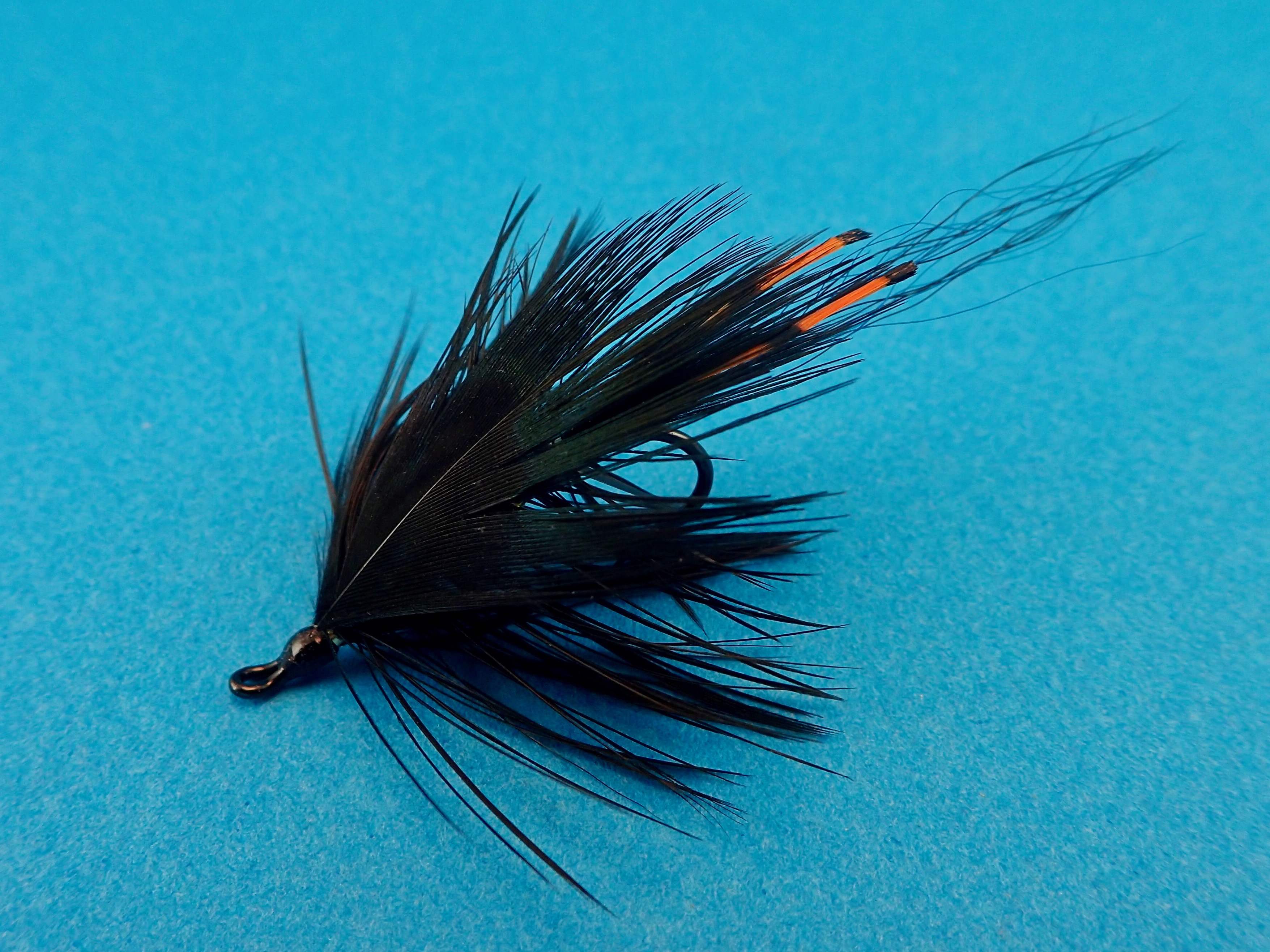
If you’ll pardon the wordplay, I offer relief to those who are already weary of the crass holiday commercialism that seems to start earlier each year. Here are three favorite patterns that feature basic black. Give yourself the gift of tight lines, and tie one on.
The Bombardier Flatwing. Treat yourself to an explosion when you swing this big flatwing in the wee hours of a chilly April very early morning.
The Bruiser Big Eelie. Unlike the unis of the New Zealand All Blacks rugby side, this lethal sand eel sports some blurple. Perfect for getting into a scrum with some stripers on a moonless night.
If you fish for striped bass with a fly rod, you’re operating under an unimpeachable assumption: whatever you hook must be within close range. Fly casting range. Not practice casting on a lawn with just a fly line. I’m talking standing thigh-deep in the ocean with a line and leader and fly and waves and wind and if it’s the dark of the moon, limited vision. You might get 100 feet if you’re a tournament-level caster, or have a two-handed surf rod. For most folks in standard conditions, it’s probably 75 feet or less. If the wind is honking in your face, you might be talking well under 50.
Sometimes, distance just doesn’t matter. (The last striper I caught took the fly under a rod’s length away from me.) And sometimes, like Wednesday night, distance is everything.
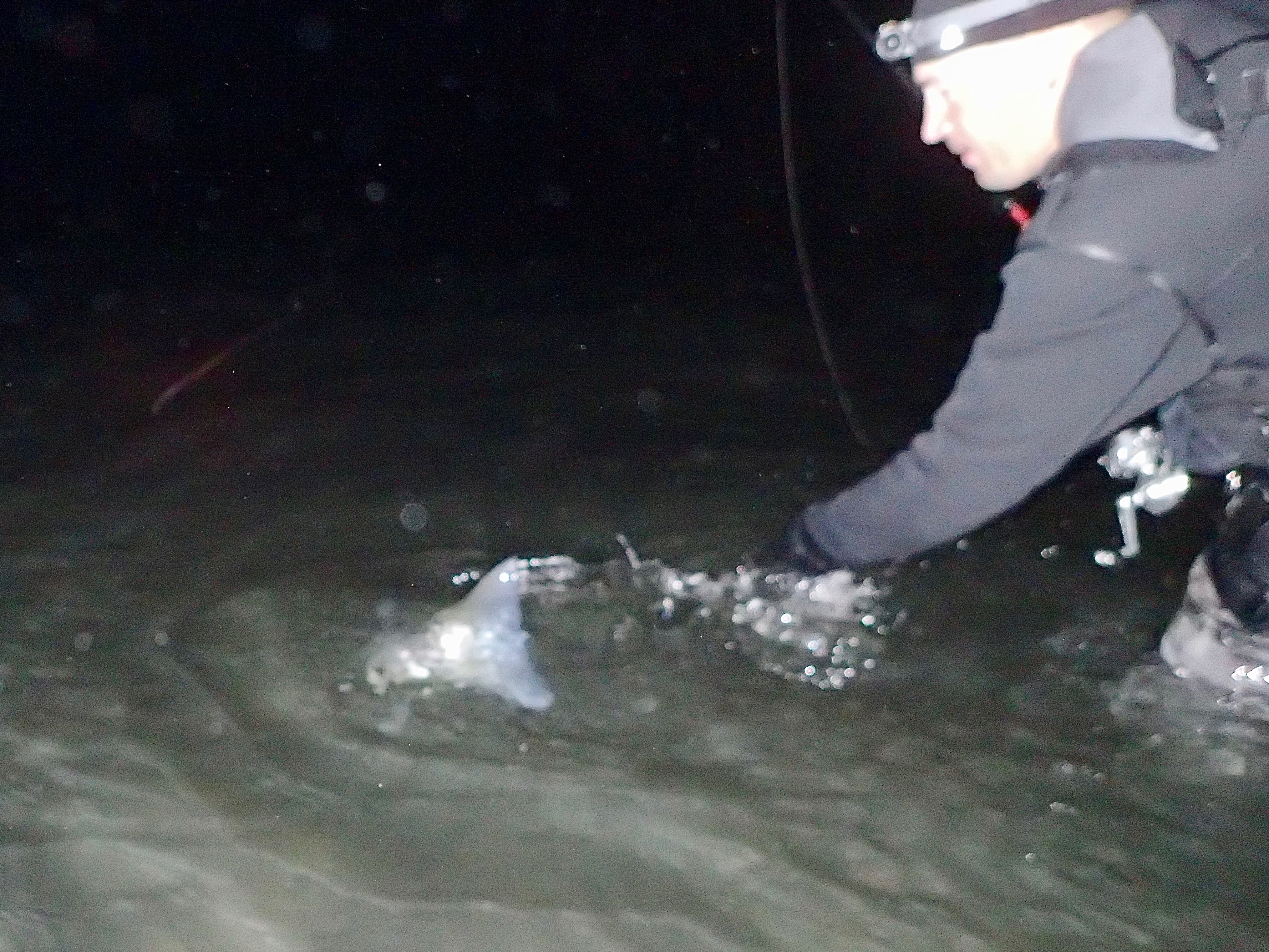
I fished with surfcaster extraordinaire Toby Lapinski, and it was a tale of the tape. Toby got into a half-dozen-plus fish ranging from 5 to 15+ pounds, and I blanked. Oh, I had a few pulls from squid, a solo sharp rap, and then later, a momentary hookup. But the spelling of the word of the number of bass I landed begins with a Z. Toby was launching his wares way over 100 feet, and that’s where all the action was. I had my two-handed surf cannon with me, but I was well short of where the fish were holding and feeding. I saw one of Toby’s hookups, and it was a good 50 feet beyond what I was making. (And I was having a very good casting night, bottoming out on just about every cast.)
A cast, a mend, a slow gathering of the line, and….nothing. (Photo by Toby Lapinski)
You might think I was discouraged, but that wasn’t the case. I was delighted that Toby was getting into fish. Most of all, it served as proof that I wasn’t fishing poorly. I just couldn’t get the fly out far enough. Nobody could have. Thank goodness those nights are the exception.
Out thinking as we trudged back along the beach was to try a different, earlier stage of the tide, when the fish might be in closer. It’s all one huge science experiment, with your lab report being graded by the fish. So I’ll be looking to bump that C up to an A.
If you’ve taken a lesson with me or attended one of my presentations, you’ve heard me say that we all put our waders one leg at a time. So, even though I may be considered an authority of sorts, I’m still human — and I still make mistakes on the water.
Twice now, on my last two trips to the Cape, the catch has been trending small. Twice, I’ve subsequently hooked into something very large, and lost the fish.
Now, you could make a case that I was a little unlucky. There’s probably some truth to that. But the single biggest reason I lost those potential cows is because I wasn’t ready for them. I didn’t make a powerful initial hookset. And by the time I realized what was happening, I’d already lost the fish.
Gordo hooking up. At least someone on this crew knows what they’re doing.
My most recent tale of woe came earlier this week on the Brewster Flats. I was fishing a small weighted crab pattern, probably on a size 4 hook, letting it bounce along the bottom, then swing up at the end of the drift. It had been a slow morning — Gordo, who was spin fishing with a jig head small soft plastic, had connected with two smaller bass. So that’s what I was expecting. I hadn’t had a touch all morning, and had been cycling through patterns in a desperate attempt to find something the fish might eat. The crab fly was on the dangle below me just over a deep hole, and I was daydreaming.
WHACK! The bass hit the fly like a bullet train. Immediately, line began screaming off the reel. The fish made a textbook striper series of runs: one good, long one, then a pause (where I attempted to reset the hook and gain some line). Then a second powerful, albeit shorter run. I reset again, but it felt wrong. I was furiously cranking the reel when the line went slack. Heartbreak.
So. I hoping that I’ve learned my lesson. It’s OK to expect small, but be prepared for big. I certainly will be.
I’m a little late on the draw here — Ken used to make his September Night reminder post on his website early-to-mid August — but here we are and it is indeed time. While I try to provide you with original content, this is an important repeat. The September Night is a great fly. It’s a fly you should know about. It’s a fly you should be fishing. And, it’s traditional (in so many ways!). Here’s some of my text from a long ago post:
Fall has begun, and for striper anglers in the northeast fall means finger mullet. The September Night pattern can be found in Ken Abrames’ classic Striper Moon. It was one of the featured patterns in my 2015 American Angler article Soft Hackles For Striped Bass.) You don’t even need long flatwing saddles to tie it — I’ve gotten away with stung hackle in a pinch. Just look for chubby, webby feathers.
Ken Abrames’ September Night
Hook: Eagle Claw 253, 1/0-3/0; Thread: white 6/0; Tail: 30 gray bucktail hairs, then two white saddle hackles tied in flat, then two strands silver Flashabou; Body: silver braid; Throat: sparse, long white bucktail tied as a 3/4 collar, both sides and bottom; Collar: white marabou, folded or doubled 3-4 turns; Wing: 30 long white bucktail hairs, then 15 purple bucktail hairs, then 2 strands blue Flashabou, then one natural black saddle hackle.
I’m really not in a bad mood about it, but yeesh! I have been getting my butt kicked in the salt since June. Granted, it’s been a trip here, a trip there. Wednesday night I fished a top-secret mark with surfcaster extraordinaire Toby Lapinski. We both agreed that it looked fishy as hell: moon going behind a cloud bank for good, light winds making just the right amount of chop, falling barometer, moving tide, and….no bait. What?!? No legions of silversides? No juvenile menhaden? Toby managed a few courtesy bumps and a husky 8-10lb bluefish; all I could muster was a lightning fast double-blip hit that I suspect was a smaller blue. We only gave it 90 minutes, but we just weren’t feeling it.
Which brings us to the second part of this post. Dennis Zambrotta wrote that when he fishes the west side beaches of Block Island, he gives a mark 10 casts or so and then moves on. I don’t have any hard and fast rules like that, other than when I’m fishing by feeling, I get into a yeah or nay mindset. And on this night, the nays were screaming out loud. I was the one who formally called it, and Toby later confessed that he was ready to leave even before that. I guess when you reach a certain level, and have a certain familiarity with a mark and its patterns, you’re either feeling it or you’re not. Maybe if we stayed another hour, we’d have gotten into some fish. We did agree that if fellow surfcaster extraordinaire Jerry Audet was with us, he’d still be out there.
Jerry is a wonderful example of an angler with a plan. He knows who he is and how he wants to fish and he does it with consistently great results. You could learn a lot from a guy like Jerry — even if you never pick up a spinning rod — and a good place to start is last month’s Anglers Journal Podcast, Surfcasting With Jerry Audet. Give it a listen. Take notes. Appreciate his knowledge and passion.
Even if you’re inclined to get the hell off the reef and get to bed before 2am.
I recently came across this wonderful photo of Ken Abrames taken by fly fishing shooters extraordinaire Barry and Cathy Beck. It was posted by Tom Keer on one of his social media feeds. I don’t know where the shot was taken, but it’s a great look at an extraordinary fly caster. I remember seeing Ken in a parking lot in Watch Hill with my Salmo Sax #3 and a Rio Outbound long head 9-weight line. He held the rod in his right hand; his left hand was stuffed into the front pocket of his khakis. One false cast…waaay back….then one smooth, yet powerful stroke forward, and out went the entire length of line. (That’s 100 feet for those of you keeping score at home.) There are those who will tell you that the double haul — or as Ken liked to call it, “high line speed gymnastics” — is essential to being able to fly fish in saltwater. They never saw Ken cast. I’ve still never double hauled in my life — thanks to Ken.
Photo courtesy of Tom Keer and taken by Barry and Cathy Beck.
It’s a warm, humid Block Island night, the kind you get in early summer when the mainland is baking. Dark of the moon. Surf on the low side of moderate, but enough to create a wash zone and necessitate mends over the tops of incoming waves. I’ve scoured the trough of this beach for over an hour with a Big Eelie, and made the decision that it’s not happening. I glance at my watch. 11:25pm. Normally, I’d be all fired up, knowing that if there are no bass here, they’ll be somewhere else, and — best of all — I have another two hours to fish. Maybe three, if the bite is good. But I’m about to do something extraordinary. I catch the fly in the hook holder, reel up, and head back to the Jeep. I’m done. Heading back to the cottage.
What’s extraordinary about this is that in all my decades of fishing Block Island, I’ve never quit a night session before midnight.
This makes three consecutive years of disappointing fishing from the shore on Block Island, and this was the worst by far. The story is one I could tell you in numbers: Seven nights. Five striped bass. Four skunks (six if you count my two daytime sight fishing blanks). No fish over 22″. And the third straight year I’ve failed to land a bass of 10 pounds of better.
What’s behind all this? I can give you my best guesses. A burgeoning grey seal population. Warming inshore waters. Bass that never showed up inshore in numbers in June, so why would they show up now? An abundance of food and cooler water offshore. Dwindling striper stocks. I can tell tell you with fierce conviction that the patterns from ten years ago are a distant, bittersweet memory. Fish are aren’t where they were a decade ago (and don’t get me started on 15-20 years ago). It’s enough to make me heave a rueful sigh.
It’s not for lack of bait. Crabs everywhere. More sand eels than I’ve seen in recent summers, although they were much smaller (1″-2″) than usual. Squid galore. In fact, four nights into the trip, I’d landed as many squid as bass. To amuse myself, I turned on my light and watched the squid attack my sand eel fly. Squid generally muddle along, but their closing speed is impressive. And the bite is not. I sight fished two days on Crescent Beach and blanked on both. The first day I only saw a total of six cruising targets, and some of those may have been the same fish. The second day, in 90 minutes, I didn’t see a single bass(!). Really? Then there was plain old bad luck. I had confirmed reports of smaller bass blitzing sand eels at dusk on two consecutive nights. The first night, I’d gotten a late start, and I caught the last remaining bass of that feed. The next night, I missed it entirely. Not to be denied, I showed up at the mark the third night ready to fish at 8:30pm. Same tide window, same wind direction, same barometer, and…nothing. No bass, no blitz. You really can’t make this garbage up.A rocky point, structure, and wash over a sandy bottom holding bait. Scouting mission complete, I headed back after dark to fish the same tide. 15 years ago, I’d be posting pictures of one of the 20-pounders I released. This year, you get a nice seascape. That’s all there is to see here, folks.Mr. Dour out for an evening stroll. By the end of the week, I was rationalizing my existence by viewing my time as enjoying a good cigar, and oh, by the way, I’ll also be doing this casting and mending thing, too. Mid-week, there was a Steve Culton sighting. An angler was coming out as I was going in, and exclaimed, “I know you! You’re the Block Island fly fishing guy. Steve.” Turns out he’d never fished the Island before, and came across some of the articles I’d written while doing a search. As always, if you see me out and about, please come say hello. I highly recommend ‘Gansett tall boys, fresh steamers, and Ballard’s famous lobster as a consolation prize. And don’t forget Aldo’s ice cream!
Neville has been following me for some time now, all the way from England. While he’s on holiday in the States this week, we had the time to meet up in Rhode Island for a lesson. We met at his rental in Point Judith, and tied a deer hair shrimp, my Grass Shrimp Solution, a Big Eelie, and then a Mutable Squid. That kept us busy for a couple of hours. Then we geared up and headed to an estuary to practice the greased line swing and its associated tactics. The tide was wrong, but we had moving water, and we even had a swing and a miss when Nev was stripping in his line to make another cast. (Teaching moment: the bass that chased his Ray’s Fly was small. Stripping a fly is a great way to attract small striped bass.) Neville is a very enthusiastic learner (he recorded much of our session on his phone) and I have only the highest amount of respect for those who dive into a subject with such eagerness and passion. Well done, Nev!
All the way from Merry Old England! Here’s Nev putting his TFO TiCr five-weight through its paces. He’s well on his way to becoming a dangerous striper-catching machine.
Edward Ringwood Hewitt was one of the leading innovators in American fly fishing and fly tying. The Skating Spider…Bivisisble…Neversink Stone…these are all Hewitt creations. Hewitt was obsessed with finding out everything he could about what made fish eat. To wit, he created a list of seven factors that made a pattern successful, and ranked them in order of importance. Gary LaFontaine, another keen student of feeding behavior and effective fly design, lists them in his masterwork Caddisflies. Number one is the light effects of the fly, above and below the surface. Number seven, the least important, is accuracy of imitation of the naturals.
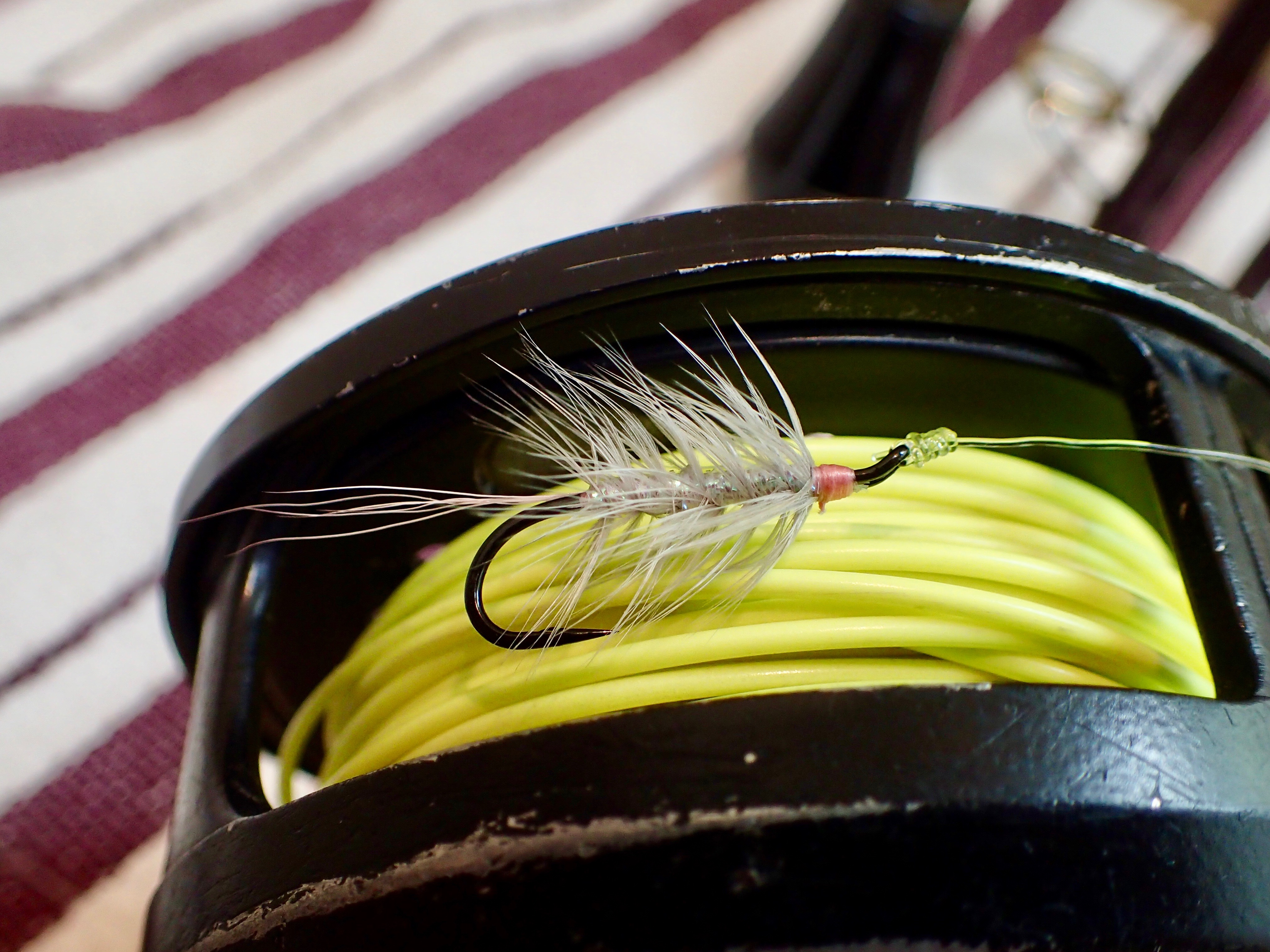
So it should come as no surprise that The Grass Shrimp Solution, a ridiculously simple pattern constructed of a few strands of bucktail, some braid, and a hen feather, excels at fooling striped bass. It has no eyes, no tail, no carapace. But it does have the essential bite triggers that stripers are keying on. In Caddisflies, LaFontaine makes a very big deal about what fish are looking for when they’re feeding; it’s often a single, essential characteristic of the natural. The Grass Shrimp Solution offers a translucent silhouette when viewed from below; the soft hackle and sparse feelers provide movement; and when held on the dangle, the fly creates a wake just like the naturals. Impressionism. It’s what’s for dinner.
If you placed the Grass Shrimp Solution in a shop next to patterns with shells and eyes, no one would buy it. Fortunately, striped bass don’t browse through fly bins.
This is from an email sent out today by the CT DEEP:
“Greetings fellow fishing enthusiasts. CT DEEP is sending you this email to let you know that the Atlantic States Marine Fisheries Commission (ASMFC) took emergency action earlier this month to implement a 31-inch maximum size limit on recreational striped bass fisheries along the Atlantic coast. For more information about the ASMFC emergency action, please read the ASMFC news release available at http://www.asmfc.org/uploads/file/64529753pr10AtlSripedBassEmergencyAction.pdf as well as the informative FAQ page that was compiled by the Massachusetts Division of Marine Fisheries available at https://www.mass.gov/info-details/striped-bass-emergency-action-frequently-asked-questions-faq
To come into compliance with the ASMFC emergency action, CT DEEP will implement a new 28-31” harvest slot limit for striped bass effective May 26, 2023. The new 28-31” harvest slot limit that will become effective on May 26th means that any striped bass that is less than 28 inches or greater than or equal to 31 inches must be released without avoidable injury. This regulation will apply to all waters of the state (marine and inland district).
Questions on the new striped bass harvest slot regulation can be sent via e-mail to deep.marine.fisheries@ct.gov , or call 860-434-6043 and leave a voicemail and someone from DEEP Marine Fisheries will return your call as soon as possible.
ASMFC is required to hold four public hearings within 30 days of any emergency action to provide information on the action and obtain public comment. ASMFC will hold four virtual hearings and has released a hearing schedule. Members of the public may also submit written comments by sending an e-mail to comments@asmfc.org or by mail to:
Emilie Franke
Atlantic States Marine Fisheries Commission
1050 N. Highland Street, Suite 200 A-N
Arlington, VA 22201
The virtual public hearing schedule is as follows:
Wednesday, May 17 5:00 – 7:00 p.m. (Completed)
Monday, May 22 6:00 – 8:00 p.m.
Tuesday, May 23 5:00 – 7:00 p.m.
Wednesday, May 31 6:00 – 8:00 p.m.
To register for a virtual hearing, please go to this link:
and use the dropdown menu to select the hearing date you plan to attend. Hearings will be held via GoToWebinar, and you can join the webinar from your computer, tablet or smartphone. If you are new to GoToWebinar, you can download the software by (https://support.goto.com/webinar/help/how-do-i-download-goto-webinar) or via the App store under GoToWebinar. We recommend you register for the hearing well in advance of the hearing since GoToWebinar will provide you with a link to test your device’s compatibility with the webinar. If you find your device is not compatible in advance of the hearing, please contact ASMFC at info@asmfc.org (subject line: GoToWebinar help) and we will try to get you connected. We also strongly encourage participants to use the computer voice over internet protocol (VoIP) so you can ask questions and provide input at the hearing.”






 currentseams.com