Back from the Edison Fly Fishing Show, and CFFA Show this weekend

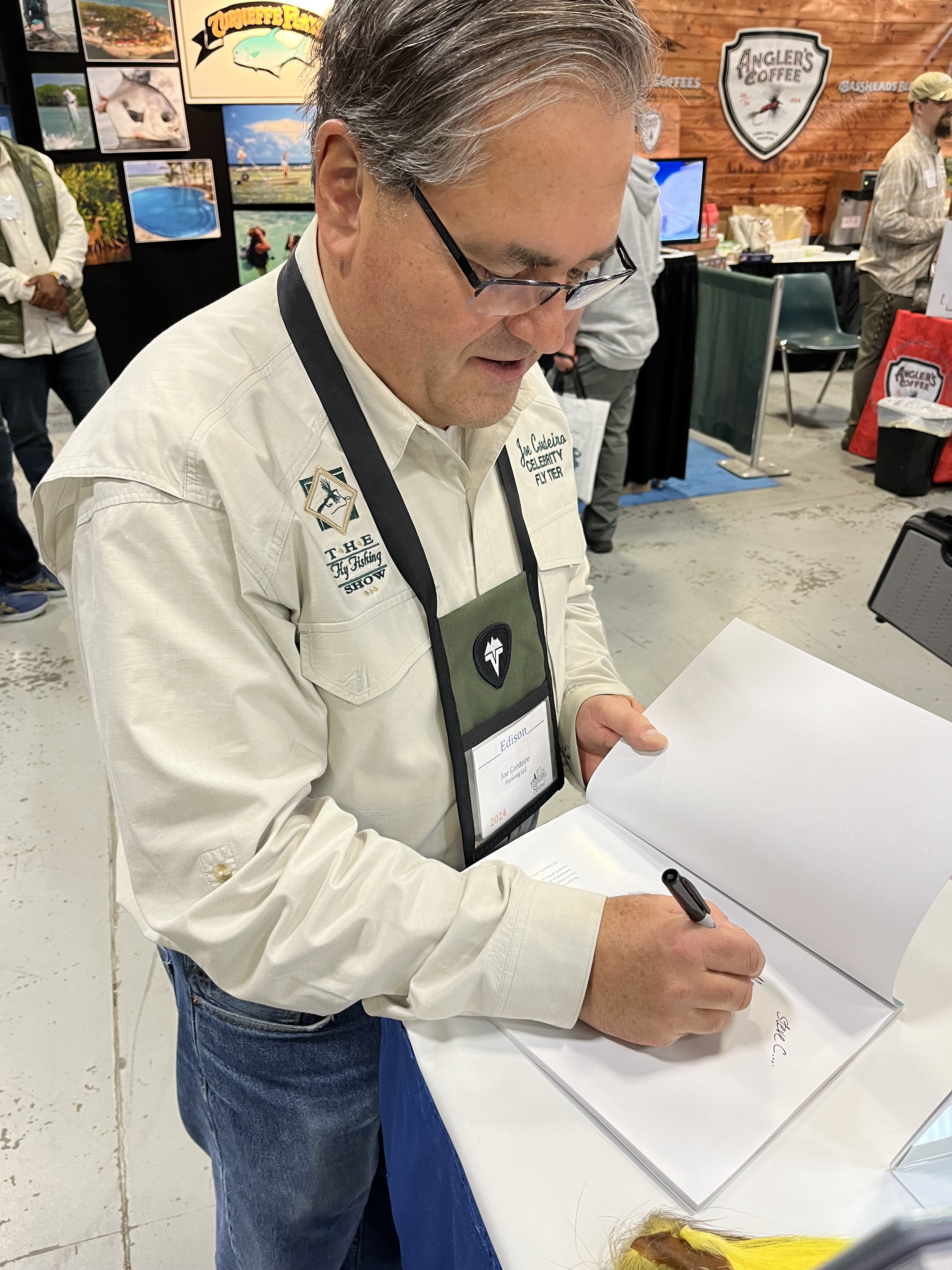
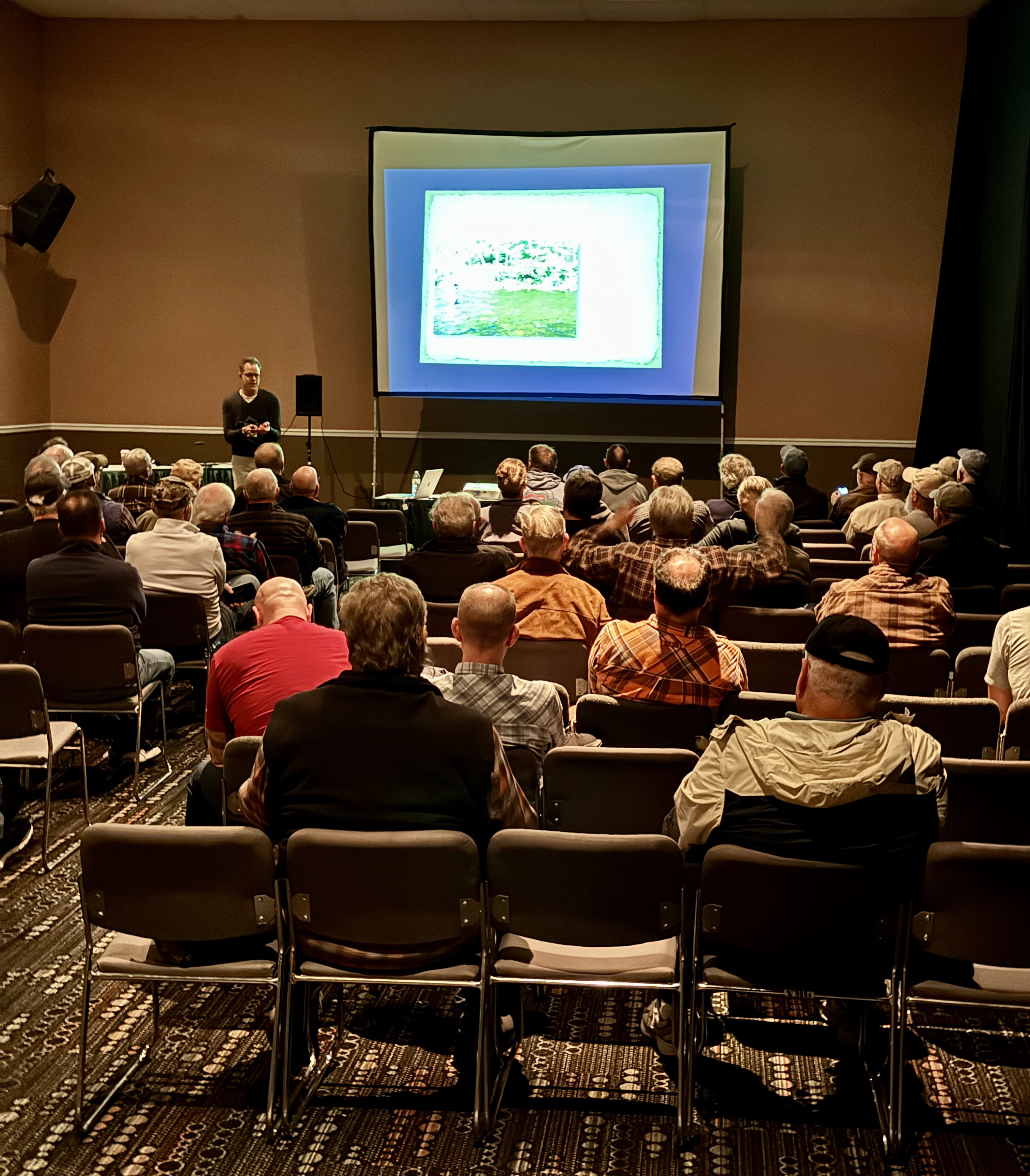
What a fantastic show! This past weekend in Edison, I reconnected with old friends, made some new ones, bought some stuff I really needed (no, really!), walked the floors, took in some tying demos and bits of seminars, lead a couple seminars, taught two classes, and had about as much fun fly fishing as you can without actually being on the river. I’ll be giving you a more detailed report later this week — in the meantime, here I am converting the masses to the ancient and traditional art of the wet fly.

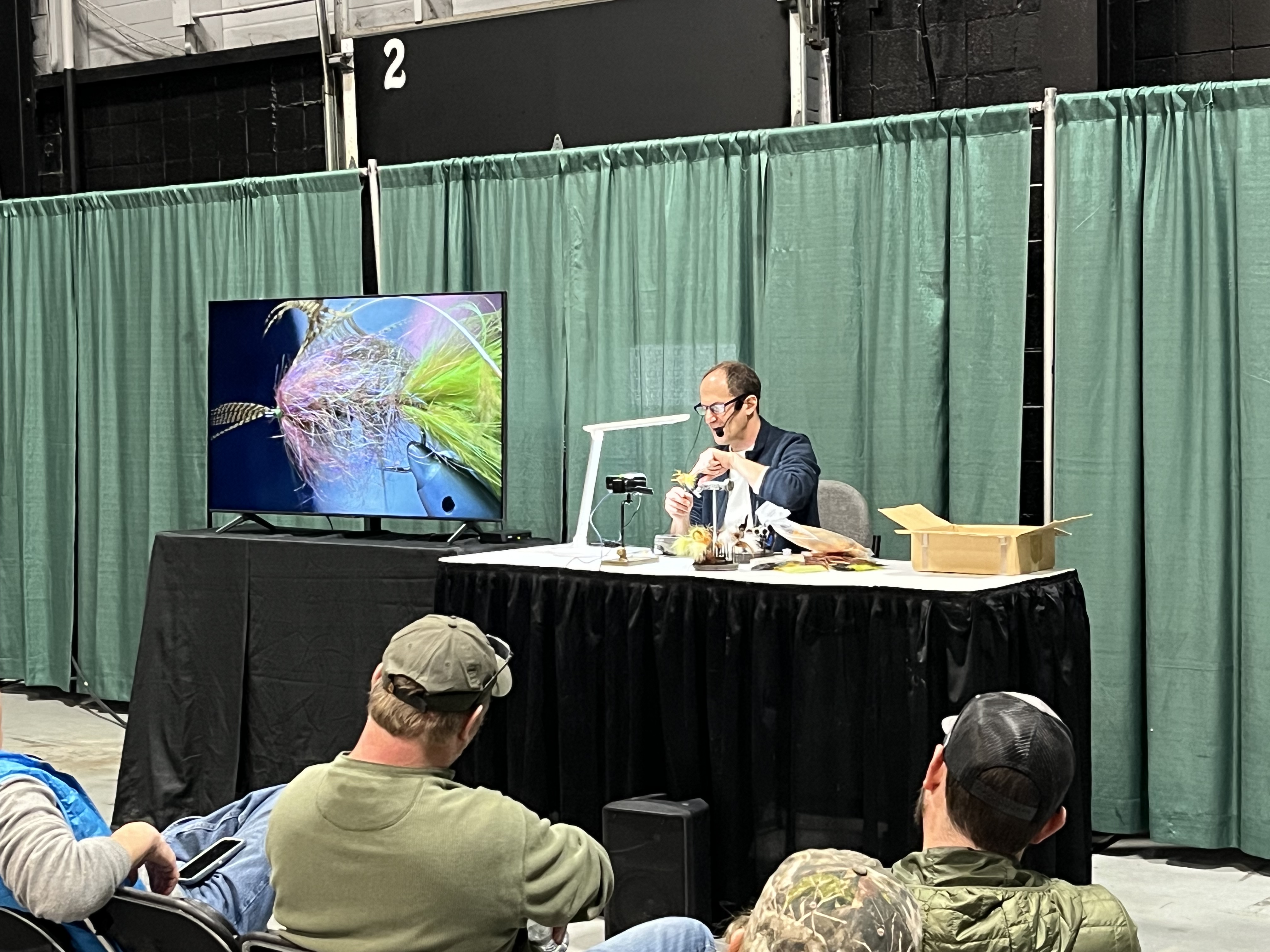
A tremendous start to Edison 2024! It’s always gratifying to speak to a larger audience, and the size of the crowd that came to see me present my seminar “Modern Wet Fly Strategies” at 10:15am Friday morning was a wonderful sight to behold. Thanks so much if you took the time to see me, and kudos to you for looking to expand your knowledge base. Fly fishing show seminars are included in the price of your ticket, and are the perfect way to see experts and discover new methods, tactics, and strategies. Photo by Landon Mayer.

Speaking of shows, this Saturday, Feb. 3, is the “best little fly fishing show around.” Yes, it’s the CFFA Show, 9am-3pm, at Nomads in South Windsor. Unfortunately, I won’t be able to attend, but there will be other tyers and speakers and the usual assortment of vendors. I’ll see you there next year. In the meantime, you can make sure you don’t miss any of my appearances by following currentseams or following me on Instagram @stevecultonflyfishing. See you out and about or on the river.

Currentseams Best of 2023: #7-#5

#7: Marlborough and Edison Fly Fishing Shows and another International Fly Tying Symposium. You already know that I’m a big fan of The Fly Fishing Show. Where else can you meet and talk to some of the best fly fishers and tyers in the world, find all kinds of cool gear, and get those hard-to-find tying treasures — all under one roof? When I’m not speaking or teaching or tying, I’m walking the show floor, shopping, meeting and greeting, and sitting in on as many seminars and classes as possible. You should be, too. My 2024 Marlborough Schedule for January 5-6-7, is here, and here — now just over a week away!

Hey! I know that guy.

~

#6: The Great Diving Caddis Wet Fly Revelation. I’m a professional fly tier, guide, instructor, speaker, and all-around fly fishing nerd. Still, I don’t know it all. Far from it. And thank goodness! Learning new things and making new discoveries one of the things that makes fly fishing continuously thrilling. As evidence, I offer LaFontaine’s Diving Caddis wet fly. I read about it last winter, tied and fished it in the spring, and wow, did it ever produce. The first evening I fished it, positioned as my middle dropper, it accounted for two-thirds of the two dozen trout I landed. It produced untold numbers for my clients. It’s now a seasonal staple on my team of three. Brilliant!

All kinds of sizes and color combinations are possible. This is a size 14 in tan. You can find the recipe here.

~

#5: Completing My First Book Outline and Sample Chapter Draft. For years, people have been asking me, “When are you going to write a book?” Okay…how about now? The first pass stuff is off with a publisher, and I’m waiting to hear back from them. Fingers crossed. Oh! You’ll want to know what it’s about. The West Branch of the Farmington River.

Small Stream Report: First foot instead of last blast

As a creature of habit, I lovingly cling to my routines. So I was as surprised as anyone when I decided to not go small stream fishing on New Year’s Eve. Logic trumped tradition; by delaying a few days, the water would be a little warmer and hopefully any residual ice would be long gone. On the drive up, we did see some sheltered woodland streams where mini-glaciers abounded. But when we (myself and surfcaster extraordinaire Toby Lapinski) arrived at the stream we were relieved to see that frozen water was almost non-existent.

The water was barely into the high side of medium, which is just about right for winter fishing, and the brook was running clear and cold. Overcast skies didn’t hurt, nor did temperatures in the low 40s. Toby started out bottom bouncing and jigging, while I went the dry/dropper route. The action far exceeded our expectations. As you can imagine, going deep won the day, but I had enough action on both the dry and dropper that I kept them on for hours. (If reading this is getting you fired up for small streams, I have a presentation tonight in Danbury, The Eastern Brook Trout; later this month, you can see me present Finding Small Stream Nirvana at the Marlborough Fly Fishing Show, and a week later in Edison.)

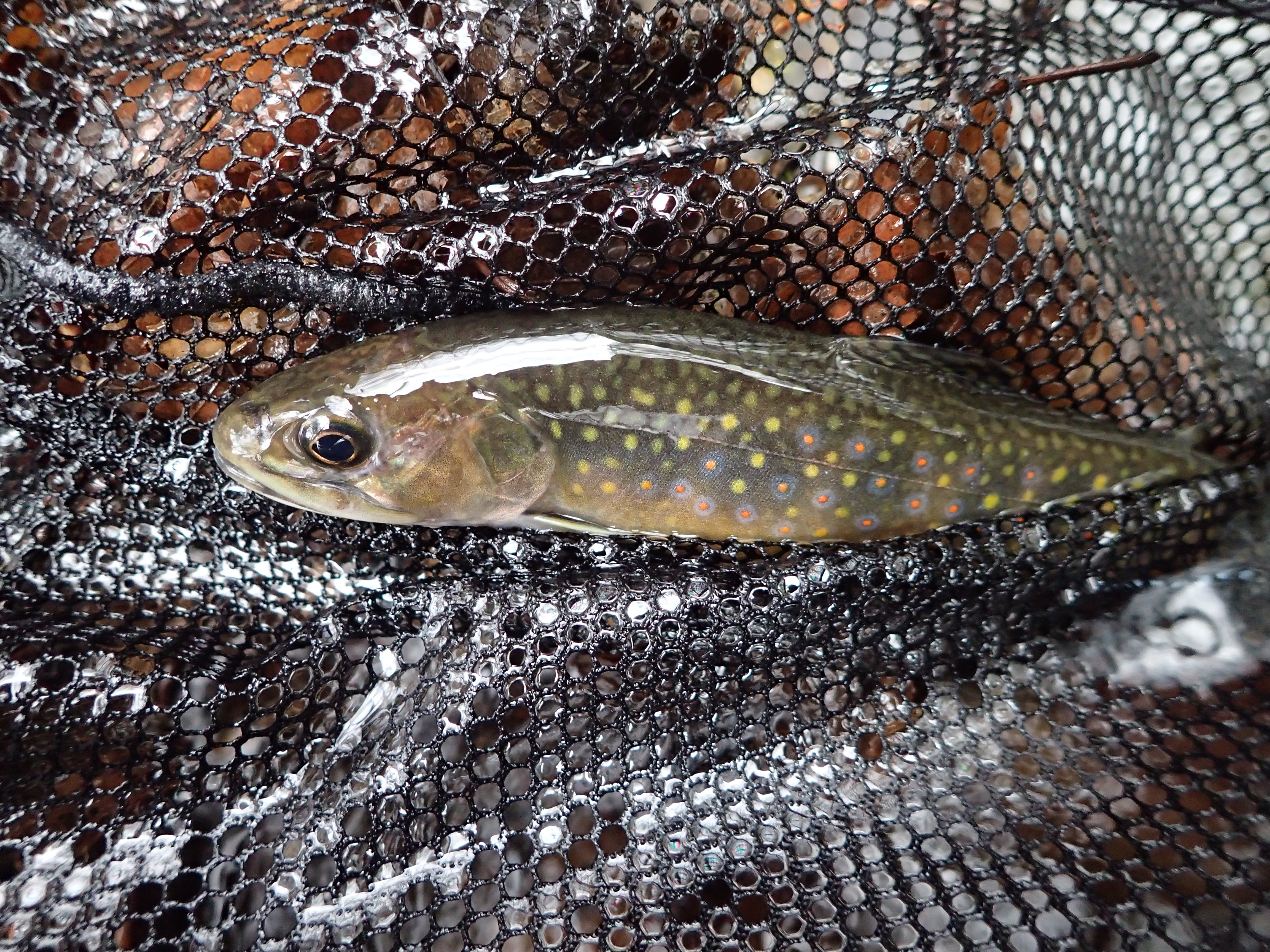
The first fish of any year is noteworthy, even more so when it’s a stunning display of nature’s paint box. Taken on a size 14 Improved Sofa Pillow.
When I was a kid, I ruefully wondered why tropical fish had all the cool colors. Cut to 55 years later when I now know better. Since fish like this aren’t ever getting replaced by the stocking truck, it bears repeating: barbless hooks only; keep photos to a minimum (I landed dozens and took shots of only three); make sure your hands are wet; keep fish in the water in your net until ready to shoot; never expose fish to air for more than a few seconds; and never lay a fish down on rocks/gravel/leaves/grass. Thank you. (Photo by Toby Lapinski)
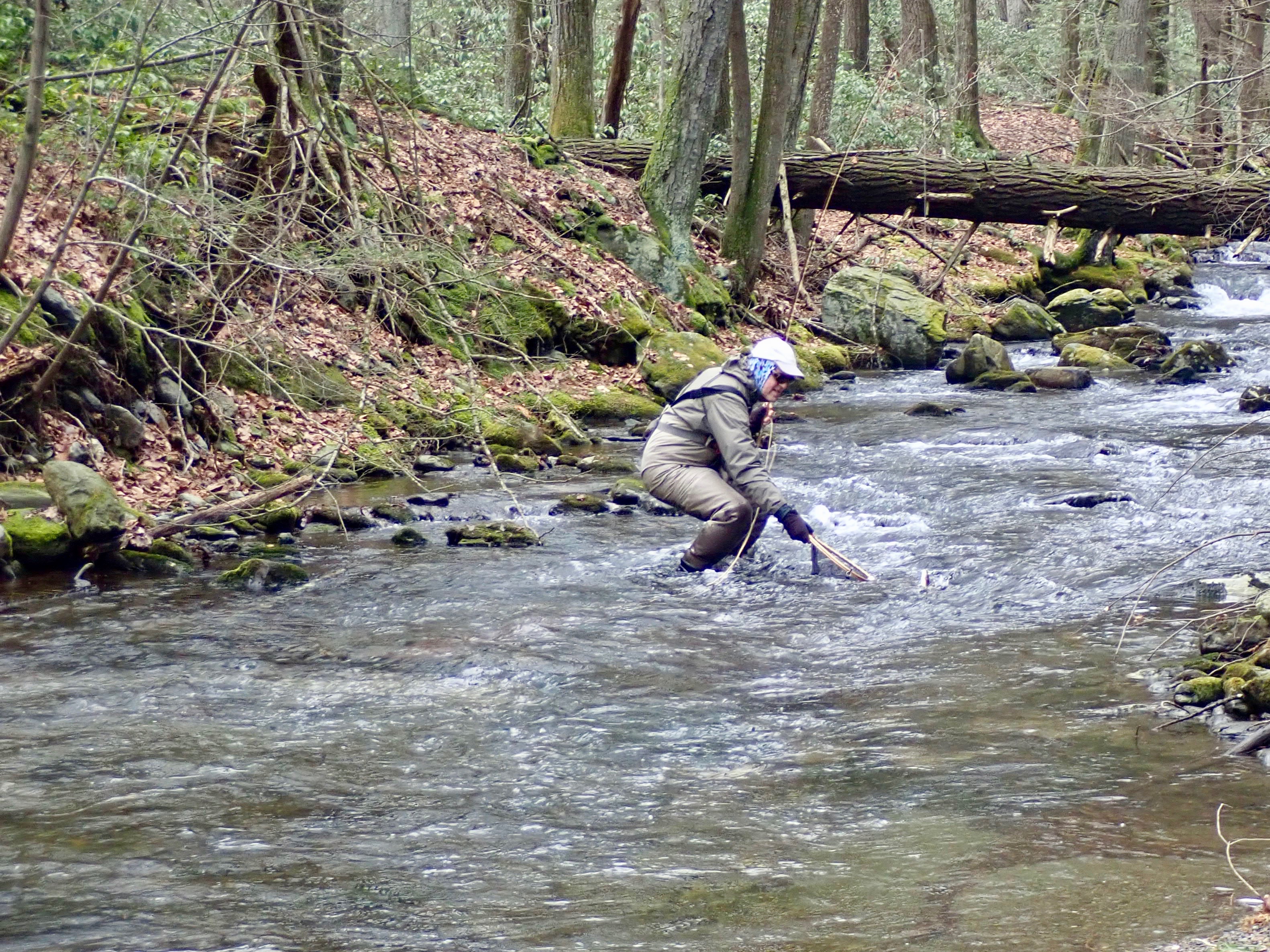
Small stream fly fishing for native trout may be fly fishing in its purest form. (Photo by Toby Lapinski)
Halo, I love you (again). Besides pulchritude, this fish is noteworthy because its thinness indicates a spawned out fish — and therefore a redd may be nearby. It’s a good idea to limit walking within the stream bed from mid fall to mid spring; the last thing anyone wants to do is tread on a redd and make all those future brookies dead. (Yes, I know it.) (Photo by Toby Lapinski)

Hello, 2023! Don’t forget your CT license, and there are some new regs.

2023 is spread out before us, an immense blank canvas upon which we may paint glorious fishing pictures. Yeah, OK, there will be some blanks and some crappy conditions and days where it just doesn’t go our way. Whatever. It all beats the crap out of sitting at a desk.

To start: don’t forget to get a 2023 Connecticut license. (I only mention this because someone who looks a lot like me did.)

There are some new inland sport fishing regs for CT, too. You can get all the fishing regs from the CT DEEP website, but the one that is most meaningful to all of us is that there is now no closed season for fishing on all lakes, ponds, rivers, and streams. That means if you want to fish for trout on an off-the-books thin blue line in March, have at it. A great change and a long time coming.

Catch ’em up!

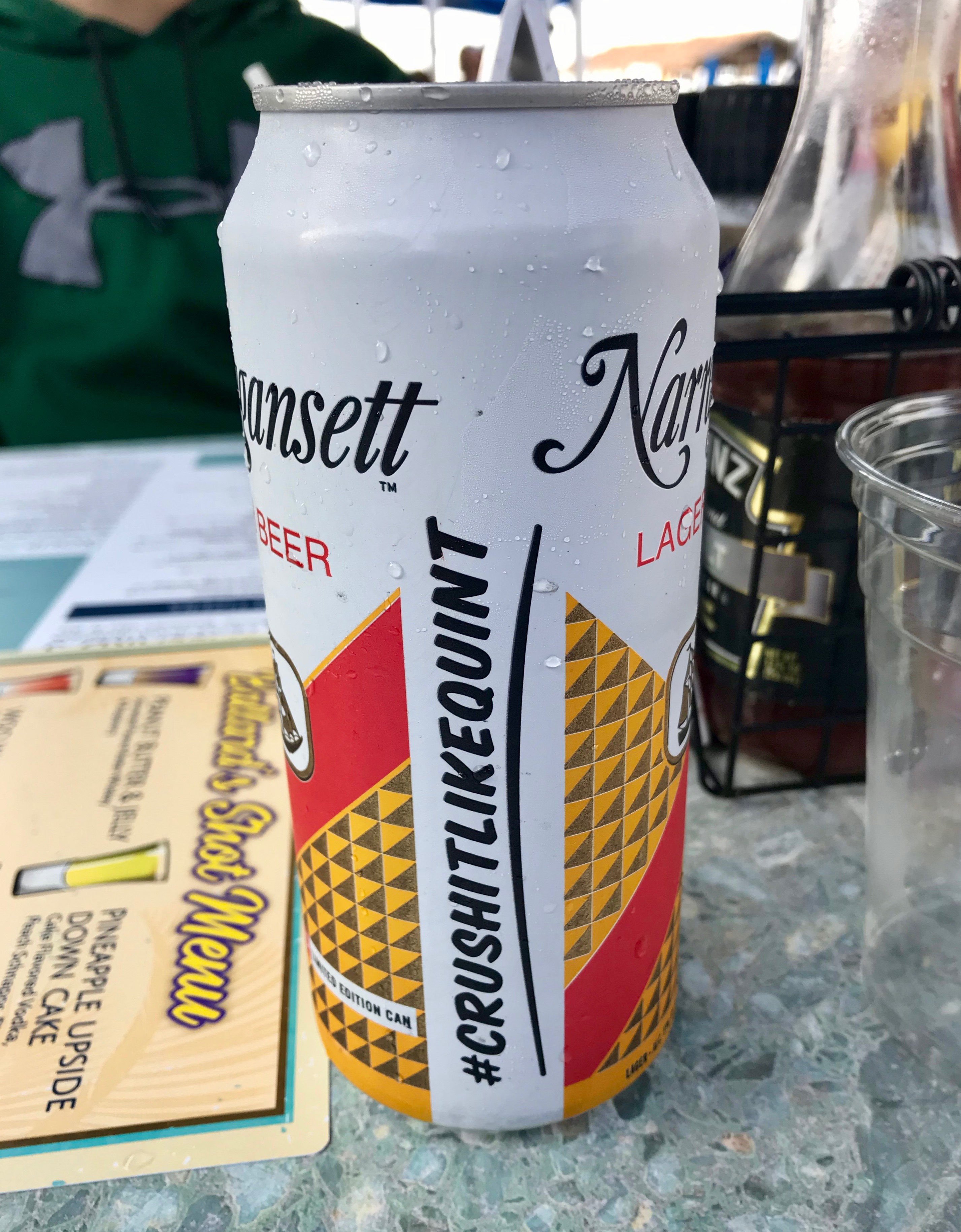
Here’s to doing what the can says.

Small stream anglers, take care: the spawn has begun

The spawn is taking place on some northeastern wild brook trout streams. I recently fished a brook on consecutive Thursdays, and the changes over the course of a week were dramatic. Seven days ago, there were only a few leaves in the water and no visible signs of spawning activity. A week later, the brook was congested with foliage and several redds were apparent. I spotted a large hen on one, and a few active fish on another.

In case you don’t know, a redd is a spawning bed. The fish select an area with enough water and current and the right size gravel, then clear the area of debris and other sediment before depositing eggs and spreading milt. (This is why spawning and post-spawn fish often present with scraped bellies and frayed fins.) Redds are fairly easy to spot; they look like light colored patches contrasting against much darker substrate. On a small stream, redds may be anywhere from a couple of square feet in area to significantly larger. A distinct light colored patch with fish darting about on the bottom nearby is a sure sign that you’ve discovered a redd.

Every small stream angler should know how to identify a redd, or spawning bed. Here’s a classic, can’t-miss-it redd: A dramatically lighter patch of gravelly stream bottom surrounded by darker substrate. There were a few fish milling about, but they scattered when I stood up to take this photo.

Maintaining the integrity of redds and protecting spawning fish is vital to the future of any wild trout stream. The stocking truck is not coming to replenish what humans destroy! Here’s what to do if you see a redd: First, leave it and the fish that are near it alone. Don’t try to catch spawning fish. Let nature take its course. Next, make a mental note of the location. Chances are that the fish have been using the general area to spawn for dozens or hundreds or thousands of generations. Finally, stay out of the water near the redd for the remainder of the fall, winter, and early spring. If you crush the eggs or the developing fry, that would be bad.

Besides, it’s pretty cool to simply sit on a rock and watch the beginnings of the next generation of Salvelinus fontinalis.

Small Stream Report 10/6/22: Nature finds a way (and then some!)

I hit a hidden gem last week that takes about 2 1/2 hours to get to. That may seem like a lot of effort — you’ll get no argument from me — but it’s usually worth it. And on this day, it was.

Over the years, this brook has seen its ups and downs. I’ve been moderately disappointed by it my last few outings, especially by the size and number of the fish. But you get what you get, and the fact that it still has native char, like it has for thousands of years, is a true blessing. So: I won the weather lottery. A warm, sunny, gorgeous, Indian summer day. After the rains, the water level was spot-on perfect, running cold and clear. In terms of numbers, the fishing was off the charts. I landed dozens (despite my best attempts not to, in order to reduce stress) and pricked dozens more. No beasties in the mix — you like to get a couple in the 9″+ class — but I did dredge up a few 7-8-inchers in the deeper pools. The brookies were everywhere. I started with a dry/dropper, which was moderately successful, but when I switched to subsurface (a tungsten bead head nymph/worm thingy) I couldn’t keep the char off the fly. What a wonderful day to be out in the woods.

This was typical of the size of fish I was landing. I also had dozens of smaller char attack the fly, the vast majority of which did not result in a hookup. I’ve mentioned this before, but I’ll repeat: please try to limit the number of fish you photograph. The less time they spend out of the water, the better their chances for survival. It goes without saying that you’re wetting your hands and using barbless hooks, right? What precious gems, our beloved Fontinalis.
Life is mighty good when you’re taking a shot like this one. Another word of caution: we’re getting close to the spawn, so be on the lookout for redds. They’re fairly easy to spot, usually a lighter patch of gravel beside darker surroundings. If you notice a redd, make it your policy to stay out of the water, period. And of course, be a good sport and leave any fish on or near a redd alone to do their thing. Remember, the stocking truck isn’t coming back to replace what gets wiped out. Thank you for your consideration. 🙂

Small Stream Report: Nature finds a way, Part MMXXII

This is a very late report from last week. After a hot, dry, droughty summer like the one we experienced in 2022, I like to head to a few small streams to get a handle on how the natives fared. This trip was last Friday, well before this week’s much-needed soaking. As I suspected, the water level on this brook was on the low side of low. Much of it was unfishable. But there was plenty of good news.

The water temperature was bracing and cold, certainly colder than it ever was this summer, but this brook has many places for the char to go to escape the summer heat, even in low water. I saw dozens and dozens of fish, many of which looked to be young of year. I also found a few pods of bigger brook trout — nothing really huge, but in the 7-8″+ class. On an outing like this, I do get to do some fishing, but a lot of it is more inspection-oriented, with the intent of spooking fish. Often, with the water so low, the natives want nothing to do with the sight of you or your rod waving around. I got no interest of the dry fly, and pricked two with a weighted jig-type fly.

Then, yesterday after the rains, I visited a different stream. What a bounty! But you’ll have to wait a couple days for that report…

At a normal level, the flow should be covering the rocks you see center photo. This pool is usually good for a couple of hungry swipes; on this day it was a barren brookie wastleland. A reminder as we get near spawning time: be on the lookout for redds. Consider not wading into brooks at all. Redds are pretty easy to spot; usually a lighter area a foot or two in diameter against a darker gravel bed.

Way Out West, Part Two: The South Platte River

I’d known about the South Platte for years, but never got the itch to go fish it, until I did — and now I am faced with a matter of difficult settlement: my favorite trout water is almost 2,000 miles away.

It’s so easy to fall in love with the South Platte. Since it’s a tailwater, it’s a viable fishery year-round. It’s got so much productive water that you could very likely stumble into fish (and if you know how to read water, you could quickly become a dangerous machine). In addition to being cold — I didn’t take a temperature, but it had to be high 40s-low 50s — the water is clear enough that the eagle-eyed among us can sight fish for trout. And the trout — ah, the trout — are fat and feisty and fantastic. Plus, there are lots of them. Subsurface invertebrates are everywhere and provide the trout with a daily smorgasbord. It’s almost like someone imagined, then created a trout theme park fantasyland. Really, it’s that good.

Early morning on the first day. Cam might be contemplating the fish at his feet, or the sheer beauty of his surroundings. These streamside boulders are typical of the South Platte in Cheesman Canyon, and sometimes these behemoths are in the river proper. Along with the smaller boulders, it makes for the kind of structure trout love. On both days, my experience was: find one fish, and there are a bunch more close by. I think we saw a half dozen other anglers on Wednesday. Friday, the “crowded” day, maybe twice that many. I fear that western anglers would be mortified by the hordes on eastern streams.
Afternoon on the first day. The water is at 250cfs and running with breathtaking clarity. It was easy to pick out fish, especially if you knew where to look (on day one they were holding in riffly moving water 1-2 feet deep). This slot extended far down the glide past where I was standing when I took this photo. Both Cam and I hooked fish along the entire length of this wrinkled water center stream.
Day two. The water is up to 300cfs. Our guide, Chris Steinbeck of the Blue Quill Angler, said that Thursday morning the water had some color, but cleared up after noon. I think I liked this height better; having no experience to compare to, I’d call this flow medium. Here’s what’s so wonderful about the South Platte: there are fish everywhere. Compare to the Farmington, where there are vast stretches (especially now) of unproductive water. I caught more brag-book trout in an hour on the South Platte than I might in a month on the Farmington. If you can read water, and make adjustments like weight and indicator position, and perform quality drifts, there’s no reason why you can’t do likewise. Cam doesn’t fly fish, and he stuck over a dozen trout on day one.
I believe the river is so productive because of the high percentage of viable water. The analogy I came up with was the South Platte is like a high-gradient northeast wild brookie stream, times 10 in size. See what I mean?
A so-ugly-it’s-beautiful golden stonefly from Chris’ Friday sampling. We also came up with midges and baetis and PMD nymphs. There were a couple stray salmon flies flitting about over the course of both outings. Not shown: scuds, an important food source for South Platte trout. I creamed ’em the first day with Pat Dorsey’s UV Scud.
Compared to the Farmington and the Housatonic, wading the South Platte is a walk in the park. Absent the fast-moving, deeper sections, this was about as tricky as the footing got. (I still don’t see why the possibility of falling in should prevent me from getting into the best position to catch that fish — although I’m pleased to report that I did not go swimming on the South Platte.) Much of the river is granite sheets and smaller gravel bottom. Bottom snags were few and far between; I didn’t lose a single rig the entire trip. As you can see, the rocks are covered with this mossy vegetation, hence the substantial scud population. Clearing weeds off of flies and rigs was a constant task, although it served as a good reminder that my presentations were where they should be. Coming next: Part 3 — The Fishing.

Weird scenes inside the white fly hatch

Just a couple of photos from the recent White Fly action to entertain you on a Friday. Enjoy the weekend and please do a rain dance!

Ugh! Why do I smell so bad? Turns out it’s not me, but rather the hundreds of dead White Fly spinner carcasses stuck in my net from the previous night’s expedition. White fly spinners have a knack for finding their way into/onto your clothing, gear, glasses, and, very regrettably, into your nose, mouth and ears. This bears repeating: White flies taste really, really bad.
Not the shot I was hoping for, but it’s interesting enough to share. This stacked image has some nice scribbly abstracts of the moon over the trees and its reflection on the water, and the white fly tracks are reminiscent of jet contrails.

Housatonic Mini-Report 6/20/22: A Housy Slam (of sorts)

I had my doubts about yesterday’s Housatonic smallmouth trip. The water was still a little higher than I like it (410cfs in the TMA) and definitely cooler (upper 60s). Unfortunately, I was right. It hasn’t turned on yet.

I started off in the upper end of the TMA. That was dead as Julius Caesar. All I could manage were two pipsqueaks and a busted wading staff. (Argh!) Off to the bottom end of the TMA where I witnessed spin anglers in the FFO area (called the TIP line, 800-842-4357 in case you don’t already have it programmed into your phone) and managed just one fish, a rainbow trout. He was in and out of the net so fast he didn’t have time to feel stressed. Absent my trusty staff, I fell in and soaked an arm and experienced the dread down-the-leg trickle. Sure, there are worse times of the year to fall into the Hous, but it’s almost always an unpleasant sensation. With a crappy bite and volumes of anglers still around (damn this cool weather), I made the command decision to head south.

7pm arrival, and finally, sweet solitude! Besides smallmouth, I managed a decent bluegill and a rock bass to complete the slam. I took them topwater (Gurgler), film (Countermeasure), and deeper (Soft Daddy). Observations: every one of the fish I caught at this second mark — covering about 250 yards of water — came in frog water about 2-3 feet deep. Every fish I took on the Gurgler hit when the bug was sitting stock still. Rather than ramping up, the bit tailed off at dusk. Swarms of white/grey mottled caddis everywhere, but virtually nothing rising. July is coming…

Why it’s called frog water. There were far more tadpoles than rusty crayfish, although I did well hopping the Soft Daddy along the bottom.