by Steve Culton © 2006
Wow. Has it been seven years already since I wrote this? “Stalking Wild Trout” was one of my first web articles. Its initial home was flyaddict.com, and now it’s here on currentseams. I’ve tidied up a few rough patches and thrown in a few photos. And here it is:
It was a perilous approach to the bend. I crept down the steep bank, grabbing the trunk of a sapling for support, all the while trying to dodge the broken glass and poison ivy. Wading gingerly over the slime-coated rocks, I moved through the shallow riffles, past a submerged old-fashioned home radiator. When I got to the opposite bank, I tiptoed over discarded bricks, fired long ago in some nearby kiln, and loose streamside boulders that threatened to pitch me into the deep pool if I wasn’t careful. There, 30 feet away, wild brown trout were sipping insects off the delicate line of foam that curled into a gentle slack water eddy. Like Quint hooking himself to his fighting chair in “Jaws,” I removed the size 16 Tan Caddis from the hook holder and quietly stripped line off the reel. One, two false casts, then line, leader and tippet settled gracefully onto the water. The Caddis never had a chance. It had barely drifted a foot before the trout sucked it under. I set the hook. And, like Quint, I was into a ferocious fighter of a fish.

Ooh. Aah. Oh.
Fishing for wild trout has become a passion for me. It has taken me to many of the State’s Class 1 WTMAs (Wild Trout Management Areas) as well as nameless brooks most fishermen wouldn’t give a second look. Sure, I love the Farmington, and you’ll find me there an awful lot. But there’s nothing quite like the satisfaction one gets from bagging a wild fish, one that grew up with no knowledge of food pellets, feeding schedules, holding tanks, or stocking trucks. These are primal, wary, wanton creatures that, when hooked, fight like fish twice their size — and if you’re going to catch one, you’d better bring your “A” game.
The Water
Connecticut currently has eleven Class 1 WTMAs, defined by the DEP as “Abundant wild trout, not stocked.” Fishing here is with a single, barbless hook fly or an artificial. Catch and release only. No bait ever. Sidebar: I’m not going to list the names of the streams, or tell you how to get to them, not because I’m a secretive jerk, but because I consider them a precious resource. The last thing our Class 1 WTMAs need are hordes of fisherpeople — or worse, poachers — descending upon them. I figure that if you really want to fish them, you can do your homework and look them up in the DEP guide, find them on a map, and figure out how to get there. That’s what I did. Fishing Class 1 waters is not casual casting, it’s a commitment.
What’s more, fishing these streams will not appeal to everyone. They can be technically difficult to fish, and in many cases require special equipment and tactics. Some of them are less than pristine, and can give off a gamey odor in warmer weather. Poison Ivy and mosquitoes abound. You may have to hike hundreds of yards through steep ravines and dense, trailless woods. If you’re out of shape, you may want to hit the Stairmaster a few times before heading out. Sound like fun? Read on.
You need to take the DEP’s use of the word “abundant” with a grain of salt. Many could be the outing you get skunked, especially if you go during mid-day or when the water is low or off-color. Rest assured, they’re in there. Getting them to come out to play is the challenge.
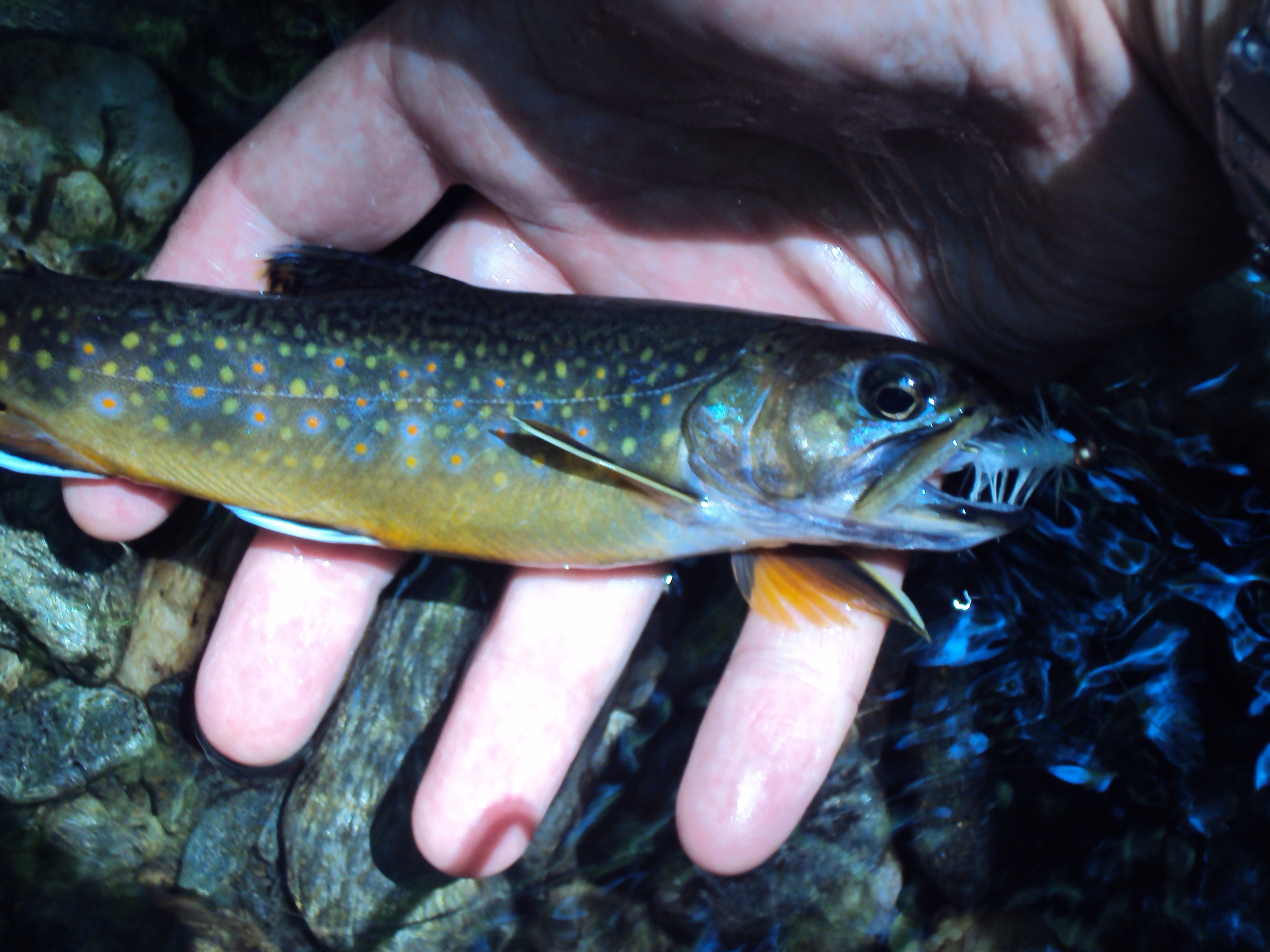
The waters are as varied as the state’s weather. Some of them are lilting meadow brooks, others are more a series of waterfalls than an actual stream. Some are so martini-clear and cold you’d swear you were in northern Maine, while others are in urban settings with stained flows and enough river bottom debris to start your own salvage yard. But they all hold wild trout, mostly brookies and/or browns, with an occasional surprise tiger trout for good measure. And because most of these streams haven’t been stocked in years, it’s the only way to know for sure that you’ve caught a wild fish — or in the case of brook trout, a native wild fish.

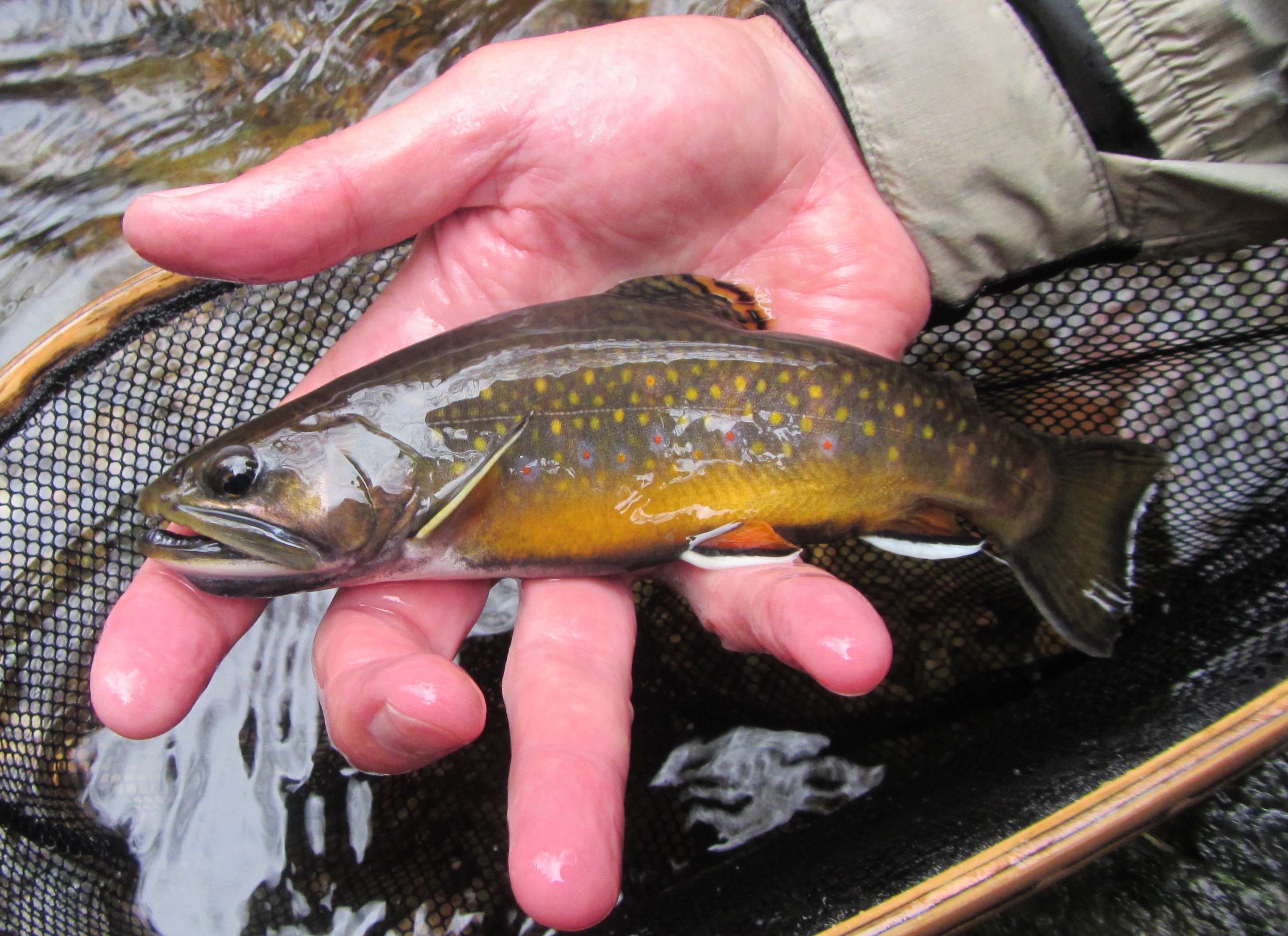
If there is a fish native to the eastern US that’s prettier than the brook trout, I’ve yet to see it.
Beyond the Class1s, there are hundreds of unnamed – or at least unstocked – small streams crisscrossing the state. The colder, canopy-covered ones can be wild brook trout bonanzas. Sadly, many are on private property, but the enterprising, courteous angler can always ask for permission from the landowner. My personal favorite tactic is to take my three-year-old with me. After all, who can turn down a polite tow-headed youngster who wants to fish with daddy?
Tackle and Equipment
Think light and small. Your 9-foot 5-weight rod serves you well on the Farmington, but in tight small stream quarters it’s only going to make you miserable. I have a Fenwick 6-foot 5-weight fiberglass rod that makes me weep with joy every time I use it in a densely wooded area. A 6-foot leader is all you need, and surprisingly, you don’t need micro tippet to fool the fish. I use 4x or 5x. When you hook trees and branches on every third cast, you’ll appreciate a tippet that gives you the luxury of getting medieval with a snagged branch.
Waders are a must, even on small streams. You’ll be in and out of deeper holes, climbing up riverside banks, and marching through forests of poison ivy. There are frequently no parking lots or trails, so be prepared to hike and bushwhack. Bug repellent: yes. Water if it’s a hot day, and snacks to keep you fueled. Cell phone in case you have an emergency, but don’t count on a signal. And because you could be in a remote spot, a small medical kit with some basic first aid supplies. I keep mine in an old mint tin tucked in the back of my vest.
Polarized glasses are a big help for spotting fish. I usually take my net, but keep it strapped up to my vest because I rarely use it. And though it may not be your thing, I find there’s nothing like a fine cigar (or two) to celebrate the landing of a wild trout. Plus, the smoke does a fine job of keeping the bugs away.
Flies
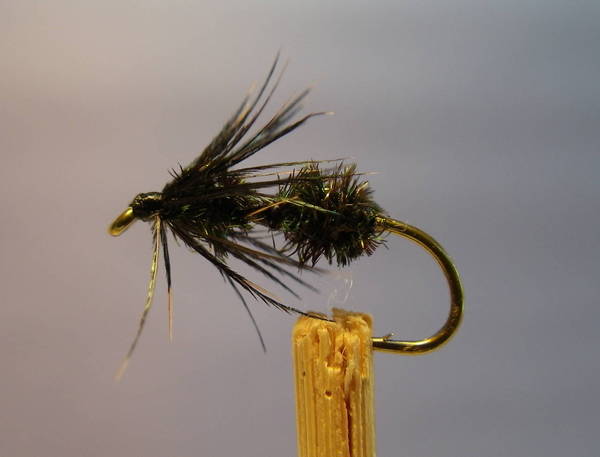
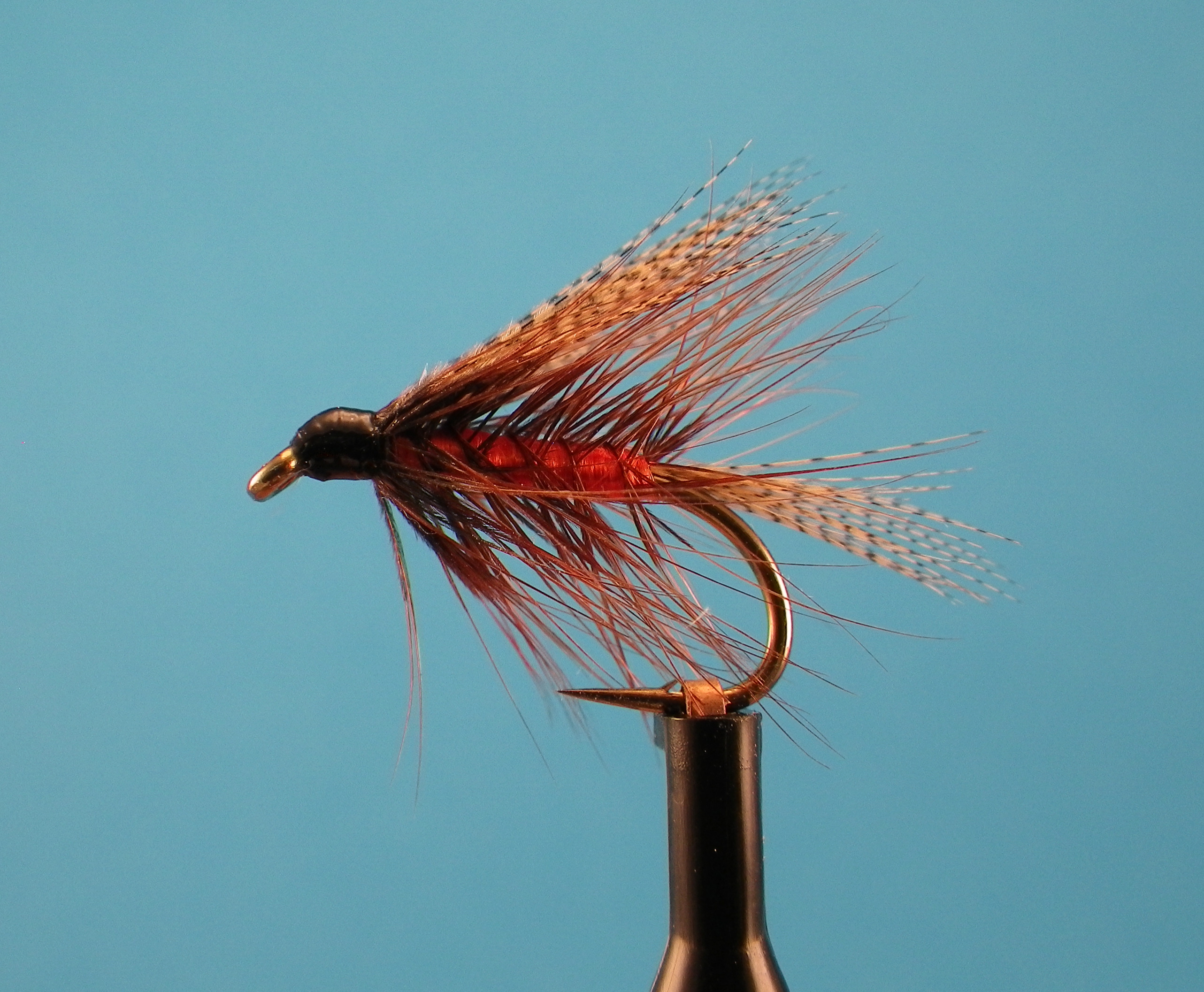
You don’t need a lot of different flies in your box to fool wild fish. If it’s a brookie stream, all you really need is a size 16 Yellow Stimulator and size 16 Tan Caddis. Basically, any bushy attractor pattern will do, and if you want to go up or down a size you’ll be covered. The fish you’ll be catching are mostly going to be in the four to nine inch range, but I’ve caught them as small as two inches, and heard of 20+ inch fish being taken by DEP sampling crews. The point is, a smaller fish may need a smaller hook, so if you must catch that pesky little fink who keeps whacking your size 16, you might consider tying on a size 20. Brookies are the kamikaze of wild fish, and they will, with suicidal abandon, hit the same fly over and over. I’ve cast to a fish and gotten a dozen hits on a Stimulator before finally hooking him.
In the summer months, ants, crickets, hoppers, and beetles can be lethal. You can hedge your bets with a nymph dropper off a cricket or hopper. Nymphing works well when the fish aren’t rising. Think basic patterns like Copper Johns, Tung Head Caddis, Bead Head Pheasant Tails, Hares Ears, etc. Go small: 16-20. And don’t forget streamers. I had great success this spring stripping in Wooly Buggers and Zonkers. Streamers are particularly effective in high water conditions — if you can find the room and a pool deep enough to fish them.
And of course, if you see a hatch coming off, by all means match it.

You could fish a wild trout stream with nothing but bushy dries and expect to do well. This is a size 14 Improved Sofa Pillow.
Tactics
On Class 1 WTMAs, your approach is everything. Think s-t-e-a-l-t-h. You need to be very light-footed as you walk to the stream, particularly the ones with soft clay banks. I remember earlier this year thinking I had done a good job sneaking up on a pool, only to stumble on my last step. The trout tore through the water in a Chinese fire drill before bolting for parts unknown. Needless to say, that pool was done for a while. Now, on the waterfall-type streams surrounded with rocks, you can get away with a more cavalier style of walking and wading. Just remember, these fish don’t see a lot of people, and any streamside movement they detect will trigger their flight reflex. Whenever possible, approach pools from the rear. Keep a low profile. Yes, you may have to crawl a little — even through shallow water — to get where you need to be to catch fish.

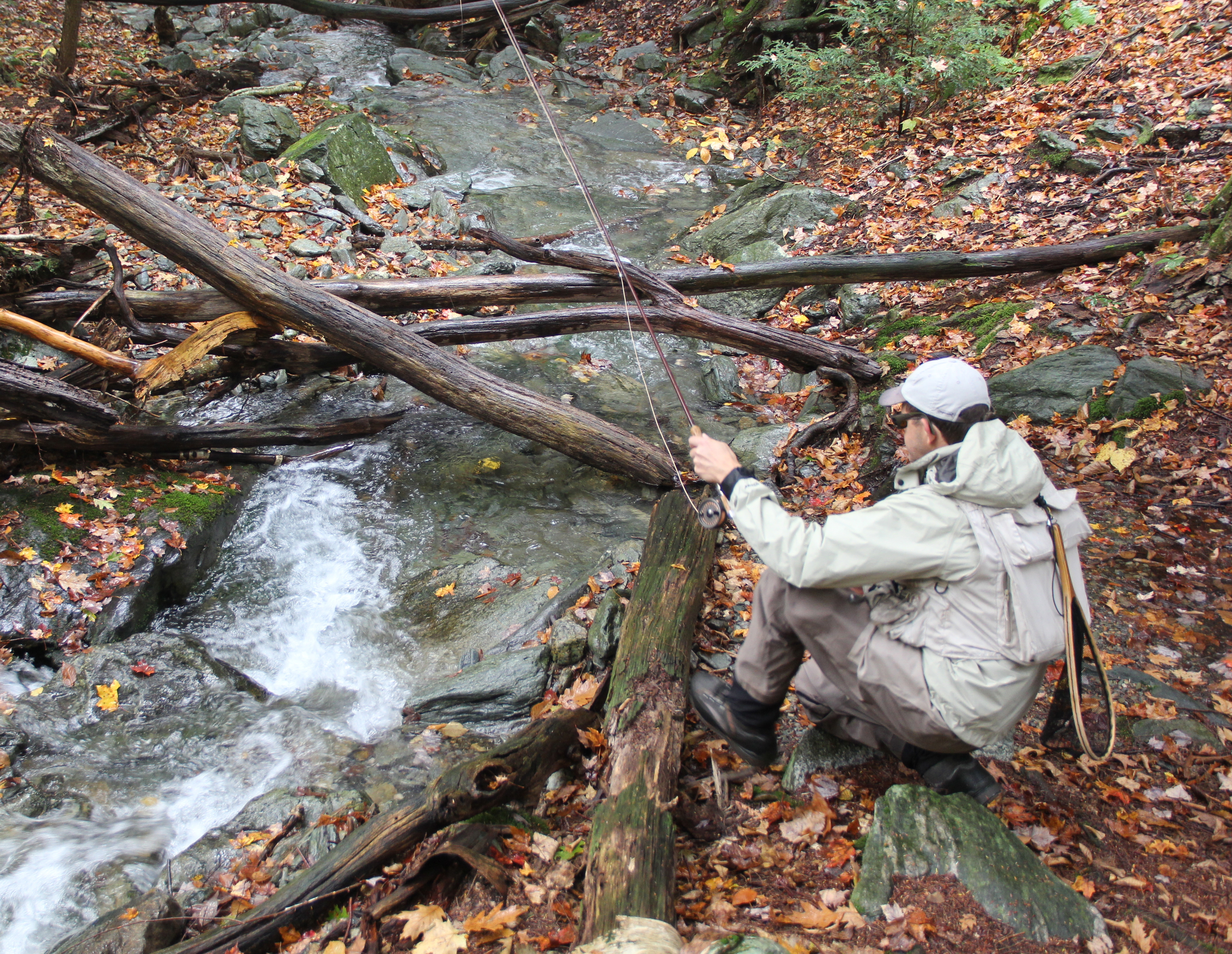
Some wild trout streams are so small, you can easily leap across them. I like to look for structure like these logjams, and fish the seams around the whitewater in plunge pools. I pulled several brookies out of this small hole, and they were still biting when I left it.
Ever fished Greenwoods on the Farmington? You could false cast out to your backing in that pool. On many WTMAs, false casting is neither advisable nor even doable, thanks to canopy and streamside vegetation. (Please resist the temptation to break off that branch you just hooked. It provides much-need shade in the summer.) If you’re going to fish small streams, you’ll need to become adept at the bow-and-arrow cast, the roll cast, and what I call the drift cast. If you’re unfamiliar with the first two, there are plenty of on-line references and tutorials. The drift cast isn’t something I invented, but I have practiced and perfected it to the point where I can reach spots, unseen by the fish, that were previously out of my fishing range.
Use the drift cast to reach a pool you can’t sneak up on from behind. On one of the Class1s I go to, there’s a terrific little bend pool with a massive log fall over it; it’s virtually impossible to fish it from the tail of the pool. Not to worry. I sneak to a spot about 40 feet above the downed tree, strip off some line, and feed the line, leader, and fly into the current. I start stripping off line to continue drifting the fly to just under the log. The fly line, and therefore the fly, move at the speed of the current, creating a natural drift. No takes? Load the rod tip, and shoot the fly half way back upstream, and repeat.
Since many of these streams don’t allow you to fish streamers at a 90-degree angle to the current (due to stream size and the fact that you’d spook the fish) use the drift cast to drift your streamer down through a pool. You can then strip the fly in, and repeat.
Sometimes the drift cast works too well. I had discovered a gorgeous little brookie stream in March with a pool that cornered at a 120-degree angle. It looked extremely fishy. Problem one was that it was so covered with collapsed saplings and brush there was no way to present the fly other than to drift cast. Problem two was that there was a three-inch brookie that would nip at, miss, and sink the fly before it could get to the target area I believed held his big brother. The solution? The drift cast with a twist. I placed my dry fly on a concave dead leaf, and float the leaf down through the current, over the pesky little fish. Just short of the target area, I gently tugged the line and pulled the fly off the leaf (this took some practice). BANG! There was the eight-inch brookie I knew was hiding in there.
One nice thing about small brookie streams is that you can sometimes get away with wet fly swings using a dry, or even skating the dry through the current. Try dangling a Stimulator in the current and see what explosive strikes you can trigger.
Handle fish as little as possible, and then always with wet hands. Once the trout is close it will frequently shake itself off if you just grab your leader or tippet. In hot weather the fish are under stress, so don’t overplay them, and keep them in the water if you can. Exposing a fish to 90o air is a huge shock to their system. Remember, if you kill a wild fish, the DEP isn’t coming back in a month to replace it. Likewise, don’t hit the same stream every other day for a week. Give the trout a break. They’re not going anywhere, and conditions permitting, they’ll be even bigger and stronger next year.

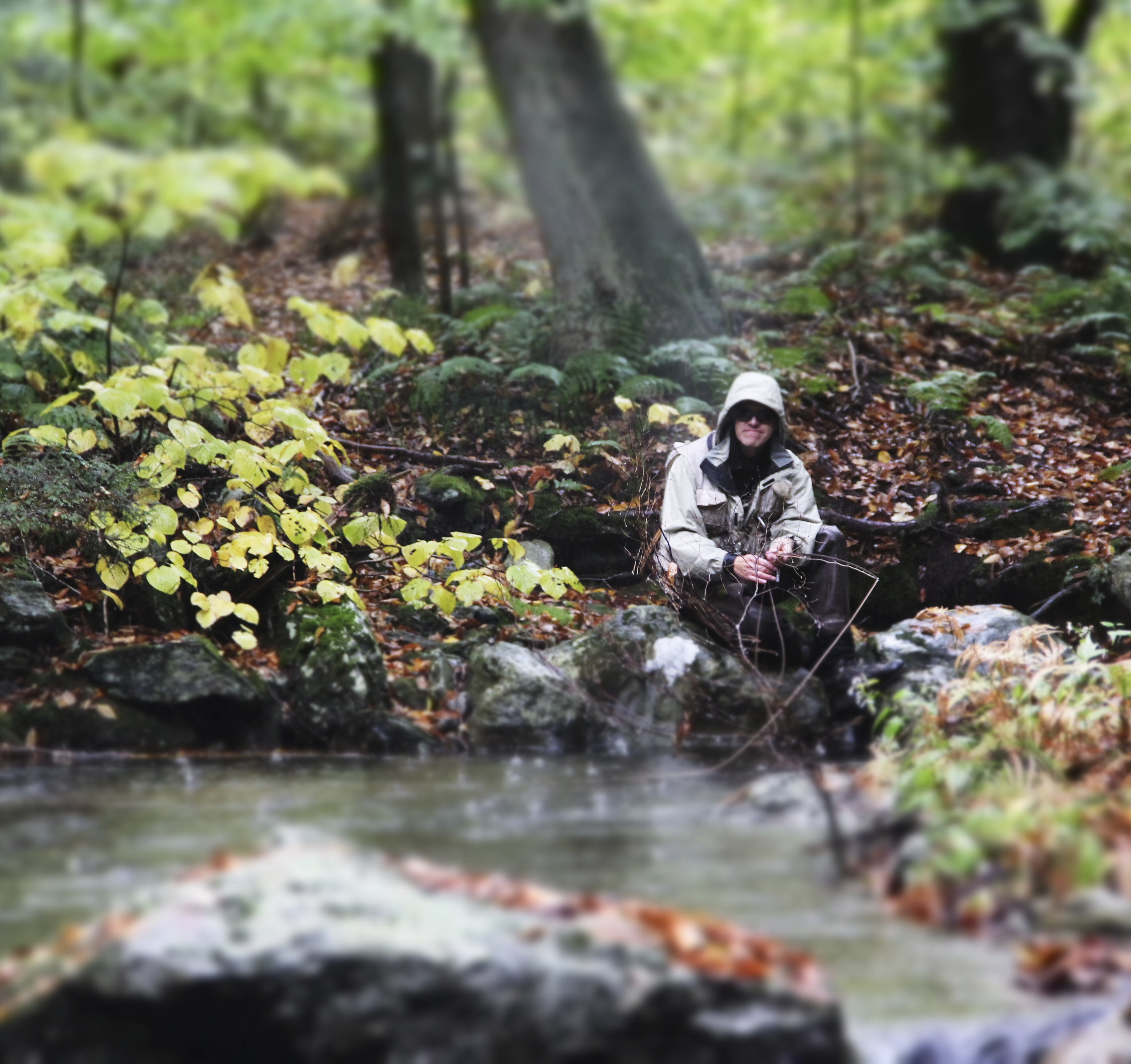
Such a grim countenance. Either someone’s got his game face on, or is mortally depressed that the weatherman kicked the forecast. Again.
A Fish Story
His name is Gus, and he lives in __________ Brook. Gus is a 9” brook trout, and smart — or at least careful — for a fish. He lives in a bathtub-sized pool behind a rock, just above a one-foot waterfall, and I’ve semi-hooked him a couple dozen times. I always know it’s Gus because of his size (this is a brook in every sense of the word, and he has very distinctive coloring). Gus likes to whack whatever I drift over him, but he just refuses to truly eat the fly. It’s our little game, and we love playing it. But I’m competitive, and I’m betting I can out-stubborn Gus. And when that day comes, I’m going to shake his fin. Offer him a cigar. Then happily send him back to his comfortable little home on this gorgeous woodland stream.







 currentseams.com