Last night I did my second international Zoom presentation with the Ottawa Fly Fishers. They are a small but very enthusiastic group, and it’s been a pleasure getting to know them. The subject was “Wet Flies 101.” I don’t need to tell you about my passion for tying and fishing wet flies, so spreading the word is kind of like getting extra frosting with your cake. Thank you again, Ottawa Fly Fishers, for being such swell hosts!
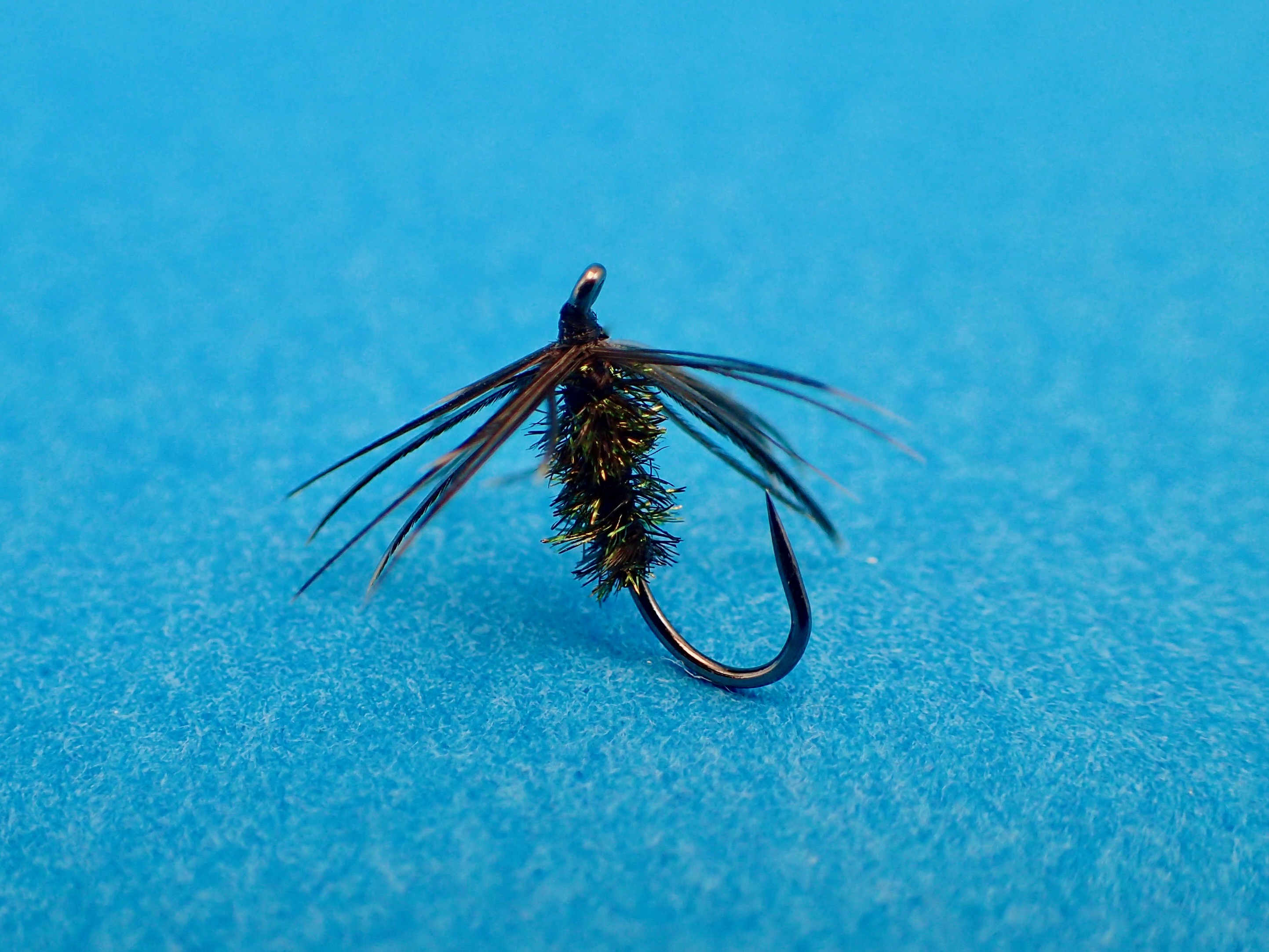
One afternoon, many years ago, this fly saved my bacon. I was guiding Matt, and it had been a slow, disappointing day. All of sudden, for no apparent reason, trout started eating the middle dropper, a size 16 Starling and Herl. Whatever was hatching unseen underwater, it was small and dark and the fish wanted it. Remember Ken’s sage advice: droppers are the fastest way to find out what the fish want.
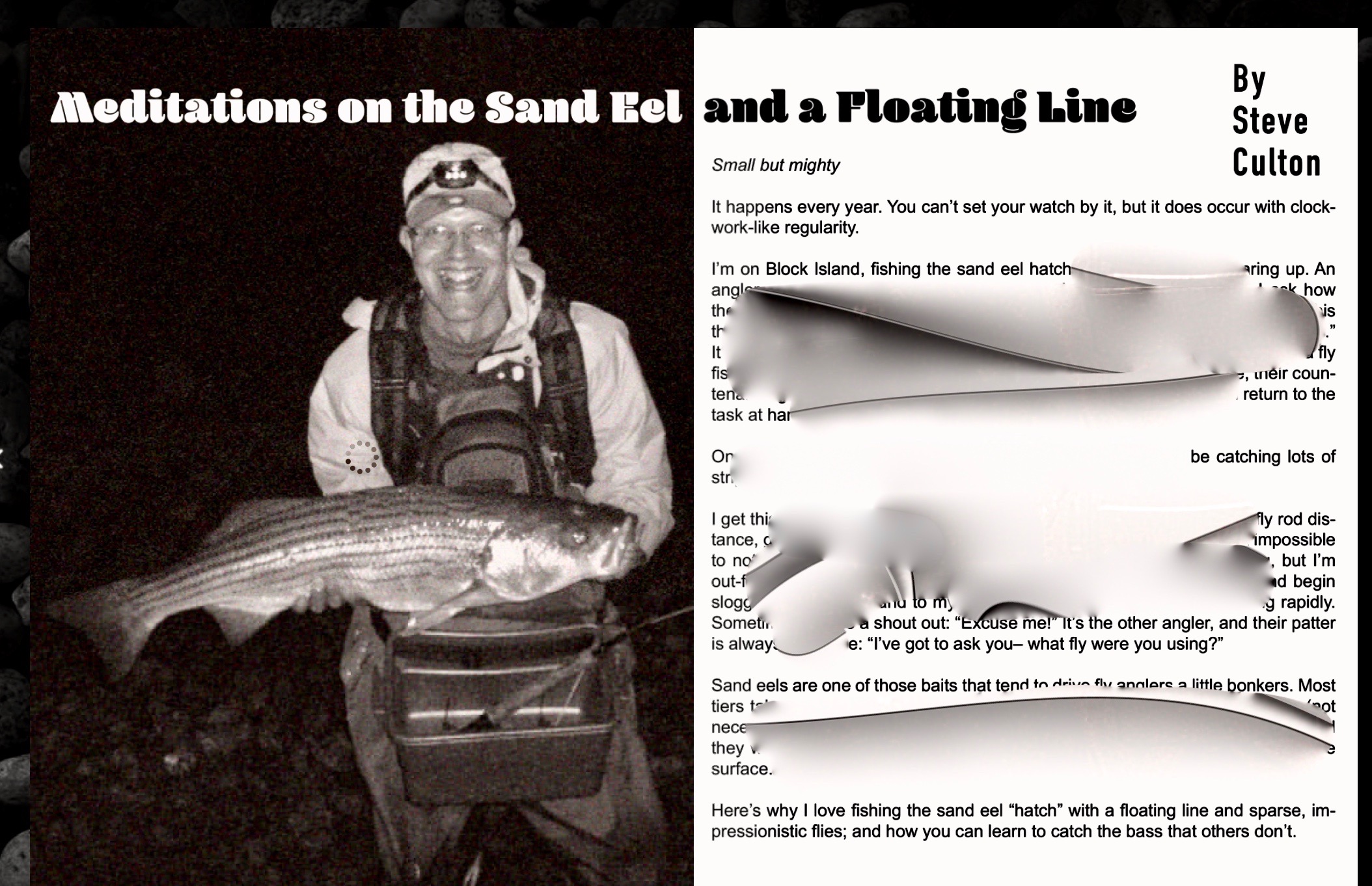
I’m delighted to have piece in the diamond issue of Surfcaster’s Journal. Meditations on the Sand Eel and a Floating Line is exactly what it sounds like: my thoughts on fishing this important bait using traditional patterns and salmonid tactics — and catching more striped bass. Most anglers I see targeting stripers feeding on sand eels use intermediate lines and weighted flies. They’re missing out, and typically only catching the stripers that are willing to chase. Some of the answers to the mysteries of “How come I can’t catch those bass?” when they’re feeding on sand eels are unveiled within.
Surfcaster’s Journal is an online e-zine. If you’re not reading it, you should be. Although the focus is primarily on using spinning gear, there is some in-depth fly casting content (like this piece) — and there is plenty of invaluable information that may be gleaned from the traditional surfcasting articles. It’s only 20 bucks for a year. You can subscribe here.
I remember this night like it was just a few months ago: Block Island, July, and a school of 15-20 pound bass were in close harassing sand eels for several hours. The stripers were very willing to jump on. But what about those frustrating nights when you can’t buy a hit? Read Meditations on the Sand Eel and a Floating Line and become a closer.
Mini-striper report 10/16/22: I fished for several hours last night with surfcaster extraordinaire Toby Lapinski. He was plugging and I was on the 2H fly rod. Conditions appeared to be perfect, but the neither the bass not the bait got the memo. Toby managed two school bass and yours truly took the skunk. Toby had a trenchant analysis of the evening, which, as you have not yet heard it, I will now precede to relate: “Bleaaahhhh.” That’s a direct quote.
Steve Culton will be making his first appearance at the 2022 International Fly Tying Symposium, November 12-13 in Somerset, NJ. (I know, sounds like a press release, but this kind of is.) In case you haven’t visited, and are looking for more information, the Symposium site is live. There was a glitch yesterday in the class registration link; that has been fixed. So, if you want to attend my class, Tying Soft Hackles, Winged and Wingless Wets, Saturday Nov 12 from 1pm-3:30pm, you can register here.
I’m currently working on two new seminars that will debut at the Symposium. The first, on Saturday at 10:30, is Tying and Fishing Wet Flies. This will cover some basic wet fly construction, theory, and how to present and fish wet flies — and you’ll also get to see some of my favorite patterns. On Sunday at 11am, it’s Beyond Cast and Strip: Presentation Flies for Stripers. I’ll be covering fly design, use of natural materials, sparseness in design, and — drum roll — presentations other than cast and strip. If you want to attend either or both, you just show up, and I’m hoping for a good turnout from currentseams followers. And of course, I’ll be at a tying table when I’m not teaching and presenting.
If you’re just casting and stripping, a spinning rod is a much better tool for that job. Find out why I tie striper flies the way I do, the secret ingredient in all my patterns, and how to present them — at this year’s International Fly Tying Symposium.
On page 77 of my copy of A Perfect Fish, scribbled in the margin just to the right of the recipe for the R.L.S. Sure Thing, is a single word. Fall. Then, below that, in smaller letters, 8-9″, night time when there’s a little moonlight KA 3/12/10. These are the notes I took from a phone conversation I was having Ken Abrames on that date. If you went through my copy of the book, you’d find notations like this one sprinkled throughout. Such are the benefits of befriending the author.
The funny thing about the Sure Thing is that up until last week, the only thing that was certain about that pattern was that I would blank when I fished it. To be fair, I didn’t fish it a lot. But over the years it got enough time in my rotation to cause a chuckle whenever I thought of the name. Pshaw! Sure thing, indeed.
Nonetheless, I tied one up last Thursday because I was going out in the fall with a little moonlight, just after dusk. I made it 9″ long like the man said. And I remember thinking, as I lashed feather to hook “If not tonight, when?” Besides, Toby (Lapinski, surfcaster extraordinaire) had done well his previous outing at this mark with a yellow needlefish. The Sure Thing is a three-feather flatwing with at least one yellow saddle and plenty of yellow bucktail. It would be a very reasonable facsimile of Toby’s plug.
My newly minted R.L.S. Sure Thing, as yet unshaped, but ready to hunt. I’ll try to remember to feature this pattern and recipe in a future post.
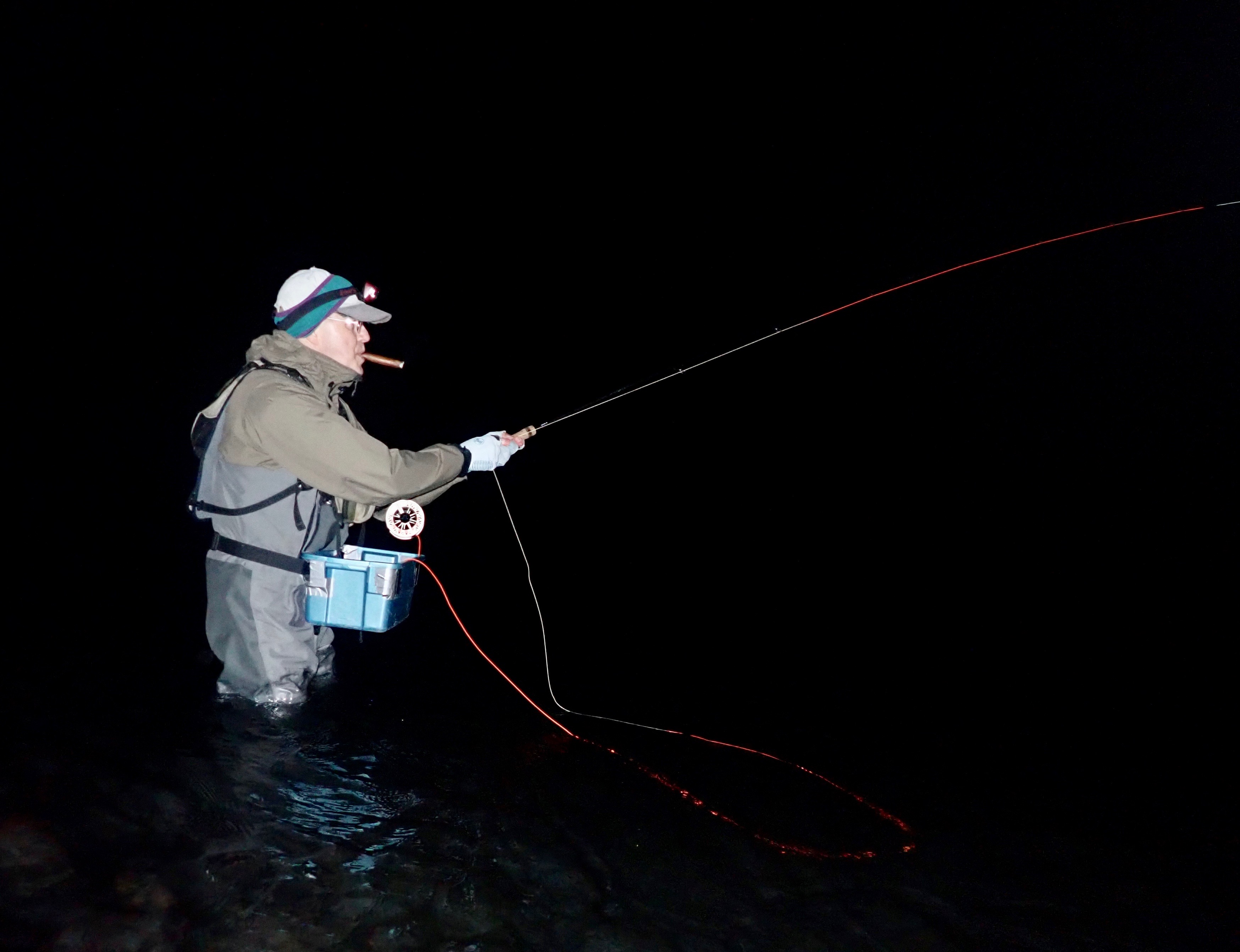
We settled in and began to cast, me with my two-hander and floating line and Sure Thing, Toby with his surf rod and bag of plugs. Right away Toby was into stripers. Nothing too big by his standards, but enough to whet our big bass appetites. Even though it was early in the incoming, the current was already beginning to pick up speed as it rushed across the rocky bottom. This was my second time here, and I knew what I had to do: make a cast, immediately throw a large upcurrent mend, gather in the slack, and let the fly greased line swing over the bar.
Big fish don’t miss, and this one drilled the Sure Thing with precision accuracy. The beauty of the greased line swing manifests with such takes; you feel the heaviness of the fish, see the surface erupt in a chaotic whitewater geyser, and hear the distinct sound made by a large object as it thrashes on the surface. My cast had only been about 70 feet, and I quickly came tight to the striper.
I set the hook. Then again, and once more. Normally, I’d put a bass this size on the reel, but I’d already begun stripping her in. It wasn’t until she was about 25 feet out that I questioned my decision. I let her take a little line from hands, and used the rod tip to deflect the more frantic short bursts. She was close now.
Always fight a big fish from the bottom third of the rod. Note that the rod angle is below 45 degrees. I was confident in my hook set, and the fact that I had a sticky sharp 3/0 hook and a 30-pound mono leader. It’s only when I feel the fish is running out of fight that I raise the rod tip to lift its head and lip it. The raised rod tip also cushions any sudden late bursts by the fish, which are sometimes difficult to manage when you’re hand stripping a larger bass. Photo by Toby Lapinski
Twice I thought I was in a good position to lip her. Twice she refused. And then it was over. The camera was readied, rod tucked under arm, fish supported — she never left the water — and then the most satisfying part. Release. Watching her melt into the dark waters of Long Island Sound, knowing you may catch her again some day. Perhaps it’s the fist bump from the friend who was there to share it with you that is the most satisfying. Or, maybe the victory cigar.
Whatever. It doesn’t have to be a sure thing.
38″, 20-pound class, R.L.S. Sure Thing. This has been my best year since 2018 for bigger bass.Photo by Toby Lapinski
Bert took a striper lesson with me on Monday. We banged around two different tidal marks near Long Island Sound. The wind made for a few casting and mending challenges, and the water was heavily stained. Bert learned about non-stripping presentations where the angler brings the fly to the fish. The greased line swing, the dangle, strategic mends — these are all now part of Bert’s striper fly fishing vocabulary. We even had a tug in the midst of this mid-day maelstrom. We also covered fly selection, dropper rig construction and presentation, and baitfish ID. If you want to catch those hard-to-catch, unwilling-to-chase, and (most of all) bigger striped bass on a regular basis, you need to learn presentation. Great job, Bert!
Despite the low visibility, we saw several bait balls of juvenile Atlantic Menhaden. Nice loops!
Then, Monday night, I ventured to the Ocean State. It never occurred to me that the entire southern New England coastal waters might be stirred up by the blow. Yep, the estuary I fished was the same sandy mess and weed farm. Bait was everywhere — mullet, peanuts, silversides — but the only thing that was on them were a few bass in the 12″-16″ range. In a little over two hours I managed a couple hits from these smaller guys, but no hookups. I stayed out way later than I should have, and I didn’t hit the pillow until after 3am. Maybe next time.
Here’s a question from long-time reader Bill G: There have been big blitzes on the Cape, but I’m not getting hookups. Do you recommend a floating line for fishing blitzes?
As with many questions, there are simple answers — and complex ones, too. The simple answer is: yes. With a floating line, I can mend, so I have more control over current and my presentation. I can present at the surface, near the surface, or deep (depending on leader length, type, and fly weight/structure/materials); and I can present on a dead drift, the swing; or strip. As with many questions I get about lines/leaders/flies, you must first answer the question, “What do you want the fly to do?” — and go from there.
Which brings us to the subject of blitzes. In the abstract, blitzes are good. You’ve got a concentration of bait and bass, so the mystery of where are the stripers and what are they eating has been eliminated. Sometimes, it’s too easy: all you need to do is toss a fly into the maelstrom and you’re on. But we’ve all experienced the frustration of fishing a blitz where we can’t buy a strike. Line type is important, but there are other factors to consider as well.
Is there a lot of bait? If so, are you fishing droppers? Fishing two or more flies during a blitz will dramatically raise your hookup odds.
Where are you making your presentation? The middle of the bait ball is often the worst place for your flies. Try presenting along the edges or a couple feet away — or try going underneath the bait. Blitzing stripers are looking for easy pickings: the stragglers or wounded or dead that are outside the safety of the bait ball.
How are you presenting? If the stripers are looking for easy pickings, a stripped fly may be your worst option. That’s why dead drift presentations near the bait are often so effective.
Fly selection matters. Try sparse, impressionistic patterns than move and breathe and create the illusion of life even when at rest.
I’ve had success during blitzes with both floating lines and full sink lines — but the one time I recall using a full sink, it was because it was so windy, and that was the easiest line to cast. Thanks, Bill, for the great question, and I hope this helped.
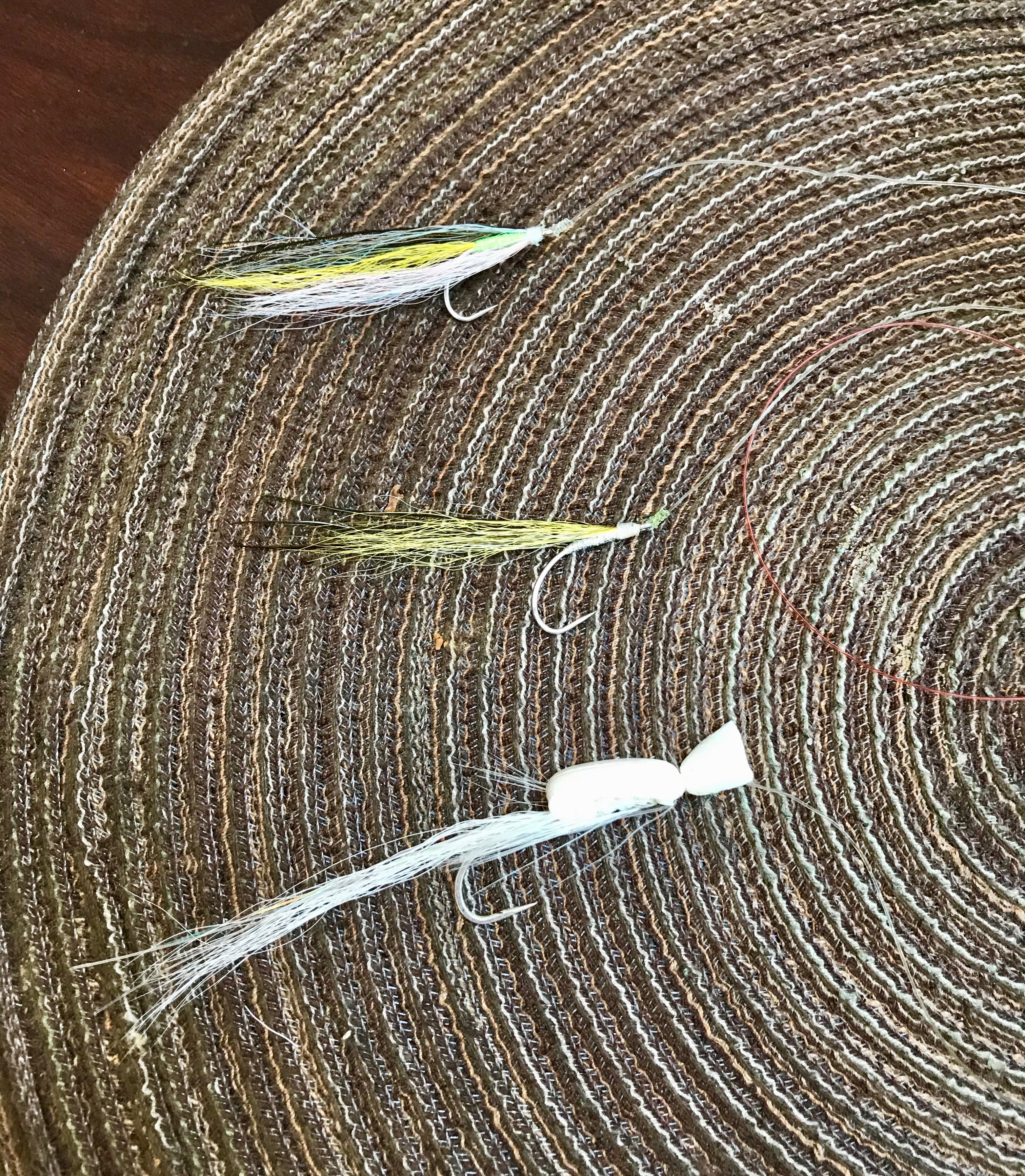
When there’s a lot of bait in the water, I like sparse, impressionistic patterns like this Little Crazy. A basic bucktail with a marabou throat, I based the color scheme on Ken Abrames much larger flatwing, the Crazy Menhaden. The Little Crazy is becoming one of my favorite juvenile Atlantic Menhaden patterns.
Here’s a great question from Will: When you are running your gurgler/eel dropper setup, how are you setting the hook on a dropper take? Trout land tells me to set down and across the direction of the drift, but saltwater land is telling me to strip set. He’s referring to my suspension dropper rig where I’ve got a floating fly on point and two smaller flies on dropper tags.
This is a question to which there is no simple answer. My best attempt at a distilled response would be: Strip set. (Kindof.)
Here’s why it’s a little complicated. There are multiple factors to consider, such as conditions; current; the type of take (feeding frenzy slam, gentle sipping take, greased line swing inhale?); the position of the rig relative to you, etc.
When I’m fishing a suspension dropper ring, I am rarely using a stripped presentation (the closest I’m getting to stripping is something akin to a slow gathering of slack line) — so I’m not doing a traditional strip set. Instead, when I need to set the hook, I most often hold the line against the cork and thrust the rod back toward my hips, essentially mimicking a strip set. Depending on the ferocity of the take and the size of the fish, I may set the hook in this manner multiple times. I always set and reset multiple times with a large bass. Even if I am doing a static presentation like a straight dangle, I have the line in one hand and am ready to spring into action.
Sometimes the striper eats the fly, turns and swims away, thus setting the hook himself. (This is why I preach sticky sharp hooks, and checking your hook points often.) You may need to reset; wait until the fish stops moving, then point the rod at the bass, and set as outlined above.
And sometimes you feel the pressure of the fly being sucked in, or maybe a just a small tap. You should wait to feel the weight of the fish before you do any setting — otherwise you may come up with nothing. This is especially true during a greased line swing or when you’re on the dangle.
A near-slot bass taken this summer on an Orange Ruthless, part of a three-fly team. The strike came just as the presentation transitioned from swing to dangle, about 50 feet below my position in a moderate current. In this case, she was feeding with confidence and blasted the fly, setting herself. I executed a thrust set to drive the hook further home, and a couple minutes later I was taking this photo.
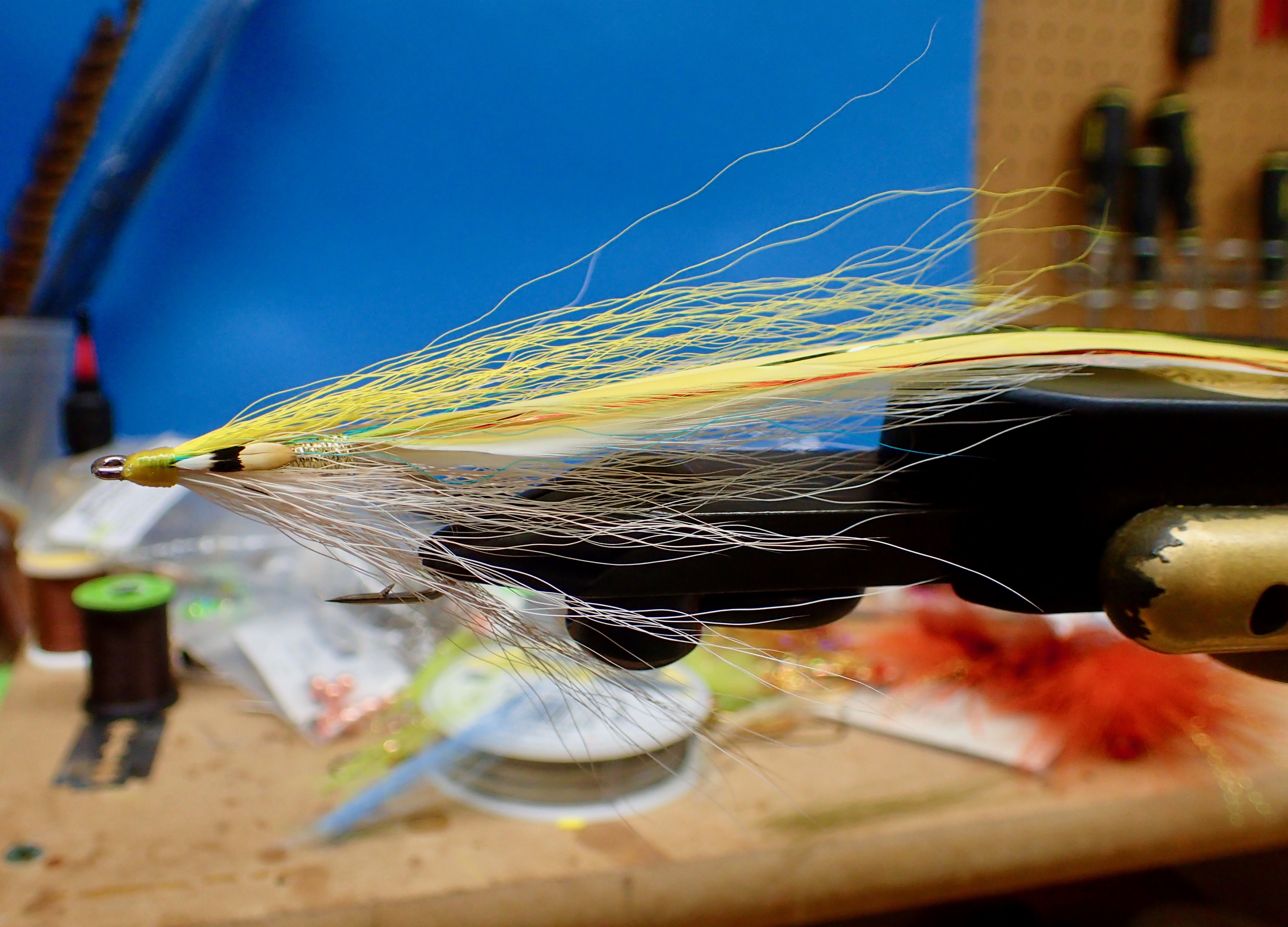
I don’t know if you’ve noticed, but suddenly it’s fall. The shadows have started getting longer earlier. There’s an early morning nip in the air. (At least my wife tells me so — I’m still sleeping when she’s out running.) There are even a few leaves on the ground, although that can be attributed to drought as much as anything. Nonetheless, fall has begun, and for striper anglers in the northeast fall means finger mullet. The September Night pattern can be found in Ken Abrames’ classic Striper Moon. It was one of the featured patterns in my 2015 American Angler article Soft Hackles For Striped Bass.) You don’t even need long flatwing saddles to tie it — I’ve gotten away with stung hackle in a pinch. Just look for chubby, webby feathers.
Ken Abrames’ September Night
Hook: Eagle Claw 253, 1/0-3/0; Thread: white 6/0; Tail: 30 gray bucktail hairs, then two white saddle hackles tied in flat, then two strands silver Flashabou; Body: silver braid; Throat: sparse, long white bucktail tied as a 3/4 collar, both sides and bottom; Collar: white marabou, folded or doubled 3-4 turns; Wing: 30 long white bucktail hairs, then 15 purple bucktail hairs, then 2 strands blue Flashabou, then one natural black saddle hackle.
Ugh. That seems like a fair enough description of the the state of the Block Island fishery from shore. Like last year, it was very slow, giving us two consecutive years of ugh. I was able to catch fish every night (save one) only because I was hopping around the island from mark to mark in a desperate search for stripers. The most I could manage on any night was three, sometimes only one, and this is now three consecutive years without a slot or legal bass(!?!). Sure, the boat bite has been good — Cam scored a couple junior cows off the south side on a boat trip — but since mid-June, for both pluggers and fly anglers, the shore bite has been lousy. I saw very few bass cruising the east side beaches during daylight. There were sand eels scattered here and there, but no substantial schools. And no schools of cruising bass — just an occasional lone wolf. Stay tuned for a more detailed report/photo essay.
Spotlight on you, gorgeous. This near-slot striper hammered my Big Eelie as it drifted across a sandbar on the outgoing tide. It was one of three fish on that night. Every time I thought the bite was going to pick up, it didn’t. I say again: Ugh.
I’ve had the B.I.G. Big Eelie variant on my brain ever since I read Dennis Zambrotta’s Surfcasting Around The Block. In case you’re unfamiliar, Dennis devotes an entire chapter to the popular needlefish plug — and he details how bright, fluorescent lime green was all the rage among needlefish aficionados. Dennis dubbed the color, “Block Island Green,” and it was so popular back in the day that you could always find an incredible number of fluorescent lime green spray paint cans at the island hardware store. Fortunately, you don’t need to summon your inner painter to tie the B.I.G. Big Eelie. All you need is some bucktail, a few pencil thin saddles, and a sandbar over which to swing this bright green striper catching machine.
The B.I.G. Big Eelie
Hook: Eagle Claw 253 3/0
Thread: Fluorescent green or chartreuse 6/0
Platform: 30 hairs white bucktail
Tail: First, a white saddle; second, 4 strands light green Flashabou; third, three chartreuse or bright green saddles. (All saddles pencil thin.)
Body: Pearl braid
Collar: Fluorescent green marabou, tied in at the tip, 2-3 turns


 currentseams.com