Matching The Hatch with Wet Flies

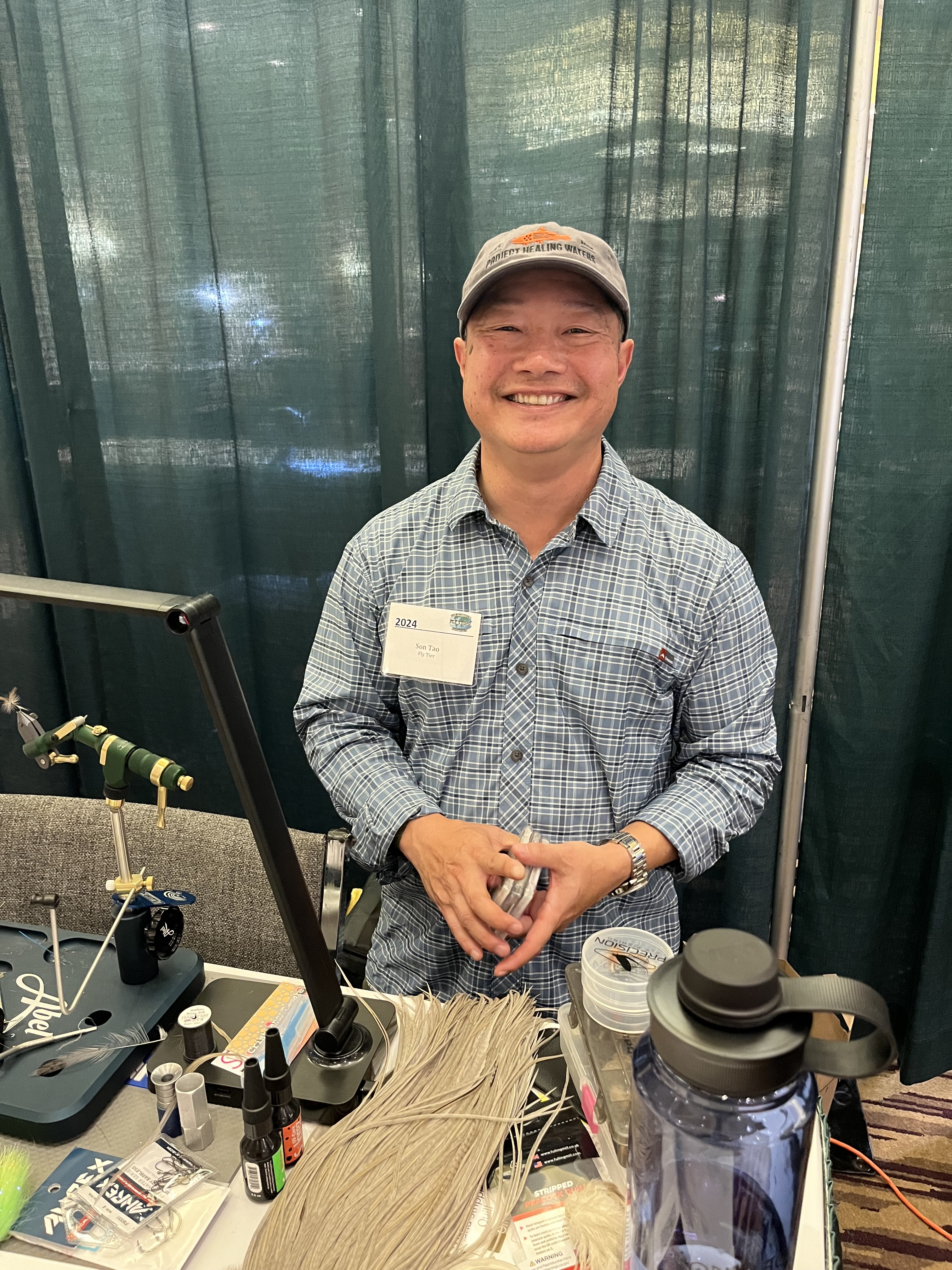
“Matching The Hatch With Wet Flies.” That’s the title of my Featured Tier demo this Sunday at 11:45am at the International Fly Tying Symposium in Somerset, NJ. As I prepare for the demo, I had a few thoughts I wanted to share.

When you’re fishing wet flies, matching the hatch doesn’t matter — until it does. And then, you’d best be prepared. What I mean is, there will be times when fish will eat a wet fly simply because it looks alive and like something good to eat. The bug that wet fly is supposed to represent may not be hatching at that moment. It may be entirely out of season. It may be the wrong color or size. But nonetheless, it gets stomped.

However, the more you fish with a team of three wet flies, the more you will encounter situations where the trout will only have what’s hatching, presented in the water column exactly where they are feeding on the naturals. They may pick out one fly on the three fly team to the ruthless exclusion of the other flies. That’s when matching the hatch pays dividends. You’ll be the person leaving the pool, trailed by other anglers who will want to know, “What fly were you using?”

So: know your hatch windows. Understand what food is most likely to be in the water. Understand how those bugs behave. Specific patterns aren’t as important as matching size, color, and profile. Give the trout a choice. They will always tell you when you get it right.

See you this weekend!

LaFontaine’s Diving Caddis is a good choice for a late afternoon-into evening pattern — because that’s when the trout are most likely to be seeing egg-laying female caddisflies. One memorable evening, I landed two dozen trout in two hours — sixteen on the Diving Caddis.

Currentseams Q&A: Wet fly or dry/dropper for emergers?

I got this question when I spoke earlier this month the EJTU meeting. It’s a good one. I’d just shown the group a video of trout taking sulphur emergers. The rises were regularly timed and showy/splashy. You could also see the bugs in the air.

The question was: When you get to the river and you see a scene like that, do you automatically go to a a dry/dropper? A: No. I will start with a wet fly team of three, and two of them will likely be sulphur patterns. There’s a lot to unpack here in terms of that decision. In this particular video, it was late afternoon in June. The rise forms clearly said the fish were on emergers. The time of year, time of day, rise forms, and visible bugs (sulphurs, whose nymphs are in the drift a good long time before emergence) indicated that the trout were taking their food just below the surface. A dry/dropper might get you some takes, but why not feed the fish like they’re already eating? Which is, subsurface, just below the film. A wet fly team of three fits that bill perfectly.

A splashy, emerger rise form (upper left) still taken from the video. You can also confirm that the trout are taking the emerger by the lack of duns on the surface. This doesn’t mean you can’t catch fish on the surface. It just means the dry fly may not be the most efficient method.

Note that a dry-dropper may be a better method for presenting just under the surface with different hatches. A midge pupa in winter would be a good example of that.

A brief wet fly outing on private waters and other notes of interest

On Monday I had the opportunity to fish a private stream, so naturally I jumped on it. This is a lovely brook that wants to be a river, and it’s not easy water. Its banks are overgrown, and there’s often a three foot drop from terra firma to water. The first beat we fished was particularly challenging; a lot of the water crawls along, creating glassy pools where any movement sends the fish into flight toward the nearest cut bank. I was instructed to stay out of the water as much as possible, but when did I ever follow directions when I wanted to do my thing? I decided that I needed to get in, summon my inner stealth ninja, and fish downstream.

Sure enough, I crept up on pool that had risers. The hatch was midges and caddis, and there were a few stray Hendrickson spinners. Some of the takes were more emergery, some gentle sips. I had two fish slam the fly the moment it hit the water, and a few more that required a little coaxing. I took six fish, which I was told was pretty darned good, a nice mix of stocked and wild brookies and some chunky rainbows. All three flies were eaten: Squirrel and Ginger (sparkle variant — more on that soon!), Hendrickson spider, and LaFontaine’s diving caddis, tan.

The second beat was not as kind. It began good enough, with my biggest fish of the day, a rainbow with a dramatic pink band (you can see it on Instagram @stevecultonflyfishing) on the second cast. But even though this mark was far better suited for wet flies, I only managed one more trout (do creek chubs count?), and even with that one, I had to wait a half hour and go back after I missed her the first time. I think the lack of activity was due to the hatches being over, and everyone with fins being well fed. Or, maybe I just stunk. Or maybe it was just fishing. No matter. It was just capital to be out fishing. Thank you. Peter G., for your most generous invitation.

It’s almost never a bad idea to swing wet flies when you see feeding fish, especially during an emergence. However, be advised: if the trout aren’t feeding regularly and rhythmically, and you don’t get hit after three good presentations, you may be in for a bit of a wait…

Meanwhile, nose to the grindstone on the book. As far guide trips go, I am not taking any more dates in May. If you see me on the river, please come say hello.

Then, of course, there’s the new house and vegetable garden, which won’t plant itself. What a wonderful collection of obligations.

Dear Angler: Did you know you were a terrorist?

This is an excerpt from a letter to the editor of The Courant, Saturday, January 17, 2015. The author is referencing a story the paper ran on ice fishing:

“Selective human empathy, such as humans for their pets, is a fundamental shortcoming to evolving a sustainable civilization. To the victims of slaughter or pleasure sports, whether fishermen, hunters or ISIS, there is no difference. Classic reaction: A fish with feelings? Ha.”

I’m not sure where to begin here. We’ll start with the glass house metaphor. Let’s give the writer the benefit of the doubt and assume he doesn’t eat meat or own a single leather item.

The assertion that a civilization that keeps some animals for pets and eats others is retarding its evolution is patently absurd. Dogs have been domesticated for over 10,000 years. How much longer have humans have been eating animal flesh, and where would we be on the evolutionary calendar today if we were all vegans?

We could move on to politically incorrect sexism next. “Fishermen?” Not “anglers?” That’s a fairly substantial liberal thought spectrum faux pas. If you have a dick and you fish, you’re bad person. Female anglers, apparently, are exempt from such judgement. (April Vokey will no doubt be relieved.)

The “fish have/do not have feelings” argument is ultimately a cul-de-sac. I could offer up such pearls as, “What would be a trout’s reaction if you played Tchaikovsky’s ‘1812 Overture’ for it?” “Are bigger fish evil because they prey on smaller fish — and do those smaller fish feel bad when they get eaten?” Or even, “If a fish has the capacity to feel, why doesn’t it swim toward you when it is hooked rather than away?” No one is going to convince me that fish are anything other than rather primitive animals, and I’m not likely to convert the other side.

But equating me with ISIS because I fish?

That kind of thinking makes fish look intelligent.

Farmington River 1, UConn 0

Those of us who love the Farmington River spoke out — and our voices were heard. UConn will be using the CT Water Company, rather than the MDC, to fulfill their future water needs.

The following is a quote from last Tuesday’s Hartford Courant:  “The selection eliminates a controversial $51 million plan by the Metropolitan District Commission to build a 20-mile pipeline from East Hartford that would have drawn water from the Barkhamsted and Nepaug reservoirs. Opponents assailed the plan, saying it would draw down the watershed of the Farmington River, a popular recreation spot.”

Yeah, baby. That’s us. Opponents. Assailants. Righteous defenders of natural resources. Thanks to everyone who spoke up, signed the petition, wrote letters, and sent emails.

Grassroots activism is so underrated.

Winner.

Image

And, winner.

Image

UConn wants to divert 5 million gallons of water a day from the Farmington River. What can you do about it? Start here.

Yes, the same UConn that drained the Fenton River Class 3 Wild Trout Management Area dry a few years back, killing hundreds of trout. They’re up to their greedy, water-sucking ways again. Only this time it’s the Farmington River they’re after. Yep, the same Farmington River that had lethally low flows last August, killing scores of fish. But, what’s another five million gallons a day in the name of progress? So what if we have to build a pipeline halfway across the state? Who cares if more fish die, or if people can’t fish or kayak or float, or if businesses that depend on the river suffer?

If you do care, please sign this petition. Pass it along to a friend.

http://petitions.moveon.org/sign/voice-your-support-for?utm_source=2013-05-30+UConn-MDC+water+petition+%2B+calls&utm_campaign=UConn+water+petition+5-30-13&utm_medium=email

The future of the Farmington remains cloudy. Help send a clear message to UConn and the MDC: Leave our river alone!

Image