CT hatcheries funding update

The Governor’s obtuse, short-sighted recommendation that funding for Connecticut’s hatcheries be eliminated met with a stalemate. A special session of the legislature has been called for Tuesday, December 8. If you have not done so already, please contact the Governor’s office and your representative to voice your opinion. A link with more information from the CT River Salmon Association and ways to contact the Governor and legislators can be found here.

Also, here is a pdf from the Fisheries Advisory Council with supporting information: CostofCuttingHatcheries1.

Make your voice heard!

No hatcheries, no Farmington River Survivor Strain.

Big Survivor Strain brown hen

DEEP Farmington River Sampling scheduled for September 9, 10, 11

This comes from Neal Hagstrom of the DEEP:

Just a heads up for everyone. The DEEP will be sampling the River Sept 9-11th. We will be working from Barkhamsted downstream.

On the 9th Hogback Road, around the Campground, and possibly the drive-in Pool.

On the 10th Halford’s Run, and the Greenwoods – the big brood stock collections at the Wood Shop that pm.

On the 11th Ovation and above Satan’s Kingdom. We hope to get flows restored mid-day on the 11th. 

This assumes that mother nature cooperates and no rain limits our work. Angler’s cooperation on clearing the river during these activities is greatly appreciated because your safety is a primary concern and people in the water affect the efficiency of our operation. 

As always, all broodstock will be returned to the river in early December after they complete their recovery from spawning.

If there are questions I can be reached at the Marlborough Fisheries Office 860-424-4179

Neal

~

In case you are unaware, the MDC draws down the flow from the Hogback dam in early September so DEEP and volunteer crews can take their fish census and gather brood stock browns for their Survivor Strain program. As Neal mentioned, it is best to stay clear of the crews while they are working. That doesn’t mean you can’t go fishing elsewhere on the river. However, given the recent stretch of unusually hot weather and a forecast that calls for more of the same, I would suggest that it might be prudent to give the trout a break.

If you’ve never been on a sampling, it’s a fascinating experience. Anyone can volunteer by contacting the DEEP.

Tip of the week: visit the river while the water is way down. Note where the truly deeper holes are. Bank that information for future withdrawals.

A brood stock brown that was captured and bred in fall, 2012, (red elastomer left eye) then returned to the river in December of that year. I caught her in April of 2013. I wonder how many of her kids I’ve crossed paths with?

Big Survivor Strain brown hen

Why I love the Survivor Strain program

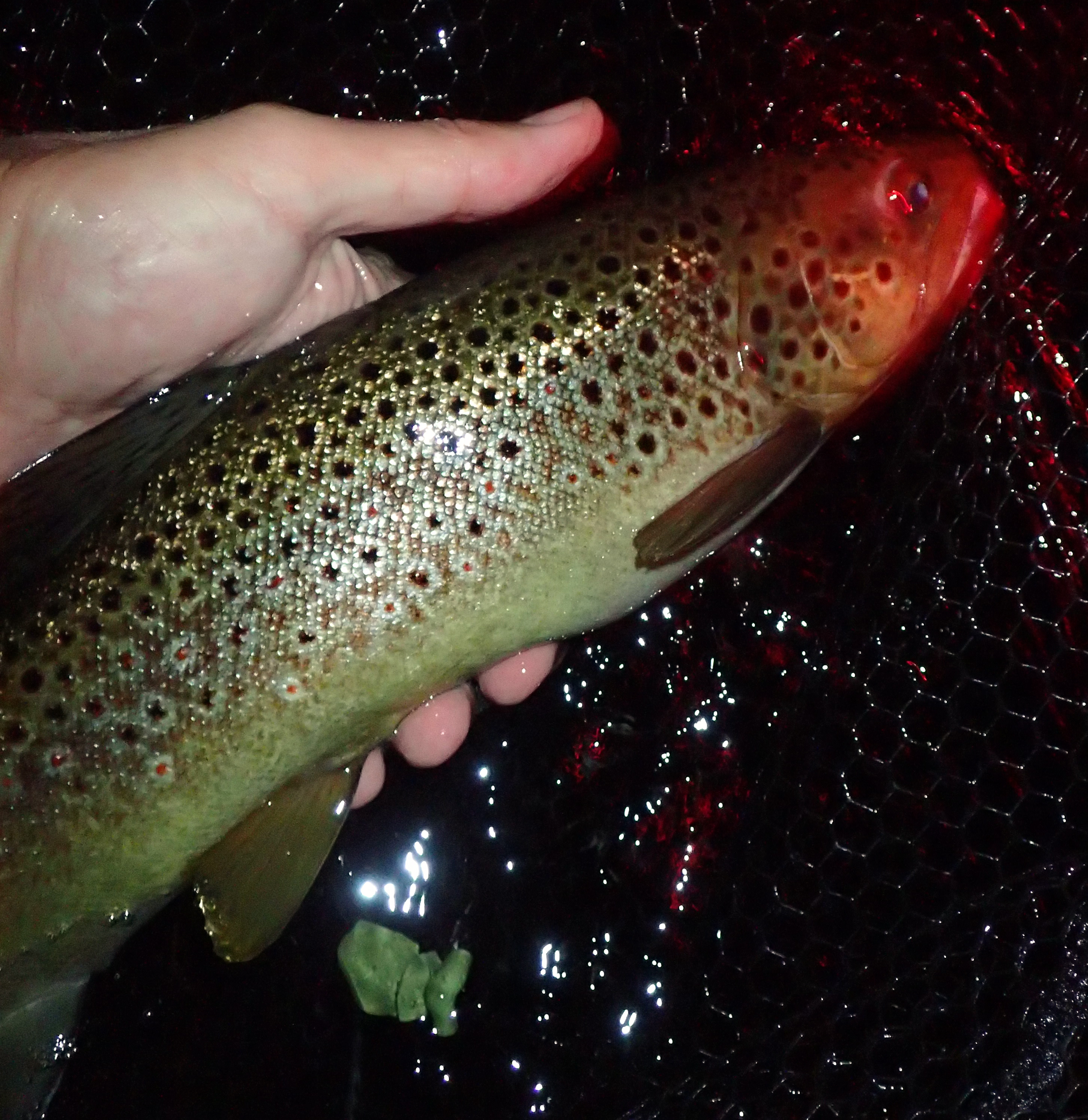
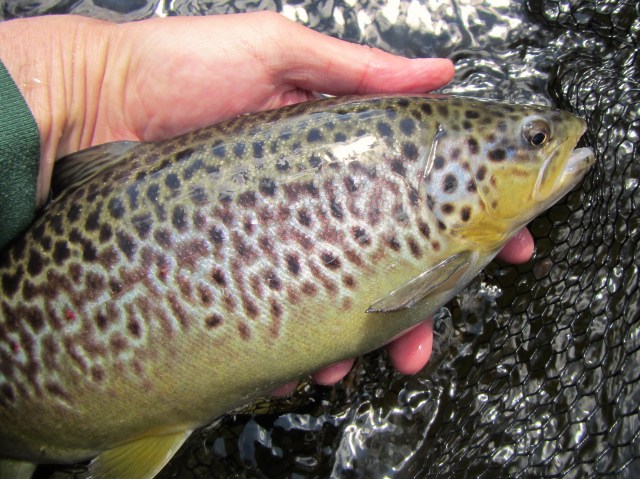
Not every big fish in the Farmington is wild. Here is a Survivor Strain brown from a recent outing. Large, well-developed fins, clipped adipose, and some distinctive haloing around the lower spots. I wonder what else is in that belly? The fish’s attack was textbook big brown: hit, hit, then the take. You read so many reports of people catching 18″ trout on the Farmington that I suspect a good percentage of those fish are actually short of 18, what with it being such a nice, round default number. But I can tell you with certainty that this fish was at least 18″, measured against my landing net, which I’m pleased to report had some difficulty accommodating the catch.

Farmington Survivor Strain brown

Douglas Thompson talks. The American Fisheries Society listens — and responds.

“The Cost of Trout Fishing,” a recent op-ed piece by Douglas Thompson in the New York Times (Thompson 2015), included several inaccurate statements and fundamental misunderstandings of fisheries management and aquaculture.

Those words are taken from an article recently published by the AFS. Here’s a pdf of the entire article. Note a source citing  some of our own DEEP folks.

AFS Responds to an Op-ed in the New York Times 2015-2

A beautiful winter Survivor Strain brown. Thanks, DEEP, for your excellent work on the Farmington River.

2:14 SS Brown

Farmington River Mini Report 4/30/15: A good day for wets

My best guess is that everyone looked at the five day forecast and decided that yesterday would be ideal for playing hooky. How else to explain the dramatic reduction in angler traffic today? Not that I’m complaining. I bounced around to several spots on the upper TMA, and fished all by myself for two glorious hours.

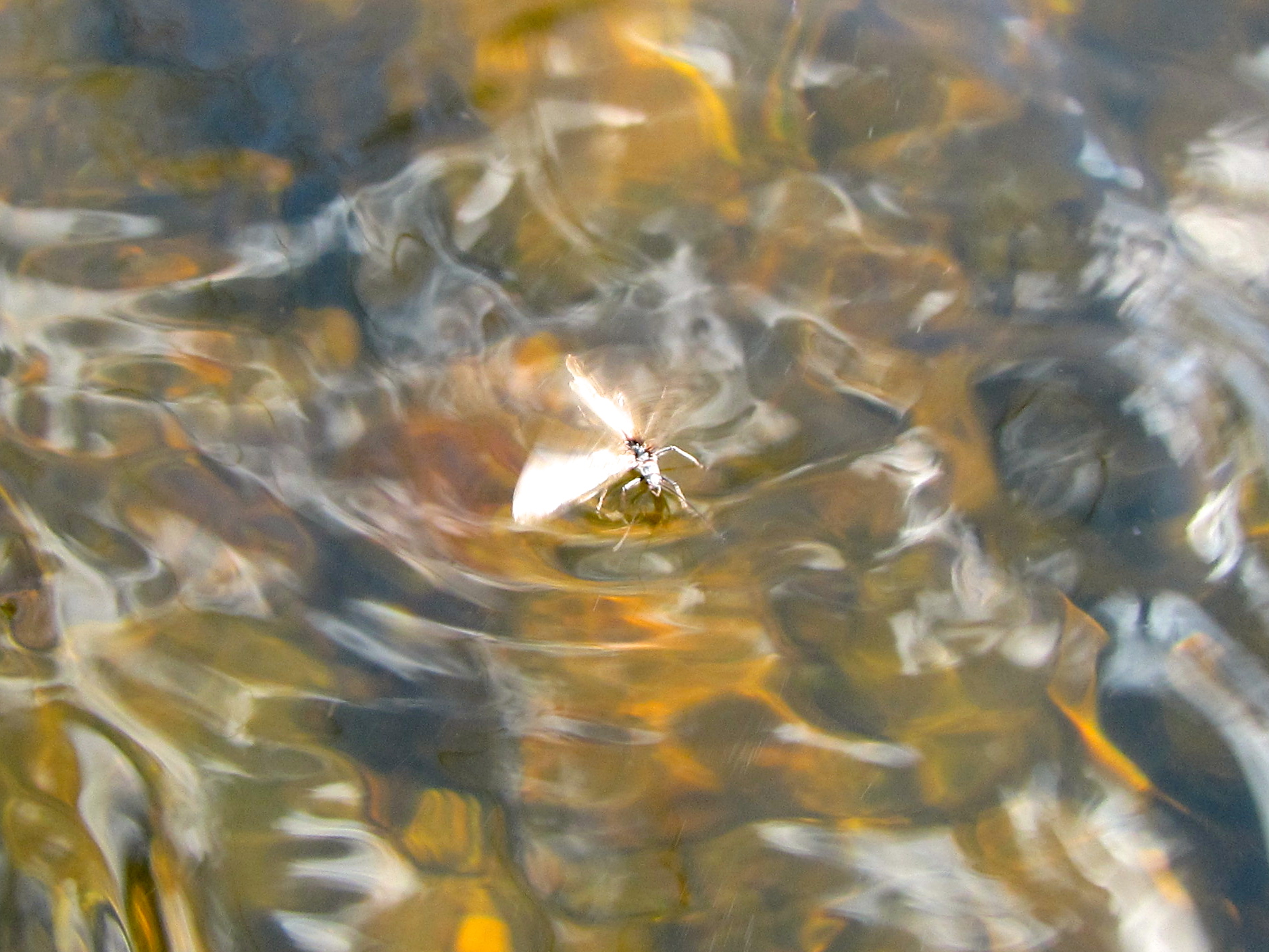
Conditions: Cooler than yesterday, mix of sun and clouds, chilly breeze (dammit, I left my fleece vest in the truck). Water 425cfs, 48 degrees, crystal clear. Not nearly as many caddis as yesterday, and that resulted in no takes on the Squirrel and Ginger. Size 12 SHBHPT was the runaway favorite fly. Plenty of midges, and some size 16-18 BWOs. No H bugs. Saw only one rise (as opposed to dozens yesterday).

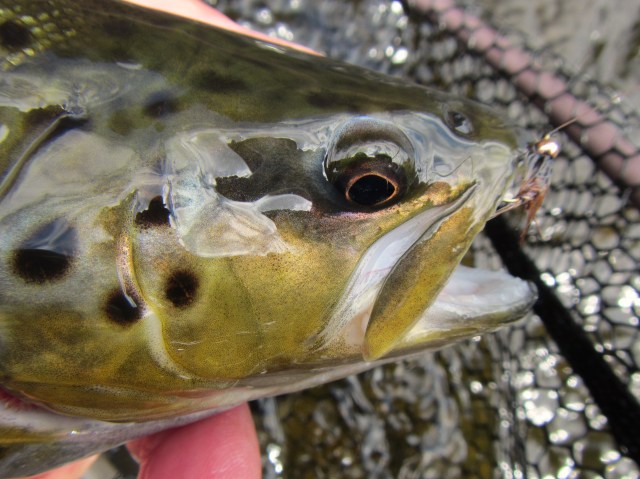
Yes, dear, you have something on your lip. Hold still and I’ll take it out.
IMG_3050

How I fished: three fly team of wets, two size 12 S&Gs and the pictured BHSHPT. The bead was copper tungsten. Mostly casting down and across, but I did some upstream and  short-line deep presentations. I caught them on the swing, the mended swing, the dangle, and the short-line deep. A fair mix of standard-issue and Survivor Strain stockees. I stopped counting after a dozen. I say this not to brag (if you were there you would have likewise caught a multitude) but rather to illustrate how good the fishing was on the wet. If Woody Allen fished, he might have said, “80% of success is just showing up…with wet flies..after they’ve stocked the upper TMA.”

“Tell me, Two Caddis Humping, why do you ask?”

IMG_3043

Lessons re-learned: If there’s a sudden pause in what has been fairly constant action, check your three-fly rig for tangles. Yep, that’s not helping. Make sure the line lays out flat on the cast. The wind will screw you every chance it gets. If you’re fishing wets, let the new standard-issue stockees take the fly before you set the hook. If you try to set on the bump/tap, you’ll miss the fish. Let them hook themselves. The Survivor Strain and holdover/wild fish will simply clobber the fly. Bless them. Expect a good fight. Some of the new SS fish are shaped like a rugby ball.

The obesity crisis in Survivor Strain browns. For newly stocked fish, they sure can swim. This one had to be coerced into the net.
IMG_3039

Thank you, NYC TU for last night’s Farmington River presentation

Many thanks to the New York City Trout Unlimited chapter for hosting me last night. We got off to a fine start with a cheeseburger, fries and Shackmeister Ale at the Shake Shack at Grand Central. As you have no doubt read here before, a fed presenter is a happy presenter. Then, a short two-blocks-and-change walk to the Orvis store in Manhattan. How convenient.

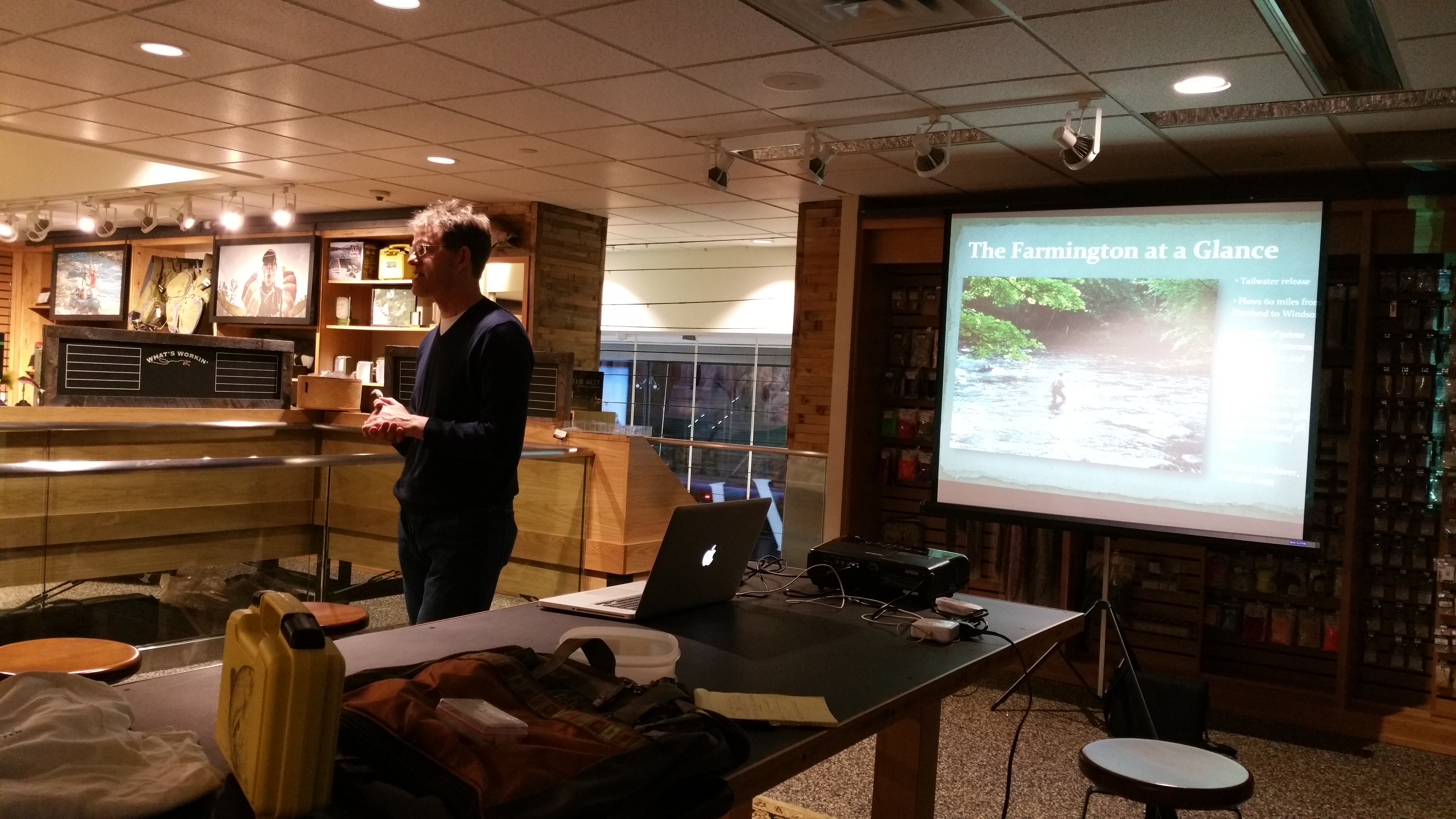
Dim the lights and we’ll get this party started (photo courtesy of Rob Ceccarini).

TU_NYC

The presentation’s formal title is “The West Branch: Southern New England’s Blue Ribbon Trout Stream.” But we like to keep things fun and loose, so there’s very little formality other than talking about what magically pops up on the screen. It’s always gratifying to have a strong turnout, and I’d like to thank everyone who took the time to listen, talk to me, and ask questions.

Now, all this Farmington River business has got me in the mood for some fishing. Maybe later this week.

Reminder: My next appearance is tomorrow night, Wednesday, April 8, at the CFFA Tyers’ Roundtable, 7pm at Veterans Memorial Clubhouse, East Hartford, CT. Hope to see you there.

The state of the Farmington River and other shocking news

In case you didn’t know (and if you’ll pardon the inflamatory headline) the Farmington River has lots of trout. Lots of big trout. And lots of wild trout. All good news if you like to fish the Farmington.

We know this because every September, the MDC draws down the flow of the dam and electroshocks the river. The electroshocking has two purposes: trout census, and gathering broodstock for future generations, aka Farmington River Survivor Strain. (For more on Survivor Strain, see my article in the Spring 2014 issue of The Drake.)

I didn’t attend, but the DEEP delivered their state of the river address to the FRAA a few weeks ago. Here’s their story in numbers: