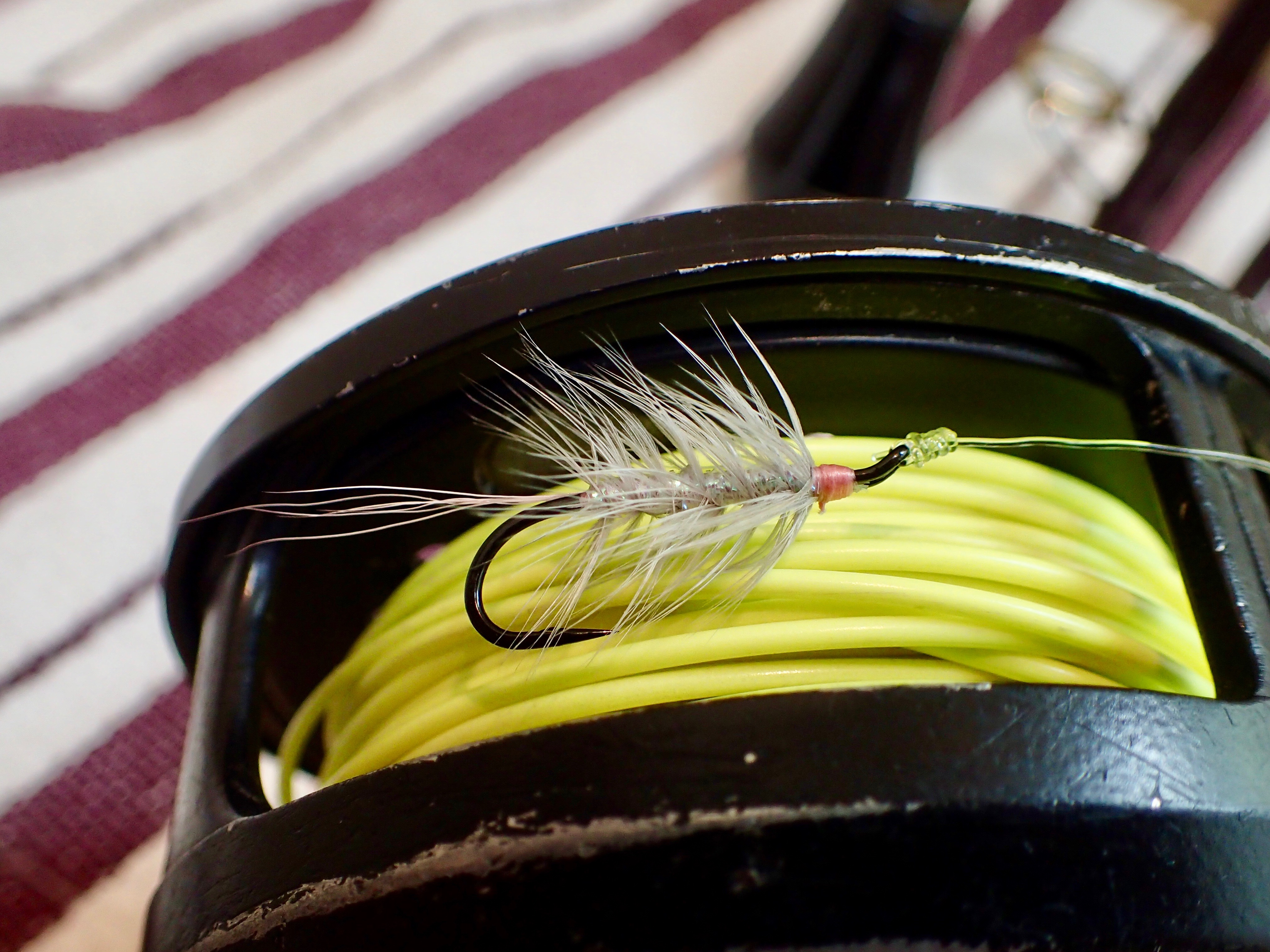
In just one month, LaFontaine’s Diving Caddis wet fly is already paying huge dividends

Back in the lonesome, isolated days of the pandemic, I mentioned that I’d never read Gary LaFontaine’s masterwork, Caddisflies. Currentseams subscriber Mayson Neel would have none of that. So he found a used hardcover copy of Caddisflies in fantastic condition (the book is out of print) and had it shipped to me. I started reading it, was intrigued, but like so many other projects, finishing it just fell by the wayside.

Cut to this winter, where I cracked it open, found my trusty yellow highlighter, and started anew. I’m happy I did, because I can tell you that what I’ve learned has resulted in dozens of trout caught, for both me and my clients.

I have so much to share about Caddisflies — I really can’t believe I ignored this book for so long — but I’d like to start with LaFontaine’s Diving Caddis wet fly. The female of many caddis species dive to the streamed to lay their eggs, encased in a gleaming bubble. LaFontaine writes, “Both the brightness and the action of the diving female are enough to make a wet fly imitation necessary…(the fly’s) pure Antron filaments, hanging free over the back, reflect more light.” He goes on to list four primary patterns, plus eleven secondary ones. I was dumbfounded to see that there isn’t a tan caddis pattern in the group; the closest we get is a tan/pale green version. So I made up my own tan diving caddis variant:

LaFontaine Tan Diving Caddis (Steve Culton variant) Hook: Standard wet fly size 14-20; Thread: Tan UNI 6/0; Body: Tan Caddis LifeCycle dubbing, small gold wire rib; Underwing: brown partridge feather fibers; Overwing: 20-30 tan sparkle yarn filaments; Hackle: One turn brown rooster hackle

Tying notes: LaFontaine specified the Mustard 7957-B hook; I went with my standard issue heavy wet fly hook, the TMC 3769, size 14. He doesn’t include a rib, but I like the segmented look it creates. While he specifies Sparkle yarn for the body, the LifeCycle dubbing makes a fine stand-in with its blend of natural and synthetic fibers. I plan on trying a few without the rib, and using the sparkle yarn, chopped up, to create a rougher, buggier body. I found it curious that he chose stiff rooster hackle, but LaFontaine explains that the fibers “Stand out from the body and add vibrancy to the moving wet fly.” Many of the photos I’ve seen of other ties feature a collar using several turns of hackle, but LaFontaine is adamant that the collar be kept sparse.

Although I’ve only been fishing this fly for a month, I’ve had several outings where it was the only fly on the team of three that was getting eaten…or the fish chose it by a wide margin over the other patterns.

LaFontaine Diving Caddis Wet Fly Rogues’ Gallery

Farmington River, May 30, 2023

The requirements of a successful grass shrimp fly pattern are…well, they certainly don’t include realism

Edward Ringwood Hewitt was one of the leading innovators in American fly fishing and fly tying. The Skating Spider…Bivisisble…Neversink Stone…these are all Hewitt creations. Hewitt was obsessed with finding out everything he could about what made fish eat. To wit, he created a list of seven factors that made a pattern successful, and ranked them in order of importance. Gary LaFontaine, another keen student of feeding behavior and effective fly design, lists them in his masterwork Caddisflies. Number one is the light effects of the fly, above and below the surface. Number seven, the least important, is accuracy of imitation of the naturals.

So it should come as no surprise that The Grass Shrimp Solution, a ridiculously simple pattern constructed of a few strands of bucktail, some braid, and a hen feather, excels at fooling striped bass. It has no eyes, no tail, no carapace. But it does have the essential bite triggers that stripers are keying on. In Caddisflies, LaFontaine makes a very big deal about what fish are looking for when they’re feeding; it’s often a single, essential characteristic of the natural. The Grass Shrimp Solution offers a translucent silhouette when viewed from below; the soft hackle and sparse feelers provide movement; and when held on the dangle, the fly creates a wake just like the naturals. Impressionism. It’s what’s for dinner.

If you placed the Grass Shrimp Solution in a shop next to patterns with shells and eyes, no one would buy it. Fortunately, striped bass don’t browse through fly bins.

Three things striper fly tyers (and anglers) could learn from Gary LaFontaine

As I continue to pore through Gary LaFontaine’s masterwork Caddisflies, I’m reminded of the sheer volume of universal concepts that apply to fly fishing. So, even though he’s talking about fishing for trout that are feeding on caddisflies, LaFontaine could easily be talking about stripers feeding on sand eels or grass shrimp. A true maverick, he isn’t afraid to think or act differently, to challenge conventional wisdom, or conduct experiments to prove his theories. (Listen to the science. You’ve heard that one before) The more you fish for trout and stripers, the more you begin to see patterns and similarities between the species and how you should be fishing for them. Here are three themes in Caddisflies from which I think striper anglers and fly tyers who want to dramatically elevate their game could benefit.

Realism is the least important factor in fly design. I don’t have the actual stat, but I’m comfortable in saying that nine out of ten striper baitfish patterns feature glued on, ultra-realistic eyes. (Other than on these pages, when was the last time you saw a squid fly without big googly eyes?) If realism, from eyes to full-bodied profile to opacity to exact coloring, etc., is so important, how come my baitfish flies (and yours, and everyone else’s) continue to catch stripers long after they’ve literally been ripped to shreds? It’s a rhetorical question, but I’ll answer anyway. It’s because the bass are keying on certain bait or environmental characteristics that serve as bite triggers, and those triggers are still present in the remnants of the fly. LaFontaine knew that making a favorable impression on the fish — by showing them at least one primary feature or action that identified the fly as something that looked like what they were eating — was far more important than rendering a carbon copy.

I get this all the time: “That doesn’t look like a squid.” But Ken AbramesMutable Squid isn’t designed to “look like a squid.” It’s designed to create the illusion of life. I don’t know what stripers think it is, but they’ve eaten this fly enough times for me to know that they think it’s something good to eat.

Energy efficiency is the reason for selective feeding. Fish, especially bigger ones, are essentially lazy. So when they’re glommed onto grass shrimp in a feeding lane, you can engage in the futile activity of ripping and stripping a big fly past them, or deliver what they’re eating to their waiting mouths. This is why there is no one-size-fits-all “go-to” striper fly — and why learning presentation with a floating line is so important. Match the hatch, learn its nuances, make it easy for the stripers to feed, and you’ll catch more bass.

Fish are not intelligent. There is no such thing as an educated striped bass. Fish cannot reason. They are programmed for survival, and these primal forces have nothing to do with fly fishing or why you can’t fool that lunker. The fish is simply doing what’s it’s doing, and it’s up to you to crack the code.

I’m currently reading — and loving — “Caddisflies” by Gary LaFontaine

First of all, I can’t believe that it’s taken me this long to read this book. OK, so it’s out of print and even used copies are pricey. (This would seem like a good time to thank the currentseams follower — he knows who he is — who so generously gifted me a used copy in excellent condition. Tightest of lines to you, good sir!) But still. Next, I can’t believe I’ve never tied nor fished his sparkle pupae or sparkle emerger patterns. Methinks I have been missing out some bravura action. Like the book, I’ve known about these patterns for years, I’ve just never…egad.

So much of what I’ve read thus far resonates, particularly the bite triggers theory as it applies to fly tying caddis patterns. (Saltwater fly tyers should read those passages, and transpose them to what they’re tying. But most won’t. They like their big googly eyes and realistic flies too much.) I’m particularly interested in the upcoming how-to fishing sections. In the meantime, I have some materials to order…